I wasn’t there in person yesterday – I haven’t been to a concert for a couple of years now – but I thought I’d share this recording of the sold-out Good Friday performance of Handel’s Messiah from the National Concert Hall in Dublin. Although nowadays associated mainly with Christmas, Messiah was intended to be performed at Easter and had its premiere 280 years ago in Dublin on Good Friday in 1742. The National Symphony Orchestra was conducted by Nicholas McGegan, with soloists including Máire Flavin (soprano) James Oxley (tenor) and Stephan Loges (bass-baritone) with the National Symphony Chorus (David Young, chorus director). Enjoy!
Archive for the Music Category
Handel’s Messiah at the National Concert Hall
Posted in Music with tags George Frideric Handel, Messiah, National Concert Hall on April 16, 2022 by telescoperThe Old Rugged Cross – George Lewis
Posted in History, Jazz with tags George Lewis, Good Friday, Jazz, The Old Rugged Cross on April 15, 2022 by telescoperA descendant of Senegalese slaves, George Lewis was born in the French Quarter of New Orleans in 1900 where he learned to play the clarinet and started to play with jazz bands in the 1920s. Many musicians left New Orleans for Chicago during that period but Lewis stayed and lived on in relatively obscurity until the New Orleans “revival” began in the 1940s. After appearing on records with likes of Bunk Johnson, Lewis became a sort of Patron Saint of traditional jazz, with a style rooted in the home-town traditions of Gospel Music and Street Parades that was very different from that of the popular clarinetists of the Swing Era such as Benny Goodman and Artie Shaw. Lewis was never a great player from a technical point of view, but he was an authentic emblem of early Jazz and the back-to-basics move he represented proved very popular especially in Western Europe and Lewis had a late renaissance in his career in which he travelled widely playing with “traditional” bands around the world during the height of the “trad” boom of the fifties and sixties. He died in 1968.
Anyway, because it’s Good Friday I thought I would post this video of him in his later years playing the hymn The Old Rugged Cross, which was written in 1912 and has been a staple of New Orleans funeral processions ever since:
Blues Yesterday – Art Hodes
Posted in Jazz with tags Art Hodes, Blues Yesterday, Ukraine on March 22, 2022 by telescoperI’ve long been a fan of Art Hodes, a brilliant jazz and blues pianist, whose self-taught style reminds me quite a lot of Thelonious Monk, although Monk was a modernist and Hodes a traditionalist. It was only tonight however that I was reminded that he was actually born in Mykolaiv (Ukraine), in 1904, although he moved to America when he was only a few months old. He’s probably best remembered for some of the great early records of the Blue Note label, including some with Sidney Bechet, made in New York in the late 30s and early 40s, but he spent much of his later life playing and recording and living in and around Chicago. He died in 1993.
Anyway, here’s a record that wasn’t released until 1994, after his death, which is typical of his relaxed yet slightly quirky take on the blues and which I couldn’t resist sharing today because of the Ukrainian connection.
The Great Gate of Kyiv – Horowitz
Posted in Music with tags Great Gate of Kiev, Modest Mussorgsky, Pictures at an Exhibition, Vladimir Horowitz on March 3, 2022 by telescoperModest Mussorgsky’s Piano Suite Pictures at an Exhibition was inspired by a series of artworks by his friend Viktor Hartmann. The 10th movement of this suite was based on a design for Bogatyr Gates intended to be placed at the entrance to Kiev Kyiv:

The gates were never built, so at least they can’t be destroyed. Here is the piece played live at a concert in Carnegie Hall by Vladimir Horowitz, who was born in Kyiv.
A Time for Peace Piece
Posted in Jazz on February 22, 2022 by telescoperWith all that’s going on in the world right now it seems appropriate to repost this beautiful track by the great jazz pianist Bill Evans. I remember reading somewhere that Bill Evans recorded this right at the end of a session, in 1958. It was unrehearsed, entirely improvised and done in one take. It’s based on a simple two-chord progression that subsequently appeared in Flamenco Sketches, one of the tracks on the classic Miles Davis album Kind of Blue. To my ears, Peace Piece is more redolent of the composition style of Erik Satie than any other jazz musician I can think of. Although it starts out very simply it becomes more complex and fragmented as it develops, and makes effective use of dissonance in creating tension to contrast with the rather meditative atmosphere established at the beginning. Anyway, this is one of my all-time favourite tracks by one of my all-time favourite jazz musicians so I hope you don’t mind me sharing it on here.
Jazz Quiz – Spot the Link
Posted in History, Jazz with tags Come on and Stomp Stomp Stomp, Hattie Burleson, Jazz, Johnny Dodds, Superstitious Blues on February 11, 2022 by telescoperTime, I think, for a quick lunchtime jazz quiz. Here are two great old records from the classical period of Jazz. Can you spot the link between them?
The first is a slow blues recorded in 1928 called Superstitious Blues featuring a formidable singer by the name of Hattie Burleson in the company of Don Albert (trumpet), Siki Collins (soprano saxophone), Allen Van (piano), John Henry Bragg (banjo) and Charlie Dixon (brass bass):
The second, an up-tempo stomp recorded a year earlier in 1927, is one of the hottest jazz records ever made – the way it catches fire for the last 45 seconds or so is absolutely sensational no matter how many times you listen to it. It is performed by the Johnny Dodds (on clarinet) and his Black Bottom Stompers, consisting of George Mitchell and Natty Dominique on cornets, John Thomas on trombone, Charlie Alexander piano, Bud Scott banjo and Johnny Dodds’s younger brother, Warren ‘Baby’ Dodds, drums.
So, what’s the connection?
Well, nobody tried to answer so I will: real name of Don Albert, the trumpet player in the first track, was Albert Dominique and he was the nephew of the more famous Natty Dominique who played on the second track. Not a lot of people know that.
Carúl Inis Córthaidh
Posted in Irish Language, Music on December 20, 2021 by telescoperThe Wexford Carol is a traditional Christmas song whose origin is obscure. It is often said to date from the 12th Century, or even earlier, but music historians consider it more likely to be from the 15th or 16th Century. Whatever its provenance, it’s a fascinating folk melody with a haunting, timeless quality to it.
The song is associated with Enniscorthy in County Wexford so is called in the Irish Language Carúl Inis Córthaidh or Carúl Loch Garman, Wexford being one of those towns in Ireland with an Irish name (Loch Garman) that bears no phonetic relationship whatsoever to its English name. Anyway the song is very well known and there are a lots of versions floating around, but is usually sung in English so I thought I’d post a version in Irish. Altogether now “Ó, tagaigí uile is adhraigí …”
Il Mio Tesoro – John McCormack
Posted in History, Opera with tags Don Giovanni, Il Mio Tesoro, John McCormack, Wolfgang Amadeus Mozart on December 19, 2021 by telescoperThe aria Il Mio Tesoro Intanto from Act II of Mozart’s great Opera Don Giovanni is widely regarded as a test piece for Operatic tenors because of its demanding mix of long flowing lines, big leaps and florid coloratura ornamentation. The other day I heard a performance by the great Irish tenor John McCormack which, despite being recorded over a hundred years ago (in 1916) completely blew me away. I thought I’d share it here.
John McCormack made over 800 records in his lifetime, the vast majority of them Irish songs and ballads that found a huge audience not only in Ireland but also in the Irish diaspora in the United States of America; this part of his career was extremely lucrative making him a millionaire. His first love was the Opera: a lyric tenor of the highest quality, his career overlapped with that of the great Enrico Caruso and the two became great friends after McCormack moved to the United States and became a regular at the Metropolitan Opera. It was Caruso who made the first ever million-selling record (Vesti La Giubba from I Pagliacci in 1902) and perhaps that’s what persuaded McCormack to embark on a recording career.
Before the 1920s gramophone recordings were entirely acoustic, made by a process exactly the reverse of a gramophone player. Musicians and singers would play into a horn at the sharp end of which was a needle that could leave an impression on the recording medium. In the early days the recording would be made on a wax cylinder, but this was soon replaced by plastic or acetate discs. It wasn’t possible to make recordings longer than a few minutes using this method.
Here’s an example of an early recording session showing what it was like. The chap with the moustache is Sir Edward Elgar:
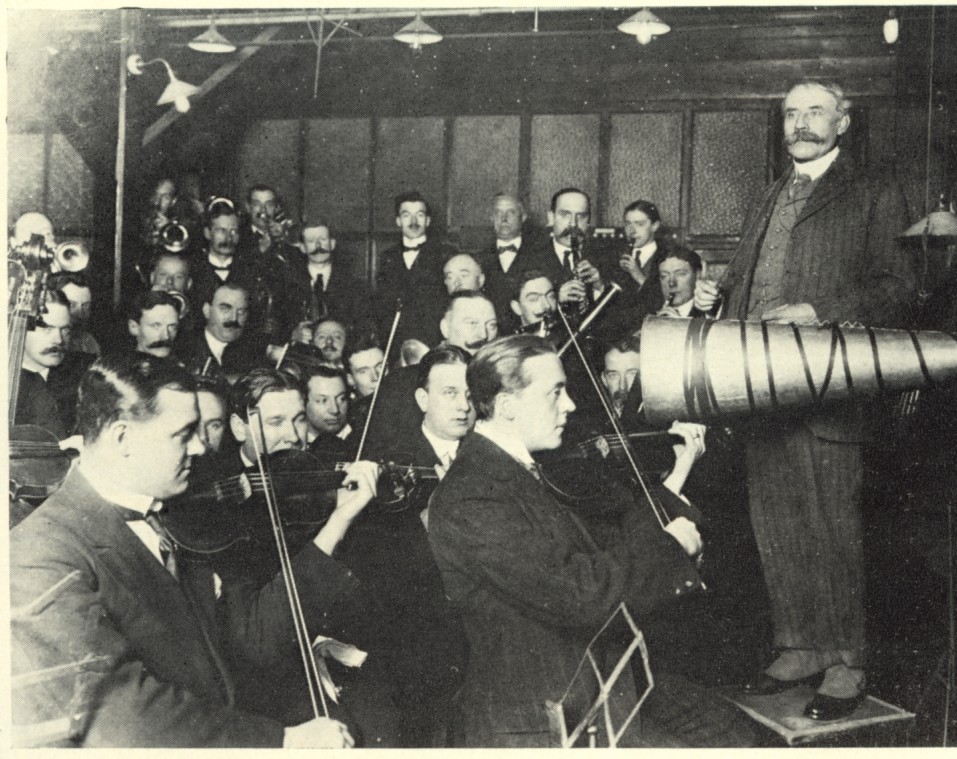
Given this sort of arrangement it is no surprise that the sound of the Orchestra of the Met is muffled and distorted on the following recording. Almost certainly McCormack would have been standing right in front of the horn so his sizeable form would have acted as a kind of baffle. When I think of these old records it always seems a wonder that you can hear anything at all.
Despite the limitations of the recording technology the crystal clarity of McCormack’s voice and his superb control shine through. I listen to quite a lot of old jazz records made in a similar way so my ears are perhaps unusually forgiving but I think this is one of the greatest versions of this aria that I’ve ever heard – and I’ve heard quite a few. I hope you enjoy it too.
P.S. John McCormack was born in Athlone, which is about 100km due west of Maynooth.
Rum & Coca Cola – The Christie Brother Stompers
Posted in Jazz with tags Christie Brother Stompers, Ian Christie, Keith Christie, Ken Colyer, Rum and Coca Cola on December 11, 2021 by telescoperAnd now for something completely different in the form of a lovely bit of British revivalist Jazz from 70 years ago. Once upon a time I had a 7″ EP record with this track on it, but I’m afraid I lost it along the way. I’ve been hoping someone would put it on Youtube and it seems about six months ago somebody did!
The song Rum and Coca Cola was a hit for the Andrews Sisters in the immediate post-war years although it began as a satirical calypso with clear references to prostitution. Anyway, it’s a catchy tune and it’s no surprise that it was picked up by traditional jazz bands during the New Orleans revival, including this terrific version by the Christie Brother Stompers made in 1951; note the calypso-style piano intro.
When this particular record was made, British bands were being heavily influenced by the discs that were coming over from the States at the time – especially from Bunk Johnson’s 1940s band and the Kid Ory band – to the extent that a recorded-in-a-garage sound was sedulously acquired. Despite the somewhat muffled sound quality, I really love this record for the general exuberance of the playing, especially that of the superb trombonist Keith Christie whose style of tailgate trombone was clearly influenced by Kid Ory.
Keith Christie was for some time a member of the front line of Humphrey Lyttelton’s band and when Keith Christie passed away in 1980, Humph devoted full hour on his weekly radio programme The Best of Jazz to examples of his work (including this track). I remember Humph drawing attention to the robust humour that permeated Keith’s playing and admitting that when he was with the Lyttelton band they had several band meetings in which he tried to get him to temper the playful side of things. Quite wrongly, he admitted because while Keith Christie often brought out the humorous side of trombone he never mocked it.
The revivalist bands of that day were indeed a bit po-faced about their jazz and although the music they produced is great fun to listen to, they were all deadly serious about it. I think “The Guv’nor” Ken Colyer (who plays cornet on this track) was even more grave than Lyttelton and I’m not sure how he felt about Keith’s propensity to emphasize the knockabout fun of the music, though it is true that this band did change personnel rather abruptly shortly after the 1951 session.
The full line-up is: Keith Christie (trombone); Ian Christie (clarinet, Keith’s brother); Ken Colyer (cornet); Pat Hawes (piano); Ben Marshall (banjo); Micky Ashman (bass); and George Hopkinson (drums). I think Keith Christie’s playing on this is absolutely terrific, not only his solo – built in Kid Ory style around a single phrase – but his rumbustious contributions to the ensemble from about 1:45 seconds. And what a head of steam they build up together! Enjoy!
R.I.P. Steve Bronski (1960-2021)
Posted in Biographical, LGBTQ+, Music with tags Bronski Beat, Jimmy Somerville on December 9, 2021 by telescoperI was saddened to hear this evening of the death at the age of 61 of Steve Bronski, co-founder of the band Bronski Beat which provided much of the soundtrack of my early twenties. I spent many an hour in the mid-80s dancing away in gay clubs to their up-tempo numbers like Hit That Perfect Beat but, as I’ve mentioned on this blog before, the song Smalltown Boy had a particular resonance for me because it was about thoughts and feelings I knew very well but had never heard expressed in popular music. I really felt like the Smalltown Boy in the song.
Rest in Peace, Steven William Forrest, aka Steve Bronski (1960-2021).

 In the Dark