Archive for the Music Category

Jazz Quiz – Name that Trumpeter

Posted in Jazz on November 27, 2021 by telescoper

It’s difficult to post a quiz that can be answered easily by the use of Google, but I thought I’d try because this track from Youtube doesn’t have any personnel information or recording date on it.
It’s a big band arrangement by Benny Carter of the standard Just You Just Me. Carter himself solos on this live performance along with other members of the band, but can you put a name to the trumpeter who comes at about 43 seconds, after Carter’s opening solo?

Read on for the answer:

Continue reading

Pithecanthropus Erectus – Charles Mingus

Posted in Jazz with tags , on November 13, 2021 by telescoper

I heard this track on the radio the other night courtesy of John Kelly’s show and thought I’d write a post about it because I think it’s a neglected masterpiece. Pithecanthropus Erectus is the title track of an album by Charles Mingus released in 1956. For that time it was incredibly new: the long passages of static harmony, along with grunts and squeals from the horns, all became common place in avant garde jazz in later years but it is very surprising to hear them in a record from the mid 50s.

Mingus intended this piece to convey in music humanity’s evolution, which he imagined would end in violent destruction. Who’s to say he was wrong? The tune itself is in an intriguing ABAC form with the B and C sections based on the same unvarying harmonic pattern but the C section being agitated and even chaotic. On the first and last choruses the alto sax of Jackie Mclean and the tenor of J.R. Monterose play improvised duets on the B section while the C section involves the whole band improvising collectively in a style reminiscent of the free jazz of the 1960s. The unusual accents on the fourth beat of the bar were later adopted by Miles Davis on Milesetones. These are just a couple of examples of how influential this track was to turn out to be. Looking back on it in historical perspective you can see how much of the musical vocabulary of jazz expanded with this one track.

Mingus shared with Miles Davis the ability to create music that was distinctively his own while somehow at the same time giving his musicians plenty of time to express themselves. In this performance there’s a very fine piano solo by Mal Waldron who, among other things, very effectively channels Thelonious Monk to a marvelous bass accompaniment by Mingus.

The other three tracks on the album are good too, but inevitably pale beside this work of genius in which Mingus managed to weld all these new and untried elements into a completely satisfying unity that was years ahead of its time.

Keys, Blues, a House, and an Infirmary

Posted in Music with tags , , , , on November 7, 2021 by telescoper
Scott’s Corner

I’m not finding very much time these days to continue trying to teach myself how to play the piano but I thought I’d share a quick post that probably only demonstrates how little I know about music.

The other day I decided to try to play The House of the Rising Sun without the music, i.e. by ear. Knowing that it is basically an 8-bar blues for which I thought I could easily figure out the chords I looked up what key it should be played in. Google confidently told me this:

So I set about trying to pick out the melody in that key, but I couldn’t get it to sound right at all (even allowing for the fact that my piano is a bit out of tune). Then I realized that it’s not really in F Major at all. It’s actually in D Minor (the relative minor of F Major, so it also has the same B flat but with a scale that starts on A rather than F). Transposing the chords into D Minor makes it sound much more moody. It can also be played in A Minor as demonstrated by the Modern Jazz Quartet whose Blues in A Minor is unmistakably the same tune:

Anyway, fooling around with 8 bar blues in different keys I tried F Minor and it struck me that there was a marked similarity between House of the Rising Sun and another famous 8-bar blues St James Infirmary. In fact you can sing the lyrics to St James Infirmary quite easily to the tune of House of the Rising Sun.

Both of these tunes have very old origins: Jack Teagarden, for example, introduced his classic 1947 live performance of St James Infirmary with the words “the oldest blues I ever heard”. I always assumed both these tunes referred to real places, but that seems wrong too. There was no “House in New Orleans” they called the Rising Sun, nor was there a St James Infirmary. They are not the same song, and neither started off as an 8-bar blues, but they do have elements in common and may be derived from a common ancestor.

The most famous version of The House of the Rising Sun is the 1964 hit by Eric Burdon with the Animals (including Alan Price on keyboards, who did the arrangement):

Interestingly, Eric Burdon and the Animals made a much less famous version of St James Infirmary in 1968 which I think demonstrates the similarity between the two tunes:

Hallowe’en – Charles Ives

Posted in Music with tags , , on October 31, 2021 by telescoper

I posted about this fascinating piece by Charles Ives ten years ago today, when I was still in Cardiff, but the link on that post to the actual music has died so I’m posting it again today.

If you like you can read my first ever Hallowe’en post from 2008 here.

R.I.P. Bernard Haitink (1929-2021)

Posted in Music with tags , , on October 24, 2021 by telescoper

Renowned conductor Bernard Haitink passed away on 21st October at the age of 92. It’s hard to pick one piece to commemorate such a distinguished career in music so I’m not going to try to be objective. Some time ago I bought the complete set of Mahler Symphonies performed by the Royal Concertgebouw Orchestra in 1966 with Haitink at the helm and I think their performance of Mahler Symphony No. 3 is up there with the very best.

It’s interesting that as recently as 2018, another performance of Mahler 3 directed by Haitink won the BBC Recording of the Year. There is also a complete live performance from 1983 on Youtube which I was tempted to post here but the whole Symphony is about 100 minutes long so I decided instead to just post an excerpt which, fortunately, someone has already put on Youtube.

Here’s just one movement – the sixth and last – from that epic work. This movement is marked langsam which basically means “slow” but I think many conductors take this movement too slowly. Haitink for me judges the pace perfectly. There’s an overwhelming sense of catharsis at the climax of this movement.

R.I.P. Bernard Haitink (1929-2021)

Two Sugars

Posted in Jazz with tags , , , , , , , on September 25, 2021 by telescoper

The song Sugar (That Sugar Baby Of Mine) was written by Maceo Pinkard, Edna Alexander and Sidney Mitchell way back in the 1920s and quickly became a jazz standard played in various ways by various musicians. To illustrate its versatility as a vehicle for improvisers here are two very different versions that are favourites of mine that I’ve had reason to remember recently.

In 1980 I bought an album by the extraordinarily underrated Scottish Jazz singer Jeanie Lambe with the Danny Moss Quartet when it first came out. The British tenor saxophonist Danny Moss was married to Jeanie Lambe from 1964 until his death in 2008. Jeanie passed away last year at the age of 79. Many versions of Sugar are slow and slushy but this a straight-ahead swinging take on it, played at a jaunty tempo, with a fine solo by Danny Moss in the middle.

The second version is totally different. It was performed by the Newport All-Stars at a midnight concert in Paris in 1961. The band was led by pianist George Wein who passed away on 13th September. As well as being a musician in his own right, George Wein owned and ran the famous Storyville club in Boston during the late 40s and early 50s but was perhaps most famous for being behind the annual Newport Jazz Festival, which began in 1954 and is still going to this day. It was quite usual at these festivals to have an all-star band playing in support of various solo artists, which is why Jack Teagarden and Buck Clayton turned up playing behind Chuck Berry at the 1958 Festival. George Wein also persuaded Thelonious Monk to allow Pee Wee Russell to sit in with his Quartet on clarinet for a set – I have the record of that gig and it’s every bit as strange and wonderful as you might imagine!

An eccentric character who struggled with alcoholism, Pee Wee Russell (real name Charles Ellsworth Russell) was somewhat unreliable as a musician but although he was frequently wayward he had a unique voice and, when he was on good form, a beautifully lyrical way of playing with a really original approach to harmony. It might surprise you to know that Sidney Bechet was a big fan of Pee Wee as – no less surprisingly – was Benny Goodman. The great Coleman Hawkins said of Pee Wee in 1961:

For thirty years, I’ve been listening to him play those funny notes. I used to think they were wrong, but they weren’t. He’s always been way out, but they didn’t have a name for it then.

I’ve always been drawn to very original musicians like Pee Wee Russell; the sort that when you hear just one note you recognize immediately who it is. It’s not all about technique. Pee Wee had soul. Messrs Bechet, Goodman and Hawkins et al knew that for all his technical deficiencies he was the genuine article, a complete original.

I’ve always felt that one should judge musicians by their best playing rather than their worst and, on that night in Paris, Pee Wee produced this achingly beautiful and hauntingly tender rendition of Sugar, played as a slow ballad. He’s introduced on this track by George Wein who aptly described him as “The Poet of the Clarinet”. You can of course listen to the track and decide for yourself, but I think this is gorgeous.

R.I.P. George Mraz (1944-2021)

Posted in Biographical, Jazz with tags , , , on September 19, 2021 by telescoper

I find myself doing yet another R.I.P. post. The great bassist George Mraz passed away on 16th September at the age of 77. When I heard the news I immediately thought of the famous live sessions he did as a member of Art Pepper’s Quartet at the Village Vanguard in New York in July 1977. The quartet featured Art Pepper (mainly on alto sax but also on clarinet and tenor saxophone), Elvin Jones on drums, George Cables on piano and George Mraz on bass. I think Art Pepper was very close to the peak of his prowess on these albums, having spent large parts of his earlier life in prison for narcotics offences. I had the privilege of seeing him play live on a couple of occasions, and he was great, but sadly he died in 1982 at the age of just 56.

The Art Pepper Quartet played on three consecutive nights and recordings were released on LP as Thursday Night at the Village Vanguard, Friday Night at the Village Vanguard and Saturday Night at the Village Vanguard; the latter being the source of this track. I bought all three albums and it’s worth quoting Art Pepper’s comment on Side 1 Track 1 of that album, the ballad You Go To My Head, on the sleeve of the LP

This is something I call a New York ballad. We played it a little faster that I usually play a ballad. Playing with George Mraz was great. When you play with a rhythm section, especially for the first time, sometimes everybody has their own ideas about the tune: the changes, the groove. But with George there’s a communication, he listens, and I can really feel what he’s doing.

Art Pepper, Sleeve Note for Saturday Night at the Village Vanguard

This is an object lesson for a bass player on how to provide a rich and swinging accompaniment at a relatively slow tempo:

Rest in peace, George Mraz (1944-2021).

Attica Blues

Posted in History, Jazz, Music with tags , , on September 9, 2021 by telescoper

I was reminded just now that today marks the 50th anniversary of the Attica Prison Rebellion, the bloodiest prison riot in American history which began on 9th September 1971 as a protest against poor living conditions in the Attica “correctional facility” in New York state. Four days of violence ensued that ended in the deaths of 32 inmates and 11 prison officers, along with scores of wounded.

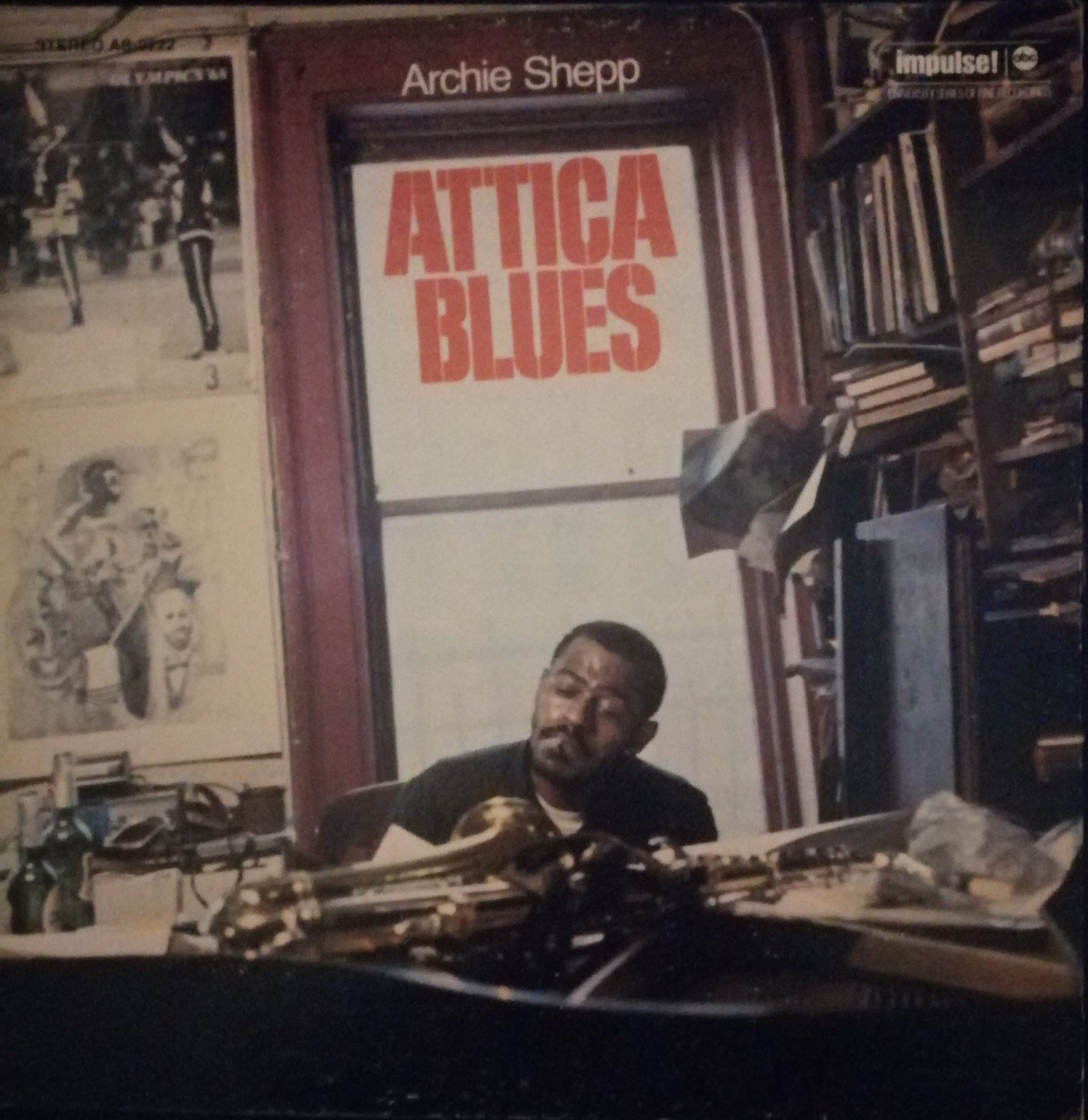
That episode inspired a brilliant album by Archie Shepp, which I have on LP (above), which is dedicated to George Jackson, a leading member of the Black Panthers who was shot dead while attempting to escape from San Quentin prison in California in August 1971, an event which contributed to the tensions in Attica prison that led to the riot a few weeks later.

Musically, the album is a fusion of soul, funk and avant-garde Jazz, the arrangements incorporating strings and vocals alongside the jazz soloists. The sound is absolutely redolent of the early 70s. Here’s the title track, Attica Blues:

Shostakovich String Quartet No. 8, arranged for Wind Quintet

Posted in Biographical, Music, Uncategorized with tags , , , on September 7, 2021 by telescoper

One of the treasured items in my CD collection recently moved from Cardiff is a boxed set of the Shostakovich String Quartets by the Fitzwilliam String Quartet:

When I took it out of the packing case last night it suddenly reminded of the following video I saw a few weeks ago. I think the String Quartets contain some of Shostakovich’s finest music, and the 8th (Opus 110, in C Minor) – written in just three days after the composer saw the aftermath of the bombing of Dresden – is especially intense. I don’t usually like rearrangements of string quartets for other instruments – there’s something very special about the texture produced by string instruments which is difficult to improve upon – but this is really interesting. It’s arranged by David Walter for five wind instruments (clarinet, French horn, cor anglais, flute and bassoon) and played by the Aquillos Wind Quintet, an unusual combination that provides a very fresh take on this piece while maintaining its dark expressiveness and brooding atmosphere.

P.S. Regular readers of this blog might recognize the clarinet player…

Messers, Dreamers and Misfits

Posted in Art, Education, Music with tags , , , on September 5, 2021 by telescoper

After the death of Charlie Watts last week, Fintan O’Toole wrote a piece in the Irish Times (here, unfortunately behind a paywall) pointing out that, along with a large fraction of the English rock musicians that began their careers in the 1960s, Charlie Watts went to Art School; Harrow Art School in his case. O’Toole goes on to argue that society needs to find ways to nurture its creative talents and that modern education is far too utilitarian to allow space for “Messers, Dreamers and Misfits”.

I agree with the broad thrust of Fintan O’Toole’s argument. I think the School and University systems are far too focussed on examination and assessment at the expense of genuine education. What I disagree with is the idea that creativity is only to be found in the Arts. When I saw the phrase “Messers, Dreamers and Misfits” it struck me that this could very well describe many of my colleagues in physics, and in science generally – and I don’t mean that in any way as an insult!

There is an explicit assumption in much of the world that creativity is only to be found in the Arts. That’s just not true. Who can say that Einstein didn’t have a creative mind? It is true that if you want to be, say, a theoretical physicist you do have to do formal training in the methods used, especially mathematics. But that is no different from an art school really. To be a painter you have to learn the techniques needed to manage the media you are using. To be a musician you have to learn the basics of harmony and solve the technical problems involved with playing an instrument. Artists have to pay their dues just like scientists. I wrote about this here, in the context of the great Jazz pianist Bill Evans, where I said:

All subjects require technical skill, but there is more to being a great jazz musician than mastery of the instrument just as there’s more to being a research scientist than doing textbook problems. So here’s to creativity wherever it is found, and let’s have a bit more appreciation for the creative aspects of science and engineering!

Anyway, here in Ireland, the Leaving Certificate results came out on Friday and next week we’ll begin the process that determines how many students we’ll have doing Mathematical and Theoretical Physics at Maynooth. It always surprises me how many students choose study subjects other than Physics, but then I remember that I went from School to Cambridge in 1982 to read Natural Sciences, fully expecting to specialize in Chemistry but just found Physics more interesting and, yes, more fun.

I don’t know whether I count as a creative person at all, but I’m definitely a misfit, prone to dreaming and – especially at the moment in the middle of unpacking my belongings – my house is a mess!

Anyway, here is a message for students just about the start their Third Level education here in Ireland or elsewhere. The most important advice I can give is to choose the subject that you will enjoy most, but pursue your other interests too. Charlie Watts was interested in music while at art school. There’s no reason why a theoretical physicist can’t pursue an interest in music too. I can think of at least one prominent example of a person who managed to become a pop musician and a physicist.

Given my own background I read Fintan O’Toole’s article as clear encouragement to students to pick theoretical physics.