I’ve just seen the sad news of the death at the age of 80 of the Rolling Stones’ drummer Charlie Watts. Tributes are justifiably pouring in, mainly concentrating on his career as a rock drummer. I’ll just say that while I’ve never seen the Rolling Stones play live, I did go and see Charlie Watts play at Ronnie Scott’s club in London with a jazz group. I thought they were pretty good actually, with Watts on drums not at all trying to hog the show but instead playing very unobtrusively thought still clearly enjoying himself in the more intimate surroundings of a Jazz club rather than a huge rock venue.
In fact Charlie Watts began as a jazz drummer and although he earned his fame and made a fortune after switching to rock and roll, he always kept an interest in jazz. Indeed he recorded an album of performances of Charlie Parker tunes from which I picked the track below. My Dad – himself a Jazz drummer who was never effusive in his praise of other drummers – rated Charlie Watts as technically sound rather than flashy which was the opposite to most rock drummers. At any rate he passed the test of holding the sticks “properly” (i.e. using the trad grip).
Anyway, by way of my own little tribute to an excellent musician and somewhat eccentric gentleman, here is Charlie Watts with his Quintet playing the Charlie Parker composition Bluebird.
I first heard the track below on Humphrey Lyttelton*’s Radio 2 show The Best of Jazz, which I used to listen to every Monday night when I was at School. I must have heard this sometime around 1981, i.e. about thirty years ago. From the moment I heard the first achingly beautiful phrases of theme of this tune, called Ophelia, I was entranced and it did more than any other single record to fill me with a love of modern jazz. Although I’d always loved jazz, I had tended to think of it as music “of the past” – even the “modern” jazz of e.g. Charlie Parker fell into that category – and usually made in a recording studio. This sounded so new, so exciting, and indeed so beautiful, that it filled me with the urge to hear live jazz whenever and wherever I could. It cost me a lot of money and a lot of late nights, but I think it was worth it.
The performance was recorded live at Ronnie Scott’s Club in London in June 1980 and released on the small British record label Mole Jazz, an offshoot of the famous (and sadly now defunct) record shop of the same name that used to be on Gray’s Inn Road. I loved the track Humph played so much I got the album Blues for the Fisherman straight away (by mail order) and, although I still have it, I have almost worn it away by playing it so much. It’s a brilliant, brilliant album, with the intense atmosphere of a live performance adding to the superb playing of the musicians.
The band is listed as the “Milcho Leviev Quartet featuring Art Pepper”, although that was probably for contractual reasons, as this was the same band that toured extensively as “The Art Pepper Quartet”: Art Pepper on alto saxophone, Milcho Leviev on piano, Tony Dumas on bass and Carl Burnett on drums. I was lucky enough to see this band play live at the Newcastle Jazz festival not long after I got the record and they were great then too. Art Pepper sadly passed away in 1982.
As far as I’m aware this record wasn’t released on CD until very recently and, fortunately, a public-spirited person has put the tracks from the original album and some previous unreleased material on Youtube, so I’ve seized the opportunity to post the track which did so much to inspire me about jazz when I was 18 years old. There’s so much to enjoy in this piece, including the superb drumming of Carl Burnett and virtuosic piano of Milcho Leviev, but the star of the performance for me is Art Pepper (who also wrote the tune). His playing is at times lyrical and at times agonized, but always compelling and this band was especially good at spontaneous transitions of mood and dynamic. I love this performance, and I hope some of you will too.
P.S. Incidentally, Humphrey Lyttelton was born in May 1921 so he would have been 100 this May had he lived.
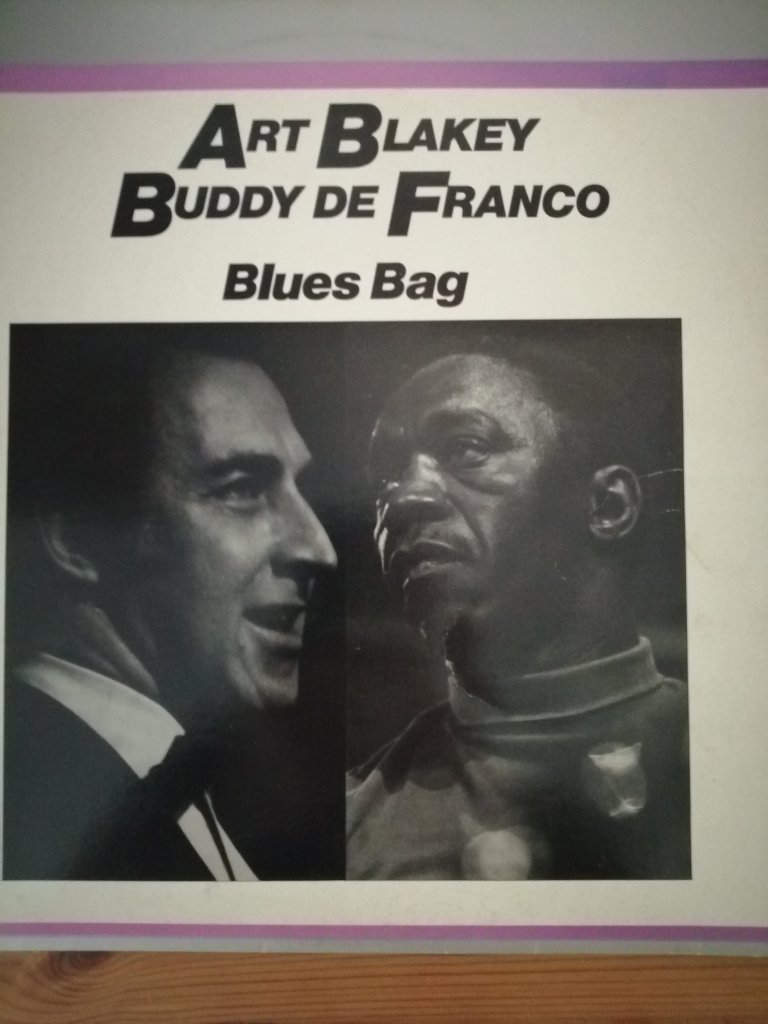
One of the things I did during my recent visit to Wales was to pack up my old vinyl LPs for removal to Ireland. I have quite a lot of them on digital formats now but that’s not true of all of them so I’m looking forward to listening to the others very soon.
I bought this particular album Blues Bag as a curiosity as it features the unlikely combination of Buddy De Franco on clarinet (bass clarinet on several tracks, including the one below) and Art Blakey on drums.
Whatever I thought the combination of the smooth style and impeccable technical virtuosity of Buddy De Franco with the powerful and aggressive drum foundryman Art Blakey would be like before I bought the LP, when I first heard it the thing that struck me was how superbly they complemented each other.
Anyway, I thought I would post a track so you can decide what you think. This is Dizzy Gillespie tune called Kush. I think this version is great, with very fine work on the drums by Blakey.
Last week I saw an old episode of the TV Series Van der Valk (the original series, starring Barry Foster). I thought it was very good, actually. It brought back a lot of memories as I watched the series avidly first time round, right from the first programme, which was broadcast in 1972 when I was still at junior school. In those days, Amsterdam was as distant to me as Timbuktu! The theme tune, Eye Level played by the Simon Park Orchestra became a surprise hit and reached Number 1 in the charts in 1973. It’s a simple tune but very catchy. We even played it in recorder class in the school. I wonder what the Dutch word for “ear worm” is?
I also watched this edition Top of the Pops when it was first broadcast. I was – and still am – amused by the audience teeny boppers wondering whether and how to dance to this number! What I didn’t notice then was that there’s some very fine camera work in this short clip…
Well, some proper rain has arrived at last. I think the plants in my garden are pleased so I thought I’d celebrate with this lovely version of Pennies from Heaven (“Every time it rains it rains Pennies from Heaven”) by the great Lester Young recorded live in a small club, Olivia Davis’s Patio Lounge in Washington D.C., in 1956. In about 1981 bought a set of several LPs recorded over this six-night residency with a house trio led by Bill Potts on piano. People say that “Pres” was in decline at this stage of his life, but it doesn’t sound like that to me from the recrods. The band was a bit nervous when they met their esteemed guest before the first night’s performance as there was no time for a rehearsal, but they gelled immediately playing a selection of blues and standards. Lester Young didn’t need much to send him on his thoughtful way – he often paid even less attention to the tune than he does here – and he clearly enjoyed himself in this modest setting.
I’m a day late posting this, but I only thought of it this morning. It’s a fine performance by the New York Philharmonic conducted by Leonard Bernstein of “The Fourth of July”, the third movement of his “Holidays Symphony” by the great Charles Ives. The video even shows the score so you can play along at home! As Ives himself famously said:
Saddened to hear of the death last week of the great Jazz trombonist Curtis Fuller I’ve been thinking of an appropriate track to play. Fuller had a long and distinguished career alongside many great artists which makes it difficult to pick just one track as a tribute, but as so often is the case I found myself gravitating back to the late 1950s which I think is probably my favourite period in Jazz history.
Thus I settled on a track from the studio album Blue Train recorded in 1957 by a sextet led by John Coltrane and featuring Curtis Fuller (trombone) and Lee Morgan (trumpet) with Kenny Drew on piano, Paul Chambers (bass) and Philly Joe Jones on drums. It’s a superb album which is a must-have for any serious collector of this music. I thought I had already posted a track from this album on here, actually, but apparently I haven’t.
John Coltrane is now an established as one of the leading figures in the development of modern Jazz but this record is a reminder that he achieved recognition somewhat later in his life than many other soloists. At 31, he wasn’t exactly old when this album was recorded in 1957 but he was certainly no newcomer either. Obviously it took him a while to find his voice. By contrast the trumpeter Lee Morgan was, astonishingly, only 19 when this record was made; Curtis Fuller was in his mid-twenties.
Everyone plays beautifully on all the tracks on this album, and the blend of trumpet tenor sax and trombone in the ensemble gives this band a very distinctive sound, but I’ve picked a track on which Curtis Fuller really excels as a soloist. The rest of the tunes being based on the blues, this is actually the only ballad on the album, written by Jerome Kern and Johnny Mercer, and called I’m Old Fashioned…
Posted in Covid-19, Music on May 2, 2021 by telescoper
When (if?) this Covid business ends I hope we’ll remember the things that kept us going through it. Here is one of the socially distanced concerts broadcast by RTÉ Lyric FM*. I hope that in a few years’ time people will look back on recordings of events like this and understand what a weird time it has been. People come and go, but the music continues.
I found the performance of the incidental music by Jean Sibelius for Pelléas et Mélisande starting at about 24.40 very moving, the isolation of the orchestra and the emptiness of the hall, enhancing the extraordinarily beautiful music. I think fans of The Sky At Night will enjoy it too…
P.S. It was the 22nd birthday of RTE Lyric FM on May 1st 2021..
Today is International Jazz Day which gives me an excuse to post this documentary about the late great Humphrey Lyttelton the anniversary of whose death was last weekend; he passed away on 25th April 2008.
I particularly like this programme because, as well as talking about his own career as a musician and bandleader and as brilliant chairman of the panel show I’m Sorry I Haven’t A Clue, it mentions his radio show The Best of Jazz which I listened to avidly every Monday night and from which I learned a huge amount about the music that I love so much. I taped many of these broadcasts actually, but have long since lost the cassettes. Although his own music was in the mainstream he always played a wide selection of Jazz tracks both ancient and modern on his programme and introduced me to many artists I would otherwise never have heard of.
The views presented here are personal and not necessarily those of my employer (or anyone else for that matter).
Feel free to comment on any of the posts on this blog but comments may be moderated; anonymous comments and any considered by me to be vexatious and/or abusive and/or defamatory will not be accepted. I do not necessarily endorse, support, sanction, encourage, verify or agree with the opinions or statements of any information or other content in the comments on this site and do not in any way guarantee their accuracy or reliability.



 In the Dark