Archive for the Music Category

But Beautiful – Tony Bennett & Bill Evans

Posted in Jazz with tags , , , on August 4, 2020 by telescoper

I’m kicking myself for having forgotten that yesterday, August 3rd, was the 94th birthday of that great jazz singer Tony Bennett so I’m correcting that omission today by posting one of my favourite recordings of his, a tune written by the famous songwriting pair of Johnny Burke and Jimmy van Heusen, recorded in 1975 with Bill Evans on piano. When one of the greatest ever jazz singers gets together with one of the greatest ever jazz pianists, what could the result be But Beautiful?

Happy Birthday, Tony Bennett!

Trustan with Usolde

Posted in Literature, Opera with tags , , , , , , , , on August 1, 2020 by telescoper

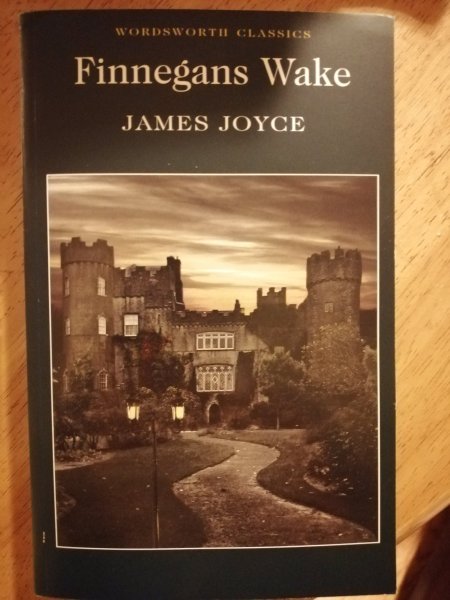
It is, I think, fairly well known that physicist Murray Gell-Mann was inspired to pick the name quark for the name of a type of subatomic particle by a passage from Finnegans Wake by James Joyce:

— Three quarks for Muster Mark!
Sure he hasn’t got much of a bark
And sure any he has it’s all beside the mark.

What is perhaps less well known is the identity of “Muster Mark” in that quote. In fact it is King Mark of Cornwall, husband of Queen Iseult in the legend of Tristan and Iseult. The Iseult in that legend is Irish. She has has an affair with Tristan, nephew of King Mark, with tragic consequences. This legend appears in many literary forms including, most famously, Richard Wagner’s Opera Tristan und Isolde. It also comes up frequently in Finnegans Wake including this passage on the same page (in the edition I have) as the Muster Mark quote above:

That song sang seaswans.
The winging ones. Seahawk, seagull, curlew and plover, kestrel
and capercallzie. All the birds of the sea they trolled out rightbold
when they smacked the big kuss of Trustan with Usolde.

See how Joyce plays with the substitution of “u” for “i” here as in “Muster”. Either that or the “I” key on his typewriter didn’t work properly. Or he had fat fingers and kept hitting the wrong key; U and I are next door on the keyboard.

Incidentally there is a small village in Dublin called Chapelizod which is where a church was built dedicated to Queen Iseult. Whether there is any real connection between this place and the historical Iseult is very doubtful.

Now, where was I. Oh yes. Back to Opera.

Years ago, when I lived in Nottingham, on a warm summer evening I decided to listen to some of the live broadcast on BBC Radio 3 of a performance of Wagner’s Tristan und Isolde from Glyndebourne. I made myself a cocktail and took the radio out into the garden with the intention of listening to a bit of it before going out for the evening. This was back in the days when I actually used to go out on the town on Saturday nights; now I’m too old for that sort of thing.

Anyway, I was hooked right from the Prelude. Act I came and went and I decided to make some dinner in the interval, opened a bottle of wine, and returned to listen to the rest of it. The glorious music washed over me in the sultry twilight. Darkness fell, a second bottle of wine was opened, and still I listened – no doubt to the consternation of my neighbours. The final Liebestod was so beautiful I almost cried. Eventually I retreated to the house having experienced my first all-out Wagner trip.

My enjoyment of that occasion was of course helped by the fact I could get up and walk around occasionally, as well as by the liberal intake of fine wine. Nevertheless I do think Tristan and Isolde works very well on the radio – nothing very much happens on stage anyway (especially in Act II) so you can just let the music work it’s magic.

The reason for all this rambling is that there is a special broadcast of Tristan und Isolde on RTÉ Lyric FM. This performance, recorded in 2012, features as Isolde the celebrated dramatic soprano Miriam Murphy who very sadly passed away suddenly a few weeks ago. Tonight’s programme is a tribute to her memory. I believe Miriam Murphy is the only Irish soprano to have sung the role of Isolde. I’ve heard a few clips from it and her voice sounds amazing.

The Opera is preceded on the radio by a documentary about the production, the first in Ireland for 50 years and the first by a brand new company based in Ireland. I think James Joyce would have approved.

So that’s my Saturday evening sorted out!

Update: I listened to the broadcast and it is an astonishingly wonderful performance by Miriam Murphy.
Jordu

Posted in Jazz with tags , , , , , , on July 30, 2020 by telescoper

Now for one of those jazz posts that people don’t seem to like and which will no doubt reduce today’s blog traffic even further. This is a very nice version of a tune called Jordu which was written by pianist Irving “Duke” Jordan in 1953 and which became part of the standard jazz repertoire after a wonderful version was recorded by Clifford Brown and Max Roach in 1954. It’s not hard to figure out where the title comes from. The version I’ve picked is much later, and features a trio with the great Ed Thigpen on drums and Mads Vinding.

Duke Jordan began his recording career with the brilliant Dial sessions with Charlie Parker in 1947 and he carried on making great music after he moved to Denmark in the 1970s until his death in 2006. The Steeplechase label on which this record was released is actually based in Copenhagen too. He is buried in Vestre Kirkegard in Copenhagen. He was in my opinion one of the most consistently underrated pianists of his era.

When I was younger I used to try to figure out by ear the chord changes in Jazz standards. Nowadays you can find cheat sheets all over the internet, which rather takes the fun out of it. This tune is a particularly interesting challenge to unravel as well as to perform  but if I ever got a band together we would definitely (try to) play it!

Jordu is in a standard AABA form. The A sections are constructed from dominant chords in a pattern based on the ii-V-I progression which is very common in jazz. The variation introduced here is to use a major II instead of a minor ii and add a dominant 7th to the basic triad, which makes a much richer sound. The eight bars of the A section are divided into four pairs, the first of which finds the theme played without backing chords or rhythm accompaniment, the second having the backing instruments accent beats 1, 3 and 4. The first sequence is a II/V/I in C minor, using a D7 instead of a minor ii chord. Then it’s a similar sequence in in Eb major (F7/Bb7/EbMaj7). After a repeat of the first II/V/I, the A sections ends with Ab7 – G7 (bVII7 – V7). Every chord but one in the entire section is a dominant 7th.

Since the A section ends in an unresolved way on the V chord (G7), a device used quite a lot in music stylistically based in the bebop era, Duke Jordan devised  a two-bar coda to be played at the end of a performance that resolves to the tonic (Cm), bringing everything gently back to Earth to finish.

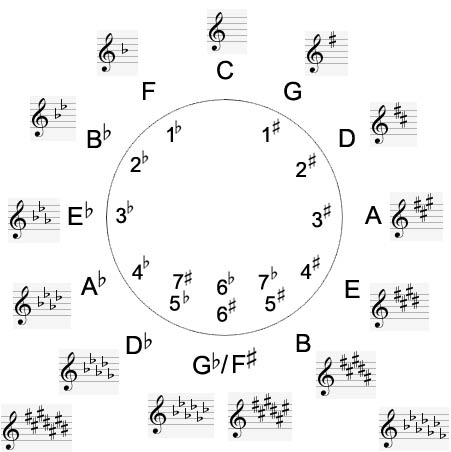
The B section is based on the Circle of Fourths, another standard jazz device but still a challenging pattern to improvise on. If you want to learn to play jazz most tutors will have you practicing a lot on the Circle of Fifths (clockwise) and Circle of Fourths (anticlockwise) trips around this diagram showing all the major and minor keys:

Anyway, you don’t have to know anything about the harmonic structure of this piece to enjoy this lovely playing. Duke Jordan’s solo finds him completely at home in this tune, and why shouldn’t he? He wrote it!

The people who do things and what they do

Posted in Art, Cricket, Football, Opera, Television with tags , on July 19, 2020 by telescoper

It’s a tough lesson to learn in life that the people you admire or idolize for their contribution in a particular arena (whether that be sport, art, science or something else) turn out to be people you can’t stand in terms of their character or political views.

You have to separate, for example, having a high regard for Ian Botham’s cricketing prowess from having a high regard for his personal character. In fact I can think of few sportspeople whose company I’d enjoy socially.

The same goes in many other spheres. Richard Feynman was a truly great physicist but I’ve never bought into the personality cult surrounding him. In fact I doubt I would have liked him very much at all if we’d ever met in person. They say you should never meet your heroes. They’re right.

Another example is Richard Wagner, a brilliant composer but really horrible man, who brings us to this clip from the end of Twilight of the Gods (the last episode of Series 7 of Inspector Morse, first broadcast in 1993).

I won’t spoil the plot if you haven’t seen it but it involves a famous opera singer, Gladys Probert, who visits Oxford to perform and receive an honorary degree. On the way to the ceremony she is shot, but was she the intended victim?

Opera-loving Morse is a huge admirer of Gladys Probert but in the course of his investigation he uncovers some unpleasant truths about her private life. He solves the crime but the case leaves him dispirited.

Here is the ending. John Thaw is Inspector Morse and Kevin Whateley is Detective Sergeant Lewis.

Cricket Lovely Cricket!

Posted in Cricket, Music with tags , , on July 8, 2020 by telescoper

How great it is to see the return of Test Match cricket to England and the comforting familiarity it brings of sitting around not watching any play because of the pouring rain and Stygian gloom.

There may not have been much cricket at Southampton today (lovely or otherwise) but I couldn’t resist sharing this bit of West Indies cricketing nostalgia in calypso form, vintage 1950, by Lord Beginner..

R.I.P. Ennio Morricone (1928-2020)

Posted in Film, Music with tags , , on July 6, 2020 by telescoper

I heard the sad news this morning that legendary composer Ennio Morricone has passed away at the age of 91. Morricone will be remembered not only for the music he himself created for films but on the huge influence he had on other composers and indeed on cinema generally.

I’ve posted this piece before but I make no apology for posting it again as a tribute to the Maestro. It’s the climactic final shoot-out from Sergio Leone’s iconic Spaghetti Western* The Good The Bad And The Ugly, featuring Clint Eastwood, Lee Van Cleef and Eli Wallach, respectively, together with superbly innovative (and very complex) music on the soundtrack from Morricone. It was the guitarist Alessandro Alessandroni (who also did the whistling on the soundtrack) producing that unforgettable twangy sound with a hint of scordatura. I also think this is the first time any film composer had used gunshots as part of the score…

*These films are way better than was generally appreciated at the time of their release.

Update: I just love this response to an efflux of babble…

“Like a rusty squeezebox… ” – Mozart’s Serenade No 10 for Winds III. Adagio

Posted in Music with tags , , , , on June 27, 2020 by telescoper

Although it has introduced many people to the music of Wolfgang Amadeus Mozart, which is a very good thing, I have to admit that I didn’t really enjoy the film Amadeus. This is partly because not much of it is actually true and partly because, even treated as a piece of fiction, the two main protagonists are depicted far too crudely.

It is probably true that Mozart was quite a strange man as an adult but I attribute that largely to the fact that he was an infant prodigy which, together with having a very pushy and ambitious father, denied him a proper childhood. You see the same phenomenon in the modern era with child stars in Hollywood and the music industry.

The film is also very hard on Antonio Salieri who is made out to be a musical incompetent, which he certainly wasn’t. Salieri actually wrote a lot of very lovely music, though he obviously wasn’t Mozart.

One thing that the play/film does get right however is in Salieri’s description of the Adagio movement from Mozart’s Serenade No. 10 (K361) for wind instruments (and string bass):

On the page it looked nothing. The beginning simple, almost comic. Just a pulse, bassoons and basset horns, like a rusty squeezebox. Then suddenly; high above it, an oboe, a single note, hanging there unwavering, till a clarinet took over and sweetened it into a phrase of such delight! This was no composition by a performing monkey! This was a music I’d never heard. Filled with such longing, such unfulfillable longing. It seemed to me that I was hearing the very voice of God.

I stick to my opinion that Mozart wrote a lot of music that wasn’t really all that good, but I also think you should judge artists by their best work rather than their worst and Mozart wrote enough masterpieces any one of which would confirm him as a creative genius of the highest order. This piece is one of those masterpieces. The whole Serenade – seven movements, lasting almost an hour – is beautiful but this movement stands out.

The hallmark of a genius is often simplicity, isn’t it? That goes for science as well as the arts. I don’t really know what beauty really is but the essence of it often lies in simplicity too.

Now I have to make a confession and ask for help from readers. The confession is twofold: (a) I have never heard this piece in a live performance; and (b) I don’t possess a recording of it. I’d therefore like to ask my readers for recommendations as to the best version to buy on CD or download.

In the meantime here is a taster in the form of a performance by the wind musicians of the London Symphony Orchestra. Enjoy!

The World Is Waiting For The Sunrise

Posted in Jazz with tags , , on June 22, 2020 by telescoper

Today has been one of those frustrating days at work that ends with a to-do list longer than it started with so I’m in need of a pick-me-up. Here is Benny Goodman and his Sextet recorded on the Ed Sullivan show in 1960 playing The World is Waiting For the Sunrise. Goodman loved this tune and played many different versions of it over his long career. The audience definiely enjoyed this, and I think it’s BG himself who ends this one with a yeah to prove that he enjoyed it too! I hope you do likewise.

Over the years there have been some (indeed many) jazz critics who have written that Benny Goodman’s clarinet playing was `clinical’ and `unemotional’ and other such nonsense.  I think his playing on this is absolutely sensational (as incidentally is Red Norvo on the vibes).  Enjoy!


Songs of Comfort and Hope

Posted in Covid-19, Music with tags , , on June 12, 2020 by telescoper

I was just looking back at a post I wrote early in the New Year and saw that top of the list of things I resolved to do more of in 2020 were (1) to go to more live concerts and (2) to see more of Ireland. Unfortunately the Covid-19 Pandemic put paid to both of those (and the other things on the list too). I haven’t listened to live music since March and haven’t set foot outside Maynooth in that time either!

Anyway, someone at the National Concert Hall in Dublin hit on the idea of putting on live concerts without an audience. I wasn’t sure it would work but based on this concert, broadcast a couple of weeks ago, and now available as a recording on Youtube I think it does. This recital features wonderful Irish mezzo-soprano Tara Erraught and pianist Dearbhla Collins in a programme of songs by Franz Liszt, Franz Schubert, Aaron Copeland and Richard Strauss followed by some Irish folk songs. I think it’s a lovely performance, and I found the setting of an empty hall unexpectedly moving.

Cristo Redentor – Donald Byrd

Posted in Jazz with tags , on June 2, 2020 by telescoper

Duke Pearson was inspired by the famous statue that looks down over Rio de Janeiro to write this tune, of which this is the very first version, put on record in 1963 and released a year later in 1964 to become an instant classic. It’s a wonderful fusion of jazz, blues and gospel music but above all it’s a gentle hymn to peace and respect.I don’t think I have to explain why I think it’s apt to put it up today.

Front and centre is Donald Byrd on trumpet, but the rest of the band includes Hank Mobley (tenor), Herbie Hancock (piano), Donald Best (vibes), Kenny Burrell (guitar), Butch Warren (bass) and Lex Humphries (drums). The choir consists of 8 voices (4 male, four female) but sadly they are not named on the liner notes.