I’m not sure how many readers will agree with Glenn Gould’s analysis of Mozart’s piano compositions, especially his later ones, but I think it’s well worth watching and listening to, not least because the presenter is obviously relishing the opportunity to say what he really thinks in the full knowledge that in the process he is winding up a great many of his audience! It’s also interesting how he delivers his pieces to camera: it doesn’t look like he’s using an autocue but he’s a very precise and coherent speaker.
Follow @telescoperArchive for the Music Category
How Mozart Became a Bad Composer, by Glenn Gould
Posted in Music with tags Glenn Gould, Mozart, Wolfgang Amadeus Mozart on October 26, 2020 by telescoperCulture Night 2020
Posted in Biographical, Covid-19, Education, Maynooth, Music on September 19, 2020 by telescoperYesterday evening was Culture Night 2020. I’m afraid the only event I was able to enjoy was the concert from the National Concert Hall by the RTÉ National Symphony Orchestra under the direction of Gavin Maloney that consisted of:
Bartok: Romanian Folk Dances, BB 76
Mozart: Clarinet Concerto K.622 in A Major
John Finucane (clarinet)
Mendelssohn: Symphony No.4 Op.90 in A Major (Italian)
Here is the concert as it appeared on the live stream.
The bright and breezy Italian Symphony by Mendelssohn was a welcome tonic at the end of yet another exhausting and stressful week.
On Culture Night last year I was actually in the National Concert Hall after spending a very enjoyable afternoon wandering around Dublin. Yesterday however it was announced that after a surge in Covid-19 cases in the capital additional restrictions would be imposed there. What a difference a year makes! On Culture Night 2019 nobody had even heard of Covid-19.
Because many of our students come from the West Dublin area it has been decided to ‘escalate protective measures‘ at Maynooth University. This means, among other things, that the maximum class size for in-person lectures is 30. That means we have to revise our teaching plans yet again with just a week to go before the students arrive on campus, though I think for Theoretical Physics it really only changes the second-year modules. That is unless there are further restrictions, which is not unlikely.
Another exhausting and stressful week beckons!
Follow @telescoperA Semester of Covid-19
Posted in Biographical, Covid-19, Education, Maynooth, Music with tags Beethoven, Covid-19, education, ireland, Mendelssohn, Mozart, music, teaching on September 12, 2020 by telescoperIt’s the Twelfth of September so it’s now precisely six months to the day since schools and colleges in Ireland were closed because of the Covid-19 pandemic. The initial announcement on 12th March was that the closure would be until 29th March. Little did we know then that six months later campus would still be closed to students.
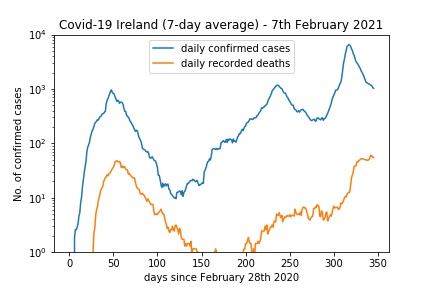
Here is how the pandemic has progressed in Ireland since March:

On 12th March, 70 new cases of Covid-19 were announced in Ireland; yesterday there were 211. The current 7-day average in Ireland is over 180 new cases per day and is climbing steadily. Things are similar, if not worse, elsewhere in Europe. as countries struggle to contain the pandemic while simultaneously attempting to reopen their economies. We are heading towards a very difficult autumn, with a large second peak of infection definitely on the cards. Who knows how this will turn out?
The word ‘semester’ is derived from the Latin for ‘six months’ but the term now applies almost exclusively to half a university teaching year, usually more like four months.
I’m looking ahead to the next teaching semester at Maynooth University, which starts in two weeks. The last time I gave a face-to-face lecture was on the morning of March 12th (a Thursday). Going home that evening I was engulfed by morbid thoughts and wondered if I would ever see the students again. Now we’re making plans for their return to (limited) on-campus teaching. Outline teaching plans have now been published, so returning students will have an idea how things will go. These will be refined as we get a better idea of student numbers. Given the continued increase in Covid-19 cases there is a significant chance of another campus closure at some point which will necessitate going online again but, at least to begin with, our students in Theoretical Physics will be getting 50% or more of the in-person teaching they would have got in a normal year.
Yesterday third-level institutions made their first round of CAO offers. Maynooth’s can be found here. Our offer for MH206 Theoretical Physics & Mathematics is, like many courses around the country, up a bit at 510 points reflecting the increase in high grades in this year’s Leaving Certificate.
We won’t know the final numbers for at another week or more but based on the traffic on Twitter yesterday Maynooth in general seems to be very popular:

Outline teaching plans are available for new students but these will not be finalised until Orientation Week is over and students have registered for their modules, which will not be until Thursday 24th September, just a few days before teaching starts. The weekend of 26th/27th looks like being a very busy one!
Returning to the original theme of the post I have to admit that I haven’t set foot outside Maynooth once in the last six months. I haven’t minded that too much, actually, but one thing I have missed is my weekly trip to the National Concert Hall in Dublin. Last night saw the start of a new season of concerts by the RTE National Symphony Orchestra at the NCH. There is no live audience for these so it’s not the same as being there in person, but watching and listening on the live stream is the next best thing.
Last night’s programme was a very nice one, of music by Mendelssohn Mozart and Beethoven, that not only provided a welcome tonic to the end of a busy week but also provided a great example of how to adapt. I’m glad they’re back and am looking forward to the rest of the season.
Follow @telescoper
R.I.P. Gary Peacock (1935-2020)
Posted in Jazz with tags Albert Ayler, Free Jazz, Gary Peacock, Ghosts, Jazz, Sonny Murray, Spiritual Unity on September 8, 2020 by telescoperI heard on Saturday via social media that the great bass player Gary Peacock had passed away on 4th September, only to see other posts claiming that the rumours of his death were a hoax. I was relieved about that but then it turns out that the hoax reports were themselves a hoax and Gary Peacock had indeed died. He was 85 years old.
Gary Peacock is probably best known for his work with the likes of Keith Jarrett, Bill Evans and Jack DeJohnette but as a tribute I thought I would post an example of his earlier work with Albert Ayler. I think the album Spiritual Unity with Gary Peacock on bass and Sonny Murray on drums is one of the highlights of 1960s free jazz.
This tune, the shorter of two versions on Spiritual Unity of an original composition by Albert Ayler called Ghosts, is a great example how he could make coherent what at first hearing sounds like disassociated bursts of sound. It involves remarkable improvised melodies based on short thematic lines designed to evoke unsophisticated folk music or nursery tunes. It may sound primitive on the surface, but it’s very complex underneath and creating this extraordinary sound world clearly required great technical mastery from Ayler and his supporting musicians, especially Gary Peacock, who plays wonderfully on this track.
Rest in peace, Gary Peacock (1935-2020)
Follow @telescoper
Bird 100: Kim
Posted in Jazz with tags bebop, Charlie Parker, Jazz, Kim, Rhythm Changes on August 29, 2020 by telescoper
Still going with posts to celebrate the centenary of the birth of Charlie Parker, aka Bird, a musical genius on the saxophone whose influence not only on jazz but on twentieth century music is incalculable. I’ve posted quite a few tracks by Bird over the years and one thing I’ve learned from doing that is that he’s by no means everyone’s cup of tea. I can’t do anything about that, of course, but I can at least point out the existence of his wonderful legacy to those (regrettably many) people who’ve never heard of him or his music I still remember the mixture of astonishment and exhilaration I felt when I first heard him on record and if I can give that sense of joy to just one person via the blogosphere then it’s worth a hundred posts.
Here’s Kim, another one of Bird’s tunes based on the rhythm changes, with an alto sax solo improvised at breakneck speed and with incredible virtuosity. The other day I was talking to a friend of mine who only has a passing interest in jazz and he asked me whether Charlie Parker really was that good. Well, if you’re asking that question to yourself, listen to this and then you’ll have the answer. As far as I’m concerned this is three minutes of pure awesome….
Follow @telescoperBird 100: Now’s The Time
Posted in Jazz with tags Blues, Charlie Parker, Now's the time on August 29, 2020 by telescoper
The next item in my homage to Charlie Parker on the occasion of the centenary of his birth is one of his variations on the blues in F, called Now’s the Time. It’s definitely one of the bluesiest of Bird’s blues, and indeed it’s quite close to the usual 12-bar chord progression:
| F7| F7| F7 |F7 | B♭7| B♭7| F7| F 7|C7| B♭7| F7| F7|
In fact this goes something like
F7|B♭7|F7|Cm7 F7|B♭7|B♭7|
F7 D7#9| Gm7|C7|F7 D7|Gm7 F7|
Follow @telescoperBird 100: Bloomdido
Posted in Jazz with tags bebop, Bloomdido, Blues, Charlie Parker, Dizzy Gillespie, Jazz, Thelonious Monk on August 29, 2020 by telescoper
Here is another bit of music to celebrate the 100th anniversary of the birth of the great saxophonist Charlie Parker (“Bird”) on 29th August 1920.
I’ve written quite a few posts relating to Charlie Parker over the years but today has provided a good excuse to spend my lunchtime writing another one, this time featuring one of my favourite tracks from one of my favourite albums. First released in 1952 but in fact recorded in two separate sessions in 1949 and 1950, the album Bird and Diz was actually the last studio album made under the joint leadership of Charlie Parker and Dizzy Gillespie, the two main architects of the bebop revolution; the track I’ve picked has the added advantage of featuring another great musical genius on piano, Thelonious Monk.
The Charlie Parker composition Bloomdido is yet another of his variations on the blues, though this one is a bit less intricate than some of the others he wrote. Here are the chords for Bloomdido:
You can see that the progression is based around the standard three chords of a blues in B♭. The foundation is a “tonic” chord (T) based on the root note of whatever key it’s played in, in this case B♭. This sometimes a basic triad consisting of the first, third and five notes of a major scale starting on that note or, as in this example, including the dominant 7th so it’s B♭7. The next chord is the subdominant chord (S), shifting things up by a perfect fourth relative to the tonic, in this case an E♭7 and then finally we have the dominant (D) which brings us up by a fifth from the original root note, in this case F7.
The basic blues sequence in B♭ would be four bars of B♭7 (T), two of E♭7 (S), back to B♭7 (T) for two, then the characteristic bluesy cadence returning to two bars of B♭7 (T) via one bar each of F7 (D) and E♭7 (S). The sequence for Bloomdido has a few alterations, including a characteristic turnaround at the end, but is otherwise fairly recognizable. I guess the first part of the title is a play on the blues origin too, though I wonder if the second part suggests that some of the alterations are inspired by the A-section of the Juan Tizol standard Perdido?
Some people tell me they find Charlie Parker’s music “too technical” and that somehow if music “needs to be explained” it’s not good music. I don’t understand that attitude at all. I find this music so fascinating and exciting to listen to that I want to try to dig a little bit into it and find out what’s going underneath the surface. It’s particularly striking what a difference a few substitutions and passing chords can make to the overall harmonic “feel” of a piece like this compared to a standard blues sequence, for example. But you don’t need to study the chords to appreciate the sheer beauty of the music that Charlie Parker built on these harmonic foundations; his solo on this track, as on so many others he recorded in his short life, is just sublime even if you don’t realise how hard it is to play! I guess it all depends whether your way of enjoying a thing is to sit back and let it wash over you, or for it to inspire you to find out more. Many of the physicists I know are deeply interested in music. Perhaps that’s because they’re the sort of people who don’t just think “wow that’s beautiful”, they tend to think “wow that’s beautiful – how does it work?”.
Charlie Parker and Albert Einstein died in the same year, just over a month apart, the former in March 1955 and the latter in April. They were two very different geniuses but it’s as difficult to imagine physics without Einstein as jazz without Bird.
Follow @telescoperBird 100: Bird’s Nest
Posted in Jazz with tags bebop, Bird, Bird's Nest, Charlie Parker, Errol Garner, Rhythm Changes on August 29, 2020 by telescoper
Here’s another track to celebrate the centenary of the birth of the great Charlie Parker.
When I was at school most of my friends seemed to be into heavy metal, which I found completely tedious, so while they were out buying LPs by Hawkwind or Iron Maiden I was acquiring a secret collection of classic jazz records. Among my most prized purchases was a boxed set of six vinyl discs entitled The Legendary Dial Masters; they’re now available on CD, of course. I listened to these records over and over again and can easily understand why they’re regarded as some of the greatest musical performances of the twentieth century, not only in Jazz but in all music.
There’s a curious story about the Dial sessions, in that they took place in Hollywood California as part of an “exclusive” one-year contract (signed in 1946) between Dial records and Charlie Parker, who just happened to have signed another exclusive contract with the Savoy label based in New York. By this time in his life, Parker was already seriously addicted to heroin and this example of duplicity is consistent with other aspects of his behaviour: he regularly cheated and scrounged off friends and strangers in order to feed his habit and probably gave relatively little thought to the consequences of being found out. In this case, the clear breach of contract was pretty quickly rumbled, which could have led to a lawsuit, but it seems to have been settled amicably by the record labels, who agreed that both sets of recordings could be made commercially available.
It would take scores of blog posts to do justice to these great tracks, so I’ll just make a few comments now. First thing to mention is that the LPs forming the boxed set don’t just include the final versions as released, but usually a number of incomplete or discarded takes. At the session in question, recorded on February 19th 1947, there are 13 takes in all for just four tunes. It’s fascinating listening to these alternative versions (which are often, in my view, just as good if not better than the “final” version), not least because they demonstrate the wonderful spontaneity of Charlie Parker’s playing. They also have an experimental feel to them. The track I heard last night, Bird’s Nest, is, on one level, yet another bebop composition based on the chord changes of the George Gershwin standard “I got rhythm”, but what’s very special about it is just how free his improvisation is, both rhythmically and harmonically. It is, of course, well known that Charlie Parker’s nickname was “Bird” (originally Yardbird), and this track in particularly demonstrates that his playing really was very like birdsong – agile, quirky and above all intensely beautiful. The main difference is that most birdsong is actually atonal, which Bird’s music was not.
Another thing worth mentioning about this track is the identity of the piano player. When I heard it last night it triggered a vague memory that Errol Garner made some records with Charlie Parker. Was this one of them? I honestly couldn’t remember, but became increasingly convinced when I heard the piano solo. Later on, a quick search through my discography revealed that I was right. It is indeed a young Errol Garner. Although he doesn’t play badly, he doesn’t sound to me either comfortable or convincing playing bebop. Nevertheless, this session gives an important glimpse into the musical development of a major artist. You could say the same thing about the other tracks made around the same time by Bird and the young Miles Davis.
But that’s enough words. The whole point about music is that it says something that can’t be said with words. Birds manage perfectly well without them too.
Follow @telescoperBird 100: Cherokee
Posted in Jazz with tags bebop, Charlie Parker, Cherokee, Ko-ko, Musician's Strike 1942-1944 on August 29, 2020 by telescoper
My next choice to celebrate the music of Charlie Parker, on the occasion of the centenary of his birth, features him very early in his career, with the relatively unknown Efferge Ware on guitar and Little Phil Phillips on drums, playing the jazz standard Cherokee. This track was recorded in 1941 (when Parker was only 21 years old) in Bird’s home town of Kansas City. There is a gap in Charlie Parker’s discography between 1942 and 1944, which was when the American Musicians Union called a strike which led to a ban on all commercial recordings. When the ban game to an end Charlie Parker’s recordings with Dizzy Gillespie, Max Roach, Bud Powell and others unleashed the new harmonic language of bebop on the general public from New York City where it had been incubating during the strike. Parker’s style had evolved greatly in the intervening two years which no doubt made his playing sound all the more revolutionary when the ban was lifted. Although this version of Cherokee is to some extent a pre-bebop recording, you can hear the originality and beauty of Bird’s improvisation (complete with cheeky quotation from the “Popeye” theme) and it’s clear where he was heading.
The sophisticated and complex chord sequence of Cherokee (with its trademark ii-7–V7–I progressions) made it a firm favourite with bop musicians who tended to play it even faster than this earlier version.
In 1945, during what was arguably the first ever bebop recording session, Charlie Parker and Dizzy Gillespie decided to play a variation of Cherokee using the same chords but a different head. During the first take the musicians absent-mindedly played the theme from Cherokee at which point there was a cry of anguish from the control room uttered by a producer, who obviously had hoped that if they stayed off the actual tune he wouldn’t have to pay composer’s royalties. They started again, made another take, called it Ko-Ko, and it became one of the classics.
The 1941 version is valuable from a historical perspective but you don’t have to be interested in that to enjoy the wonderful fluidity and invention of Bird’s playing.
Follow @telescoperBird 100: The Quintet at Massey Hall
Posted in Jazz with tags 15th May 1953, Bud Powell, Charles Mingus, Charlie Parker, Dizzy Gillespie, Jazz, Massey Hall, Max Roach, The Quintet of the Year, Toronto on August 29, 2020 by telescoper
For my next piece in celebration of the centenary of the birth of Charlie Parker I thought I’d pick a classic live performance from May 15th 1953 at Massey Hall in Toronto. Originally released as a vinyl LP with only 6 tracks on it, and called The Quintet of the Year, but subsequently re-released in various versions on CD, with various titles including Jazz at Massey Hall. The whole concert is available on Youtube here:
This concert was planned to unite the greatest stars of the bebop era who had performed together earlier in their careers but had gradually evolved different styles over the intervening years. The line-up is Charlie Parker on alto, Dizzy Gillespie on trumpet, Bud Powell on piano, Charles Mingus on bass and the great Max Roach on drums which is stellar by any criterion!
Gatherings of star jazz players have often turned out to be disappointing, largely because very great musicians can sometimes interfere negatively rather than positively with each other, not necessarily consciously but because they can have ideas incompatible with one another. This evening, however, was a glorious exception to this rule, doubtless because all the musicians had worked together in the past, and their subsequent individual development had not taken them too far beyond their shared musical background. It is true that the ensemble passages are slight, but that doesn’t matter much because the solos are of such a remarkable and consistently high standard. Charlie Parker turns in some of the very best of his later recorded work, giving the lie to those who argue that his musical abilities were in decline at this time. He might not play as elegantly as he did on the classic Dial and Savoy sessions, but he is significantly more adventurous, with startling melodic contrasts in much of his work. At times this is a bit of a problem in that he seems to full of ideas that what comes out is a sequence of breathtaking fragments rather than a cohesive solo. This happens on A Night in Tunisia, for example, which never quite fulfills the promise of its magnificent opening break. On other tracks, though, especially Hot House his improvisations are just brilliant. It’s hard to imagine listening to this that in less than two years he would be dead.
Dizzy Gillespie matches Parker in superb fashion, betraying none of the offhandedness that often afflicted his later recorded performances, and the pyrotechnical quality of his playing is as exhilarating as it is instantly recognizable. Gillespie was an extrovert on stage and his frequent dancing around on the stage results in him going on and off mike from time to time, but it doesn’t detract from the performance once you realize why he’s fading in and out. It is, after all, a live performance and if you shut your eyes you can imagine Dizzy Gillespie the showman without any difficulty at all!
Most Jazz reviewers confine their comments on the rhythm section to a few kind words, but in this case that would be a travesty. The limitations of live recording technology in 1953 result in a rather unbalanced mix, but the flip side of that is that you can hear particularly well the pivotal importance of the bass playing of Charles Mingus. Between them Mingus and Max Roach lay down a relentlessly propulsive beat as well as taking gripping solos; the drum workouts in Wee and Salt Peanuts are astonishing in their interplay of rhythm and texture. Trumping even them, however, is the genius of Bud Powell who plays at a level consistently high even by his own standards.
Bud Powell is a fascinating musician for many reasons. Much less of a formalist than many Jazz pianists he nevertheless seems to generate a real sense of unity, more through the emotional drive underpinning his phrases than by imposing any set structure on his improvisations. His solo on Wee offers a fine example of this: moving inexorably towards a shattering climax as the right hand figures vary ceaselessly in their length and the chords punched out by the left hand grow more frequent and more percussive.
This album is another must-have for any serious collector of post-War jazz. The individual parts are all superb, but the whole is even greater than their sum.
PS. I had the pleasure of attending a concert at Massey Hall myself, when I was on sabbatical in Toronto in 2005/6.
Follow @telescoper