À propos de rien, but to chill for a few minutes while I have a cup of tea after this afternoon’s Engineering Mathematics lecture, I thought I’d post a piece of music. As regular readers of this blog (both of them) will know, I listen to quite a lot of jazz. In the course of doing that it has often struck me that there can hardly be a tune that’s ever been written – however unpromising – that some jazz musician somewhere hasn’t taken a fancy to and done their own version. Louis Armstrong turned any amount of base metal into gold during his long career, but here’s an example from a more modern legend, Sonny Rollins, who is still going strong at the age of 89.
The full personnel listing is Sonny Rollins (tenor saxophone); Donald Byrd (trumpet); Wynton Kelly (piano); Gene Ramey (bass); and Max Roach (drums). The track was recorded in 1956. The band is playing a tune called How are thing in Glocca Morra? and it was written for the 1947 musical Finian’s Rainbow (which I hate). This version, though is absolutely gorgeous. It clearly doesn’t take much to inspire a genius…
I was deeply saddened last night to hear of the death at the age of 84 of legendary operatic soprano Mirella Freni who belonged to the generation of stars that included Joan Sutherland, Renata Tebaldi, Renata Scotto and Maria Callas. Freni’s light and elegant voice was perfectly suited to lyric roles, especially Mozart and Puccini, although in the later years of her long career she did broaden her repertoire considerably. For me (and I guess many others) her signature role was as Mimi in La Bohème to which she brought not only lovely singing, but a wonderful tenderness and warmth to the character. As a small tribute here she is in that role with the great Luciano Pavarotti (who was born in the same town as Freni, Modena).
Last night I once again found myself settling into a seat at the National Concert Hall in Dublin for a performance by the RTÉ National Symphony Orchestra, this time under the direction of Mihhail Gerts. There was only one item on the menu – the Symphony No. 8 by Anton Bruckner – but what a feast it turned out to be!
Bruckner had a habit of making multiple revisions to his scores, and the Eighth Symphony is no exception to this. There are two major versions (usually referred to as the 1887 and 1890 versions) but also numerous edited variations of these two. For the record last night we heard the edition made by Robert Haas, based mainly on the 1890 version, but replacing some pieces which had been edited out of the 1887, perhaps most notably a quiet passage in the Third (Adagio) Movement.
This is a colossal work, lasting about 90 minutes in performance and requiring a huge orchestra so the stage was very crowded when the concert got under way.
As well as larger than usual string sections, the brass section comprises no less than eight horns, three trumpets, three trombones and a tuba as well as a quartet of Wagnertuben which you don’t often see in a symphony orchestra. These instruments have a sound somewhere between that of the horns and the trombones and they add an immense solidity to the section that produces a wall of sound that has an extraordinary effect when heard live, especially during the fortissimo passages (of which there are several in this work).
Woodwinds include a bass clarinet and a contrabassoon alongside the more usual clarinets and flutes, and there are three harps and percussion. A special mention must be made of the timpanist (Grahame King) who was given a huge amount to do, and did it all exceptionally well.
The work is structured in four movements, each of which involves a shift from minor to major (the piece opens in C minor) but each covers a very varied musical landscape. The overall atmosphere of the work varies too. At times it is tranquil (or perhaps merely resigned) but it often evokes a sense of conflict and sometimes even terror. It does, however, end in a glorious crescendo that gives a sense of triumph. Along the way there is some truly memorable passages: a gorgeous dialogue between flutes and clarinets in the 2nd Movement (Scherzo) comes to mind, and the Adagio as a whole is just magnificent.
I have never heard this work performed live, and have to admit I got completely lost in the performance. Despite the length of the concert, I never looked at my watch once during the whole thing. Congratulations to Mihhail Gerts and the entire orchestra for taking us on such an epic journey. I enjoyed every second of it, and so I think did the rest of the audience, because the end was greeted with a standing ovation.
But you don’t need to rely on my opinion. You can’t beat live music, but the entire concert is here for you to enjoy as live on the Lyric FM stream. Enjoy!
I may not have been able to attend the concert at the National Concert Hall in Dublin on Friday 31st January, but I did listen to it live on the Radio. Now you can experience the whole thing yourself via the Youtube recording of the live stream. The programme consisted of three pieces by Ludwig van Beethoven played by the RTÉ National Symphony Orchestra under the direction of Leonard Slatkin:
The Consecration of the House Overture
Violin Concerto (soloist Stefan Jackiw)
Symphony No. 7
I very much enjoyed listening to the concert, especially the up-tempo finale of the Seventh Symphony. I gather there was a problem with the live stream that meant the sound wasn’t broadcast along with the pictures, but they’ve fixed it on the recording so now you can experience both sight and sound from the NCH:
I heard last night the sad news that saxophonist arranger and bandleader Jimmy Heath had passed away at the age of 93. Jimmy Heath was a terrific musician whom Miles Davis described as `one of the thoroughbreds’ and who performed on a huge number of really important records as leader or as sideman throughout a long career than spanned seven decades.
I spent last night going through the part of my record collection that I have here in Maynooth to select a track to play as a small tribute, and came up with this up tempo track on a Blue Note collection. It’s standard written by Harold Arlen called Get Happy. I hadn’t listened to it for ages and I’d forgotten how great it is. It was recorded in 1953 by a six-piece band led by trombonist Jay Jay Johnson, and featuring Clifford Brown (trumpet), Jimmy Heath (tenor saxophone), John Lewis (piano), Percy Heath (bass, Jimmy’s brother*) and Kenny Clarke (drums). They’re all great musicians, and they make a wonderfully rich ensemble sound for a small band. Jimmy Heath plays a fine solo, rather typical of his early style (which, although he plays tenor sax rather than alto is clearly in the mould of Charlie Parker) and you also get the chance to hear the great Clifford Brown .
*Jimmy’s other brother Albert Heath was a fine drummer.
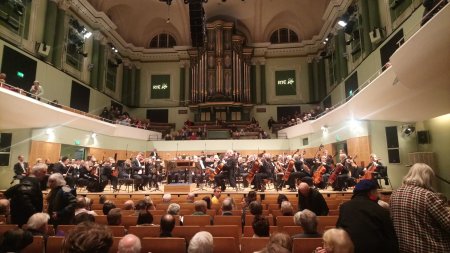
Following my decision to see more live music in 2020, last night found me taking my seat at the National Concert Hall in Dublin for a performance of the Requiem in B♭minor by Antonín Dvořák (Op. 89) featuring the RTÉ National Symphony Orchestra and the RTÉ Philharmonia Choir conducted by Patrik Ringborg with solo vocalists Adrienn Miksch (soprano), Patricia Bardon (alto-, Julian Hubbard (tenor) and William Thomas (bass). The members of the choir were just taking their places as I sat down (as were other members of the audience).
I hadn’t heard Dvořák’s Requiem before last night’s concert. Indeed before I saw the advert for the concert I didn’t even know it existed. It just doesn’t seem to be performed vary often. Heaven knows why, because it’s actually rather wonderful. It does involve large orchestral forces, a full choir and a concert organ, but then so do many other works that are performed very frequently in concert halls around the world.
The Dvořák Requiem consists of thirteen sections divided into two Parts (with an interval between them) and is based on settings of the traditional Latin mass for the dead. The music lasts about 95 minutes altogether. The prevailing mood for Part 1 is at times mysterious, restless, questioning and reflective while Part 2 is much more affirmative, even at times joyous, with some uplifting (and wonderfully loud) tutti passages. Although ostensibly in a minor key, there’s much more of the feeling of a major key tonality during the later stages. Overall the piece ends up seeming more of a celebration of life rather than a lament for the dead. Throughout the piece there’s interesting interplay between choir, orchestra and soloists and it’s also very tuneful, as you would probably expect from Dvořák.
After a slightly hesitant start, both choir and orchestra soon got into the swing of things and produced a superb concert that ended up drawing a standing ovation from the audience in the National Concert Hall. Last night’s concert was, I’m glad to say, sold out.
Anyway, you don’t have to take my word for it: the whole concert is on Youtube (it starts about 3 minutes in).
P.S. You will soon see that the presenter last night was not the usual Paul Herriott, but Aedín Gormley.
What we call the beginning is often the end. And to make an end is to make a beginning. The end is where we start from.
from Four Quartets, ‘Little Gidding’ by T. S. Eliot.
I said yesterday that I don’t really do New Year’s resolutions (largely because I know I’m no good at keeping them) but in an idle moment this morning (or should I say “a period of reflection”?) I posted on Twitter a few things I hope to achieve in 2020 and thought I’d share them here.
In no particular order:
Go to more live concerts. Although I enjoy the radio and recordings, I far prefer to listen to live music at concerts. Attending such events helps also support the venues and musicians as without an audience both would die. I’m ashamed to say I haven’t heard any live jazz in Ireland!
See more of Ireland. I moved to Maynooth two years ago but apart from one visit to Galway and one to Armagh I still haven’t travelled much beyond the Dublin area. I must get around more, especially to the South.
No more working weekends. I’ve been in the office for at least one day every weekend since I started at Maynooth. I did the same when I was at Sussex too, and seem to have relapsed. I have always had problems managing my own work/life balance but I realise it’s not setting a good example to younger folk to be getting it so obviously wrong. I’ll add not reading work emails at weekends to this.
Be a better colleague. This is something I think one should always strive to be, but I have particular need to improve. I know that over the last four years or so things weighed very heavily on me behind the scenes and I ended up letting people down on too many occasions. I apologise for that and will try to do better in future.
Read more books. I used to be a voracious reader of all kinds of books, both fiction and non-fiction, but I somehow got out of the habit. I now have a stack of unread works that I must try to read before the year is out!
Finish more things! Not unrelated to No. 4 above, I have been very poor over the last few years at completing projects and writing papers. I need to clear the backlog and get on with some new things.
Do more to promote Open Access publishing. I’m not surprised that the status quo in academic publishing is proving hard to dislodge, but I believe that change can be achieved if researchers take the initiative. I’m proud of what we have achieved so far at the Open Journal of Astrophysics but there’s much more to be done.
There are some others, but they’re too personal to put on here!
The views presented here are personal and not necessarily those of my employer (or anyone else for that matter).
Feel free to comment on any of the posts on this blog but comments may be moderated; anonymous comments and any considered by me to be vexatious and/or abusive and/or defamatory will not be accepted. I do not necessarily endorse, support, sanction, encourage, verify or agree with the opinions or statements of any information or other content in the comments on this site and do not in any way guarantee their accuracy or reliability.


 In the Dark