“Only connect” they say so I thought I’d connect two topical items with this video clip of one of my favourite movie scenes.
The first item is that on 15th February next year the legendary composer Ennio Morricone will be conducting a concert of his music in Dublin. Moricone’s 90th birthday was on 10th November 2018.
The other thing is that the UK Parliament is currently debating the terms of Brexit. It seems that there are now only three options: accept Theresa May’s ugly Withdrawal Agreement, reject it and suffer a bad `No Deal’ Brexit or take the sensible, good choice of withdrawing Article 50, admitting it was all a terrible idea in the first place, and remaining in the European Union.
So here we are then, the climactic final shoot-out from Sergio Leone’s famous Spaghetti Western The Good The Bad And The Ugly, featuring Clint Eastwood, Eli Wallach and Lee Van Cleef respectively, together with superb (and very complex) music on the soundtrack from Morricone. We all know who wins in the end, at least in the film.
P.S. Hats off to the guitarist Alessandro Alessandroni (who also did the whistling on the soundtrack) producing that unforgettable twangy sound with a hint of scordatura…
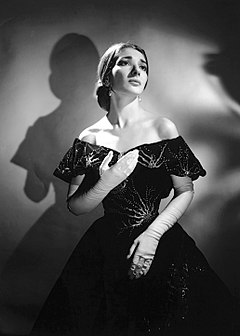
Had she still been alive, December 2nd 2018 would have been the 95th birthday of the most renowned opera singer of her time, Maria Callas.
She was born in 1923 in New York city of Greek parents who had moved there the previous year, and christened Maria Anna Sofia Cecilia Kalogeropoulou. Her mother, disenchanted with her deteriorating marriage, abandoned her husband (Maria’s father) and took Maria and her sister back to Athens in 1937. Maria enrolled at the National Conservatoire of Greece the same year after winning a scholarship with the quality of her voice, which
was warm, lyrical, intense; it swirled and flared like a flame and filled the air with melodious reverberations.
At this age, Maria was a rather plump young lady with a rather deep voice. Initially, she aspired to be a contralto but at the Conservatoire she was encouraged instead to become a dramatic soprano. Accordingly, she underwent special training to raise her natural pitch (or tessitura) and learned how to control her remarkable voice more accurately so she could sing in a sufficiently disciplined fashion that she could take on the dazzling coloratura passages that she would perform in later years with such success. She also worked on her chest tones to broaden the scope of her voice in the mezzo region. Although she became more technically refined as a singer during this period, there were some things that didn’t change. One was the sheer power of her voice, which is something that we tend to notice less in these days of microphones and studio recordings. People who heard her sing live confess to being shocked at the sheer scale of sound she could deliver without amplification. Perhaps more tellingly, she eschewed many of the devices sopranos tended to use to control the highest notes, usually involving some alteration of the throat to produce accuracy at the expense of a thinner and more constricted tone. When Callas went for a high note, she always did so in a full-throated manner. This often produced a piercing sound that could be intensely dramatic, even to the extent of almost knocking you out of your seat, but it was a very risky approach for a live performance. Audiences simply weren’t used to hearing a coloratura sing with such volume and in such a whole-hearted way. It wasn’t always pretty, but it was certainly remarkable and often very moving. It was this aspect of her voice that led her friend Tito Gobbi (who sang with her in Tosca) to call it una grande vociaccia, which I translate in my schoolboy Italian as meaning something like “a big ugly voice”. That isn’t meant to be as disparaging as it sounds (Gobbi was a great admirer of Callas’ singing).
Having listened to lots of recordings of Maria Callas I have to admit that they are certainly not all good. Sometimes the voice didn’t come off at all. Unkindly, one colleague said that she “sang with her ovaries”. When she talked about her own noice, Callas herself often referred to it as if it were some independent creature over which she had very little control. Anyway, whatever the reason, when she was bad she was definitely bad. But I adopt the philosophy that one should judge artists (and scientists, for that matter) by their best work rather than their worst, and when Callas was good she was simply phenomenal, like a sublime and irresistible force of nature. That’s why they called her La Divina.
Although her talent was very raw in the beginning there was no question that she always had a voice of exceptional power and dramatic intensity. When she started singing professionally she immediately attracted lavish praise from the critics not just for her voice but also for her acting. As a young soprano she sang in an astonishing variety of operas, including Wagner‘s Tristan und Isoldeand Die Walküre, neither of which one would now associate with Callas.
It was in the late 194os that Callas began to take an interest in the type of opera that would really make her name. Bel canto opera was rather unfashionable at that time, probably because audiences preferred the grittier and more realistic verismo style. Virtually single-handed, Callas resurrected the bel canto canon by injecting a true sense of drama into works which had previously just been seen as vehicles for the singers to demonstrate their art. Callas brought an entirely new dimension to the great operas by Bellini (Norma, I Puritani, La Somnambula…) and Donizetti (Lucia di Lammermoor, Anna Bolena), although she was sufficiently versatile to also perform brilliantly in the verismo syle of Verdi and Puccini as well as lesser known composers such as Giordano (Andrea Chenier). Recordings of many of these performances are available, but it is sad that this glorious period of her singing career happened just a bit before high quality equipment was available so the true glory of her voice isn’t always evident.
In 1953, Callas decided that she wanted to change her appearance, perhaps so she would look more appropriate for the parts she was playing on stage. At the time she weighed almost 200lbs. In order to lose weight as quickly as possible, she followed the barbarous but highly effective expedient of swallowing a tapeworm. She lost 80lbs in a matter of months. The dramatic loss of weight changed her body and her face, emphasizing her high angular cheekbones and giving her a striking look very well suited to the opera stage. But it also affected her voice somewhat, especially at the upper end where she seems to have found it more difficult to avoid the dreaded “wobble” which was one of the alleged imperfections that critics tended to dwell upon.
Callas also had very poor eyesight which required her to wear very thick spectacles in order to see at all, a thing she refused to do onstage with the result that she was virtually blind during performances. In fact, during a performance of Tosca at Covent Garden she leant too far over a candle and her hair caught fire. Improvising magnificently, Tito Gobbi, as the loathsome Scarpia, extinguished the fire by throwing water at her before the audience had noticed. Although they weren’t much use for seeing with, her eyes were a great asset for her acting, in turns flashing like a demon then shining like an angel.
After her weight loss, Callas was suddenly no longer just a wonderful singer but also a strikingly beautiful woman. Her career took a back seat as she started to revel in the glamorous lifestyle that opened up in front of her. Her voice deteriorated and she performed rather less frequently. Eventually she embarked on a love affair with Aristotle Onassis, a notorious serial collector of trophy women. She hoped to marry him but he abandoned her to marry Jackie Kennedy, widow of John F. Kennedy.
She never really recovered from the failure of this affair, retired from singing and lived out the last years of her life as a virtual recluse in her apartment in Paris. She died in 1977.
I had heard a lot about Maria Callas when I was younger, but the recordings that I listened to (generally from the 1960s) were really not very good as her voice was undoubtedly much diminished by then. I just assumed that, as is the case with many artists, the legend of Callas was all mere hype. Then, about fifteen years ago, I was listening to BBC Radio 3 and they played the final scenes of the great 1954 recording of Norma with Callas in the title role, conducted by Tullio Serafin. I was completely overwhelmed by it and tears flowed freely from my eyes. I’ve always had a tendency to blub when I hear really beautiful music, but as I’ve got older I’ve learned not to be embarrassed by it. At least I don’t cry at football matches.
In England, Callas is probably best remembered for her performances in Tosca in Covent Garden. I have recordings of her in that role and they are really wonderful. But there are many fine recordings of Tosca by other singers, some of which are almost as good. In the case of Norma, though, there isn’t any other performance that comes within a mile of the Callas version. Or if there is, I’ve yet to hear it.
Now I know that there are some people, even opera lovers, who just don’t get Callas at all (just look at the comment boards on Youtube). I grant that she wasn’t always the most accurate singer, and I don’t think you could say her voice had a purely classical beauty. But even if you don’t like her voice you have to admit that she revitalized the opera stage and brought a new public into the theatres. I can’t imagine what the state of opera would be now, if there hadn’t been a Callas and you can’t argue that she is now an iconic figure. What I admire most about her is that, like it or loath it, her voice is instantly recognisable. In this sense, she always puts me in mind of a kind of operatic version of Billie Holliday. She’s a far cry from the many bland mediocrities that pass themselves off as opera singers nowadays.
I’m going to end with the obligatory clips from Youtube. There’s a lot of Callas on there, not all of it good. I’ve chosen a couple of items, although neither of them has a proper video. The first was performed live in 1955 in front of the notoriously difficult audience at La Scala in Milan and recorded from a radio broadcast so that the sound quality is quite poor. A studio recording of this aria, from Andrea Chenier, features most movingly in the film Philadelphia. This live version, however, is notable for a number of reasons. One is that you get some idea of the power of the Callas voice in the way she pushes aside the entire orchestra and is even able to cut through the distortions introduced by the rather primitive recording technology. The second thing is that she sings it so beautifully, with such feeling, lovely phrasing, and so much colour and vitality. Listen to the way the texture of her voice matches perfectly her changing emotions as she tells her story. The shattering, climactic high C that occurs near the end is a perfect example of what I was saying above. She stabs this note out like her life depended on it. It sends shivers down my spine and clearly had the same effect on the audience. The thunderous applause that follows the end of this aria is quite frightening in its intensity, but gives a good idea how much her public adored her. If you can put up with the lo-fi recording, this is certainly a better performance than the studio version.
The final piece has to be from Norma. I think Bellini is a wonderful composer of opera, but he doesn’t make life easy for the singers. There’s never any doubling of the vocal line by the orchestra so the singer is very exposed. This doesn’t bother Maria Callas. This is the famous aria Casta Diva, which has become a kind of signature tune for her and it’s one of the pieces that she always seemed to perform beautifully. It might be a bit hackneyed but I love it and, after all, it’s my blog. There’s also a nice compilation of pictures.
I’d be interested to hear what the general opinion of Callas is based on a sample of the two or three people who read my blog, so please feel free to add your comments!
Apparently today is Thanksgiving (whatever that is) but, more importantly, it is also the Feast of Saint Cecilia. That reminded of this wonderful piece of music, which I thought I’d post to mark the occasion. It is the Hymn to St Cecilia, with words by W.H. Auden set to music by Benjamin Britten and performed on this recording by the Choir of King’s College, Cambridge conducted by Sir David Willcocks.
Incidentally, 22nd November is also Britten’s birthday; he would have been 105 today.
After I posted about Britten’s War Requiem a couple of weeks ago, some comments appeared at Another Place (i.e. Facebook) about Britten and whether he really was a great composer whose legacy would endure. My view, which I’ve stated on this blog a number of times, is that one should judge artists (and scientists, for that matter) by their best work rather than their worst. In my opinion, Mozart wrote a lot of music that wasn’t very good but if all he’d ever done in his life was write, e.g., Don Giovanni he’d still be regarded as a timeless genus.
Even if you don’t like all of Britten’s music, there are enough masterpieces among his output to guarantee a lasting reputation. I would put Peter Grimes and the Serenade for Tenor, Horn and Strings firmly in the category of masterpieces alongside the Hymn to St Cecilia.
Anyway, if you’d like to nominate any works by Britten as examples of his best or worst then please feel free to do so via the Comments Box below.
Last night I was back at the National Concert Hall in Dublin for an immensely powerful and moving performance of Benjamin Britten’s War Requiem. This vast work is composed for two orchestras (a standard symphony orchestra and a smaller chamber orchestra), two choirs (a chorus of adult voices and a boy’s choir) and three solo vocalists. Last night the soloists were Ailish Tynan (soprano), Gavan Ring (baritone) and Robin Tritschler (tenor), who performed with the combined forces of the RTÉ National Symphony Orchestra, the RTÉ National Concert Orchestra, the RTÉ Philharmonic Choir and the boy Choristers of St Patrick’s Cathedral in Dublin, all conducted by David Brophy.
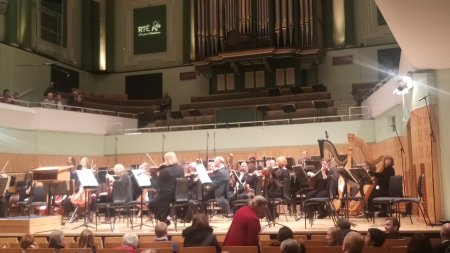
You can see the members of the Philharmonia Choir in position in the above photograph, which I took about ten minutes before the performance began; the choristers were out of sight in the gallery above and behind me, near where the President of Ireland, Michael D Higgins, was sitting.
The War Requiem was commissioned for the consecration in 1962 of the new Coventry Cathedral built to replace the 14th century cathedral that was destroyed along with most of the city in a devastating air raid ion 1940. It’s a remarkable work that juxtaposes settings of traditional liturgical Latin texts against poems by Wilfred Owen. The idea of doing this may have originated with the first poem Britten uses, Anthem for Doomed Youth, which itself deploys words associated with religious services to emphasize the soulless brutality of warfare:
What passing-bells for these who die as cattle? -Only the monstrous anger of the guns. Only the stuttering rifles’ rapid rattle Can patter out their hasty orisons. No mockeries now for them; no prayers nor bells; Nor any voice of mourning save the choirs,- The shrill, demented choirs of wailing shells; And bugles calling for them from sad shires.
What candles may be held to speed them all? Not in the hands of boys but in their eyes Shall shine the holy glimmers of good-byes. The pallor of girls’ brows shall be their pall; Their flowers the tenderness of patient minds, And each slow dusk a drawing-down of blinds.
These settings are sung by soloists accompanied by the smaller chamber orchestra (positioned at the front of the stage) while the more traditional liturgical elements involve the larger forces arrayed behind.
I’ve known this work for many years largely through the classic 1963 recording conducted by Britten himself, with Galina Vishnevskaya, Peter Pears and Dietrich Fischer-Dieskau as soprano, tenor and baritone soloists respectively. I’m so familiar with that version that it was at first a little disconcerting to hear very different voices, but that very soon gave way into an appreciation of three very fine artists in their own right. All three were excellent last night, but I have to give extra special plaudits to Ailish Tynan, who sang with extraordinary passion in the Sanctus and Libera Me. The Latin text of the latter section includes:
Tremens factus sum ego, et timeo dum discussio venerit, atque ventura ira. Libera me, Domine, de morte aeterna. Quando coeli movendi sunt i terra. Dies illa, dies irae, calamitatis et miseriae, dies magna et amara valde. Libera me, Domine.
Ailish Tynan performed this not just as an evocation of the horrors of wars past but also with a sense of anguished foreboding about wars yet to come. It was deeply moving and clearly heartfelt. I found this from her on Twitter this morning:
1. Last night was a remarkable night for me in so many ways. I sang my first Britten Requiem in my home country. It was attended by our President and was greeted by a standing ovation in the National Concert Hall Dublin. In a world gone mad this felt incredible.
The first few bars of the War Requiem are enough to tell you right from the start this is music is coming from the same imagination that gave us Peter Grimes and a host of other masterpieces, and the quality of the music is sustained throughout the 85 minutes or so of its duration. There are some wonderful touches in the orchestration, such as the Dies Irae (with a definite nod in the direction of Verdi, but with tricky 7/8 rhythms). The Boys Choir was also used extremely effectively, the fact that they could not be seen (at least by me) adding to the ethereal quality of their voices. In all, it added up to an intense experience, I think for the musicians as well as the audience.
At the end of the music, David Brophy kept his arms (and baton) extended for a considerable time before gradually lowering them to signal the end of the performance. I really appreciated that several seconds of silence, which was immaculately observed by the audience. It’s good to have a time to reflect on what you’ve just heard before the applause begins. When the ovation had died down, the elderly lady sitting next to me (whom I’d never met before) turned to me and said `Wasn’t that wonderful?’. It was only then that I realised how powerfully I’d been affected. I tried to answer, but found I was a bit choked, and all I could get out was “Yes, it was”. I hope that didn’t come across as rude. It’s just that sometimes music expresses things that words can’t convey. Actually, come to think of it, that’s what it’s for.
Anyway, you don’t need to take my word for how good a concert it was, because you can watch the whole thing here:
(Please note that there are quite a few minutes of blank screen before it starts, but it is there!)
Congratulations to all the musicians involved last night for a tremendous performance, and thank you for a wonderful experience. It was a privilege to be there.
I don’t know. You wait 50-odd years for the opportunity to hear a live performance of Symphony No. 7 in C by Dmitri Shostakovich, and then two come along within a year. It was last November in Cardiff that I first heard this epic work in concert, and last night I was at the National Concert Hall in Dublin where it was performed by the RTÉ National Symphony Orchestra conducted by Stanislav Kochanovsky.
The first half of last night’s concert featured two works by Dmitry Kabalevesky (a contemporary of Shostakovich): his overture to the Opera Colas Breugnon and is Cello Concerto No. 1 with soloist Richard Harwood. Both of these were pleasant enough but I (and, I think, most of the rest of the audience) had their minds firmly on the main event to come after the interval.
The Leningrad Symphony is a piece that evokes particular memories for me as I first heard it about thirty years ago on the radio while sitting in a car that was driving through a torrential downpour in the middle of the night from Kansas City to Lawrence in the mid-West of the USA. The repeating theme and snare drum figures in the 1st Movement that represent the remorseless advance of the invading army had even more powerful effect when accompanied by the incessant driving rain. I’ve heard this piece on recordings and live broadcasts on many occasions since then, but had never heard it performed live until last November.
Shostakovich in a fireman’s uniform in Leningrad, 1941
What can I say about this work? Well, not much that hasn’t been said before. It was dedicated to the city of Leningrad where the composer lived, until he was evacuated during the siege, and where he wrote most of the 7th Symphony. He served as a volunteer fireman in Leningrad during the early part of the Second World War (see above), having been turned down for military service owing to his poor eyesight. Leningrad was besieged by German forces for almost 900 days, from September 1941 until January 1944, and it’s impossible not to see the work in this historical context.
Though the four movements have themes – `War’, `Memories’, `My Native Field’ and `Victory’ – this is not really a programmatic piece. It does, however, succeed in invoking the terror and brutality of armed conflict in a manner that is so compelling that it’s almost overpowering. Many symphonies have as a theme some kind of struggle between light and dark, or between good and evil, but it always seemed to me that this work is not so much like that as it is a representation of a struggle simply for survival against annihilation. Even the end of the intense fourth movement, when the music finally resolves into the key of C Major, suggesting a kind of `victory’, echoes of the previous conflict persist, suggesting (to me anyway) that this particular battle does not intend in any kind of triumph but in a sense of grim endurance that is more resignation than resolution. The composer himself, however, explained later in life that the ending represented
..the victory of light over darkness, wisdom over frenzy, lofty humanism over monstrous tyranny.
We could do with a victory of that sort these days.
Musicologists tend not to like this Symphony so much as some of Shostakovich’s others and its reputation dwindled in the West in the post-War period. Maybe it is true that it has defects when thought of as an exercise in composition, but fortunately I am not a professional critic so I am quite content to say that for me, personally, this work has an emotional impact like few others and it is one of my favourites in the whole symphonic repertoire. Last night the RTÉ Symphony Orchestra delivered an impassioned performance that confirmed everything I felt about this work but with the added dimensions that you can only get from a live performance.
At the beginning I wasn’t sure I was going to enjoy last night’s performance. I thought it began at an uncomfortably brisk tempo, but once the orchestra had settled down it turned into a magnificent performance. From the immaculately controlled crescendo representing the advancing invaders that erupts into a nightmarish depiction of the ensuing battle right through to the last movement with its ending in resolution tempered in bitterness and regret, this performance had me gripped at least as much as last year’s.
In the first movement, Kochanovsky had the strings playing with a strident, agonized sound that was remarkably affecting . But the highlight of the evening came from the brass section placed in the choir stalls (four French horns, three trombones and three trumpets; you can see their empty desks in the picture I took before the start of the concert). When they stood up and let rip at the climax of the first movement crescendo the effect was absolutely thrilling. Their position high above the stage made it seem they were playing right in your face. When the glorious noise eventually subsided I realized that I had been gripping the armrests of my seat and my knuckles had turned white. I don’t think you can experience music with such intensity unless you hear it live.
At the end there was an immediate outbreak of cheering and a well-deserved standing ovation. I wish I could have stayed longer but I had to leave to catch a train back to Maynooth. (The Leningrad Symphony being rather long, I thought I might have to dash off at the end so I booked an end-row seat.) Let me at least use the opportunity afforded by this blog to congratulate Stanislav Kochanovsky and all the musicians last night for a magnificent performance of an epic masterpiece.
Time for a quick lunchtime post before I settle down to an afternoon of marking coursework.
On Monday evening after finishing preparing my lectures and things for Tuesday, I decided to tune in for a while to The Blue of the Night on RTÉ Lyric FM which is presented by Bernard Clarke. This is a programme that I listen to quite often in the evenings as I enjoy its eclectic mix of music.
Anyway, the Blue of Monday Night included a recording of the movement Ondine from the piano suite Gaspard de la Nuit by Maurice Ravel. As I listened to it, I started to think of an entirely different piece, the jazz classic Giant Steps, by John Coltrane (which I’ve actually posted on this blog here). Not really expecting anything to come of it, I sent a message on Twitter to Bernard Clarke mentioning the fact that the Ravel piece reminded me of Giant Steps. A few minutes later I was astonished to hear Giant Steps playing. Bernard had not only replied to me on Twitter, but had slipped the Coltrane track into the programme. Which was nice.
That confirmed the similarity in my mind and I did some frantic Googling to see if anyone else had noticed the similarity. Of course they have. In a rather dense article about music theory (most of which I don’t understand, having never really studied this properly) I found this:
I didn’t know at first what the up and down arrows annotating the two pieces were, but they represent the harmonic progression in a very interesting way that I had never thought about it before. The assertion is that in some sense the (sub-dominant) IV and (dominant) V chords which very common in popular music are closely related. To see why, imagine you play C on a piano keyboard. If you go 7 semitones to the right you will arrive at G, which is the root note of the relevant V chord. That’s up a perfect fifth. But if instead you go 7 semitones to the left you get to F which is a fifth down but is also a perfect fourth if looked at from the point of view of C an octave below where you started. In this way `up’ arrow represents a perfect fifth up (or a perfect fourth down) while the `down’ arrow is a perfect fifth down or a perfect fourth up. This is deemed to be the basic (or `simple proper’) chord progression.
Single or double arrows to left or right represent substitutions of various kinds (e.g. a minor third), but I won’t go further into the details. The key point is that while the actual chords differ after the first few changes because of the different substitutions, the chord progression in these two piece is remarkably similar judged by the sequence of arrows. The main exception is a different substitution in bar 3 of the Coltrane excerpt. Both pieces end up achieving the same thing: they complete an entire chromatic cycle through a sequence of basic progressions and substitutions.
I don’t know whether Coltrane was directly inspired by listening to Ravel or whether they both hit on the same idea independently, but I find this totally fascinating. So much so that I’ll probably end up trying to annotate some of the chord changes I’ve worked out from other recordings and see what they look like in the notation outlined above.
I came across this on Youtube a while ago and I quite often play it when I’m at work if I’m in need of an aural pick-me-up when I’m flagging a bit. The tune All The Girls Go Crazy is one of many manifestations of a 16-bar blues theme that was fairly ubiquitous in New Orleans Jazz. The recording is by a band led Ken Colyer who I think is on cornet rather than trumpet on this track, but the Youtube poster gives no other information about the personnel or the date. I’m going to stick my neck out and say that the clarinettist sounds to me like Ian Wheeler and the drummer is without doubt Colin Bowden, one of the very best drummers in this style that the UK has ever produced. If I’m right then I think the date is somewhere around the mid-1950s, at the peak of the New Orleans revival in the UK. No doubt some other jazz fan out there will correct me if I’m wrong!
Ken Colyer (`the guvnor’) had very firm ideas about how New Orleans music should be performed, and you’ll notice that there’s much more ensemble work here than you find in the typical string-of-solos approach adopted by many `Trad’ bands of the period.
I’m going to look very silly if it’s not Colin Bowden on drums here, but for me he (or whoever else is the drummer) is the star of this performance, as it is he who is responsible for the steadily increasing sense of momentum, achieved without speeding up (which is the worst thing a rhythm section can do). Notice how he signals the end of each set of 8-bars with a little figure on the tom-toms and/or a cymbal crash, and it is by increasing the strength of these that he raises the excitement level. Notice also that he also has the last word with his cymbal, something jazz drummers are wont to do.
P.S. If you look here, you’ll see a certain Peter Coles playing alongside Ken Colyer in the 1970s. It’s not me, though. It’s my uncle Peter…
Last night I was once again at the National Concert Hall in Dublin for a concert by the RTÉ National Symphony Orchestra, this time conducted by Kenneth Montgomery. I took the above picture about five minutes before the start of the concert and, although a few more people arrived before the music began, it was a very low attendance. I don’t think the hall was more than 20% full. I’m not sure why. Perhaps Storm Callum made it difficult for some to make the journey to Dublin? I was delayed a bit on the way there from Maynooth, but I’m glad I made it because it was a fine concert.
I always appreciate it when unfamiliar works are programmed alongside more standard repertoire, and last night provided a good example of that. One piece was an established favourite among concert-goers, another I have on CD but have never heard live, and one I had never heard before at all.
The opening piece was In Memoriam by Arnold Bax. Although considered by many to be an archetypal English composer, Bax had a strong affinity for Ireland and indeed lived here from 1911 until the outbreak of war in 1914. I’ve always felt Bax’s music was greatly influenced by Sibelius, but he was very interested in Celtic culture and that comes across in his In Memoriam, which is built around a very folk-like melody. The work was composed to honour Pádraig Pearse, one of the leaders of the 1916 uprising, who was subsequently executed by the British authorities, and was written in the immediate aftermath of the rebellion in 1916. It is a very fine piece, in my opinion, starting in a rather elegiac mood, but with passages that celebrate of Pearce’s life than mourn his death, and the ending is very moving, like a beautiful sunset.
There was then a short delay while various rearrangements were made on stage. Off went the wind instruments and percussion, and into the space vacated by their departure moved a subset of the string instruments, creating a second (smaller) string orchestra separated from the remaining musicians. In addition, the principals of the relevant sections arranged themselves to form a string quartet around the conductor’s podium. If you didn’t know before reading this what was about to be played, then that description will no doubt have led you to conclude that it must be the Fantasia on a Theme by Thomas Tallis by Ralph Vaughan Williams. This is an evergreen concert piece, for good reason, and the string players of the RTÉ National Symphony Orchestra delivered a very fine account of it. I remarked on the fine playing of the string section after the last concert I attended at the NCH, and they did it again.
After the interval was a piece I had never heard before, the Sinfonia “De Profundis” by Belfast-born A.J. `Archie’ Potter, composed fifty years ago in 1968, and first performed in 1969 by the RTÉ National Symphony Orchestra in Dublin. The title is a reference to Psalm 130, and some of the thematic material comes from liturgical music. In the composer’s own words:
As the title suggests, it is a musical account of one man’s own progress from despair over a particular circumstance in his life to spiritual recovery and (for the time being of course) triumph over the powers of darkness.
Although `a journey from darkness into light’ is a description that could apply to many symphonies (especially those of Beethoven), this work in five movements does not have a typically `symphonic’ structure in that it is based on variations on a theme drawn from a 16th century carol spread throughout the whole work rather than confined to one movement, alongside another element comprising a `tone row’. The juxtaposition of `traditional’ diatonic and `modernist’ serialist explorations generates tension which is only released at the very end, when it is released by the arrival of a new theme borrowed from the `Old 124th’.
That brief description of what is going on in this work doesn’t do justice at all to the impression it creates on the listener, which is of a richly varied set of textures sometimes mournful but sometimes boisterous, with dashes of robust humour thrown in for good measure. I’m not at all familiar with A.J. Potter, but I must hear more of his music. Based on this piece, he was both clever and expressive.
As a bonus we had an orchestral encore in the form of another piece by Archie Potter, much shorter and much lighter. Orchestral encores are rare in the UK, but seem to be less so here in Ireland.
After that I left in order to return to Maynooth. Appropriately enough, in the light of the piece by Bax, I took a train from Pearse station…
Following the advice of novelist E.M. Forster to `only connect’, I thought I’d do just that by only connecting two bits of news. The first is that legendary saxophonist Pharaoh Sanders is playing at the National Concert Hall in Dublin next month and the second is that astronomers have been discussing whether or not a moon can have a moon and, if it can, whether it should be called a moonmoon or a submoon or something else. Well, I think such an object should be called a Moon Child, after the album by Pharaoh Sanders from which this is the title track. With a link like that, I’m sure it’s only a matter of time before I get offered a job as a radio presenter!
The views presented here are personal and not necessarily those of my employer (or anyone else for that matter).
Feel free to comment on any of the posts on this blog but comments may be moderated; anonymous comments and any considered by me to be vexatious and/or abusive and/or defamatory will not be accepted. I do not necessarily endorse, support, sanction, encourage, verify or agree with the opinions or statements of any information or other content in the comments on this site and do not in any way guarantee their accuracy or reliability.




 In the Dark