Time, I think, for some vintage jazz. This one doesn’t really need many words of introduction. It was recorded on May 7th 1927 in the Okeh Studios in Chicago by Louis Armstrong and his Hot Seven: Louis Armstrong (cornet), John Thomas (trombone), Johnny Dodds (clarinet), Lil Armstrong (piano), Johnny St. Cyr (banjo), Pete Briggs (tuba), and Warren `Baby’ Dodds (drums). Two things are worth saying, though. One is that this piece is very modern-sounding for its time, in that there’s very little of the ensemble work that one associates with New Orleans jazz, just two extended solos by Louis and Johnny Dodds, and that those solos are both very free. The other is that Armstrong’s solo is so good that there were only a few soloists who could have taken over from him without creating an anti-climax. Fortunately, one of those men (Johnny Dodds) was in the studio and did just that, matching Satchmo in power and invention. Enjoy!
Follow @telescoperArchive for the Music Category
Wild Man Blues
Posted in Jazz with tags Johnny Dodds, Louis Armstrong, Wild Man Blues on February 16, 2018 by telescoperThe Greatest Scarpia
Posted in Opera with tags Opera, Scarpia, Tito Gobbi on February 15, 2018 by telescoperThursdays are always busy so today I’ll just put this here. It’s the great operatic baritone Tito Gobbi as Baron Scarpia in Tosca, a role he sang almost a thousand times in his career. This is the Te Deum scene, at the end of Act I, in which Scarpia after sending his men to follow Tosca to her lover Cavaradossi, he sings of his lustful desire as worshippers gather fora service at the Church in which the action takes place.
There have been many excellent interpreters of the role of Tosca (in which role I think Renata Tebaldi was every bit as good as Maria Callas) but Tito Gobbi (who sang the role with both Callas and Tebaldi) was the Scarpia of his age, and perhaps of any…
Follow @telescoperWNO Tosca
Posted in Opera with tags Carlo Rizzi, Opera, Puccini, Tosca, Welsh National Opera on February 12, 2018 by telescoperMy current schedule takes me back and forth across the Irish Sea, making it a bit of challenge to take in as many musical events as I’d like to, but I did manage to get to see yesterday’s performance of Tosca at Welsh National Opera. I don’t usually go for afternoon performances, but this was basically my option. Not surprisingly there was a packed house in the Wales Millennium Centre for a tale of jealousy and murder set to gorgeous music by Giacomo Puccini.
Tosca is an opera in three acts (which means two intervals wine breaks…). It’s a melodrama, and is set in Rome in 1800. Each act takes place in a very specific location within the Eternal City. Act I is in the Church of Sant’Andrea della Valle, Act II in the Palazzo Farnese, and the final denouement of Act III takes place among the battlements at the top of the Castel Sant’ Angelo overlooking the Tiber. The setting is so specific to time and place that it resists being monkeyed about with, done in modern dress, staged in a chip shop or whatever. Thankfully, Michael Blakemore’s production (of which this is a revival) is very firmly of the period and location required. As a longstanding opera bore, I have to admit that I have been on a Tosca pilgrimage and have visited all three locations in Rome. The scenery used in last night’s performance isn’t exactly as the real locations but it definitely evokes them very well.
Floria Tosca (Claire Rutter) is a celebrated opera singer who is in love with an artist (and political radical) by the name of Mario Cavaradossi (Hector Sandoval), who helps to hide an escaped political prisoner while working on a painting in Act I. The odious Baron Scarpia (Mark Doss), Chief of Police, comes looking for the convict and decides to catch Tosca and Cavaradossi too. He lusts after Tosca and hates Cavaradossi. In Act II, we find Scarpia at home eating dinner for one while Cavaradossi is being tortured in order to find out the location of the escapee. Tosca turns up to plead for his life, but she hasn’t bargained with the true depths of Scarpia’s depravity. He wants to have his way with her, and to put pressure on he lets her listen to the sound of her lover being tortured. She finally consents, in return for Scarpia’s promise to let Cavaradossi go and grant free passage to the two of them. This he seems to do, but while she is waiting for him to write the letter of conduct she sees a knife. Instead of letting Scarpia defile her, she grabs it and stabs him to death. Act III begins with Cavaradossi facing execution, sure he is about to die. Tosca is convinced that this is just a charade and that Scarpia ordered them to pretend to shoot Cavaradossi so he wouldn’t look like he was being merciful, which would be out of character. The firing squad fire and Cavaradossi falls. But it was no fake. He is dead. Tosca is distraught and bewildered. Shouts offstage reveal that the police have found Scarpia’s body and that Tosca must have murdered him. To avoid capture she hurls herself from the battlements. Her last words are “O Scarpia, avanti a Dio!” – “I’ll meet you before God, Scarpia”.

Hector Sandoval (Cavaradossi) and Claire Rutter (Tosca). Picture credit: WNO.
The opera wasn’t particularly well received when it was first performed in 1900, being famously described by one critic as “a shabby little shocker”, but it has become a firm favourite with audiences around the world and is now acknowledged as a masterpiece of music drama. So how did Puccini manage to transform a penny-dreadful plot into a great work of art? I don’t think it’s hard to see why it works so well.
First and foremost, there’s the music, which is wonderful throughout, but it is always plays an essential part in keeping everything moving. Of course there are the great arias: Vissi d’arte, Vissi d’amore sung by Tosca in Act II and E Lucevan le Stelle from Act III, sung by Cavaradossi; but even apart from those tremendous set-pieces, Puccini uses the music to draw out the psychology of the characters and underline the drama. Although not usually associated with the use of leitmotifs, Puccini deploys them throughout: Scarpia’s arrival is announced with a suitably menacing theme that recurs whenever he is present or even just referred to. This theme is actually the first thing we hear as the Opera starts. It also plays Scarpia out at the end of Act 1 when he sings his magnificently chilling Va Tosca over a setting of the Te Deum. Time does stand still for Tosca’s great Act II aria, the dramatic fulcrum of the Opera, but that just emphasises the pace of the rest of the piece. This is a work with no spare flesh or padding anywhere, and a perfect interplay between music and action. The moment when Tosca sees the knife with which she will kill Scarpia is signalled by the orchestra.
And that leads to the second point. Each of the three principals could have been very two-dimensional: Cavaradossi the good guy.; Scarpia the bad guy; Tosca the love interest. But all the characters have real credibility and depth. Cavaradossi is brave and generous, but he succumbs to despair before his death. No superhero this, just a man. Scarpia is a nasty piece of work all right, but at times he is pathetic and vulnerable. He is monstrous, but one is left with the impression that something made him monstrous. And then there’s Tosca, proud and jealous, loving but at the same time capable of violence and spite. It is a truly shocking moment when she kills Scarpia. In this production, she doesn’t just stab him once: she chases him around the room repeatedly plunging the knife into him, then stands over him as he begs for help. There’s no attempt to sanitise the violence of his death. It’s all so real. I guess that’s why this type of opera is called Verismo!
Top marks for the Orchestra of Welsh National Opera, under the direction of Carlo Rizzi, who did full justice to Puccini’s magnificent score. Claire Rutter has a fine voice for the role, and I thought Hector Sandoval sang and acted wonderfully. The big numbers in Tosca are quite familiar, but they still sounded fresh and were performed with great feeling. Best of all, Mark Doss has a dark baritone voice that gave Scarpia a tremendous sense of power and danger. He even got a few pantomime boos at the end.
Follow @telescoper
The Quickening of the Year
Posted in Education, Maynooth, Music, The Universe and Stuff with tags Computational Physics, Imbolc, Physics, Python, Quickening of the Year on February 1, 2018 by telescoperIt’s 1st February 2018, which means that today is Imbolc, a Gaelic festival marking the point halfway between the winter solstice and vernal equinox. This either happens 1st or 2nd February, and this year it is the former. In this part of the world – I’m in Ireland as I write- this day is sometimes regarded as the first day of spring, as it is roughly the time when the first spring lambs are born. It corresponds to the Welsh Gŵyl Fair y Canhwyllau and is also known as the `Cross Quarter Day’ or (my favourite) `The Quickening of the Year’.
So, talking of quickening, the pace of things is increasing for me now too. This morning at 9am I gave my first ever lecture in Maynooth University in a lecture theatre called Physics Hall, which is in the old (South) part of campus as opposed to the newer North Campus where the Science Building that contains my office is situated.
After that it was back to the Department for some frantic behind-the-scenes activity setting up accounts for the students for the afternoon lab session, which is in a computer room near to my office. Students attend one two-hour lab session in addition to the lecture, on either Thursday or Tuesday. The first lecture being this morning (Thursday) the first lab session was this afternoon, with the same material being covered next Tuesday.
I was far more nervous about this afternoon’s lab session than I was about this morning’s lecture as there seemed to be many things that could go wrong in getting the students up and running on our Linux cluster and getting them started on Python. Quite a few things did go wrong, in fact, but they were fewer in number and less drastic in outcome that I had feared.
So there we are, my first full day teaching in Maynooth. I think it went reasonably well and it was certainly nice to meet my first group of Maynooth students who, being physics students, are definitely la crème de la crème. I’ve got another 6 weeks like this (teaching on Tuesday in Cardiff and on Thursday in Maynooth) before the Easter break so it’s going to be a hectic period. Just for tonight, however, I’ve got time to relax with a glass or several of wine.
Incidentally, I was impressed that Physics Hall (where I did this morning’s lecture) is equipped with an electric piano:
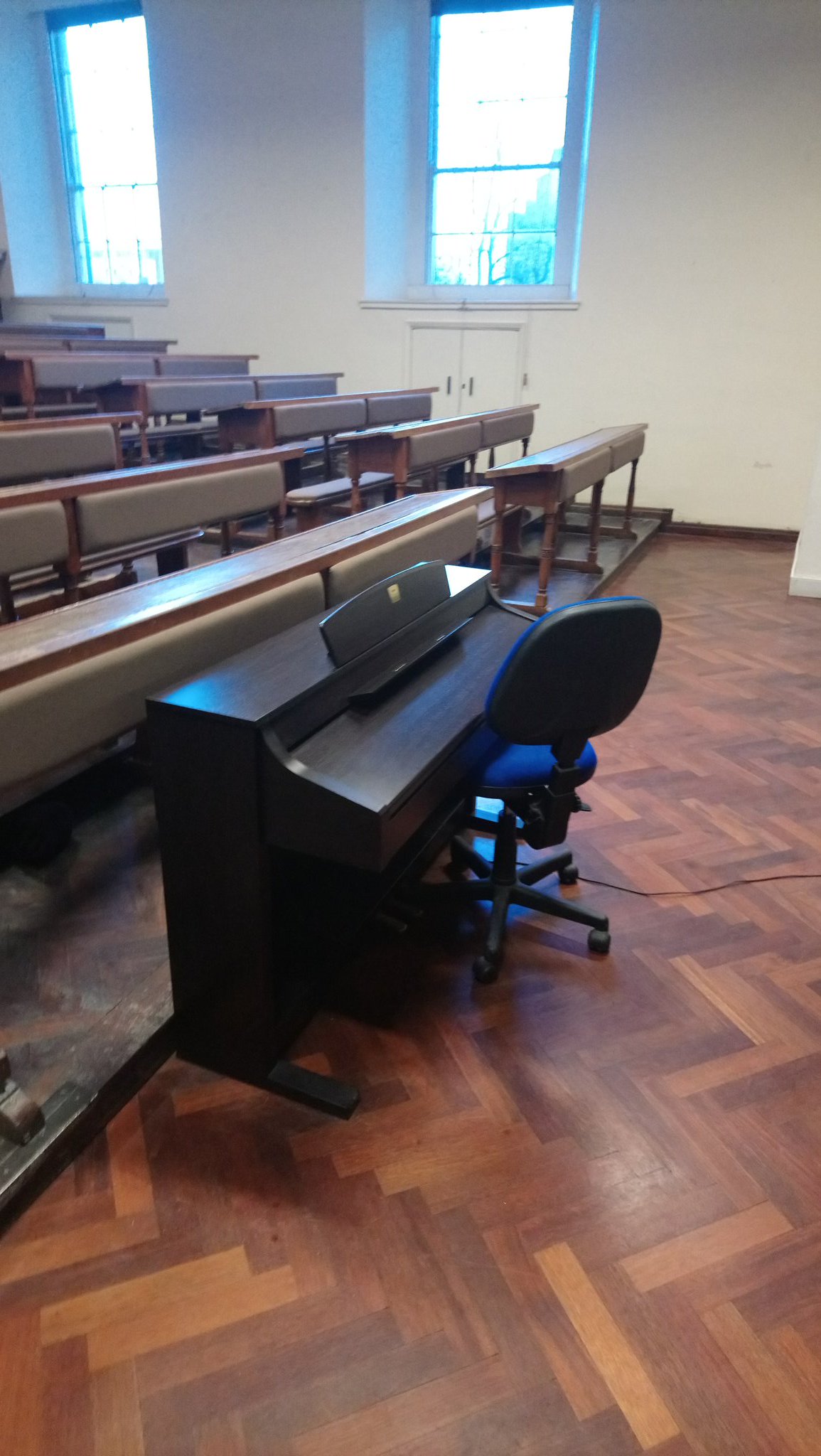
I wonder if anyone can suggest appropriate musical numbers to perform for a class of computational physicists? Suggestions are hereby invited via the Comments Box!
Follow @telescoperR.I.P. Hugh Masekela (1939-2018)
Posted in Jazz with tags apartheid, Hugh Masekela, Jazz on January 23, 2018 by telescoperI woke up this morning to the very sad news that South African jazz trumpeter Hugh Masekela had lost the long and courageous battle he had been fighting against cancer and has passed away at the age of 78. Hugh Masakela did a huge amount to establish a uniquely South African jazz tradition and much of his music was a response to the struggle against apartheid. Although some “serious” jazz fans have criticised him for `selling out’ in his forays into pop – for which he simplified his playing style considerably – this approach definitely succeeded in bringing many new people to his music. His was exactly the same approach as Louis Armstrong, actually, and I for one don’t begrudge either his commercial success.
I was fortunate to hear Hugh Masekela live many years ago at Ronnie Scott’s Club. He had a wonderful stage presence, and played a typically eclectic mix of music and it was a wonderful night that I’ll remember for the rest of my life.
Here’s a clip of him playing and singing that gives an idea of what the man and his music were like and just how much he will be missed.
R.I.P. Hugh Masekela (1939-2018).
Follow @telescoperCome Sunday
Posted in Jazz with tags Come Sunday, Duke Ellington, Mahalia Jackson on January 21, 2018 by telescoperI can’t believe that I’ve been sharing music on this blog for almost a decade and haven’t yet posted this. It’s a beautiful Duke Ellington song Come Sunday, written for the extended concert suite Black, Brown and Beige, later appeared in the Duke Ellington concerts of sacred music, and eventually became a jazz standard. It was written for solo voice along with the full Ellington band, but this almost entirely a cappella version featuring the great gospel singer Mahalia Jackson with a few bits of Duke Ellington on piano is my favourite version. It’s a hauntingly elusive melody, but Mahalia Jackson fills it with her entire soul…
Follow @telescoperThe WNO Orchestra at St David’s Hall
Posted in Music with tags Antonin Dvorak, Felix Mendelssohn, Henning Kraggerud, Ludwig van Beethoven, Orchestra of Welsh National Opera, Tomáš Hanus on January 15, 2018 by telescoperIt has been a very busy weekend but yesterday afternoon I took time out to visit St David’s Hall in Cardiff to hear the Orchestra of Welsh National Opera conducted by Tomáš Hanus in a programme of music by Beethoven, Mendelssohn and Dvořák. I’ve noticed that many of the international concerts that are a regular part of Cardiff life have been moved from weekday evenings to weekend afternoons. No doubt that it is for commercial reasons. I have to admit that I’m not a big fan of matinee concerts, but as it happens I’m not going to be available for many of the weekday evening concerts for the foreseeable future so I thought I’d give this one a go. The programme was a middle-of-the-road bums-on-seats affair, but if it brings people into the concert hall that is a good thing and it was nice to see a big crowd, including a sizeable contingent of schoolchildren, there to enjoy the show.
First up we had a favourite piece of mine, Beethoven’s Egmont overture, inspired by the story of Lamoral, Count of Egmont whose execution in 1568 sparked an uprising Spanish occupation that eventually led to the independence of the Netherlands. It’s a stirring, dramatic work, ideal for opening a concert programme. I thought the tempo was a bit slow at the start, which made increase in speed towards the end a little jarring, but otherwise it was well played the full orchestra, arranged with six double-basses right at the back of the stage facing the conductor with the brass either side. That was very effective at generating a rich dark sonority both in this piece and in the Dvořák later on.
The next item was a very familiar work indeed, the Violin Concerto in E minor by Felix Mendelssohn. This is perhaps best known for its lvoely second movement (in which they key changes to C major) but the other two movements are really innovative and virtuosic. In the wrong hands the slow movement can be horribly schmaltzy but Norwegian soloist Henning Kraggerud managed to bring out is beauty without wallowing in its romanticism. It was a very fine performance, warmly appreciated by the audience. Henning Kraggerud treated us to an encore in the form of an intruguing piece by a musician previously unknown to me, Olof Bull, a fellow Norwegian and a contemporary of Mendelssohn.
After the wine break the main event of was another familiar piece, the Symphony No. 9 (“From the New World”) by Antonín Dvořák, a piece full of nostalgia for his Czech homeland written while the composer was living in America. It’s a piece I’ve heard very many times but it still manages to stay fresh, and yesterday’s performance was full of colour of verve. Tomáš Hanus (himself Czech) chose this piece as a tribute to an old friend who passed away last year, and it was was played with great passion.
I’d heard all the pieces in this programme many times, both in concert and on record, but they all stand up to repeated listening, simply because they’re so very good. I do like to hear new works – and do wish the programming at St David’s Hall were a little more adventurous – but they do have to make ends meet and there’s in any case much to enjoy in the standard repertoire, especially when it’s played by a fine orchestra. Such pieces can fall flat when you get the feeling that the musicians themselves are a bit bored with them, but that emphatically wasn’t the case yesterday.
It will soon be time to Welsh National Opera’s new season, with a new production of Verdi’s La Forza del Destino alongside revivals of Tosca and Don Giovanni. It’s going to be tricky to see them all, but I’ll give it a go!
Follow @telescoperYellow Tango
Posted in Jazz with tags Bud Powell, Dick Twardzik, Thelonious Monk, Yellow Tango on January 12, 2018 by telescoperBefore Christmas I posted one of my favourite pieces of music, The Fable of Mabel, performed by a band led by Serge Chaloff and featuring pianist Dick Twardzik (who also composed the piece). I thought I’d follow this up with another piece by Twardzik, this time in a trio with Carson Smith on bass and the excellent Peter Littman on drums.
This piece was recorded in late 1954, at which time the two great influences on jazz piano were Bud Powell and Thelonious Monk. Here’s a good example of how Twardzik manages to nod in the very different directions of these two great musicians – the Monk influence in particular stands out a mile when the rhythm switches from Latin-American to 4/4 at about 1:43 – while also managing to find a very original voicea which was all his own. It’s such a terrible shame that within a few months of this session Twardzik was dead (of a heroin overdose, at the age of 24) and jazz had lost one of its most promising young artists.
Follow @telescoperHold ’em Joe – Sonny Rollins
Posted in Jazz with tags calypso, Hold 'em Joe, Jazz, Sonny Rollins on January 6, 2018 by telescoperSo I’m in Dublin airport waiting to board a (delayed) flight. Since it’s cold and dark outside I thought I’d take the opportunity to use the free airport Wi-fi to share something that put a bit of a spring in my step when I heard it on the radio a couple of days ago. It’s a truly phenomenal performance on tenor saxophone by the great Sonny Rollins over an infectious calypso rhythm generated by Mickey Roker on drums. Enjoy!
Follow @telescoper


