I was reminded this weekend that today (9th April 2018) is the 90th birthday of American musician, singer-songwriter, satirist, and mathematician Tom Lehrer. Although he has retired from theatres of both musical and lecture variety, his songs (and especially the one I’ve selected) remains topical to this day. I’m about to retreat into a bunker to finish marking a batch of coursework so please enjoy the following short tribute and wish Tom Lehrer a very happy 90th birthday!
Follow @telescoperArchive for the Music Category
Tom Lehrer at 90!
Posted in mathematics, Music with tags Tom Lehrer, We will all go together when we go on April 9, 2018 by telescoperAngela Hewitt at St David’s Hall – The Goldberg Variations
Posted in Music with tags Angela Hewitt, Goldberg Variations, J.S. Bach, Johan Sebastian Bach, music, St David's Hall on April 8, 2018 by telescoper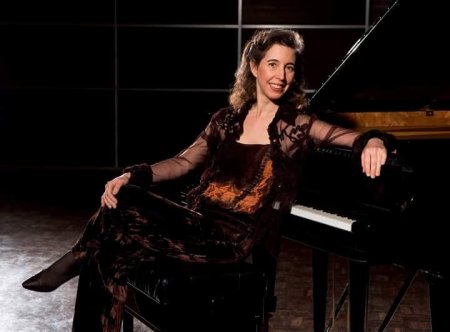
Angela Hewitt (picture credit: St David’s Hall website )
This afternoon I had the great pleasure of attending a solo piano concert at St David’s Hall in Cardiff featuring star pianist Angela Hewitt (pictured above). The programme consisted of one work – but what a work! – the monumental Goldberg Variations by Johann Sebastian Bach.
I’ve been looking forward to this concert for weeks, not only because it was a rare opportunity to hear Angela Hewitt play, but also because although it’s a very special piece to me I’ve never heard the entire work played live before today.
The fact that I love this work so much is probably connected with my love of Jazz. Although ostensibly totally different idioms, the basic idea of ‘theme and variation’ unites these forms. Not much is known about Bach’s approach to the composition of this particular work but it wouldn’t surprise me if he improvised at least some of the variations. Above all, though, it’s when those walking bass lines for the left hand appear (e.g. near the end of the Aria) that Bach really swings; I always imagine Percy Heath or Ray Brown accompanying those passages on the double bass.
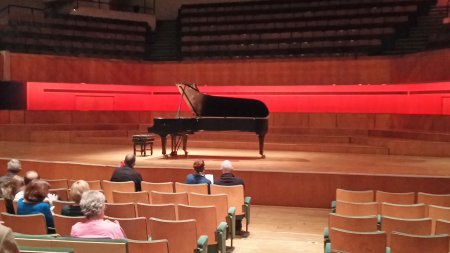
The sense of anticipation for this concert probably explains why I arrived earlier than usual:
I have eight different versions of the Goldberg Variations on CD, including one by Angela Hewitt and the two extraordinary (and extraordinarily different) recordings by fellow Canadian Glenn Gould. If I had to pick my favourite, however, it would probably be one by Andras Schiff, but I find much to enjoy in all of them. I think the great thing about Bach’s music is that it’s so beautifully constructed that it can be played in a huge variety of ways and still be exquisite.
I’ve heard some people describe Angela Hewitt’s way of playing Bach as ‘affected and punctilious’ and others ‘elegant and crisply articulated’. They’re probably all describing the same thing, but some people like it and some don’t, it’s just a matter of taste.
Recordings are not the same as a live experience, and today underlined to me just how much more I enjoy live concerts. The concert lasted about 80 minutes (without an interval) – there are 30 variations altogether – and I don’t think I’ve ever seen an audience at St David’s with such rapt attention. For me the time went so quickly that I was quite startled when I heard the start of penultimate section (‘Quodlibet’) signalling that we were near the end. After the final note of the closing recapitulation of the opening Aria had subsided, the soloist kept her face down over the keyboard as if daring anyone to break the spell. Eventually she raised her head, smiled, and the applause began, followed by a standing ovation. The St David’s audience is usually rather reticent so that tells you how good this was. What better way can there be to spend a Sunday afternoon?
P.S. Angela Hewitt walked on and off stage with the aid of a metal crutch, suggesting some form of leg injury. On the unlikely event that she reads this, let me wish her a speedy recovery from whatever it is!
Follow @telescoperDark Slender Boy – Liam O’Flynn
Posted in Music with tags Liam O'Flynn, Uilleann Pipes on April 4, 2018 by telescoperI’m by no means an expert on the Uilleann pipes, but the sad death of Liam O’Flynn (after a long struggle with cancer) a few weeks ago gave me occasion to hear some recordings of his, and I was captivated by the amazing sounds coming from this instrument.
The Uilleann pipes look a bit like a much larger version of the Northumbrian smallpipes I am familiar with from the region of my birth, in that the bag is inflated using an elbow pump, but they have a much wider range – two octaves – and can play sharps and flats. A master such as Liam O’Flynn could also generate a range of other effects, by bending notes in much the same way as a jazz or blues musician would, and also achieving subtle changes of tone and volume. Here’s a lovely example of his art, a solo performance of a tune called Dark Slender Boy on which he conjures up a world of musical possibilities.
Follow @telescoperDebussy, Mozart and Messiaen at St David’s Hall
Posted in Music with tags BBC National Orchestra of Wales, Claude Debussy, Jac van Steen, Olivier Messiaen, St David's Hall, Steven Osborne, Wolfgang Amadeus Mozart on March 25, 2018 by telescoper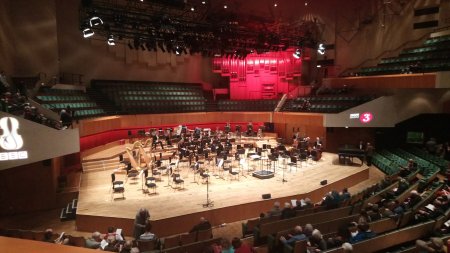
The view from Tier 2 before the concert
After work (and a pint or two) on Friday evening I headed to St David’s Hall for a concert by the BBC National Orchestra of Wales conducted by Jac van Steen. The concert was broadcast live on BBC Radio 3 so you can listen to it on the iPlayer for a month.
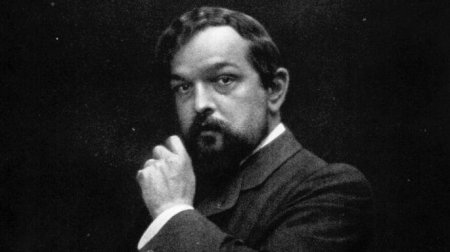
Two of the four pieces on the programme were by Claude Debussy (abovel, to mark the centenary of his death which was 100 years ago today (on 25th March 1918).
The concert opened with Debussy’s Nocturnes and ended with La Mer , both works consisting of three movements for a large orchestra and showing the vivid chromaticism and lush orchestration that typifies so many of his compositions. The last movement of Nocturnes includes some wordless singing, which was performed beautifully by female singers from the Royal Welsh College of Music and Drama.
The second piece was Mozart’s Piano Concerto No. 27 in B flat Major K. 595, with soloist Steven Osborne. This, Mozart’s last piano concerto, is a nice piece, well played by both pianist and (pared-down) orchestra but I felt it was a rather incongruous choice for this programme. It was probably chosen because it is in some sense a valedictory piece, but all it did for me in this concert was emphasize how much the harmonic vocabulary of music expanded between Mozart and Debussy, and left me feeling that the Mozart piece was rather trite in comparison.
After the wine break we heard a piece that was completely new to me, Les Offrandes Oubliées by Olivier Messiaen, a wonderfully expressive piece with wildly contrasting moods, clearly influenced by Debussy but with a distinctive voice all its own. Messiaen is one composer I definitely wish I knew more about.
After the superb La Mer which ended the published programme, something very unusual happened for a classical concert in the UK: there was an encore by the orchestra in the form of a dance by Debussy orchestrated by Maurice Ravel.
All in all, a very enjoyable evening and a fitting tribute to Claude Debussy, a composer who was both modernist and impressionist and whose influence on the development of music is incalculable.
Follow @telescoperThe Lamentations of Jeremiah
Posted in Music with tags Cardiff Polyphonic Choir, Lent, The Lamentations of Jeremiah, Thomas Tallis on March 24, 2018 by telescoperThis evening I’m going to this concert, which I’ve been looking forward to for some time.
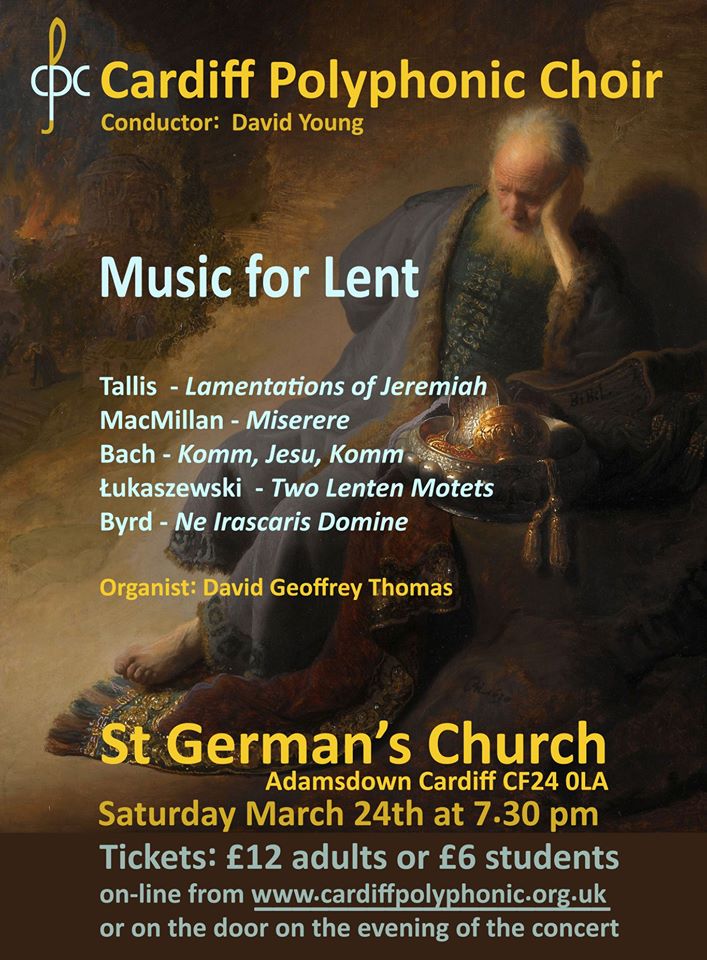
It may be sombre and melancholy, but the setting of The Lamentations of Jeremiah by Thomas Tallis is also astonishingly beautiful and it’s been one of my favourite choral works for many years. In fact it’s one of the most frequently played recordings on my iPod because I turn to it when I need to listen something peaceful and reflective. I have never heard it performed live, however, so this will be a treat for me. To give you a taster, here is the work (performed by The Sixteen):
P.S. The Hebrew text of the Book of Lamentations is remarkable for being in the form of an acrostic, with each verse starting with consecutive letters of the Hebrew alphabet. Tallis sets verses from the Latin (Vulgate) translation, but includes the initial letters of the Hebrew version: Aleph, Beth, etc..
UPDATE: I went to the concert as planned. Very enjoyable it was, though I was a bit surprised to find the two parts of The Lamentations of Jeremiah were not performed one after the other but either side of two motets by Lukaszewski. I guess this is to emphasise that they are separate pieces rather than one 20-minute long work but I always listen to them together.
The concert had an interval of about 25 minutes but, lamentably, no drinks were on sale…
Follow @telescoperBird of Paradise – In Memoriam Charlie Parker
Posted in Jazz with tags Bird of Paradise, Charlie Parker, Miles Davis on March 12, 2018 by telescoperToday is the 63rd anniversary of the death, in 1955 aged just 34, of the great saxophonist and composer Charlie Parker, also known as `Bird’. I know a lot of people don’t really `get’ Bird’s way of playing, but for me he created some of the most beautiful and exciting sounds not only in jazz, but in any musical genre. Here, to mark his memory, is a piece called Bird of Paradise (a thinly disguised version of the Jerome Kern standard All The Things You Are) recorded in 1947 for the Dial label with a quintet that included a young (21 year-old) Miles Davis on trumpet. Miles Davis was still finding his way musically at the time of the Dial sessions, but Bird had already established himself as a powerful creative force and his solo on this number is absolutely exquisite.
Follow @telescoperAn Interview with Lauritz Melchior
Posted in Opera with tags Lauritz Melchior on March 10, 2018 by telescoperI’ve written more than once about the great tenor Lauritz Melchior, and the other day I came across this fascinating interview with him recorded when he was in his eighties and was living in America.
It’s full of interesting comments, but I have to say that above all I just love the way he speaks. English spoken with a Danish accent sounds so wonderful to my ears, especially with that tendency to inflect downward at the end of words. It sounds wonderfully lugubrious.
Follow @telescoperWillow Weep For Me – Mary Lou Williams
Posted in Jazz with tags Ann Ronell, International Women's Day, Mary Lou Williams, Willow Weep For Me on March 8, 2018 by telescoperToday is International Women’s Day, so I thought I’d post this lovely performance of the standard Willow Weep For Me, not just because it is played by the wonderfully talented pianist composer and arranger Mary Lou Williams, but because the song itself was written by Ann Ronell…
Follow @telescoper45° Angle
Posted in Jazz with tags 45 degree angle, Dannie Richmond, George Duvivier, Herbie Nichols, Jazz on February 24, 2018 by telescoperSome time ago I posted a piece of music by Dick Twardzik from the mid-50s. The jazz piano scene in those days was so heavily dominated by Thelonious Monk and Bud Powell that pianists seem to struggle to find their own voice in the space created by those two. Twardzik certainly succeeded, though he died very young. Well, here’s another track from roughly the same period (1957) featuring another underrated musician who solved this problem in a different way. This fine track, undoubtedly influenced by Monk and Powell, but at the same time with its own sound, is by Herbie Nicholls, playing his own composition 45° Angle with the excellent George Duvivier on bass and Dannie Richmond on drums. Enjoy!
Follow @telescoperThe Philharmonia Orchestra: Beethoven & Mahler
Posted in Music with tags Cardiff, Death in Venice, Gustav Mahler, Ludwig van Beethoven, Mahler Symphony No. 5, Piano Concerto No. 1, St David's Hall on February 19, 2018 by telescoper
I spent yesterday afternoon at a very enjoyable concert at St David’s Hall in Cardiff for a programme of music by Beethoven and Mahler given by the Philharmonia Orchestra under Principal Guest Conductor Jakub Hrůša. The picture above was taken about 10 minutes before the concert started, from my seat in Tier 1. Quite a few people arrived between then and the beginning of the performance, but there wasn’t a very big audience. St David’s Hall may have been less than half full but those who did come were treated to some fantastic playing.
The first half of the concert consisted of Beethoven’s Piano Concerto No. 1 (in C) with soloist Piotr Anderszewski. This work was actually composed after his Piano Concerto No. 2 but was published first. It consists of three movements, an expansive slow movement (marked Largo) sandwiched between two sprightly up-tempo movements, marked Allegro con brio and Rondo-Allegro Scherzando, respectively. I think the first part of the last movement, full of energy and wit, is the best part of this work and Anderszewski play it with genuine sparkle. His performance was very well received, and he rounded it off with a charming encore in the form of a piece for solo piano by Bartok.
After the wine break we returned to find the piano gone, and the orchestra greatly expanded for a performance of Mahler’s Symphony No. 5 , the fourth movement of which (the `Adagietto’) is probably Mahler’s best-known music (made famous by its use in Visconti’s 1971 film Death in Venice). This lovely movement is sometimes performed on its own – a practice Mahler himself encouraged – but I think it’s particularly powerful when heard in its proper context, embedded in a large orchestral work that lasts well over an hour.
Although nominally five movements, this work is really in three sections: the first section consists of the first two movements (the first starting with Trauermarsch (a funeral march), and the second a stormy and at times savage movement, punctuated with brief interludes of peace). The last section consists of the beautiful Adagietto 4th movement (played entirely on the strings) followed by an energetic and ultimately triumphant finale. In between there’s an extended Scherzo, which is (unusually for Mahler) rather light and cheerful. Roughly speaking this symphony follows a trajectory from darkness into light and, although it certainly doesn’t go in a straight line, and does start with a death march, this is undoubtedly one of Mahler’s cheerier works!
The Philharmonia Orchestra gave a very accomplished and passionate reading of this piece, with especially fine playing from the brass section (who have lot to do). The exuberant ending brought many members of the audience to their feet and rightly so, as it was a very fine performance – the best I’ve heard live of this work.
Follow @telescoper

