Archive for the Music Category

Der Rosenkavalier at WNO

Posted in Opera with tags , , , , , , , on June 5, 2017 by telescoper

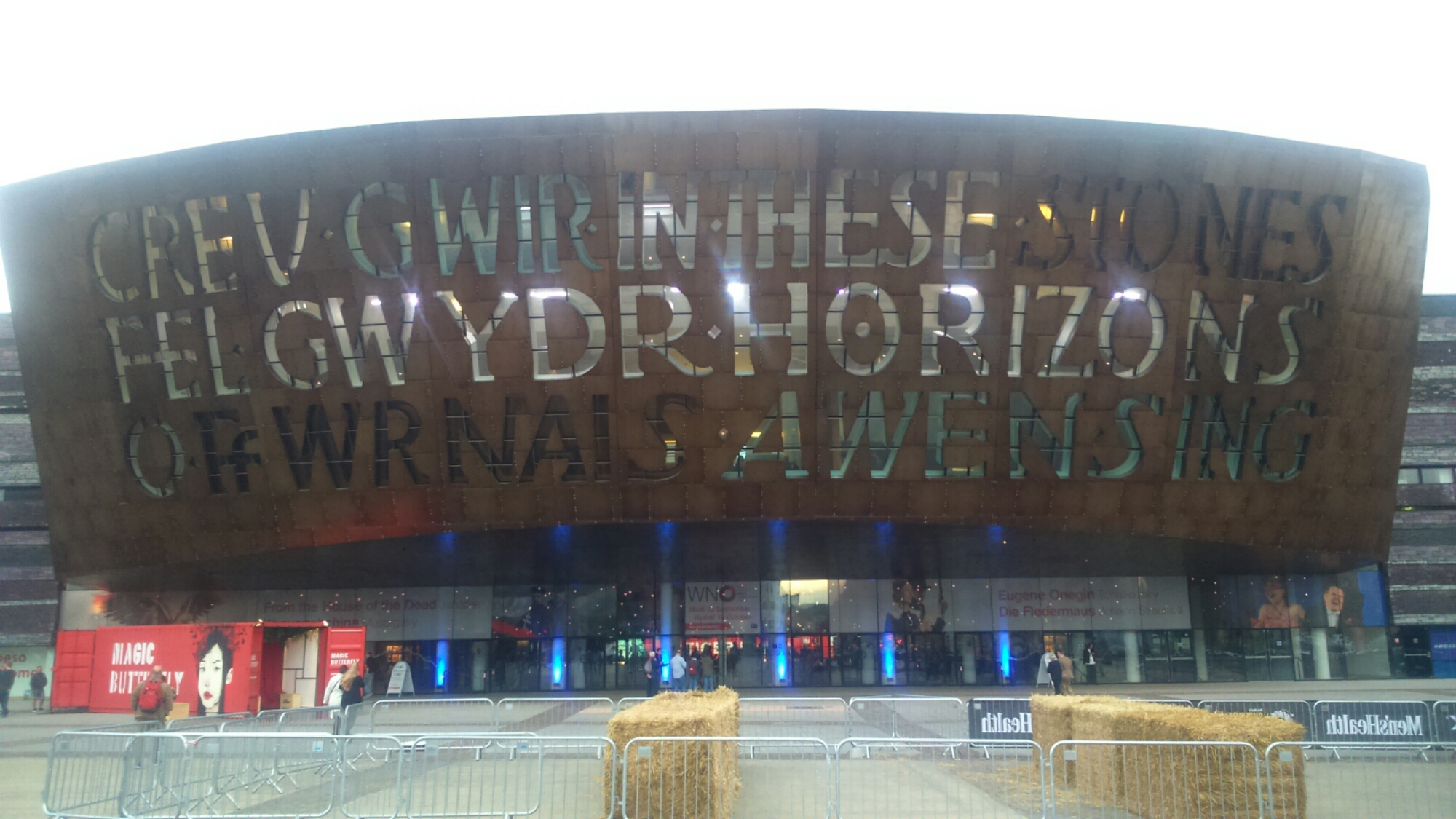
I’m in London attending a cosmology meeting (of which more, perhaps, anon) but I couldn’t resist posting a quick review of yesterday’s birthday treat: the first performance of a new production of Der Rosenkavalier by Richard Strauss. It wasn’t exactly a first night as such because it was a 3pm start. In fact it was still daylight when I got home..

Der Rosenkavalier is superficially a comic opera but it also moments of great depth and poignancy, dealing with the passage of time and the nature of love. The libretto contains some lovely passages, such as this:

Die Zeit, die ist ein sonderbar Ding.
Wenn man so hinlebt, ist sie rein gar nichts.
Aber dann auf einmal, da spürt man nichts als sie.
Sie ist um uns herum, sie ist auch in uns drinnen.
In den Gesichtern rieselt sie,
im Spiegel da rieselt sie,
in meinen Schläfen fliesst sie.
Und zwischen mir und dir da fliesst sie wieder,
lautlos, wie eine Sanduhr.

Most of the comedy is supplied by an intrigue involving the boorish Baron Ochs, played brilliantly by bass Brindley Sherrat, who wishes to marry the innocent Sophie (largely to acquire the property of Sophie’s father). The Baron engages dashing young Octavian to deliver a ceremonial silver rose to Sophie as a wedding gift. Octavian arrives with the gift but falls in love at first sight with Sophie and his feelings are reciprocated. When the Baron turns out to be the horrible git that he is, Octavian engineers a plot to discredit him, rescue Sophie from a potentially disastrous marriage and claim her for himself. The cunning plan, which proves successful, involves Octavian dressing as a maid in order to catch the Baron in flagrante.

It’s worth mentioning that the part of 17-year old Octavian is played by a female singer – in this production the excellent Lucia Cervoni – who at one point has to be a girl playing a boy playing a girl, rather like Cherubino in the Marriage of Figaro. Sounds silly? Well, it is but it was beautifully done and gloriously funny.

Octavian (right) presents Sophie with the silver rose..

Octavian is a `trouser role’ but in this production the character begins with trousers off, having a bit of rumpy-pumpy with the Marschallin (played by the wonderful Rebecca Evans), who is much older than Octavian. At the start of the Opera they are in a passionate relationship, but the Marschallin is conscious of the passage of time and that her relationship with Octavian can’t last. At the end of Act I, she points out to Octavian that their relationship can’t go on and he storms out, shortly to meet young Sophie (in Act II).

In this production the Marschallin is often accompanied on stage by the silent and solitary figure of an old lady, who it turns out is a representation of herself in later life. It’s a clever device and would have been even more effective had the old lady not reminded me so much of Madge Allsop

The staging is in period, and for the most part pleasantly straightforward but there is a rather gimmicky element of steadily encroaching sand, presumably ‘the sands of time’ referred to in the last line of the excerpt quoted above. I felt this was neither necessary nor convincing. The theme of time’s inexorable progress is clear enough. There’s no need to labour it.

Near the end of Act III, after much coming and going, and the odious Baron’s entrapment and humiliation, the Marschallin  is left alone with her former lover Octavian and his intended bride Sophie, we arrive at the Opera’s emotional high point, and indeed one of the most sublime moments in the entire operatic repertoire, the sumptuous trio Hab Mir’s Gelobt,  in which the Marschallin comes to terms with the loss of Octavian and blesses the relationship between him and Sophie. This is one of the pieces of music that really affects me very powerfully, and I am not too proud to admit that I did let go a tear or two. Maybe more. Not because it is especially sad, but because it’s so very beautiful the way the three voice blend together and with the orchestra.

I don’t give star ratings but from a vocal point of view this is definitely one of the finest performances I’ve ever seen on the Opera stage. All four principals: Rebecca Evans, Lucia Cervoni, Brindley Sherratt and Louise Alder (Sophie) rose to the challenges of their roles in great style. All were superb so it would be wrong to single out one, but I will say that I was surprised to discover that this was Rebecca Evan’s debut as the Marschallin – she was just about perfect in the role.

The Orchestra of Welsh National Opera directed by Tomas Hanus played Strauss’s lush score with great precision and passion,  holding together a wonderful afternoon at the Wales Millennium Centre. An altogether excellent way to spend a birthday afternoon!

Captain SKA – Liar Liar

Posted in Music, Politics with tags , on June 2, 2017 by telescoper

I don’t know why, but every time I go onto Youtube these days I get a horrible Conservative Party propaganda video. Obviously some sort of algorithm has decided to inflict this crap on me because I’m deemed to be likely to be persuaded to vote for the Tories. I can promise them that this is not the case. The Tories may win next week’s election, but this campaign has revealed Theresa May as thoroughly cowardly and dishonest, despite her best efforts to hide from public scrutiny. I will be voting for Welsh Labour.

Anyway, I’ve decided to retaliate by posting this: it’s Liar Liar by Captain SKA. It’s in the top ten of the UK singles chart, but the BBC refuses to play it. I can’t compete with the Beeb, but every little helps….

Summertime – Albert Ayler

Posted in Jazz with tags , , on May 26, 2017 by telescoper

George Gershwin’s beautiful song Summertime has been recorded countless times in countless ways by countless artists, but if you’re expecting it to be performed as a restful lullaby, as it is normally played, you’ll probably be shocked. This version is a heartbreaking expression of pain and anguish performed by the great Albert Ayler, and it was recorded in Copenhagen in 1963.

P.S. The painting shown in the video is by Matisse….

Gene Krupa and Benny Goodman in Chicago

Posted in Jazz with tags , , , , , on May 10, 2017 by telescoper

Following up the post I did last week about Joe Morello which proved very popular, here is another about a drummer whose name came up in the discussion following that item, Gene Krupa.

Gene Krupa didn’t exactly invent the image of the drummer as a madman who sat at the back of the band, but he certainly cultivated it. He may sometimes have lacked subtlety in his playing, but he always injected a huge amount of energy into a performance whether in a small group (as here) or behind a big band.

His extrovert personality proved an excellent complement to the rather introverted bandleader Benny Goodman which, together with his undoubted technical ability, led to them having a very long working relationship. That said, Gene Krupa did leave the Goodman Orchestra in 1938 reportedly because Benny Goodman didn’t his drummer’s tendency to hog the limelight, insisting on taking a drum solo in just about every number. They did continue to work together for many years afterwards, however, as this clip demonstrates.

Many people credit Gene Krupa for basically inventing the modern drum kit and was certainly one of the first drummers in Jazz to be well known as a soloist and, indeed, the first to become a nationwide celebrity. He also inspired subsequent generations of drummers: Keith Moon of The Who was an admirer of Gene Krupa and I was told some years ago that Krupa also provided the inspiration for `Animal’, the drummer in the Muppet Show band.

People don’t generally realize what a smash hit Benny Goodman’s band was in the pre-War years – their fame was exactly on the scale of the `Beatlemania’ of a few decades later.

My Dad taught himself to play the drums using a book called The Gene Krupa Drum Method. I found his (very old and battered) copy of it among his personal effects after he died almost a decade ago and gave it – along with his drums, sticks, brushes, etc – to a local school. One thing that came from learning from a book was that he learnt to read drum music very well, which helped him get jobs with various dance bands. Few Jazz drummers of his generation could read music.

This performance, dating from the 1960s, represents a kind of reunion the three members of Benny Goodman’s famous trio of the 1930s (Goodman, Krupa and Teddy Wilson), along with bassist George Duvivier. I never really understood how that original trio managed to get away without having a bass player, but it was hugely popular and made a number of terrific records.

There’s a (somewhat rambling) verbal introduction by Benny Goodman, so I’ll restrict myself to a couple of observations. One is that Gene Krupa (who is clearly enjoying himself in this clip – watch him at about 3:07!) shows off the `trad’ grip very effectively. The other is that if you look closely at Teddy Wilson’s right hand you can see that he doesn’t have the use of his index finger, which he was unable to unbend. I believe that came about as the aftermath of a stroke and it caused him a lot of problems in later life although he carried on playing well into the 1980s. Anyway, he still plays very nicely, as do they all. Enjoy!

Symphonie Fantastique

Posted in Music with tags , , , , , , , , on May 8, 2017 by telescoper

After a busy weekend I’m gradually trying to catch up on last week’s happenings. One thing I haven’t had time to mention yet is that on Thursday night I went to a concert at St David’s Hall in Cardiff that featured the BBC National Orchestra of Wales under the direction of Xian Zhang. The orchestra repeated the programme the following day (Friday) at the Brangwyn Hall in Swansea, so you can listen to it it for the next month on the BBC iPlayer.

The main item on the menu was the Symphonie Fantastique by Hector Berlioz. I have to confess that I’ve been a bit prejudiced about this piece since I was at school. I had a music teacher who adored Berlioz and wouldn’t shut up about him, basically telling us that he was the best composer ever. I didn’t buy it then, and despite a very fine performance on Thursday, I still don’t buy it now. It’s n0t that Berlioz is short of musical ideas or technical accomplishment: there are some memorable passages in this Symphonie, including the dance-like theme of the second movement, and the  “march to the scaffold” in the fourth movement.  I’m not at all averse to big loud symphonic works, either, as regular readers of this blog will know. My difficulty is that it’s all a bit too obvious. The BBC National Orchestra of Wales is a fine orchestra and I enjoyed their playing enormously. I particularly appreciated seeing the  percussion section get a good workout! I was also impressed by the conducting of Xian Zhang who gave a sense of shape where previously I’d heard only bombast. It’s the composition that’s the problem for me, though. Berlioz lays it on with a shovel, but I still think this is a rather superficial piece.

Before the Berlioz, in the first half, were two much more interesting pieces. The first, a piece called Internet Symphony No. 1 “Eroica” by Tan Dun is less than five minutes long is a hugely entertaining blend of Eastern and Western musical influences.

After that appetizer we had a dazzling performance of the Rhapsody on a Theme by Paganini by Sergei Rachmaninov with soloist Stephen Hough at the piano. This piece comprises a set of 24 variations on a them from one of Paganini’s caprices for solo violin.

Incidentally, the “theme by Paganini” used as the basis of this piece is the same one that was used for the musical introduction to the TV programme “South Bank Show“, although I think quite a lot of people know that.

The Rhapsody on a theme of Paganini is piece full of contrasts: sometimes pyrotechnical, sometimes lyrical. My favourite section is the 18th variation, in which a lovely romantic melody emerges and is picked up by the whole orchestra in a manner that’s very characteristic of Rachmaninov. It gets me every time, but then I am a terrible softy. You can hear this played by Stephen Hough at the Proms in 2013 here (about 20:20 into the video). Incidentally, this tune is just an inversion of the theme transposed into a different  key and slowed down.

The Rachmaninov alone was worth the cost of the ticket! It’s such a shame that he wrote so little music after emigrating from Russia to the United States in 1917. He made a living doing concert tours after that, and had little time to compose. Thank goodness he found time to write this, though!

We also had an encore by Stephen Hough that provided yet another contrast. Debussy’s Clair de Lune is a very familiar piece, but it provided an appropriately light and reflective epilogue to the first half.

I will persevere with Berlioz, I suppose, like I do with Brahms, but I think I’m going to be hard to convince. If anyone can suggest a piece by Hector Berlioz that they think will change my mind, please feel free to suggest it via the comments box!


Unsquare Dance

Posted in Jazz with tags , , on May 4, 2017 by telescoper

By way of a small postscript to last week’s post about the great Joe Morello, here’s a piece that shows he was such a great drummer he didn’t even need a drum!

Dave Brubeck’s tune Unsquare Dance is basically a blues built around a single bass figure and played in 7/4 time, making it not inconsiderably difficult to dance to. Difficult, but not impossible! On top of that the tempo actually speeds up during this performance. It’s normally a cardinal sin for a rhythm section in jazz to speed up – the beat has to stay rock steady while the soloists push ahead or lag behind. That’s what generates the sort of dynamic tension that characterizes as swinging performance. In this tune Dave Brubeck was just playing a little joke on the `foot-tappers and finger-snappers’ so he can be forgiven for his trangression.

Listen out, though, for Joe Morello’s contribution. His solo consists entirely of rim shots (made by striking the rim rather than the skin of a snare drum). I believe it is Joe Morello who laughs out loud at the end, partly with relief that they managed to get through this tricky little piece without screwing up!

As you can see, this was released as a 45rpm single and it became quite a hit (by the standards of Jazz records), reaching No. 14 in the UK charts back in 1962.

A Joe Morello Drum Master Class

Posted in Jazz with tags , , , , on April 28, 2017 by telescoper

After a busy morning, I reckon it’s time for a pause and a quick blog post. I stumbled across this clip of a great drum solo a while ago and immediately bookmarked it for future posting. As happens most times I do that I then forgot about it, only finding it again right now so I thought I’d post it before I forget again.

This is the great Joe Morello at the very peak of his prowess in 1964, with the Dave Brubeck Quartet with whom he recorded over 60 albums. That band pioneered the use of unusual time signatures in jazz, such as 3/4, 7/4, 13/4, 9/8 and most famously in their big hit Take Five which is in 5/4 time throughout; they recorded a number of other tracks in which the time signature shifts backwards and forwards between, e.g., 7/4 and the standard 4/4.

A few points struck me watching this clip. The first is that it’s a great example of the use of the ‘trad’ grip which is with the left hand under the stick, passing between the thumb and index finger and between the second and third fingers, thusly:

The right stick is usually held with an overhand grip. Most jazz drummers (whether they play ‘trad’ jazz or not) use this grip. Most rock drummers on the other hand use a ‘balanced’ grip in which both sticks are held with an overhand grip. You might think holding the left-hand and right-hand sticks the same way is the obvious thing to do, but do bear in mind that people aren’t left-right symmetric and neither are drum kits so it’s really not obvious at all!

The trad grip looks a bit unnatural when you first see it, but it does have an advantage for many of the patterns often used  in jazz. Once you’ve mastered the skill, a slight rotation of the wrist and subtle use of the fingers makes some difficult techniques (e.g. rolls) much easier to do rapidly with this grip than with the balanced grip. I’m not claiming to be a drummer when I say all this, but my Dad was and he did teach me the rudiments. In fact, he thought that drummers who used the balanced grip weren’t proper drummers at all!

(I’ll no doubt get a bunch of angry comments from rock drummers now, but what the hell…)

Anyway you can see Joe Morello using the trad grip to great effect in this clip, in which he displays astonishing speed, accuracy and control. The way he builds that single-stroke roll from about 2:28 is absolutely astonishing. In fact he’s so much in command throughout his solo, that he even has time to adjust his spectacles and move his bass drum a bit closer! Jazz musicians used to joke that atomic clocks could be set to Joe Morello, as he kept time so accurately, but as you can see in this clip he did so much more than beat out a rhythm. It’s only about 3 minutes long but this solo really is a master class.

Joe Morello was never a ‘showy’ musician. He never adopted the popular image of the drummer as the madman who sat at the back of the band that was cultivated by the likes of Gene Krupa in the jazz world and later spread into rock’n’roll. Bespectacled and wearing a suit and tie he looks a bit like a bank clerk, but boy could he play! The expression on Dave Brubeck’s face tells you that he knew he was very lucky to have Joe Morello in his band.


One Hundred Years of Ella Fitzgerald

Posted in Jazz with tags , , on April 25, 2017 by telescoper

This morning Radio 3 reminded me that the great jazz singer Ella Fitzgerald was born exactly one hundred years ago today, on April 25th 1917. She passed away in 1996, but her legacy lives on through a vast array of wonderful recordings. I couldn’t resist marking the anniversary of her birth with this track, which I hope brings a smile to your face as it does to mine every time I listen to it. This track won her  Grammy award for the best vocal performance that year, which is pretty remarkable because she forgot the lyrics to the song! Besides this, there’s a lot of other great stuff on the album Ella in Berlin (including more improvised lyrics and some sensational scat singing on How High The Moon) so if you’re looking to start an Ella Fitzgerald collection this is a great place to start.

Mack the Knife had been a huge hit for Louis Armstrong in 1956 and then again for Bobby Darin in 1959. By all accounts Ella was prevailed upon to add it to her repertoire for live concerts. She wasn’t that keen but  reluctantly agreed. Obviously however she wasn’t so  enthusiastic as to actually learn the words! On the other hand, when you have a wonderful voice and an amazing musical imagination, who needs the words? Ella not only made up some lyrics herself on the fly, but also threw in a rather wonderful Louis Armstrong impersonation for good measure. Enjoy!


Recycled Bach

Posted in Music with tags , , , , , , on March 31, 2017 by telescoper

I had the office to myself this morning so I was listening to Essential Classics presented by Rob Cowan on BBC Radio 3 earlier on. During the course of the programme he pointed out that Johann Sebastian Bach was not averse to a bit of recycling and gave the following example. I’m sure that everyone has heard of Bach’s Mass in B Minor (BWV232), which is widely regarded as one of the greatest works ever composed in the entire history of music.

However, although this work is often depicted as a kind of culmination of Bach’s career as a composer and it wasn’t completed until 1749 (the year before Bach’s death), many sections were in fact recycled from much earlier compositions.

For example, give a listen to this. It is the Aria Ach, bleibe doch, mein liebstes Leben from the Cantata Lobet Gott in seinen Reichen (BWV11), often called the Ascension Oratorio, which was first performed in 1735. Apart from the fact that it sets a different text in a different language – the B Minor Mass is a setting of the complete `Ordinary’ of the Latin mass – and there are one or two musical differences here and there, this is instantly recognizable as an earlier incarnation of the sublime Agnus Dei from the B Minor Mass..

Oh, and if you’ve got half an hour to spare you could watch this video of a sparkly and sprightly performance of the entire cantana.

 p.s. It’s Bach’s birthday today: he was born on March 31 1685.


We’ll Be Together Again

Posted in Jazz, Politics with tags , , , , , on March 29, 2017 by telescoper

So, we’ve come to it at last.

At 12.30 BST the Prime Minister’s letter invoking Article 50 of the Lisbon Treaty will be delivered to the President of the European Council, Donald Tusk. This will begin the process by which the United Kingdom leaves the European Union. It also begins the process of dismantling the United Kingdom itself. Scottish independence is now an inevitability as is, probably on a slightly longer timescale, the reunification of Ireland.

I am sad beyond words that this country has taken this path to self-destruction, but can only hope that we eventually see sense and change or mind at some point in the next two years, or return to the fold at some later stage.

No artist was better at conveying a sense of tragedy and loss through their music than Billie Holiday, and here’s a track by her that perfectly expresses my feelings at this bleak time:

No tears, no fears
Remember there’s always tomorrow
So what if we have to part
We’ll be together again