Archive for the Music Category

Chuck Berry on a Summer’s Day

Posted in Music with tags , , , , , , , on October 19, 2016 by telescoper

I was meaning to post this yesterday about Chuck Berry to mark his 90th Birthday. I’m putting it here as a bit of an oddity but I hope you find it interesting.

Chuck Berry appeared in Bert Stern’s classic film Jazz on Summer’s Day which was filmed at the 1958 Newport Jazz Festival. He performed on that occasion with a pick-up band called the Newport All-Stars, and the number that made it into the film was Sweet Little Sixteen, a tune that he actually wrote. I find two things fascinating about this performance. One is that the “backing band” is a stellar group of Jazz legends: the drummer is the great Jo Jones (who led the lightly swinging rhythm section of the great Count Basie band of the 1930s); the trumpeter is Buck Clayton, another Basie alumnus; and the trombonist is none other than Jack Teagarden. To a Jazz fan like myself, the talents of these musicians are totally wasted: they seem somewhat bemused by Chuck Berry’s gyrations on stage as well as bored by the material. When the time comes for the improvised solos that a jazz audience demands, only the relatively unknown clarinettist Rudy Rutherford – usually a tenor saxophonist who played with a number of bands, including Count Basie’s – was prepared to stand up and be counted, his strange effort is evidently a source of great amusement to the rest of the band, but at least he got into the spirit!

The other fascinating thing is what a historical document this is. During the 1950s Jazz was beginning to lose out to Rock and Roll in the popularity stakes, hence the plan of booking Chuck Berry to boost the audience figures at the Newport Jazz Festival. The tension on stage is almost palpable and even Chuck Berry occasionally looks a bit embarrassed by the whole thing. But it’s also a wonderfully observed portrayal of the styles of the time, especially through the audience shots. I wonder what happened to the cute couple dancing to this performance?

Anyway, belated best wishes on his 90th Birthday, here’s Chuck Berry recorded live 58 years ago at the Newport Jazz Festival in 1958, singing and playing Sweet Little Sixteen.


P.S. I forgot to mention the superb photography.


The Firebird (and more) at St David’s Hall

Posted in Music with tags , , , , , , on October 18, 2016 by telescoper

Just a quick note to catch up on concert-going activities from last week, as for various reasons I had to skip a few days of blogging…

Last Thursday night (13th October) I was lucky enough to attend a tremendous concert at St David’s Hall in Cardiff featuring the BBC National Orchestra of Wales conducted by Thomas Søndergård at the start of their 2016/7 season. The main item on the bill was the complete score for Igor Stravinsky’s ballet The Firebird. This is a thrillingly piece, involving a huge orchestra, numbering about a hundred musicians, including some positioned away from the rest of the orchestra. In a performance of the ballet the main orchestra would be in the pit, not on the stage, and the musicians offstage in the concert would be onstage with the dancers. If you see what I mean.

The orchestration of The Firebird is a tour de force: intricate but vividly coloured, full of excitement and colour and the BBC National Orchestra of Wales played it with great passion and aplomb. A really brilliant performance.

The Firebird filled the second half of the programme. In the first half we heard three pieces by French composers: Prélude à l’après-midi d’un faune by Claude Debussy; the three songs from Shéhérazade by Maurice Ravel, sung by the inestimable Sarah Connolly; and  the Flute Concerto by Jacques Ibert played by Emily Beynon. The first two pieces are fairly standard in the concert repertoire, but the last one was completely new to me. The last piece is very fine indeed, consisting of two dazzlingly virtuosic faster movements (Allegro and Allegro Scherzando) either side of a lyrical Andante. The orchestra was somewhat pared down for this part of the concert, but it’s nevertheless a piece of substantial weight and harmonic complexity. Hats off to Emily Beynon and the BBC NOW for a wonderful introduction to this work.

What a rich and varied programme for a single concert, all wonderfully played. I’m certainly looking forward to the rest of the season!


Just Like a Woman

Posted in Music with tags , , on October 13, 2016 by telescoper

Posted in honour of Bob Dylan being awarded the Nobel Prize for Literature.

I am of course delighted that this prestigious honour has, for the first time, been bestowed on a singer/songwriter. Surely it can only be a matter of time before it goes to a blogger?


Paul Carr’s Lunchtime Concert at St David’s Hall

Posted in Music with tags , , , on October 12, 2016 by telescoper

Yesterday I went to my first-ever lunchtime event at St David’s Hall in Cardiff, which was a concert of organ music performed by Paul Carr. There wasn’t a very big crowd, which must have been quite unsettling for the soloist in such a big venue, but the recital was thoroughly enjoyable. The eclectic programme consisted of:

Alfred Hollins: Concert Overture No 2 in C minor

JS Bach: Trio Sonata No 5 in C, BWV 529 (3 movements)

Antonio Soler:  Concerto No 6 for two organs (Minué)

Hans-Martin Kiefer:  Die ganze Welt hast du uns überlassen (Blues Chorale)

Eric Coates, arr Edward Marsh:  The Dambusters March

Marco Enrico Bossi: Scherzo in G minor

Louis Vierne: Two movements from Symphony No. 1

The reason I attended – apart from just having the rare opportunity to hear the magnificent organ at St David’s Hall – was the Bach Trio Sonata. Bach wrote six of these and they’re all an absolute joy to listen to, so for me the concert was worth it just for that piece.  I have to admit that I was also intrigued to the music by Eric Coates for the 1955 film The Dam Busters played on an organ. Paul Carr actually pointed out that this piece is a nod in the direction of Elgar: its fanfare-like opening and big “very English sounding tune” is really reminiscent Pomp and Circumstance March No. 1. Indeed I gather the famous “bouncing bomb” melody has even been used for a hymn (“God is our strength and refuge”, based on Psalm 46). Anyway, the climactic ending of the piece, played on a huge organ like the one at St David’s Hall with all the stops out, is powerfully effective, and almost as noisy as I imagine flying in a Lancaster bomber must be.

The other pieces were completely unfamiliar to me before, but constituted a very pleasant menu for a lunchtime treat, all wonderfully served by Paul Carr. The only problem with lunchtime concerts, is that they don’t give you time for an actual lunch!


The Hallé at St David’s

Posted in Music with tags , , , , , , , , , on October 9, 2016 by telescoper

On Friday evening I kept up the concert-going, this time at St David’s Hall in Cardiff (which I haven’t been to for far too long). This was the first in the new season of concerto that will run until next summer.

On the bill on Friday was the Hallé Orchestra from Manchester (which is in the Midlands) under the direction of Sir Mark Elder.

The first half of the concert featured two works, the symphonic poem The Golden Spinning Wheel by Antonín Dvorak and Liszt’s Piano Concerto No. 2, with soloist Benjamin Grosvenor.

The Dvorak piece is full of energy and  colour and nice tunes, but I found it rather long for what it has to say. Still, it was a good workout with which to get the Hallé warmed up.

I’m not a huge fan of Liszt. I often find his compositions showily virtuosic but rather shallow. Liszt’s Second Piano Concerto is actually much less like that than I expected. Consisting of a single movement lasting just over 20 minutes, it certainly has its pyrotechnical passages, but the piano also takes a back seat too. It’s a very enjoyable work, dazzlingly played at this concert by youthful star soloist Benjamin Grosvenor.

The second half was devoted to a very well-known piece, Beethoven’s Sixth Symphony (“The Pastoral”). It was, however, played in an unusual way that gave it a very fresh sound. Instead of having the basses and cellos in one block, Sir Mark Elder divided them into two groups either side of the stage, one with the first violins and one with the second violins. This simple device managed to create a much more solid  sound from the orchestra, as well as seeming to lower its centre of gravity, as it were. This heightened the impact of the excellent Hallé strings and gave the whole orchestra a rich sonority that perfectly suited the elemental power expressed by Beethoven’s composition.

A very enjoyable concert. Next one, in a couple of weeks, will be Mahler’s Symphony No. 2 (“The Resurrection”). I can’t wait for that!

Llŷr Williams plays Beethoven

Posted in Music with tags , , , , , , on October 7, 2016 by telescoper

Determined to enjoy civilisation as much as I can while we still have it, last night I went to a splendid concert at the Royal Welsh College of Music and Drama in Cardiff featuring acclaimed Welsh pianist Llŷr Williams in an all-Beethoven programme.

The first half of the recital consisted of the three piano sonatas (Opus 10), which are his fifth, sixth and seventh sonatas altogether. Although these are still early works by Beethoven you can already see him pushing back the restrictions of the sonata form. The first two sonatas of this set are of the standard three movement fast-slow-fast format – the first, to my mind, very reminiscent of Haydn – whereas the third has four movements and is looking ahead to what Beethoven would do in future compositions; the  second movement of this third Sonata is particularly beautiful, in a darkly sombre way. None of these pieces reach the heights of his later works, but there is much to enjoy in listening to them.

After the interval we had the Diabelli Variations (Opus 120). The amusing story behind this much later work was recounted by Llŷr Williams before he started to play it. In 1819 the music publisher and  composer Anton Diabelli hit on an idea for a kind of publicity stunt for his publishing business. He wrote a little tune (a waltz, in fact) and sent it to a number of prominent Viennese composers (Beethoven amongst them) with the invitation to write a variation on it. The plan was to parcel all the individual variations together and sell the work as a kind of advertising brochure for Austrian culture. Beethoven wasn’t keen at first – at least in part because he thought the tune was too dull – but he then he decided to turn the project on its head by writing a complete set of variations himself. He wrote the first 19 in quick succession in 1819 and wrote another 14 a few years later. The 33 variations he produced altogether cover an astonishing musical and emotional range: sometimes witty, sometimes tragic, always fascinating. Llŷr Williams aptly described this collection as “one of the pinnacles of the piano repertoire”. Being almost an hour long it must be a demanding work to play, but he clearly relished performing it.

As a Jazz fan it has often struck me how great musicians in that idiom can find inspiration in seemingly unpromising tunes, turning base metal into gold through their gifts for improvisation. Last night it struck me how similar that is to Beethoven’s use of a simple little tune as the basis for the Diabelli variations. Theme and variation, that’s what it’s all about!

Llŷr Williams is currently doing a concert series exploring all of Beethoven’s piano works at the Wigmore Hall in London and these are being recorded for broadcast by BBC Radio 3. In fact, next week (on Tuesday 11th October, at 7.30) you have the chance to hear exactly the same programme that we heard last night. I’ll certainly be listening!

P.S. I’ll leave the pronunciation of “Llŷr” as an exercise to the reader…


The Merchant of Venice at Welsh National Opera

Posted in Opera with tags , , , on October 3, 2016 by telescoper

image

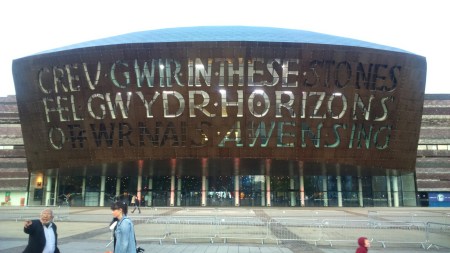
Last Friday (30th September 2016) I got another fix of opera in the form of a new Welsh National Opera production of The Merchant of Venice by André Tchaikowsky at the Wales Millennium Centre in Cardiff Bay (above; the people in the bottom left of the picture were having an important discussion about the location of the nearest Fish & Chip shop).

The Opera sticks very closely to Shakespeare’s play of the same name, even to the extent that the libretto uses some of the original text verbatim. That creates the opposite problem to that which I mentioned in my review of Verdi’s Macbeth. In Verdi’s case the text was excessively abridged with many memorable passages omitted entirely, but in this case the Opera struggles to under the weight of so many words. It’#s not just that the Opera has to be rather long in order to accommodate so much of the original play,  more that Shakespeare’s verse has a compelling rhythm to it that echoes but also amplifies the cadences of natural English speech. Unless it is done exceptionally well, setting the words to music actually detracts from the poetry rather than adding anything to it. Take for example, Portia’s wonderful speech in the courtroom scene (Act IV of the play; Act III of the opera):

The quality of mercy is not strained;
It droppeth as the gentle rain from heaven
Upon the place beneath. It is twice blest;
It blesseth him that gives and him that takes:
‘T is mightiest in the mightiest; it becomes
The throned monarch better than his crown:
His sceptre shows the force of temporal power,
The attribute to awe and majesty,
Wherein doth sit the dread and fear of kings;
But mercy is above this sceptred sway;
It is enthronèd in the hearts of kings,
It is an attribute to God himself;
And earthly power doth then show likest God’s
When mercy seasons justice. Therefore, Jew,
Though justice be thy plea, consider this,
That, in the course of justice, none of us
Should see salvation: we do pray for mercy;
And that same prayer doth teach us all to render
The deeds of mercy. I have spoke thus much
To mitigate the justice of thy plea;
Which if thou follow, this strict court of Venice
Must needs give sentence ‘gainst the merchant there.

These words have music to them in their own right, a music that, frankly, I preferred to what Tchaikowsky added which seemed to distort their proper metre.

I’m not saying that I didn’t like the music; the score is often highly effective. Rigorously atonal – in fact somewhat reminiscent of Alban Berg – it generates great psychological tension and carries considerable emotional force. I just think it was a mistake to take such a literal approach to Shakespeare’s text.

That said, there is a great deal to savour in this production. The staging is extremely well done, with each scene having a completely different look and feel, and the principals sang their roles extremely well. Lester Lynch was a particularly fine Shylock, managing to transcend the stereotypical aspects of his character with a performance of great nobility. The antisemitism of Shakespeare’s play is certainly present in the Opera,  but casting Shylock as a black actor turns it into a more general statement about the evil of prejudice. The play only hints that the relationship between the two men Antonio and Bassanio is more than just a friendship, but the Opera clearly suggests that there is a sexual element to it. Antonio is left alone and distraught at the end, as Bassanio abandons him for Portia, but sympathy for him is limited by his awful behaviour towards Shylock. That suggests (at least to me) that the abuse Antonio directs at Shylock is born of his own internal conflict. At any rate he ends the Opera as he starts it, on a psychiatrist’s couch.

A word must be said about Antonio. The role (for a counter-tenor) was supposed to be sung by Martin Wölfel but he was indisposed by laryngitis. In stepped Feargal Mostyn-Williams at very short notice in what must be an immensely demanding role. I thought he was very good indeed. He held the stage well and though he struggled to project over the orchestra at the start (presumably due to nerves) he grew into the role very well.

This is a production that’s well worth seeing, and I enjoyed it a lot despite the difficulties I tried to explain above. Sadly there were only two performances in Cardiff, so if you want to see it you’ll have to catch it on tour or next summer when it is to be staged at the Royal Opera House in Covent Garden.


Friday Music Quiz: The Yardbird Suite

Posted in History, Jazz with tags , , on September 30, 2016 by telescoper

Not much time to write today so I thought I’d put up a bit of music to end the week. This is a classic from 1946, featuring Charlie Parker leading a band that included a very young Miles Davis. The Yardbird Suite an original composition by Parker, and has become a jazz standard, but he never copyrighted the tune so never earned any royalties from it.

Now, here’s a little question to tease you with. Can anyone spot the connection between this tune and a notable event that occurred today, 30th September 2016?

Answers through the comments box please!


Happy 70th Birthday to the “Third Programme”!

Posted in Jazz, Music, Opera, Uncategorized with tags , on September 29, 2016 by telescoper

I’ve just got time for a quick post-prandial post to mark the fact that 70 years ago today, on September 29th 1946, the British Broadcasting Corporation (BBC) made its first radio broadcast on what was then called The BBC Third Programme. The channel changed its name in 1970 to BBC Radio 3, but I’m just about old enough to remember a time when it was called the Third Programme; I was only 6 when it changed.

radio-times

It was a bold idea to launch a channel devoted to the arts in the depths of post-War austerity and it was perceived by some at the time as being “elitist”. I think some people probably think that of the current Radio 3 too. I don’t see it that way at all. Culture enriches us all, regardless of our background or education, if only we are given access to it. You don’t have to like classical music or opera or jazz, but you can only make your mind up if you have the chance to listen to it and decide for yourself.

My own relationship with Radio 3 started by accident at some point during the 1990s while I was living in London. I was used to listening to the Today programme on Radio 4 when I woke up, but one morning when my alarm switched on it was playing classical music. It turned out that there was a strike of BBC news staff so they couldn’t broadcast Today and had instead put Radio 3 on the Radio 4 frequency. I very much enjoyed it to the extent that when the strike was over and Radio 4 reappeared, I re-tuned my receiver to Radio 3. I’ve stayed with it ever since. I can’t bear the Today programme at all, in fact; almost everyone on it makes me angry, which is no way to start the day.

Over the years there have been some changes to Radio 3 that I don’t care for very much – I think there’s a bit too much chatter and too many gimmicks these days (and they should leave that to Classic FM) – but I listen most days, not only in the morning but also in the evening,  especially to the live concert performances every night during the week. Many of these concerts feature standard classical repertoire, but I particularly appreciate the number of performances of new music or otherwise unfamiliar pieces.

I also enjoy Words and Music, which is on Sunday afternoons and Opera on 3, which includes some fantastic performances Live from the Metropolitan Opera in New York, and which is usually on Saturday evenings. And of course the various Jazz on 3 programmes: Jazz Record Requests, Jazz Line-up, Geoffrey Smith’s Jazz, etc.

It’s not the just the music, though. I think BBC Radio 3 has a very special group of presenters who are not only friendly and pleasant to listen to, but also very knowledgeable about the music. They also have some wonderful names: Petroc Trelawny, Clemency Burton-Hill, and Sara Mohr-Pietsch, to name but a few. There’s also a newsreader whose name I thought, when I first heard it, was Porn Savage.

I feel I’ve found out about so many things through listening to Radio 3, but there’s much more to my love-affair with this channel than that. Some years ago I was quite ill, and among other things suffering very badly from insomnia. Through the Night brought me relief in the form a continuous stream of wonderful music during many long sleepless nights.

I wish everyone at BBC Radio 3 a very happy 70th birthday. Long may you broadcast!


Jazz Samba – Bill Evans & Jim Hall

Posted in Jazz with tags , , , on September 21, 2016 by telescoper

A couple of weeks ago I posted an item about a classic recording of On Green Dolphin Street featuring the great pianist Bill Evans. At the weekend I was listening to some CDs from my collection and thought I’d post a track from one of them, an album called Intermodulation (recorded in 1966) which features Bill Evans in collaboration with the guitarist Jim Hall. One of the notable things about Bill Evans’s On Green Dolphin Street was the “two-handedness” of his playing which gives his improvisations a very rich harmonic structure. In this recording, however, apart from the introduction and ending he uses practically only his right hand. The reason for this change in style is simple: he wanted to leave space for Jim Hall’s guitar chords to be heard. Anyway, it’s a lovely piece with a real sense of dance to it, and in which the pairing of these two great musicians is heard to great combined effect. Enjoy!