I recently posted a piece of music by the great blues and boogie-woogie pianist Jimmy Yancey. According to the blog stats page that post is proving quite popular so I thought I’d add another piece the same musician. This is Jimmy Yancey’s characteristically bluesy take on The Rocks, based on one of the more conventional left-hand patterns used in boogie-woogie that you will probably recognize from many other musical contexts.
Follow @telescoperArchive for the Music Category
Belshazzar’s Feast
Posted in Music with tags BBC National Chorus of Wales, BBC National Orchestra of Wales, Double Concerto for Violin and Cello, Edward Elgar, Frederick Delius, Martyn Brabbins, Paul Watkins, Tasmin Little on December 2, 2016 by telescoperLast night I made my way through the foggy streets of Cardiff to St David’s Hall to attend a concert by the BBC National Orchestra of Wales (joined for the second half by the BBC National Chorus of Wales and Members of Bristol Choral Society) conducted by Martyn Brabbins for a programme of music by British composers, culminating in a performance of Belshazzar’s Feast by William Walton. The whole concert was broadcast live on BBC Radio 3 and you can listen to it here on iPlayer for the next month.
The concert began with the “concert overture” In the South (Alassio) by Edward Elgar. I put “concert overture” in inverted commas because, at about 25 minutes, it’s a bit long for an overture and is really more like a tone poem. Elgar wrote most of it when on holiday in Italy in 1904. He was actually planning to write a full symphony but the inspiration he’d hoped to get from fine weather didn’t transpire because it was even colder and damper in Alassio than in his native Malvern. Incidentally, Alassio is in the North of Italy not the South. The music Elgar composed when the weather improved is not a full symphony, but a bright and colourful piece which comprises a number of episodes, some pastoral and some tempestuous. It’s richly orchestrated and served as an enjoyable warm-up for the musicians (and audience). Conductor Martyn Brabbins, by the way, was sporting an impressive beard which lent him extra gravitas on the podium.
The second item on the agenda was the Double Concerto for Violin and Cello by Frederick Delius, which provided an interesting contrast, from an overture that’s too long for an overture to a concerto that’s too short – at around 20 minutes in duration – to be a concerto. The two principals here were Tasmin Little (violin) and Paul Watkins (cello), both of whom played very well but the sound balance made the cello a little hard to hear over the rest of the orchestra, despite the fact the orchestra was pared down a little for this piece, with some of the strings and the percussion that was heavily used in the Elgar being removed. This work, which is rather rhapsodic in form, certainly has its moments of beauty – especially when the violin and cello combine – but overall I found it hard to discern an overall structure and sense of development. Perhaps I’m being harsh, though, as talk in the bar during the interval that followed immediately was generally very enthusiastic about this piece. Tasmin Little also appeared in the lounge to sign CDs and talk to fans.
After the interval was the main event, William Walton‘s sumptuous Belshazzar’s Feast. This was originally commissioned by the BBC in 1929 who asked for a “small-scale choral work” which would be suitable for a radio broadcast. I’m not sure what part of “small-scale” Walton didn’t understand, but he produced a work that required orchestral and choral forces far too large to be accommodated in the original studio venue, so it wasn’t performed until 1931 at the Leeds Music Festival. To be fair to Walton it is a fairly short work – about 35 minutes long – but it packs a huge range of choral and orchestra textures. It’s of the form of a cantata based on words taken from Psalm 137 (“By the rivers of Babylon…”) and the Book of Daniel, divided into a series of episodes that run into each other. It tells the story of Babylonian king Belshazzar who defiles the holy vessels of the Jews (who are in captivity in Babylon) by using the vessels to toast the heathen gods. A ghostly apparition appears in the form of a human hand which writes on the wall `MENE, MENE, TEKEL UPHARSIN’ (which is to say ‘Thou art weighed in the balance and found wanting’). Belshazzar is killed that very night, and his kingdom falls to bits.
For this piece the Orchestra was back up to full strength, with two additional banks of brass instruments in the tiers above and to either side of the stage and the might St David’s Hall organ was also deployed. Behind the main body of the BBC National Orchestra of Wales were the massed ranks of the singers: the BBC National Chorus of Wales and members of the Bristol Choral Society and on stage was bass soloist Neal Davies. They combined to produce a truly exhilarating performance. I loved every minute and was deeply impressed by the variety and expressiveness of Walton’s score. The end of the concert was greeted with rapturous – and richly deserved – applause. I’ve never heard this piece live before, only on record, and I’m very glad to have been able to hear it done so well in such a great venue with such great singers and musicians.
And then I was out in the cold again, walking back to Pontcanna. The fog was even thicker after the concert than it was before and I found my usual path through Sophia Gardens completely enshrouded in a mist so dense I couldn’t see where I was going. I had to make a diversion onto Cathedral Road where there was at least some illumination. When I got home I realized I hadn’t had any dinner so had a cheese sandwich. Not exactly a feast, but at least I didn’t defile any sacred drinking vessels either…
P.S. The next concert I’ll be going to at St David’s Hall is the traditional seasonal performance of Handel’s Messiah..
Follow @telescoperYancey Special
Posted in Jazz with tags Blues, boogie woogie, Jimmy Yancey, Yancey Special on November 30, 2016 by telescoperTime for a bit of Boogie Woogie. This is by the great Jimmy Yancey who, despite having a strong claim to be regarded as the founding father of this style of piano playing, is nowhere near as well known as he should be. In fact he only began to make recordings relatively late in life and never earned enough money to give up his day job, which was as a groundsman for the Chicago White Sox baseball team. He was nevertheless a huge influence on people like Meade Lux Lewis and Albert Ammons who made a great commercial success out of this genre.
You may or may not know that Boogie Woogie encompasses quite a wide `library’ of left-hand bass patterns, many of which have their own names: the Rocks, the Trenches and the Fives to name but three. I’ve always felt that there was an interesting paper (or perhaps PhD thesis) to be written about the various permutations of notes involved in these figures, which mainly (but not exclusively) involve the root, third, fifth and sixth notes of the relevant chord, which are usually themselves part of a standard 12-bar blues progression. Usually the little finger of the left hand picks out the root note and since the pattern played by the other fingers doesn’t change as the chords change remembering where your pinkie has to go more-or-less guarantees that the rest of the pattern ends up in the right place.
The simplest of all these Boogie Woogie figures to play is the Barrelhouse left-hand style that just involves a pair of two-note chords (root-fifth and root-sixth). Double up each of those chords and you get the left hand for Meade Lux Lewis’s classic Honky Tonk Train Blues, and so on. I mention that because if you follow the Youtube link you’ll see a photograph of Jimmy Yancey watching Meade Lux Lewis play.
Anyway, though most Boogie-Woogie left-hand bass figures have rather abstract names such as those listed above, this one – which you’ll recognize from a number of other tunes, such as Fats Domino’s Blueberry Hill – is always called the Yancey Special left hand as a tribute to its inventor. Apart from that lovely rolling bass line, what else is great about this track is the way Jimmy Yancey generates such a sense of forward momentum at a relatively slow tempo, e.g. by using the very effective technique (called a “pick-up”) of starting a right-hand phrase just before the bar line indicate by the left hand.
Follow @telescoperFive – Tony Scott & Bill Evans
Posted in Jazz with tags A Day in New York, Bill Evans, clarinet, Jazz, Tony Scott on November 24, 2016 by telescoperJust this morning finally submitted some documents for a couple of proposals that I’ve been stressing over for the past couple of months, so I thought I’d relax a little bit by posting some music.
Not long ago I shared a track on which Lester Young played clarinet as opposed to his usual tenor saxophone. I got to thinking afterwards that it’s quite interesting how the clarinet has become less prominent in Jazz as the music has evolved. The old `liquorice stick’ is one of the instruments that appears in the front line in `traditional’ New Orleans Jazz (alongside trumpet and trombone) and remained a key part of bands as different styles gradually developed until the Swing Era of the 1930s. Some of the greatest big bands of that period were led by clarinetists such as Benny Goodman, Artie Shaw and Woody Herman to name but three. However, when bebop arrived on the scene in the immediate post-War era the clarinet had been almost totally eclipsed by the saxophone. Perhaps that was because bebop was largely a reaction against swing music and musicians wanted to establish a radically different musical vocabulary. The alto saxophone in particular, championed by Charlie Parker, could – at least in the hands of a virtuoso like Parker – be played at breakneck speed but also had a much edgier sound and was capable of a different range of expression. The same comments apply to the tenor saxophone, as exemplified by John Coltrane. There were exceptions of course, notably Buddy Defranco, but as modern jazz developed the saxophone remained the dominant solo instrument.
Anyway, these thoughts popped into my head the other day when I was listening to Composer of the Week on BBC Radio 3 which featured the great Jazz pianist Bill Evans. One of the tracks played on the programme I listened to featured Evans together with clarinetist Tony Scott taken from the album A Day in New York which was recorded in 1957. A very large proportion of my very favorite recordings derive from the late 1950s, largely because so many new directions were being explored, and this is another track that seems to be looking ahead to something beyond the bebop era. Anyway, this is the track I heard the other day. It’s called Five, and I love the way the Scott constructs his solo from the jagged fragmentary theme, at first cautiously but gradually gathering momentum until it gets fully into its groove.
Follow @telescoperVladimir Ashkenazy and the Philharmonia Orchestra
Posted in Music with tags Alexander Borodin, Alexander Glazunov, Alice Sara Ott, Overture to Prince Igor, Philharmonia Orchestra, Piano Concerto No. 1, Pyotr Ilyich Tchaikovsky, Sergei Rachmaninov, Symphony No. 1, Vladimir Ashkenazy on November 21, 2016 by telescoperI was indisposed over the weekend so I wasn’t able to do a write-up of the concert I attended at St David’s Hall on Friday evening, featuring the Philharmonia Orchestra conducted by Vladimir Ashkenazy in a programme of all-Russian music. Ashkenazy is of course best known as a pianist, but he has in recent years increasingly appeared in public performances as a conductor, apparently preferring to confine his piano playing to the recording studio. I’d never seen him in the flesh before and was surprised when this rather diminutive man bounded onto the stage and, hardly pausing for breath, started the concert. He’s obviously not one for hanging about.
First item on the menu was the Overture to the Opera Prince Igor by Alexander Borodin. At least the piece is attributed to Borodin, but no trace of the original score has ever been found; the piece as performed nowadays was entirely reconstructed from memory by Alexander Glazunov. It’s a rather conventional overture for the time, consisting of a sort of fast-forward of some of the outstanding themes and musical motifs that occur in the Opera.
In case you didn’t know Borodin was only a part-time composer. His day job was as a Professor of Organic Chemistry. He also died quite young – at the age of 53 – suffering a heart attack at a fancy dress ball.
Given is relatively short life and his occupation with other matters, Borodin didn’t write all that much music, but what survives is of generally very high quality, and this piece is no exception. A very nice warm-up for the larger works to come.
(Yes, I say Borodin was “quite young” at the age of 53 because that’s how old I am…)
Next up was one of the most familiar concert pieces of the entire classical repertoire, the Piano Concerto No. 1 by Pyotr Ilyich Tchaikovsky. Certainly the spectacular opening, with its fanfare-like introduction followed by a dramatic string theme supported by huge chords from the piano, must be one of the best-known introductions to a classical work. It’s curious though that the theme that gives it such an imposing start is not heard anywhere else in the concerto, though what follows is hugely absorbing and entertaining, if a bit theatrical for some tastes. It’s not too theatrical for me, I hasten to add. I love it.
(Coincidentally, Tchaikovsky also died at the age of 53.)
The soloist for the performance was Alice Sara Ott who played with great verve and virtuosity. It’s a piece that calls for some muscular playing, and despite her slender build, Alice Sara Ott was up tot the task. She practically lifted herself up off the stool on a number of occasions to generate enough downward force on the keys.
After the interval we had Symphony Number 1 in D Minor by Sergei Rachmaninov. The first performance of this work in 1897, conducted by Glazunov with the composer in the audience, was a complete disaster and the piece was so badly received that Rachmaninov refused to allow it to be published (and even destroyed the score). It wasn’t until 1945 that the orchestral parts were found and the symphony reconstructed that it was performed again. I think it’s a very satisfying symphonic work. Although ostensibly in D Minor it spends most of the time in major keys (F major in the second movement, B♭ major in the third, and D major in the finale). Like all great symphonies it takes the listener on a journey through a very varied soundscape – and times wistful and and at others exuberant. I particularly enjoyed the lengthy coda at the end of the 4th movement.
I really don’t know why this work was so savaged by the critics when it was first performed, although Rachmaninov laid the blame firmly at the conductor’s feet. I think he would have appreciated last night’s concert a lot more than
[twitter-f0llow screen_name=’telescoper’]
Roopa Panesar – Raga Puriya Gat
Posted in Music with tags Gunwant Kaur, Indian Classical Music, Raga, Roopa Panesar, sitar, Sukhwinder Sing, tabla, tanpura on November 16, 2016 by telescoperLast night I listened to an absolutely fascinating live concert of Indian Classical Music on BBC Radio 3. I know very little about this kind of music, but was captivated by the energy, spontaneity and sense of excitement – not to mention the extreme virtuosity – of the playing. I wish I knew more so I’ve decided to enlist the help of the blogosphere to suggest recordings suitable for the education of an ignorant person like myself. Please offer your suggestions through the comments box below.
In the meantime, though, here is a clip featuring one of the musicians from last night’s concert, Roopa Panesar on sitar (the large stringed instrument) with the amazing Sukhwinder Singh on tabla (the small drums) and Gunwant Kaur on the tanpura. There’s a lot of improvisation in a Raga such as this, which gives it a lot of the freewheeling flavour of Jazz (complete with audience applause at particularly exciting moments) but it inhabits a sound world all of its own and is underpinned by wonderfully fluid rhythmic pulse.
Follow @telescoperYour Molecular Structure – R.I.P. Mose Allison
Posted in Jazz on November 16, 2016 by telescoperR.I.P. Mose Allison (1927-2016)
Follow @telescoperMidnight Blues
Posted in Jazz with tags Bunk Johnson, George Lewis, Warren "Baby" Dodds on November 15, 2016 by telescoperIt’s amazing what you can find on Youtube…
This extraordinary recording of a slow blues was made in 1944. It’s extraordinary for two reasons.
One is that it is far longer than most discs of the time, and was recorded at 33 1/3 rpm rather than the 78 rpm that was usual for the time. The reason why that is extraordinary is that the long-playing record wasn’t introduced until 1948 so this track had to wait about five years until it was released commercially. The sound quality is unusually good for the period and it’s great to hear the musicians stretch out in a way that wasn’t possible on a 78rpm record. Notice also that it’s not just a string of solos, there are duets and ensemble passages , all very characteristic of authentic New Orleans music.
The other extraordinary thing is the band: Bunk Johnson (tpt) Jim Robinson (tmb); George Lewis (clt); Alcide “Slow Drag” Pavegaeu (bss); Lawrence Marrero (bjo); and Warren “Baby” Dodds (dms). Most of these musicians who had grown up in New Orleans but had not joined the mass exodus of great musicians (including Louis Armstrong) who left for Chicago when Storyville was closed down in 1917. Most of the jazzmen who stayed behind fell into obscurity compared to those who left. Bandleader on this occasion, Bunk Johnson was a case in point. He was born way back in 1879 and played with some of the legends of early New Orleans Jazz, a connection with history which was enough to make him a sort of “patron saint” of the revivalist movement when he was rediscovered in the 1940s.
One musician who had moved to Chicago (with his brother, clarinettist Johnny Dodds) was Baby Dodds, the first really great Jazz drummer, who had played alongside his brother and Louis Armstrong in King Oliver’s Band as well as on the glorious Hot Fives and Hot Sevens. His playing is barely audible on most of those old records, but he is heard to good effect on this track.
Anyway, I think it’s a superb performance, dripping with nostalgia for an era of music that would have been lost had it not been for these priceless recordings…
Follow @telescoper
Daphnis et Chloé at St David’s Hall
Posted in Music with tags BBC National Chorus of Wales, BBC National Orchestra of Wales, Daphnis et Chloe, Idomeneo, Maurice Ravel, Sergey Prokofiev, Thomas Zehetmair, Wolfgang Amadeus Mozart on November 11, 2016 by telescoperTaking a short break from today’s duties – which are substantial – I’ve just got time to mention that last night I went once again to a concert at St David’s Hall in Cardiff. This time it was the BBC National Orchestra of Wales under the direction of conductor laureate Tadaaki Otaka, who were joined for the second half of the performance by the BBC National Chorus of Wales. The concert was broadcast live last night on BBC Radio 3, although I didn’t listen to it on the radio myself because I was there in person. In fact I only just got there in time because last night they switched on the Christmas lights in Cardiff city centre and I had to make my way through the crowds to get to St David’s Hall.
The programme began with an appetizer in the form Mozart’s, brief but dramatic overture to the opera Idomeneo which Mozart wrote when he was just 25. It’s interesting how much more attention one tends to pay to an overture when it’s detached from the main event it is supposed to precede. In fact you sometimes even find people talking during the overture at the Opera, which as far as I’m concerned is a crime of the most serious order. Anyway, the Idomeneo overture is in a compact sonata form, which is something I’d never appreciated before despite having seen the Opera a number of times.
After that there was a memorable performance of Prokofiev’s Second Violin Concerto with soloist Thomas Zehetmair. I’d never heard this piece before, and was captivated from the very opening in which the soloist enters alone without any orchestral preface or accompaniment. The piece consists of two sprightly and intense allegro movements either side of a more lyrical adagio. It’s a very virtuosic solo piece but also full of interesting melodies and innovative orchestration. I was sitting in the stalls directly in front of the cellos and basses who had to work phenomenally hard, sometimes doubling the melodic line of the much nimbler solo violin. Great stuff.
The interval was followed by a complete performance of the music to the ballet Daphnis et Chloé by Maurice Ravel. As is the case with Stravinsky’s Firebird (which I heard in St David’s Hall a few weeks ago) music from this ballet is often played in the form of a suite or, in the case of this ballet, two suites, but I have to say the whole is much greater than the sum of the suites. It’s a glorious (and very sensual) work, brilliantly orchestrated, full of vibrant colours and lush textures, and even more wonderful when accompanied by the wordless singing of the massed ranks of the BBC National Orchestra of Wales. The score lasts a full hour, but that time seemed to flash by in this performance which was extremely well received by a very appreciative audience.
Anyway, for the next month you can listen to the whole concert on the BBC iPlayer so feel free to add your comments below if you get the chance to hear it.
The only downside of the evening was that on the way out I bumped into disgraced former Conservative MP and current UKIP AM, Neil Hamilton, along with equally ghastly wife. So traumatised was I by that experience that I was forced to visit the Urban Tap House for a beer before walking home.
Follow @telescoperFamous Blue Raincoat – R.I.P. Leonard Cohen
Posted in Music, Poetry with tags Famous Blue Raincoat, Leonard Cohen on November 11, 2016 by telescoper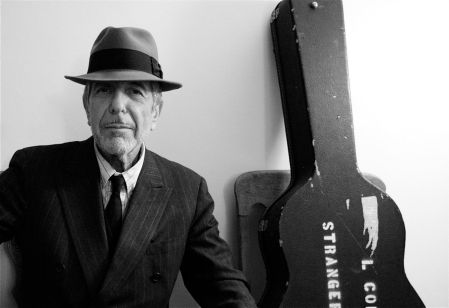
I heard the news this morning of the death, at the age of 82, of the great Leonard Cohen (above). The media are full of appreciations of his work and comments from admirers. I can add very little except that so many of the comments I’ve seen on social media have described his death as like the loss of an old friend, which is exactly how I feel. He often dealt with dark and troubling themes, but always with defiant humour instead of despair: “There’s a crack in everything, that’s how the light gets in”.
Sadly the light has gone out, this time for good. At least he will live on in our hearts through his music, though sadly he won’t live to win the Nobel Prize for Literature (which I think he deserved more than Bob Dylan).
As a tribute here is what I think is his best song, Famous Blue Raincoat
Rest in Peace, Leonard Cohen (1934-2016).
P.S. I don’t mind telling you that I’ve just about had enough of 2016.
Follow @telescoper


