I was listening to BBC Radio 3 last night. The evening concert happened to feature Mahler’s wonderful 4th Symphony, so obviously I turned the volume up. All of which reminded me of this scene from the film Educating Rita, featuring Julie Walters and Maureen Lipman. Fortunately in my case nobody rang the doorbell. I am not to be disturbed when listening to old Gustav.
After spending most of the day on campus for the first Applicant Visit Day of 2106 at the University of Sussex I went home feeling a bit exhausted, but my spirits were soon lifted when I switched on BBC Radio 3 to find a broadcast just startiong of Tannhäuser (or Tannhäuser und der Sängerkrieg auf Wartburg to give it it’s full title). It wasn’t quite the usual Saturday Night Live from the Met because the performance was actually recorded on October 31st 2015 at the Metropolitan Opera in New York, so I won’t quibble about that. Composed in 1845, Tannhäuser is a relatively early work by Richard Wagner which he called a “Romantic opera in three acts” indicating that it has the structure of a conventional opera; later on in his career he was to abandon that format in favour of the Music Drama (which is not built on a succession of arias and recitatives) as Tannhäuser is.
I won’t go into too much detail of the plot, but Tannhäuser is basically about typical Wagnerian themes: the conflict between spiritual and earthly love, between life and death, and the hope of redemption. The eponymous hero, a minstrel knight, takes a walk on the wild side in Act I by visiting Venusberg, in the course of which he is unfaithful to his beloved Elizabeth. He turns up in Act II at Wartburg where there i a sort of mediaeval Eurovision Song contest. First singer up is the naive but honorable Wolfram who sings a beautiful song about courtly love, but Tannhäuser finds it all a bit tame and sings a much raunchier number, which reveals that he’s been a naughty boy. There is uproar, swords are drawn and it all gets a bit fraught. Eventually Tannhäuser is persuaded to atone for his transgressions by undertaking a pilgrimage to Rome. Unfortunately for him the Pope isn’t in an absolving mood and tells him he’s going to suffer eternal damnation. In Act III, Tannhäuser, clearly unhinged, talks about returning to Venusberg – if he’s damned anyway he might as well go out with a bang – but then he discovers his beloved Elizabeth is dead and, overcome by grief and remorse, he dies too.
Regular readers of this blog will know that I have an ambivalent attitude to Wagner, but last night I was hooked from the moment I switched the radio on and listened right through to the end, which came four hours later. I have heard Tannhäuser before and knew the familiar show-stoppers (especially the famous Pilgrim’s Chorus, which is as uplifting a piece of music as you will hear anywhere). What was so very special last night, however, was the quality of the singing, which was truly wonderful all the way through the principals and chorus. The broadcast is available on iPlayer for the next month. If you have never had a taste of Wagner, give it a go. This opera is full of great tunes but they were sung better in this performance than in any other I have heard. As a little taster, here is Wolfram (sung by baritone Peter Mattei) from the same production we heard last night, singing his Act III aria O du mein holder Abendstern (O thou my fair evening star).
The Times Higher has given me yet another reason to be disgruntled this week, in the form of an article that talks about the possible effect of the proposed Teaching Excellence Framework (TEF) on “creative” subjects. What bothers me about this piece is not that it criticises the TEF – I think that’s an unworkable idea that will cause untold damage to the University system if, as seems likely, it is railroaded through for political reasons – but that the author (Nigel Carrington, Vice-Chancellor of the University of Arts London), like so many others, lazily implies that STEM disciplines are not creative. I think some of the most intensively creative people in the world are to be found in science and engineering and creativity is something we try very hard to nurture in students at Sussex University regardless of discipline.
Anyway, while feeling grumpy about this article, I remembered this video of an interview with the great jazz pianist, Bill Evans. Jazz is undoubtedly an intensely creative form, not only because it requires spontaneous real-time conversion of ideas into sounds. Evans talks with great passion and insight about creativity in music-making, but the striking thing about what he says at the very beginning about the need to analyse your subject at a very elementary level before proceeding in order to create something that’s “real” applies equally well to, e.g. theoretical physics as it does to jazz.
In the following section he reiterates this point, but also stresses the discipline imposed by a particular form and why this does not limit creativity but makes it stronger.
It’s better to do something simple that is real. It’s something you can build on. because you know what you’re doing. Whereas, if you try to approximate something very advanced and don’t know what you’re doing, you can’t build on it.
No matter how far I might diverge or find freedom in this format, it only is free insofar that it has reference to the strictness of the original form. That’s what gives it its strength.
In much the same way, theoretical physics is not made less creative because it has to obey the strict rules of mathematics but more so. This is true also in the fine arts: the more limited the canvas the more creative the artist must be, but it also applies to, e.g. engineering design. Self-teaching is important in STEM subjects too: the only really effective way of learning, e.g. physics, is by devoting time to working through ideas in your own mind, not by sitting passively in lectures.
All subjects require technical skill, but there is more to being a great jazz musician than mastery of the instrument just as there’s more to being a research scientist than doing textbook problems. So here’s to creativity wherever it is found, and let’s have a bit more appreciation for the creative aspects of science and engineering!
Well, it’s Saturday Night so I thought I’d post a bit of classic Jazz from the late twenties. This is from the superb Duke Ellington band, vintage 1929, which was resident at the Cotton Club in Harlem, New York City. I haven’t seen a personnel listing for this but the soloists are easy to identify: Barney Bigard on clarinet, James “Bubber” Miley on trumpet, and Joe “Tricky Sam” Nanton on trombone. The tune Saturday Night Function has become a traditional jazz standard but not many bands can get close to that unique Ellington sound, especially the growling trumpets. Enjoy!
By way of an interlude in this busy period as term gets back underway I thought I’d post this beautiful track by the great jazz pianist Bill Evans. I remember reading somewhere that Bill Evans recorded this right at the end of a session, in 1958. It was unrehearsed, entirely improvised and done in one take. It’s based on a simple two-chord progression that subsequently appeared in Flamenco Sketches, one of the tracks on the classic Miles Davis album Kind of Blue. To my ears, Peace Piece is more redolent of the composition style of Erik Satie than any other jazz musician I can think of. Although it starts out very simply it becomes more complex and fragmented as it develops, and makes effective use of dissonance in creating tension to contrast with the rather meditative atmosphere established at the beginning. Anyway, this is one of my all-time favourite tracks by one of my all-time favourite jazz musicians so I hope you don’t mind me sharing it on here.
The rain’s lashing down outside so instead of going out I thought I’d indulge myself with a bit of musical entertainment. This piece is the Grand Pas de Deux from a seasonal Christmas favourite, the ballet The Nutcracker, by Piotr Ilyich Tchaikovsky (Op. 71). It reminds of an occasion, almost twenty years ago, when I had the chance to go to a concert at the Berliner Philharmonie. This was such a long time ago that I’ve forgotten which visiting orchestra was playing, although I do remember that it was Russian and extremely good. The main programme consisted of Stravinsky (Petrushka Suite) and Shostakovich (Symphony No. 10) but at the end they did this as an encore. In performances of the ballet this piece is usually taken quite slowly to accommodate the dancers but, as is more often the case in concert performances, this time the orchestra took it at a brisk pace and with so much passion and colour it was like I was hearing it for the very first time. People can be snobbish about Tchaikovsky because he’s “too popular”. Well, this is a popular piece for one reason and one reason only: it’s beautiful.
Although my ordering would have been a little different, I was quite surprised that the top 10 corresponded so closely with my own selection. In fact 8 of the above list would have made it into mine: Miles Davis; Louis Armstrong; John Coltrane; Charlie Parker; Billie Holiday; Thelonious Monk; and Bill Evans.
The only differences were that (a) I couldn’t possibly have had Billie Holiday without having Lester Young and (b) I simply had to have Ornette Coleman in there. To accommodate Messrs Young and Coleman I would have displaced Ella Fitzgerald and Oscar Peterson. The latter are great artists, of course, but I wouldn’t say either influenced the development of Jazz as much as the others I mentioned, and that’s one of the criteria I applied.
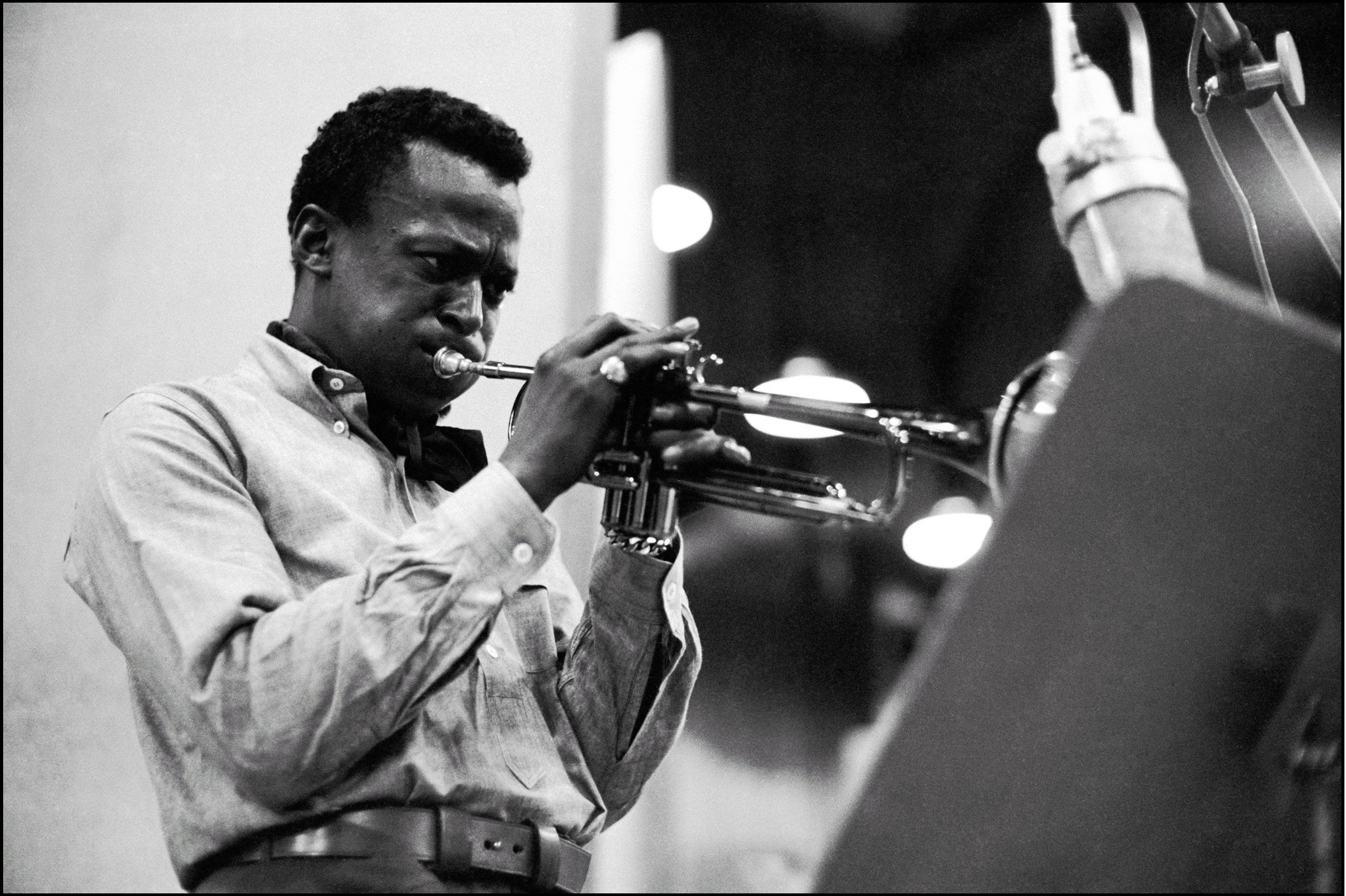
No surprise that Miles Davis (above) came top. He changed musical direction so many times that he should actually count as four or five different musicians. It’s no coincidence that Miles Davis, John Coltrane and Bill Evans all appeared on Kind of Blue, which is arguably the greatest jazz record of all time. I don’t think any serious Jazz enthusiast could have left out Charlie Parker or Thelonious Monk either. And of course, Louis Armstrong just had to be there too. It’s hard to imagine what Jazz would have been without Satchmo. The same goes for the great Duke Ellington.
Anyway, it’s all a matter of personal choice. There are dozens of great jazz artists who didn’t make it into the top ten. Among my near misses were Coleman Hawkins, Sidney Bechet, Eric Dolphy and Dizzy Gillespie.
Last night on Radio 3 there was a concert involving music by Cecil Coles (among others). Coles – who, as far as I know, was no relation – was killed in action in the First World War, in April 1918. In fact he was shot and mortally wounded by a sniper while working as a stretcher-bearer trying to rescue injured soldiers from a wood, a task for which he had volunteered. He was 29 when he died and not much of his work as a composer survives. In the interval of the Concert I heard this recording of a work by Coles, which I think is very touching. It’s a setting of one of the Elegiac Stanzas (“Sic Juvat Perire”) by Thomas Moore. Here’s the text:
When wearied wretches sink to sleep, How heavenly soft their slumbers lie! How sweet is death to those who weep, To those who weep and long to die!
Saw you the soft and grassy bed, Where flowrets deck the green earth’s breast? ‘Tis there I wish to lay my head, ‘Tis there I wish to sleep at rest.
Oh, let not tears embalm my tomb, — None but the dews at twilight given! Oh, let not sighs disturb the gloom, — None but the whispering winds of heaven!
The views presented here are personal and not necessarily those of my employer (or anyone else for that matter).
Feel free to comment on any of the posts on this blog but comments may be moderated; anonymous comments and any considered by me to be vexatious and/or abusive and/or defamatory will not be accepted. I do not necessarily endorse, support, sanction, encourage, verify or agree with the opinions or statements of any information or other content in the comments on this site and do not in any way guarantee their accuracy or reliability.