I was just reminded that it was on 24th January 1975 – 50 years ago today – that pianist Keith Jarrett played a live solo concert at the Opera House in Köln, West Germany. The concert was recorded and released on ECM Records as a double LP later that year. It went on to become the best-selling solo album in jazz history and the best-selling piano album ever. It’s a must-have for anyone interested in jazz.
You don’t need me to tell you why as the whole concert is available for your listening pleasure here:
It’s been a while since I shared any music on this blog, so here’s a favourite track of mine from the late Fifties. The tune, Speak Low, which was written in 1943 by Kurt Weill and rapidly became a jazz standard. The following is an instrumental version but it’s worth mentioning that the lyrics were written by Ogden Nash, a man much more known for humorous verse than for beautiful love songs.
Anyway, this version is from a great album called Sonny’s Crib recorded in 1957 by a band led by pianist Sonny Clark and released on the Blue Note label in 1958. Clark was an excellent piano player but he’s not as well known nowadays as he should be, largely because he died very young (in 1963, at the age of just 31, from a heart attack caused by a heroin overdose). I bought the album on vinyl when I was still at school, perhaps 45 years ago, and I still have it. This particular track has also featured in many “best of” collections.
Alongside Sonny Clark (piano), the sextet contains John Coltrane, no less, on tenor sax who, just a couple of weeks before, had recorded the album Blue Train as leader, also for Blue Note. Coltrane does plays a prominent role in this track and indeed in the whole session. There’s also fine Curtis Fuller (trombone) and Donald Byrd (trumpet), Art Taylor (drums) and Paul Chambers (bass). Credit must ago to Rudy van Gelder for producing that very distinctive Blue Note sound that does justice to the great musicians that recorded for the label.
Although the Toccata and Fugue in D Minor, thought* to be by Johann Sebastian Bach, is such a famous work that few people out there will not have heard it, I couldn’t resist sharing this great version which a friend send me recently. It was played by Hungardian-born organist Xaver Varnus in 2013 in the beautiful but cavernous Berliner Dom. It’s particular noticeable how Varnus adjusts his performance to account for the reverberation time. Playing too quickly when there is a long echo can lead to confusion but in this case the playing is crisp enough to hear the piece unfolding while slow enough to let the acoustic add a special ingredient of its own. This performance lasts a good couple of minutes longer than any other version I have on CD. One of the YouTube commenters on this video puts it very well indeed: “It’s nice to see an organist who understands they are not only playing the organ, but the entire building. His timing as the sound decays across the auditorium is impeccable.” Indeed. A mere recording can’t capture the sensation of hearing the music through the soles of your feet as well through your ears, but it’s very enjoyable nonetheless. It’s also good to see the organist close up so you can see how demanding it is to play a work like this.
*the attribution to Johan Sebastian Bach has been questioned. There is no surviving manuscript in Bach’s hand and the evidence that it was actually written by him is circumstantial.
Since Christmas is approaching rapidly, I thought I’d share this video of the first ever public performance of Christmas setting for Chamber Choir, Gallery Schola and Organ from Dr Ryan Molloy, based on a newly-composed text by Maynooth University Professor of Old Irish, David Stifter. It was recorded in the impressive chapel of St Patrick’s Pontifical University during the annual carol service at Maynooth which took place this year on 17th December. The Irish title Rétglu etir rind means “a star among constellations”.
Well, just back from the Department Christmas dinner, I find myself filled with the festive spirit (or more, accurately, wine) so I thought I’d share a seasonal piece of music. As regular readers of this blog (both of them) will know, I listen to quite a lot of jazz. In the course of doing that it has often struck me that there can hardly be a tune that’s ever been written – however unpromising – that some jazz musician somewhere hasn’t taken a fancy to and done their own version. Louis Armstrong turned any amount of base metal into gold during his long career, but here’s a record I could scarcely imagine before hearing it. It’s Santa Claus is coming Town recorded in 1964 by the great Bill Evans on piano in a trio with Gary Peacock on bass and Paul Motian on drums. As far as I know this is the only Christmas tune that Bill Evans ever recorded, but I think it’s great. Enjoy!
On 9th December 1964 – exactly 60 years ago to the day – John Coltrane (ts), McCoy Tyner (p), Jimmy Garrison (b) and Elvin Jones (d) got together to record at Rudy Van Gelder’s Studio in New Jersey. In a single session they created what is probably Coltrane’s masterpiece, A Love Supreme, an album that proved immediately popular and influential when it was released in 1965.
A Love Supreme represents a sort of musical culmination of everything this quartet had achieved and it’s not surprising that they abruptly changed direction soon after making this record. They had said everything they could say in this format. Coltrane’s next great album, Meditations, recorded in 1965, features the same musicians (with the addition of Pharaoh Sanders on tenor sax and a second drummer, Rashied Ali), but it’s much freer in style.
A Love Supreme consists of four sections: Acknowledgement, Resolution, Pursuance and Psalm. As you might imagine from the titles, it’s a deeply spiritual piece. Acknowledgement is based on an 8-bar theme underpinned by a four-note phrase played on the bass that fits the phrase “a love supreme”. Coltrane impovises rather meditatively on this theme, then the group chants “a love supreme” in unison while Elvin Jones elaborates the rhythm in complex double-time. The second movement, Resolution, is based on a different 8-bar theme and Coltrane’s playing and interplay with Jones is much more agitated but it’s in Pursuance that he pulls out all the stops. Harmonically, Pursuance is a blues but it’s taken at a fast tempo and Coltrane plays with the harsh, strangulated tone he had developed by this time. After all this frantic activity he imbues the final section, Psalm, with a radiant solemnity, as he pours out an incredibly beautiful solo, with Elvin Jones providing a perfectly judged accompaniment, the rise and fall of his drum rolls showing wonderful control.
Anyway, these are just words. It’s much better just to listen to the music, as I have done twice already this evening. Enjoy!
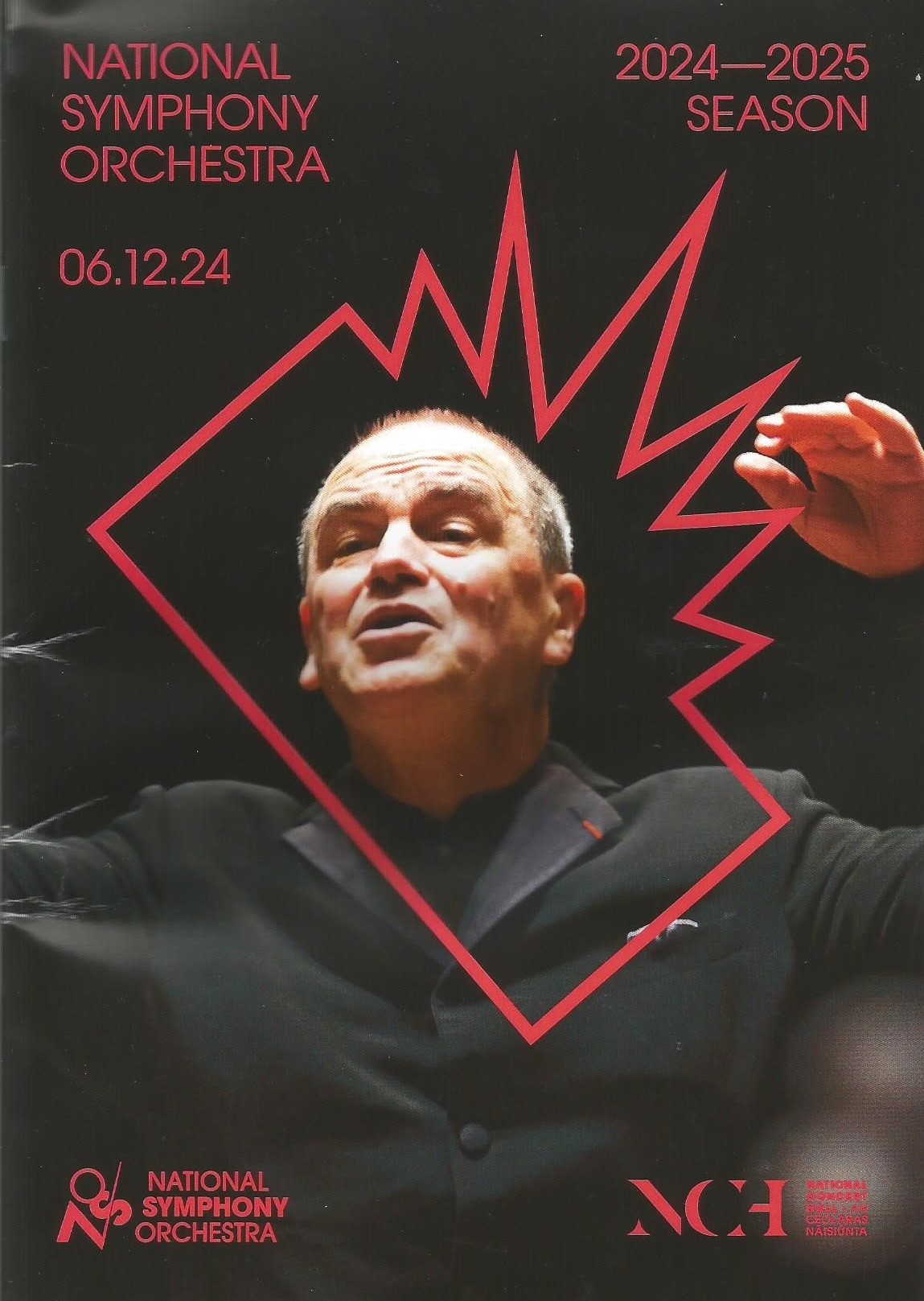
It was a dark and stormy night but I braved the inclement weather to travel to the National Concert Hall in Dublin for what will be my last concert of 2024. It look like being a nearly full house when I booked my ticket, but in the end there were quite a few empty seats perhaps because various groups decided not to make a journey owing to Storm Darragh. My own travels went without a hitch and in fact I even managed to walk from Connolly to the NCH before the performance and back to Pearse after it without getting rained on.
Mozart wrote at least five violin concertos, and he was at most 20 when he wrote the last of the five that are known. During last night’s performance I was thinking a lot about all I had failed to achieve by the age of twenty! Influenced by his father Leopold, the violin was Mozart’s first instrument, but he later moved on and preferred to play keyboard instruments. Perhaps he wanted to escape from his father’s domination, which might explain why he didn’t write any more pieces for solo violin in the rest of his (short) life.
The 5th Violin Concerto is sometimes called “The Turkish” though there isn’t much of a Turkish influence in the music. Whatever the name, it is a very enjoyable piece in three movements, played quite beautifully last night by Stefan Jackiw and by the pared-down NSO. The soloist got a very warm ovation and responded with a solo encore in the form of a largo movement from a Bach violin sonata.
After the wine break we returned to find the stage much fuller with a large brass section and extra strings added to the smaller forces required for the Mozart. Bruckner’s Seventh Symphony is a huge and varied work lasting over an hour in performance. The radiant first movement, with its noble melody soaring over shimmering violin tremolos is very reminiscent of Wagner, as is much of the rest of the Symphony (especially in terms of the orchestration). Bruckner famously idolized Wagner and this composition is at least partly a tribute to his musical hero. It is said that Bruckner had a premonition of Wagner’s death in 1883 and the cymbal crash during the second (slow) movement symbolizes the moment that he found out that his premonition had come true. That whole movement (marked Sehr feierlich und sehr langsam; very solemn and very slow) is very moving: sombre though not excessively mournful. The third movement Scherzo is marked Sehr Schnell (very fast) but I found the tempo last night vigorous, but not epecially fast. I was expecting something a bit wilder. The last movement actually sounded to me more like Mahler than Wagner, with a resounding climax.
The Seventh is probably Bruckner’s best known and most performed Symphony. It was certainly a big hit for him when it was first performed in 1884. The composer was born in 1824 and last nigtht’s concert was billed as Bruckner 200. I think the 7th was a good choice to mark the occasion and the performance, with superb playing by the brass section (including the Wagner tuben), and the orchestra very well marshalled by Hans Graf, was a fitting tribute.
My next trip to the NCH won’t be until January, but I’m already looking forward to the Leningrad Symphony after the Christmas break!
After a gap of a few weeks due to other commitments, last night I went to the National Concert Hall in Dublin to see and hear another programme of music performed by the National Symphony Orchestra. Unusually for these Friday evening concerts by the NSO, it wasn’t broadcast live or even, judging by the absence of microphones on and over the stage, recorded. I suppose that might have been for some contractual reason.
Tyhe conductor for this performance was Patrik Rinborg, from Sweden. The first thing that struck me about him was that he is very tall – his was a towering presence on the podium. Looking through my back catalogue I find I attended a performance of the Dvořák Requiem conducted by him back in January 2020, not long before the pandemic struck.
The first piece, Everything was asleep as if the universe was a vast mistake by Judith Ring, received its performance in January 2023. The title is from a translation of a quite by Fernando Pessoa. I found this piece quite interesting, especially the changes of colour and energy, but spoilt a little for me by the repeated short sliding phrases coming from the trombones, which I thought sounded rather lavatorial and therefore jarring in the context of the work. Anyway, Judith Ring was in the audience last night and came up on stage at the end of the performance to great applause.
The second work was a perennial favouite in the concert hall, the Cello Concerto in B minor by Antonín Dvořák. I think most people, if asked to name half-a-dozen great works for cello and orchestra would put this one on their list. Last night’s soloist was Camille Thomas, resplendent in a glamorous purple frock, who played beautifully. Her body language was interesting even when she wasn’t playing, sometimes leaning back with her arms by her sides as if transported by the music, and sometimes turning around to look at the orchestra to encourage them. She got a well-deserved ovation at the end, and did a solo encore in the form of a piece called Song of the Birds by Pablo Casals.
After the wine break we returned for Symphony No. 5 in E minor, Op. 64 by Pyotr Ilyich Tchaikovsky. In advance of the concert I had this muddled up with the Manfred Symphony, which I have heard live before. That was indeed the fifth symphony that Tchaikoksky composed, but is not counted among the numbered symphonies. I hadn’t previously heard a full performance of the Symphony No. 5 we heard last night, so I came to it relatively fresh. Things to note about it are distinct shifts in tonality through the four movements, and a single motif repeated throughout in different forms. It did make me think of the Symphony No. 7 “Leningrad” by Shostakovich who seems to have borrowed the idea for the “invasion” theme of the first movement.
I enjoyed the performance a lot – it was played with much vigour and nuance by the NSO – but at a first hearing I’m not a huge fan of the piece. It’s a bit less than 50 minutes long and by the end I was very bored with the motif. I wasn’t as uplifted by the final movement, where it reaches resolution in E Major, as I think I was supposed to feel as I thought it very brash and unsubtle.
Anyway the audience responded with generous applause at the end of this concert, which was quite a long one (partly because of the encore). For one thing that meant I had much less time to wait for my train back to Maynooth than usual.
This evening I happened across a reminder that today is the centenary of the birth of saxophonist and composer Paul Desmond, who was born on November 25th 1924. Paul Desmond is best known for his work with Dave Brubeck’s quartet from 1951 to 1967, and particularly as composer of their smash hit Take Five. He didn’t only work with Brubeck, though. He made fine recordings with Chet Baker and Gerry Mulligan amongst others. His gentle tone and lyrical phrasing on alto saxophone were instantly recognizeable and very typical of the West Coast style of cool jazz, and on alto saxophone was instantly recognizeable. Never a speed merchant in the Charlie Parker tradition, Desmond fell out with Brubeck’s drummer Joe Morello who would often set the tempo, especially on Take Five, too fast in live performances, so I thought I’d pay my little tribute by playing a less familiar number, the Japanese-influenced Koto Song on which Paul Desmond plays very beautifully.
The views presented here are personal and not necessarily those of my employer (or anyone else for that matter).
Feel free to comment on any of the posts on this blog but comments may be moderated; anonymous comments and any considered by me to be vexatious and/or abusive and/or defamatory will not be accepted. I do not necessarily endorse, support, sanction, encourage, verify or agree with the opinions or statements of any information or other content in the comments on this site and do not in any way guarantee their accuracy or reliability.


 In the Dark