Prolific jazz pianist, composer, and arranger Herbie Hancock was born on 12th April 1940, which means that today is his 85th birthday. I’ve posted quite a few pieces of music featuring Herbie Hancock over the years so I thought I’d put up something a little different to mark his birthday in the form of this unusual but very cool version of The House of the Rising Sun, featuring Donald Byrd on trumpet, Hancock on piano, Kenny Burrell on guitar, Bob Cranshaw (bass) and Grady Tate (drums) and the Donald Byrd Singers. This track appeared on the album Up With Donald Byrd which wasn’t well received when it came out in 1964, but I like it!
P.S. I did a Google search for Herbie Hancock House of the Rising Sun and found this:
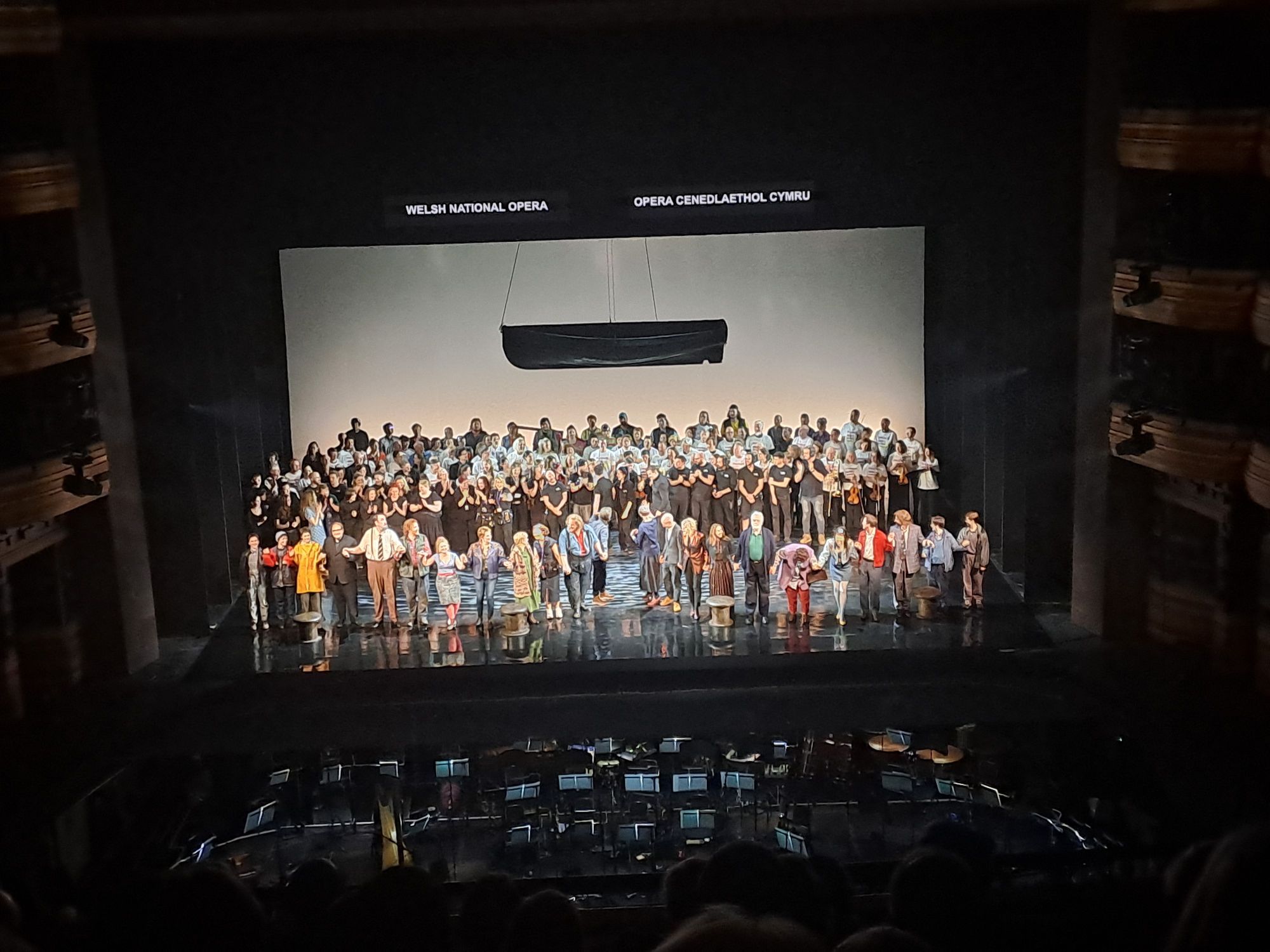
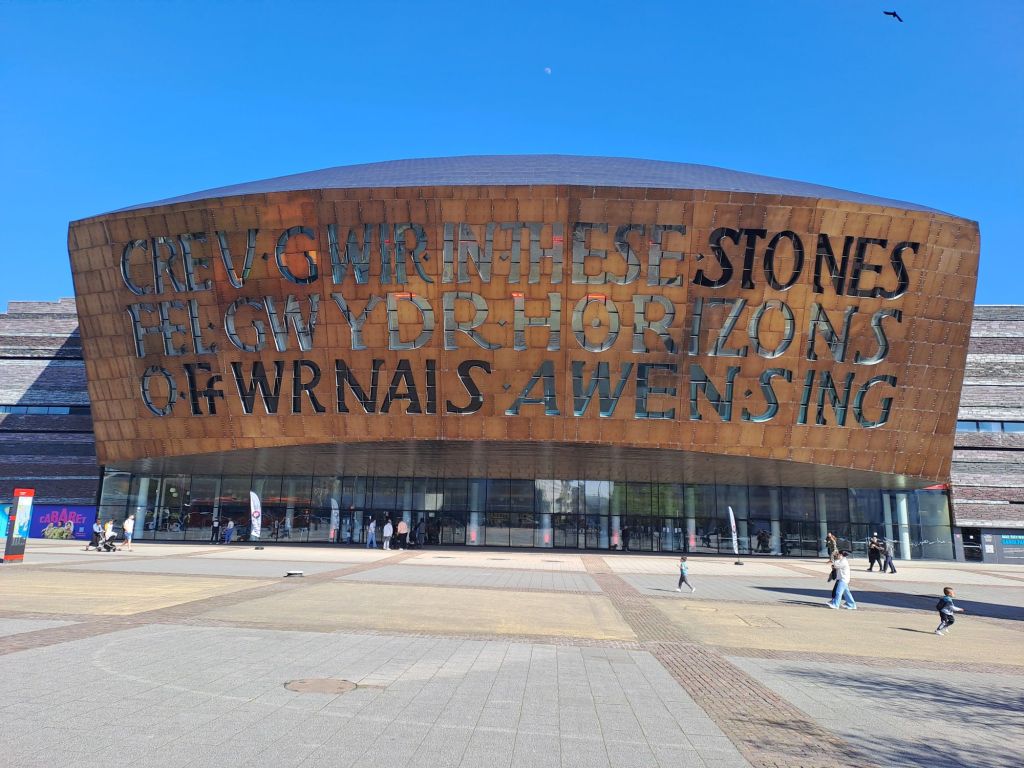
The reason for my flying visit to Cardiff this weekend was to visit the Wales Millennium Centre to catch the opening night of Welsh National Opera’s new production of the Opera Peter Grimes by Benjamin Britten. It was a full house and, being a premiere, there was a fair sprinkling of media types among the crowd. There will no doubt be many reviews but I don’t mind adding to the verbage. I’ve seen this Opera several times and it is one of my favourites in the entire repertoire.
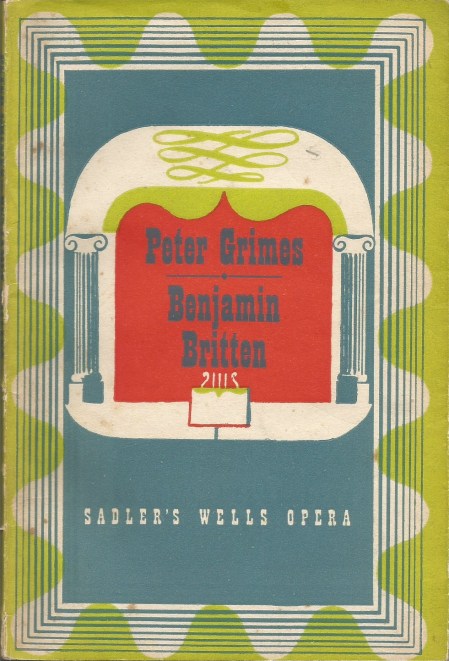
Peter Grimes premiered at Sadler’s Wells in London on 7th June 1945 almost 80 years ago. I wasn’t there – I’m not that old – but I do have an original programme from that season (left), bought in a second-hand bookshop. Perhaps surprisingly, given the grim subject matter and the intense music it was an immediate hit with audiences. Its popularity has not wained. Welsh National Opera gave its first performance in 1946, but is currently facing an uncertain future.
I’ve often heard Peter Grimes described as one of the greatest operas written in English. Well, as far as I’m concerned you can drop “written in English” from that sentence and it’s still true. I think it it’s a masterpiece, fit to rank alongside any by any composer. Searching through the back catalogue on this blog, however, I didn’t find any reviews of it, so the times I’ve seen it must have been before I started blogging back in 2008. I saw an excellent production by Opera North in Nottingham many moons ago, and also remember one at Covent Garden which stuck in my memory for its impressive staging.
Based on a character from the narrative poem The Borough by George Crabbe, the story revolves around the eponymous Peter Grimes, a fisherman, and the inhabitants of a small coastal village in Suffolk. Grimes is by no means a sympathetic character: he is an outcast with no social skills and is prone to fits of violent temper. The Opera begins witha Prologue in which Grimes is in court after the death of his apprentice; he is acquitted of any wrongdoing but the folk of the Borough – apart from the schoolteacher Ellen Orford and retired naval Captain Balstrode – still regard him as guilty. Against all advice, Grimes takes on another apprentice (John) whom he is subsequently suspected of mistreating. When the second boy dies (in accidental circumstances), Grimes flees with the crowd in pursuit. At the end he is given no choice but to take to his boat, sail it out to sea and sink it, taking his own life.
For me the key to the success of this Opera is its treatment of the character of Peter Grimes. In the original poem, Crabbe depicts Grimes is a monstrous figure rather like a pantomime villain. Britten is much more sympathetic: Grimes is misunderstood, a misft who as never been socialised; he just doesn’t know the rules that he should conform to. That’s his tragedy. Britten’s Grimes is not a villain. He’s not a hero either. At one point, shockingly, he even lashes out at Ellen Orford a lady who has shown him nothing but kindness. There’s good and bad in Grimes, like there is in all people. Who of us can say that we don’t share some of the faults of Peter Grimes? And if he’s bad what made him bad? Was he himself abused as a child? Could a little kindness along the way have made him better adjusted?
The Opera not just about Grimes, though. We get a vivid insight into the life of an isolated seaside community: the gossiping hypocrisy of the “good people” of the Borough, the debauchery of the landlady and her two “nieces” who cater to the needs of their male visitors, but above all the importance of the sea in their lives – stressed by Britten’s wonderful interludes describing dawn over the town, moonlight over the sea, and a raging storm. It also sheds light on the common practice of “buying” apprentices from the workhouse, essentially a means of slave labour, a systematic abuse far worse than anything Grimes ever does!
Anyway, to last night’s performance. In short, it was magnificent. The cast was very strong indeed: Nicky Spence shone in the role of Peter Grimes (tenor). Britten wrote the part to suit the characteristics of the voice of his partner, Peter Pears, and it doesn’t suit all tenor voices: the superb arioso When the Great Bear and Pleiades, for example, has dizzying head tones that challenges some singers. Ellen Orford was the excellent Sally Matthews (soprano) and Balstrode was the admirable baritone David Kempster.
I’ll mention three particularly memorable moments, near the end of the opera. The first is after the apprentice John has died; the gorgeous sea interlude Moonlight, which serves as a prelude to the third and final act, is played while the grieving Grimes cradles the lifeless corpse of the boy. The second is when Grimes is on the run, with the chorus calling his name and baying for blood. In fear of his life, he breaks down and is reduced to repeating his own name to himself. I’ve always found that scene unbearably moving and it was that way again last night. Finally, at the very end, the bodies of the two dead apprentices appear, one sprawled on a rock, the other standing eerily in the suspended boat which is tipped up vertically above the stage. When Grimes accepts Balstrode’s advice to drown himself, the two boys come to life; they exchange smiles, hold hands and walk off into the distance. It’s the only time Grimes looks happy in the whole performance. Only in death can he find his peace.
The staging is very spare but cleverly done. The basic set consists of a wet beach sloping up towards the rear above which from time to time a small fishing boat appears, suspended by wires, in a variety of attitudes. Otherwise there is little in the way of scenery. The clever part of this is the use of the dancers of Dance Ensemble Dawns. All the boys’ roles were in fact played by female dancers, including John the second apprentice, a non-speaking role played with great pathos by Maya Marsh whose use of body language was extraordinarily effective. Not only did they portray the boys of the village, often to be found generally misbehaving and taunting Peter Grimes, they also use their movements do evoke the storm in an extraordinarily compelling way. Not content with that they came on from time to time, in stylised fashion, to move scenery and props. The inn, for example, is conjured up by two simple props: a door frame and a window frame, held up by members of the ensemble for other members of the cast to walk or lean through. In all these contributions, the dancers were brilliant.
The simplicity of the staging probably reflects the financial crisis currently engulfing Welsh National Opera. They probably just didn’t have the money to pay for a elaborate sets, but it’s a testament to the skill and creativity of the designers that they were able to pull a triumph out of a financial disaster. I was sitting in the Circle so could see very well into the orchestra pit, where all the musicians of the Orchestra of Welsh National Opera were all wearing “SAVE OUR WNO” t-shirts. They played their hearts out. The WNO Chorus has always been excellent every time I’ve seen them, and last night was no exception.
At the end of the opera, the cast, chorus and dancers were joined on stage not only by the entire orchestra (including instruments, where possible) and many members of the technical team. I’ve never seen that happen before! There were speeches by the co-directors of WNO expressing their determination to carry on through the financial turbulence that threatens to drown them. Welsh National Opera is a wonderful part of the artistic and cultural scene not only in Wales but across the rest of the UK and beyond. It just cannot be allowed to wither.
P.S. Last night’s performance was recorded for later broadcast on BBC Radio 3.
I got up at Stupid O’Clock this morning to catch an early morning plane from Dublin to Cardiff. It was very cold when I arrived but it soon warmed up and turned into a lovely day.
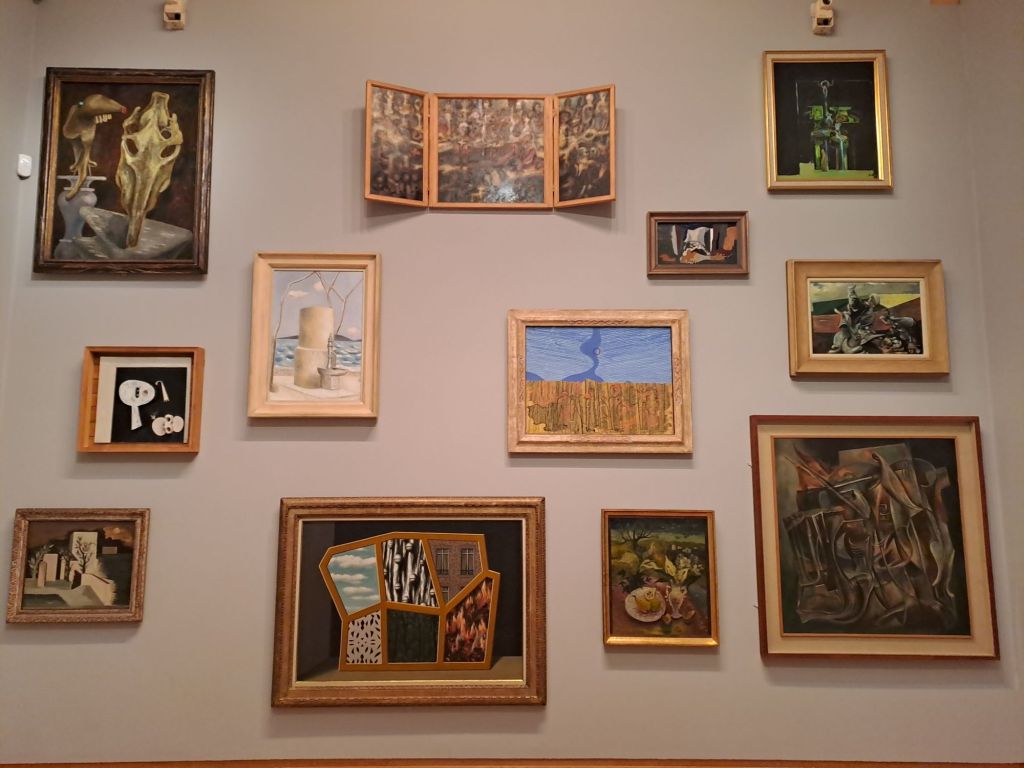
I had a nice breakfast at Bill’s when I arrived in the City then did tour of the National Museum of Wales where there is an exhibition about the Miners’ Strike of 1984/5, from which this display case caught my attention:
I also had time for a round of Name That Artist (scoring a miserable 3/12, for Sutherland, Ernst, and Magritte).
After that, I took a stroll around Bute Park before heading to my hotel in Cardiff Bay to check in and have a rest before the reason for my visit, an event which will take place here at 7pm:
I won’t be able to blog about that until I get back to Maynooth tomorrow afternoon.
I thought I’d use the excuse that I’m teaching particle physics again to revive an old idea linking that subject to Mozart’s Opera The Magic Flute (Die Zauberflöte, K. 620).
I can’t remember how many times I have seen this opera performed nor in how many different productions. It’s a wonderful creation because it manages to combine being utterly daft with being somehow immensely profound. The plot makes no sense at all, the settings are ridiculous (e.g. “rocks with water and a cavern of fire”), and the whole thing appears to be little more than a pantomime. Since it’s Mozart, though, there is one ingredient you can’t quibble with: a seemingly unending sequence of gorgeous music.
When I first saw The Magic Flute I thought it was just a silly but sublime piece of entertainment not worth digging into too deeply. I wondered why so many pompous people seemed to take it so terribly seriously. Real life doesn’t really make much sense, so why would anyone demand that an opera be any less ridiculous? Nevertheless, there is a vast industry devoted to unravelling the supposed “mystery” of this opera, with all its references to magic and freemasonry.
But now I can unveil the true solution of problem contained within the riddle encoded in the conundrum that surrounds the enigma that has puzzled so many Opera fans for so long. I have definitive proof that The Magic Flute is not about freemasons or magic or revolutionary politics. It is actually about particle physics.
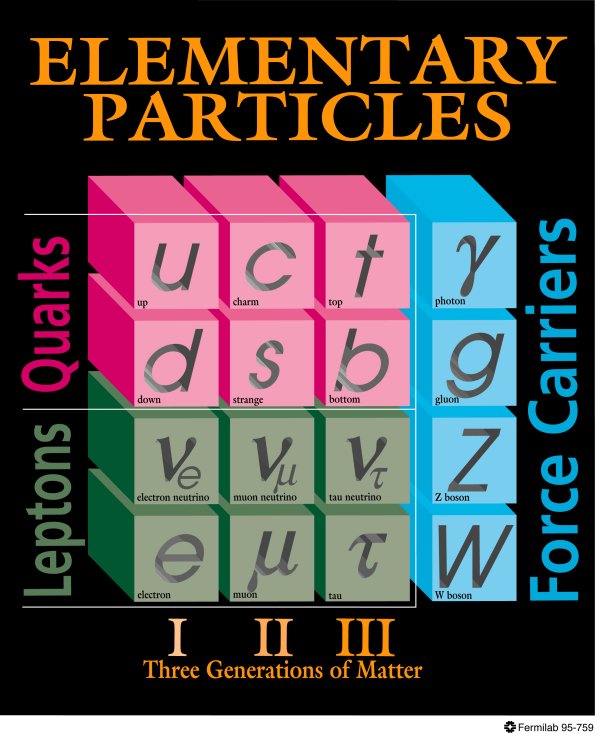
To see how I arrived at this conclusion note the following figure which shows the principal elementary particles contained within the standard model of particle physics:
To the left of this picture are the fermions, divided into two sets of particles labelled “quarks” and “leptons”. Each of these consists of three pairs (“doublets”), each pair defining a “generation”. This structure of twos and threes is perfectly represented in the cast The Magic Flute.
Let’s consider the leptons first. These can be clearly identified with the three ladies who lust after the hero Tamino in Act 1. This emotional charge is clearly analogous to the electromagnetic charge carried by the massive leptons (the electron, muon and tauon, lying along the bottom of the diagram). The other components in the leptonic sector must be the three boys who pop up every now and again to help Papageno with useful advice about when to jangle his magic bells. These must therefore be the neutrinos, which are less massive than the ladies, and are also neutral (although I hesitate to suggest that this means they should be castrati). They don’t play a very big part in the show because they participate only in weak interactions.
Next we have the quarks, also arrayed in three generations of pairs. These interact more strongly than the leptons and are also more colourful. The first generation is easy to identify, from the phenomenology of the Opera, as consisting of the hero Tamino (d for down) and his beloved Pamina (u for up); her voice is higher than his, hence the identification. The second generation must comprise the crazy birdcatcher Papageno (s for strange) and his alluring madchen who is called Papagena (c for charmed). That just leaves the final pairing which clearly is the basso profundo and fount of all wisdom Sarastro (b for bass bottom) and my favourite character and role model the Queen of the Night (t for top).
To provide corroboration of the identification of the Queen of the Night with the “top” quark, here is a clip from Youtube of a bevy of famous operatic sopranos having a go at the immensely different coloratura passage from the Act 1 aria “O Zittre Nicht, mein leiber Sohn” culminating in a spectacular top F that lies beyond the range of most particle accelerators, never mind singers.
There’s some splendid frocks in there too.
The Queen of the Night isn’t actually in the Opera very much. After this aria in Act 1 she disappears until the middle of Act 2, probably because she needs to have a lie down. When she comes back on she sings another glass-shattering aria (Der Hölle Rache kocht in meinem Herzen), which I like to listen to when I’m writing referee reports. The first line translates as “The rage of hell is boiling in my heart”.
The remaining members of the cast – The Speaker and Monostatos, as well as sundry priests, slaves, enchanted animals and the chorus – must make up the so-called Force carriers at the left of the table, which are bosons, but I haven’t had time to go through the identifications in detail. They’re just the supporting cast anyway. And there is one particle missing from the picture, the Higgs boson. This accounts for the masses of other particles by exerting a kind of drag on them so it clearly must be the Dragon from Act 1.
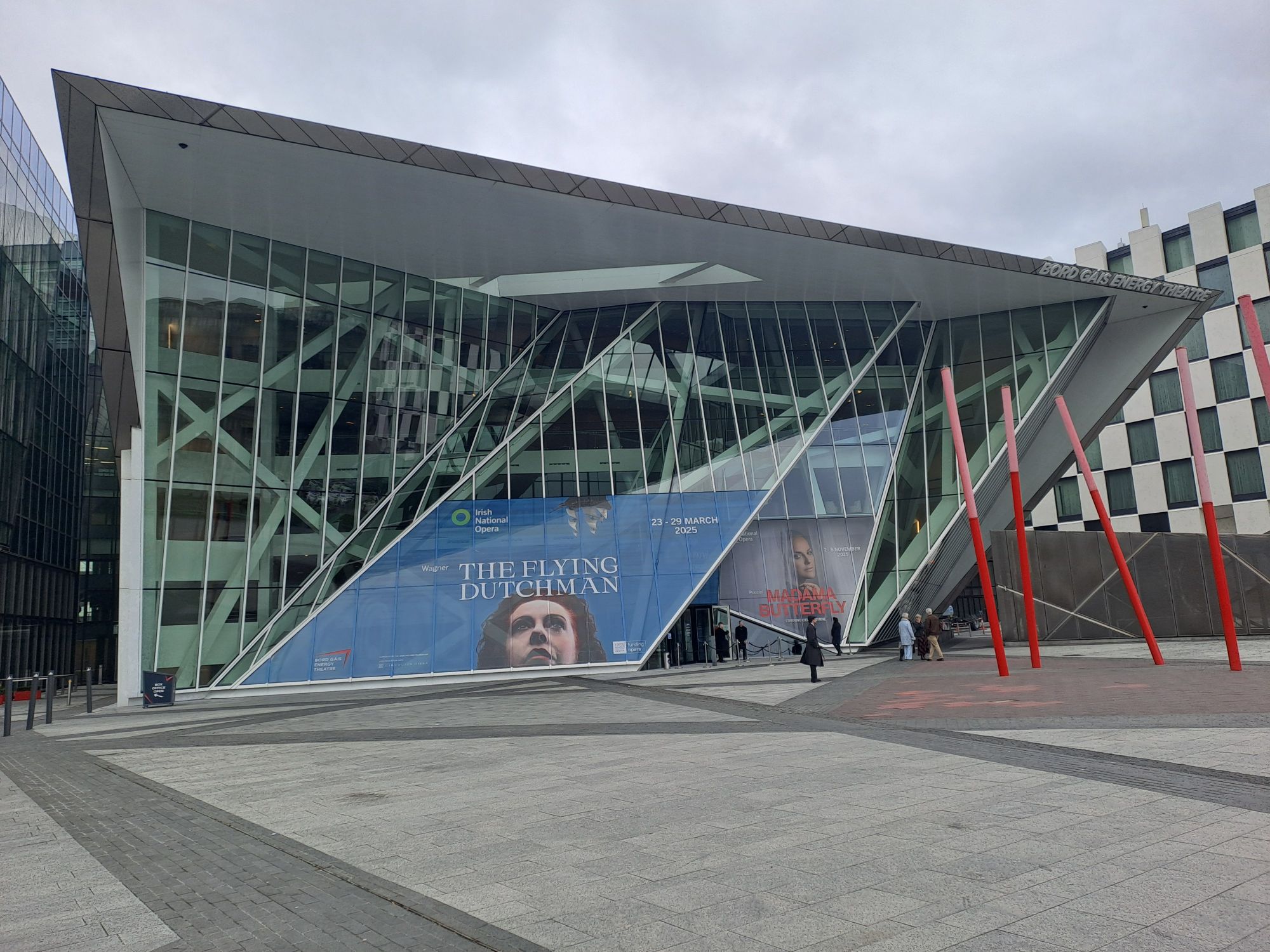
And so it came to pass that this afternoon I took the bus into Dublin to catch the first performance of Irish National Opera’s new production of Richard Wagner‘s The Flying Dutchman (or Der fliegende Holländer to give its proper title) at the romantically named Bord Gáis (Gas Board) Energy Theatre. It wasn’t exactly the first night, as the performance started at 5pm, but it did have a first night feel to it, with a smattering of media types in the full house.
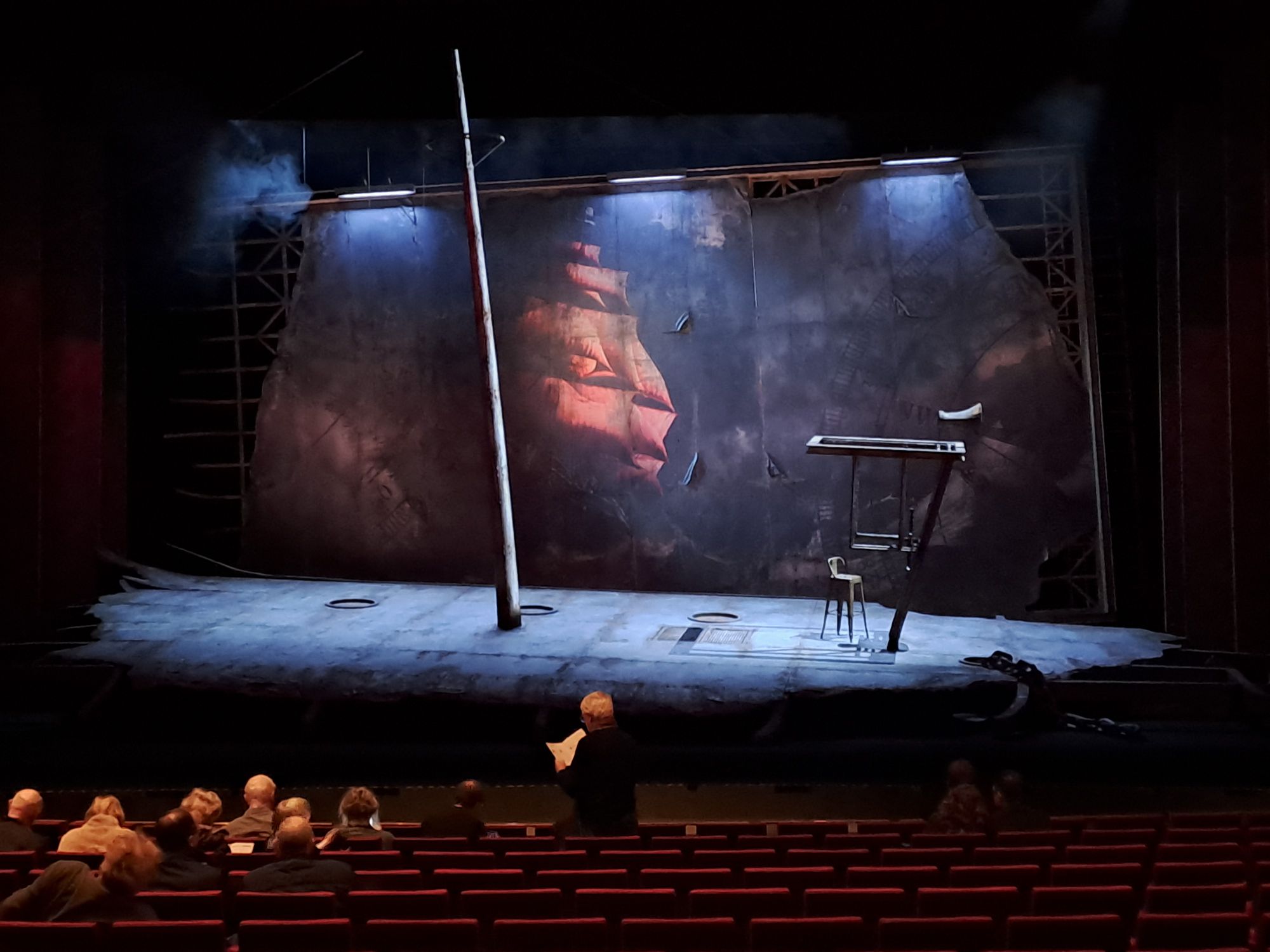
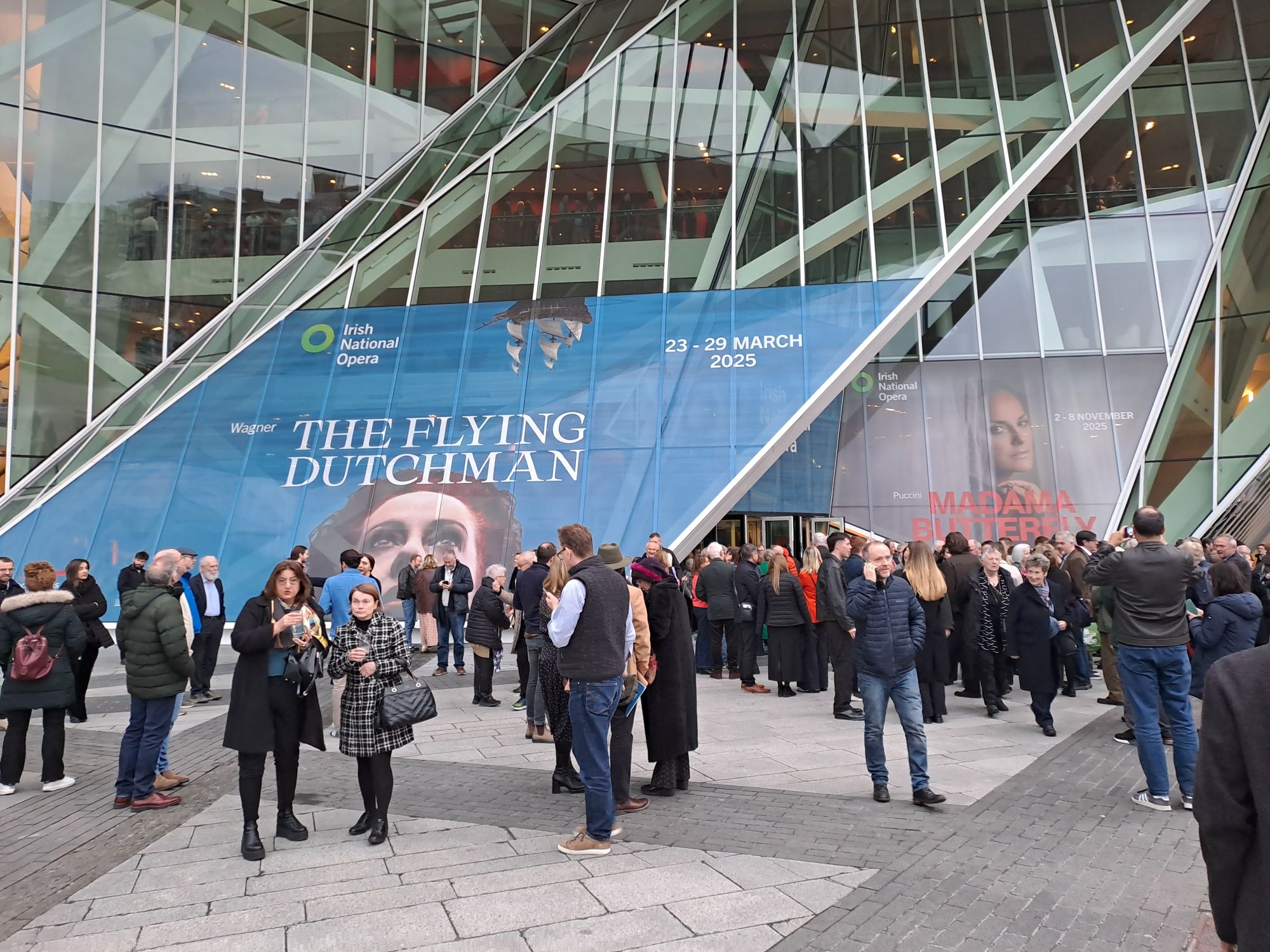
OutsideInsideOutside again
The event took a bizarre twist at the interval, which was after Act 1. I’d only just collected my glass of wine when the fire alarm went off and we were told to leave the building. Amusingly, some of the cast joined us outside too, in costume. It was a false alarm, but the precautionary exodus extended the interval by about 15 minutes or so. When we were making our way back in, I overheard a nearby wit say “Never mind: worse things happen at sea”. Given the plot of the opera, that seemed a very apt comment.
The Flying Dutchman is an early composition by Wagner, first performed in 1843 when Wagner was only 30 years old. It’s much more of a conventional opera than his later music dramas. At least to my ears there are passages that sound a lot like Verdi, especially those featuring the chorus. It’s also quite short: it’s often performed without an interval, but even with one (and a fire alarm to boot) it’s only about three hours. On the other hand, there are some manifestations of things to come, especially the frequent use of a leitmotif whenever the eponymous Dutchman appears or is mentioned.
The story is set somewhere on the coast of Norway. This production has an intriguing preamble while the famous overture is playing. While the menfolk are away at sea, the women of a coastal village are going about their business. Among them is a little girl in a striking red coat. Shades of Schindler’s List, I thought. The little girl turns out to be “Little Senta”, a representation of the innocence of Senta, the leading female character.
The opera proper begings on a ship captained by a man called Daland which has been driven off course by a storm and is sheltering at anchor. While the crew are taking some rest, another ship appears beside and The Dutchman climbs onto Daland’s ship to have a look around. He meets Daland, explains that he is exiled from Holland, is fed up with travelling the seas all alone. He showers Daland with gifts and asks if he can marry Daland’s daughter, Senta. Daland is very keen to have a rich son-in-law and speedily gives his consent.
Meanwhile, back onshore, we’re in Act II. Senta is revealed to be obsessed with a portrait of the Flying Dutchman, a man cursed to wander the oceans until he finds a woman prepared to be completely faithful to him. She has known about this legendary figure since she was a child and wants to be the person who saves him from his fate. One person not happy about this is Erik, an impoverished hunter who himself wants to marry Senta. Eventually Daland’s and the Dutchman’s ships come home. Senta is overwhelmed to meet the Dutchman in person and consents to marry him.
Act III begins with a big party at which the sailor’s on Daland’s ship get drunk and try to get the crew of the Dutchman’s ship to reveal themselves, initially to no avail because they are ghosts. When they do appear it’s not a pretty sight. Erik comes back and tries to convince Senta to stay with him instead of mmarrying the Dutchman. The Dutchman overhears them and interprets their discussion as a betrayal in progress. He tells Senta to forget the whole thing and jumps on board his ship which descends into the sea. Heartbroken, Senta throws herself into the water after him, and drowns.
In the closing stages, Senta has changed is wearing a striking red coat just like Little Senta wore at the beginning. When Senta dies, Little Senta’s lifeless body appears suspended from a rope in the middle of the stage, symbolising her sacrifice and shattered dreams.
In a very strong cast, James Cresswell (bass) was an outstanding Daland, but others were fine too: Gavan Ring (tenor) was The Steersman, Jordan Shanahan (baritone) The Dutchman, Carolyn Dobbin (mezzo) Mary, Giselle Allen (soprano) Senta, Toby Spence (tenor) Erik and the non-singing part of Little Senta was engagingly played by Caroline Wheeler. The Orchestra and Chorus of Irish National Opera were also in fine form.
The set design by Francis O’Connor was relatively simple but highly effective: the only significant change after Act I (see picture above) was the wheelhouse to the right was removed and a lighthouse placed further towards the rear, from which Senta took her plunge at the end. There was some dramatic use of animated back-projections too.
This is the first time I’ve seen this opera. I was very impressed with the performance, both musically and dramatically. If anyone is thinking of trying their first taste of Wagner then they could do much worse than this production, but they’ll have to hurry – there are just three more performances in Dublin (Tuesday 25th, Thursday 27th and Saturday 29th March).
P.S. I usually go by train into Dublin for concerts and other performances, but there are two buses that go all the way from Maynooth to the Grand Canal Quay, which is where the Bord Gáis Energy Theatre is located so I thought I’d try them out. I took a C4 in and a C3 home, both journeys being pleasantly uneventful.
Not to labour the point about the correct pace for a Pavane which I made here and here, here’s a piano roll of Maurice Ravel playing a solo version the piece of which I heard the orchestral version last week, Pavane pour une infante défunte. Piano rolls are still being made, by the way. One feature that distinguishes them from other recording formats is that you can vary the tempo without changing the pitch. If you play a vinyl record faster then the pitch goes up. On a piano roll you always get the right notes. To be sure that this is the original tempo you would need to establish that it’s being played at the same speed as it was recorded. If that is the case, it’s definitely a bit faster than most versions I’ve heard – and (in my opinion) none the worse for that. Aside from the tempo, it’s interesting how he approaches the piece, emphasizing the harmony far more than the melody.
In my post on Saturday I raised the question of the tempo for the orchestral version of Pavane pour une infante défunte by Maurice Ravel. A pavane is a stately dance, which is to be played quite slow but it’s not a funeral dirge. As Ravel himself is reported to have said “It’s the Princess (infante) who is sup[posed to be dead (defunte), not the Pavane”. There is a temptation when playing a lovely tune to wallow in it a bit too much, I think. In this light I now share a recording of a different Pavane, Opus 50 by Gabriel Fauré which is also quite well known. Here is the composer himself playing it in 1913 on his very own piano at a tempo which I find very pleasing and not too slow…
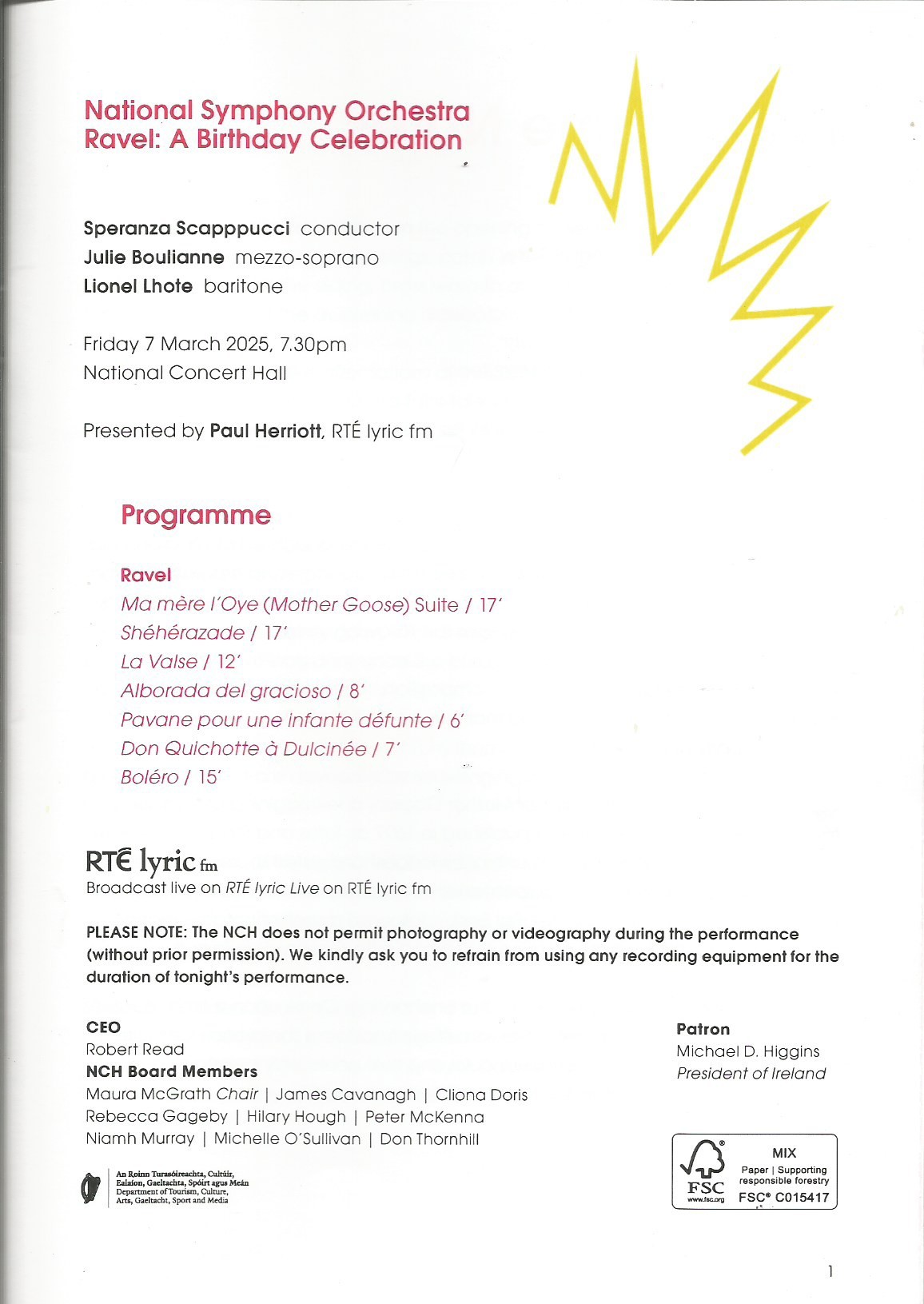
Yesterday (8th March 2025) was the 150th anniversary of the birth of Maurice Ravel and the National Symphony Orchestra celebrated it in fine fashion with all-Ravel programme for last night’s concert under the direction of guest conductor Speranza Scappucci (whose name aquired an extra p for the printed programme):
As you can see, it was basically a selection of Ravel’s greatest hits and there’s no surprise that the concert ended with a performance of Boléro, which is by no means the most interesting of Ravel’s compositions but is easily his most famous. Ravel himself said that `it has no music in it’, meaning that it doesn’t have any variation or thematic development or invention, but was written deliberately as an experiment to see how far he could get in writing a work that was entirely based on rhythm and repetition. The result was a smash hit and earned him a very great deal of money, but he grew to resent the fact that it was so much more popular than the other works he himself thought were much better. I know some people who hate this piece, but I think it’s great fun and always enjoy hearing it. Last night was no exception.
The composition of Boléro is so simple that even a non-musician like me can play it. It’s basically written in a slow 3/4 time signature on which is superimposed the following figure:
The second part is basically a repeat of the first, with the last two eighth notes replaced with triplet. The whole pattern consists of 24 notes. I once tried to count how many times it is repeated in a performance of Boléro, but gave up when I got to 100. I think it must be over 200 times. This figure is introduced first on a single snare drum, which carries on playing it for the duration, i.e. for about 15 minutes in total. As the piece develops the same pattern is picked up by various other instruments, either alone in combination. A second snare drum joins in too. The key to the piece is to keep this all very strictly in tempo, as the piece gradually gets louder.
As I’ve mentioned before on this blog, my Father was a (jazz) drummer. I remember once borrowing his snare drum and attempting to play along with a recording of Boléro. The pattern shown above is not that hard to play in itself, but it’s not as easy as you probably think to keep in tempo as you play it louder and louder. At the start it’s fine: you begin by tapping the sticks on the skin of the drum very close to the rim. To increase the volume you gradually move the point of impact closer to the centre of the drum, which naturally makes it louder. However, to get louder still you have to increase the distance the sticks move, and that makes it tougher to keep to tempo. Playing along at home is one thing, but playing the percussionist playing this in an orchestra must leave the drummer feeling very exposed. One mistake, any speeding up or slowing down, and the whole performance will be ruined. Percussionists very often have little to do for long passages in an orchestral work, but this takes it to the opposite extreme. It requires constant concentration, but no variation or embellishment is allowed. I suppose professional musicians just get into the zone and don’t think about the possibility of screwing up. Last night the task fell to Section Leader Rebecca Celebuski, who performed it flawlessly.
The bolero rhythm is just one element of the composition, of course. There is a melody, in two parts. The first simple and catchy, the second bluesier and a bit syncopated. Each part is played twice, passed around the instruments of the orchestra, first individually and then in combinations. Sometimes the melodic line is doubled, but there are no complicated harmonies and the piece stays in C major throughout, apart from a sudden change of key near the very end. The second part of the melody allows the musicians to release their inner jazz a bit, playing behind or across the beat to generate the feeling that the tune is trying to escape the confines of the incessant rhythm. As is the case in jazz, this sense of tension only works if the basic rhythm is kept strictly in tempo as the crescendo builds
The third element of the composition is the simplest of all, but I feel that it is very important in determining whether a performance of Boléro really rocks. That is a rhythmic pulse based on the three beats of the underlying 3/4. When they’re not playing the melody or shadowing the bolero pattern, the orchestra play this figure and it ends up being boomed out by the timpani in tremendous style but also as the piece progresses the stress shifts between the three beats as different instruments contribute.
I know it’s a familiar piece but I really enjoyed last night’s performance. I’ll also reiterate that as well as making a great sound, a full symphony orchestra playing during a piece like this is also a tremendous thing to watch.
Anyway, it wasn’t all about Boléro. In the first half we had the orchestral suite Ma mère l’Oye (My Mother the Goose), the song cycle Shéhérazade with vocals by excellent mezzo-soprano Julie Boulianne, and La Valse. The last of these is a masterpiece, originally conceived as a tribute to the Viennese waltz, but not composed until after TheFirst World War, and turned into a kind of tragic parody, starting out sombre and brooding, gradually building into a garish intensity and then into a brutal, almost chaotic, ending.
After the wine break we heard Alborado del Gracioso, a beautifully atmospheric with a strong Spanish influence and the orchestral version of Pavane pour une infante défunte, played well but a little too slowly for my tastes, and the only piece of the evening that I’d never heard before, Don Quichotte à Dulcinée, a miniature song cycle lasting just 7 minutes, comprised of settings of three poems by Paul Morand. Soloist was baritone Lionel Lhote who not only sang very well but had a very engaging stage presence.
And then it was Boléro, received with great applause and a standing ovation, and then by train back to Maynooth. There were a lot of French people in Dublin last night, presumably not for the Ravel, but for this afternoon’s rugby. They will be enjoying themselves in the city right now, as France convincingly beat Ireland 27-42 in the Six Nations, to end the home team’s hopes of a grand slam. Disappointment for the Boys in Green, but France were excellent and thoroughly deserved to win. Losing to a side as good as that is no disgrace.
Well, it’s Shrove Tuesday, Pancake Day, Mardi Gras and Fat Tuesday which gives me four excuses to post this lovely old record made by Humphey Lyttelton’s Paseo Jazz Band in the early Fifties. That’s the band that featured Humph’s regular crew alongside a number of London’s marvellous West Indian musicians of the time, hence the abundance of percussion and the resulting infectious calypso beat. I’ve posted this before but the link died, so here it is again. Enjoy!
I just heard the sad news of the death at the age of 88 of the wonderful singer Roberta Flack. Many years ago I posted my favourite song of hers (performed live on Top of the Pops way back in 1972) but it seems the link I used is now broken so I’ll post the original version. Roberta Flack’s The First Time Ever I Saw Your Face first appeared on her album First Take back in 1969 but it didn’t become a hit until it featured in Clint Eastwood’s (1971) film Play Misty For Me. Incidentally, the bass player on this track is the great Ron Carter.
It’s probably the most beautiful love song I’ve ever heard and to my mind it hasn’t dated at all in 50 years. I suppose if you’ve ever felt about someone the way it describes you never forget…
Rest in peace, Roberta Flack (1937-2025). To the dark, and the endless skies.
The views presented here are personal and not necessarily those of my employer (or anyone else for that matter).
Feel free to comment on any of the posts on this blog but comments may be moderated; anonymous comments and any considered by me to be vexatious and/or abusive and/or defamatory will not be accepted. I do not necessarily endorse, support, sanction, encourage, verify or agree with the opinions or statements of any information or other content in the comments on this site and do not in any way guarantee their accuracy or reliability.