Nina Simone. Emile Latimer. Live in 1969. Magical.
Follow @telescoperArchive for the Music Category
Black is the colour of my true love’s hair
Posted in Jazz with tags Black is the colour of my true love's hair, Emile Latimer, Nina Simone on February 20, 2013 by telescoperLulu at WNO
Posted in Opera with tags Alban Berg, Lulu, Welsh National Opera on February 18, 2013 by telescoperTime for a quick post about Saturday night at the Opera while I have my sandwich lunch. I have reviewed Lulu by Alban Berg before but David Pountney’s production for Welsh National Opera was quite different to the Covent Garden version I saw a few years ago.
Berg was a student of Arnold Schoenberg, but he developed his own take on the twelve-tone techniques developed by his mentor. Not everyone finds serialist music easy to enjoy, but I think if you’re going to have a go at it this Opera is one of the best places to start. I think the score for Lulu is completely wonderful with a constantly changing texture, sometimes lushly romantic (with a big nod in the direction of Mahler in Act I), sometimes bleak and disjointed. It’s easy to understand why Berg is such an influential composer: you can hear in this Opera the ideas behind many Hollywood movie scores, and there are whole sections that sound like they come from the soundtrack of a Hammer Horror film.
So what about the Opera itself? The plot revolves around the character of Lulu, an enigmatic figure who is at times innocent and vulnerable and at others cynical and manipulative. Her personality is only revealed to us through her interactions with men, all of which end in disaster. Lulu’s first husband has a heart attack and dies; her second commits suicide. She then shoots another man and is imprisoned but eventually escapes. By the end of the opera, many years later on, she has wound up in London and is living in poverty and working as a prostitute. She dies at the hands of Jack the Ripper.

The structure of the Opera is like a mirror, with Lulu’s reversal of fortunes happening after an intermezzo in the middle of Act 2, at the centre of which there is a remarkable musical palindrome (shown above). Before this her role in the drama is to drive the men around her into obsession, madness and death, although she never appears to understand why she has this effect on them. After the dramatic fulcrum of the piece she becomes more and more of a victim. The reason for this is not some great change in her own psychological make-up but just that she is losing her looks, as a result of illness and ageing. No longer sexually desirable, she has lost the only way of controlling the men in her life. From this point her decline is inexorable and death inevitable. It’s also no coincidence that her murderer is played by the same actor who plays her first lover, Dr Schön.
This production looks very different to the Covent Garden production, but rather than describe it in words it’s probably easier to look at the promotional video made by WNO.
It’s a very vivid and imaginative staging based on a stark framework made of metal that dominates the stage. A particularly effective and disturbing idea is to have the corpses of Lulu’s ex-lovers winched up into this structure on meat hooks after they’re dead and left to dangle there for the rest of the performance. Although the principal element of the set remains in place throughout, changes of mood and location are represented with dramatic changes of lighting and colour; Victorian London is memorably evoked with fog and a plethora of raised umbrellas. It’s all quite different from how I would have imagined the piece, but none the worse for that.
Marie Arnet was an excellent Lulu, giving a delicately nuanced portrayal of a complex central character who is as manipulated as she is manipulating. She is in turns cold-hearted and vulnerable, seductive and exploited. She bares all in this production, first in Act II, and is again naked when she is killed at the end of Act III. Neither scene is done gratuitously. Although her death scene is very shocking and horrific, it is not done in a titillating way. The rest of the cast was very good too, and the Orchestra of Welsh National Opera under Lothar Koenigs played the extraordinary music with clarity and energy. The saxophones and vibraphone, included to lend a bit of jazz-age decadence to the piece, were very prominent.
Before seeing this production I saw that the first night got a rave review and five stars in the Guardian. I wasn’t sure what to make of that as I rarely agree with published reviews. In fact I agree with much of Andrew Clements said, but wouldn’t have given it five stars. I’d probably give it four, if I did stars…
In Berg’s score the singers are sometimes called upon to use a stylised method of vocalisation in between speaking and singing (called Sprechstimme). This can be extremely effective from a dramatic point of view when done well. In this production I was perturbed that the short pieces of the libretto intended to be performed in this way were in fact delivered by disembodied recorded voices. I thought that was peculiar when I first noticed it, and as it recurred throughout the performance it started to irritate me quite considerably. I couldn’t tell which character was meant to be speaking, and in any case the recorded voices sounded nothing like those of any of the characters on stage. This device was probably used because some of the parts were played by people in animal masks, but other than that I couldn’t see the point of it.
That was an unfortunate blot on an otherwise excellent production, but there was still much to enjoy and I’m very glad I went back to Cardiff to see it.
Follow @telescoperRebranding Welsh National Opera
Posted in Opera with tags Marketing, Wales Millennium Centre, Welsh National Opera, WNO on February 17, 2013 by telescoperI went last night to Welsh National Opera’s new production of Lulu by Alban Berg; I’ll post a review in due course when I’ve got more time. Before I get the train back to Brighton I thought I’d post a quick comment on WNO’s recent “rebranding” exercise. This was described by Director David Pountney as follows:
WNO’s rebranding exercise is an integral part of its overall strategy to make itself as fit as possible to face the many challenges of the current environment. This includes a reinvigorated artistic programme, a rigorously tight management of our financial outgoings, and a positive search for alternative funding. The branding exercise is far more than creating a new logo. It has resulted from detailed consultations within and outside the company on its mission and its identity, and has resulted in a renewed image that will serve for the next decade. Central to this is of a re-designed website, together with a new style of programme book to reflect the company’s themed seasons. Together these form an integrated strategy to support the company’s prosperity and creative energy over the coming seasons.
One immediately obvious consequence of this rebranding is the demise of the very attractive and handy old programmes (such as the one for Tosca on the left), and their replacement by a much bigger season programme that covers in this case three different operas (Lulu, Madame Butterfly and The Cunning Little Vixen, bundled together incongruously under the theme of Free Spirits) . The new style programme is much heavier and larger so that it doesn’t fit in jacket pocket. It also means that if you just want to see one Opera in the season, and want to buy a programme for that one only, you can’t. Shades of the academic publishing industry. Any further visits of mine to WNO definitely won’t involve buying a programme..

Anyway, one thing the marketing types can’t bugger up with their rebranding nonsense is the wonderful Wales Millennium Centre, snapped here as I went to get a bite to eat after last night’s performance.

My Funny (and very sad) Valentine
Posted in Jazz with tags Chet Baker, My Funny Valentine, St Valentine's Day on February 14, 2013 by telescoperI suppose I should make some concession to Valentine’s Day, so here’s the classic 1954 Chet Baker version of the Rodgers & Hart tune My Funny Valentine. This was a big hit during the period when jazz switched from the frenetic pace and jagged angularity of bebop to the smooth cocktail bar sounds of the Cool School; its popularity owed as much to Baker’s youthful good looks and attractive singing voice as to the trumpet solo on this recording.
But that was 1954. A lifelong addiction to heroin exacted a terrible toll on Chet Baker. Here’s a harrowing and heart-rending reprise of My Funny Valentine recorded, just a year before his death, at a concert in Tokyo in 1987.
Sic transit gloria mundi.
Spiegel im Spiegel
Posted in Biographical, Music with tags Arvo Pärt, Piano, Spiegel im Spiegel, Violin on February 11, 2013 by telescoperI’ve been so busy this last week that I really needed to unwind a bit on Sunday morning, for which purpose I picked this beautifully spare and sublimely contemplative piece by the great Estonian composer Arvo Pärt. This music always makes me think of the first line of the Desiderata…
Go placidly amidst the noise and haste, and remember what peace there may be in silence
..except of course that it’s not silent.
Emotion and the Scientific Method
Posted in Biographical, Music, The Universe and Stuff with tags Emotions, Observer, research, Science, scientific method on February 10, 2013 by telescoperThere was an article in today’s Observer in which four scientists from different disciplines talk about how in various ways they all get a bit emotional about their science. The aim appears to correct “the mistaken view that scientists are unemotional people”. It’s quite an interesting piece to read, but I do think the “mistaken view” is very much a straw man. I think most people realize that scientists are humans rather than Vulcans and that as such they have just as many and as complex emotions as other people do. In fact it seems to me that the “mistaken view” may only be as prevalent as it is because so many people keep trying to refute it.
I think anyone who has worked in scientific research will recognize elements of the stories discussed in the Observer piece. On the positive side, cracking a challenging research problem can lead to a wonderful sense of euphoria. Even much smaller technical successes lead to a kind of inner contentment which is most agreeable. On the other hand, failure can lead to frustration and even anger. I’ve certainly shouted in rage at inanimate objects, but have never actually put my first through a monitor but I’ve been close to it when my code wouldn’t do what it’s supposed to. There are times in that sort of state when working relationships get a bit strained too. I don’t think I’ve ever really exploded in front of a close collaborator of mine, but have to admit that one one memorable occasion I completely lost it during a seminar….
So, yes. Scientists are people. They can be emotional. I’ve even known some who are quite frequently also tired. But there’s nothing wrong with that not only in private life but also in their work. In fact, I think it’s vital.
It seems to me that the most important element of scientific research is the part that we understand worst, namely the imaginative part. This encompasses all sorts of amazing things, from the creation of entirely new theories, to the clever design of an experiment, to some neat way of dealing with an unforeseen systematic error. Instances of pure creativity like this are essential to scientific progress, but we understand very little about how the human brain accomplishes them. Accordingly we also find it very difficult to teach creativity to science students.
Most science education focuses on the other, complementary, aspect of research, which is the purely rational part: working out the detailed ramifications of given theoretical ideas, performing measurements, testing and refining the theories, and so on. We call this “scientific method” (although that phrase is open to many interpretations). We concentrate on that aspect because we at have some sort of conception at least of what the scientific method is and how it works in practice. It involves the brain’s rational functions, and promotes the view of a scientist as intellectually detached, analytic, and (perhaps) emotionally cold.
But what we usually call the scientific method would be useless without the creative part. I’m by no means an expert on cognitive science, but I’d be willing to bet that there’s a strong connection between the “emotional” part of the brain’s activities and the existence of this creative spark. We’re used to that idea in the context of art, and I’m sure it’s also there in science.
That brings me to something else I’ve pondered over for a while. Regular readers of this blog will know that I post about music from time to time. I know my musical tastes aren’t everyone’s cup of tea, but bear with me for a moment. Some of the music (e.g. modern Jazz) I like isn’t exactly easy listening – its technical complexity places a considerable burden on the listener to, well, listen. I’ve had comments on my musical offerings to the effect that it’s music of the head rather than of the heart. Well, I think music isn’t an either/or in this respect. I think the best music offers both intellectual and emotional experiences. Not always in equal degree, of course, but the head and the heart aren’t mutually exclusive. If we didn’t have both we’d have neither art nor science.
In fact we wouldn’t be human.
Goodbye-ee!
Posted in Biographical, Music, Television with tags Dudley Moore, Goodbye, Peter Cook on January 30, 2013 by telescoperWinterreise – Im Dorfe
Posted in Music with tags Benjamin Britten, Im Dorfe, Peter Pears, Schubert, Winterreise on January 23, 2013 by telescoperIt’s quite difficult to catch the snow as it’s falling with a simple camera like the one on my Blackberry, but here’s an attempt taken yesterday…
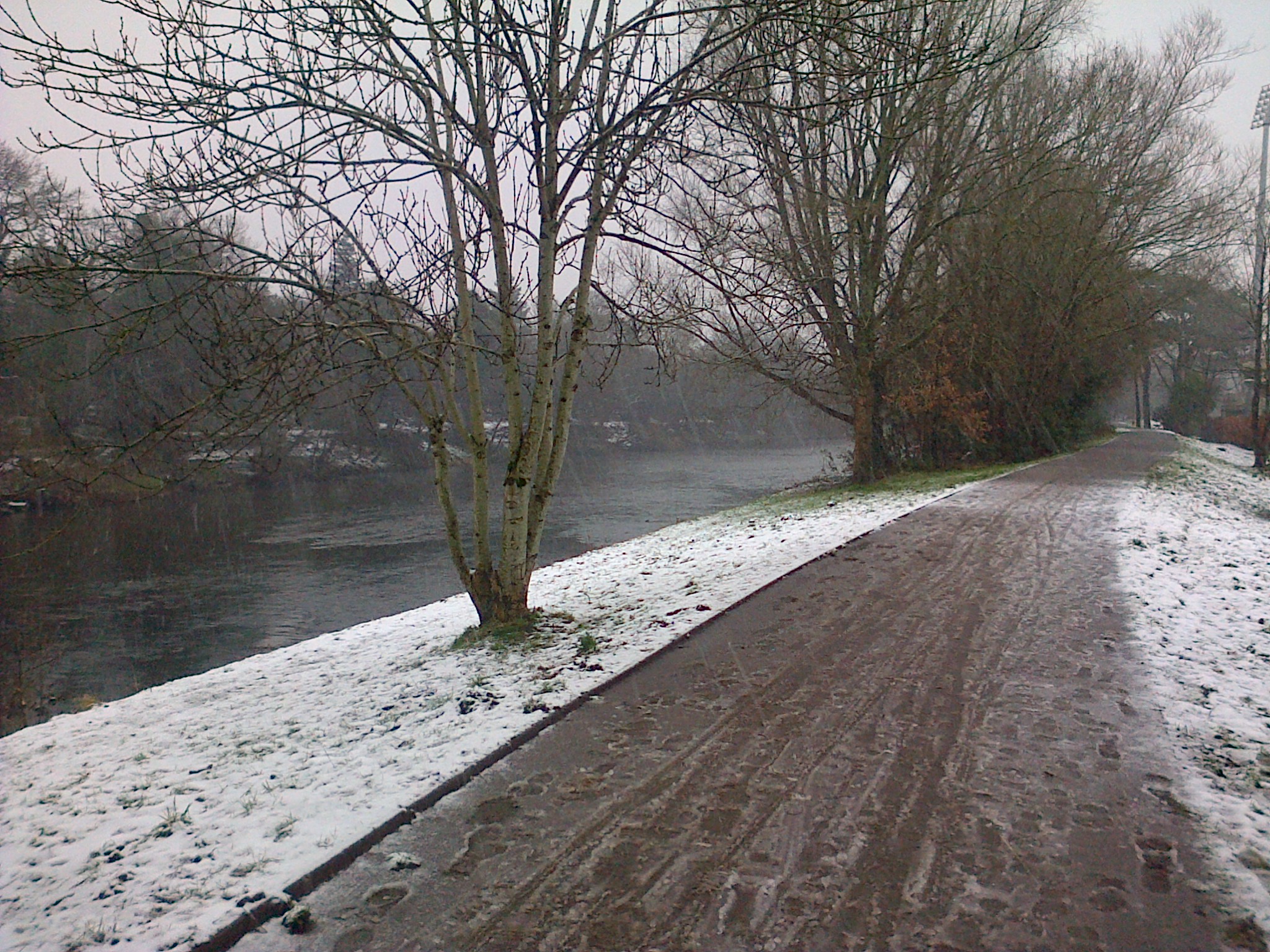
As pure as the driven slush…
Anyway, today it’s cold again and it’s started snowing again and I’m going to be working late again finishing this wretched report, so I thought I’d take a quick break to post some suitably wintry music. This is from the wonderful recording of Winterreise by Benjamin Britten and Peter Pears, complete with sheet music so you can sing along. The piano accompaniments for Schubert’s songs are so simple only a genius could have written them…
Tough Tenors
Posted in Jazz with tags Eddie "Lockjaw" Davis, Johnny Griffin, Tin Tin Deo, Tough Tenors on January 19, 2013 by telescoperI found this on Youtube recently and couldn’t resist posting it. I actually have a vinyl LP of the album Tough Tenors, featuring Eddie “Lockjaw” Davis and Johnny Griffin as the eponymous rugged saxophonists, but it’s one I haven’t yet transferred to digital. As the album title suggests, Messrs Davis and Griffin play their instruments in a very muscular fashion, so at teams it seems like music to lift weights by, but they play with a great deal of imagination too. Here, for example, is very original version of the Dizzy Gillespie/Chano Pozo composition Tin Tin Deo, with a particularly fabulous solo by Johnny Griffin.
P.S. The album was recorded in 1962, and the other musicians were Horace Parlan (piano), Ben Riley (drums) and Bud Catlett (bass).
Aida in Verona (2006)
Posted in Biographical, Opera, Uncategorized with tags Arena di Verona, Franco Zefirelli, Opera, Verona on January 10, 2013 by telescoperI thought I’d try out the WordPress app for my Blackberry by posting this old picture, taken in the Arena di Verona while we were waiting for the start of the sumptuous production of Verdi’s Aida on 30th July 2006. The Opera doesn’t start there until it gets dark, but the evening sun was glinting on the gold pyramid sitting in the centre of the stage, so I couldn’t resist getting a picture. The late start meant we enjoyed a nice dinner before the performance, along with a very nice bottle of Amarone…


