Archive for the Music Category

Helle Nacht – Per Nørgård

Posted in Music with tags , , on March 11, 2012 by telescoper

And now for something completely different. I was listening to CD Review on Radio 3 yesterday morning and in the course of a fascinating section about new modern classical works, I heard some wonderful music by a Danish composer called Per Nørgård, whose name (pronounced in Danish something like nur-gaw) was quite new to me until then.  I’ve spent most of this morning downloading various collections of his music and am now in danger of becoming a Nørgård bore.

Much of  Nørgård’s  music is based on ideas inspired by fractal geometry and exploits the so-called infinity series, representing a kind of extension of the serial techniques pioneered by such composers as Arnold Schoenberg.  One of the great things about Nørgård, however,  is that you really don’t need to know about that, or indeed that the following piece was inspired by the Aurora Borealis, in order to enjoy it. This is Nørgård’s Violin Concerto No. 1 Helle Nacht.

Waltz of the Demons

Posted in Jazz with tags , , on March 3, 2012 by telescoper

I stumbled across this on Youtube; it’s in 3/4 time and I’ve never been very good at waltzing. I thought I’d post it on here because it features Booker Little, fabulous trumpet player who sadly died very young (at the age of 23) in 1961. He was an inspired improviser with a highly individual sense of phrasing, and an amazing ability to articulate complex ideas at fast tempi. Listening to him playing makes you wonder into what new directions he might have taken jazz had he lived even just a few years longer.

The band was led by alto saxophonist Frank Strozier, and the excellent rhythm section of Wynton Kelly (piano), Paul Chambers (bass) and Jimmy Cobb (drums) will be familiar to fans of Miles Davis. This track is called Waltz of the Demons..

A Little Respect

Posted in Biographical, Music with tags , on February 25, 2012 by telescoper

And if I should falter
Would you open your arms out to me?

Wee

Posted in Jazz with tags , , , , on February 20, 2012 by telescoper

Here’s an exhilarating little duo featuring alto saxophonist Lou Donaldson and the extraordinarily brilliant  pianist Tete Montoliu. Lou Donaldson at times sounds more like Charlie Parker than Charlie Parker ever did, but if you’re going to play bebop there’s no better example to follow. Tete Montoliu on the other hand never sounded like anyone other than himself. He was from  Barcelona, by the way, and was born completely blind. The tune, written by drummer Denzil Best, is called Wee although it does have an alternative title, Allen’s Alley; it’s yet another one built around the chord changes of Gershwin’s I Got Rhythm. Anyway, it’s a typically intricate and edgy tune that finds these great musicians at their playful best.

My Funny Valentines

Posted in Jazz with tags , , , , , , , , on February 14, 2012 by telescoper

I’m not really into all this St Valentine’s Day nonsense (meaning: “I never get any cards”), but at least it provides me with an excuse to post three versions of the great Rogers & Hart ballad  My Funny Valentine.

The first is by the great Miles Davis Quintet featuring Miles Davis on trumpet, Wayne Shorter on tenor sax, Herbie Hancock on piano, Ron Carter bass and Tony Williams on drums. This was recorded live in Milan on October 11th 1964. There’s a slight distortion in the sound in the form of a pre-echo, which is a bit eery, but I still think it’s a marvellous performance.

And if Miles Davis isn’t your cup of tea, here is something completely different. It’s by Julie London, but very late in her career in 1981 when she was 55. Her voice was much smoother in her heyday in the 1960s, but I love the smokey sound of this very characterful rendition. By ear I’d say the bass player on this is Ray Brown and the guitar is Barney Kessel, both of whom (like Julie London herself) are no longer with us.

Last one up is a miracle of joint improvisation between the great Bill Evans on piano and Jim Hall on guitar, the sort of music that mere mortals can only dream of…

It’s that time again…

Posted in Music, Rugby with tags , , on February 12, 2012 by telescoper

Today was the day for the first home game of the RBS Six Nations for Wales, so Cardiff was absolutely buzzing with that special atmosphere that only rugby and an influx of 80,000 people into a city with a population of 325,00 can bring. I was out and about earlier on but had to watch the game on TV as I lack the wherewithal to get tickets for occasions of such immensity. Wales were red-hot favourites for this game, and won comfortably enough in the end against Scotland although the game was closer than the 27-13 scoreline might suggest; Scotland had a try incorrectly disallowed, which might have made all the difference. The Scots fans also played their part, some of them camping out in the park near my house in the freezing cold for two nights before today’s game, and offered a fine rendition of Flower of Scotland before the kick-off. But there’s something special about the Welsh National Anthem on days like this. I’m glad they’ve dispensed with the professional pop singers that they’ve sometimes used to lead the singing. Wales is a nation that doesn’t need to pay people  to sing for it…

Flyin’ High

Posted in Jazz with tags , , on February 10, 2012 by telescoper

I’m in need of a bit of a pick-me-up today, because it’s wet and gloomy outside and we’re all busy making the final push to get our STFC consolidated grant application together. I found this on Youtube the other day and it definitely does the trick for me. It’s by the marvellous Jazz clarinettist Edmond Hall. I always thought he was very underrated, but judging by the superbly detailed wikipedia page devoted to him, someone out there rates him very highly indeed! Ed Hall’s clarinet style is immediately recognizable for the incisiveness of his tone, which made him one of the “hottest” jazz clarinet players of all time. He’s also pretty much unique because he stuck with the old Albert System (aka “Simple System”) clarinet; the vast majority of practitioners prefer the Boehm System. In fact I don’t even know if it’s possible to buy an Albert System clarinet these days.

Anyway, whatever clarinet he played, he played it beautifully. I love the way he keeps changing gear throughout this performance, especially around 2.42 when he pulls out all the stops and shifts into the higher register for a sizzling last set of choruses. Wonderful.

Sinfonia Antarctica

Posted in History, Music with tags , , , , , , , , on February 8, 2012 by telescoper

Just time for a quick post while I eat my breakfast this morning about last night’s Scott Centenary Concert at St David’s Hall Cardiff. The concert was given by the City of London Sinfonia (conducted by Stephen Layton) and last night’s performance was actually the third date in a tour which takes them next to Cheltenham and then to the Cadogan Hall in London. I mentioned this concert in a post last week.

The main music for the evening was written by Vaughan Williams. The concert started with excerpts from his score for the 1948 film Scott of the Antarctic, interspersed with dramatic readings from Scott’s own diaries and letters, by actor Hugh Bonneville. Apparently Vaughan Williams found the subject matter of the film so compelling that he wrote a huge amount of music, most of it before even seeing the screenplay, and only a small part was actually used in the movie soundtrack. He later re-worked much of this material into a full symphony, The Sinfonia Antarctica, his 7th, which was performed in full after the interval. Musically speaking, therefore, the opening piece was really a taster for the full work, but the readings were deeply moving.

Scott kept full diaries all the way from the beginning to the end of the expedition so they describe the journey in remarkable detail, and with no little poignancy. The initial optimism gradually tempered turned to crushing disappointment when they discovered that Amundsen had beaten them to the South Pole. When they turned  home to try to reach safety before the Antarctic winter closed in around them, Scott’s diary asks for the first time “I wonder if we’ll make it.”  Passages describing the awful death of Petty Officer Evans and Captain Oates’ noble sell-sacrifice were included, and the last terrible days when, without food or fuel, the three remaining companions were entombed in their tent by a raging blizzard, were depicted by Scott’s increasingly fragmentary and heartbreaking notes. One can’t really imagine the depth of their suffering, of course, but the desolation of their last hours is obvious. Their bodies were not found until 8 months later.

Before the interval we heard a new commission, Seventy Degrees Below Zero, by Cecilia McDowell, featuring tenor Robert Murray. This was an orchestral setting of various parts of the scientific record of Scott’s Last Expedition. I have to say I didn’t really like the piece: the vocal lines lacked interest and the orchestral music lacked any real sense of variation or development. Robert Murray struggled to project, his rather thin tenor voice not really suited to the music.

After the interval we had a complete performance of the Sinfonia Antarctica. Although I enjoyed it very much, I’m still not sure how well this hangs together as a symphony. There’s no doubt, however,  that it contains a number of strokes of genius. The opening theme, heard at various points later on in the piece, manages to conjure up  the Antarctic landscape – not only the snow and ice but also its singular desert-like aridity – as well as a deep sense of tragedy. The second movement featuring soprano Katherine Watson and women’s voices from the Bath Camerata and Wells Cathedral School Chamber Choir in wordless singing produced a wonderful unearthly atmosphere. Later on, there’s a passage featuring an organ which gave me the chance to  hear he magnificent organ at St David’s Hall for the first time.
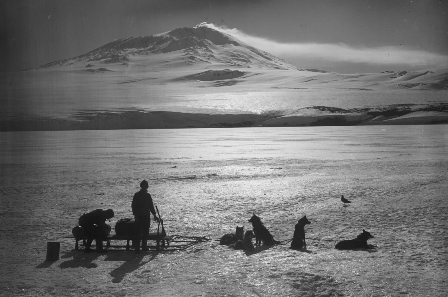
Projected above the orchestra throughout the performance were still photographs actually taken during the expedition. Some of these – like the one shown above – were stunning, but after a while I found them a bit of a distraction from the music.

Overall, an interesting concert rather than a brilliant one, which was well received by the (relatively small) audience at St David’s.

Winterreise – Das Wirtshaus

Posted in Art, Music with tags , , , on February 4, 2012 by telescoper

It’s cold again, and it’s just  started snowing, so here’s some wintry music. I know that the recording of Winterreise by Benjamin Britten and Peter Pears is by no means everyone’s favourite version, but I like it a lot. There’s the added bonus in this video of a glimpse of the art of Caspar David Friedrich.

P.S. Das Wirtshaus means “The Inn”, but in the poem by Müller that forms the lyric for this song, the inn is actually a graveyard…

Di Provenza

Posted in Opera with tags , , on February 1, 2012 by telescoper

It’s a cold and gloomy morning as befitting the first of February, so I thought you might appreciate a touch of the warmth of the South of France. This is Germont’s Aria Di Provenza il mar, il suol from La Traviata by Giuseppi Verdi. The recording – made, incredibly, in 1907 – provides a rare chance to hear the magnificent baritone of the legendary Titta Ruffo whose nickname, appropriately enough, was Voce del Lione “Voice of the Lion”. Despite the limitations of the recording, which required the aria to be cut down to fit within 3 minutes, this is still a stunning performance which makes most modern-day baritones sound like a wet weekend. If you listen carefully right at the end you’ll hear someone say “bravo”…