Archive for the Music Category

Move

Posted in Jazz with tags , , , , on May 23, 2011 by telescoper

Well, it’s 1pm and my third-year students are just sitting down for two hours of fun with their Nuclear and Particle Physics examination. For my part I’m obliged to sit by the phone for the next two hours in case there’s a problem with the examination paper. Ideal excuse for a quick blog post while I eat my sandwich.

I also notice from my trusty wordpress dashboard that this is my 1000th post since I started blogging, way back in late 2008.  Time to indulge myself, then. I haven’t posted much jazz recently so I thought I’d share this classic recording with you. It’s from my favourite era of jazz – the late 1950s – and my favourite kind of jazz, bebop, which by then had matured, ripened and hardened considerably since its birth in the 1940s.

This gives me the excuse to mention a nice article in Saturday’s Grauniad about the poet Philip Larkin, his love for “trad” and his hatred for the “modern” jazz exemplified by bebop. It’s entirely a matter of personal taste, of course, but speaking for myself I can say that I’ve never had any problem loving jazz of all ages. For me, though, it reached a peak in the late 50s with musicians of the calibre of Miles Davis, John Coltrane, and Ornette Coleman.

This particular track features alto-saxophonist Lou Donaldson whom many jazz critics regarded as a pale imitation of the pioneering be-bop icon Charlie Parker but whose playing I’ve always admired. In my book, anyone brave enough to follow Charlie Parker deserves the highest esteem. In any case when Lou Donaldson walked into the Van Gelder studio in Hackensack, New Jersey on July 28th 2008 he clearly had fire in his belly.

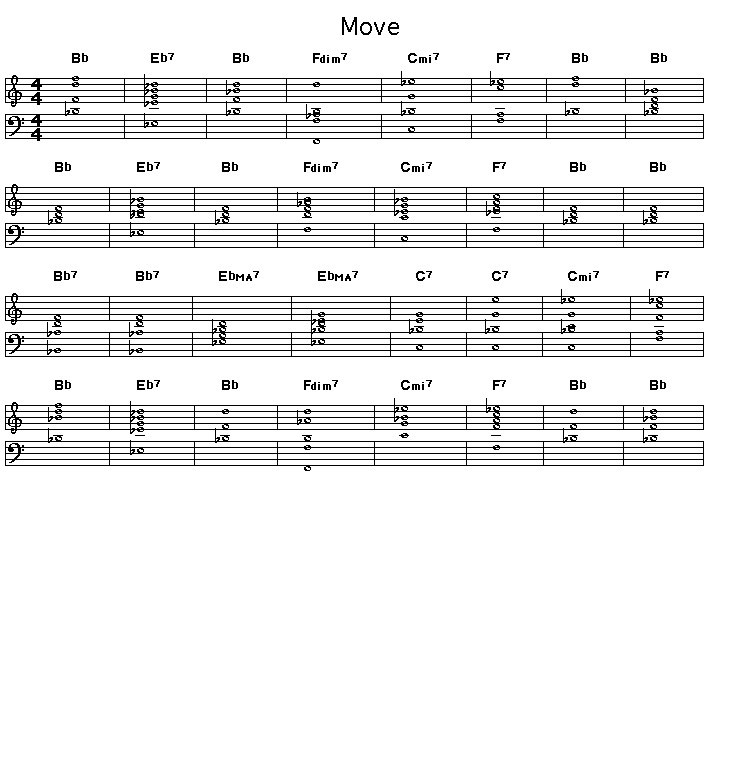
The tune is entitled Move and it was written by drummer Denzil Best. It’s quite unusual for a drummer also to be a composer, but Best wrote a number of classic jazz tunes. I even managed to find the chords that make up this one’s 32 bar AABA structure…

Many bebop compositions are based on the chord progressions of standard tunes, such as How High the Moon or I Got Rhythm, but with the melody replaced by something much more intricate than the original tune. I don’t recognize the chords above from anywhere else so it may be an entirely original composition by Denzil Best. I’m sure there’s a jazz buff out there who will correct me if I’m wrong. In any case the jagged melody is archetypal bebop stuff – complex and angular, very difficult to play but intensely exciting to listen to.

Share/Bookmark

Cosi fan tutte

Posted in Opera with tags , , , , on May 21, 2011 by telescoper

It’s been a long time since I posted an opera review. That’s because neither of the operas offered by Welsh National Opera earlier this year appealed to me very much and since then I’ve been too busy doing other things to take in an opera anywhere else. However, the summer season of WNO has now started so now at last there’s something of an operatic nature to write about. In fact, I was lucky enough to get tickets for the first night of WNO’s new production of Così fan tutte by Wolfgang Amadeus Mozart and duly went along yesterday evening. The Millennium Centre was pretty full – as you’d expect for a first night of an enduringly popular opera.

In case you weren’t aware, Così fan tutte is a masterpiece of comic opera (or, technically speaking, opera buffa) written in collaboration with Lorenzo da Ponte who also wrote the libretti for Don Giovanni and The Marriage of Figaro. The title can be loosely translated as “That’s how all women behave”; the -e on “tutte” indicates a feminine plural. The plot -such as it is – revolves around two pays of lovers: Guglielmo, who is engaged to Fiordiligi, and Ferrando, who is engaged to Fiordiligi’s sister, Dorabella. Both Guglielmo and Ferrando are sailors. All four are friends with the scheming Don Alfonso, who orchestrates the unfolding events, presumably for his own amusement.

Don Alfonso suggests to Ferrando and Guglielmo that their beloved fiancées are not as faithful as they seem to imagine and the three agree a wager. Ferrando and Guglielmo pretend that they’ve been called up for active service. Don Alfonso joins Fiordiligi and Dorabella in the sumptuous trio Soave sia il vento as the men appear to sail off for battle. The ladies are heartbroken and pledge fidelity to their departed lovers. However, the two sailors soon return in disguise in order to attempt their seduction. After various goings-on the men succeed in seducing each others fiancees and a mock wedding is staged. The marriage is interrupted by the sound of the sailors’ return. After the quickest of quick changes the two men re-appear without their disguises and confront their unfaithful women. Don Alfonso has won his bet.

Like all opera buffa the plot sounds faintly ridiculous – which it is – but of course the key to its success as a piece is not just the comic action, but also the gorgeous music which carries it along. In this particular opera there’s almost no end to the musical loveliness as Mozart has each principal singing alone, and in combinations of twos and threes. Mozart’s writing for two, three or four voices is truly wonderful to listen to, and there are many fine examples of such in this opera.

In this production Guglielmo and Ferrando are sailors who are stationed in a British seaside resort, complete with promenade, pier, Punch & Judy show and Italian ice-cream parlour (named Botticelli‘s). This setting takes  it quite a long way downmarket  compared to the original location of Naples, especially when the Butlins-style redcoats appear, and this is carried through to the much coarser way the comedy is handled than you find in many productions of this piece. This approach does provide enjoyable moments of slapstick hilarity but also causes some difficulties.

For example, it is key to this opera that the character of Don Alfonso has to have some sort of power over the four main protagonists. In other words, it has to be credible that they believe what he says and go along with his suggestions. In this production, however, Don Alfonso is meant to be a “local pier entertainer” – in fact he actually looks more like Flash Harry. I found it hard to accept that anyone would believe anything that this particularly dodgy spiv had to say, and his interaction with the two ladies in particular lacked all credibility.

Another thing I didn’t like was the way the opening of the piece was handled. Like most of Mozart’s operas, Così fan tutte is blessed with a splendid overture, perhaps not as brilliant the other Da Ponte operas but full of playful exuberance and very much worth listening to. You can call me old-fashioned, but I do like to hear the overture, preferably with an empty stage or with the curtain down. In this production, however, as soon as the overture started, the stage began to fill with various extras doing various (admittedly comic) things. A particularly funny sequence of people walking dogs backwards and forwards got a huge laugh, but which drowned out the music entirely. What a waste.

I suppose the overall point I’m trying to make is that this production tried too hard to get cheap laughs. It’s just not necessary to milk it like that – it’s funny enough anyway!

However, these are relatively small objections. I’ll temper them by adding that some of the comedy in this production is inspired. Ferrando wore a false nose that made him look like Barry Manilow and Guglielmo’s false moustache gave him the appearance of Comrade Stalin. The latter looked particularly louche in white tennis shorts and ghastly red blazer.

Neal Davies (baritone) was Don Alfonso, amusingly played but lacking the deep sonority in his voice really needed to carry the role off. Ferrando was played by Robin Tritschler (tenor), whose light agile voice is ideal.  Gary Griffiths (baritone) as Guglielmo was outstanding, with an excellent voice and obvious flair for the comic touches. Fiordiligi (Camilla Roberts) and Dorabella (Helen Lepalaan) were also good. Despina – a waitress in Botticelli’s ice-cream parlour and Don Alfonso’s accomplice (often in disguise) – was pert and feisty but her voice lacked projection; at times she was barely audible.

Anyway, in view of the fact that the comedy dog-walking interfered with last night’s overture I thought I’d end  by posting a version here. I love the way that little phrase is thrown around among the wind instruments!

Share/Bookmark

Der Abschied

Posted in Music with tags , , , , , , on May 18, 2011 by telescoper

A little dickie bird (or, more accurately, quite a large one with impressive plumage) emailed me to point out that today, 18th May 2011, is the 100th anniversary of the death of Gustav Mahler. I couldn’t let the date go unmarked, so thought I’d post something here. I couldn’t decide which of two bits to put up, so decided to go with them both.

Although it’s long (and I don’t really like posting segments of things) it seemed appropriate to offer Der Abschied (“The Farewell”), the last movement from Das Lied von der Erde. I picked this version, featuring the legendary mezzo soprano Christa Ludwig.

Incidentally, Das Lied von der Erde is a symphony and it was written by Mahler after the 8th Symphony. However, it isn’t the 9th Symphony, which is a different work, or indeed the 10th which was unfinished at Mahler’s death and which I heard here in Cardiff recently.

If you haven’t got time to listen to all of that one, try this remarkable recording instead. It’s Urlicht, one of the songs from Das Knaben Wunderhorn which appears in Mahler’s 2nd Symphony (“The Resurrection”), sung by the late Maureen Forrester (contralto) and conducted by none other than a (very young) Glenn Gould.

Share/Bookmark

Mr PC

Posted in Jazz with tags , , on May 16, 2011 by telescoper

I came across this just now and it completely blew me away so I thought I’d share it  here. It’s a solo version of the John Coltrane tune Mr PC  by the amazing (British-born) bassist Dave Holland. Words totally unnecessary. Wow will do.

Share/Bookmark

Ba-dum Ching!

Posted in Music with tags , , , , on May 15, 2011 by telescoper

One of the good things about having a blog is the chance to bore the entire internet with your own peculiar obsessions. As regular readers of In the Dark will be aware, one of my fascinations is the origin and evolution of words and phrases. This morning I had an interesting exchange on Twitter with neuroscientist and comedian extraordinaire Dean Burnett, which revolved around the word “rimshot”…and a similar word with quite different meaning which I won’t repeat in polite company.

Ever wondered what the name is for  the (often ironic) drum effect often used in cabaret or night club acts to puncuate a joke, like this?

Well, the answer is “rimshot”.

Or at least that’s the word that’s pretty universally used by comedians.

Curiously, though, if you are a percussionist rather than a comedian then a rimshot is something quite different. My father was a drummer so I had a lot of relevant terminology (flams, paradiddles, chokes, you name it) drummed into me when I was a kid. Technically, in fact, a rimshot is a single sound created by hitting the head of the drum and the rim at the same time with a drumstick. It’s an effect probably used more frequently in jazz than in other forms of music, and a good example can be heard on Miles Davis classic Summertime on which the excellent Philly Joe Jones applies a rimshot to every 4th beat of the bar. The clicking sound is something similar to that produced by claves. Nothing much to do with the word as used by comedians, then…

The word used by drummers for what comedians call a rimshot  is actually a sting. That’s certainly what my Dad always called it anyway. He often had to play in Working Mens’ Clubs and didn’t really like being on with comedians, most of whom were terrible and also told extremely blue jokes. In fact, I’m pretty sure he only ever used a sting in the ironic sense, when the gag was exceptionally poor.

There are many possible variants of the sting but the basic “ba-doom ching” is this:

which involves a tom-tom, closely followed by a kick on the bass drum, then a short pause followed by the bass drum and snare played together at the same time as a choked cymbal crash. Some stings are more elaborate than this, and a sting can indeed involve a rimshot, but most I’ve heard don’t.

Of course it’s not at all unusual for one word to have different meanings in different fields, so I’m not arguing that “rimshot” is wrong, but it’s interesting (at least to me) to wonder how when and why this divergence of meaning happened..

Incidentally, at the risk of boring you all even further, I’d add that the comedian’s rimshot has also evolved via a metonymic shift to refer not only to the sound the drummer makes but also to the joke that provoked it. In other words, an exceptionally good (or, more likely, bad)  gag is often itself referred to as a rimshot.

And with that, my time’s up. You’ve been a lovely audience. Thank you, and goodnight.

Ba-Dum Ching!

P.S. If you’re ever in need of a rimjob rimshot, you can get one here.

Share/Bookmark

Across the Universe

Posted in Biographical, Music with tags , , , , , on May 9, 2011 by telescoper

My first day back at the office for a while meant loads of forms, a revision lecture, and lots of time chatting with students about project choices for next year. I hope I convinced them all that I’m a terrible project supervisor and they really should pick someone else’s projects…

Anyway the upshot of all this is that I’m fair knackered, so in lieu of my usual meandering posts I’ll offer you a musical treat, one that’s quite different from the usual fare I serve up on this blog. Quite a few people pull my leg about my old-fashioned musical tastes, but I’m notpretending to be young and trendy by posting this piece. After all, the vocal artist, Brian Molko, lead singer of the popular beat combo Placebo,  is himself nearly forty and therefore nearly the same age as me. Oh well, perhaps not. Anyway, I found out about this recording, made last summer, from a friend and thought I’d post it because of its vaguely cosmic title and, well, other reasons.

The song Across the Universe was penned by John Lennon and appeared on the Beatles’ final album Let it Be. The appearance of the Sanskrit phrase “jai guru veda om” dates it to the time when the Beatles were dabbling with transcendental meditation; it involves a greeting to guru dev (a.k.a. Brahmananda Saraswati) as well as the mystic symbol om used as a mantra.

It’s impossible to translate “om” properly – that’s the whole point of a mantra, I guess – but one meaning attributed to it is a kind of primordial vibration. I’m tempted to suggest that it means the acoustic oscillations that created the temperature variations in the cosmic microwave background and seeded the formation of the large-scale structure of the Universe, but I won’t.

There’s a bonus second song in this clip, a cover version of Ne Me Quitte Pas by Jacques Brel, a singer and songwriter who should be on everybody’s list of famous Belgians, as indeed should Brian Molko as he was born in Belgium. That might be why he got to perform in the unlikely setting of the European Parliament in Brussels at event called I♥EU. I suspect there weren’t many UKIP members there…

Share/Bookmark

Bach for Easter

Posted in Music with tags , on April 24, 2011 by telescoper

Well, it’s Easter Sunday and it seems entirely appropriate to post this to mark the occasion. It’s the Sinfonia from the wonderful Easter Oratio BWV 249 by Johann Sebastian Bach, first performed on Easter Day in 1725.

Soul Limbo

Posted in Cricket, Music with tags , , , on April 16, 2011 by telescoper

Yesterday after I finished work I shunned the usual Friday-night trip to the Poet’s Corner in favour of dropping in to Sophia Gardens to catch my first County Cricket of the season. It’s actually Glamorgan‘s second game – they lost the first , away at Leicestershire – but they’re doing much better in this one, against Gloucestershire. There was a sparse crowd, but there was some absorbing cricket as Glamorgan’s batsmen fended off some good bowling to end the day on 185 for 3. The game is finely poised, with Glamorgan carrying on this morning to build a handy lead but the game could still go either way.

Anyway, in belated honour of the start of this year’s cricket season, here’s a piece of music that will bring back a lot of memories to those who, like me, used to spend a lot of their time glued to the BBC’s cricket coverage. It’s Soul Limbo, by Booker T and the M.G.’s, the long-time theme tune for the BBC’s cricket coverage. And there’s also a few clips of cricket action to go with it…


Share/Bookmark

Salty Dog

Posted in Jazz with tags , , on April 16, 2011 by telescoper

Well, that’s the end of term and I’m now free, from teaching at least, for three weeks. I thought I’d celebrate by posting a piece of bawdy good-time jazz. Here’s the fabulous Lizzie Miles singing with a band led by the shamefully underrated but wonderfully named New Orleans trumpeter Sharkey Bonano.


Share/Bookmark

Back to Bach

Posted in Music with tags , on April 4, 2011 by telescoper

Another very busy and tiring day gave me no time to post anything until I got home this evening. Still, Ye Olde Blogge seems to be managing well these days without me. I’m going to have an early and largely blog-free night tonight, but I thought I’d share this with you before I slump onto the sofa. I heard this piece on the radio a few days ago. I usually wake up when my alarm clock turns the radio on. Sometimes the music doesn’t get me going straight away and I slumber on for a while. When this came on, however, I was mesmerised and couldn’t have gone back to sleep if I’d wanted to.

I’ve loved the music of Johann Sebastian Bach for a very long time, but a lot of his work is still new to me, as this piece was until very recently. It’s one of the trio sonatas for organ that he wrote relatively late in life, apparently to help his sons learn to play the organ. The trio sonata format usually involved two different solo instruments playing over a bass accompaniment called a continuo, but here all three parts are played on the organ by one musician. The result is absolutely beautiful, especially played as this recording on a lovely sounding organ.

I’ve listened to this piece repeatedly over the last week or so and every time I hear it I’m filled with a sense of euphoria. I think awesome is an understatement for such music as this.

PS. The pictures are of the town of Leipzig, which was Bach’s home for many years.


Share/Bookmark