Jimmy Giuffre (1921-2008) was an immensely gifted saxophonist and clarinet player who was also an accomplished arranger and composer who worked for many big bands. His most famous piece as an arranger was Four Brothers which he wrote for Woody Herman’s fantastic saxophone section of Stan Getz, Zoot Sims, Serge Chaloff and Herb Steward. My first encounter with Giuffre as an instrumentalist was in the opening track of the 1958 film Jazz on a Summer’s Day playing a tune called The Train and the River which has been a favourite of mine for many years. Back then he had a quite accessible style that blended jazz with folk elements, but he later developed a freer and more “modern” approach, including the use of electronic instruments and elements of jazz/rock fusion. I recently read a biographical article about him and – for obvious reasons – was intrigued that in 1985 he made an album called Quasar so I thought I’d share the title track here. Giuffre is on soprano sax on this one.
Archive for the Music Category
Quasar – The Jimmy Giuffre 4
Posted in Jazz with tags Four Brothers, Jazz, Jimmy Giuffre, quasar, The Train and the River on August 19, 2024 by telescoperBen Webster in Copenhagen
Posted in Jazz with tags Assistens Kirkegård, Ben Webster, Copenhagen, Kenny Drew, Niels-Henning Ørsted Pedersen, Someone to Watch Over Me on July 9, 2024 by telescoperThe great tenor saxophonist Ben Webster moved to Europe in 1964 and spent much of the rest of his life in Denmark until he passed away in 1973. After his cremation, his ashes were interred in the Assistens Kirkegård in Copenhagen; I visited his grave many moons ago:

That’s a bit of context for a beautiful clip I just stumbled across and couldn’t resist sharing here. It was filmed in Copenhagen in 1965 in the intimate surroundings of the apartment of Danish bass player Niels-Henning Ørsted Pedersen (who plays on the track), with Ole Steenberg on drums and Kenny Drew on piano. Kenny Drew is also buried in the Assistens Kirkegård, in a grave not far from Ben Webster’s.
This is a fine demonstration of Webster’s beautifully tender way of playing ballads, in this case George Gershwin’s Someone to Watch Over Me.
All Things You Are – Joe Pass
Posted in Jazz with tags All the things you are, Brecon Jazz Festival 1991, Jazz, Joe Pass on June 23, 2024 by telescoperThe Mooche – Steve Lacy
Posted in Jazz with tags Duke Ellington, Points, soprano saxophone, Steve Lacy, Steve Potts, The Mooche on June 15, 2024 by telescoperDuke Ellington’s tune The Mooche, composed in 1928, belongs to an era that spawned many other atmospheric classics such as Luis Russell’s Call of the Freaks and Don Redman’s Chant of the Weed. Fifty years later the menacing undertone of The Mooche was seized upon by saxophonist Steve Lacy and turned into an unforgettably raw version on his 1978 album Points (which I bought on vinyl when it first came out) in which he duets on soprano with Steve Potts, delivering the haunting minor-key theme with a sound like knives being sharpened.
All The Things You Might Be
Posted in Jazz with tags All the things you are, chords, Jazz, Jerome Kern on April 29, 2024 by telescoperApparently the great American songwriter Jerome Kern didn’t like Jazz at all. It’s ironic therefore that his tune All The Things You Are is such a favourite among Jazz musicians, sometimes played as it is and sometimes forming the underlying chord progression for some other tune. Here it is, sung by the sublime Ella Fitzgerald:
The first things you learn if you try to teach yourself something about how jazz works is that there are two basic forms: the Twelve-bar Blues and the Thirty-two-bar form built from an A section and a B section (the bridge) arranged AABA. It’s true that this gets you quite a long way but it doesn’t take you long to realize that many famous Blues are not based on 8 or 16 -bar cycle and many of those that are 12-bar blues don’t have the standard progression. Then you find out that some of the most well-known Jazz standards aren’t AABA either.
All The Things You Are is an example. The chorus of this tune actually consists of 36 bars in a A1A2BA3 form with two twists on the usual 32-bar AABA song-form: A2 transposes the initial A section down a fourth, while the final A3 section adds an extra four bars. The result is much easier to lose your way when you try to improvise but, on the other hand, provides a very rich framework within which to experiment. That’s obviously why Jazz musicians like it so much.
Here is a backing track for this tune that shows you the chords without the melody. Although I’m a fairly incompetent musician I love trying to play along to this sort of thing, playing the melody for one chorus to find your feet and then just letting the chords suggest possibilities. It’s tremendous fun and very rewarding if you do manage to play something original, even if it makes Jerome Kern turn in his grave.
Revolução dos Cravos
Posted in History, Music, Politics with tags Carnation Revolution, Fascism, History, Portugal, portuguese, Revolução dos Cravos, Zeca Afonso on April 25, 2024 by telescoperMy office mate in Barcelona is Portuguese and he very proudly reminded me this morning that today, 25th April 2024, is the 50th anniversary of the Carnation Revolution that ultimately overthrew a fascist dictatorship and led Portugal towards becoming a progressive democracy. Just over a year later, General Franco died and Spain began its transition to democracy too. Both countries joined the European Community in 1986 and are now members of the European Union. It’s hard to believe, only 50 years on, that fascism is on the rise once more in Europe (and elsewhere). That makes it all the more important to remember the struggles of the not-so-distant past.
The signal for the Revolução dos Cravos in Portugal to begin was a song played on the radio. The result was remarkable. Although led by military officers dissatisfied with the ruling regime, it garnered a huge level of popular support and morphed into a coordinated campaign of mass civil resistance. When regime change was achieved, it was largely peaceful. The name “Carnation Revolution” refers to the flowers given to soldiers by people celebrating their liberation from authoritarianism.
Fascismo nunca mais! Vinte e cinco de abril sempre!
I couldn’t help sharing the song that triggered that huge historical moment. It is Grândola, Vila Morena by Zeca Afonso. Few people can lay claim to have written a song that brought down a dictatorship.
Mad about the Boy – Blossom Dearie
Posted in Jazz with tags Blossom Dearie, Jazz, Mad About the Boy, music, Noel Coward, Piano, Ronnie Scott's Club on April 17, 2024 by telescoperThe song Mad about the Boy was written by Noel Coward and published in 1932. It’s a song about an infatuation with a movie star and has generally been performed by female singers, although it was apparently inspired by Coward’s own crush on Douglas Fairbanks Jnr (which wasn’t reciprocated). The song became popular again in 1992 when a version recorded by Dinah Washington was used in a famous Levi commercial. . I never liked Noel Coward’s own recording – with him singing in a curious falsetto – very much at all, although I suppose it is authentic to what Coward was writing about. For a long time my favourite version was Dinah Washington’s but recently I came across this version, which has now, for me, eclipsed that one.
Blossom Dearie was a very underrated singer and pianist. Her voice – very high and girlish – was well suited to the whimsical songs she seemed to like to sing, but it meant that she wasn’t taken as seriously as a singer as she might have been. The lack of appreciation of her singing also extended to her piano playing, which was consistently excellent and innovative. No less a pianist than the great Bill Evans was a huge admirer of her musicianship, and he even attributed his use of stacked fourths in the left hand as inspired by Blossom Dearie. Other reasons to like this recording are that it was made live at Ronnie Scott’s Club in London and she goes straight into a verse that’s missed in many versions, probably because it uses the word “gay”. I love the way the accompaniment changes the mood each time she repeats the verses.
El Castell de Barbablava – Teatre del Liceu
Posted in Barcelona, Opera with tags Béla Bartók, Bluebeard's Castle, El Castell de Barbablava, Gran Teatre del Liceu, Nicholas Brownlee, Victoria Karkacheva on April 13, 2024 by telescoper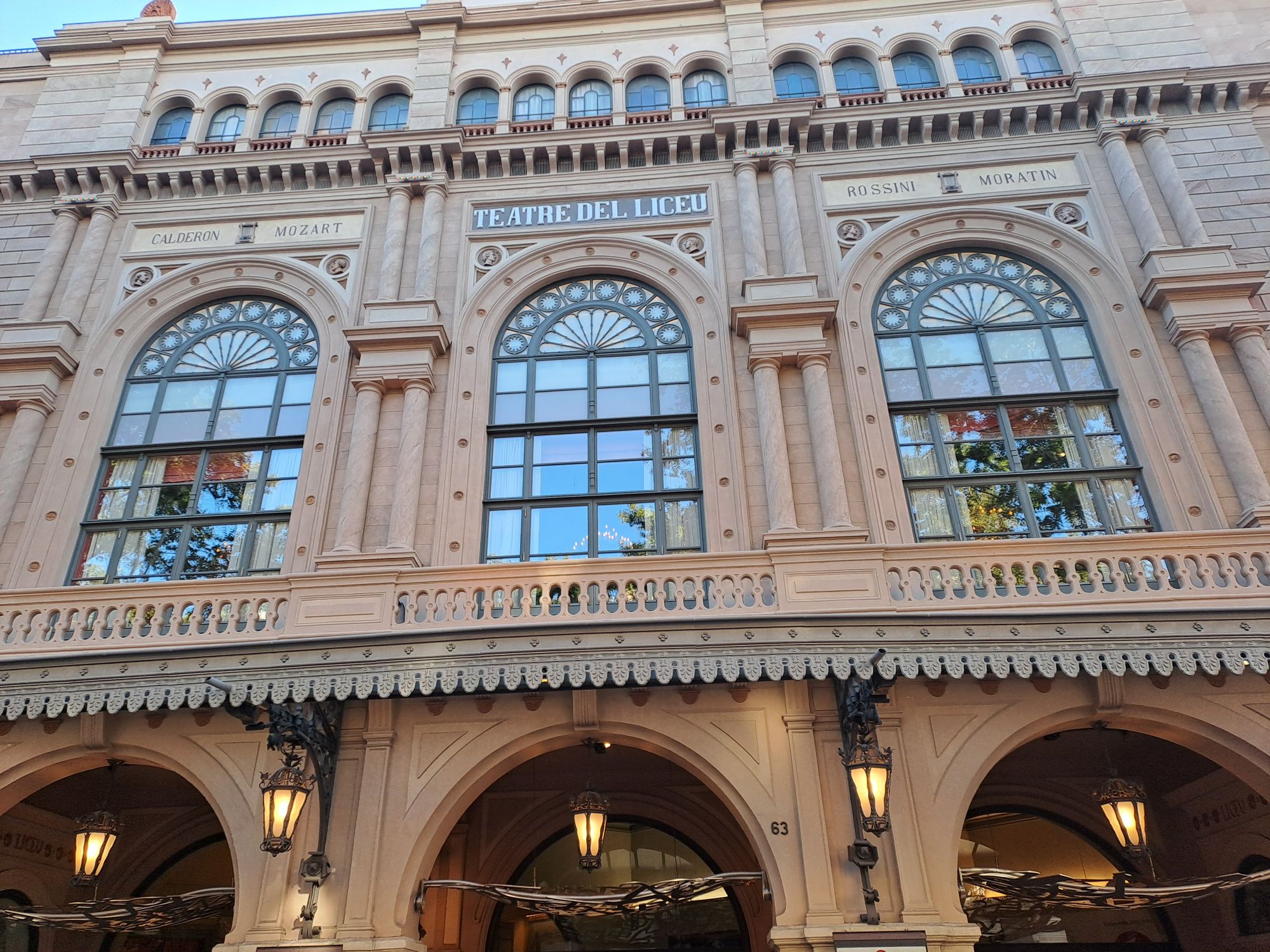
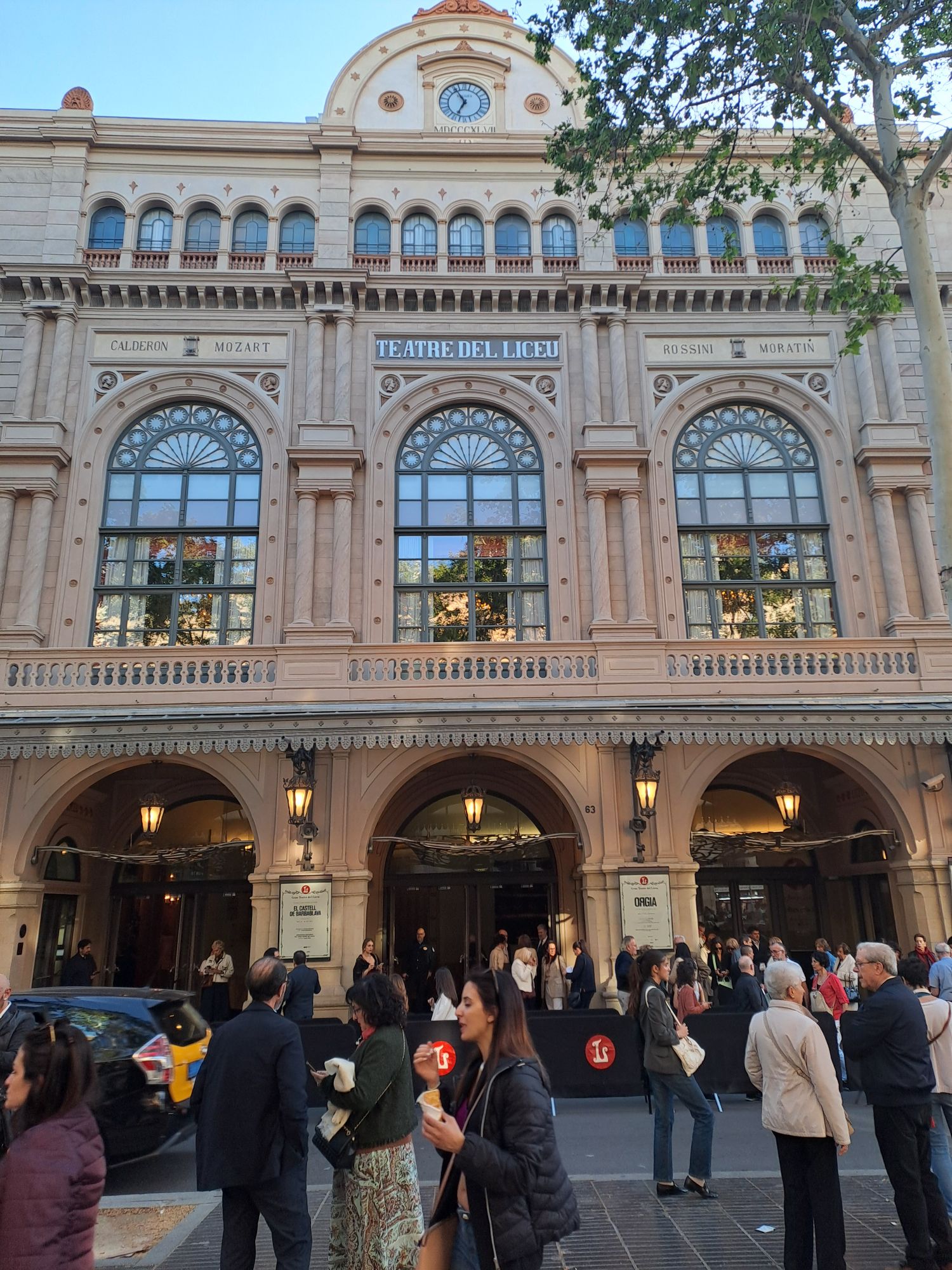
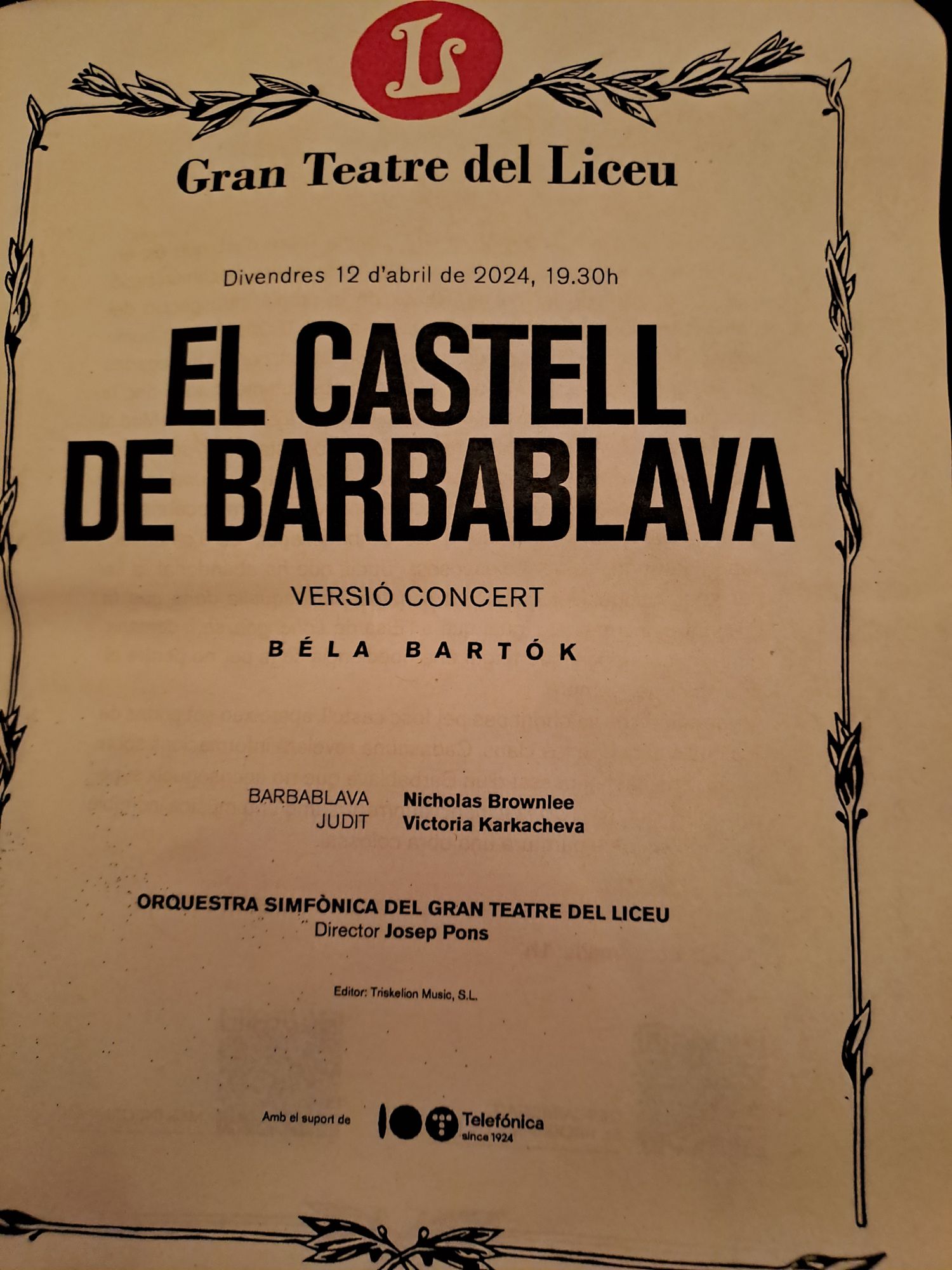
I was thinking last weekend that in, all the time I’ve spent in Barcelona this year, and all the times I’ve travelled through the Metro station called Liceu, I’ve never been inside the Gran Teatre del Liceu. I decided to remedy that by booking a ticket to see last night’s performance of Bluebeard’s Castle, a one-act Opera by Béla Bartók. The theatre is actually on La Rambla, and I had to dodge through the hordes of tourists to get there, but it’s an easy walk from my apartment.
El Liceu is indeed very beautiful inside and deserves its reputation as one of the world’s finest opera houses. The main hall is about the same size as that of the Royal Opera House in Covent Garden, with a seating capacity of over 2,000, and it does have a similar decor, with red and gold everywhere. When I booked my ticket (on Monday) there were plenty of seats available to choose from, so I wondered what the attendance would be like. As it turned out, it wasn’t quite full but there was a good crowd in.
I have seen Bluebeard’s Castle a couple of times before, but it surprises me that there are no old reviews in my back catalogue on this blog. From that observation I deduce that both times I saw it were before 2008, which is when I started blogging. I do think it’s a masterpiece, however, which is why I jumped at the chance to see and hear it again. Last night’s was a concert performance, i.e. without staging, which works well with this Opera as there are only two principals and it sometimes it’s good to leave a lot to the listener’s imagination. The performance was in the original Hungarian language, with surtitles provided in Catalan, Spanish and English.
The Opera is based on a French folk legend of Bluebeard, a murderous character foreshadowing Jack the Ripper, and Judith, who has for some reason fallen in love with him, despite it being widely believed that he murdered his previous wives. She travels with him to his castle and, when they arrive, she starts to ask Bluebeard some uncomfortable questions as she makes her way through the dark castle. Seven doors appear to which Bluebeard holds the keys. Each one will reveal information about the personality and past of a Bluebeard. The first door opens to reveal a blood-soaked torture chamber, for example. And that’s just the start…
The final door reveals his former wives, apparently still alive. But are they ghosts? Who knows? Judith doesn’t seem to mind. She becomes the fourth wife and disappears into the darkness enfolding the other three. That’s the end.
The Opera doesn’t really have that much to do with the folk story. It is really an allegory – the rooms contain secrets of Bluebeard’s past, including past relationships, which he has locked away deep inside himself. Only Judith’s persistent questioning can persuade him to reveal them.
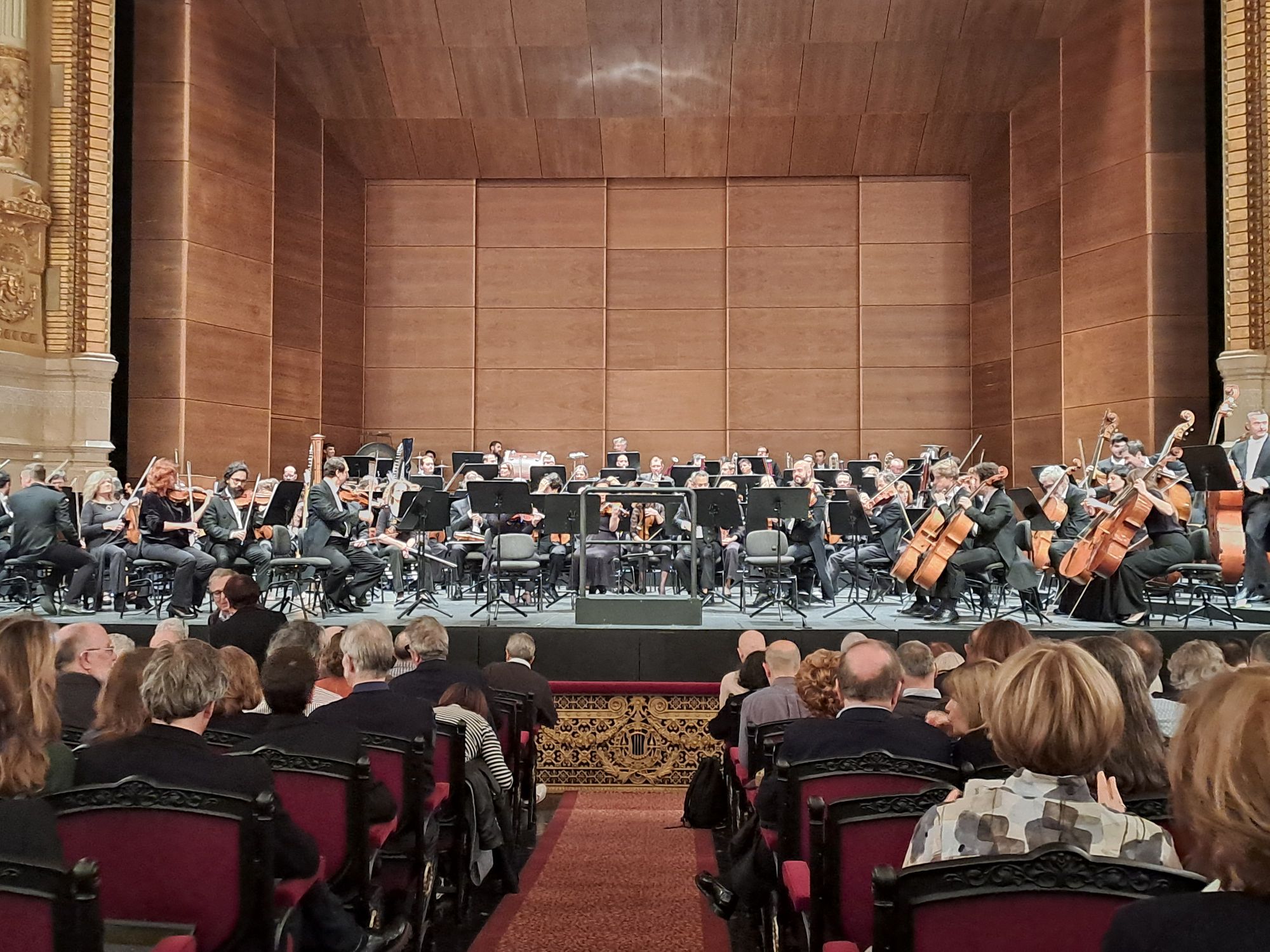
The music for Bluebeard’s Castle is extraordinarily rich and varied, changing as each door is opened. A large orchestra is needed to produce these changes of texture, as you can see in the picture I took before the performance. The musicians, under the direction of Josep Pons, played superbly as well as supplying eery sighs when the libretto demanded it. Vocals were supplied by bass-baritone Nicholas Brownlee as Bluebeard and mezzo soprano Victoria Karkacheva; both were excellent.
The performance lasted only about an hour. One of the things about going to an Opera in the evening is that one usually has to have something to eat before the performance, because it’s likely to be too late afterwards to find anywhere still serving food. That doesn’t apply here in Spain, where people generally eat rather late. I was thinking as I left last night that it was the first time I had been to an Opera that started at 7.30pm after which it was still too early to have dinner!
John Henry – Big Bill Broonzy
Posted in Music with tags Big Big Broonzy, Blues, Folk, John Henry, music, The Ballad of John Henry on April 2, 2024 by telescoperI’ve been meaning to post this track for some time but for some reason haven’t got around to it until now. It was recorded in Germany in 1951 and is a solo performance by legendary guitarist, blues singer and guitarist Big Bill Broonzy. The song, often called the Ballad of John Henry, tells the story of the folk hero John Henry, a man whose job was to use a 12lb hammer drive a steel drill into a rock to make holes for explosives to blast the rock in constructing a railroad tunnel. In the legend, John Henry is pitted against a steam-powered drill. He beats the machine, but is exhausted by his efforts and dies with his hammer in his hand.
By the way, you will hear reference in the song to a “shaker”. This was a man whose job it was to hold the drill – an object like a chisel – against the rock while it was struck by the hammer, and move it about to loosen the rock around it. I dread to think what happened if the hammerman missed the drill.
The historical facts around the location of the story of John Henry and indeed the identity of the hero are open to debate, but it’s a wonderful song and this is a brilliant and very characteristic performance of the song by Big Bill Broonzy whose singing, playing, and announcement to the song, will bring it all back to anyone lucky enough to hear him in the flesh. Bill Broonzy was on a European tour at the time this record was made, and I have back at home a very old LP of him singing and playing at the Dancing Slipper in West Bridgford, in Nottingham. I also have a copy of the album from which this performance is taken, the other side of which is by Graham Bell and his Australian Jazz Band. The full introduction to John Henry begins with Bill Broonzy saying rather sardonically “Thank you. Thank you. Thank you. I’m glad to be here too, don’t think I ain’t” before the rest of it that you hear.
The Magic Flute at the Sydney Opera House
Posted in Opera with tags Opera, Opera Australia, Sydney Opera House, The Magic Flute, Wolfgang Amadeus Mozart on February 29, 2024 by telescoper

I’m just back from my second night at the Sydney Opera House, at which I saw Opera Australia’s production of Mozart’s The Magic Flute. What has been a very warm day turned into a very sultry evening, and it was nice to take my drink outside during the interval to admire the view:

I’ve lost track of how many different productions I have seen of this strange and wonderful masterpiece, and this was a distinctly Australian version. Technically it’s not an opera, but a singspiel: the recitative – the bit in between the arias – is spoken rather than sung. It’s really more like a musical comedy in that sense, and was originally intended to be performed in a kind of burlesque style.
The Magic Flute also has many points of contact with the pantomime tradition, including the character of the villainous Monostatos who, in this performance, was reminiscent of Rolf Harris. Papageno was a working class Australian, sporting a mullet, and carrying an Esky in place of the usual array of nets and birdcages. On her first entrance, the Queen of the Night put me in mind of Gloria Swanson in Sunset Boulevard. Sarastro, with long hair and flowing robes, looked like the leader of some sort of New Age cult; his acolytes were dressed in everyday casual clothes. The three boys – referred to as “spirits” in this production – were actually two boys and a girl, but “spirit” is a gender-neutral term so that’s fine.
I won’t even attempt to explain the plot, if you can call it that, because it’s completely daft. It’s daft, though, in a way that much of life is daft, and I think that’s the secret of its enduring popularity. Mozart’s music carries you along and constantly seems to be telling you not to take it all too seriously. It seems to me that it must be hard to get the balance right between the comedy (which frequently border on the slapstick) and the serious. The worst thing to do is to make it too pompous. This production doesn’t fall into that trap, but in playing it virtually entirely for laughs I think it misses the depths that make a truly successful version. The ending – in which the rays of the Sun are supposed to dispel the darkness – involved a big reveal to a picnic with the chorus in beach wear and sunglasses. There’s a lot to be said for sunshine, and I found the idea mildly amusing, but there should be more to the end of this Opera than that. On the other hand, Pamina’s aria in Act II, when she is heartbroken because she thinks Tamino has abandoned her, was intensely moving, so it wasn’t all shallow.
The sets are simple but use clever devices to suggest the extraordinary scene changes required by the libretto, including pyramids, forests, waterfalls and flames. The ordeals by fire and water, for example, are depicted using reflective strip curtains, red for fire and blue for water. The dragon in Act I is conjured up by shadow puppets against a translucent curtain.
Papageno, played by an understudy whose name I didn’t catch, was the pick of the performers but overall the cast was not particularly strong vocally. David Parkin’s basso wasn’t nearly profundo enough for Sarastro and he struggled with the lowest notes. I’m not sure either why he also played The Speaker, who is a distinct role. Giuseppina Grech as the Queen of the Night looked fabulous and hit her high notes, but the elaborate coloratura passages were not well articulated.
This probably seems very negative than I intended. There is much to enjoy in this production. It’s very entertaining, and at times riotously funny. It was just a bit too superficial for my taste.

 In the Dark