I just remembered that today (February 3rd 2009) is the two hundredth anniversary of the birth of Felix Mendelssohn. Rather than sing Happy Birthday, I thought it would better to celebrate with a Song without Words. Mendelssohn wrote eight famous books each containing six Songs without Words for solo piano, but I’ve picked one written for piano and cello (Opus 109) because I think the cello can sing like no other instrument, and also because I found a rare clip that features the wonderful Jacqueline du Pré on cello, with her mother Iris du Pré on piano. Enjoy!
I noticed this morning that I’ve passed a bit of a milestone on here. I’ve actually reached my 100th post. That probably means I’ve been spending way too much time blogging but, undaunted, here I go again.
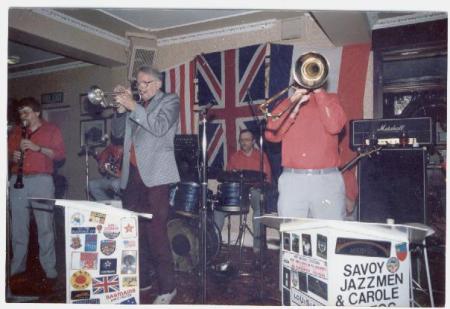
Ages ago (or it seems like ages ago) I posted an item about Humphrey Lyttelton and during the course of it I mentioned that my Dad had played the drums with Humph some years ago. I did mention in that post that I would put up a picture as soon as I found it, which I have now done. Here it is, taken probably somewhere around 1990.
I’m not entirely sure of the venue. I always thought this session took place in the Corner House in Newcastle but on closer inspection it doesn’t really look like it in this photograph so I wouldn’t bet on my memory being right. It’s not a great photograph, but that’s definitely my Dad (Alan Coles) on the drums. I don’t know the other personnel, but you do get a proper impression of how tall Humph was (he’s on trumpet, of course) .
Humph of course had his own band but many jazz venues (including the Corner House) preferred to invite soloists only to come and play with the house band. The main reason I think was that it was cheaper that way. And of course the local musicians loved it because they got to play with their heros. My Dad idolized Humphrey Lyttelton but when he finally got to play with him he was extremely nervous and didn’t particularly enjoy the evening.
Semi-professional bands like the Savoy Band shown here couldn’t afford fancy band uniforms or outfits so for some reason they all seem to settle on cheap red nylon shirts, as shown in the picture. I don’t know why because they’re not at all pleasant to wear if you’re going to be sweaty. But these shirts reminded me of a story that I’ve bored people with over many years. When I was little (in the 70s) there was a similar band in Newcastle called the Phoenix Jazz Band. They also wore horrible red nylon shirts for gigs, except for their young bass player (a guy called Gordon) who refused to do so. This uppity young student teacher turned up for gigs in a black-and-yellow hooped jersey so he looked rather like a bumble-bee or a wasp. The rest of the band called him, rather sarcastically, Sting. He soon went on to other things but the name stuck.
My dad always claimed that Sting had played the double bass in our garage – when I lived in Benwell village. I don’t remember having seen him though, and I might well have been having my leg pulled. Actually it wasn’t a garage anyway, more of a big wooden shed where he kept his drums and lots of other junk.
Anyway, I don’t know if I’ve mentioned this but I did for a while have dreams of becoming a Jazz musician myself. I wanted to be a saxophonist but my Dad persuaded me that I should learn to play the clarinet first and it would be easy then to switch to sax. I don’t think it was very good advice because they’re quite different instruments to play, but I rather think he had pushed the clarinet because he wanted me to play traditional Jazz rather than modern stuff.
I found that I had quite a good ear for music and a pretty good sense of rhythm so I mastered the rudiments fairly quickly but never got much further than that. I even got as far as sitting in with some bands, but never became a full-time member of one.
Sitting in with one of these traditional Jazz bands is a very informal business. Usually the repertoire consists of standard tunes that everyone knows and there are no real arrangements as such. The trumpet usually plays the lead for a chorus or two, with impromptu clarinet and trombone alongside, then there’s a sequence of solos (usually a couple of choruses for each player, unless you really get into it and the leader shouts “take another!”), and then you play out to the end. Other than that you make it up as you go along.
But there is one notable exception to this, a number called High Society. This probably began as a Mardi Gras parade tune but later on came to be played as an up-tempo flag-waver. Almost every Jazz band, however, plays it the same way. It starts with a sort-of call to arms with drum rolls and a few phrases on the horns a bit like a fanfare before moving into tempo and it has quite a few scored passages that are played straight (i.e. without improvisation). When it breaks eventually into the solos there is an unwritten rule that the clarinet soloist plays a standard set-piece solo obbligato, at least for one chorus, after which it’s back to the more normal improvised solo.
I don’t know how this became such a strong tradition but you can check it out yourself. There are dozens of versions of High Society played by different Jazz bands and the clarinettist will always play the same basic notes. There’s a classic recording by Jelly Roll Morton on which there are two clarinettists (Albert Nicholas and Sidney Bechet) who both play the original licks, one after the other.
The story I heard was that this solo (as well as possibly the tune itself) was written by a man called Alphonse Picou who was born in 1878 and played with the first real Jazz band in New Orleans, which was led by the legendary figure of Buddy Bolden, the first great jazz trumpeter. Bolden died in 1931 but no recordings by him have ever come to light because he stopped playing before 1910 and spent most of the rest of his life in mental institutions. It is said that Buddy Bolden’s band did make a cylinder recording, but this grail-like object has never been found.
High Society is such a well known tune and is such fun to play that it is very often part of after-hours Jam sessions at clubs like the Corner House where I did once actually play the Alphonse Picou solo from memory (or at least some sort of approximation to it), having heard it so many times on different records.
Last weekend, when I was playing around on Youtube, I chanced upon a bit of film of New Orleans Jam Session from 1958. It was looking back down a very long tunnel into ancient history but you could have knocked me down with a feather when I saw, sitting down next to the piano at the left, the great man himself, Alphonse Picou. I never thought there would be a film of him, thinking that he was, like Buddy Bolden, an almost mythical figure. I later found elsewhere, a clip from the same session of him playing his own famous solo! However, he was 80 years old and very frail at the time and he doesn’t actually play it that well so I’ll spare his posthumous blushes (he died in 1961) by picking a rather better number from the same session.
The tune I’ve picked to put on here is called Mamie’s Blues. They play it with that lovely lazily lilting beat that’s so typical of authentic New Orleans Jazz but is actually so difficult to get right. And if it wasn’t enough to see Alphonse Picou, there are several other legendary names too: Paul Barbarin (drums), George Lewis (clarinet) and Jim Robinson (trombone) amonst others. The session happened 50 years ago at which point these were all very old men and they’re all long gone now.This clip, to me, is every bit as important a piece of history as, say, an original score by Mozart.
They may all look like they’ve seen better days, but they certainly still knew how to play!
I was very sad yesterday to hear of the death at the age of 83 of the pioneering children TV’s presenter Tony Hart. The newspapers and television have been filled with suitably glowing tributes to him, because he was not only a superb presenter but also a warm and generous person. That’s quite a rare combination in the world of television, so I’m told.
I knew of him primarily through Vision On, a programme which I watched avidly as a child, and only found out much later on that it was intended to be for deaf children. The show involved comedy sketches and cartoons, as well as Tony Hart’s contributions which involved creating works of art live in front of the camera. He hardly ever spoke and used only the simplest of materials to create very beautiful things with the idea that this would inspire his audience to get in touch with their artistic side without making it look too much like a lesson. He did it brilliantly.
Here’s the middle chunk of a broadcast from 1975 which will bring it all bank to those of you of a certain age like me, but notable also in that it includes Sylvester McCoy who later became the 7th Doctor Who:
Best of all, this segment ends with my favourite bit, The Gallery, accompanied by a piece of music which is almost as redolent with nostalgia for me as the theme from Doctor Who. The track concerned is called Left Bank Two and was performed by the Noveltones; it can be heard here in full. Just a trio of vibraphone, guitar and drums played with brushes, I think it’s a masterpiece of relaxed simplicity. Nobody got his collar wet playing it, that’s for sure. It’s the sort of music you might have expected to hear in a smart cocktail bar in the early 60s but is now inextricably linked to The Gallery.
I was struck watching the above clip just how good the childrens’ drawings and paintings were too. I tried several times to get something shown in The Gallery, but never succeeded.
Searching the net for material about one of the world’s leading astronomy projects The Square Kilometre Array, I inadvertently used the well-known abbreviation SKA in Google and was inundated with sites about Ska, the Jamaican music genre that paved the way to Reggae and also fuelled the 2 Tone movement which swept the UK music scene in 1979.
When I was still in School, I was never a big fan of Punk (which immediately preceded Ska in popularity), but absolutely loved bands like The Specials, The Beat and especially Selecter. I adored the music, but also loved their inclusive multi-racial philosophy. Being a bit of an anorak I actually managed to get hold of some of the very rare original Ska recordings, principally by the superb Skatalites who are still going almost 50 years after they were founded. This wonderful band specialised in irreverent and highly eccentric cover versions of movie film tunes from the 1960s including Doctor Zhivago and James Bond, plus the classic Guns of Navarone.
Ska was usually played (at least nominally) in 4-4 time, but each beat was really a cluster of sub-beats forming a triplet. Usually the drummer put a heavy bass accent (and usually a side stick or rim shot on the snare) on the 3rd component of each triplet, and there would be guitar chops, other percussion, and/or brass riffs on the “off” beats. It is said that this structure was inherited, at least in part, from the marching bands that played in Jamaica and it does give a kind of strutting feel to the overall pulse. But wherever it came from the beat gives the music an infectious lilting rythm that gives anyone dancing to it an irresistible urge to jump up and down, especially on up-tempo numbers. The tripletty structure also gives those with no sense of rythm a greater probability of moving in time with at least one relevant beat. Ska also spawned Reggae which inherited its curious rythmic figure, but added a bass accent on the 1st and 3rd beats of the bar (the “on” beats”) and was generally played much slower.
In need of a bit of cheering up I abandoned my quest for astronomical learning and went on yet another trip down memory lane via Youtube, which I enjoyed enormously, so I decided to put up here a piece full of nostalgia for me which I hope at least some of you might enjoy.
Here are The Specials, recorded on British TV in 1979 (a programme which I think I actually watched at the time). They are playing the theme from The Guns of Navarone as a direct tribute to the Skatalites, whose wonderful original version you can also find on Youtube here (although it is really just audio).
A new season is about to start at English National Opera and I’ve been spending a lot of time and money recently getting tickets for some of the operas, as well as organizing the logistics of getting to and from London. Among the forthcoming productions is a revival of Nicholas Hytner’s production of Mozart’s The Magic Flute (Die Zauberflöte, K. 620).
I can’t remember how many times I have seen this opera performed nor in how many different productions. It’s a wonderful creation because it manages to combine being utterly daft with being somehow immensely profound. The plot makes no sense at all, the settings are ridiculous (e.g. “rocks with water and a cavern of fire”), and the whole thing appears to be little more than a pantomime. Since it’s Mozart, though, there is one ingredient you can’t quibble with: a seemingly unending sequence of gorgeous music.
When I first saw The Magic Flute I thought it was just a silly but sublime piece of entertainment not worth digging into too deeply. I wondered why so many pompous people seemed to take it so terribly seriously. Real life doesn’t really make much sense, so why would anyone demand that an opera be any less ridiculous? Nevertheless, there is a vast industry devoted to unravelling the supposed “mystery” of this opera, with all its references to magic and freemasonry.
But now I can unveil the true solution of problem contained within the riddle encoded in the conundrum that surrounds the enigma that has puzzled so many Opera fans for so long. I have definitive proof that this opera is not about freemasons or magic or revolutionary politics.
Actually it is about particle physics.
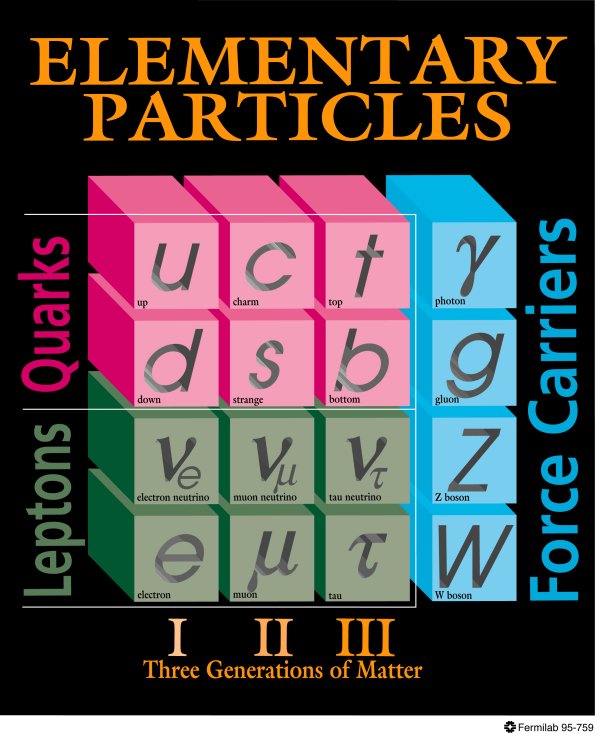
To see how I arrived at this conclusion note the following figure which shows the principal elementary particles contained within the standard model of particle physics:
To the left of this picture are the fermions, divided into two sets of particles labelled “quarks” and “leptons”. Each of these consists of three pairs (“isospin doublets”), each pair defining a “generation”. This structure of twos and threes is perfectly represented in The Magic Flute.
Let’s consider the leptons first. These can be clearly identified with the three ladies who lust after the hero Tamino in Act 1. This emotional charge is clearly analogous to the electromagnetic charge carried by the massive leptons (the electron, muon and tauon, lying along the bottom of the diagram). The other components in the leptonic sector must be the three boys who pop up every now and again to help Papageno with useful advice about when to jangle his magic bells. These must therefore be the neutrinos, which are less massive than the ladies, and are also neutral (although I hesitate to suggest that this means they should be castrati). They don’t play a very big part in the show because they participate only in weak interactions.
Next we have the quarks, also arrayed in three generations of pairs. These interact more strongly than the leptons and are also more colourful. The first generation is easy to identify, from the phenomenology of the Opera, as consisting of the hero Tamino (d for down) and his beloved Pamina (u for up); her voice is higher than his, hence the identification. The second generation must comprise the crazy birdcatcher Papageno (s for strange) and his alluring madchen who is called Papagena (c for charmed). That just leaves the final pairing which clearly is the basso profundo and fount of all wisdom Sarastro (b for bass bottom) and my favourite character and role model the Queen of the Night (t for top).
To provide corroboration of the identification of the Queen of the Night with the “top” quark, here is a clip from Youtube of a bevy of famous operatic sopranos having a go at the immensely different coloratura passage from the Act 1 aria “O Zittre Nicht, mein leiber Sohn” culminating in a spectacular top F that lies beyond the range of most particle accelerators, never mind singers.
There’s some splendid frocks in there too.
The Queen of the Night isn’t actually in the Opera very much. After this aria in Act 1 she disappears until the middle of Act 2, probably because she needs to have a lie down. When she comes back on she sings another glass-shattering aria (Der Hölle Rache kocht in meinem Herzen), which I like to listen to when I’m writing referee reports. The first line translates as “The rage of hell is boiling in my heart”.
The remaining members of the cast – The Speaker and Monostatos, as well as sundry priests, slaves, enchanted animals and the chorus – must make up the so-called Force carriers at the left of the table, which are bosons, but I haven’t had time to go through the identifications in detail. They’re just the supporting cast anyway. And there is one particle missing from the picture, the Higgs boson. This accounts for the masses of other particles by exerting a kind of drag on them so it clearly must be the Dragon from Act 1.
As a Professor of Astrophysics I am often asked “Why on Earth did you take up such a crazy subject?”
I guess many astronomers, physicists and other scientists have to answer this sort of question. For many of them there is probably a romantic reason, such as seeing the rings of Saturn or the majesty of the Milky Way on a dark night. Others will probably have been inspired by TV documentary series such as The Sky at Night, Carl Sagan’s Cosmos or even Horizon which, believe it or not, actually used to be quite good but which is nowadays uniformly dire. Or it could have been something a bit more mundane but no less stimulating such as a very good science teacher at school.
When I’m asked this question I’d love to be able to put my hand on my heart and give an answer of that sort but the truth is really quite a long way from those possibilities. The thing that probably did more than anything else to get me interested in science was a Science Fiction TV series or rather not exactly the series but the opening titles.
The first episode of Doctor Who was broadcast in the year of my birth, so I don’t remember it at all, but I do remember the astonishing effect the credits had on my imagination when I saw later episodes as a small child. Here are some tests for the sequence as it appeared in the very first series featuring William Hartnell as the first Doctor.
To a younger audience it probably all seems quite tame, but I think there’s a haunting, unearthly beauty to the shapes conjured up by Bernard Lodge. Having virtually no budget for graphics, he experimented in a darkened studio with an old-fashioned TV camera and a piece of black card with Doctor Who written on it in white. He created the spooky kaleidoscopic patterns you see by simply pointing the camera so it could see into its own monitor, thus producing a sort of electronic hall of mirrors.
What is so fascinating to me is how a relatively simple underlying concept could produce a rich assortment of patterns, particularly how they seem to take on an almost organic aspect as they merge and transform. I’ve continued to be struck by the idea that complexity could be produced by relatively simple natural laws which is one of the essential features of astrophysics and cosmology. As a practical demonstration of the universality of physics this sequence takes some beating.
As well as these strange and wonderful images, the titles also featured a pioneering piece of electronic music. Officially the composer was Ron Grainer, but he wasn’t very interested in the commission and simply scribbled the theme down and left it to the BBC to turn it into something useable. In stepped the wonderful Delia Derbyshire, unsung heroine of the BBC Radiophonic Workshop who, with only the crudest electronic equipment available, turned it into a little masterpiece. Ethereal yet propulsive, the original theme from Doctor Who is definitely one of my absolute favourite pieces of music and I’m glad to see that Delia Derbyshire is now receiving the acclaim she deserves from serious music critics.
It’s ironic that I’ve now moved to Cardiff where new programmes of Doctor Who and its spin-off, the anagrammatic Torchwood, are made. One of the great things about the early episodes of Doctor Who was that the technology simply didn’t exist to do very good special effects. The scripts were consequently very careful to let the viewers’ imagination do all the work. That’s what made it so good. I’m pleased that the more recent incarnations of this show also don’t go overboard on the visuals. Perhaps thats a conscious attempt to appeal to people who saw the old ones as well as those too young to have done so. It’s just a pity the modern opening title music is so bad…
Anyway, I still love Doctor Who after all these years. It must sound daft to say that it inspired me to take up astrophysics, but it’s truer than any other explanation I can think of. Of course the career path is slightly different from a Timelord, but only slightly.
At any rate I think The Doctor is overdue for promotion. How about Professor Who?
A few days ago I heard of the death at the age of 70 of the legendary jazz trumpeter, Freddie Hubbard. He had been ill for some time and had been in hospital in Los Angeles after having a heart attack about a month ago. His death closes a brilliant chapter in the book of American Jazz, as Freddie Hubbard was last survivor of triumvirate of brilliant young trumpeters who revitalised the jazz scene of the late 50s and provided an alternative direction to that of Miles Davis. The other members of this trio were Booker Little (died of kidney failure in 1961, aged 23) and Lee Morgan (shot to death in 1972, aged 33). Stylistically these players were descended from the great Clifford Brown who also died tragically young (in a car accident in 1956 at the age of 25), but Freddie Hubbard was the only one to achieve some measure of physical longevity alongside a longlasting musical reputation.
One of the first modern jazz albums I ever bought (Herbie Hancock’s Takin’ Off), featured Freddie Hubbard with Dexter Gordon on tenor sax. His solo on the track Watermelon Man is rightly acknowledged as a classic and it remains one of my absolute favourite trumpet solos to this day. In a completely different style, but also on the famous Blue Note label, he played with the outrageously brilliant Eric Dolphy on the pioneering free jazz album Out to Lunch.
I’ve been meaning to put something up about Eric Dolphy for some time because I think of him as an utter genius, but that will have to wait. I will, however, carry on in a somewhat morbid vein to point out that he died aged 36 in 1964 of diabetic shock while on tour in Berlin. He had collapsed onstage after taking an incorrect insulin dose and was taken to hospital. The doctors there, however, had no idea he was diabetic and assumed he had taken a drug overdose and failed to take the simple course of action that would have saved his life.
Freddie Hubbard was a versatile and virtuosic player, who played on a staggering number of the greatest jazz records of his time. That’s what you have to do to become a legend. I think he will probably be best remembered for the driving hard-bop style exemplified by drummer Art Blakey‘s magnificent band The Jazz Messengers, which Freddie joined in 1961 after replacing Lee Morgan as the trumpeter. This band survived many incarnations until the leader died in 1990. I saw them play live in 1980 and they were terrific.
Here they are in 1961, just after Freddie joined them, on a live version of the classic Moanin’ with Cedar Walton on piano, Curtis Fuller on trombone and Wayne Shorter on tenor sax.
I missed an important anniversary this week. Had she still been alive, December 2nd 2008 would have been the 85th birthday of the most renowned opera singer of her time, Maria Callas.
She was born in 1923 in New York city of Greek parents who had moved there the previous year, and christened Maria Anna Sofia Cecilia Kalogeropoulou. Disenchanted with her deteriorating marriage, her mother abandoned her husband and took Maria and her sister back to Athens in 1937. Maria enrolled at the National Conservatoire of Greece the same year after winning a scholarship with the quality of her voice, which
was warm, lyrical, intense; it swirled and flared like a flame and filled the air with melodious reverberations.
At this age, Maria was a rather plump young lady with a rather deep voice. Initially, she aspired to be a contralto but at the Conservatoire she was encouraged instead to become a dramatic soprano. Accordingly, she underwent special training to raise her natural pitch (or tessitura) and learned how to control her remarkable voice more accurately so she could sing in a sufficiently disciplined fashion that she could take on the dazzling coloratura passages that she would perform in later years with such success. She also worked on her chest tones to broaden the scope of her voice in the mezzo region. Although she became more technically refined as a singer during this period, there were some things that didn’t change. One was the sheer power of her voice, which is something that we tend to notice less in these days of microphones and studio recordings. People who heard her sing live confess to being shocked at the sheer scale of sound she could deliver without amplification. Perhaps more tellingly, she eschewed many of the devices sopranos tended to use to control the highest notes, usually involving some alteration of the throat to produce accuracy at the expense of a thinner and more constricted tone. When Callas went for a high note, she always did so in a full-throated manner. This often produced a piercing sound that could be intensely dramatic, even to the extent of almost knocking you out of your seat, but it was a very risky approach for a live performance. Audiences simply weren’t used to hearing a coloratura sing with such volume and in such a whole-hearted way. It wasn’t always pretty, but it was certainly remarkable and often very moving. It was this aspect of her voice that led her friend Tito Gobbi (who sang with her in Tosca) to call it una grande vociaccia, which I translate in my schoolboy Italian as meaning something like “a big ugly voice”. That isn’t meant to be as disparaging as it sounds (Gobbi was a great admirer of Callas’ singing).
Having listened to lots of recordings of Maria Callas I have to admit that they are certainly not all good. Sometimes the voice didn’t come off at all. Unkindly, one colleague said that she “sang with her ovaries”. When she talked about her own noice, Callas herself often referred to it as if it were some independent creature over which she had very little control. Anyway, whatever the reason, when she was bad she was definitely bad. But I adopt the philosophy that one should judge artists (and scientists, for that matter) by their best work rather than their worst, and when Callas was good she was simply phenomenal, like a sublime and irresistible force of nature. That’s why they called her La Divina.
Although her talent was very raw in the beginning there was no question that she always had a voice of exceptional power and dramatic intensity. When she started singing professionally she immediately attracted lavish praise from the critics not just for her voice but also for her acting. As a young soprano she sang in an astonishing variety of operas, including Wagner‘s Tristan und Isoldeand Die Walküre, neither of which one would now associate with Callas.
It was in the late 194os that Callas began to take an interest in the type of opera that would really make her name. Bel canto opera was rather unfashionable at that time, probably because audiences preferred the grittier and more realistic verismo style. Virtually single-handed, Callas resurrected the bel canto canon by injecting a true sense of drama into works which had previously just been seen as vehicles for the singers to demonstrate their art. Callas brought an entirely new dimension to the great operas by Bellini (Norma, I Puritani, La Somnambula…) and Donizetti (Lucia di Lammermoor, Anna Bolena), although she was sufficiently versatile to also perform brilliantly in the verismo syle of Verdi and Puccini as well as lesser known composers such as Giordano (Andrea Chenier). Recordings of many of these performances are available, but it is sad that this glorious period of her singing career happened just a bit before high quality equipment was available so the true glory of her voice isn’t always evident.
In 1953, Callas decided that she wanted to change her appearance, perhaps so she would look more appropriate for the parts she was playing on stage. At the time she weighed almost 200lbs. In order to lose weight as quickly as possible, she followed the barbarous but highly effective expedient of swallowing a tapeworm. She lost 80lbs in a matter of months. The dramatic loss of weight changed her body and her face, emphasizing her high angular cheekbones and giving her a striking look very well suited to the opera stage. But it also affected her voice somewhat, especially at the upper end where she seems to have found it more difficult to avoid the dreaded “wobble” which was one of the alleged imperfections that critics tended to dwell upon.
Callas also had very poor eyesight which required her to wear very thick spectacles in order to see at all, a thing she refused to do onstage with the result that she was virtually blind during performances. In fact, during a performance of Tosca at Covent Garden she leant too far over a candle and her hair caught fire. Improvising magnificently, Tito Gobbi, as the loathsome Scarpia, extinguished the fire by throwing water at her before the audience had noticed. Although they weren’t much use for seeing with, her eyes were a great asset for her acting, in turns flashing like a demon then shining like an angel.
After her weight loss, Callas was suddenly no longer just a wonderful singer but also a strikingly beautiful woman. Her career took a back seat as she started to revel in the glamorous lifestyle that opened up in front of her. Her voice deteriorated and she performed rather less frequently. Eventually she embarked on a love affair with Aristotle Onassis, a notorious serial collector of trophy women. She hoped to marry him but he abandoned her to marry Jackie Kennedy, widow of John F. Kennedy.
She never really recovered from the failure of this affair, retired from singing and lived out the last years of her life as a virtual recluse in her apartment in Paris. She died in 1977.
I had heard a lot about Maria Callas when I was younger, but the recordings that I listened to (generally from the 1960s) were really not very good as her voice was undoubtedly much diminished by then. I just assumed that, as is the case with many artists, the legend of Callas was all mere hype. Then, about fifteen years ago, I was listening to BBC Radio 3 and they played the final scenes of the great 1954 recording of Norma with Callas in the title role, conducted by Tullio Serafin. I was completely overwhelmed by it and tears flowed freely from my eyes. I’ve always had a tendency to blub when I hear really beautiful music, but as I’ve got older I’ve learned not to be embarrassed by it. At least I don’t cry at football matches.
In England, Callas is probably best remembered for her performances in Tosca in Covent Garden. I have recordings of her in that role and they are really wonderful. But there are many fine recordings of Tosca by other singers, some of which are almost as good. In the case of Norma, though, there isn’t any other performance that comes within a mile of the Callas version. Or if there is, I’ve yet to hear it.
Now I know that there are some people, even opera lovers, who just don’t get Callas at all (just look at the comment boards on Youtube). I grant that she wasn’t always the most accurate singer, and I don’t think you could say her voice had a purely classical beauty. But even if you don’t like her voice you have to admit that she revitalized the opera stage and brought a new public into the theatres. I can’t imagine what the state of opera would be now, if there hadn’t been a Callas and you can’t argue that she is now an iconic figure. What I admire most about her is that, like it or loath it, her voice is instantly recognisable. In this sense, she always puts me in mind of a kind of operatic version of Billie Holliday. She’s a far cry from the many bland mediocrities that pass themselves off as opera singers nowadays.
I’m going to end with the obligatory clips from Youtube. There’s a lot of Callas on there, not all of it good. I’ve chosen a couple of items, although neither of them has a proper video. The first was performed live in 1955 in front of the notoriously difficult audience at La Scala in Milan and recorded from a radio broadcast so that the sound quality is quite poor. A studio recording of this aria, from Andrea Chenier, features most movingly in the film Philadelphia. This live version, however, is notable for a number of reasons. One is that you get some idea of the power of the Callas voice in the way she pushes aside the entire orchestra and is even able to cut through the distortions introduced by the rather primitive recording technology. The second thing is that she sings it so beautifully, with such feeling, lovely phrasing, and so much colour and vitality. Listen to the way the texture of her voice matches perfectly her changing emotions as she tells her story. The shattering, climactic high C that occurs near the end is a perfect example of what I was saying above. She stabs this note out like her life depended on it. It sends shivers down my spine and clearly had the same effect on the audience. The thunderous applause that follows the end of this aria is quite frightening in its intensity, but gives a good idea how much her public adored her. If you can put up with the lo-fi recording, this is certainly a better performance than the studio version.
The final piece has to be from Norma. I think Bellini is a wonderful composer of opera, but he doesn’t make life easy for the singers. There’s never any doubling of the vocal line by the orchestra so the singer is very exposed. This doesn’t bother Maria Callas. This is the famous aria Casta Diva, which has become a kind of signature tune for her and it’s one of the pieces that she always seemed to perform beautifully. It might be a bit hackneyed but I love it and, after all, it’s my blog. There’s also a nice compilation of pictures.
I’d be interested to hear what the general opinion of Callas is based on a sample of the two or three people who read my blog, so please feel free to add your comments!
I still don’t seem able to shake off this cursed cold that I’ve had for nearly a week. I resorted to finding some of my favourite clips on youtube to cheer myself up. Actually these are so funny I think I’m quite likely to have a relapse. If there’s anyone else out there in the blogosphere who’s feeling a bit under the weather, I thought I’d share a couple of uplifting cultural moments with you.
The first is by the brilliantly talented musician and comedian Dudley Moore, who performs this hysterically funny parody of a Beethoven Piano Sonata. Dudley Moore was best known as a comedian and actor but music was his first love, and he was a wonderful pianist who could play lovely jazz as well as classical pieces. His only fault was probably that he never really acquired a style of his own. Playing Jazz, he usually sounded like Errol Garner and on the classical side he was much disposed to affectionate piss-takes like this. I particularly love the drawn-out ending which seems to take up about half the track! I wonder what old Ludwig Von would have thought of this? I suspect he would have loved it. Don’t believe everything you hear about Germans having no sense of humour.
The second is by the Danish comedian (yes, there are such things), Victor Borge. Playing half of Liszt’s Hungarian Rhapsody. It says on Youtube that it’s No. 2 but I think it’s great.
I’ve been off sick for the last few days with a nasty bug, but at least it’s given me the chance to listen to quite a lot of music. Yesterday, I was playing some of the classic recordings made in the 1930s by singer Billie Holiday and saxophonist Lester Young. I’ve had these for ages but for some reason haven’t listened to them for a while. Coming back to them after a long break just strengthened my belief that they are amongst the greatest recordings ever made in music of any kind.
Billie Holiday was born in Baltimore in 1915. After a grim and traumatic childhood she dabbled with prostitution and then ended up as a night club singer where she was spotted by talent scout John Hammond who arranged for her to make recordings with Benny Goodman‘s Orchestra in 1933. Most people don’t realise this but, by 1935, this band was a pop sensation on exactly the same scale as, say, the Beatles were to achieve three decades later.
In her early recording career, Billie wasn’t so well known so she was given relatively unpromising songs to sing. With her unique sense of phrasing, and a willingness to take outrageous liberties with both melody and rhythm, she turned out to be brilliant at turning this base metal into gold; some he was undoubtedly the best singer of a bad song there has ever been. If you ever get the chance to hear her versions of When you’re smiling or Back in your own Backyard you can marvel at how she manages to say everything about life and death using only the slenderest of lyrics.
Also featuring on both of these classic tracks was the tenor saxophonist Lester Young. Nicknamed “The President”, or “Prez” for short, he was one of the greatest of all Jazz musicians. He had a sublime gift for melodic improvisations, coupled to unrivalled sense of sheer swing as befits a mainstay of Count Basie‘s magnificently propulsive big band of the late 1930s. The sound of Lester Young at full throttle with the Basie Band riffing away behind him must have been truly magnificent to hear live and is thrilling enough on record.
Although he wasn’t at all averse to a bit of rabble rousing, and loved to see people dancing as he played, Lester Young’s solos on the Billie Holiday recordings mentioned above showed the delicate side of his nature. People often say is that the reason the two of them worked so well together musically was that they had similar sense of phrasing. I don’t agree with that at all. Billie Holiday’s vocal style sound to be more like a feminine version of Louis Armstrong’s, derived from a trumpeter’s mannerisms rather than those of a saxophonist.
Lester Young and Billie Holiday became very close friends during this period, although there is no sign that they had any form of sexual relationship. Rumours have circulated that Lester Young was gay, although I don’t think there’s any evidence to back them up. It is true that he had a rather eccentric and perhaps effeminate demeanour, but it seems that’s just the way he was. During the war, Lester Young was conscripted into the US Army and this had a dreadful effect on him personally and on his career, not least because he wasn’t allowed to play his saxophone at all. The strict discipline and macho posturing of the army affected this gentle and introverted man very badly and drove him to a nervous breakdown. He was eventually discharged from the army and, although he started playing again, his career never regained the heights it had reached in the 1930s. He had frequent bouts of ill health owing to alcoholism and drug abuse and his recordings from the late forties and fifties are of uneven quality.
Billie Holiday’s career was also in decline during the 1940s, after she became addicted to heroin, and she was imprisoned on drugs charges in 1947. Cigarettes, booze and hard drugs ravaged her voice and, although she made a number of classic records in the 1950s, her vocal style was sometimes mannered and self-conscious. I definitely prefer the earlier recordings which show her at her most original. That said, there was one song from George Gershwin‘s Porgy and Bess that invariably inspired her to an intensely moving performance, including this sensational recording made just five months before her death in 1959.
But the reason for putting this all on my blog was that playing through these old records I remembered when I used to listen to Humphrey Lyttelton‘s Jazz programme on the radio. He once admitted on the air that there was a TV recording involving Billie Holiday and Lester Young that he couldn’t watch without bursting into tears. The programme “Sounds of Jazz” was made by CBS Television in the United States in 1957 and features a vast array of great musicians, including Miles Davis and Thelonious Monk. But this excerpt is the bit that always got Humph going, and I don’t wonder why.
Lester and Billie had at one time been very close indeed, but had become estranged for some reason, and hadn’t recorded together for the best part of twenty years before this. Time had exacted its toll on both of them. Prez, in fact, was very ill during this broadcase and he looks it. Barely able to stand or hold the horn, when he plays he still manages to deliver a moving and poignant solo. The camera cuts to Billie’s reaction, full of tenderness and empathy and the emotional effect is overwhelming. So intense is that moment that you tend to forget the other magnificent players on this track (including Coleman Hawkins, the other leading saxophonist of the 1930s whose style was very different, but whom Lester Young deeply admired). As Nat Hentoff later recalled
Lester got up, and he played the purest blues I have ever heard, and [he and Holiday] were looking at each other, their eyes were sort of interlocked, and she was sort of nodding and half–smiling. It was as if they were both remembering what had been — whatever that was. And in the control room we were all crying. When the show was over, they went their separate ways.
Lester Young died in March 1959, a little over a year after this performance. In a taxi returning home from his funeral, Billie told a friend that she thought she would be the next. She died in July the same year.
The views presented here are personal and not necessarily those of my employer (or anyone else for that matter).
Feel free to comment on any of the posts on this blog but comments may be moderated; anonymous comments and any considered by me to be vexatious and/or abusive and/or defamatory will not be accepted. I do not necessarily endorse, support, sanction, encourage, verify or agree with the opinions or statements of any information or other content in the comments on this site and do not in any way guarantee their accuracy or reliability.

 In the Dark