The production of Boris Godunov now playing at the Coliseum has had mixed reviews, largely because of the performance of Peter Rose as the tormented Tsar. I usually don’t find myself agreeing very much with what music critics say and I had been looking forward to English National Opera’s take on Mussorgsky‘s opera for some time. My trip to London this weekend gave me an excuse to see it for myself and form my own opinion.
The opera is based on a play by Pushkin which tells a story based on the historical figure who ruled Russian from 1598 until 1605. In the play, Boris Godunov only becomes Tsar after murdering the son Dmitriy of the previous Tsar, Ivan IV (“the terrible”) and is plagued with ghostly visions of the dead boy. His guilt drives him into madness and eventually to death, although in this production of the opera the audience doesn’t see how he dies.
In Tim Albery’s staging, the action is shifted forwards in time to pre-revolutionary Russia, with the costumes and designed hinting a time round about 1900. The production uses Mussorgsky’s original version of the opera which is not divided into acts, but spread across seven scenes (lasting about two hours and fifteen minutes) which are performed without an interval. The limitations of the minimalistic set are more than made up for by wonderful use of lighting at one point bathes the stage in gold and at another turns it into a chill Moscow streetscape.
The update of the period allows Albery to give this production a dimension that is entirely new. The ENO chorus deliberately conjures up the idea that revolution might be imminent. At several points the chorus appear in huge numbers on stage to be held at bay by only a few soldiers with rifles. This is a very effective device, especially since the chorus is in such good voice. The passion and attack of the mob is unleashed only sparingly but when it is it is very effective in providing a vocal backdrop to the developing plot.
Mussorgky’s music for Boris Godunov is romantic, richly textured, even lush in places and full of wonderful melodies. As you can imagine from the storyline it’s also rather dark and sombre, much of it in the basso profundo region. That also goes for the singers: there is no conventional tenor role, though basses and baritones proliferate among the cast.
The one thing the music doesn’t have is a great deal of dramatic contrast, which I think must be why it appears to be difficult for the principals to bring their characters fully to life. It’s almost as if the opulence of the score holds them back. The other difficulty is that there are so many characters with not much time for the audience to get to know their personalities. Although they all sang well, I still felt they were strangers at the end. The one really outstanding performance in there was Brindley Sherratt (as the “chronicler” an old hermit called Pimen) who gave his character real depth and pathos.
And as for Boris himself? Was Boris good enough? I think Peter Rose actually sang very well and the limitations of his acting have been overemphasized by the critics. There aren’t that many opera singers who can act well, and he is certainly far from the worst I’ve seen. His voice is relatively light for a bass and he didn’t have the bottomless range that is really needed to get across the angst of the remorseful murderer. In the scenes with Pimen (another bass) he generally suffered by comparison with his opposite number’s much richer sounds at the low end of the register.
So, not for the first time, I am glad I ignored the critics and went ahead and bought my tickets for this. As it turned out I was sitting quite close to John Nettles (who plays Tom Barnaby in Midsomer Murders) and Jane Wymark (who plays his wife, Joyce, in the same series). I half-expected there to be a murder during the performance.
I had divided loyalties this evening. Tonight was a special showing of Blast-The Movie, a documentary film about an experiment involving several Cardiff astronomers. The movie has had pretty good reviews, so I originally intended to join my colleagues this evening watching it in Cardiff University’s Julian Hodge Building.
However, only last weekend I found out that tonight was also going to be the night for the Welsh premier of For You, a brand new opera composed by Michael Berkeley and with a libretto by Ian McEwan. As an added bonus, both composer and writer were going to be around to talk about the piece beforehand, so I decided to break ranks and go off to the Sherman Theatre to watch this new production by Music Theatre Wales.
The pre-performance talk was very interesting in describing how the work came about and how the collaboration between Berkeley and McEwan worked out in practice (basically words first, music after). I’d read something about this already and the opera has also been premiered in London so I’d read some of the reviews. The Guardian liked the music but was less keen on the words; the Times was uniformly positive.
So how was it? I actually thought the libretto was very fine indeed: the plot is simple but ingenious and there are some nice comedic touches to counterpoint the darkness of the overall feel. The music was what didn’t really work for me. I felt Berkeley’s score was far too dense and fussy. There’s so much going on in some passages that it subtracts from rather than adds to the text. The vocal lines often have to battle through the rest of the music like shoppers on a busy saturday afternoon on Oxford Street. Sometimes less is more.
In the opening scene the composer Charles Frieth is taking a rehearsal, with him on stage conducting the orchestra in the pit. The tuning-up sounds are carefully scored – quite a challenge for a composer, I think – and it’s a very clever opening. This idea comes back whenever there’s a particularly manic episode (usually involving the deranged Polish maid Maria), the apparent cacophony from the orchestra mirroring psychological disorder on stage. That works well too, at least the first time. But this device is used so often that it begins to irritate. If you’ve read my piece about Charles Ives you’ll realise that I’m quite partial to a bit of dissonance here and there but even I find repeated extended doses rather indigestible.
But it’s not all like that. Although it is variable, the music does have some lovely moments, including a cheeky quotation from Mozart’s The Magic Flute.
The cast was pretty good too, especially since none of the characters are particularly likeable. Baritone Alan Opie was really good as Frieth and Amanda Collins sang wonderfully well as Maria (although she did overact quite a lot). The rest of the cast was solid rather than remarkable.
Overall, I’d say it was interesting rather than wonderful, but I’m definitely glad I went.
At the interval I went to the loo for a quick pee and as I was standing there answering the call of nature I realised that the composer was using the urinal next to me. That’s something you never get with Puccini….
Not many summers ago, in 2004, I spent an enjoyable day walking in the beautiful Peak District of Derbyshire followed by an evening at the opera in the pleasant spa town of Buxton, where there is an annual music festival. The opera I saw was A Turn of the Screw, by Benjamin Britten: a little incongruous for Buxton’s fine little Opera House which is decorated with chintzy Edwardiana and which was probably intended for performances of Gilbert & Sullivan comic operettas rather than stark tales of psychological terror. When Buxton’s theatre was built, in 1903, the town was a fashionable resort at which the well-to-do could take the waters and relax in the comfort of one of the many smart hotels.
Arriving over an hour before the opera started, I took a walk around the place and ended up on a small hill overlooking the town centre where I found the local war memorial. This is typical of the sort of thing one can see in small towns the length and breadth of Britain. It lists the names and dates of those killed during the “Great War” (1914-1918). Actually, it lists the names but mostly there is only one date, 1916.
The 1st Battalion of the Nottingham and Derbyshire Regiment (known as the Sherwood Foresters) took part in the Battle of the Somme that started on 1st July 1916. For many of them it ended that day too. Some of their names are listed on Buxton’s memorial. On the first day of this offensive, the British Army suffered 58,000 casualties as, all along the western front, troops walked slowly and defencelessly into heavy fire from machine guns that were supposed to have been knocked out by an artillery barrage that had been tragically ineffective. Rather than calling off the attack in the face of this slaughter, the powers that be carried on sending troops to their doom for months on end. By the end of the battle in November that year the British losses were a staggering 420,000, while those on the German side were estimated at half a million.
These numbers are beyond comprehension, but their impact on places like Buxton was measurably real. Buxton became a town of widows. The material loss of manpower made it impossible for many businesses to continue after 1918 and a steep economic decline followed. It never fully recovered from the devastation of 1916 and its pre-war posterity never returned.
And the carnage didn’t end on the Somme. As the “Great War” stumbled on, battle after battle degenerated into bloody fiasco. A year later the Third Battle of Ypres saw another 310,000 dead on the British side as another major assault on the German defences faltered in the mud of Passchendaele. By the end of the War on 11th November 1918, losses on both sides were counted in millions.
The First World War ended a long time ago, and there is now only one living survivor of the British trenches, but the tragedy that it was shouldn’t be forgotten and neither should the sacrifices made by those caught up in the slaughter. Every year, we have Remembrance Sunday (which passed yesterday) for which it is traditional to wear a poppy after John McCrae’s poem In Flanders Fields:
In Flanders fields the poppies blow
Between the crosses, row on row,
That mark our place; and in the sky
The larks, still bravely singing, fly
Scarce heard amid the guns below.
We are the Dead. Short days ago
We lived, felt dawn, saw sunset glow,
Loved and were loved, and now we lie
In Flanders fields.
Take up our quarrel with the foe:
To you from failing hands we throw
The torch; be yours to hold it high.
If ye break faith with us who die
We shall not sleep,
though poppies grow
In Flanders fields.
And tomorrow morning, at the 11th hour of the 11th day of the 11th month – when the guns fell silent 90 years ago – I will stand (as I always do) for the two minutes of silence observed across the country. Some people consider the wearing of a poppy and the observance of the two minutes’ silence to be celebrations of militarism. I don’t. I wear mine with respect for those who have made the ultimate sacrifice (on both sides, including non-combatants, and in all wars not just the “Great” one). As their deaths recede into the past, these rituals are needed to stop us seeing them as mere statistics. Each name on the war memorial at Buxton represents a human life extinguished and is evidence of the capacity for inhumanity which we all possess and from which we must not be allowed to hide.
For me the poppy also symbolises anger for those whose arrogance and mendacity has led us into wars that we should have avoided. I thank my lucky stars that I never had to live through conflict on the scale my grandparents’ generation had to face and curse those who have inflicted that fate on others. I quote another great First World War poet, Siegfried Sassoon (writing here in prose) whose words are as apt today as they were ninety years ago:
I have seen and endured the sufferings of the troops, and I can no longer be a party to prolonging these sufferings for ends which I believe to be evil and unjust. On behalf of all those who are suffering now I make this protest against the deception that is being practised on them; also I believe that I may help to destroy the callous complacency with which the majority of those at home regard the continuance of agonies which they do not share, and which they have not sufficient imagination to realize.
That could just as easily have been written about Iraq (2003) as Flanders (1917).
Benjamin Britten was the reason I went to Buxton that day in 2004 so its only fitting I should mention the moving performance of his War RequiemI listened to yesterday on the radio. This is a powerful work that interleaves the latin mass for the dead with poetry from the greatest of all the war poets, Wilfred Owen. This is his Anthem for Doomed Youth , which is set right at the beginning of the War Requiem, the references in the poem to church services adding tragic irony to his already powerful verse.
What passing-bells for these who die as cattle?
-Only the monstrous anger of the guns.
Only the stuttering rifles’ rapid rattle
Can patter out their hasty orisons.
No mockeries now for them; no prayers nor bells;
Nor any voice of mourning save the choirs,-
The shrill, demented choirs of wailing shells;
And bugles calling for them from sad shires.
What candles may be held to speed them all?
Not in the hands of boys but in their eyes
Shall shine the holy glimmers of good-byes.
The pallor of girls’ brows shall be their pall;
Their flowers the tenderness of patient minds,
And each slow dusk a drawing-down of blinds.
Wilfred Owen died in battle in 1918, aged 25, just a week before the armistice was signed. Another statistic.
A few days ago I put up a short clip of The Train and the Rivertaken from the opening moments of the film Jazz on a Summer’s Day. This post contains the two last numbers to feature in the film, and the last one in particular is very very special.
At the 1958 Newport Jazz Festival, Mahalia Jackson (“The world’s greatest gospel singer”) played a lengthy set on the Sunday evening, and the whole concert is available on CD. She wasn’t really a jazz singer, but she was born in New Orleans (in 1911) and her style developed in the shadow of both the jazz and blues traditions that had their origins in her home town.
Three tracks from her 1958 concert made it into the film. Two of them are the sort of exuberant up-tempo stompers typical of Southern gospel music; there’s something about that beat that sets your pulse racing and makes it almost impossible to resist clapping your hands on the off beat. A fine example isthis highly locomotive rendition of Didn’t it Rain, a tune written by the world’s greatest composer (“Trad”) which has the crowd of jazz fans leaping about in the aisles.
As you can hear, Mahalia Jackson’s voice is simply phenomenal. She has so much power and emotional expressiveness that she is in a class on her own when it comes to this kind of music. In fact she gave singing lessons to the young Aretha Franklin, the one “soul “singer who came anywhere close to that quality of voice. But if you really want to hear music with from the soul, listen to Mahalia Jackson.
Although she had a number of hit records, Mahalia Jackson refused to sign for any major record label and performed throughout her life almost exclusively on gospel radio stations. I think she could easily have become a pop star if she had wanted to, but she saw her mission in life to communicate her faith to others through music. She also used a great deal of her earnings to help others by founding school bursaries and through other charitable works.
As in this concert, she usually performed with a backing band of piano, bass and organ but despite the lack of a drummer they build up a tremendous forward momentum.
Terrific though that track undoubtedly is, what comes next is truly sublime. The Lord’s Prayer is such a familiar piece of text to anyone brought up in the Christian tradition that it is difficult to imagine in advance of hearing this performance that it could be sung in such a way. The contrast between this and the previous track is immense, which makes it even more effective. This is no rumbustious rabble-rouser, just a simple and pure expression of her own deep religious faith.
Almost as moving as her singing are the cuts to the audience reaction – the same people who were leaping about a few minutes earlier sit in deep and respectful contemplation. And who wouldn’t.. I’m not a religious man but there is certainly religious music that moves me very deeply, and this is a prime example.
I’ve just finished reading The Life of Charles Ives by Stuart Feder, which I bought some time ago with my Cambridge University Press author discount and I’ve had on my shelves without getting around to read it until this week. It’s a very interesting and informative biography of one of the strangest but most fascinating composers in the history of classical music.
Charles Ives was by any standards a daring musical innovator. Some of his compositions involve atonal structures and some involve different parts of the orchestra playing in different time signatures. He also wrote strange and wonderful piano pieces, including some which involved re-tuning the piano to obtain scales involving quarter-tones. Among this maelstrom of modern ideas he also liked to add quotations from folk songs and old hymns which gives his work a paradoxically nostalgic tinge.
His pieces are often extremely diffficult to play (so I’m told) and sometimes not that easy to listen to, but while he’s often perplexing he can also be exhilarating and very moving. Other composers might play off two musical ideas against each other, but Ives would smash them together and to hell with the dissonance. I think the wholeheartedness of his eccentricity is wonderful, but I know that some people think he was just a nut.. You’ll have to make your own mind up on that.
My favourite quote of his can be found scrawled on a hand-written score which he sent to his copyist:
“Please don’t try to make things nice! All the wrong notes are right. Just copy as I have – I want it that way.”
But the point of adding this post to my blog was that in the course of reading the biography, it struck me that there is a strange parallel between the life of this controversial and not-too-well known composer and that of Albert Einstein who is certainly better known, especially to people reading what purports to be a physics blog.
For one thing their lifespans coincide pretty closely. Charles Ives was born in 1874 and died in 1954; Albert Einstein lived from 1879 to 1955. Of course the one was born in America and the latter in Germany. One inhabited the world of music and the other science; Ives, in fact, made his living in the insurance business and only composed in his spare time while Einstein spent most of his career in academia, after a brief period working in a patent office. Not everything Ives wrote was published professionally and he also rewrote things extensively, so it is difficult to establish exact dates for things especially for a non-expert like me. In any case I don’t want to push things too far and try to argue that some spooky zeitgeist acted at a distance to summon the ideas from each of them in his own sphere. I just think it is curious to observe how similar their world lines were, at least in some respects.
We all know that Einstein’s “year of miracles” was 1905, during which he published classic papers on special relativity, brownian motion and the photoelectric effect. What was arguably Ives’ greatest composition, The Unanswered Question, was completed in 1906 (although it was revised later). This piece is subtitled “A Cosmic Landscape” and it’s a sort of meditation on the philosophical problem of existence: the muted strings (which are often positioned offstage in concert performances) symbolize silence while the solo trumpet evokes the individual struggling to find meaning within the void. Here’s a fine performance of this work recorded at La Scalain Milan, in which the strings are onstage while the trumpet is in the audience. I love the way that at the end nobody seems to know if they have finished!
The Unanswered Question is probably Ives’ greatest masterpiece, but it wasn’t the only work he composed in 1906. A companion piece called Central Park in the Dark also dates from that year and they are sometimes performed together as a kind of diptych which offers interesting contrasts. While the former is static and rather abstract, the latter is dynamic and programmatic (in that it includes realistic evocations of night-time sounds).
Einstein’s next great triumph was his General Theory of Relativity in 1915, an extension of the special theory to include gravity and accelerated motion, which which came only after years of hard work learning the required difficult mathematics. Ives too was hard at work for the next decade which resulted in other high points, although they didn’t make him a household name like Einstein. The Fourth Symphony is an extraordinary work which even the best orchestras find extremely difficult to perform. Even better in my view is Three Places in New England (completed in 1914) , which contains my own favourite bit of Ives. The last movement, The Housatonic at Stockbridge is very typical of his unique approach, with a beautifully paraphrased hymn tune floating over the top of complex meandering string figures until the piece ends in a tumultuous crescendo.
After this period, both Einstein and Ives carried on working in their respective domains, and even with similar preoccupations. Einstein was in search of a unified field theory that could unite gravity with the other forces of nature, although the approach led him away from the mainstream of conventional physics research and his later years he became an increasingly marginal figure.
By about 1920 Ives had written five full symphonies (four numbered ones and one called the Holidays Symphony) but his ambition beyond these was perhaps just as grandiose as Einstein’s: to create a so-called “Universe Symphony” which he described (in typically bewildering fashion) as
“A striving to present – to contemplate in tones rather than in music as such, that is – not exactly within the general term or meaning as it is so understood – to paint the creation, the mysterious beginnings of all things, known through God to man, to trace with tonal imprints the vastness, the spiritual eternities, from the great unknown to the great unknown.”
I guess such an ambitious project – to create an entirely new language of “tones” that could give expression to timeless eternity, a kind of musical theory of everything – was doomed to failure. Although Ives was an experienced symphonic composer he couldn’t find a way to realise his vision. Only fragments of the Universe Symphony remain (although various attempts have been made by others to complete it).
In fact, the end of Ives’ creative career was much more sudden and final than Einstein who, although he never again reached the heights he had scaled in 1915 – who could? – remained a productive and respected scientist until his death. Ives had a somewhat melancholic disposition and from time to time suffered from depression. By 1918 he already felt that his creative flame was faltering, but by 1926 the spark was extinguished completely. His wife, appropriately named Harmony, remembered the precise day when this happened at their townhouse in New York:
“He came downstairs one day with tears in his eyes, and said he couldn’t seem to compose anymore – nothing went well, nothing sounded right.”
Although Charles Ives lived almost another thirty years he never composed another piece of music after that day in 1926. I find that unbearably sad, but at least a lot of his work is available and now fairly widely played. Alongside the pieces I have mentioned, there are literally hundreds of songs, some of which are exceptionally beautiful, and dozens of smaller works including piano and violin sonatas.
Although they both lived in the same part of America for many years, I don’t think Charles Ives and Albert Einstein ever met. I wonder what they would have made of each other if they had?
If you believe in the multiverse, of course, then there is a part of it in which they do meet. Einstein was an enthusiastic violinist so there will even be a parallel world in which Einstein is playing the Ives’ Violin Sonata on Youtube.
It’s not particularly relevant or topical, but I thought I’d put this up as it’s a great favourite of mine. This was the opening set from the classic film Jazz on a Summer’s Day, which is about the 1958 Newport Jazz Festival. Beautifully directed by the fashion photographer Bert Stern, this was originally intended to be a drama set against the backdrop supplied by the various concerts, but Stern lost interest in the plot storyline and it was dropped. The final cut of the film released in 1960 is basically a straight documentary about the music festival, and it’s none the worse for that.
Stern’s photography didn’t just capture the diverse personalities of the artists, who range all over the spectrum of Jazz from Louis Armstrong to Thelonious Monk. He keenly observed the audience as the performances unfolded and sprinkled some wonderfully humorous glimpses into the film. In between the music there are also some wonderful impressionistic sequences of yachts racing off the coast of Rhode Island and reflections on the water. I think the film is pure joy from start to finish and I treasure my copy of it on DVD.
The opening track of the film is The Train and the River, by the Jimmy Giuffre three. Jimmy Giuffre was an immensely gifted saxophonist and clarinet player who was also an accomplished arranger and composer who worked for many big bands. His most famous piece as an arranger was Four Brothers which he wrote for Woody Herman’s fantastic saxophone section of Stan Getz, Zoot Sims, Serge Chaloff and Herb Steward. Giuffre was at one stage a very avant-garde musician playing quite challenging material, but in 1958 he had a more accessible style that blended jazz with folk elements, as you can hear from the video.
The other members of the band are the wonderful guitarist Jim Hall and the multi-instrumentalist Bob Brookmeyer who, on this number, plays valve trombone. Notice how they cleverly interchange the lead and rythmic support so you don’t really notice that it’s such a small band. There are studio recordings of the Train and the River, but none of them are anything like as good as this live version. Unfortunately the start of the tune is missing on the video because it was played over the opening titles, but if you want the whole thing just go and buy it!
Jimmy Giuffre died in April this year, before I started blogging, so let this be a belated tribute to him. I also think it’s a fitting way to celebrate the dawn of a new era in American politics with a reminder of the tremendous vitality, creativity and diversity of the nation that brought us jazz and a fervent hope that it will rediscover its true identity in the post-Bush era. Enjoy.
Another day, another opera. Today I had to duck out of the usual post-seminar drinks and food and get down to the Wales Millennium Centre in Cardiff Bay for one of only two performances in Cardiff by WNO this season of Jenufa by Leos Janacek.
You couldn’t wish for an opera more different in style and substance than Saturday’s Otello, although I suppose both operas would probably be classed as tragedies. Gone are the opulent sets and costumes and associated courtly intrigues of Otello. Instead we enter a world of drab and claustrophobic interiors within which a dark story of ordinary country folk unfolds in all its bleakness. Jenufa has a child by her lover, Steva, whom she hopes will marry her. When he refuses to do the honorable thing, Jenufa’s stepmother, Kostelnicka, drugs Jenufa and kills the baby, disposing of the body in a freezing lake. Jenufa is then persuaded to marry the dim but devoted Laca. In the final act, the baby’s body is found, Jenufa is accused and then Kostelnicka confesses her guilty act, claiming that she wanted to save Jenufa from disgrace. She goes off to be tried for the murder, while the steadfast Laca promises to stand by Jenufa come what may.
None of the characters is particularly sympathetic or even comprehensible. Laca (Peter Hoare) changes from a brutish oaf, who accidentally stabs Jenufa in the face in Act 1, to a doting husband in Act 3. Steva (Stephen Rooke) is superficially attractive but clearly a bit of a bounder. Kostelnicka (Susan Bickley) is severe, pompous and moralistic. Jenufa (Nuccia Focile) just seems a bit vacuous in Act 1 but progressively disintegrates under the stress of shame and rejection becomes increasingly morose and unpredictable as the opera goes on.
But these are not meant to be easy roles to understand. They are as inconsistent as real people, and as difficult to figure out.
On paper the plot and characterization seem very slight, but what holds it all together is Janacek’s wonderful music which seems to pull together all the rather ragged strands left dangling by the libretto. The score features lush romantic passages interspersed with snatches of folk tunes and jagged unresolved ideas that seem to mirror the fractured psychology engulfing Jenufa and Kostelnicka. Although the story is unrelentingly grim, there always seems to be something interesting going on in the music. Near the end, when Kostelnicka confesses the infanticide and accepts her punishment the music is particularly beautiful and even uplifting. However dark the deed, it seems to say, some form of redemption is always possible. How Janacek manages to conjure such a radiant burst of optimism at the end of such a dark tragedy is nothing short of miraculous.
I could listen to Janacek’s music for hours. As a matter of fact, now I think about it, that’s exactly what I did.
Last night I went to the splendid Wales Millennium Centre in Cardiff Bay to see the production of Verdi’s Otello currently being staged by Welsh National Opera. The Opera is of course based on Shakespeare’s play Othello; I never met an Italian who could pronounce “th” properly, which presumably explains the change in spelling.
The Wales Millennium Centre is an excellent venue for Opera, both because it has very comfortable seats (quite necessary for operas of three hours’ duration, like Otello) and is also quite heavily subsidised. Last night’s tickets were about a quarter of the price you would expect to pay for the stalls at the Royal Opera House in Covent Garden. Unfortunately the centre is currently having financial problems, which I hope can be resolved.
I know many music experts – including Rob Cowan, who I listen to every morning on BBC Radio 3 – regard Otello as not only Verdi’s greatest masterpiece, but also the high point of all Italian grand opera. I’m not sure I would go that far, but it is certainly a compelling work both musically and dramatically. Watching last night’s performance it struck me how well theatrical tragedies suit adaption to the operatic form. The whole point of a tragedy is that the fall is inevitable. The hero contains within himself the seeds of his own destruction which, in the case of Otello is born of his uncontrollable jealousy.
But in order to have its full effect on the audience there must be time for the depth of impending calamity to eat into the audience. The pace of opera fits very well with this requirement. Building slowly but inexorably to the gut-wrenching climax, the best Opera achieves the kind of intensity that in Sport you can only get with Test cricket.
Verdi wrote this Opera in 1887 (when he was 74) and it represented a glorious return from self-imposed retirement. He went on to wrote another Shakespeare-inspired masterpiece, Falstaff, when he was 80.
But is Otello so very good? I think there’s one big problem with it, which is the role of the villain Iago. In Shakespeare’s play, Iago has many more lines than Otello and this gives this character time to develop into a believable, and sometimes even appealing, individual. In the operatic version he is just a bad guy who is bad for the sake of it. His pointless cruelty makes him completely two-dimensional and he therefore doesn’t work for me at all as a motivating force behind the plot.
On the good side, the production looked great, especially the giant golden lion that appeared in Act 3. The costumes were good too, set in period in a very traditional provincial-opera kind of way but easy on the eye. The chorus of Welsh National Opera was outstanding and the principals all did very well. Amanda Roocroft was an especially tender and vulnerable Desdemona.
And then there was Otello himself, played by Denis O’Neill. Sixty years old but in very fine voice, and with lots of stage presence, my only problem with him was that he’s a bit too short and portly to be playing the fearsome warrior leader. Iago (David Kempster) towered over him almost comically in their scenes together. If Iago hated Otello so much why didn’t he just kill him? He looked as though he could easily beat him in a fight.
The orchestra played well and the final act in particular was paced superbly to achieve real dramatic power. Otello strangles Desdemona and then, when he realises the treachery of Iago and the innocence of the wife he has just murdered, he kills himself with a dagger.
What did you expect from an Opera, a happy ending?
I didn’t realise it when I posted my piece about Humph’s record Bad Penny Blues a couple of days ago, that there is a new film to be premiered this in London this Saturday (October 4th) called “A Life in the Death of Joe Meek”, which includes an interview with Humph.
I knew I could’t blog for long without writing something about a great hero of mine, the inimitable Humphrey Lyttelton, better known to his many fans as “Humph”. He died earlier this year (on April 25 2008, at the age of 86) of complications following a heart operation. News of his death came as a massive shock to me, as it had never really occured to me that one day he would be no more. Tributes to him in the media were unsurprisingly glowing in their admiration.
In later years, Humph was best known as the chairman of the long-running radio comedy show I’m Sorry I Haven’t a Clue, subtitled “The Antidote to Panel Games” in which his gravelly but perfectly elocuted voice, schoolmasterish manner and impeccable comic timing proved the perfect foil to the antics of Barry Cryer, Tim Brooke-Taylor, Graeme Garden and many other contributors. I hope I get the chance to say a bit more about this programme in due course, as I treasure my collection of recordings of shows that still make me laugh at the umpteenth listening.
But Humph had many other strings to his bow. He was a talented cartoonist and a gifted writer, and also hosted the BBC Radio programme “The Best of Jazz” on Radio 2 for forty years, counting the great John Peel among his legions of listeners. I owe a special debt to Humph for this programme as I listened to it religiously every monday night at 9pm during my teenage years. He would open the show with “This his Humphrey Lyttelton here, with the best part of an hour of jazz between now and five to ten”. His theme tune then was Wanderlust, recorded by a subset of Duke Ellington’s orchestra with the great saxophonist Coleman Hawkins appearing as a guest and contributing a truly magnificent tenor solo near the end of the piece.
Through Humph I discovered most of the music I still listen to on a daily basis, jazz from the classic era of Louis Armstrong and Jelly Roll Morton, through the swing era of Duke Ellington, Benny Goodman and Count Basie, the postwar bebop period of Charlie Parker, Dizzy Gillespie and Thelonious Monk, Miles Davis and John Coltrane, then modernists like Ornette Coleman, Sam Rivers, Archie Shepp and onto the avant-garde of the time. Humph loved all kinds of jazz, and he communicated his encyclopedic knowledge a style flavoured by a dry sense of humour. I never met him in person, but I would have loved the chance to thank him for helping nurture in me a passion for all that wonderful music.
Humph was also a fine Jazz trumpeter and bandleader in his own right. When my father was at school in the 1950s, the Lyttelton band was the leading “traditional Jazz” band in Britain. Humph had played with many of the greats, including Louis Armstrong and Sidney Bechet, and won their admiration for his trumpet-playing.
My dad had become a Lyttelton fan at School and it was this that persuaded him to take up playing the drums. He joined the RAF for his national service, and he had the opportunity to play with various bands then and later on when he went back into civvy street. He was a life long admirer of Humph and eventually got to play with him at the Corner House in Newcastle but not until the 1990s. He told me it was one of the proudest moments of his life, although he had been so nervous he didn’t really play very well.
I have a photograph of this occasion somewhere, but I can’t find it for the moment. I’ll add it when I can get it scanned.
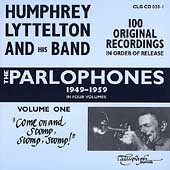
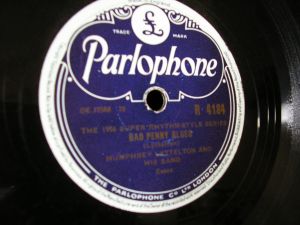
In the late 1940s Humph’s band had started to record a series of 78rpm records for the Parlophone label, starting with a lovely version of “Maple Leaf Rag” and stretching to over a hundred titles. Among these tracks was one record that actually made it into the Top 20 of the British pop charts in 1956, admittedly at Number 19, but nevertheless that’s no mean feat for a Jazz record. I should point out that this was long before my birth, but I remember hearing the track many times around the house when I was young.
The Bad Penny Blues was written by Humphrey Lyttelton and the hit recording features a quartet drawn from his band which, by the mid-1950s, had gravitated to a more mainstream jazz style, away from the “traddy” sound favoured by most contemporary jazz outfits. Indeed, he had incurred the wrath of many conservative fans by daring to include a saxophonist, the brilliant but eccentric Bruce Turner, in his outfit. Bad Penny Blues, though, featured only Humph on trumpet, Johhny Parker on piano, Stan Greig on drums and Jim Bray on bass. It was only recorded as an afterthought because it went down well at live gigs at Humph’s Jazz Club the HL Club (which later became the 100 Club, at 100 Oxford Street.)
But the real key to the success of this record was a young man by the name of Joe Meek. Starting out as a sound engineer at the Parlophone studios, Meek had quickly established an excellent reputation and in this case he was asked to take over the whole production of the record. According to Humph, they were slightly concerned at what he was doing with the microphones before they made the take but after it was done they all went home and left Meek to do some tinkering with the sound before cutting the disk. In those days, recording techniques were relatively crude and there generally wasn’t much in the way of post production, especially in jazz.
When he heard the final record, Humph was shocked. For one thing, Meek had close-miked all the instruments, including the drums – something which wasn’t generally done with jazz records for fear of (a) drowning out the rest of the band and (b) exposing the clumsiness of the drummer, the latter being a particularly problem. As Humph said, his band always sounded like the rhythm section was wearing diving boots. For this reason the drums were usually recorded with a distant mike and generally hidden in the ensemble playing. But in this case it worked out very well. Stan Greig used brushes on this track and his playing served beautifully both to propel and to punctuate the performances of the other musicians.
But it wasn’t the drums that so disturbed Humph. Meek had also fiddled with the double bass and with the left hand boogie-woogie figures of Johnny Parker’s piano, fattening them out and changing the balance to bring them right up in the final mix. He also compressed the overall sound so that the bass lines seem to press in on both the piano’s right hand and the growling muted trumpet lead, tying them closer to Greig’s insistent drum patterns and creating an unusually dense sound. The result is an intense, driving feel, with a dark undertone that is quite unlike any other jazz record of its period and redolent with the atmosphere of a smoky jazz club. I love it, especially the moment when Humph’s trumpet takes over from the piano solo. With a timely kick from the drums and against the backdrop of those bluesy thumping bass lines the band finds another gear and they build up a fine head of steam before riffing their way into the fade.
You can hear the original recording here, in a bizarre video I found on Youtube in which someone films their cassette player. I have an original 78 of this track but at the moment can’t transfer it to digital because I haven’t got a turntable, but when I do I’ll post it. Hopefully it will have better balance than the video.
Humph didn’t like the way the record had been put together, but it was an instant hit. He later joked that he hated it all the way to the bank.
Joe Meek went on to produce several classic pop records, generating many ideas that were later used by Phil Spector, but ultimately he became a tragic figure. Such commercial success as he achieved didn’t really last and he sank into debt, depression and paranoia. A gay man in an era in which homosexuality was still illegal, he became a victim of blackmail and was questioned by the police for alleged encounters with rent boys. He committed suicide in 1967 at the age of 37.
The Bad Penny Blues went on to be the “inspiration” behind Paul Macartney’s Lady Madonna,a Beatles track which has a lot of the same notes in it and also borrows the same overall feel. I can’t put it more subtly than that. George Martin, who produced the Beatles’ track, was actually in charge of the Parlophone studio at the time Bad Penny Blues was recorded…
And Humph went on to live another 52 years, bringing music and laughter to millions.
To end with, here’s a link to a later version of the tune recorded by a more recent manifestation of Humph’s band, probably in the 1980s. Note the way his technique involved the use of his eyebrows! I may be wrong, but I think the pianist on this performance is Mick Pyne and the bass is played by Dave Green. I can’t really make out the drummer.
The views presented here are personal and not necessarily those of my employer (or anyone else for that matter).
Feel free to comment on any of the posts on this blog but comments may be moderated; anonymous comments and any considered by me to be vexatious and/or abusive and/or defamatory will not be accepted. I do not necessarily endorse, support, sanction, encourage, verify or agree with the opinions or statements of any information or other content in the comments on this site and do not in any way guarantee their accuracy or reliability.


 In the Dark