Archive for the OJAp Papers Category

Three New Publications at the Open Journal of Astrophysics

Posted in OJAp Papers, Open Access, The Universe and Stuff with tags , , , , , , , on August 30, 2023 by telescoper

Not unexpectedly because of holidays, August has been rather a quiet month at the Open Journal of Astrophysics, but with people returning to work this week business has picked up again and it’s time to announce the last batch (all published this week).

In fact, this week we have published three papers, which I now present to you here. These take the count in Volume 6 (2023) up to 34 and the total published by OJAp up to 99. Who will be the author(s) of the 100th? We will just have to wait and see! I’ll do a special post for whichever paper wins that honour.

In chronological order, the three papers published this week, with their overlays, are as follows. You can click on the images of the overlays to make them larger should you wish to do so.

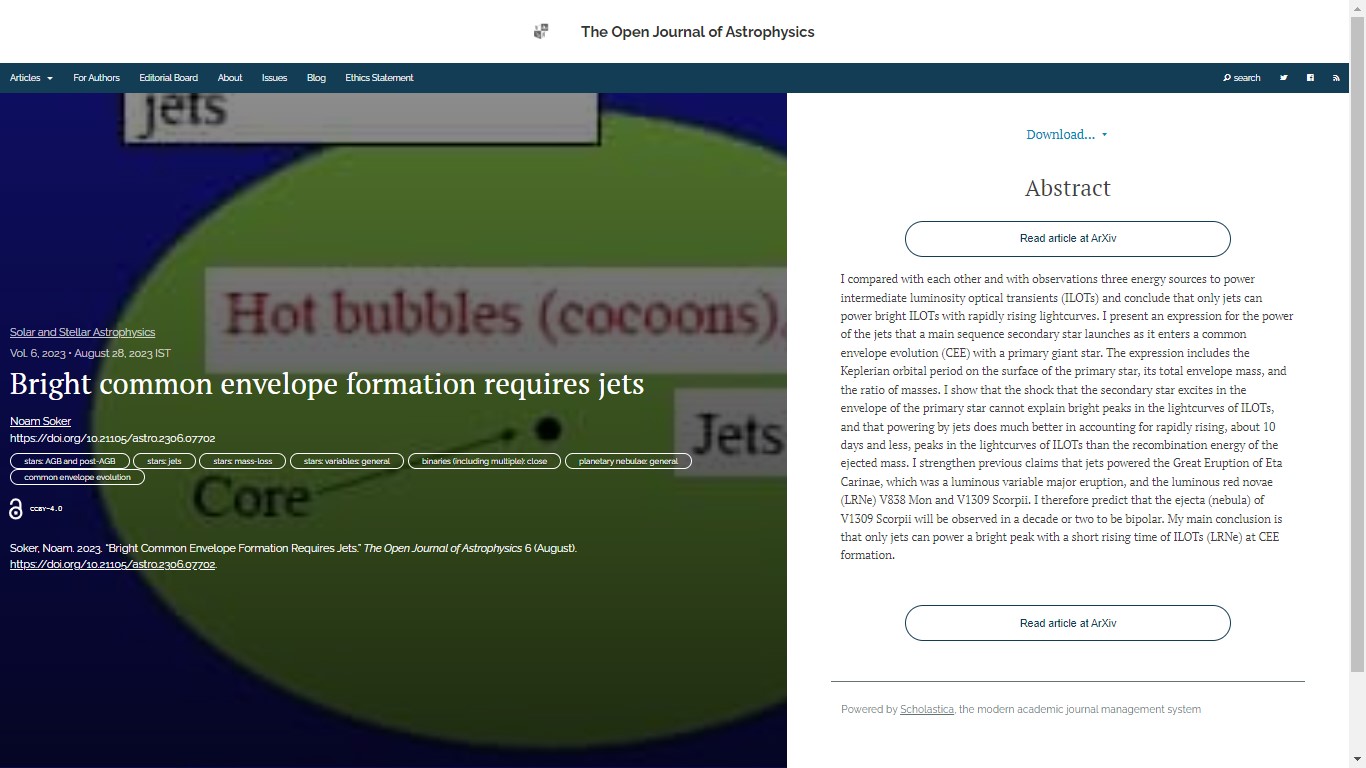
First one up is “Bright common envelope evolution requires jets” by Noam Soker of Technion, Haifa in Israel. This is a discussion of the role of jets that a main sequence secondary star launches as it enters a common envelope evolution (CEE) with a primary giant star. The paper was published on 28th August, is just the fifth item in the folder marked Solar and Stellar Astrophysics and can be found here.

Here is a screen grab of the overlay, which includes the abstract:
 

You can find the officially accepted version of the paper on the arXiv here.

The second paper to announce is “Almanac: MCMC-based signal extraction of power spectra and maps on the sphere” by Elena Sellentin (Leiden), Arthur Loureiro (Stockholm); Lorne Whiteway (UCL); Javier Lafaurie (Leiden); Sreekumar Balan (UCL); Malak Olamaie (York); and Andrew Jaffe & Alan Heavens (Imperial).  This presents a new software tool called Almanac , which uses Hamiltonian Monte Carlo sampling to infer the underlying all-sky noiseless maps of cosmic structures, together with their auto- and cross-power spectra.

This one is  in the folder marked Cosmology and Nongalactic Astrophysics. The paper was also published on 28th August 2023 and you can see the overlay here:


The accepted version of this paper can be found on the arXiv here.

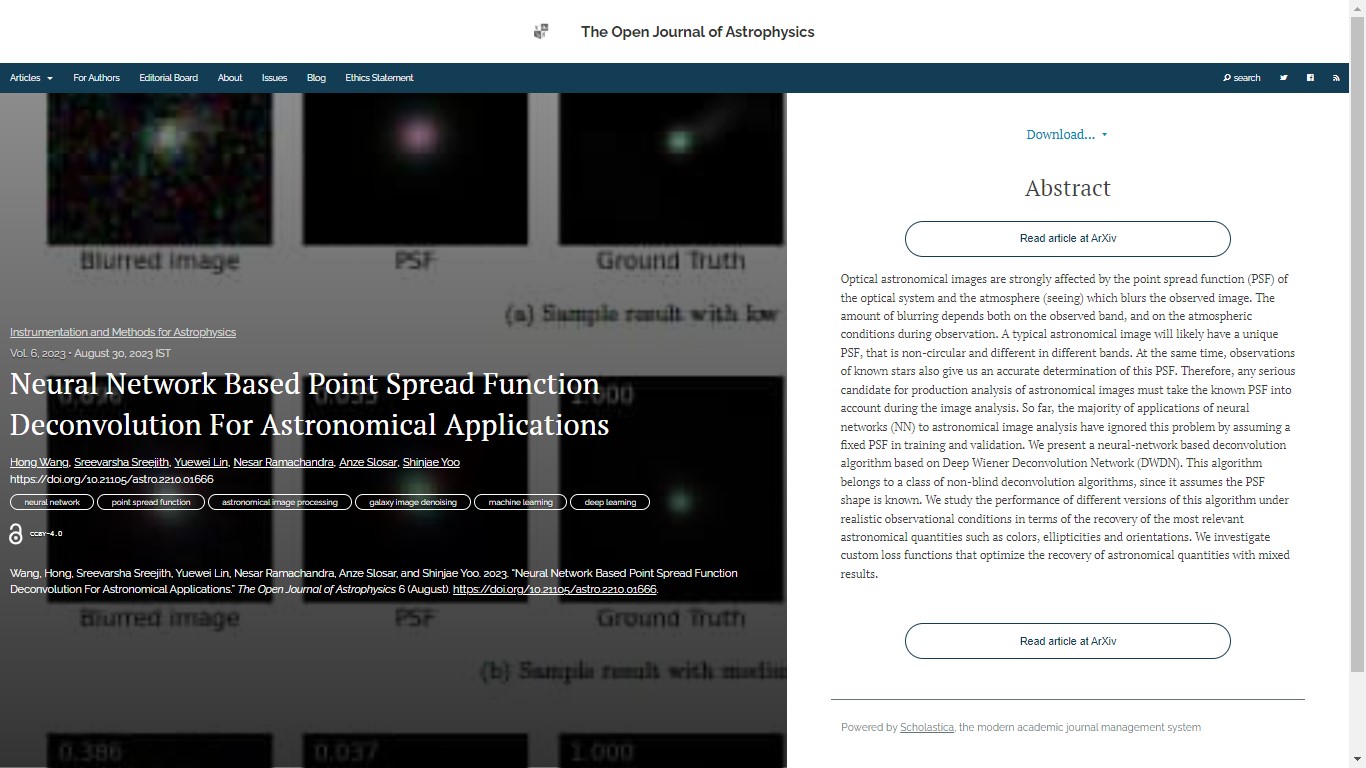
The last paper of this batch paper is in the Instrumentation and Methods for Astrophysics folder. It is entitled “Neural Network Based Point Spread Function Deconvolution For Astronomical Applications” and the authors are: Hong Wang, Sreevarsha Sreejith, Yuewin, Nesar Ramachandra*, Anze Slosar & Shinjae Yoo, all of the Brookhaven National Laboratory (NY) except * who is at the Argonne National Laboratory (IL), all based in the USA. This paper discusses a neural-network based deconvolution algorithm based on Deep Wiener Deconvolution Network (DWDN) and its performance in an astronomical context.

Here is the overlay:
 

You can find the full text for this one on the arXiv here.
Open Access Publishing in Astrophysics

Posted in OJAp Papers, Open Access on August 25, 2023 by telescoper

I’ve got a short talk this afternoon here at INAM about Open Access Publishing in Astrophysics so I thought I’d share the slides here. Among other things, the talk contains some updates about the Open Journal of Astrophysics.

The month of August has been rather quiet in terms of publishing at the OJAp no doubt because authors and referees have been taking vacations. When I managed to reconnect to the internet last night, though, I saw that revised versions of two manuscripts have been accepted so, depending on when the final versions hit the arXiv, I expect to publish a couple of papers early next week. That will take us to 98…

Update: mine was the last talk of the meeting and I overran a bit but I think it was reasonably well received despite that. Now I’m on a train waiting to go home.

From OJAp to AI

Posted in OJAp Papers with tags , on July 30, 2023 by telescoper

I was messing around with an AI “Art” generator and decided to use it to generate images to go with the latest four papers published at the Open Journal of Astrophysics, using the titles of these papers as prompts. The results are a mixture of strange and hilarious. I was only using the free version of the software which only allows 10 generations per day and there are lots of possible styles. I’m sure with more attempts one could get even more interesting outputs!

Anyway, if you click on each of the images below it should take you to an image of the overlay of the paper it is supposed to represent….

(This is a guest post by our Artificial Intelligence correspondent, A.I. Addio.)

Four New Publications at the Open Journal of Astrophysics

Posted in OJAp Papers, Open Access, The Universe and Stuff with tags , , , , , , , , , , , , , , , , on July 29, 2023 by telescoper

The rate of publication at the Open Journal of Astrophysics has now reached the point at which I think I’ll have to limit myself to weekly updates here rather than announcing every paper as it appears. We still announce individual papers on social media of course, meaning Mastodon, Facebook and the platform formerly known as Twitter…

This week we have published four papers which I now present to you here. These four take the count in Volume 6 (2023) up to 31 and the total published by OJAp up to 96. I speculated earlier this year that we might reach 100 before the end of 2023, now it looks certain we will reach the century mark as early as August! It is gratifying to see the range of papers published increasing, with all four of these in different categories.

In chronological order, the four papers published this week, with their overlays, are as follows. You can click on the images of the overlays to make them larger should you wish to do so.

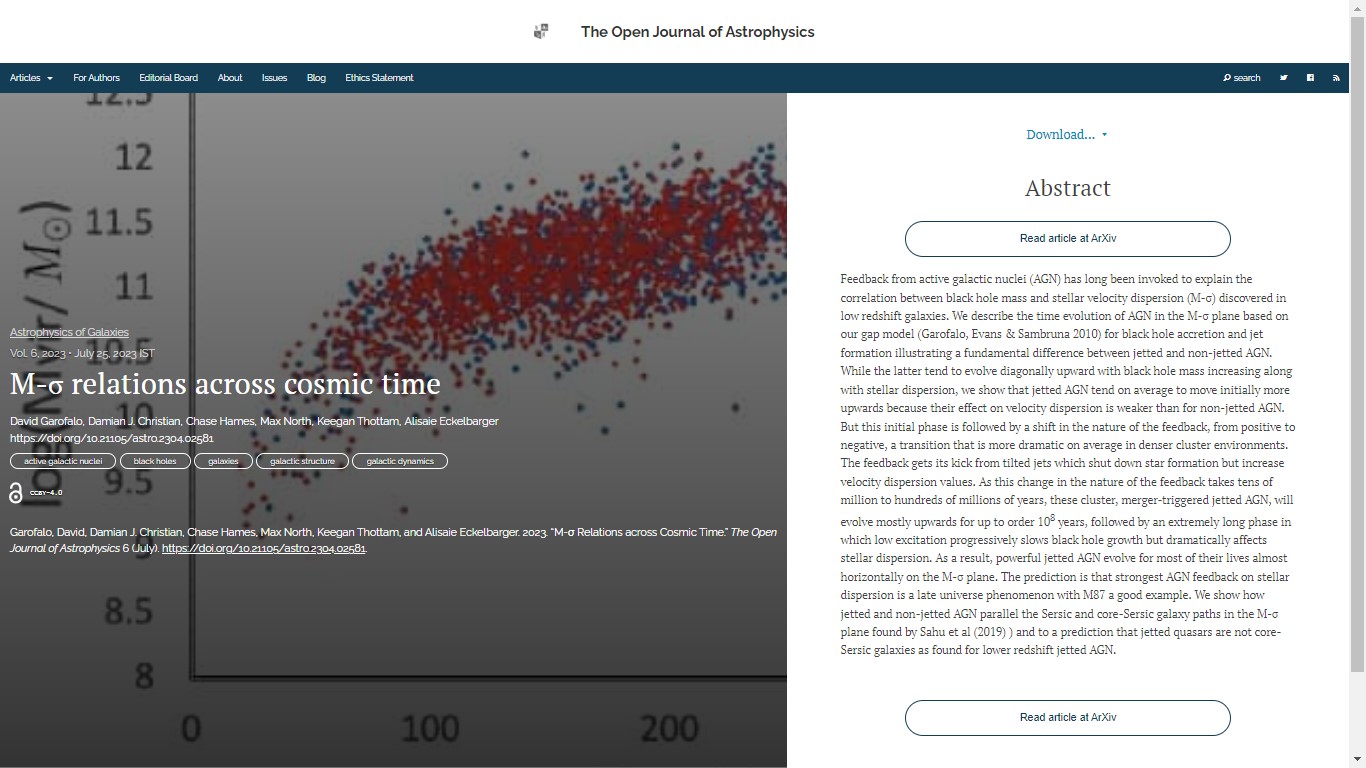
First one up is “M-σ relations across cosmic time” by David Garofalo (1), Damian J. Christian (2), Chase Hames (1), Max North (3), Keegan Thottam (1) & Alisaie Eckelbarger (1). The author affiliations are: (1) Department of Physics, Kennesaw State University, USA; (2) Department of Physics and Astronomy, California State University, Northridge, USA; (3) Department of Information Systems, Kennesaw State University, USA. This is a discussion of the relationship between black hole mass and stellar velocity dispersion discovered in low redshift galaxies and its evolution with cosmic time. The paper was published on 25th July, is in the folder marked Astrophysics of Galaxies and can be found here.

Here is a screen grab of the overlay, which includes the abstract:

You can find the officially accepted version of the paper on the arXiv here.

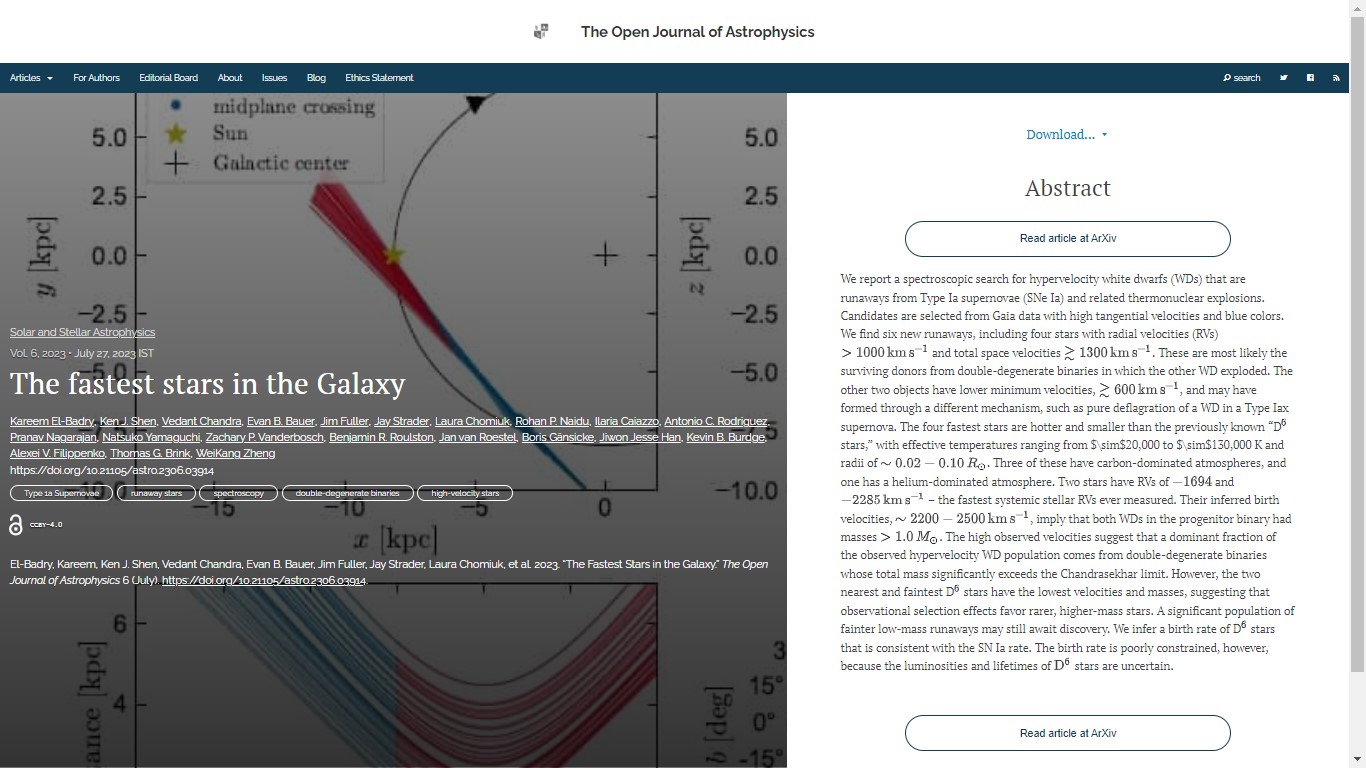
The second paper to announce is “The fastest stars in the Galaxy” by Kareem El-Badry et al. (21 authors. This one is the fourth item in the folder marked Solar and Stellar Astrophysics and it reports the spectroscopic discovery of 6 new “runaway” stars, probably the surviving members of binary star systems in which one star exploded in a Type 1a supernova. The paper was published on 27th July 2023 and you can see the overlay here:

The accepted version of this paper can be found on the arXiv here.

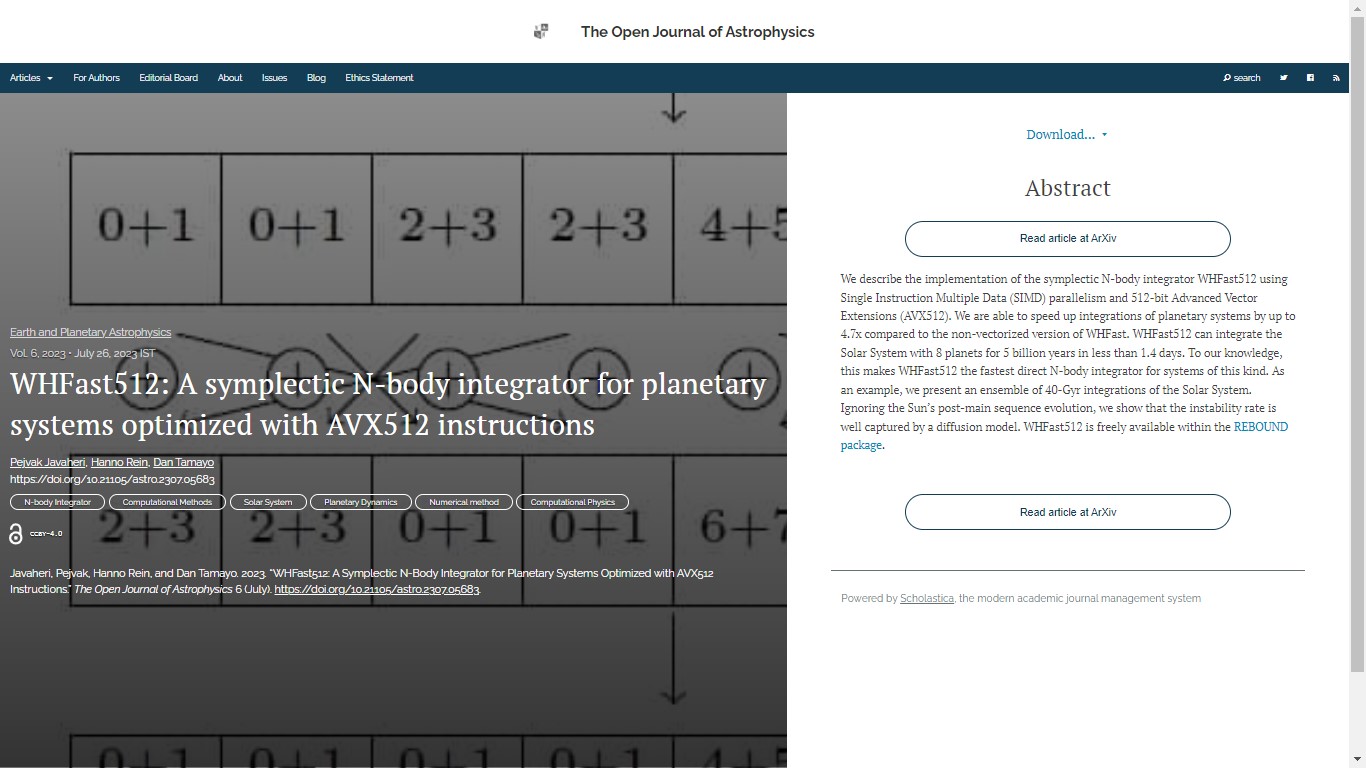
The next paper is in the Earth and Planetary Astrophysics folder. It is in fact only the second paper we have published in that area. It is entitled “WHFast512: A symplectic N-body integrator for planetary systems optimized with AVX512 instructions” by Pejvak Javaheri & Hanno Rein (University of Toronto, Canada) and Daniel Tamayo (Harvey Mudd College, USA). This paper presents a fast direct N-body integrator for gravitational systems, and demonstrates it using a 40 Gyr integration of the Solar System.

Here is the overlay:


You can find the full text for this one on the arXiv here.
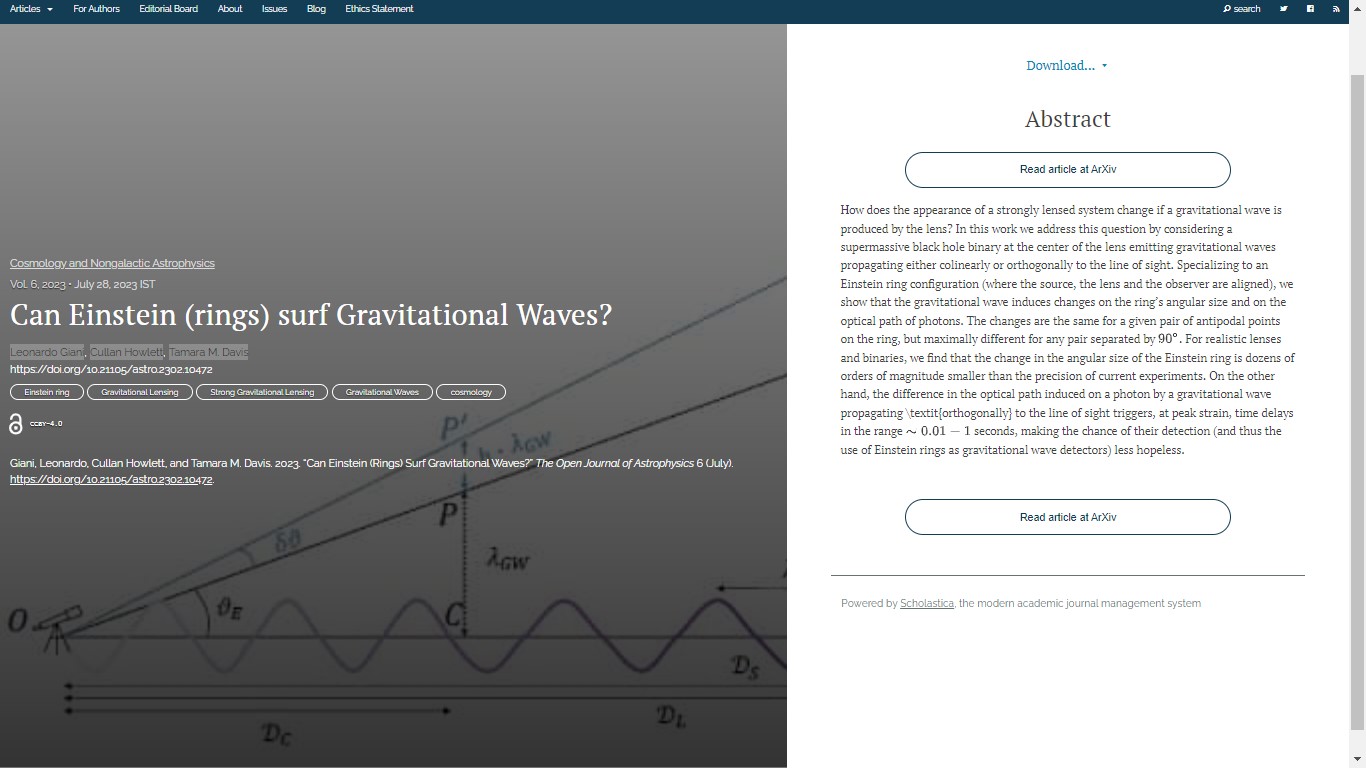
Last but by no means least, published yesterday (29th July), we have a paper that asks the question “Can Einstein (rings) surf Gravitational Waves?” by Leonardo Giani, Cullan Howlett and Tamara M. Davis of the University of Queensland, Australia. The primary classification for this one is Cosmology and Nongalactic Astrophysics and it discusses the possible effect(s) of gravitational waves on gravitational lensing observations.


You can click on the image of the overlay to make it larger should you wish to do so. You can find the officially accepted version of the paper on the arXiv here.

New Publication at the Open Journal of Astrophysics

Posted in OJAp Papers, Open Access, The Universe and Stuff with tags , , , , , , on July 22, 2023 by telescoper

Time to announce yet another new paper at the Open Journal of Astrophysics. This one was published yesterday, on 21st July 2023.

The latest paper is the 27th  so far in Volume 6 (2023) and the 92nd in all. The authors are Sohan Ghodla, Richard Easther, M.M. Briel and J.J. Eldridge, all of the University of Auckland in New Zealand.

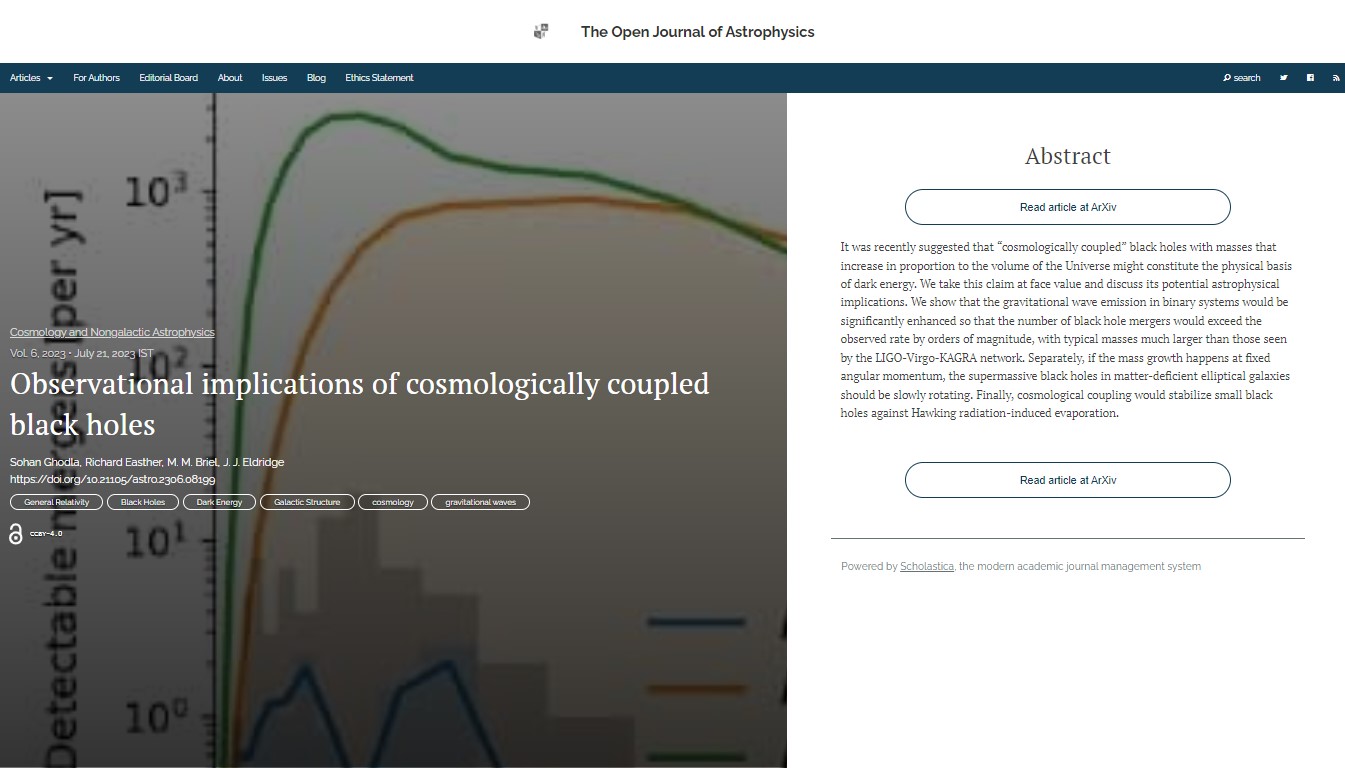
The primary classification for this paper is Cosmology and Nongalactic Astrophysics and its title is “Observational implications of cosmologically coupled black holes”.  The paper elucidates some of the consequences of a suggestion that the interaction between black holes and the global properties of space-time underlying explanation for dark energy. The key result is that the existence of cosmologically-coupled black holes implies a much larger rate of black-hole merger events than is observed.

The papers to which this is a response are mentioned here. For reference ,these earlier works were published in The Astrophysical Journal and The Astrophysical Journal Letters. There is also a detailed twitter thread about this paper by Richard Easter, posted when it was submitted as a preprint to the arXiv last month:


Anyway, here is a screen grab of the overlay of the published version which includes the  abstract:


You can click on the image of the overlay to make it larger should you wish to do so. You can find the officially accepted version of the paper on the arXiv here.

Four New Publications at the Open Journal of Astrophysics

Posted in OJAp Papers, Open Access, The Universe and Stuff with tags , , , , , , , on July 19, 2023 by telescoper

Time for an update at the Open Journal of Astrophysics. Owing to a well-deserved holiday by a member of the OJAp team, we were unable to register DOIs and associated metadata for a couple of weeks so refrained from announcing new papers during this period while other functions of the journal continued. Anyway, this week we have caught up with the backlog of four papers, which I now present to you here, all published on 17th July 2023. These four take the count in Volume 6 (2023) up to 26 and the total published by OJAp up to 91.

In no particular order, the four papers published this week, with their overlays, are as follows. You can click on the images of the overlays to make them larger should you wish to do so.

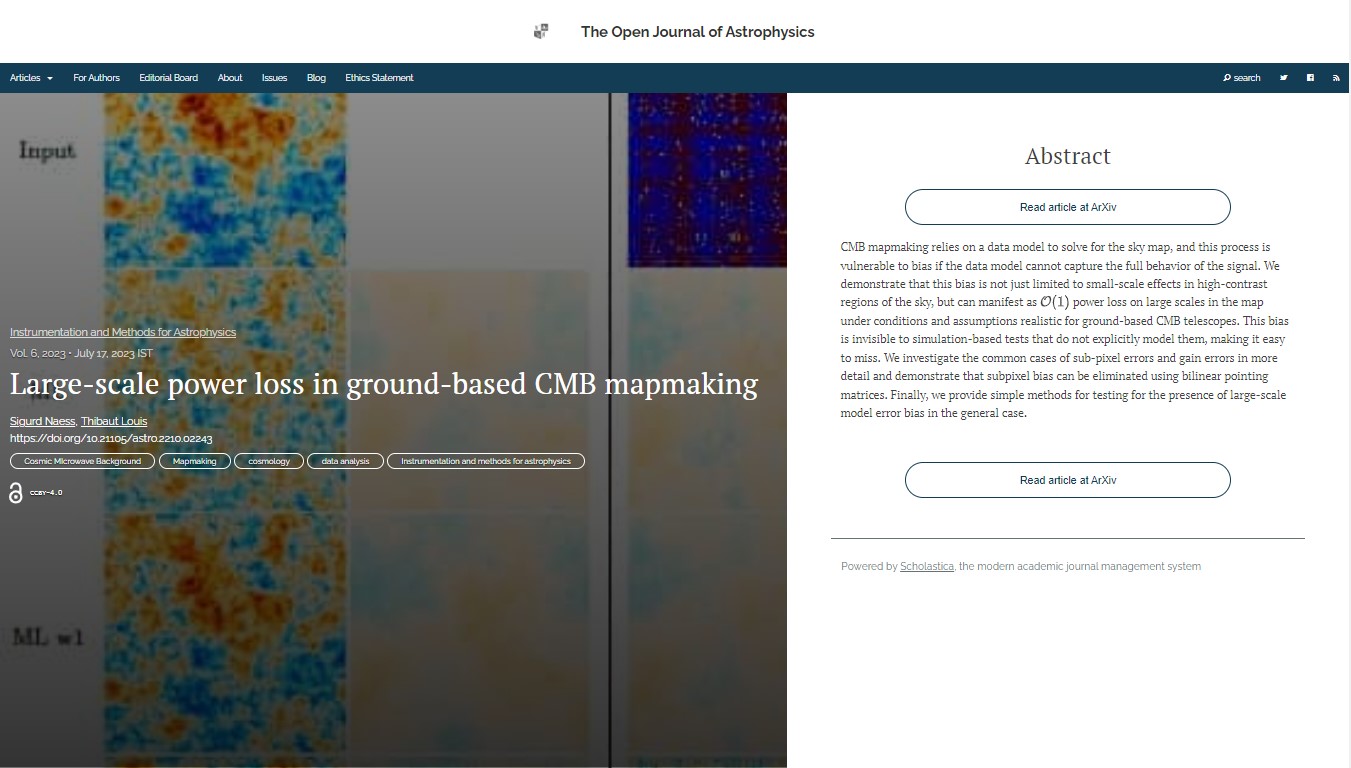
“Large-scale power loss in ground-based CMB mapmaking” by Sigurd Naess (Oslo, Norway) and Thibaut Louis (Saclay, France). This one is a discussion of the possible biases introduced by using a data model to create sky maps of CMB temperature fluctuations and is in the folder marked Instrumentation and Methods for Astrophysics.

Here is a screen grab of the overlay, which includes the abstract:


You can find the officially accepted version of the paper on the arXiv here.

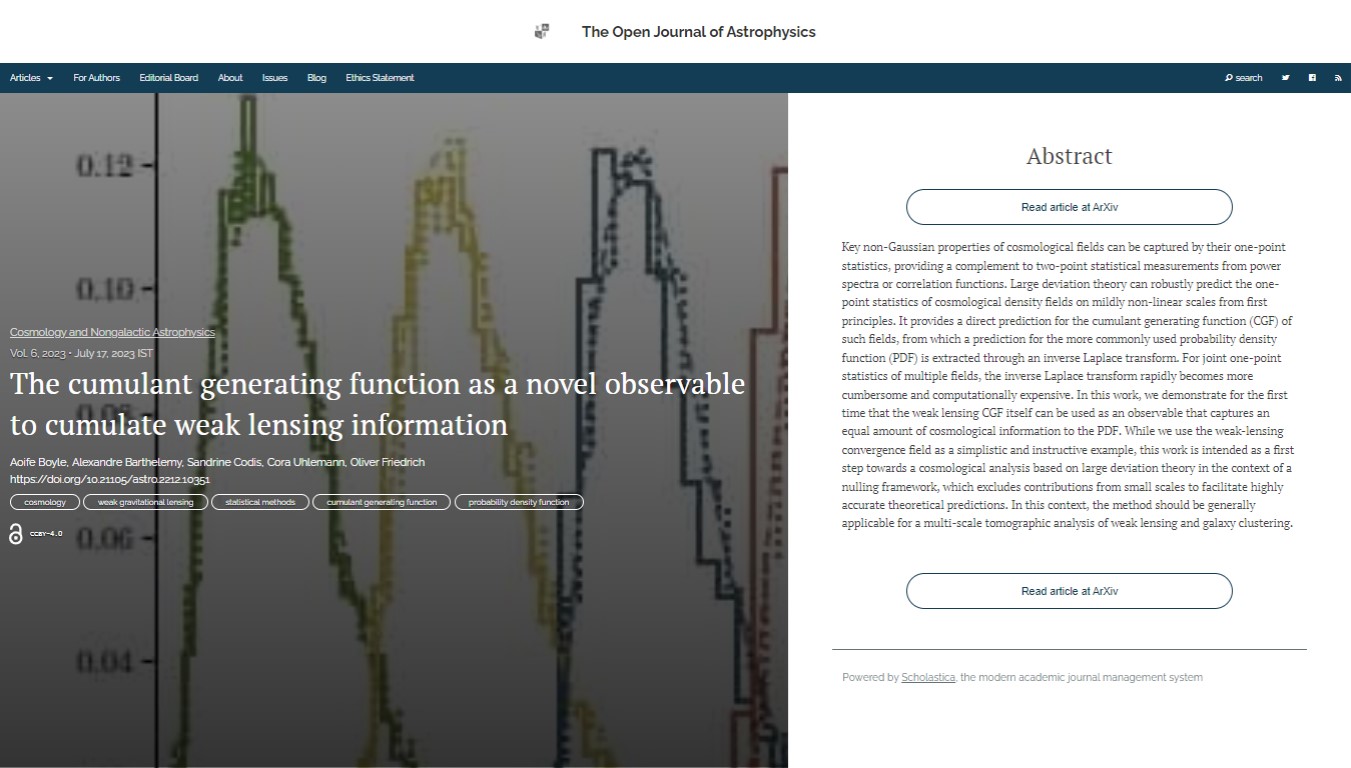
The primary classification for the next paper paper is Cosmology and Nongalactic Astrophysics and its title is “”The cumulant generating function as a novel observable to cumulate weak lensing information”. The authors are Aoife Boyle (Saclay, France), Alexandre Barthelemy (LMU, Germany), Sandrine Codis (Saclay, France), Cora Uhlemann (Newcastle, UK) & Oliver Friedrich (LMU, Germany). The paper explores the use of the cumulant generating function (CGF), from which the probability density function (PDF) can be obtained, in the context of weak gravitational lensing information.

You can click on the image of the overlay to make it larger should you wish to do so. You can find the officially accepted version of the paper on the arXiv here.

Also in the folder marked Cosmology and Nongalactic Astrophysics is the third paper “Cosmology with 6 parameters in the Stage-IV era: efficient marginalisation over nuisance parameters” by B. Hadzhiyska (Berkeley, USA), K. Wolz (Trieste, Italy), S. Azzoni (Oxford, UK; Tokyo, Japan), D. Alonso (Oxford, UK), C. García-García (Oxford, UK), J. Ruiz-Zapatero (Oxford, UK) and A. Slosar (Tokyo, Japan). This presents an efficient analytical method to speed up marginalization over nuisance parameters introduced to model systematic effects in large-scale structure data.

Here is a screen grab of the overlay which includes the abstract:


You can find the officially accepted version of the paper on the arXiv here.

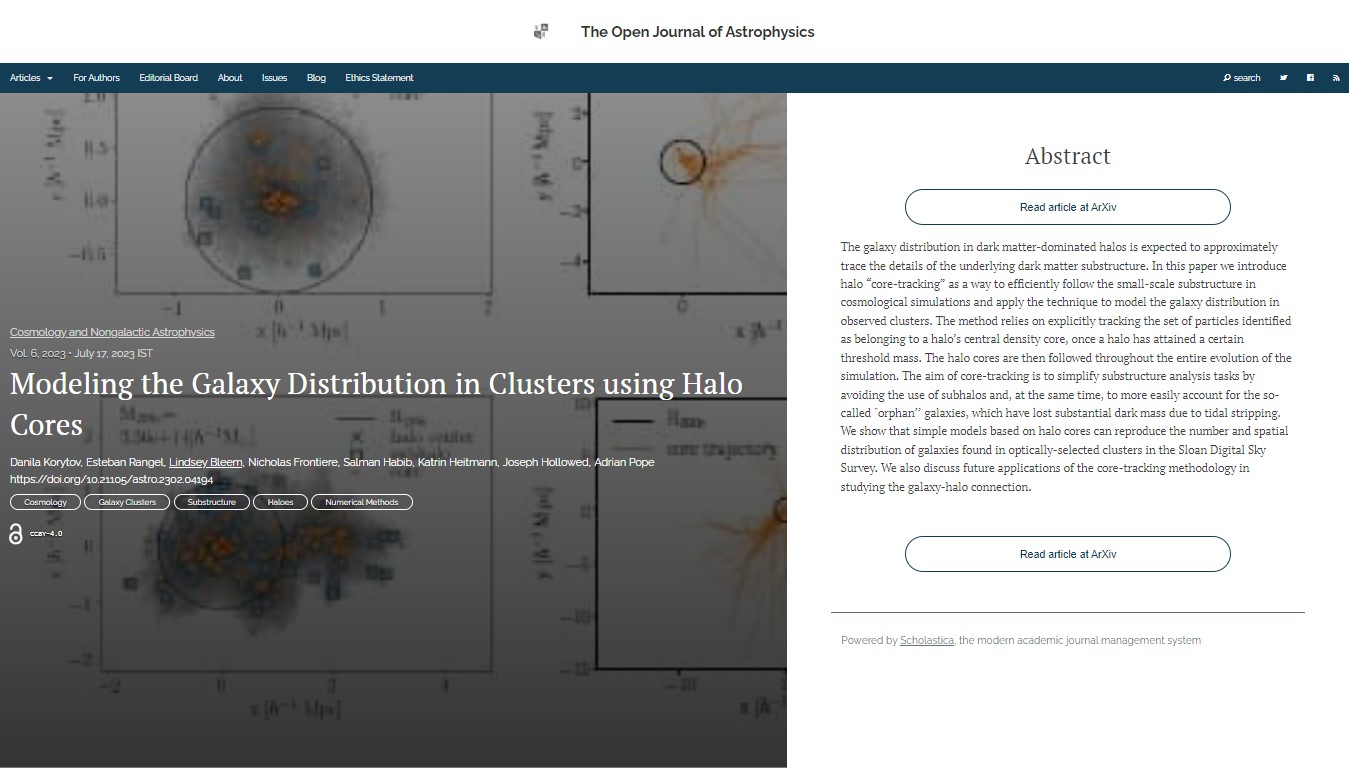
The final paper in this quartet, also in Cosmology and Nongalactic Astrophysics, is “Modeling the Galaxy Distribution in Clusters using Halo Cores” by D. Korytov, E. Rangel, L. Bleem, N. Frontiere, S. Habib, K. Heitmann, J. Hollowed, and A. Pope (all of the Argonne National Laboratory, USA). This presents a new method to speed up numerical simulations using a method of simplifying the handling of substructure in galaxy clusters using halo ‘core-tracking’.

The overlay of this one is here:


You can find the officially accepted version of the paper on the arXiv here.

Two New Publications at the Open Journal of Astrophysics

Posted in OJAp Papers, Open Access, The Universe and Stuff with tags , , , on June 28, 2023 by telescoper

Time to catch up with a couple of recent publications at the Open Journal of Astrophysics.

The first paper was published on Friday 23rd June. It is the 21st in Volume 6 (2023) and the 86th in all.

The primary classification for this paper is Cosmology and Nongalactic Astrophysics and its title is “CosmoPower-JAX: high-dimensional Bayesian inference with differentiable cosmological emulators”. The paper is about a new method, based on machine learning, to construct emulators for cosmological power spectra for the purpose of speeding up inference procedures. The software described in the paper is available here.

The authors are Davide Piras (of the University of Geneva, Switzerland) and Alessio Spurio Mancini (of the Mullard Space Sciences Laboratory, University College, London, UK)

Here is a screen grab of the overlay which includes the abstract:

You can click on the image of the overlay to make it larger should you wish to do so. You can find the officially accepted version of the paper on the arXiv here.

The second paper was published yesterday. It is the 22nd in Volume 6 (2023) and the 87th in all. Although 87 is an unlucky number for Australian cricketers – 13 short of a century – we’re still well on track to reach 100 papers by the end of the year.

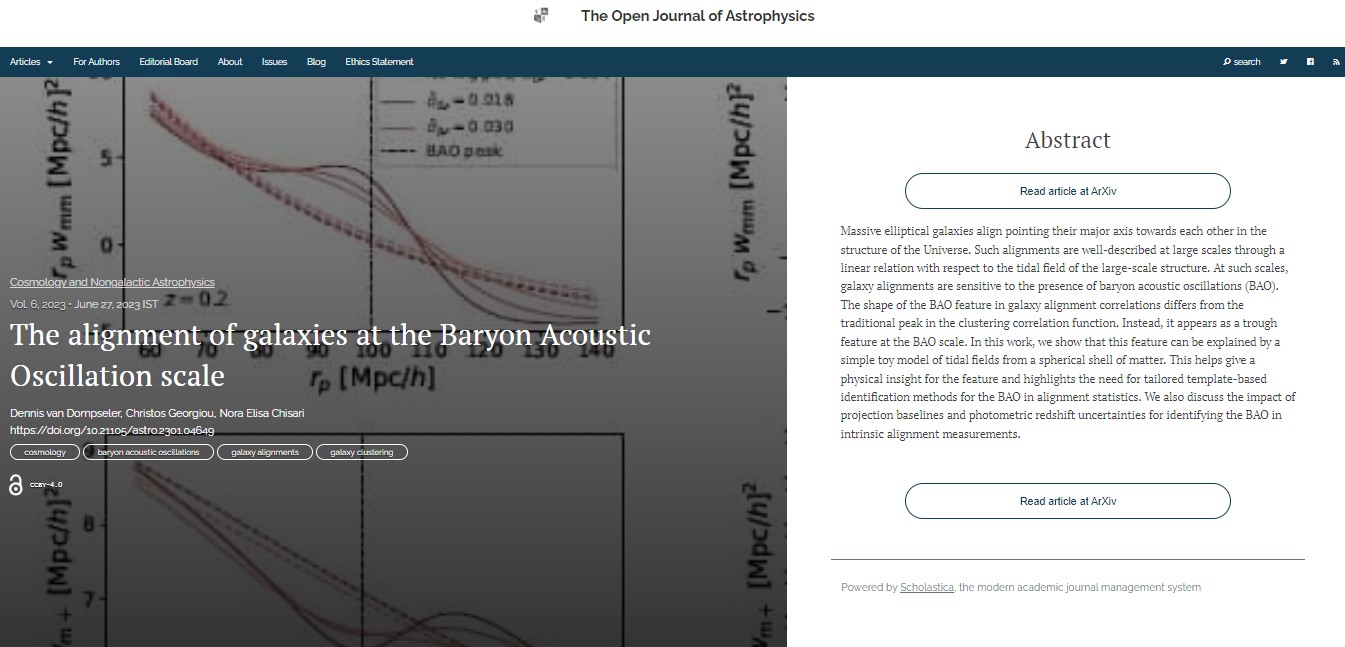
Once again the primary classification for this paper is Cosmology and Nongalactic Astrophysics. The title of this one is “The alignment of galaxies at the Baryon Acoustic Oscillation scale” by Dennis van Dompseler, Christos Georgiou & Nora Elisa Chisari all of Utrecht University, in The Netherlands.

Here is a screen grab of the overlay which includes the abstract:


You can click on the image of the overlay to make it larger should you wish to do so. You can find the officially accepted version of the paper on the arXiv here.

Copenhagen Looking Back

Posted in Biographical, Euclid, OJAp Papers, The Universe and Stuff on June 23, 2023 by telescoper

So here I am then, back in Maynooth. I had a relatively stress-free trip back, although my plane was a bit late and I had to run through Dublin Airport to catch the Hopper Bus I was booked on. Made it though.

The first thing I want to do is to thank the organizers for what was a wonderful event. I wasn’t able to attend the Euclid Consortium meeting in Oslo last year, largely because it was earlier in the year, in April (i.e. term-time) and I had teaching responsibilities. I gather it was a rather gloomy occasion because there was no concrete plan for the launch of Euclid thanks to the Russian war against Ukraine. I guess few would have predicted then that the 2023 meeting would be just a week or so before a launch on SpaceX!

I have to say the atmosphere was also helped by the excellent weather and very fine catering. The conference dinner was held in the Banqueting Hall, on the first floor of the Hans Christian Anderson Castle which stands at one of the entrances to the famous Tivoli Gardens, a few minutes from the conference venue.

Finally, one other memory that will stay with me for a while. It turned out that the week of the conference coincided with high-school graduation celebrations in Copenhagen, so every day we encountered lots of exuberant and largely inebriated teenagers around wearing funny hats and generally going a bit berserk. They made quite a lot of noise in the evenings, but it was all harmless. You’re only young once!

Having not been at an in-person conference for over four years, it was great to see some new faces and catch up with some people I haven’t seen for a long time. It was especially nice to talk to a couple of members of the Editorial Board of the Open Journal of Astrophysics. It was also nice to talk to some authors. Talking of which, here is Nicolas Tessore delivering a plenary presentation featuring work from one of the papers he has published with OJAp:

Anyway, I was up a stupid o’clock to catch my flight this morning so I think I’ll have a bit of rest and hope for the rain to stop so I can do some shopping.

New Publication at the Open Journal of Astrophysics

Posted in OJAp Papers, Open Access, The Universe and Stuff with tags , , , on June 21, 2023 by telescoper

I may be away at a conference, but it’s still time to announce yet another new paper at the Open Journal of Astrophysics. This one was published on Monday 19th June.

The latest paper is the 20th  so far in Volume 6 (2023) and the 85th in all,  so with still more than half of 2023 remaining and many papers still in the pipeline, we’re on track to reach a total of 100 papers by the end of 2023!

The primary classification for this paper is Cosmology and Nongalactic Astrophysics and its title is “Sparse Bayesian mass-mapping using trans-dimensional MCMC”.  The paper describes a new trans-dimensional Markov Chain Monte Carlo sampler for mass-mapping, using wavelets, for the construction of mass maps from weak gravitational lensing which, as I’ve previously mentioned on this blog, is what the cool kids do these days.

The authors are: Augustin Marignier, Thomas D. Kitching & Jason D. McEwen (MSSL, Mullard Space Science Laboratory), Ana M. G. Ferreira (Department of Earth Sciences), all at University College London.

Here is a screen grab of the overlay which includes the  abstract:


You can click on the image of the overlay to make it larger should you wish to do so. You can find the officially accepted version of the paper on the arXiv here.

New Publication at the Open Journal of Astrophysics

Posted in OJAp Papers, Open Access, The Universe and Stuff with tags , , , , on June 13, 2023 by telescoper

It’s time to announce yet another new paper at the Open Journal of Astrophysics. This one was published on Friday 9th June.

The latest paper is the 19th paper so far in Volume 6 (2023) and the 84th in all,  so with more than half of 2023 remaining and many papers still in the pipeline we’re on track to reach a total of 100 papers by the end of 2023!

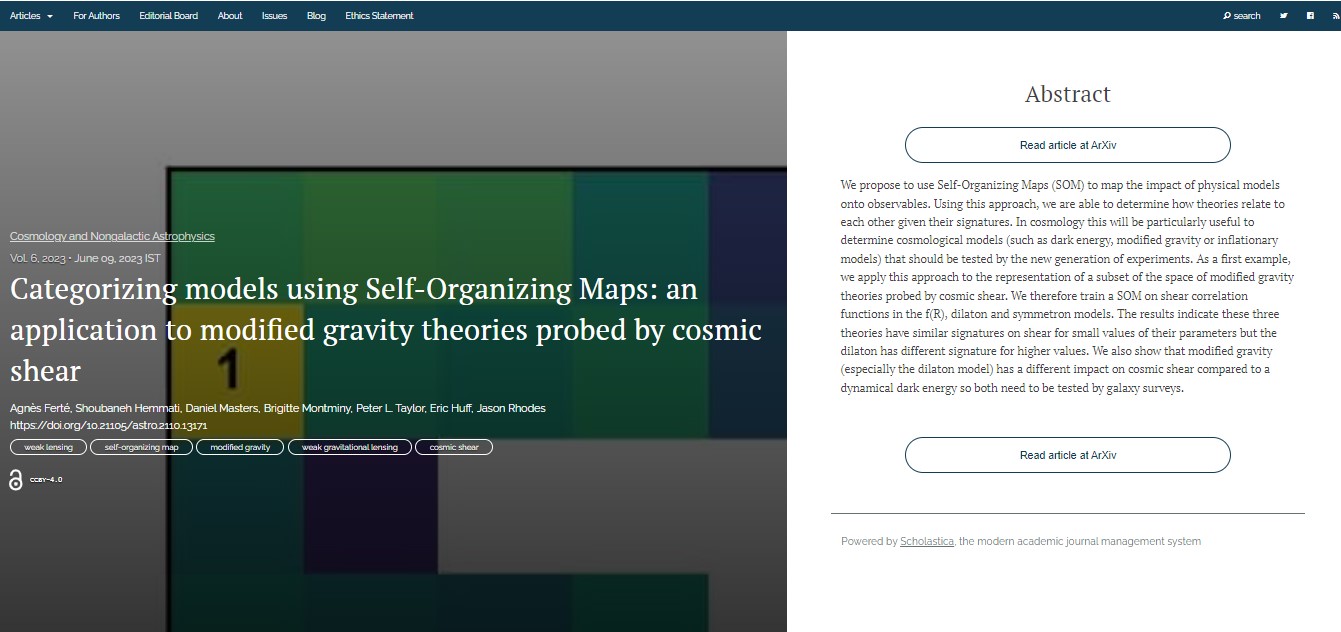
The primary classification for this paper is Cosmology and Nongalactic Astrophysics and its title is “Categorizing models using Self-Organizing Maps: an application to modified gravity theories probed by cosmic shear”. For the uninitiated, a Self-Organizing Map is a machine-learning technique that makes large-dimensional data sets easier to analyze. This paper is yet another one about weak gravitational lensing (cosmic shear), which is obviously what the cool kids do these days.

The authors are: Agnès Ferté (JPL); Shoubaneh Hemmati (IPAC); Daniel Masters (IPAC); Brigitte Montminy (JPL); Peter L. Taylor (JPL); Eric Huff (JPL);  and Jason Rhodes (JPL).

(JPL=Jet Propulsion Laboratory, IPAC= Infrared Processing & Analysis Center, both associated with California Institute of Technology, Pasadena, USA)

Here is a screen grab of the overlay which includes the  abstract:


You can click on the image of the overlay to make it larger should you wish to do so. You can find the officially accepted version of the paper on the arXiv here.

P.S. The first author tweeted about this paper: