Archive for the Open Access Category

New Publication at the Open Journal of Astrophysics

Posted in OJAp Papers, Open Access, The Universe and Stuff with tags , , , on June 21, 2023 by telescoper

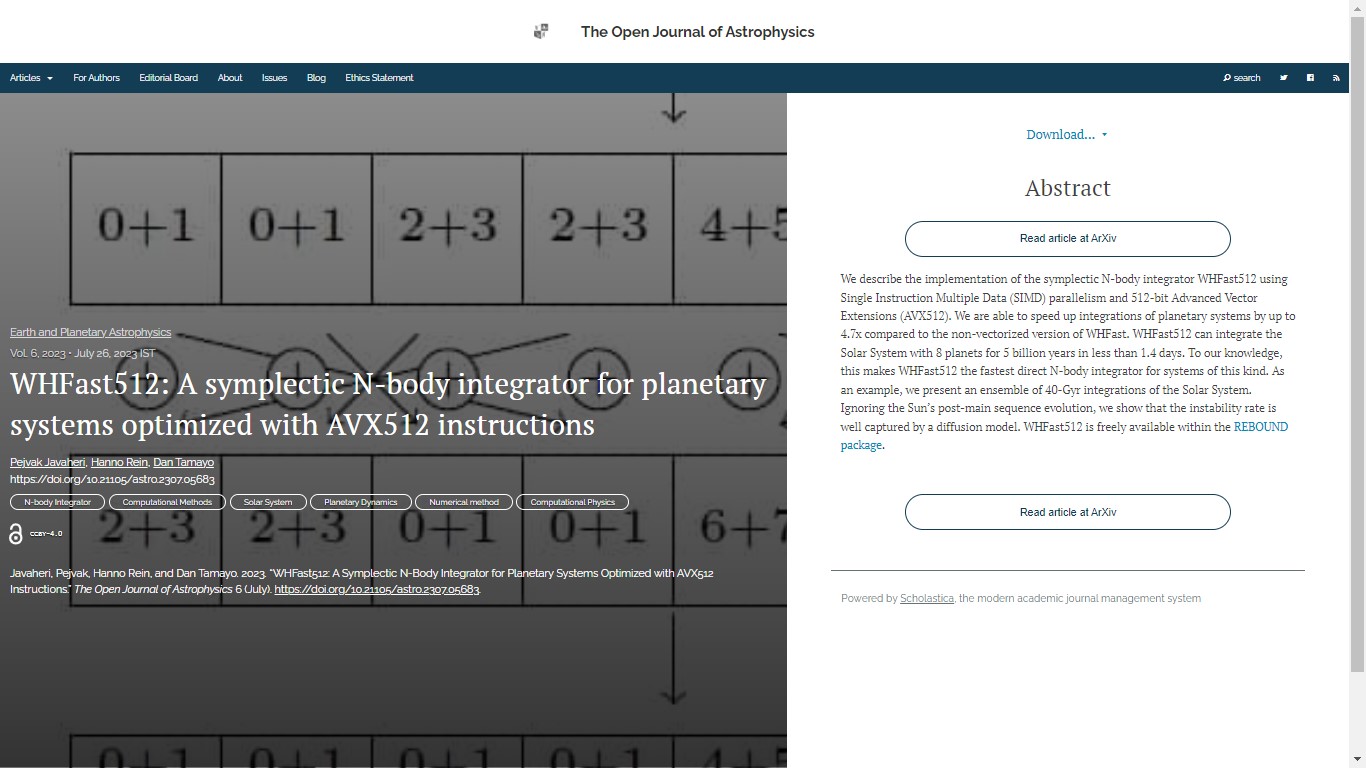
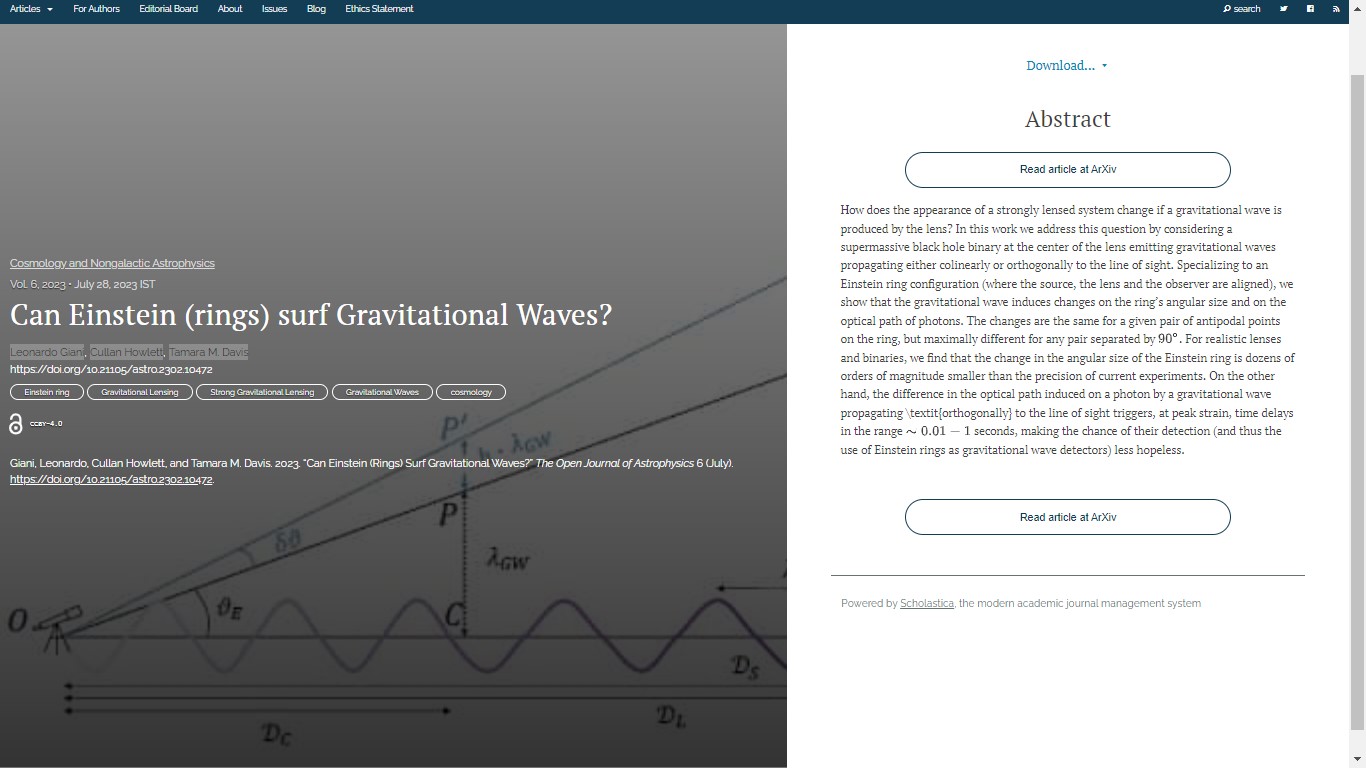
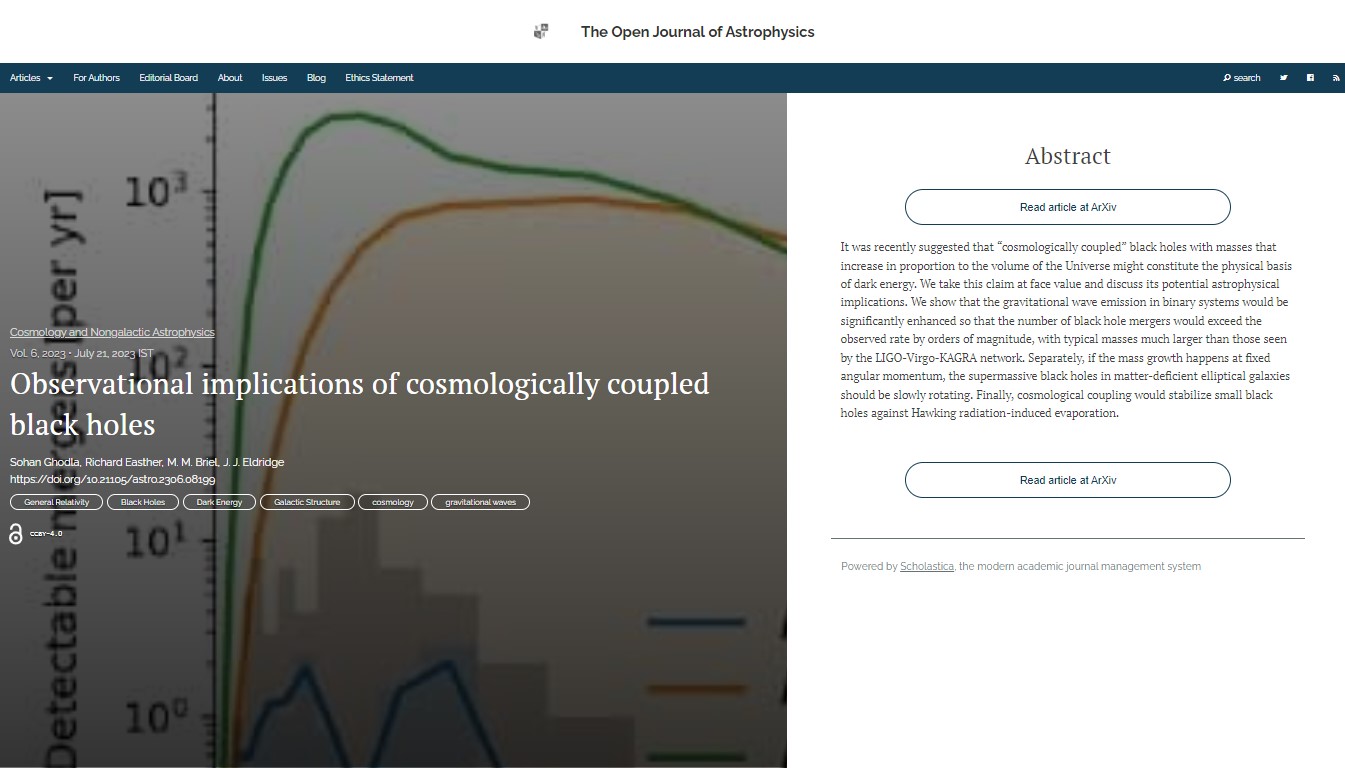
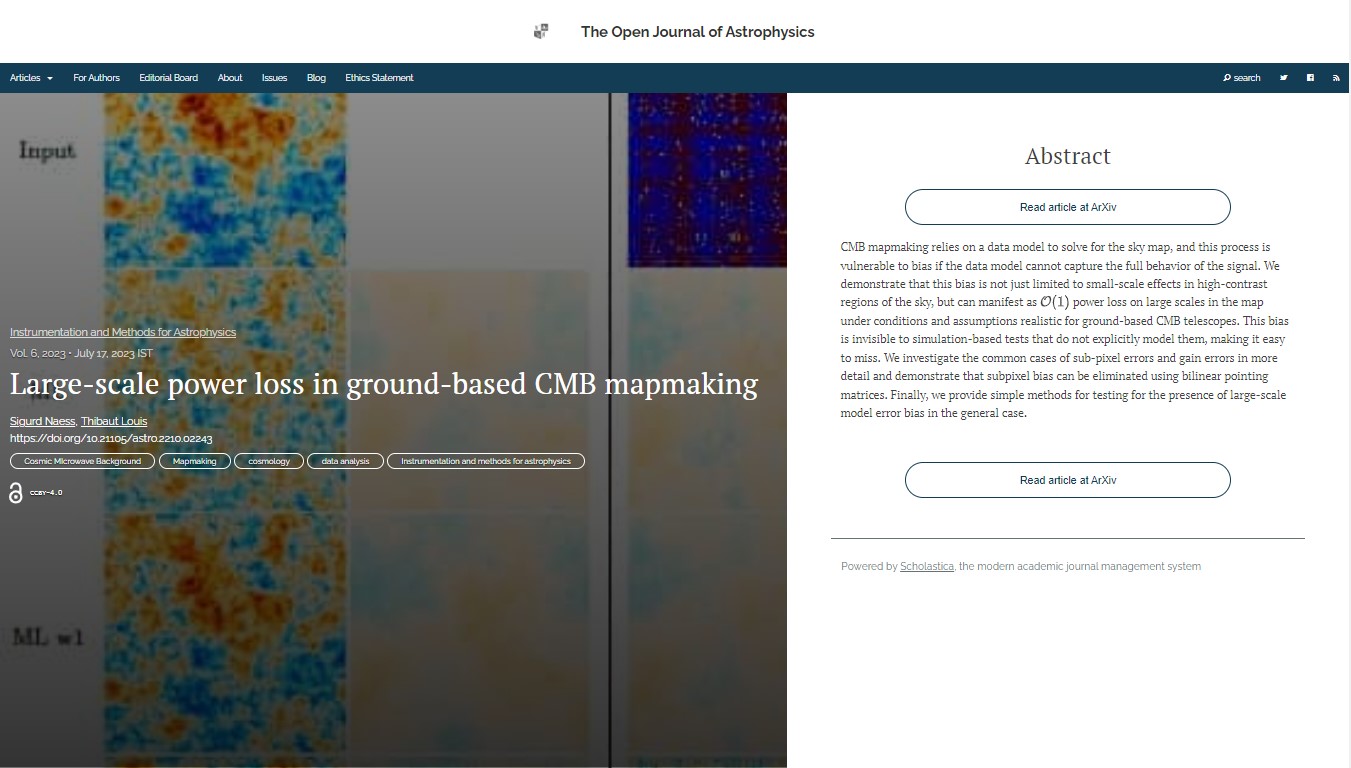
I may be away at a conference, but it’s still time to announce yet another new paper at the Open Journal of Astrophysics. This one was published on Monday 19th June.

The latest paper is the 20th  so far in Volume 6 (2023) and the 85th in all,  so with still more than half of 2023 remaining and many papers still in the pipeline, we’re on track to reach a total of 100 papers by the end of 2023!

The primary classification for this paper is Cosmology and Nongalactic Astrophysics and its title is “Sparse Bayesian mass-mapping using trans-dimensional MCMC”.  The paper describes a new trans-dimensional Markov Chain Monte Carlo sampler for mass-mapping, using wavelets, for the construction of mass maps from weak gravitational lensing which, as I’ve previously mentioned on this blog, is what the cool kids do these days.

The authors are: Augustin Marignier, Thomas D. Kitching & Jason D. McEwen (MSSL, Mullard Space Science Laboratory), Ana M. G. Ferreira (Department of Earth Sciences), all at University College London.

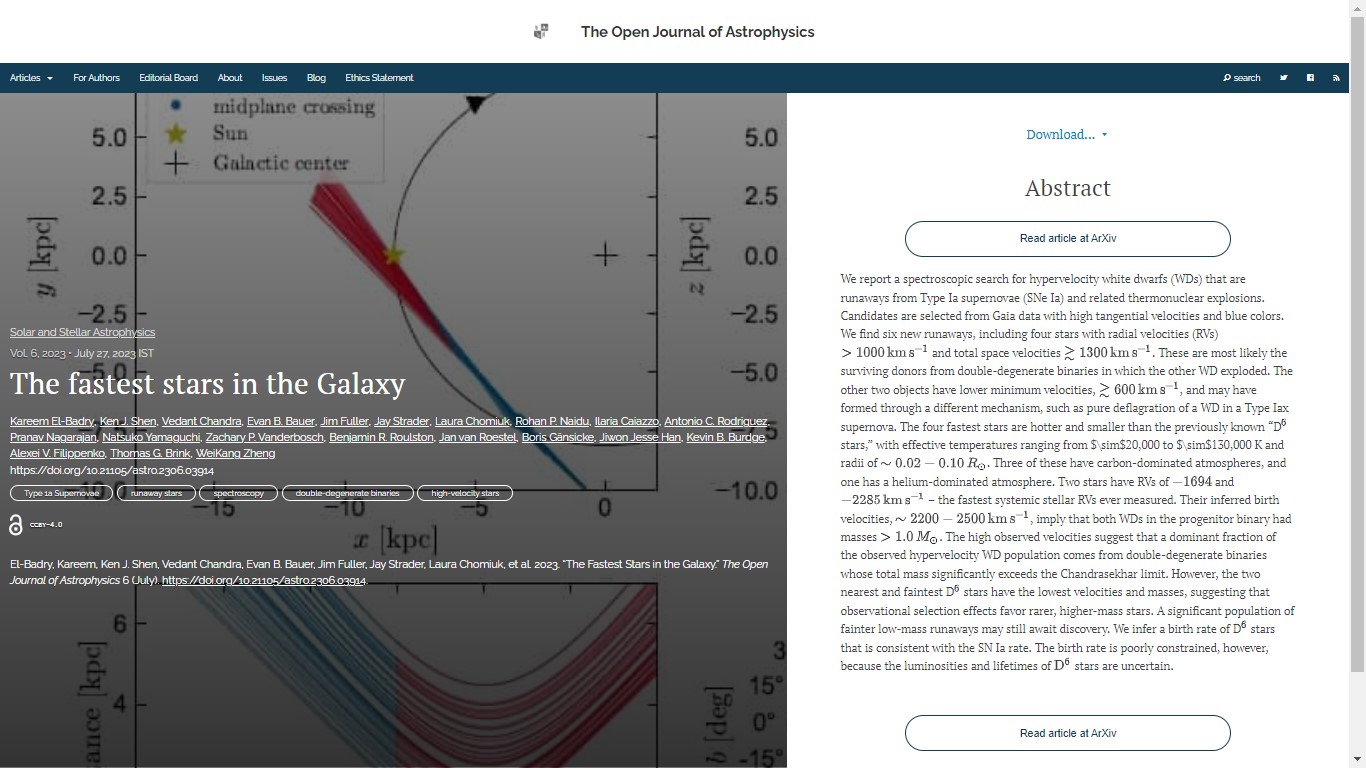
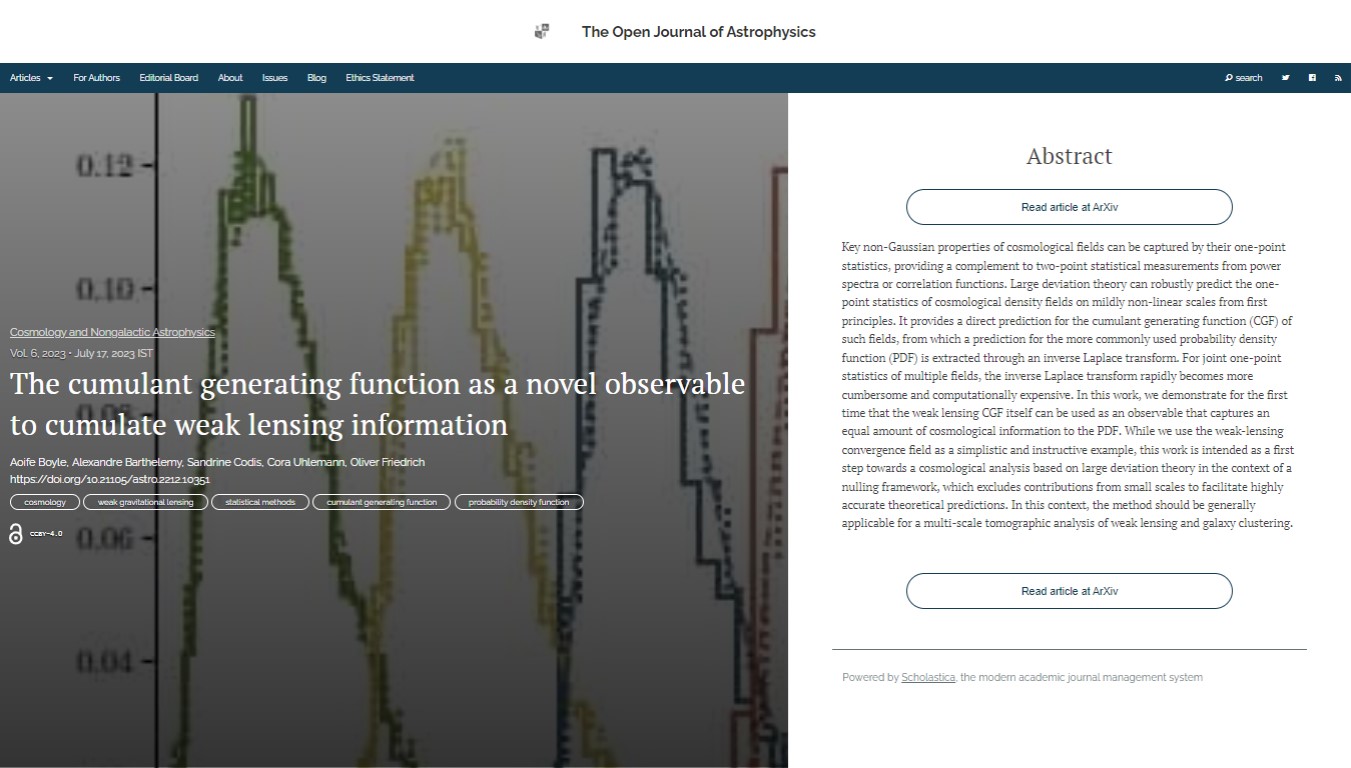
Here is a screen grab of the overlay which includes the  abstract:


You can click on the image of the overlay to make it larger should you wish to do so. You can find the officially accepted version of the paper on the arXiv here.

Never mind the points, look at the line!

Posted in Bad Statistics, Open Access, The Universe and Stuff with tags , , , , , on June 14, 2023 by telescoper

I was just thinking this morning that it’s been a while since I posted anything in my Bad Statistics folder when suddenly I come across this gem from a paper in Nature Astronomy entitled Could quantum gravity slow down neutrinos?

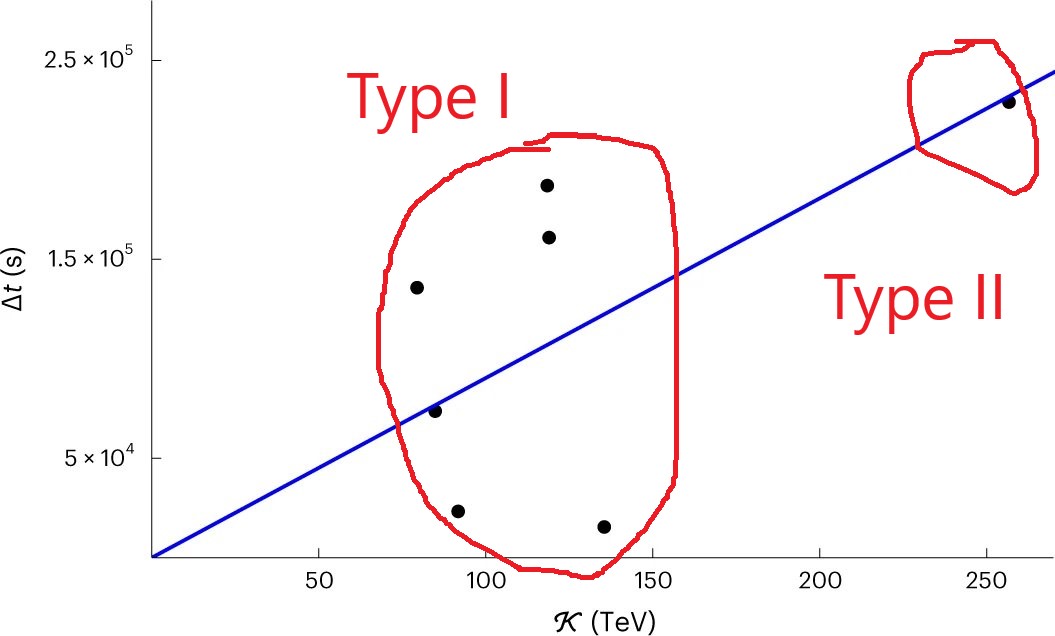
The paper itself is behind a paywall (though a preprint version is on the arXiv here). The results in the paper were deemed so important that Nature Astronomy tweeted about them, including this remarkable graph:

Understandably there has been quite a lot of reaction from scientists on Twitter to this plot, questioning how the blue line is obtained from the dots (as only one point to the right appears to be responsible for the trend), remarking on the complete absence of any error bars on either axis for any of the points, and above all wondering how this managed to get past a referee, never mind one for a “prestigious” journal such as Nature Astronomy. It wouldn’t have passed muster as an undergraduate exercise.

Of course this is how a proper astronomer would do it:

Joking aside, if you look at the paper (or the preprint if you can’t afford it) you will see another graph, which shows two other points at higher energy (red triangles):

The extra two points don’t have any error-bars either, and according to the preprint these appear to be unconfirmed candidate GRB events.

The abstract of the paper is:

In addition to its implications for astrophysics, the hunt for neutrinos originating from gamma-ray bursts could also be significant in quantum-gravity research, as they are excellent probes of the microscopic fabric of spacetime. Some previous studies based on neutrinos observed by the IceCube observatory found intriguing preliminary evidence that some of them might be gamma-ray burst neutrinos whose travel times are affected by quantum properties of spacetime that would slow down some of the neutrinos while speeding up others. The IceCube collaboration recently significantly revised the estimates of the direction of observation of their neutrinos, and we here investigate how the corrected directional information affects the results of the previous quantum-spacetime-inspired analyses. We find that there is now little evidence for neutrinos being sped up by quantum spacetime properties, whereas the evidence for neutrinos being slowed down by quantum spacetime is even stronger than previously determined. Our most conservative estimates find a false-alarm probability of less than 1% for these ‘slow neutrinos’, providing motivation for future studies on larger data samples.

I agree with the last sentence where it says larger data samples are needed in future, but also I’d suggest higher standards of data analysis are also called for. Not to mention refereeing. After all, it’s the quality of the reviewing that you pay for, isn’t it?

P.S. For those of you wondering, this paper would not have been published by the Open Journal of Astrophysics even if passed review, as it is not on the astro-ph section of arXiv (it’s on gr-qc).

New Publication at the Open Journal of Astrophysics

Posted in OJAp Papers, Open Access, The Universe and Stuff with tags , , , , on June 13, 2023 by telescoper

It’s time to announce yet another new paper at the Open Journal of Astrophysics. This one was published on Friday 9th June.

The latest paper is the 19th paper so far in Volume 6 (2023) and the 84th in all,  so with more than half of 2023 remaining and many papers still in the pipeline we’re on track to reach a total of 100 papers by the end of 2023!

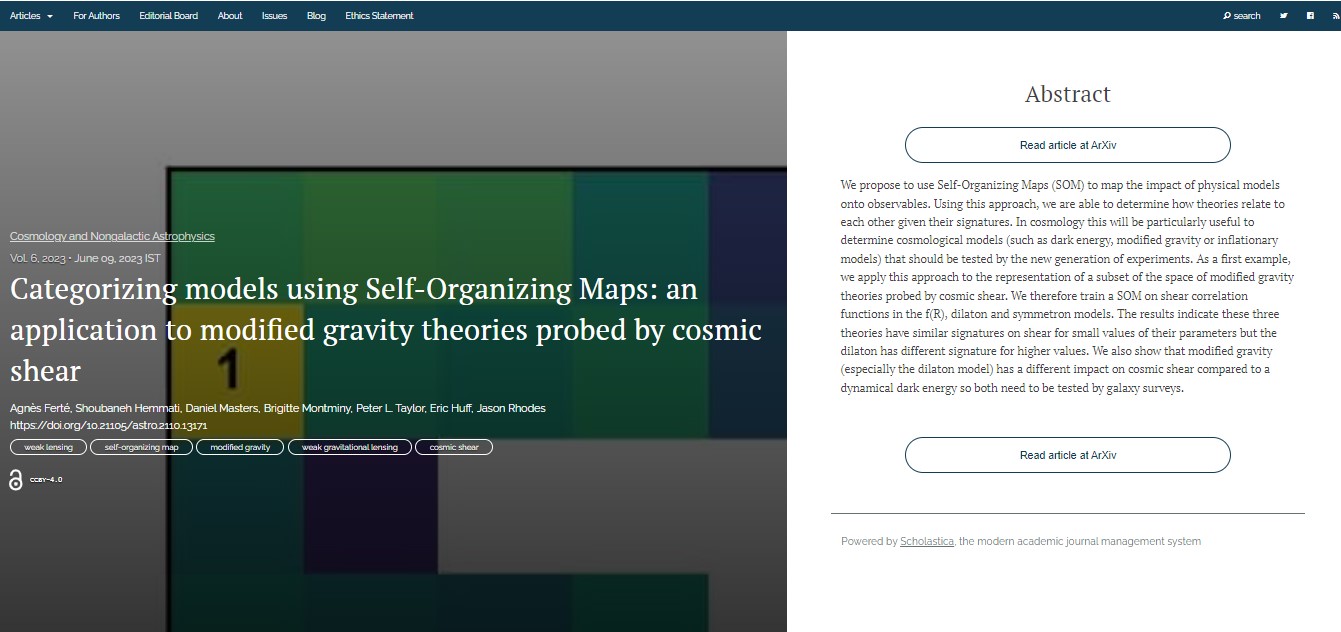
The primary classification for this paper is Cosmology and Nongalactic Astrophysics and its title is “Categorizing models using Self-Organizing Maps: an application to modified gravity theories probed by cosmic shear”. For the uninitiated, a Self-Organizing Map is a machine-learning technique that makes large-dimensional data sets easier to analyze. This paper is yet another one about weak gravitational lensing (cosmic shear), which is obviously what the cool kids do these days.

The authors are: Agnès Ferté (JPL); Shoubaneh Hemmati (IPAC); Daniel Masters (IPAC); Brigitte Montminy (JPL); Peter L. Taylor (JPL); Eric Huff (JPL);  and Jason Rhodes (JPL).

(JPL=Jet Propulsion Laboratory, IPAC= Infrared Processing & Analysis Center, both associated with California Institute of Technology, Pasadena, USA)

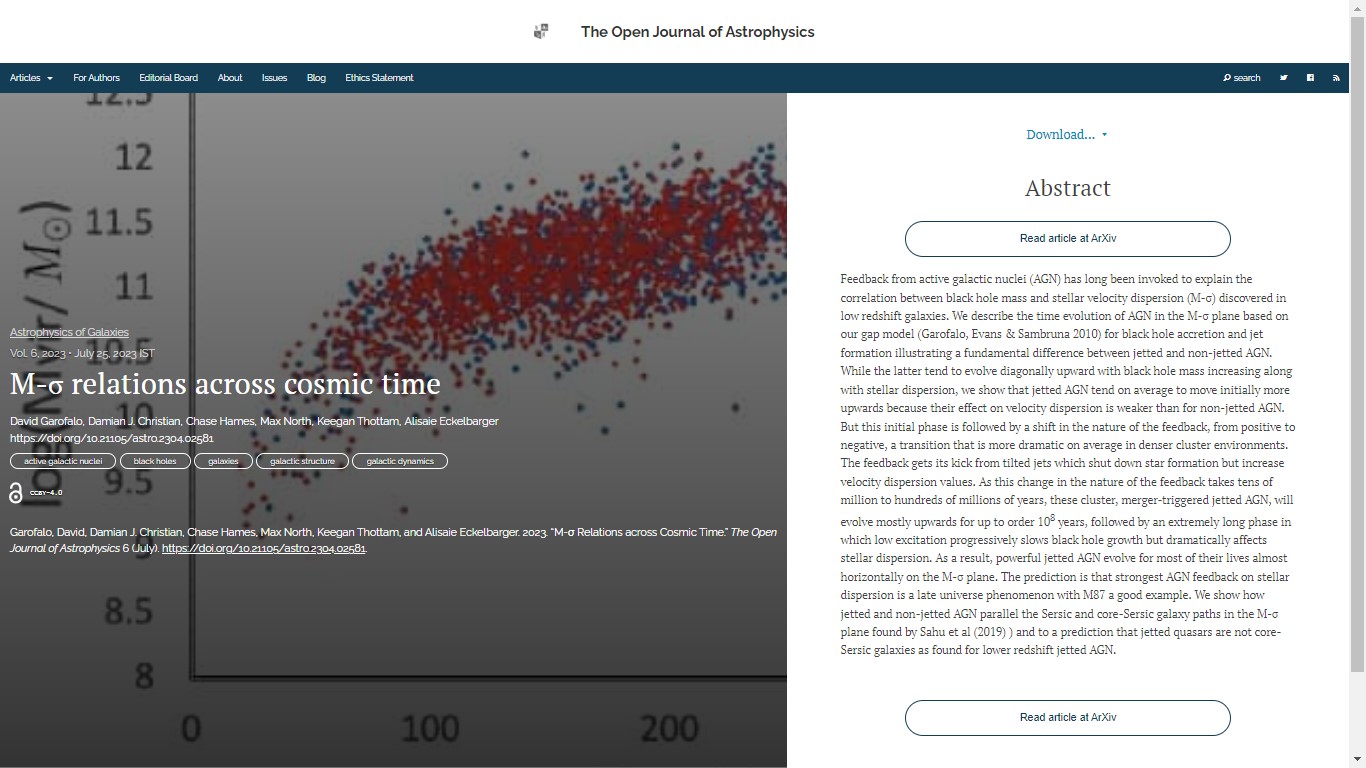
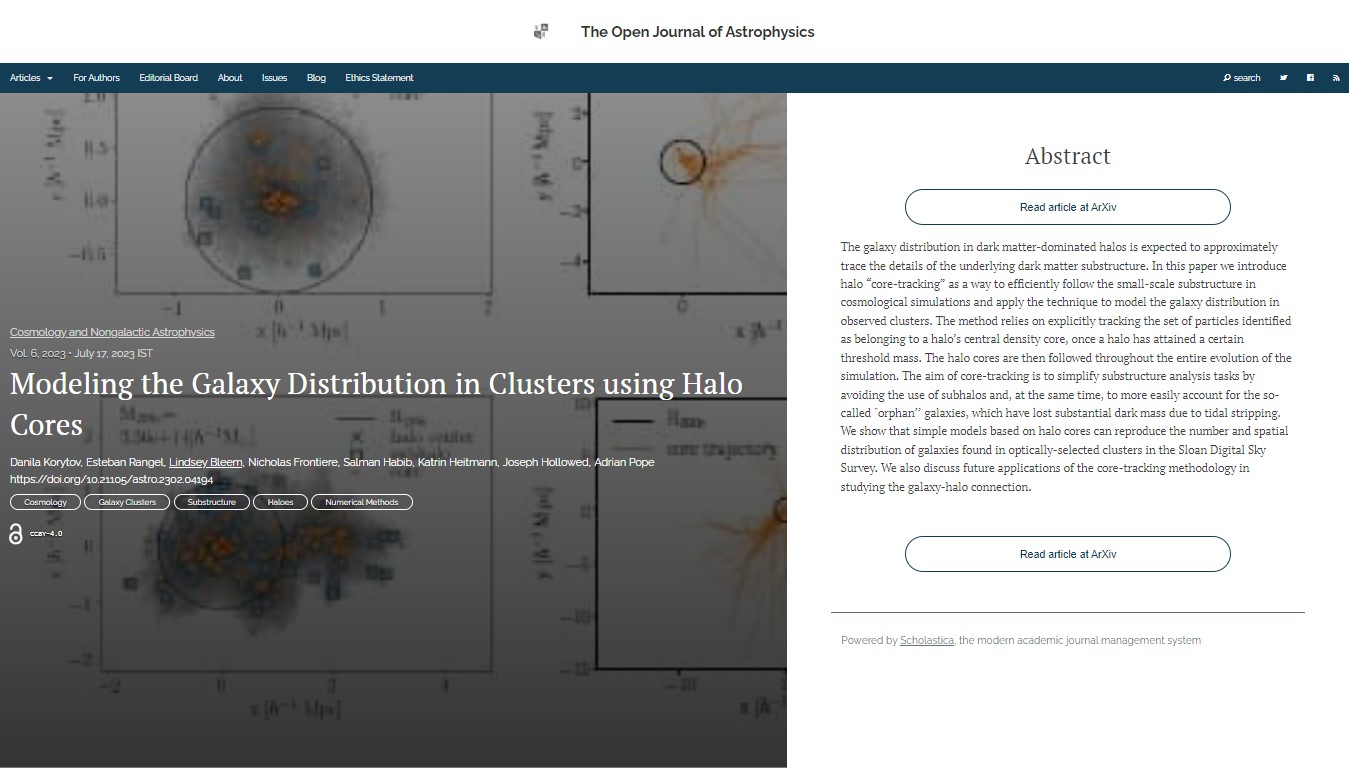
Here is a screen grab of the overlay which includes the  abstract:


You can click on the image of the overlay to make it larger should you wish to do so. You can find the officially accepted version of the paper on the arXiv here.

P.S. The first author tweeted about this paper:


Abolishing an “Industry”?

Posted in Open Access with tags , , on June 2, 2023 by telescoper

A week or so ago I mentioned that the European Council had adopted a text that calls for the EU Commission and Member States to support policies towards a scholarly publishing model that is not-for-profit, open access and multi-format, with no costs for authors or readers.

The journal Nature has responded to the news with a piece entitled EU council’s ‘no pay’ publishing model draws mixed response and the lede:

Some academics have welcomed the proposed open access plans. But publishing industry representatives warn they are unrealistic and lack detail.

It’s not really accurate to describe the response as mixed as it is completely separated: the vested interests in the academic publishing industry are against it and everyone else is for it! It’s hardly surprising to see Nature (owned by academic publishing company Springer Nature). I found this in the text of the Nature piece:

The conclusions are concerning because they support a move that would abolish an industry

Caroline Sutton, the chief executive of the STM (a membership organization of academic publishers)

Indeed, though I would argue that what the proposals would abolish is not so much an industry as a racket. I’ve been blogging here about the Academic Journal Racket since 2009. It’s nice at last to see some real movement towards its abolition. Further on, I find:

The STM is also concerned that the move would eliminate independent European publishing companies and usher in a state-defined system that could stymie academic freedom. It warns that the amount of public funds used to build repositories of academic research papers by member states or institutions is hard to quantify.

How would free open access publishing stymie academic freedom? If anything does that it’s the extortionate publishing fees levied by publishers. And it’s a very bad argument to say that the costs of repositories is hard to quantify when everyone can see your enormous profit margins!

I was thinking about the financial strife currently afflicting many UK universities. If the UK university sector has to choose over the next few years between sacking hundreds of academic staff and ditching its voluntary subsidy to the publishing industry, I know what I would pick. In this respect I’m definitely an abolitionist.

Open Access: the Future is Diamond

Posted in Open Access with tags , , , on May 24, 2023 by telescoper

As it was foretold the Council of Europe has now released a document (PDF) that calls for “transparent, equitable, and open access to scholarly publications”.  In its conclusions, the Council calls on the Commission and the member states to support policies towards a scholarly publishing model that is not-for-profit, open access and multi-format, with no costs for authors or readers. In other words, it calls for Diamond Open Access. The covering press release includes:

If we really believe in open science, we need to make sure that researchers can make their findings available and re-usable and that high-quality scientific articles are openly accessible to anyone that needs to read them. This should be particularly the case for research that benefits from public funding: what has been paid by all should be accessible to all.

Mats Persson, Swedish Minister for Education, Ministry of Education and Research

This is clearly how Open Access should be, though I am still worried that the sizeable publishing lobby will still try to persuade research agencies and institutions to pay the existing fees on behalf of authors, which does not solve the problem but merely hides it.

I know I’m not alone in thinking that the current publishing ecosystem is doomed and will die a natural death soon enough. The replacement should be a worldwide network of institutional and/or subject-based repositories that share research literature freely for the common good. Universities and research centres should simply bypass the grotesque parasite that is the publishing industry. Indeed, I would be in favour of hastening the demise of the Academic Journal Racket by having institutions make it a disciplinary offence for any researcher to pay an APC to any journal.

We are lucky in physics and astronomy because arXiv has already done the hard work for us. With the existence of arXiv, old-style journals are no longer necessary. It is great that arXiv is being joined by similar ventures in other fields, such as BiorXiv and EarthArxiv. A list of existing repositories can be found here. I’m sure many more will follow. The future is Diamond.

What is needed is a global effort to link these repositories to each other and to peer review mechanisms. One way is through overlays as demonstrated by the Open Journal of Astrophysics, there being no reason why the idea can’t be extended beyond arXiv. Other routes are possible, of course, and I would love to see different models developed. I hope the European Council call will result in more support for Diamond Open Access. But whether this happens or not, I think the next few years are going to be very exciting.

New Publication at the Open Journal of Astrophysics

Posted in OJAp Papers, Open Access, The Universe and Stuff with tags , , , on May 18, 2023 by telescoper

It’s time to announce yet another new paper at the Open Journal of Astrophysics. This one was published yesterday (17th May).

The latest paper is the 17th paper so far in Volume 6 (2023) and the 82nd in all. With this one we have now published as many papers so far in 2023 as we did in all of last year. With significantly less than half the year gone, and a large number of papers in the pipeline, I think it’s quite likely we will exceed a total of 100 papers by the end of 2023. How’s that for cosmic acceleration?

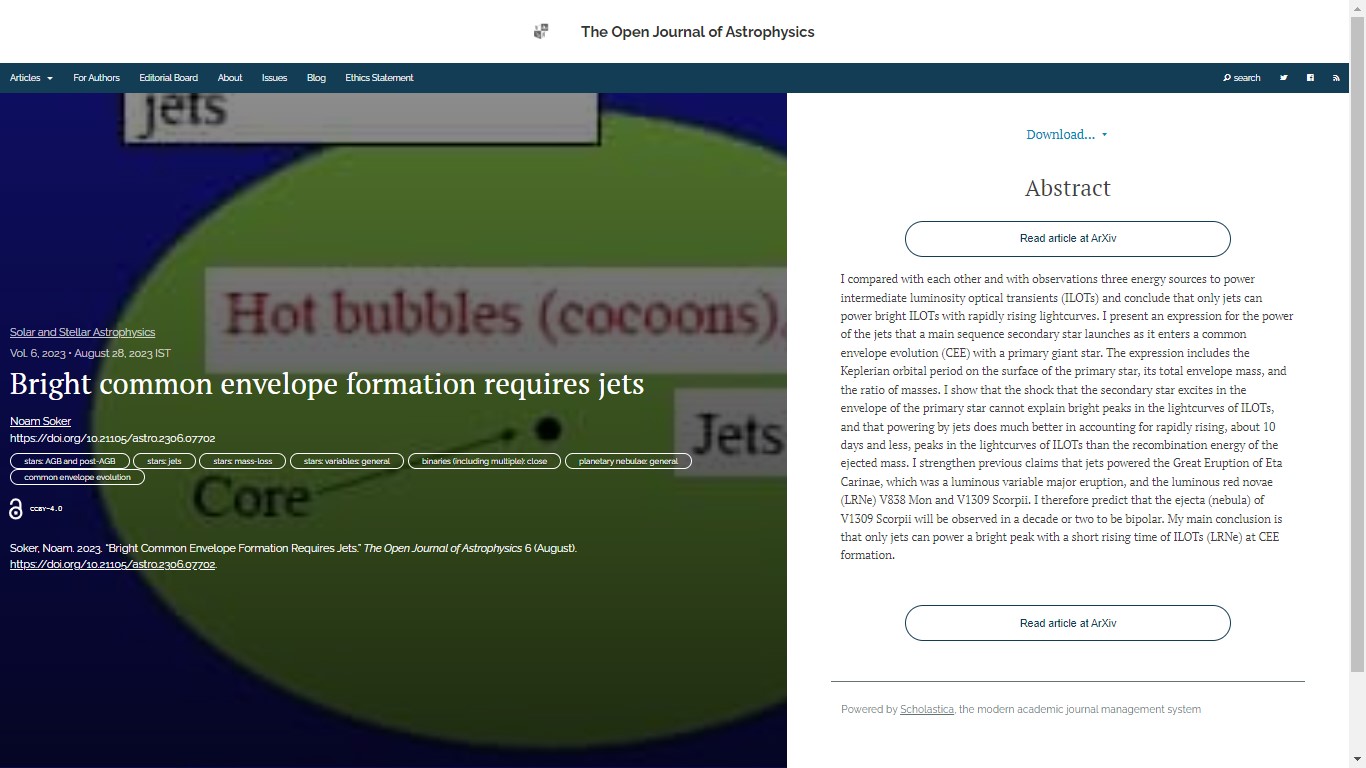
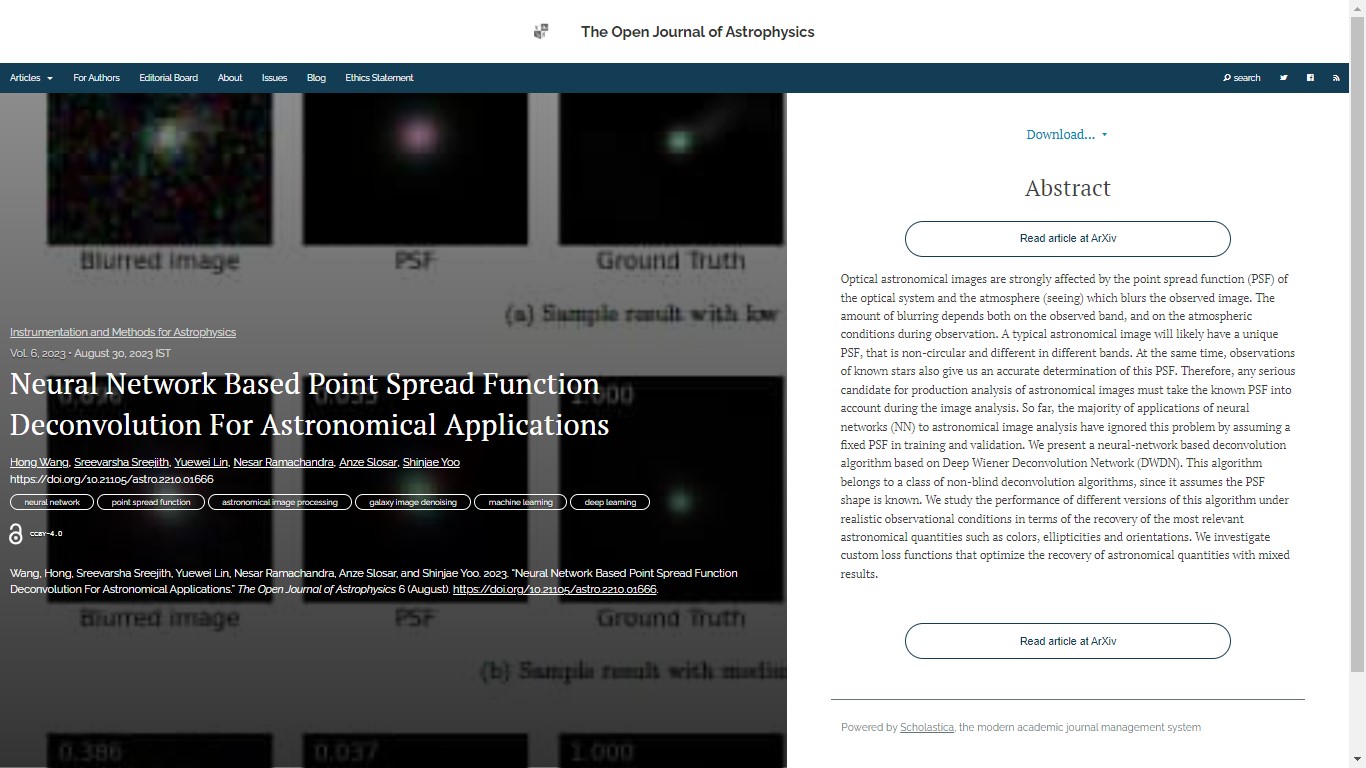
The primary classification for this paper is Instrumentation and Methods for Astrophysics and its title is “Deep-field Metacalibration”. This article describes a technique that reduces the pixel noise in estimators of weak gravitational lensing shear signals by using a deeper imaging survey for calibration.

The authors are Zhuoqi (“Jackie”) Zhang (University of Chicago, IL, USA), Erin Sheldon (Brookhaven National Laboratory, NY, USA), and Matthew Becker (Argonne National Laborary, IL, USA).

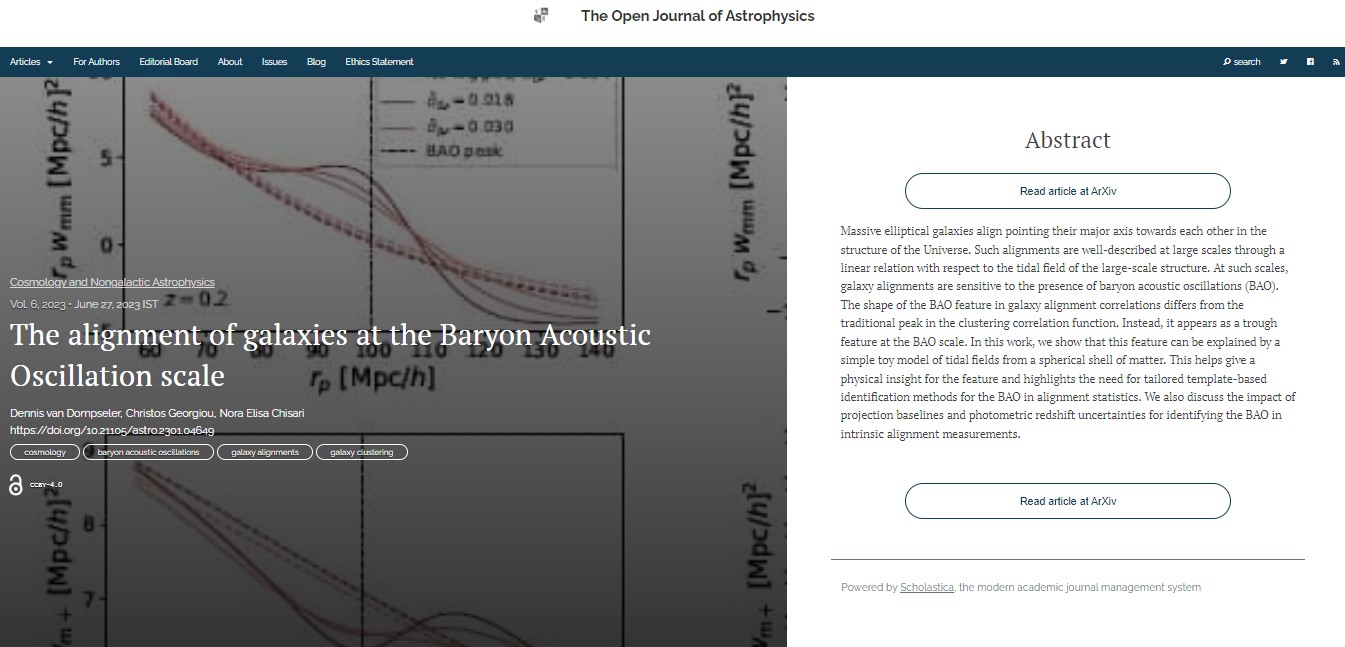
Here is a screen grab of the overlay which includes the  abstract:


You can click on the image of the overlay to make it larger should you wish to do so. You can find the officially accepted version of the paper, along with all other astrophysics and cosmology research papers worth reading, on the arXiv here.

To Preprint or not to Preprint?

Posted in Open Access with tags , , , , on May 16, 2023 by telescoper

In my capacity as managing editor of the Open Journal of Astrophysics I’ve received a few emails recently disagreeing with our policy of asking authors to submit their papers to the arXiv before submitting them to OJAp. Before reflecting on the wider issue, let me just point out that we don’t actually require papers to on the arXiv first. It is possible to submit a PDF directly to the Scholastica platform. We do however say in our For Authors page:

We strongly encourage authors to submit in the manner described above (i.e. on the arXiv first). We can receive and review papers submitted directly to this platform but since the final version must be on the arXiv in order to be published we feel it is far better to submit it there first in order to establish that it is on an appropriate topic for this journal.

Looking back over the 81 papers we have published, only a handful were submitted directly to the platform; the vast majority were put on the arXiv first.

This behaviour is in some sense a continuation of a very old practice in astrophysics. I can’t resist sharing this, one of the interesting astronomical curiosities I’ve acquired over the years, which is a preprint of the classic work of Burbidge, Burbidge, Fowler and Hoyle in 1957 (a paper usually referred to as B2FH after the initials of its authors), which is such an important contribution to the literature that it has its own wikipedia page.

Younger readers will probably not realize that preprints were not always produced in the electronic form they are today. We all used to make large numbers of these and post them at great expense to (potentially) interested colleagues before publication in order to get comments. That was extremely useful because a paper could take over a year to be published after being refereed for a journal: that’s too long a timescale when a PhD or PDRA position is only a few years in duration. The first papers I was given to read as a new graduate student in 1985 were all preprints that were not published until well into the following year. In some cases I had more or less figured out what they were about by the time they appeared in a journal!

The B2FH paper was published in 1957 but the practice of circulating preprints persisted well into the 1990s. Usually these were produced by institutions with a distinctive design, logo, etc which gave them a professional look, which made it easier to distinguish `serious’ papers from crank material (which was also in circulation). This also suggested that some internal refereeing inside an institution had taken place before an “official” preprint was produced and this lending it an air of trustworthiness. Smaller institutions couldn’t afford all this, so were somewhat excluded from the preprint business.

With the arrival of the arXiv the practice of circulating hard copies of preprints in astrophysics gradually died out, to be replaced by ever-increasing numbers of electronic articles. The arXiv does have some gatekeeping – in the sense there are some controls on who can deposit a preprint there – but it is far easier to circulate a preprint now than it was.

It is still the case that big institutions and collaborations insist on quite strict internal refereeing before publishing a preprint – and some even insist on waiting for a paper to be accepted by a journal before adding it to the arXiv – but there’s no denying that among the wheat there is quite a lot of chaff, some of which attracts media coverage that it does not deserve. It must be admitted, however, that the same can be said of some papers that have passed peer review and appeared in high-profile journals! No system that is operated by human beings will ever be flawless, and peer review is no exception.

Nowadays, in astrophysics, the single most important point of access to scientific literature is through the arXiv, which is why the Open Journal of Astrophysics was set up as an overlay journal to provide a level of rigorous peer review for preprints, not only to provide quality control but also to improve papers through the editorial process. In fact, I think the latter is more important than the former.

A Resignation Issue

Posted in Open Access with tags , , on May 8, 2023 by telescoper

I see the Observer has picked up on a story I wrote about a couple of weeks ago concerning the resignation of the entire Editorial Board of an Elsevier journal called Neuroimage. This story was reported in Nature on 21st April. Here is a quote from the Observer article:

Neuroimage, the leading publication globally for brain-imaging research, is one of many journals that are now “open access” rather than sitting behind a subscription paywall. But its charges to authors reflect its prestige, and academics now pay over £2,700 for a research paper to be published. The former editors say this is “unethical” and bears no relation to the costs involved.

Observer, 7th May 2023

“Unethical” is far too polite a word. Apparently the former editors intend to set up their own Open Access journal instead. Good!

This action demonstrates that researchers are starting to realize that the current system of ‘Gold’ Open Access is indeed a scam, and it’s a terrible shame that we have ended up having it foisted upon us. Fortunately, being forced to pay APCs of many thousands of euros to publish their papers, researchers are at last starting to realize that they are being ripped off.

The Editorial Board of Neuroimage and its sister journal Neuroimage: Reports resigned in protest at the `extreme’ APC levels imposed by the publisher, Elsevier, which they claim is being “too greedy”. Note however that the level of APC reported in the quote above is by no means exceptionally large.

I’m sure other academics will follow this example, as it becomes more and more obvious that the current arrangements are unsustainable. Previously the profits of the big publishers were hidden in library budgets. Now they are hitting researchers and their grants directly, as authors themselves now have to pay, and people who previously hadn’t thought much about the absurdity of it all are now realizing what a racket academic publishing really is.

If you’re an Editor of a journal that charges “article processing” fees of several thousand euros per paper then I think you should be considering your position…

Progress on Open Access?

Posted in Open Access with tags , , , , , , , on April 27, 2023 by telescoper

The current state of play with regard to Open Access publishing is very disappointing. The academic publishing industry seems to have persuaded the powers that be to allow them to charge exorbitant article processing charges (APCs) to replace revenues lost from subscriptions when they publish a paper free to readers. This simply transfers the cost from reader to author, and excludes those authors who can’t afford to pay.

This current system of ‘Gold’ Open Access is a scam, and it’s a terrible shame we have ended up having it foisted upon us. Fortunately, being forced to pay APCs of many thousands of euros to publish their papers, researchers are at last starting to realize that they are being ripped off. Recently, the entire Editorial Board of Neuroimage and its sister journal Neuroimage: Reports resigned in protest at the `extreme’ APC levels imposed by the publisher, Elsevier. I’m sure other academics will follow this example, as it becomes more and more obvious that the current arrangements are unsustainable. Previously the profits of the big publishers were hidden in library budgets. Now they are hitting researchers and their grants directly, as authors now have to pay, and people who previously hadn’t thought much about the absurdity of it all are now realizing what a racket academic publishing really is.

The people at the top have been slow to grasp this reality, but there are signs that this is at last happening, In the USA there has been the Nelson Memorandum (see discussion here). Now there is movement in the European Union, with member states apparently set on agreeing a  text to be published next month (May 2023) that calls for immediate open access the default, with no author fees. This is clearly how Open Access should be, though I am still worried that the sizeable publishing lobby will try to persuade research agencies and institutions to pay the existing fees on behalf of authors, which does not solve the problem but merely hides it.

I know I’m not alone in thinking that the current publishing ecosystem is doomed and will die a natural death soon enough. The replacement should be a worldwide network of institutional and/or subject-based repositories that share research literature freely for the common good. Universities and research centres should simply bypass the grotesque parasite that is the publishing industry. Indeed, I would be in favour of hastening the demise of the Academic Journal Racket by having institutions make it a disciplinary offence for any researcher to pay an APC.

We are lucky in physics and astronomy because arXiv has already done the hard work for us. Indeed, it is now a truth universally acknowledged* that every new research paper worth reading in these disciplines can be found on arXiv. Old-style journals are no longer necessary. It is great that arXiv is being joined by similar ventures in other fields, such as BiorXiv and EarthArxiv. A list of existing repositories can be found here. I’m sure many more will follow. What is needed is a global effort to link these repositories to each other and to peer review mechanisms. One way is through overlays as demonstrated by the Open Journal of Astrophysics, there being no reason why the idea can’t be extended beyond arXiv. Other routes are possible, of course, and I would love to see different models developed. I think the next few years are going to be very exciting.

*It is also a truth universally acknowledged that anyone who doesn’t understand the reference to “a truth university acknowledged” has not read Pride and Prejudice by Jane Austen…

On SciPost…

Posted in Maynooth, Open Access with tags , , , on April 24, 2023 by telescoper

On of my colleagues this morning passed on details of a recent publication to put on the Twitter feed of the Department of Theoretical Physics at Maynooth. As far as I’m aware this is the first paper authored by a member of the Department to be published on SciPost, a Diamond Open Access journal.

I’ve known about SciPost for quite a while, but have been preoccupied with the Open Journal of Astrophysics (OJAp) and have not tracked its progress very closely, but I’m glad to see it going well. Its business model is very different from the Open Journal of Astrophysics but its commitment to publishing high-quality scientific papers free of charge for authors and readers alike is most commendable. Looking at the physics section I see that there are quite a few highly-cited papers among them, over a wide spread of topics, including high-energy physics. There are only a few papers in Astronomy, however- only three when I looked.

I’ve heard it said that one of the advantages of SciPost is that, because it allows authors to keep the copyright on their publications, they can post articles freely on arXiv for wider distribution without embargo or other restriction. That is true and laudable. The logic of the Open Journal of Astrophysics, however, is that most astrophysicists use arXiv as their primary source of research literature, so if you’re going to read it on arXiv why not dispense with the separate journal and just use an overlay?

Not all research areas are so wedded to the arXiv, however, and it is great that there’s a free alternative. I’m a little surprised that nobody has set up a particle physics overlay journal (yet), as the HEP community seems to use arXiv a lot. When I asked a particle physicist about this they said it had been discussed, but they decided that they were happy enough with SciPost as an OA platform. Fair enough. The important thing to me is to avoid the excessive Article Processing Charges (APCs) imposed by mainstream journals for OA publishing.

I note that the HEP community has SCOAP3, which pays for articles to appear in Open Access form in traditional journals. In other words it hides the cost from the scientists and effectively subsidizes the academic publishing industry. It is important that there are alternatives to traditional journals so that authors to have a choice whether to adopt the SCOAP3 route.

One final comment. On the Finance page for SciPost it states that the estimated average cost per paper published is €400. That’s at 2019 rates. It’s probably higher now. That cost is a lot less than a typical APC but is still about a factor of ten higher than the cost per paper for OJAp. SciPost has a large network of sponsors so it can cover this cost. The overlay model used by arXiv is much cheaper to run.