Archive for the Open Access Category

New Publication at the Open Journal of Astrophysics

Posted in OJAp Papers, Open Access, The Universe and Stuff with tags , , , on February 14, 2023 by telescoper

It’s time to announce another new paper at the Open Journal of Astrophysics. This was published yesterday (13th February 2023). The rate of submissions has increased greatly in recent weeks, so  I am thinking seriously about switching to a weekly round-up on here instead of individual posts, but for the meantime I’ll carry on.

The latest paper is the 7th paper in Volume 6 (2023) as well as the 72nd  in all. This one is another one for the folder marked Instrumentation and Methods for Astrophysics. The title is “FRBSTATS: A web-based platform for visualization of fast radio burst properties”. This paper describes a software platform which can be accessed directly here. If you want to read more about Fast Radio Bursts, you can look here.

The authors of the paper are Apostolos Spanakis-Misirlis, who gives his affiliations as the University of Piraeus and University of Crete (Greece), and Cameron Van Eck of ANU in Canberra, Australia

Here is a screen grab of the overlay which includes the  abstract:


You can click on the image of the overlay to make it larger should you wish to do so. You can find the officially accepted version of the paper on the arXiv here.

Institutional Affiliations and the Open Journal of Astrophysics

Posted in Open Access with tags , on February 13, 2023 by telescoper

This is a copy of a blog post I put up in the Open Journal of Astrophysics website at the weekend.

The Research Organization Registry (ROR) is a community-led database that aims to provide a persistent identifier for every research organization in the world. In other words, it aims to do for institutions what ORCID does for individual researchers.

Scholastica has recently introduced a facility to allow authors to include an ROR tag for authors when they submit a paper. We encourage authors of papers submitted to the Open Journal of Astrophysics to do this. Institutions and organizations may require this in due course, as some do with ORCID, so it would be good to get into practice!

For example the ROR entry for NUI Maynooth is:

https://ror.org/048nfjm95

You can find your institutions ROR identifier here.

Not all corresponding authors of papers to OJAp supply details of institutional affiliations when they submit papers to us., presumably because it takes a while enter the relevant data. We can only supply the metadata to Crossref that authors supply to us. The more authors include the better, of course, but the ROR tag supplies a unique persistent identifier that is sufficient to pinpoint the relevant organization, so it is undoubtedly useful. Obviously, however, we can only pass this information on if authors supply it to us.

What should it mean to be an author of a scientific paper?

Posted in Open Access, The Universe and Stuff with tags , , , on February 12, 2023 by telescoper

The implementation of artificial intelligence techniques in tools for generating text (such as ChatGPT) has caused a lot of head-scratching recently as organizations try to cope with the implications. For instance, I noticed that the arXiv recently adopted a new policy on the use of generative AI in submissions. One obvious question is whether ChatGPT can be listed as an author. This has an equally obvious answer: “no”. Authors are required to acknowledge the use of such tools when they have used them in writing a paper.

One particular piece of the new policy statement caught my eye:

…by signing their name as an author of a paper, they each individually take full responsibility for all its contents, irrespective of how the contents were generated. If generative AI language tools generate inappropriate language, plagiarized content, biased content, errors, mistakes, incorrect references, or misleading content, and that output is included in scientific works, it is the responsibility of the author(s).

The first sentence of this quote states an obvious principle, but there are situations in which I don’t think it is applied in practice. One example relates to papers emanating from large collaborations or consortia, where the author lists are often very long indeed, sometimes numbering in the thousands. Not all the “authors” of such papers will have even read the paper, so do they “each individually take full responsibility”? I don’t think so. And how can this principle be enforced as policy?

All large consortia have methods for assigning authorship rights as a way of assigning credit for contributions made. But why does “credit” have to mean “authorship”? Papers just don’t have thousands of authors, in the meaningful sense of the term. It’s only ever a handful of people who actually do any writing. That doesn’t mean that the others didn’t do any work. The project would probably not have been possible without them. It does mean, however, that pretending that they participated in writing the article that describes the work isn’t be the right way to acknowledge their contribution. How are young scientists supposed to carve out a reputation if their name is always buried in immensely long author lists? The very system that attempts to give them credit at the same renders that credit worthless.

As science evolves it is extremely important that the methods for disseminating scientific results evolve too. The trouble is that they aren’t. We remain obsessed with archaic modes of publication, partly because of innate conservatism and partly because the lucrative publishing industry benefits from the status quo. The system is clearly broken, but the scientific community carries on regardless. When there are so many brilliant minds engaged in this sort of research, why are so few willing to challenge an orthodoxy that has long outlived its usefulness.

In my view the real problem is not so much the question of authorship but the very idea of the paper. It seems quite clear to me that the academic journal is an anachronism. Digital technology enables us to communicate ideas far more rapidly than in the past and allows much greater levels of interaction between researchers. The future for many fields will be defined not in terms of “papers” which purport to represent “final” research outcomes, but by living documents continuously updated in response to open scrutiny by the community of researchers. I’ve long argued that the modern academic publishing industry is not facilitating but hindering the communication of research. The arXiv has already made academic journals redundant in many of branches of  physics and astronomy; other disciplines will inevitably follow. The age of the academic journal is drawing to a close. Now to rethink the concept of “the paper”.

In the meantime I urge all scientists to remember that by signing their name as an author of a paper, they individually take full responsibility for all its contents. That means to me that at the very least you should have read the paper you’re claiming to have written.

Action Plan for Diamond Open Access

Posted in Open Access with tags on February 10, 2023 by telescoper

I came across an interesting document concerning Diamond Open Access journals and thought I’d share it here. These are journals of the good sort that charge neither authors nor readers. In particular they do not charge exorbitant Article Processing Charges, like Open Access journals of the bad sort do. The Open Journal of Astrophysics is a “diamond journal“.

The document describes an initiative (“Action Plan”) that aims for a scholarly publishing infrastructure that is equitable, community-driven, academic-led and -owned. This will enable the global research community to take charge of a scholarly communication system by and for research communities. It therefore welcomes all researchers, organisations, disciplines, and journals who share its vision and ethos to endorse it.

You can download the document as a PDF file here.

You might also want to endorse the plan, or persuade your organization/university/research lab to do so. You can do that here.

Endorsing the Action Plan does not entail any financial commitment, but makes you part of the Diamond Open Access community and engages you in the creation of conditions that will strengthen the sector. An overview of endorsing persons and organisations will be publicly available.

Perusing the list of endorsing institutes, I see Cardiff University is in there, but sadly not Maynooth (yet…)

New Publication at the Open Journal of Astrophysics

Posted in OJAp Papers, Open Access, The Universe and Stuff with tags , , , , , on February 8, 2023 by telescoper

We’re on a bit of a roll at the Open Journal of Astrophysics and it’s time to announce yet another paper. We actually published this one yesterday (7th February 2023), which makes it two in two days. I don’t think we’ll keep up that rate but we have seen a big increase in submissions recently and these are working their way through the system very nicely. We aim to publish accepted papers within a day of the revised version appearing on arXiv.

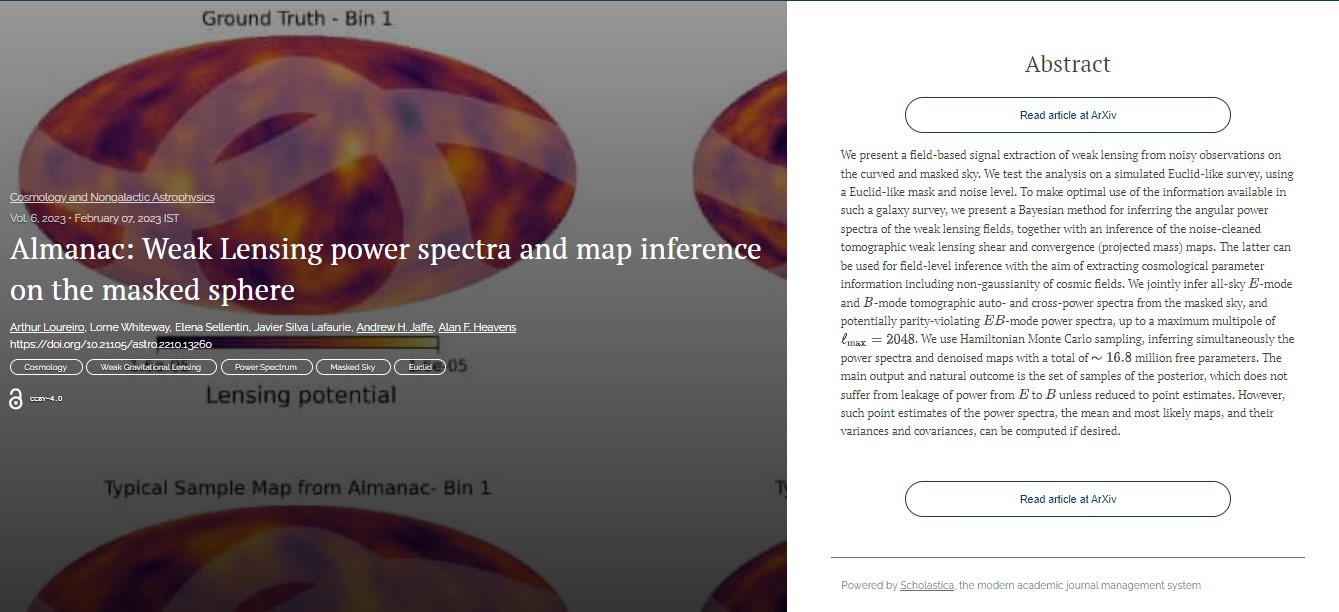
The latest paper is the 6th paper in Volume 6 (2023) as well as the 71st in all. This one is another one for the folder marked Cosmology and Nongalactic Astrophysics. The title is “Almanac: Weak Lensing power spectra and map inference on the masked sphere”. The nub of the problem addressed by this paper is that the usual statistical analysis of data presented in projection on the sky involves spherical harmonics, which are orthogonal functions on the celestial sphere, but when the sky is not completely covered (i.e. part of it is masked), these functions are not orthogonal on what remains.

The authors of this paper are Arthur Loureiro (University of Edinburgh, UK), Lorne Whiteway (University College London, UK), Elena Selentin (Leiden University, NL), Javier Silva Lafaurie (Leiden University, NL), Andrew Jaffe (Imperial College London, UK) and Alan Heavens (Imperial College London, UK)

Here is a screen grab of the overlay which includes the  abstract:


You can click on the image of the overlay to make it larger should you wish to do so. You can find the officially accepted version of the paper on the arXiv here.

New Publication at the Open Journal of Astrophysics

Posted in OJAp Papers, Open Access, The Universe and Stuff with tags , , , , on February 6, 2023 by telescoper

Well, it may be a Bank Holiday here in Ireland but there’s no break for the Open Journal of Astrophysics and it’s time to announce yet another paper hot off the press.

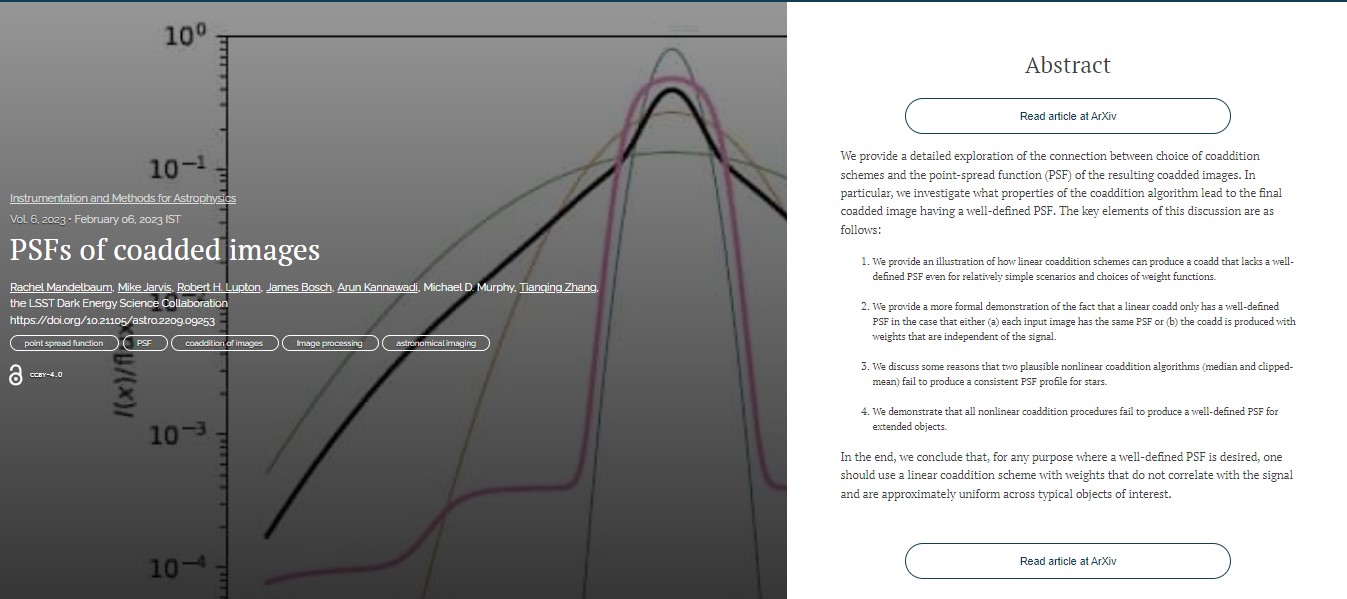
The latest paper is the 5th paper in Volume 6 (2023) as well as the 70th in all. This one is in the folder marked Instrumentation and Methods for Astrophysics. The title is “PSFs of coadded images”; for those of you not up with the lingo, “PSF” stands for point spread function.

The authors of this paper are Rachel Mandelbaum (1), Mike Jarvis (2), Robert H. Lupton (3), James Bosch (3), Arun Kannawadi (3), Michael D. Murphy (1) and Tianqing Zhang (1) and the LSST Dark Energy Science Collaboration. The affiliations of the individual authors are: (1) Carnegie Mellon University, Pittsburgh PA; (2) University of Pennsylvania, Philadelphia PA; (3) Princeton University, Princeton NJ; all in the USA of course.

Here is a screen grab of the overlay which includes the  abstract:


You can click on the image of the overlay to make it larger should you wish to do so. You can find the officially accepted version of the paper on the arXiv here.

New Publication at the Open Journal of Astrophysics

Posted in OJAp Papers, Open Access, The Universe and Stuff with tags , , , , , , on February 3, 2023 by telescoper

The articles are coming in thick and fast at the Open Journal of Astrophysics. and why trying to get them refereed and published as quickly as we can. It’s time to announce yet another paper. This one was published officially yesterday (2nd February 2023) but I just found time to post about it here today before I go to my 9am tutorial.

The latest paper is the 4th paper in Volume 6 (2023) as well as the 69th in all. This one is in the Astrophysics of Galaxies folder.

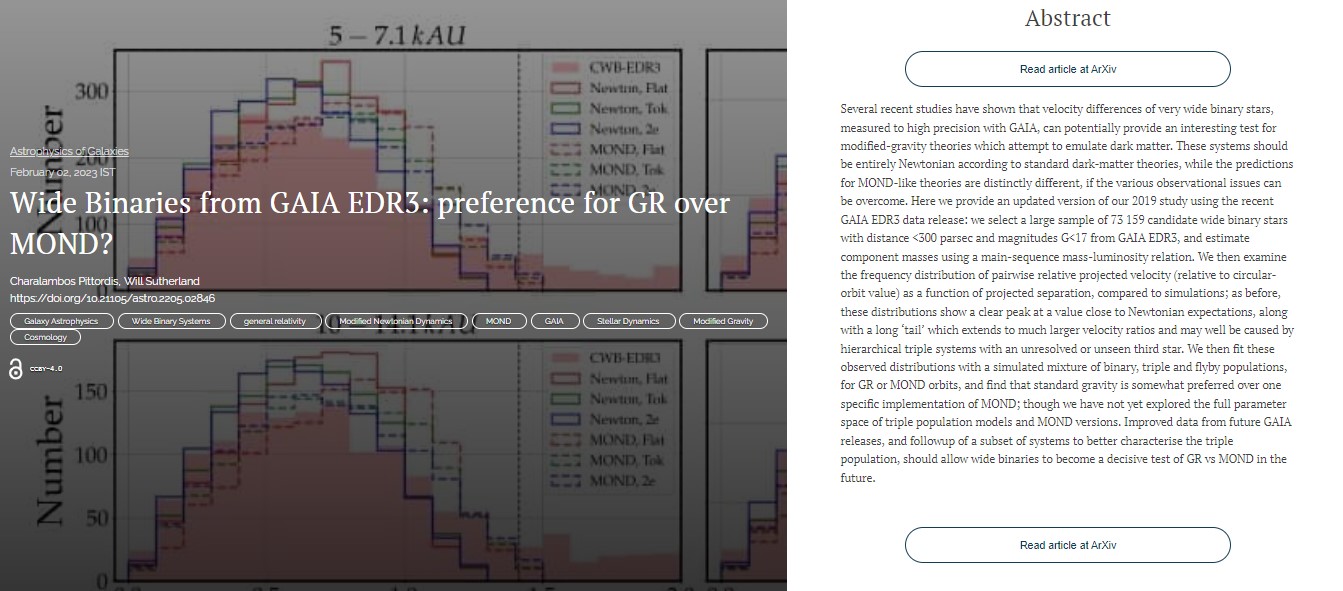
The latest publication is entitled “Wide Binaries from GAIA EDR3: preference for GR over MOND?”.  The authors of this paper,  Charalambos Pittordis and Will Sutherland, are both based at Queen Mary, University of London. We published a related paper last month.

Here is a screen grab of the overlay which includes the  abstract:


You can click on the image to make it larger should you wish to do so. You can find the officially accepted version of the paper on the arXiv here.

Page Charges and Monthly Notices

Posted in Open Access, The Universe and Stuff with tags , , , , on January 31, 2023 by telescoper

Some time ago (in 2020) I reported here that the publishers of Monthly Notices of the Royal Astronomical Society (known as MNRAS for short) had decided to abandon the print edition and only have online articles. This is not surprising as demand for hard copies was falling drastically.

At the time I heard from a reliable source that MNRAS was also planning to introduce page charges – fees paid by authors to publish papers in the journal – and posted a comment to that effect here. This comment led to wild accusations of “serious academic misconduct” by me from a certain individual who shall remain nameless.

Well, the “rumour” I reported in 2020 is now confirmed to be the truth (as I knew it was). At a recent meeting of the national societies affiliated to the European Astronomical Society, Royal Astronomical Society President Mike Edmunds confirmed that, in the near future, all authors publishing in Monthly Notices of the Royal Astronomical Society will have to pay page charges. The timescale is “within a few years”.

This is part of a move to making all articles Open Access, largely forced by Plan S through which funding agencies require research outputs to be made freely available upon publication. Page charges are Article Processing Charges by another name.

Other notable journals, such as the Astrophysical Journal (ApJ) and Astronomy & Astrophysics (A&A), have levied page charges for as long as I can remember, though in the latter case it is complicated because there is a waiver for researchers in “member” countries. ApJ and other journals also have a waiver scheme for those who cannot afford to pay. For those who have to pay, the fee is usually about $100 per page. For a long time MNRAS was the exception and indeed the only feasible choice for people who don’t have access to funding to cover page charges, including many in the developing world. More recently, however, MNRAS introduced a charge for longer papers: £50 per page over 20 pages, so a paper of 21 pages costs £50 and one of 30 pages costs £500, etc. This will now be extended to all papers. I don’t have a figure for what MNRAS will charge in future or what waivers will be offered, but it seems likely to be similar to existing journals.

The introduction of page charges is an attempt to maintain the profitability of MNRAS after the loss of income from subscriptions, as readers will no longer be required to pay to read papers. It is therefore a transfer of cost from reader to author. I chose the ‘profitability’ because the prime purpose of MNRAS is no longer the dissemination of scientific results but the generation of income to fund other activities of the Royal Astronomical Society. Despite the move to the much cheaper digital-only publishing mode, the annual cost of an institutional subscription to this journal is currently over $10,000. Most of that is goes as profit to Oxford University Press (the actual publisher) and to the Royal Astronomical Society. Page charges are nothing to do with the actual cost of publication, but are intended to protect the publisher’s profit margins.

Much of what the RAS does with the revenue generated by journals is laudable, of course, but I don’t think it is fair to fleece researchers in order to fund its activities. I think authors can see this, and the attempt to transfer costs onto researchers will backfire. In particular, it’s a move that plays into the hands of The Open Journal of Astrophysics, which publishes papers (online only) in all the areas of Astrophysics covered by MNRAS, and more, but is entirely free both for authors and readers. If you don’t want to pay page charges, or make your library pay a subscription, then you could give it a try.

For myself, I abandoned the traditional journal system many years ago, as it is so clearly a racket.

The question for the Royal Astronomical Society, and other learned societies that fund their activities in a similar way, is whether they can find a sustainable funding model that takes proper account of the digital publishing revolution. If their revenue from publishing does fall, can they replace it? And, if not, in what form can they survive?


New Publication at the Open Journal of Astrophysics

Posted in OJAp Papers, Open Access, The Universe and Stuff with tags , , , , , , on January 27, 2023 by telescoper

Time to announce another new paper at the Open Journal of Astrophysics. This one was published yesterday, 26th January 2023. The latest paper is the third paper in Volume 6 (2023) as well as the 68th in all. It’s yet another in the Cosmology and NonGalactic Astrophysics folder.

The latest publication is entitled “Palatini formulation for gauge theory: implications for slow-roll inflation” and the authors are Syksy Räsänen of the University of Helsinki in Finland and Yosef Verbin (The Open University of Israel, Ra’anana, Israel). The first author has  published a previous paper on the Palatini formulation in the Open Journal of Astrophysics.

Here is a screen grab of the overlay which includes the  abstract:


You can click on the image to make it larger should you wish to do so. You can find the officially accepted version of the paper on the arXiv here.

P.S. You may be wondering about the image shown in the overlay. This paper doesn’t contain any figures or images so I tried out the collection of stock photographs that comes free with the Scholastica platform by typing in “gauge”. The result was a quite amusing collection of pictures of various kinds of dials and other gauges. I quite liked the one above so used it just for show!

ChatGPT in the Swampland

Posted in Maynooth, Open Access, The Universe and Stuff with tags , , , , , on January 22, 2023 by telescoper

My inestimable PhD student Kay Lehnert has been having a look at the capabilities of the Artificial Intelligence platform ChatGPT at writing about string theoretical ideas, specifically the swampland conjectures. It’s remarkable what this does well but also notable what it doesn’t do well at all. What he found was so interesting he wrote it up as a little paper, which you can find on the arXiv here. The abstract is:

In this case study, we explore the capabilities and limitations of ChatGPT, a natural language processing model developed by OpenAI, in the field of string theoretical swampland conjectures. We find that it is effective at paraphrasing and explaining concepts in a variety of styles, but not at genuinely connecting concepts. It will provide false information with full confidence and make up statements when necessary. However, its ingenious use of language can be fruitful for identifying analogies and describing visual representations of abstract concepts.

It took arXiv a while to decide what to do with this paper as it doesn’t fit in any of the usual categories. The arXiv sections that usually cover string theory are General Relativity and Quantum Cosmology (gr-qc) and/or high-energy physics theory (hep-th), which was where it was originally submitted, but this isn’t really a string theory paper per se. After being held by the moderators for a while it eventually it appeared in Popular Physics (physics.pop-ph), cross-listed in Artificial Intelligence (cs.AI) & Computation and Language (cs.CL); the latter two are computer science categories, obviously.

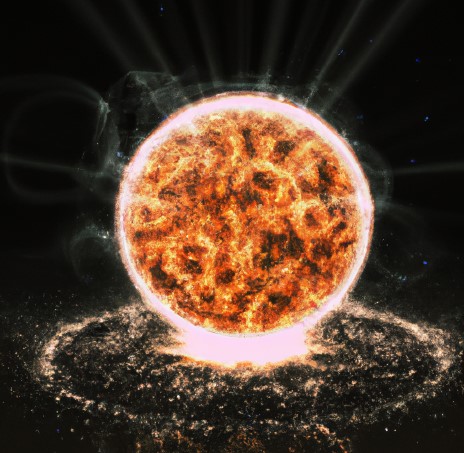
Figure 2 of the paper, which you should read if you want to know what it represents!

The reclassification of this paper was perfectly reasonable. In fact with this, as with any other arXiv paper, the thing that matters most is that it it is freely available to anyone who wants to read it and is discoverable, i.e. can easily be found via search engines. In the era of Open Access, things will generate interest if they are interesting (and accessible).

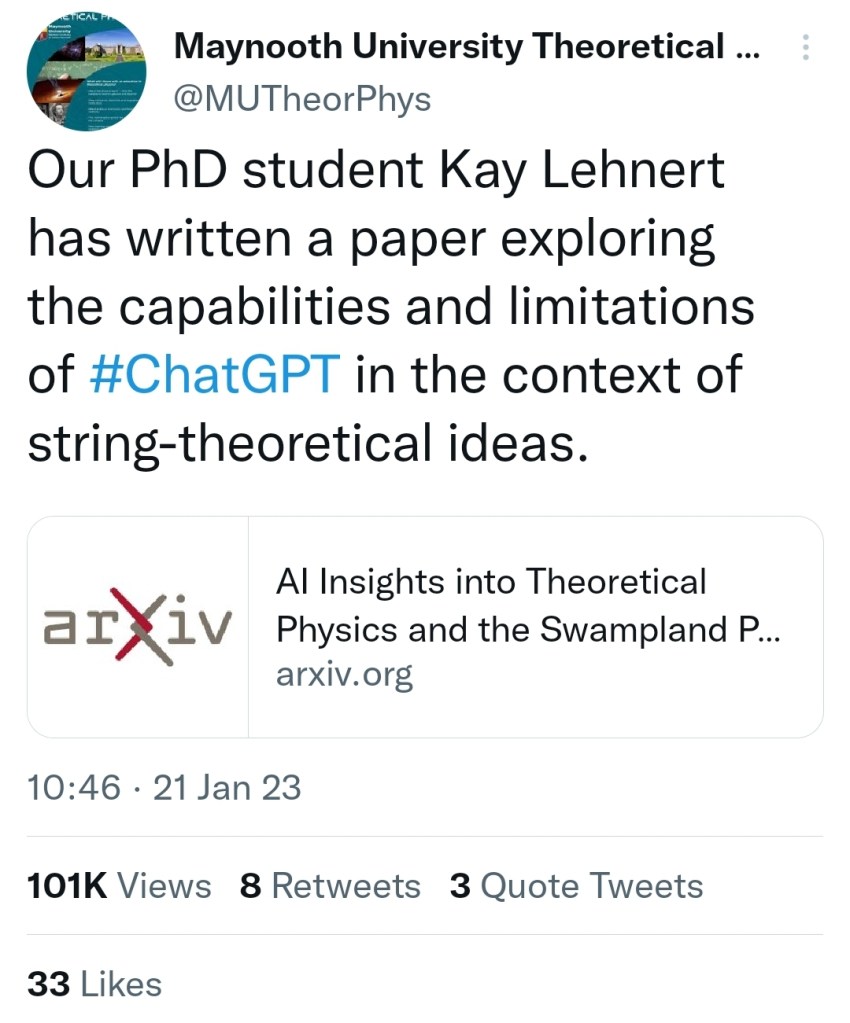
We posted the following on the Maynooth University Theoretical Physics Department Twitter account, something we do whenever a new paper by someone in the Department comes out:

Judging by the number of views (101K) by this morning, this one certainly seems to be attracting interest! Hopefully this blog post will generate even more..

Finally, there might be people reading this blog who can suggest a journal that might consider publishing an article on this sort of subject? Whatever you think about ChatGPT I think it’s generating a lot of discussion right now, so the topic is… er… topical.

Please use the box below for any suggestions.