Archive for Point Spread Function

Weekly Update from the Open Journal of Astrophysics – 23/05/2026

Posted in OJAp Papers, Open Access, The Universe and Stuff with tags , , , , , , , , , , , , , , , , , , , , , , , , , , , , , , , , , , on May 23, 2026 by telescoper

It’s Saturday once again, so time for another update of activity at the Open Journal of Astrophysics. Since the last update we have published a further six papers, bringing the number in Volume 9 (2026) to 110 and the total so far published by OJAp up to 558.

I will continue to include the posts made on our Mastodon account (on Fediscience); these announcements also show the DOI for each paper.

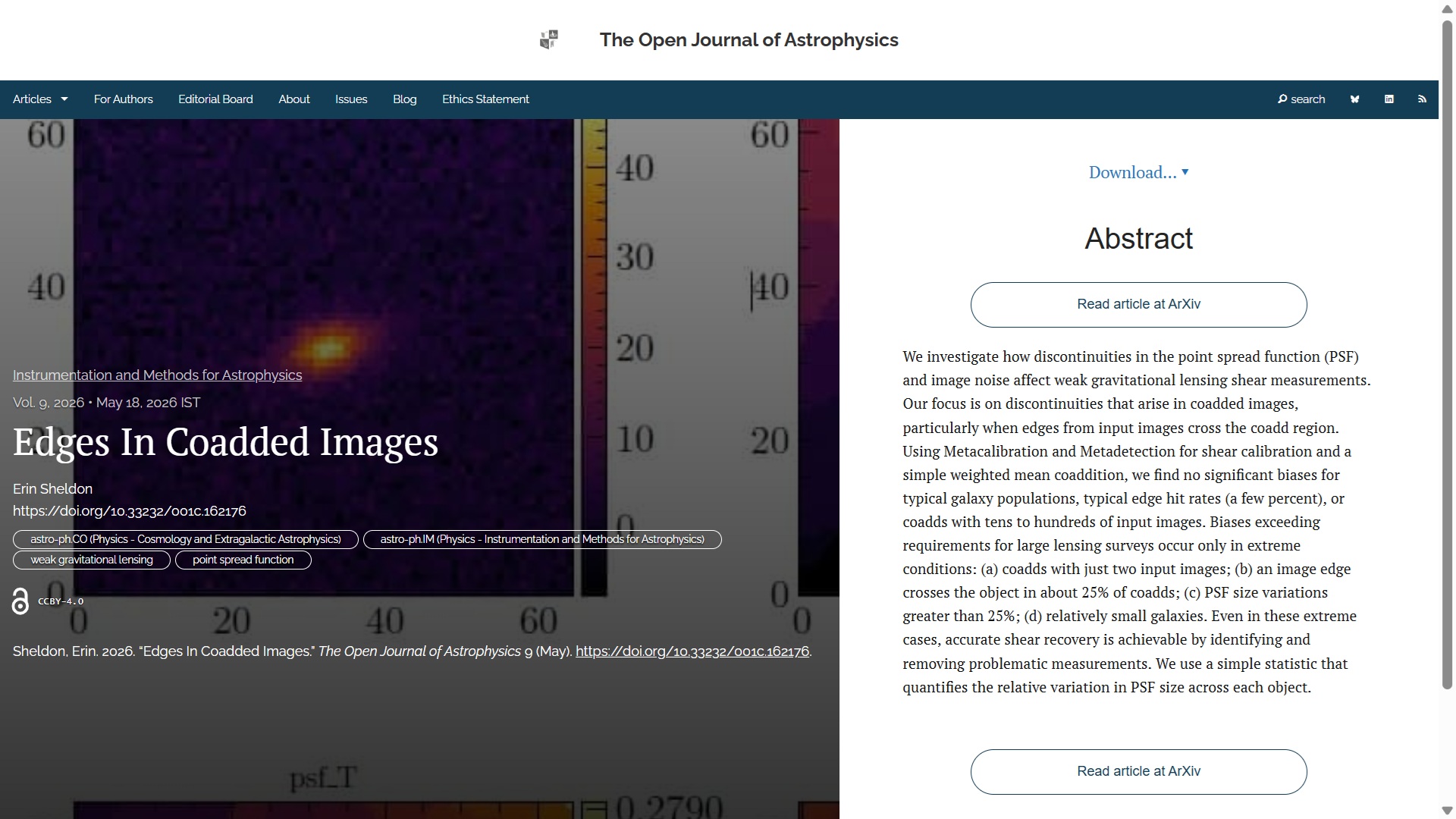
The first paper to report this week, published on Monday 18th May in the folder Instrumentation and Methods for Astrophysics is “Edges In Coadded Images” by Erin Sheldon (Brookhaven National Laboratory, USA). This paper describes a study exploring how image discontinuities and noise impact weak gravitational lensing measurements, finding no significant biases under typical conditions. Biases occur only in extreme cases, but can be mitigated.

The overlay for this paper is here
You can find the officially accepted version on arXiv here and the announcement on Fediverse here:

Open Journal of Astrophysics

New Publication at the Open Journal of Astrophysics: "Edges In Coadded Images" by Erin Sheldon (Brookhaven National Laboratory, USA)

doi.org/10.33232/001c.162176

May 18, 2026, 6:43 am 1 boosts 0 favorites

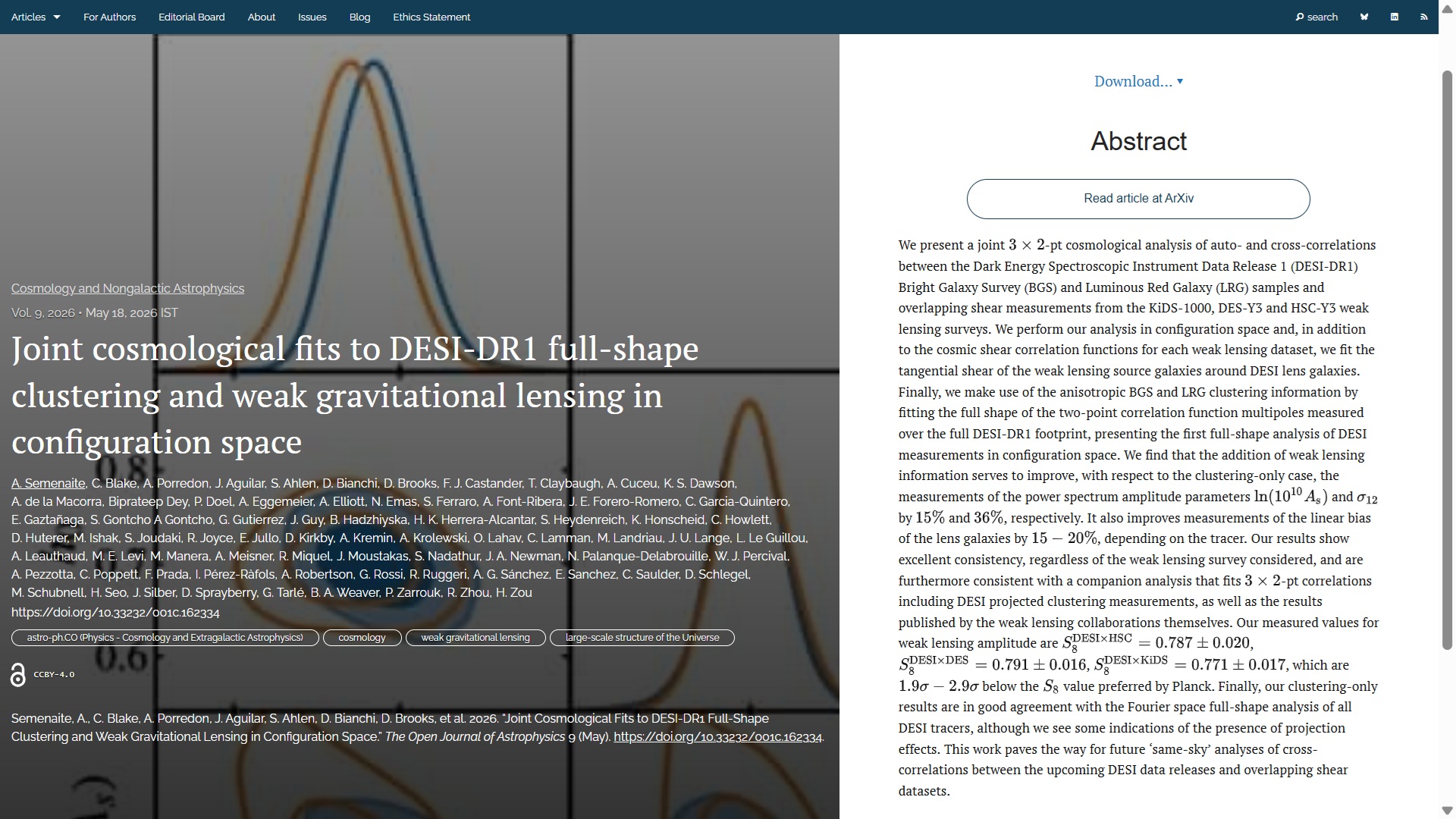
The second paper for this week, also published on Monday 18th May but in the folder Cosmology and Nongalactic Astrophysics, is “Joint cosmological fits to DESI-DR1 full-shape clustering and weak gravitational lensing in configuration space” by A. Semenaite (Swinburne Institute of Technology, Australia) and 72 other authors from all round the world. This paper presents a cosmological analysis of correlations between the DESI-DR1 Bright Galaxy Survey and Luminous Red Galaxy samples and overlapping shear measurements from various weak lensing surveys.

The overlay for this one is here:
The official version of the paper can be found on arXiv here and the Fediverse announcement here:

Open Journal of Astrophysics

New Publication at the Open Journal of Astrophysics: "Joint cosmological fits to DESI-DR1 full-shape clustering and weak gravitational lensing in configuration space " by A. Semenaite (Swinburne Institute of Technology, Australia) and 72 others from all round the world.

doi.org/10.33232/001c.162334

May 18, 2026, 6:52 am 1 boosts 1 favorites

Next one up, the third paper of the week, and the third published on Monday 18th May, and in the folder Cosmology and Nongalactic Astrophysics is “Probing Dark Energy Microphysics with kSZ Tomography” by Julius Adolff, Selim Hotinli and Neal Dalal (all of the Perimeter Institute, Canada). This paper explores how kinetic Sunyaev-Zel’dovich tomography and galaxy clustering can enhance our understanding of dark energy and its effects, potentially revealing its microphysical properties in future surveys.

The overlay for this one is here:
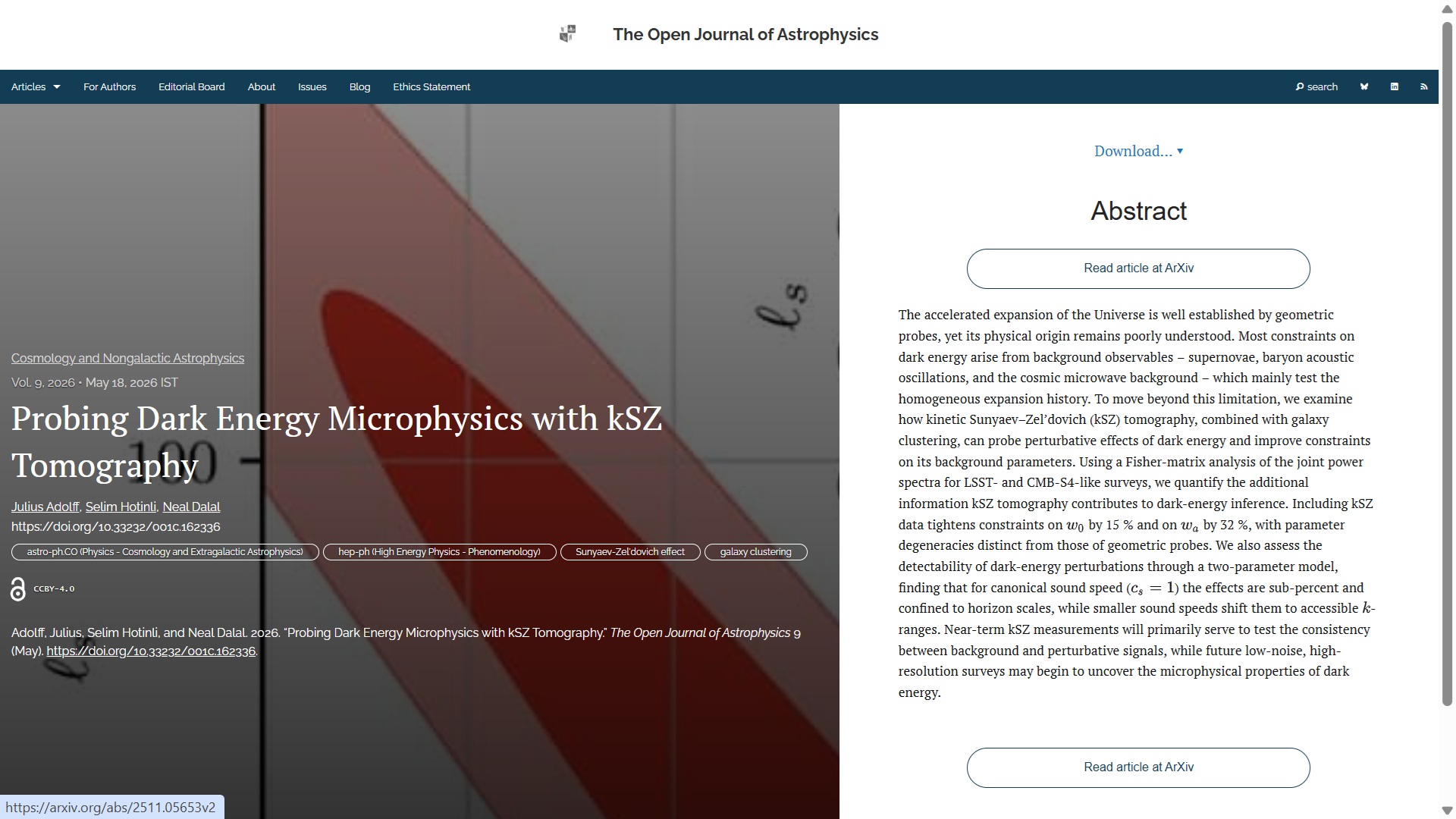
The final, accepted version can be found on arXiv here and the Mastodon announcement is here:

Open Journal of Astrophysics

New Publication at the Open Journal of Astrophysics: "Probing Dark Energy Microphysics with kSZ Tomography" by Julius Adolff, Selim Hotinli and Neal Dalal (Perimeter Institute, Canada)

doi.org/10.33232/001c.162336

May 18, 2026, 7:04 am 1 boosts 0 favorites

The fourth paper this week, published on Wednesday May 20th is “A Census of Variable Radio Sources at 3 GHz” by Yjan A. Gordon, Peter S. Ferguson, Michael N. Martinez and Eric J. Hooper (all of the University of Wisconsin, USA). This article, published in the folder Astrophysics of Galaxies, uses data from the Very Large Array Sky Survey to analyze variability in the radio sky, finding most changes consistent with blazars and quasars.

The overlay is here:
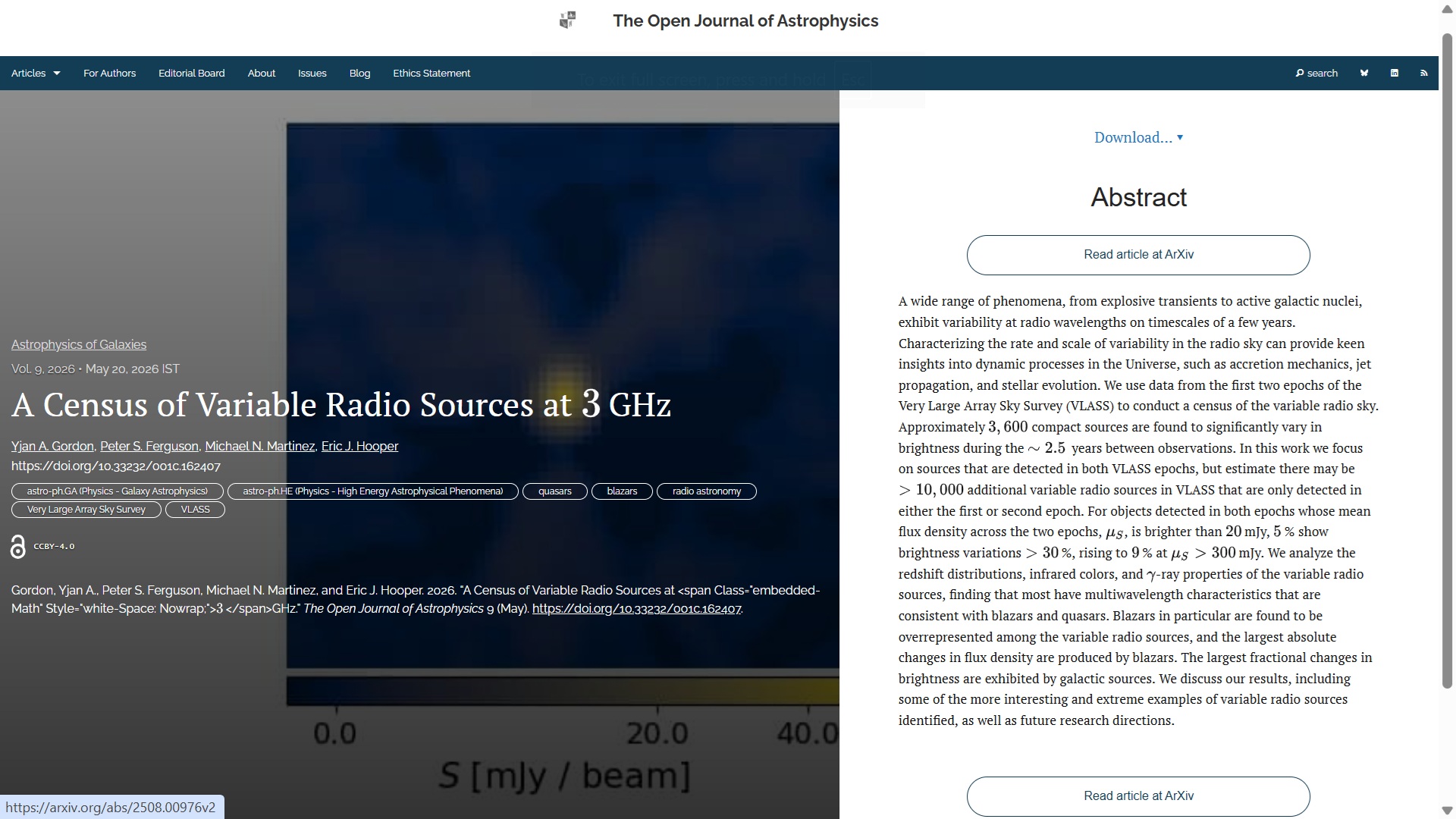
The officially accepted version can be found on arXiv here and here is the Mastodon announcement:

Open Journal of Astrophysics

New Publication at the Open Journal of Astrophysics: "A Census of Variable Radio Sources at 3 GHz" by Yjan A. Gordon, Peter S. Ferguson, Michael N. Martinez & Eric J. Hooper (U. Wisconsin, USA)

doi.org/10.33232/001c.162407

May 20, 2026, 2:52 pm 0 boosts 2 favorites

The fifth article of this week was published on Friday 22nd May in the folder Instrumentation and Methods for Astrophysics. The title is “Uncovering the Next Galactic Supernova with the Vera C. Rubin Observatory” by John Banovetz (Lawrence Berkeley Lab., USA), Claire-Alice Hebert & Peter B. Denton (Brookhaven National Lab., USA), Dan Scolnic (Duke University, USA), Anze Slosar (Brookhaven) and Chris Walter (Duke). The paper presents a study simulating how effectively the Vera C. Rubin Observatory can localize supernovae using neutrino triggers, finding a 57-97% success rate based on stellar mass density predictions.

The overlay is here:
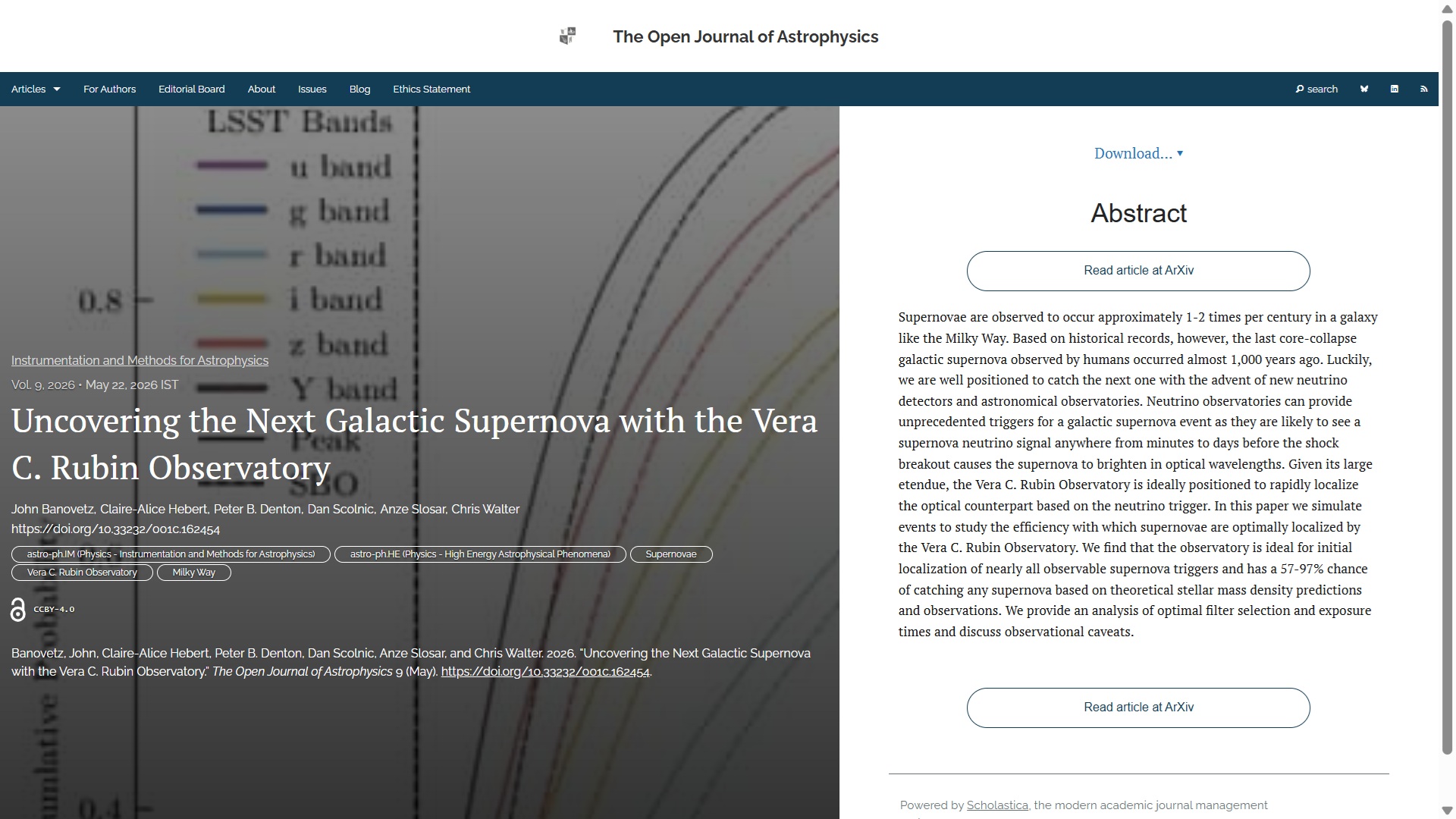
You can find the authorized version of this paper on arXiv here and the Fediverse announcement is here:

Open Journal of Astrophysics

New Publlication at the Open Journal of Astrophysics: "Uncovering the Next Galactic Supernova with the Vera C. Rubin Observatory" by John Banovetz (Lawrence Berkeley Lab., USA), Claire-Alice Hebert & Peter B. Denton (Brookhaven National Lab., USA) , Dan Scolnic (Duke U., USA) , Anze Slosar (Brookhaven), and Chris Walter (Duke)

doi.org/10.33232/001c.162454

May 22, 2026, 8:31 am 0 boosts 1 favorites

Last, but by no means least, this week we have “Pulsar timing solutions for 17 pulsars at 150 MHz from the Irish LOFAR station” by David J. McKenna (ASTRON, The Netherlands), Evan F. Keane (Trinity College Dublin, Ireland), Peter T. Gallagher (DIAS, Ireland) and Joe McCauley (Trinity). This was published on Friday 22nd May in the folder High-Energy Astrophysical Phenomena. It presents a demonstration of the use of international Low Frequency Array (LOFAR) stations in tracking and characterizing pulsars, providing new insights into these neutron stars’ emission properties.

The overlay for this one is here:
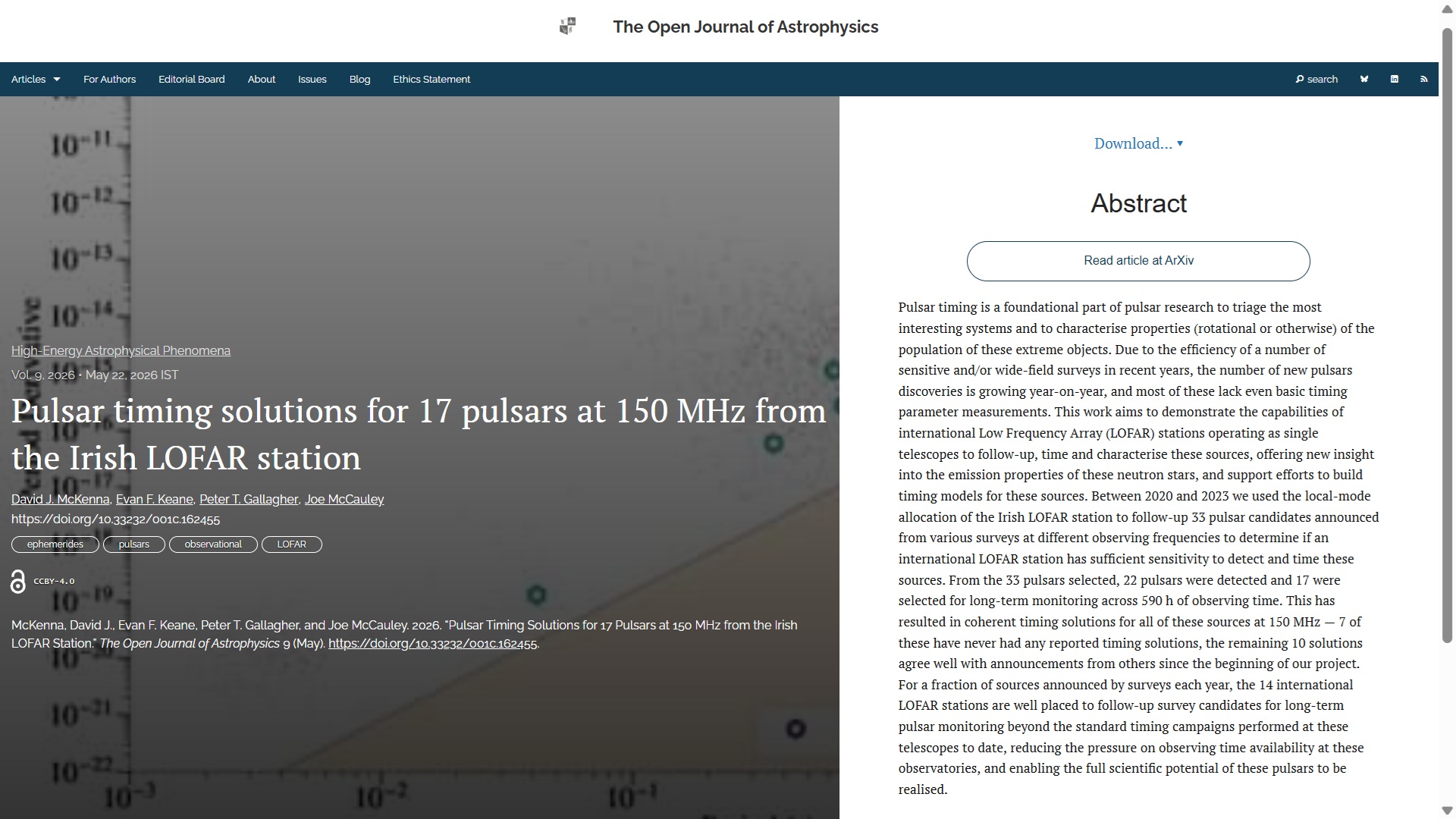
You can find the authorized version of this paper on arXiv here and the Fediverse announcement is here:

Open Journal of Astrophysics

New Publication at the Open Journal of Astrophysics: "Pulsar timing solutions for 17 pulsars at 150 MHz from the Irish LOFAR station" by David J. McKenna (ASTRON, The Netherlands), Evan F. Keane (Trinity College Dublin, Ireland), Peter T. Gallagher (DIAS, Ireland) and Joe McCauley (Trinity)

doi.org/10.33232/001c.162455

May 22, 2026, 8:59 am 0 boosts 0 favorites

And that concludes this week’s update. I’ll do another one next Saturday.
Weekly Update from the Open Journal of Astrophysics – 20/06/2025

Posted in OJAp Papers, Open Access, The Universe and Stuff with tags , , , , , , , , , , , , , , , on June 20, 2025 by telescoper

Yesterday (Thursday 19th June 2025) was a national holiday in the USA, which means that no new papers were announced on arXiv today (Friday 20th June). I have therefore decided to bring forwarded the usual weekly update of papers published at the Open Journal of Astrophysics by a day. Since the last update we have published three new papers, which brings the number in Volume 8 (2025) up to 74, and the total so far published by OJAp  is now up to 309.

The three papers published this week, with their overlays, are as follows. All three were published on Tuesday, June 17th 2025. You can click on the images of the overlays to make them larger should you wish to do so.

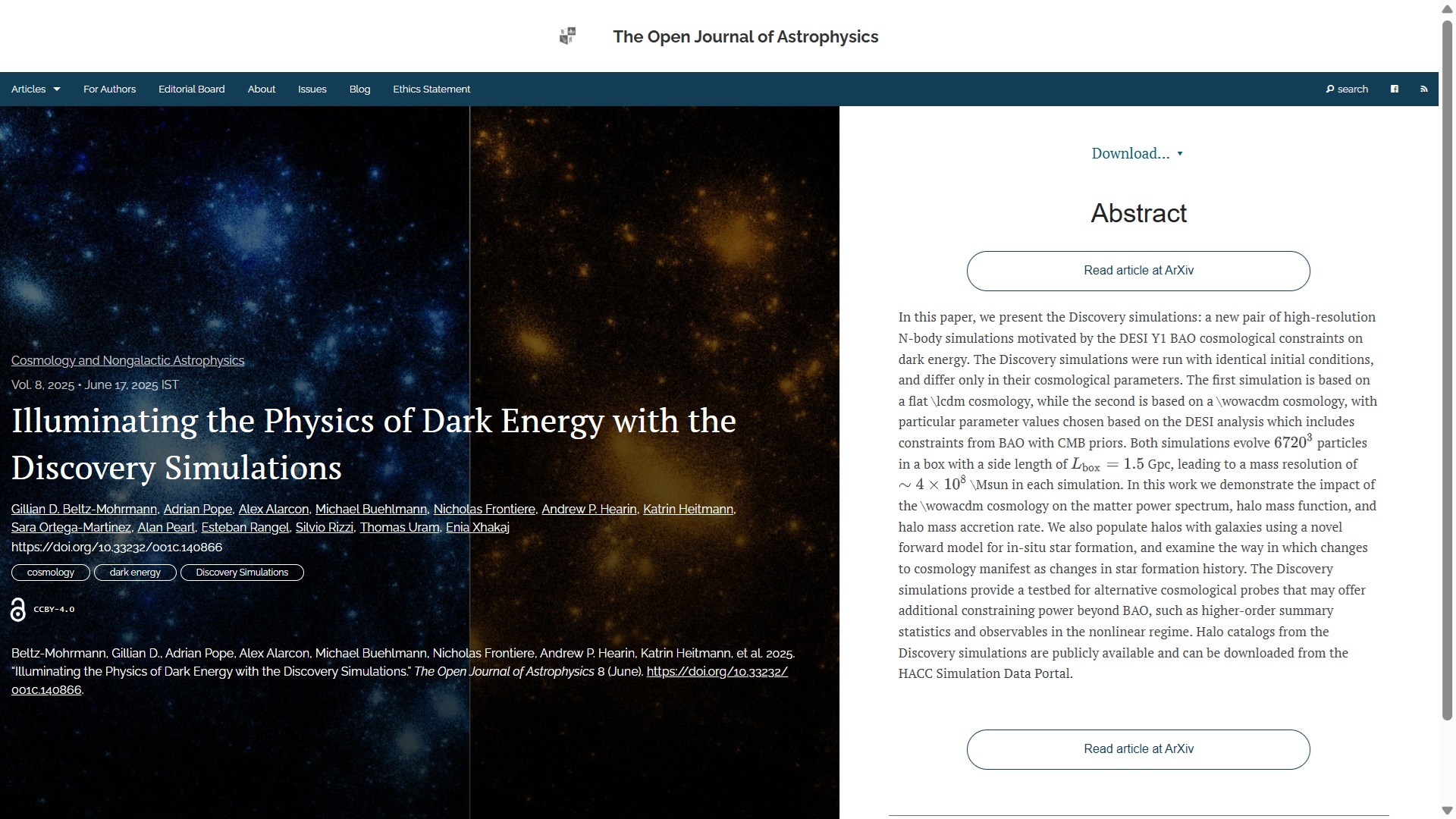
The first paper to report is “Illuminating the Physics of Dark Energy with the Discovery Simulations” by Gillian D. Beltz-Mohrmann (Argonne National Laboratory, USA) and 12 others based in the USA and Spain. This describes new high-resolution cosmological simulations providing a testbed for alternative cosmological probes that may offer additional constraining power beyond Baryon Accoustic Oscillations. It is filed in the folder marked Cosmology and NonGalactic Astrophysics.

The overlay is here:

You can read the final accepted version on arXiv here.

The second paper is in the folder marked Astrophysics of Galaxies. It is “LIGHTS. The extended point spread functions of the LIGHTS survey at the LBT” by Nafise Sedighi (Instituto de Astrofísica de Canarias, Spain) and 15 others based in Spain, USA, Iran, Italy and the UK. It describes the procedure used to construct the extended Point Spread Functions (PSFs) of the LIGHTS survey in images taken with the Large Binocular Cameras (LBCs) of the Large Binocular Telescope (LBT).

The overlay is here:


You can find the officially-accepted version of the paper on arXiv here.

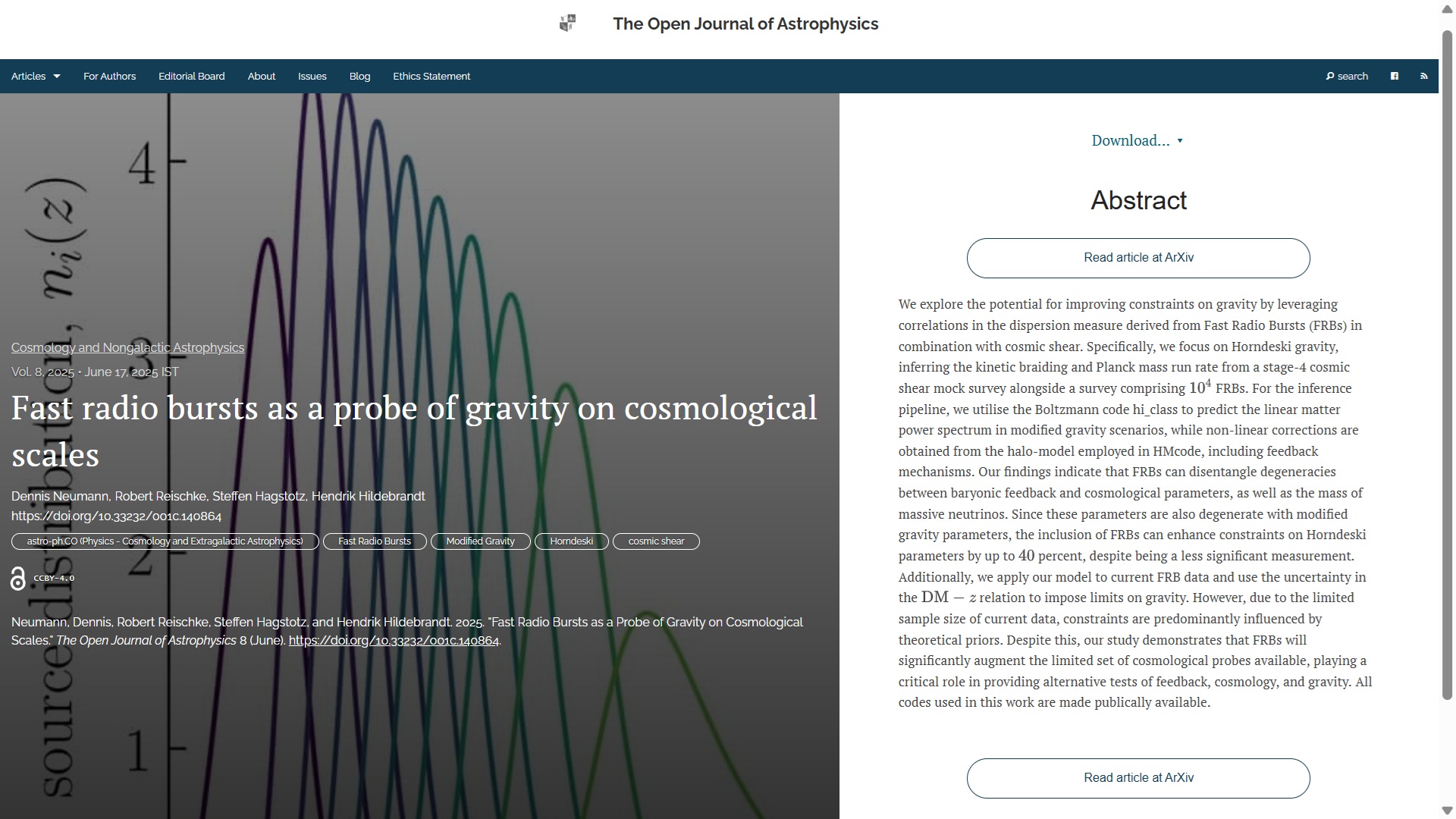
Finally this week we have “Fast radio bursts as a probe of gravity on cosmological scales” by Dennis Neumann (Leiden University, Netherlands), Robert Reischke (Universität Bonn, Germany), Steffen Hagstotz (Ludwig-Maximilians Universität München, Germany) and Hendrik Hildebrandt (Ruhr University Bochum, Germany). This is about using dispersion measures derived from Fast Radio Bursts (FRBs) in combination with cosmic shear to investigate modified gravity theories, specifically Horndeski gravity. It is in the folder marked Cosmology and NonGalactic Astrophysics.

The overlay is here:

You can find the officially-accepted version on arXiv here.

That’s all the papers for this week. I’ll revert to the usual schedule for updates next week, and post the next one on Saturday 28th June.


New Publication at the Open Journal of Astrophysics

Posted in OJAp Papers, Open Access, The Universe and Stuff with tags , , , , on February 6, 2023 by telescoper

Well, it may be a Bank Holiday here in Ireland but there’s no break for the Open Journal of Astrophysics and it’s time to announce yet another paper hot off the press.

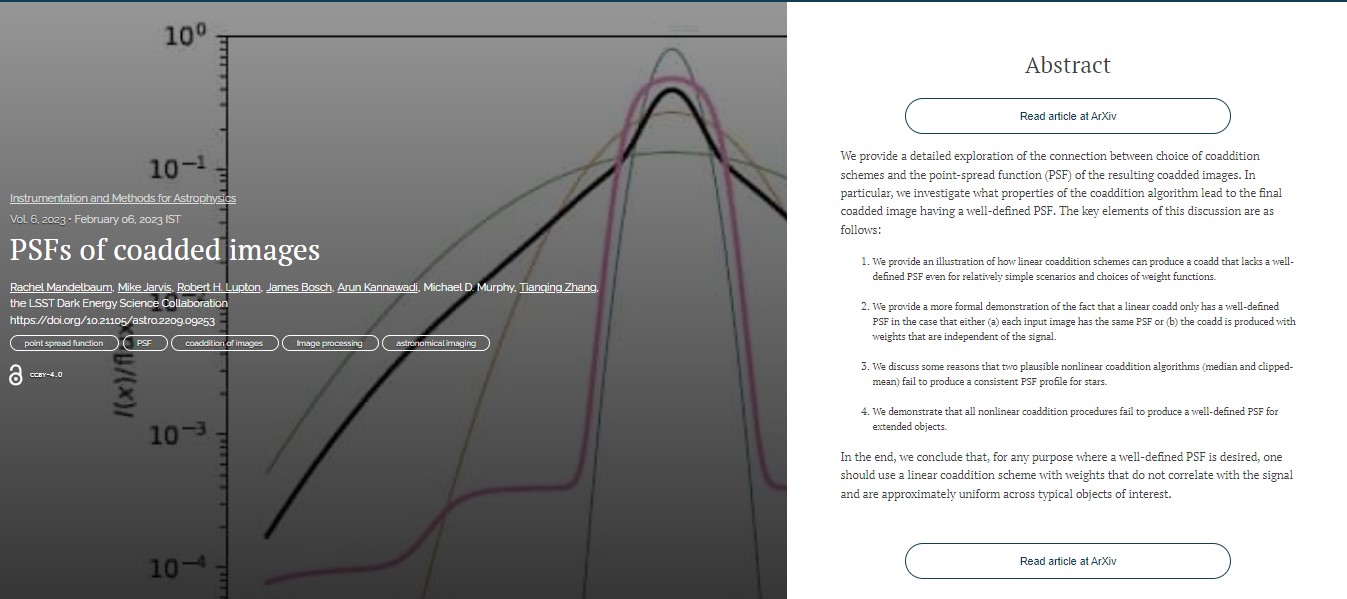
The latest paper is the 5th paper in Volume 6 (2023) as well as the 70th in all. This one is in the folder marked Instrumentation and Methods for Astrophysics. The title is “PSFs of coadded images”; for those of you not up with the lingo, “PSF” stands for point spread function.

The authors of this paper are Rachel Mandelbaum (1), Mike Jarvis (2), Robert H. Lupton (3), James Bosch (3), Arun Kannawadi (3), Michael D. Murphy (1) and Tianqing Zhang (1) and the LSST Dark Energy Science Collaboration. The affiliations of the individual authors are: (1) Carnegie Mellon University, Pittsburgh PA; (2) University of Pennsylvania, Philadelphia PA; (3) Princeton University, Princeton NJ; all in the USA of course.

Here is a screen grab of the overlay which includes the  abstract:


You can click on the image of the overlay to make it larger should you wish to do so. You can find the officially accepted version of the paper on the arXiv here.