Archive for the Open Access Category

On the Multiple Publication of Academic Research

Posted in Open Access with tags , , , on November 26, 2022 by telescoper

The topic came up in a recent conversation of the ethical issues surrounding what is sometimes erroneously called self-plagiarism, but is more accurately called duplicate publication (or multiple publication or even redundant publication). This refers to the situation in which an author publishing their own intellectual material (specifically research results) more than once in different journals or other media. This is distinct from plagiarism, which involves an author publishing someone else’s intellectual material without attribution. It is also distinct from copyright violation, which can occur if the author tries to re-use material already published in a journal that has retained the copyright; the solution in that case is simply not to publish in a journal that does that.

Publication practice differs widely in different academic fields so in what follows I’ll concentrate on what applies in Physics & Astronomy. Here there is one type of publication, the Conference Proceedings, in which papers are often near-duplicates of others. That is because speakers tend to give the same or very similar talks at different conferences, and also tend to recycle material when writing up their contributions. I see nothing particularly wrong in that, although one wonders whether a plethora of versions of the same talk is needed. I stopped writing conference papers over a decade ago as they take a lot of time to do and I don’t think they fulfil any useful purpose. In any case such articles should not count as research publications, especially if they are not peer-reviewed (which is generally the case in Astronomy). I know this is different in other fields. In Computer Science, for example, the conference article is one of the main modes of research publication.

The more serious issue is when a researcher publishes (or tries to publish) multiple versions of the same research in different journals in an attempt to pad out their publication list by passing off old material as original research. This is difficult to do nowadays because of plagiarism detection software, but not all journals deploy such tools and some cases do get through the editorial process and make it into the journal as a publication. Sometimes this even happens with high-profile journals.

The question is how one reacts to this kind of multiple publication. I did a totally unscientific social media poll recently and the results were quite interesting. Of my respondents, about 20% said that they thought multiple publication was fine. About 30% thought that multiple publication constituted academic misconduct, and about 50% thought that it wasn’t fine but fell short of academic misconduct.

I suppose the definition of research misconduct varies from one institution to another. For reference here is what it says in Maynooth University’s Research Integrity Policy statement:

Publication of multiplier papers based on the same set(s) or sub-set(s) of data is not acceptable, except where there is full cross-referencing within the papers. An author who submits substantially similar work to more than one publisher must disclose this to the publishers at the time of submission.

The document also specifically refers to “Artificially proliferating publications” as an example of research misconduct.

In the past I would have posted a poll on here but I now have to pay $15 per month for the privilege of hosting a poll so with regret I’ve unblocked my Twitter account to let you vote there:

One reason people might be tempted to indulge in multiple publication stems from the fact that the current system of research assessment depends so much on bibliometric indicators relating to refereed publications. While I regret the emphasis on bibliometrics, I do think that multiple publication of research papers is indeed academic misconduct because artificially boosting the number of such items on one’s CV might be a way of gaming the system. It seems to me that such a strategy is unlikely to work, but I have seen people try it.

New journal ‘Philosophy of Physics’ finally launched!

Posted in Open Access, The Universe and Stuff on November 23, 2022 by telescoper

I thought quite a few readers of In the Dark might be interested that there’s a new open-access journal starting up called Philosophy of Physics. It’s published by LSE Press. See this post for more details.

wuthrich's avatarTaking up Spacetime

I am excited to report that the new open-access journal Philosophy of Physics is finally online and ready to receive submissions. The Philosophy of Physics Society, together with LSE Press who will be our publishing house, have launched the new journal today.

Thank you very much to everyone in the Governing Board and the Society who contributed to realizing our key initiative!

Special thanks go to David Wallace for having accepted to act as the journal’s founding Editor-in-Chief. Read his announcement on the LSE Press’s blog here.

Please consider submitting your best work to Philosophy of Physics. In order to do so, you should become a member of the Society. It’s free for students and unwaged people, £10 for postdocs, and £20 for others. Once you are a member, you will find instructions on how to submit a paper inside the members’ area, as explained here.

View original post

New Publication at the Open Journal of Astrophysics

Posted in OJAp Papers, Open Access, The Universe and Stuff with tags , , , , on November 10, 2022 by telescoper

I’m delighted to be able to announce the 10000th paper this year, and 1000000th publication overall, at the Open Journal of Astrophysics!

That is counting in binary, of course. In base ten the  new paper at the 16th paper in Volume 5 (2022) as well as the 64th in all.

The latest publication is entitled “Evolution of Cosmic Voids in the Schrödinger-Poisson Formalism” and the authors are Aoibhinn Gallagher and Peter Coles (Who he? Ed) both of the Department of Theoretical Physics at Maynooth University. Obviously as author I played no role in the selection of referees or any other aspect of the editorial process.

Aoibhinn Gallagher – bonus marks for pronouncing both names correctly – is my first Maynooth PhD student and this is her first paper, of many I hope (and expect)! We’re already working on extensions of this approach to other aspects of large-scale structure. You can find some discussion of this general approach here.

Anyway, here is a screen grab of the overlay which includes the  abstract:


You can click on the image to make it larger should you wish to do so. You can find the officially accepted version of the paper on the arXiv here.

Here is a nice animated version of Figure 5 of the paper showing, for a 1D slice, the radial expansion of a spherically symmetric void (i.e. underdense region) using periodic boundary conditions:

The x-axis is in (scaled) comoving coordinates, i.e. expanding with the cosmological background, so that the global expansion is removed.  You can see that the void expands in these coordinates, so is expanding more quickly than the background, initially pushing matter into a dense ring around the rim of the empty void. That part of the evolution is just the same as for “normal” matter but in this case the wave-mechanical behaviour of the matter prevents it from being confined to a strongly-localized structure as well as affecting the subsequent expansion rate.

Of course in the real Universe, voids are not isolated like this but instead tend to push into each other, but we felt it was worth studying the single void case to understand the dynamics!

New Publication at the Open Journal of Astrophysics

Posted in OJAp Papers, Open Access, The Universe and Stuff with tags , , , , , on November 4, 2022 by telescoper

It’s time once again for me to announce new paper at the Open Journal of Astrophysics. The new paper, published last week, is the 15th paper in Volume 5 (2022) and the 63rd in all. The latest publication is entitled “Two-photon amplitude interferometry for precision astrometry” and the authors are Paul Stankus, Andrei Nomerotski and Anže Slosar of Brookhaven National Laboratory (USA) and Stephen Vintskevich (Moscow Institute of Physics & Technology, Russia).

The paper presents a new method for doing interferometry with quantum-mechanically entangled photons and is thus is in the folder marked Instrumentation and Methods for Astrophysics. I don’t know much about this area – and there are many whose baseline opinion is that interferometry is a bit of a fringe topic that is rather complex perhaps needs more visibility in the current phase of its development  (geddit?) – but the physics looks fascinating to me. Amplitude interferometry should be contrasted with the intensity interferometry method of Hanbury Brown and Twiss which I remember learning about as an undergraduate.

Anyway, here is a screen grab of the overlay which includes the  abstract:

You can click on the image to make it larger should you wish to do so. The full image used in the overlay is this:


You can find the officially accepted version of the paper on the arXiv here.

Open Access Week and the arXiv

Posted in Open Access with tags , , on October 17, 2022 by telescoper

Just time for a quick post to advertise the fact that next week (commencing October 24th 2022) is International Open Access Week.

I’ll be participating in one of the events – a panel discussion – organized by arXiv as part of Open Access Week. This event is entitled Trends in Peer Review of Open Access Preprints and the description is:

Speed of research is a major feature of open access preprint platforms like arXiv – formal peer review can follow later after rapid distribution of results. However, as submissions to arXiv and other preprint servers have grown, many researchers are seeking new avenues for community feedback and peer review. At this panel discussion, leaders in preprints and peer review will discuss current trends in virtual overlay journals, open peer reviews, and more. (Video recording will be available to registrants after the event)

Panelists:

  • Peter Coles, PhD, Theoretical Cosmologist at Maynooth University in Ireland and Managing Editor of The Open Journal of Astrophysics
  • Jessica Polka, PhD, Executive Director of ASAPbio
  • Antti Mikael Rousi, PhD, Senior Advisor, Research Services at Aalto University, Finland
  • Steinn Sigurdsson, PhD, Professor of Astronomy at Penn State University and arXiv Scientific Director

The event is at on Wednesday, October 26, 2022 at 15:00 UTC /11:00 EDT; that’s 16:00 Irish Time. It’s on Zoom (unless you are at Cornell and can attend in person). You need to register here.

Faking Proceedings

Posted in Open Access with tags , , , , , , on October 2, 2022 by telescoper

Almost every day I get an invitation to a fake conference somewhere, usually somewhere nice (to make the event more attractive). Usually these are caught by my spam filter, but when one isn’t the conference often turns out to be in a field I don’t work in. A small fraction are in cosmology or astrophysics but fortunately those fields are relatively small and it’s quite easy to identify whether or not they are bona fide. I’ve often wondered what happens if you turn up at one of these fake meetings, but not enough to waste money on trying to find out. Perhaps one of my readers knows? One day someone should turn up at one of them with a film crew…

It seems that along with these fake conferences there are fake conference proceedings, not just proceedings of fake conferences but proceedings of conferences that didn’t actually happen.

Publishers make a killing from publishing books of conference proceedings, which generally have a very short shelf-life. I stopped contributing to conference proceedings some time ago as I don’t think they’re worth the effort any more. It’s far better in my view for contributors just to put a copy of their slides on the conference website. I fully accept however that conference proceedings or similar publications may be important in other fields and it does seem that there is still a considerable traffic in them, with some publishers – including Institute of Physics Publishing – setting up special journals to exploit the traffic.

My attention was drawn today to an article in The Times (behind a paywall). The Times piece appears to be based on this one by the excellent Retraction Watch. It seems the IOP publishing system has been comprehensively hacked by (mostly Chinese) publishing mills. As a result the publisher has retracted 494 papers:

The vast majority – 463 articles – are from the Journal of Physics: Conference Series, while 21 are from IOP Conference Series: Materials Science & Engineering, and 10 are from IOP Conference Series: Earth & Environmental Science.

A statement from the IOP explains

These articles are being retracted following an allegation that raised concerns regarding several manuscripts. IOP Publishing has conducted a comprehensive investigation, which indicated that some papers may have been created, manipulated, and/or sold by a commercial entity.

I’m told that to be named as an author of a paper costs anything from about $500 to $US5000, depending on the calibre of the journal and how prominently you want your name to appear. It’s easy to find companies willing to provide such a service, e.g. on Facebook.

Of course this episode raises serious questions about the quality of the peer review applied to these papers, but the more serious issue is how science let itself get into a mindset that fetishizes publications in the first place. The publishing industry must share some of the blame for this. As long as this absurd situation exists there will be unscrupulous people willing and able to exploit it.

“New” Publication at the Open Journal of Astrophysics

Posted in OJAp Papers, Open Access, The Universe and Stuff with tags , , , , , on September 15, 2022 by telescoper

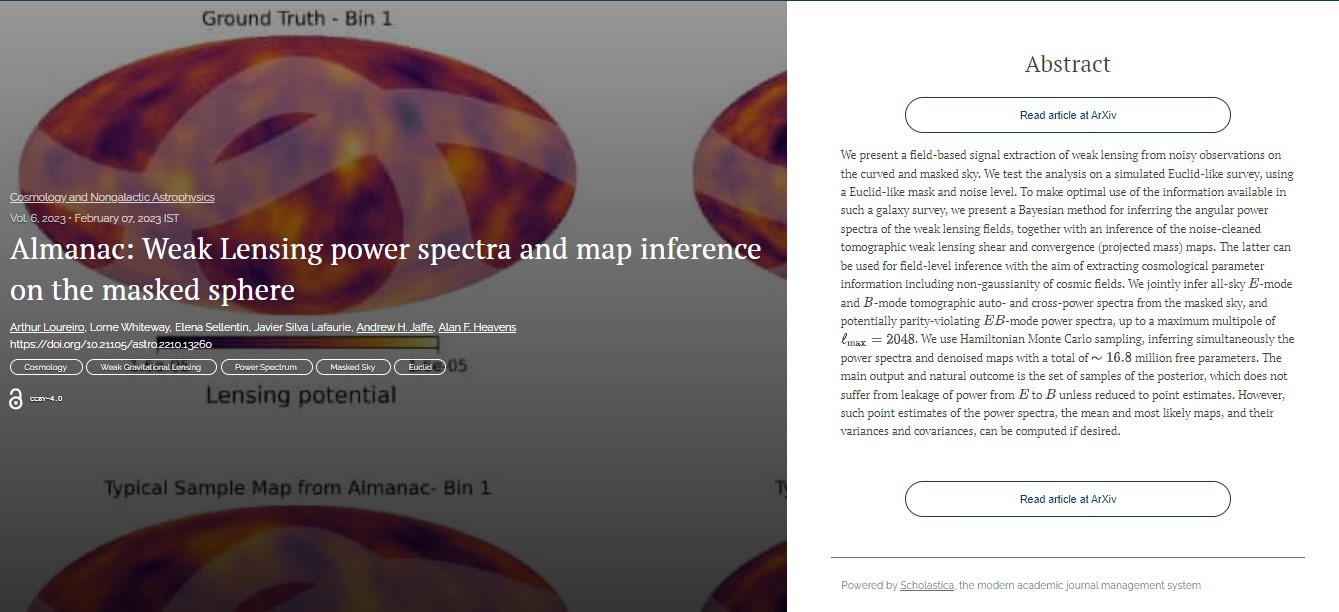
It’s time once again for me to announce the publication of another paper at the Open Journal of Astrophysics. The new paper, published last week, is the 14th paper in Volume 5 (2022) and the 62nd in all. The latest publication is entitled “Gravitational Stability of Vortices in Bose-Einstein Condensate Dark Matter”. This paper is another one for the folder marked Cosmology and Non-Galactic Astrophysics and the authors are Mark N Brook Now at the Institute for Cancer Research in London) and Peter Coles (Who he? Ed).

There is a bit of a story behind this one. The work on which this paper is based was done while both authors (Mark and I) were at the University of Nottingham. Mark was my PhD student at the time.  I left Nottingham for Cardiff in 2007 but Mark stayed behind to finish his thesis and write this paper, which appeared on the arXiv in 2009. The paper wasn’t accepted in its original form, Mark left the field after obtaining his PhD, and I was working on other things at Cardiff so the paper remained unpublished on the arXiv.

Last year, however, I was updating my publication list and noticed the old preprint so looked it up on NASA/ADS. Although not Earth-shattering, I found it had been acquiring a reasonable number of citations (16 according to ADS, including some this year) as an unpublished work largely because of increased interest in the field of condensate dark matter. I therefore approached the Editorial Board of the Open Journal of Astrophysics to ask their opinion about whether it would be appropriate to consider it for publication. They agreed and the paper was assigned to an Editor. Obviously I recused myself from the process.

Somewhat to my surprise, given that it’s basically an old paper, the referee comments were supportive. I’ve been very busy for the past year and communication with Mark was slow so it’s taken a while to revise and update the paper in line with the referee requests. We also took the opportunity to include a brief review of some papers that had come out since the original version of the paper appeared. Mark and I agreed a final text l and the paper was accepted last week. I uploaded the agreed version to arXiv and now the paper is now published. It was all a bit unconventional but there we are. It was interesting to be on the author side of the process for a change!

Anyway, here is a screen grab of the overlay which includes the  abstract:


You can click on the image to make it larger should you wish to do so. You can find the accepted version of the paper on the arXiv here.

Making (Dark Matter) Waves: Untangling Wave Interference in Multi-Streaming CDM

Posted in Open Access, The Universe and Stuff with tags , , , , on September 13, 2022 by telescoper

A couple of days ago I announced the publication of a new paper in the Open Journal of Astrophysics called Making (dark matter) waves: Untangling wave interference for multi-streaming dark matter by Alex Gough and Cora Uhlemann. I forgot on that occasion to mention that there is a video of a talk by the first author in the series Cosmology at Home, so I’m remedying that now by posting the video here. Enjoy!

New Publication at the Open Journal of Astrophysics

Posted in OJAp Papers, Open Access, The Universe and Stuff with tags , , , , , , on September 11, 2022 by telescoper

It’s time once again for me to announce another new paper at the Open Journal of Astrophysics. The new paper, published last week, is the 13th paper in Volume 5 (2022) and the 61st in all. The latest publication is entitled “Making (dark matter) waves: Untangling wave interference for multi-streaming dark matter” and the authors are Alex Gough and Cora Uhlemann (both of Newcastle University). The paper is another one for the folder marked Cosmology and Non-Galactic Astrophysics.

Here is a screen grab of the overlay which includes the  abstract:

You can click on the image to make it larger should you wish to do so. You can find the accepted version of the paper on the arXiv here.

This is a paper that’s close to one of my current research interests. I think it’s really excellent and I am very happy the authors chose to publish it in the Open Journal of Astrophysics.

As a bonus here is a groovy animated version of Figure 1 from the paper showing the development of a multi-stream region.

And if that weren’t enough here is a short talk about their work in the Cosmology From Home series by the first author Alex Gough.

A Memory of Dunsink

Posted in Biographical, History, Open Access, The Universe and Stuff with tags , on September 2, 2022 by telescoper
Dunsink Observatory

Just time for an early morning post before I get the train in order to attend the second day of this year’s Irish National Astronomy Meeting at Dunsink Observatory (in the above picture, which I took yesterday morning). Incidentally, Dunsink Observatory is Réadlann Dhún Sinche in the Irish language.

Thinking about this meeting ahead of the event reminded me of a loose end, which I managed to tidy up this week.

Once upon a time, before the pandemic, I was involved in various events to celebrate the centenary of the famous eclipse expeditions of May 1919 which had a strong connection with Dunsink Observatory (see e.g. here). Among these things was an invitation to write a paper on the subject, which appeared in Contemporary Physics in June 2019.

Contemporary Physics being a commercial journal the paper was published behind a paywall. The publication rules however allowed the paper to be made freely available after an embargo period of one year.

I had intended to put the paper on arXiv in June 2020 when the embargo period lapsed, but at that point Covid-19 had taken hold, my workload went through the roof and I forgot about it until this week when a combination of my forthcoming trip to Dunsink and the appearance of my student’s first paper on arXiv conspired to remind me. Finally, therefore, the paper has now appeared in a fully open-access form on the arXiv here, just over two years later.

The title is A Revolution in Science: the Eclipse Expeditions of 1919 and the abstract reads:

The first direct experimental test of Einstein’s theory of general relativity involved a pair of expeditions to measure the bending of light at a total solar eclipse that took place one hundred years ago, on 29 May 1919. So famous is this experiment, and so dramatic was the impact on Einstein himself, that history tends not to recognise the controversy that surrounded the results at the time. In this article, I discuss the experiment in its scientific and historical background context and explain why it was, and is, such an important episode in the development of modern physics.