It’s time yet again to announce a new publication in the Open Journal of Astrophysics! This one is the 4th paper in Volume 5 (2022) and the 52nd in all.
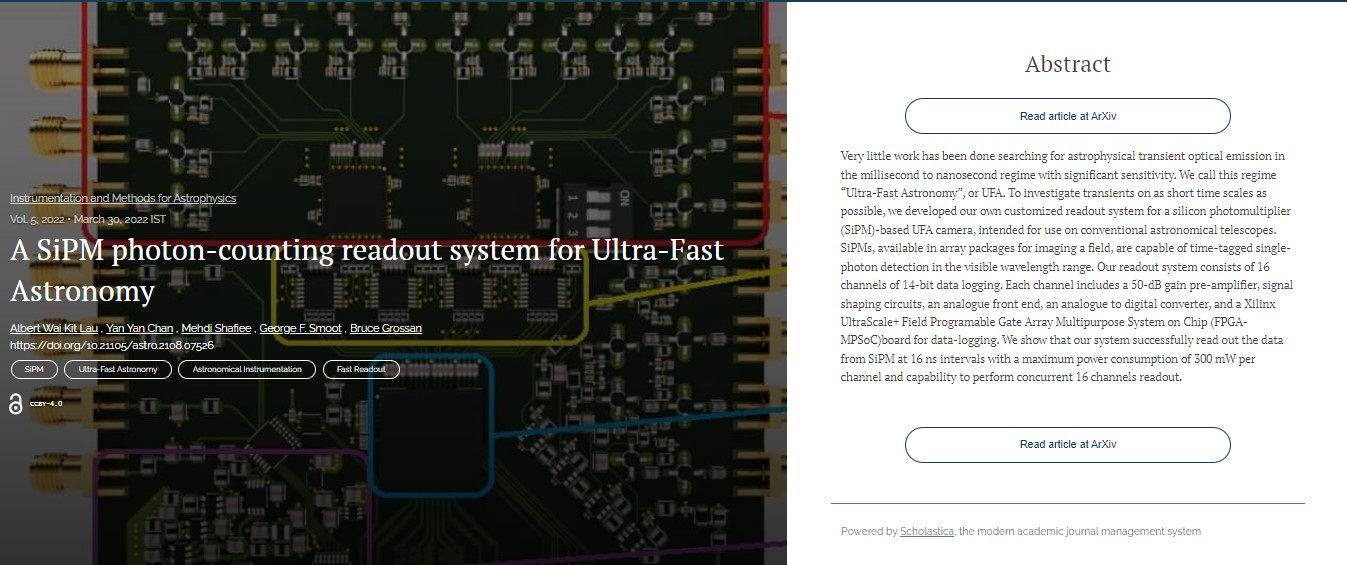
The latest publication is entitled A SiPM photon-counting readout system for Ultra-Fast Astronomy and is written by Albert Wai Kit Lau & Yan Yan Chan (of the Hong Kong University of Science and Technology), Mehdi Shafiee (Nazarbayev University, Kazakhstan) and George F. Smoot & Bruce Grossan (Lawrence Berkeley Laboratory).
This paper is in the Instrumentation and Methods for Astrophysics section, and is also the first paper we have published with a Nobel Laureate in the author list!
Here is a screen grab of the overlay which includes the abstract:
You can click on the image to make it larger should you wish to do so. You can find the arXiv version of the paper here.
Posted in Open Access on March 11, 2022 by telescoper
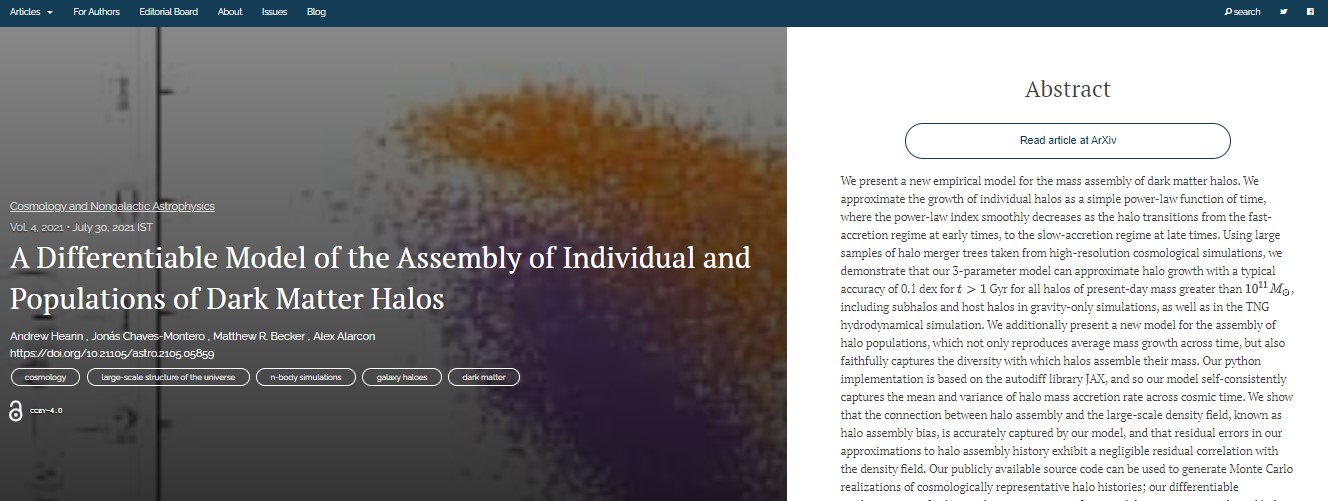
In the summer of 2021 we published a paper in the Open Journal of Astrophysics entitled A Differentiable Model of the Assembly of Individual and Populations of Dark Matter Halos. The authors are Andrew P. Hearin, Jonás Chaves-Montero, Matthew R. Becker and Alex Alarcon, all of the Argonne National Laboratory.
Here is a screen grab of the overlay which includes the abstract:
One of the authors contacted me recently to ask if it would be possible to make some minor textual modifications to the version we already published. After discussing this with the Editorial Board we agreed on the following steps:
The author sent us a new version containing the proposed revisions;
The Editor checked that they were reasonable (i.e. minor and without any significant changes to the scientific content);
After getting the green light the author placed a revised version on arXiv with a comment explanation the revisions (in this case v3);
We changed our overlay to point at the new version.
The way we are set up no further action was necessary. I think this is a nice demonstration of the flexibility of an overlay journal!
It’s time yet again to announce a new publication in the Open Journal of Astrophysics! This one is the 3rd paper in Volume 5 (2022) and the 51st in all. We actually published this on Friday, byt I’ve only just got around to announcing it here now.
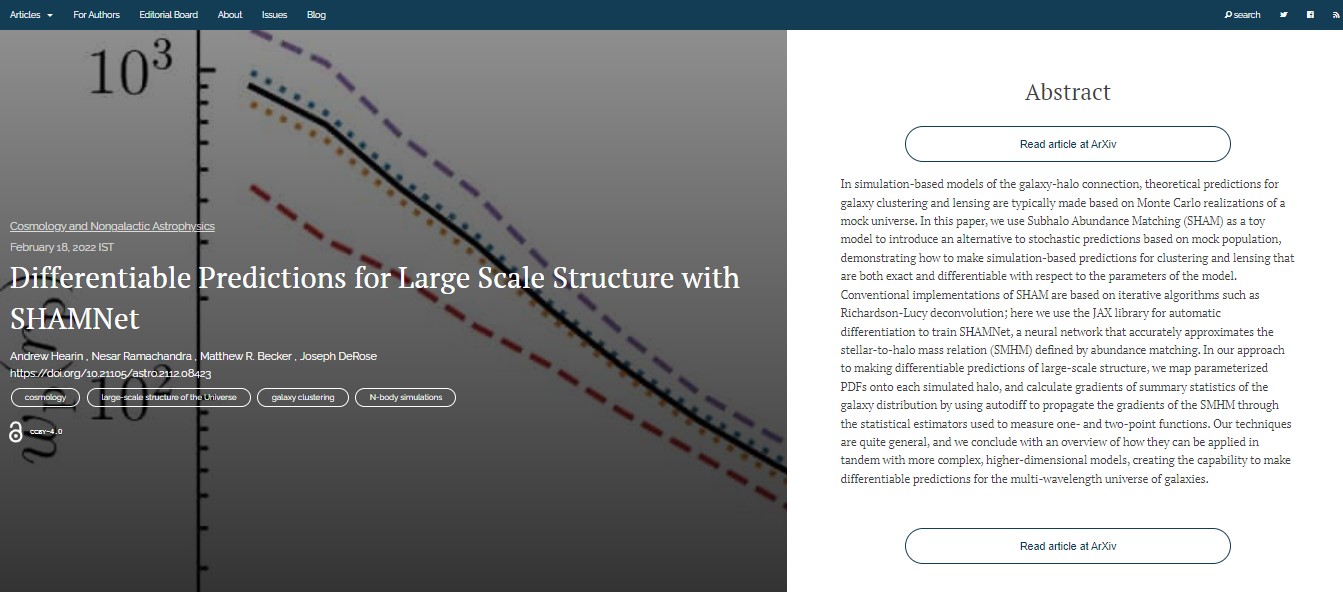
The latest publication is entitled Differentiable Predictions for Large Scale Structure with SHAMNet and is written by Andrew Hearin, Nesar Ramachandra and Matthew R. Becker of the Argonne National Laboratory and Joseph DeRose of the Lawrence Berkeley Laboratory (both institutions being in the USA).
Here is a screen grab of the overlay which includes the abstract:
You can click on the image to make it larger should you wish to do so. You can find the arXiv version of the paper here. This paper is in our popular Cosmology and Non-galactic Astrophysics section.
P. S. Here’s a bit of feedback from the author of this paper about the referees:
They reviewed the paper in conscientious detail, and every comment was thoughtful. We feel that our paper has materially improved in clarity as a result of their critique.”
Yesterday I stumbled across a new thing which I think is very cool.
Usually if you want to read a paper posted on arXiv you have to view, e.g. a PDF file. Now someone has set up a facility to view every article as a modern HTML5 page. To use this function you just need to change the “X” in the link to an arXiv paper to a “5” and you can view the whole paper, equations and all, in your browser as a web page.
I have found a few conversion errors using this facility but I assume these can be ironed out in due course. Now I have to persuade Scholastica to let us link to the ar5iv versions of OJAp papers (although I think the plan is to integrate ar5iv with arXiv at some point).
Posted in Open Access on February 14, 2022 by telescoper
A long time ago I posted a poll to see what people think about the issue of peer review. Now seems a good time to circulate it again.
In previous posts (e.g. this one) I had advanced the view that, at least in the subject I work in (astrophysics), while in its usual form peer review does achieve some degree of quality control, it is by no means perfect. Some good papers get rejected and some poor papers get accepted. Moreover, the refereeing is usually done for free by members of the academic community while journal publishers use peer review as a justification for levying publication charges in that it provides added value to the publication process – a view I disputed here.
Any system operated by humans is bound to be flawed to some extent, but the question is whether there might be a way to improve the system so that it is fairer and more transparent.
I suggested that it could be replaced by a kind of crowd-sourcing, in which papers are put on an open-access archive or repository of some sort, and can then be commented upon by the community and from which they can be cited by other researchers. This would, if you like, be a sort of “arXiv plus” – good papers would attract attention and poor ones would disappear.
We did consider having open peer review of the sort mentioned above for the Open Journal of Astrophysics but this option was not available for the no-frills off-the-shelf Scholastica platform we went for so we now operate a version of the traditional peer review system. This achieves some level of gate-keeping but also (and much more importantly, in my view) makes constructive criticism to allow authors to improve their papers. We also discussed publishing referee reports alongside the papers, but that is also beyond the scope of our current system (and would of course require the consent of referees).
I have no idea really how strongly others rate the current system of peer review. The following poll is not very scientific, but ‘ve tried to include a reasonably representative range of views from “everything’s OK – let’s keep the current system” to the radical suggestion I make above.
It’s time yet again to announce a new publication in the Open Journal of Astrophysics! This one is the 2nd paper in Volume 5 (2022) and the 50th in all. We actually published this one a couple of days ago I’ve only just got around to announcing it now.
It’s very nice to mark our 50th publication with two firsts: (1) this is the first ‘Citizen Science’ paper we have published; and (2) it is the first paper in the folder corresponding to the arXiv section on Earth and Planetary Astrophysics (astro-ph.EP).
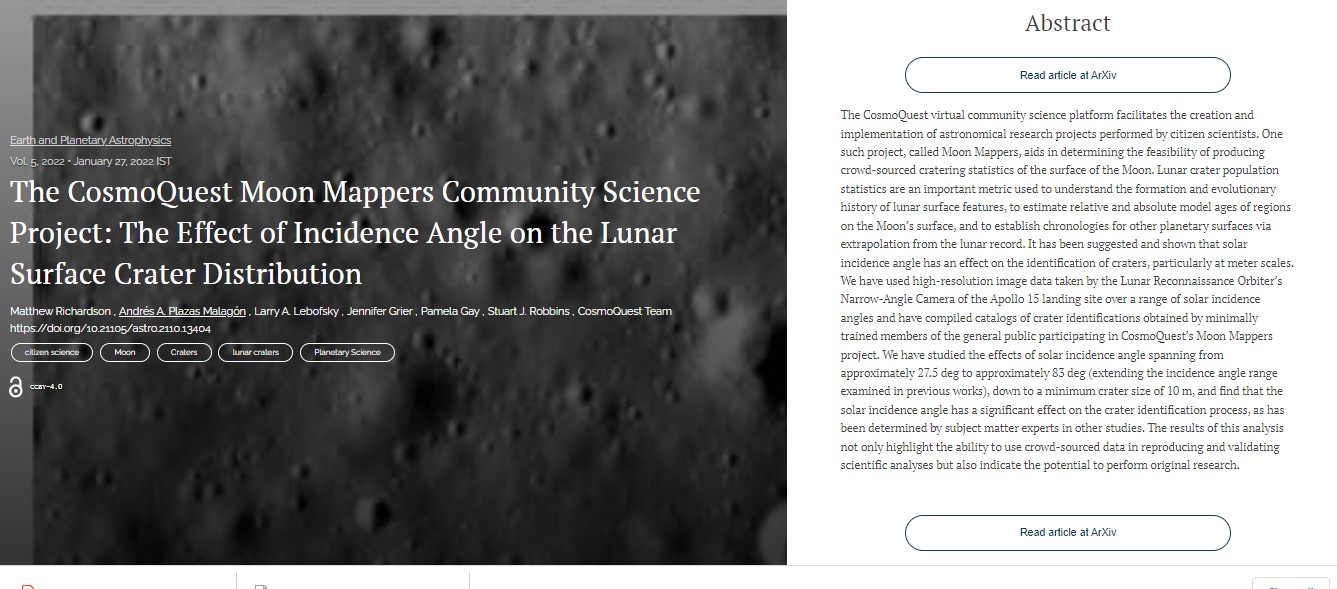
The latest publication is entitled The CosmoQuest Moon Mappers Community Science Project: The Effect of Incidence Angle on the Lunar Surface Crater Distribution and is written by Matthew Richardson (Planetary Sciences Institute, Tucson = PSI), Andrés A. Plazas Malagón (Princeton & Astronomical Society of the Pacific=ASP; corresponding author), Larry A. Lebofsky (PSI), Jennifer Grier (PSI), Pamela Gay (PSI & ASP), Stuart J. Robbins (Southwest Research Institute) and The CosmoQuest Team.
Here is a screen grab of the overlay which includes the abstract:
You can click on the image to make it larger should you wish to do so. You can find the arXiv version of the paper here. As I mentioned above this is the first publication in the folder marked Earth & Planetary Astrophysics.
There is a nice twitter thread by the corresponding author explaining what the paper is about:
We used data from @cosmoquestX‘s Moon Mappers project, which aids in determining the feasibility of producing crowd-sourced cratering statistics of the surface of the Moon. pic.twitter.com/BteVY1TwuS
It’s a New Year and therefore a new Volume of the Open Journal of Astrophysics and it’s time to announce the first publication in it! This one is the 1st paper in Volume 5 (2022) and the 49th in all.
The latest publication is entitled Validating Synthetic Galaxy Catalogs for Dark Energy Science in the LSST Era and is written by Eve Kovacs of Argonne National Laboratory and 38 others on behalf of the LSST Dark Energy Science Collaboration.
Here is a screen grab of the overlay which includes the abstract:
You can click on the image to make it larger should you wish to do so. You can find the arXiv version of the paper here. This is another one for the Cosmology and Nongalactic Astrophysics folder, which remains the most popular category so far on the Open Journal of Astrophysics site.
There is a little bit of a backlog in OJAp Towers owing to the Christmas break as some authors have been on leave and not doing their revisions, so I’d anticipate a few more papers in the next few weeks.
Time to pass on news of an interesting development from the United Nations Educational, Scientific and Cultural Organization (UNESCO) concerning Open Science. Here’s a little video to explain what it’s about:
The first international framework on open science was adopted by 193 countries attending UNESCO’s General Conference. By making science more transparent and more accessible, the UNESCO Recommendation on Open Science will make science more equitable and inclusive.
Through open science, scientists and engineers use open licenses to share their publications and data, software and even hardware more widely. Open science should, thus, enhance international scientific cooperation.
Some 70% of scientific publications are locked behind paywalls. Over the past two years, however, this proportion has dropped to about 30% for publications on COVID-19 specifically. This shows that science can be more open.
The framework document itself is here (21 pages). It’s a very general document, the strongest aspect of which is that it takes a broad view of open science. When I’ve talked and written about open access publishing I’ve always stressed that represents only one aspect of open science: there is a need to share data and analysis software too.
You can find an upbeat commentary on the new agreement by James Wilsdon here. Here’s a snippet:
At a time when ideologies opposed to universalism, multilateralism, and collaboration are gaining ground in many parts of the world—exacerbated by greed, corruption, and exploitation of common assets and resources—the scientific system is as vulnerable as it has always been to reflecting both the best and the worst of society’s wider tendencies.
Moves towards open research have gained significant ground over the past twenty years, but this progress remains fragile, under-resourced, and at times willfully or unintentionally blind to the fresh inequalities and pressures it can create—particularly for researchers and institutions in the global south.
For me, the greatest strengths of the UNESCO statement are its breadth and holism—unlike some declarations in this field, it speaks with an authentically international chorus of voices. It reasserts the need for cultural, linguistic, and disciplinary pluralism, and reminds us that openness is ultimately a means to more fundamental ends. The recommendation returns repeatedly to the importance of infrastructures and incentives, which need to be financed, sustained, and better aligned.
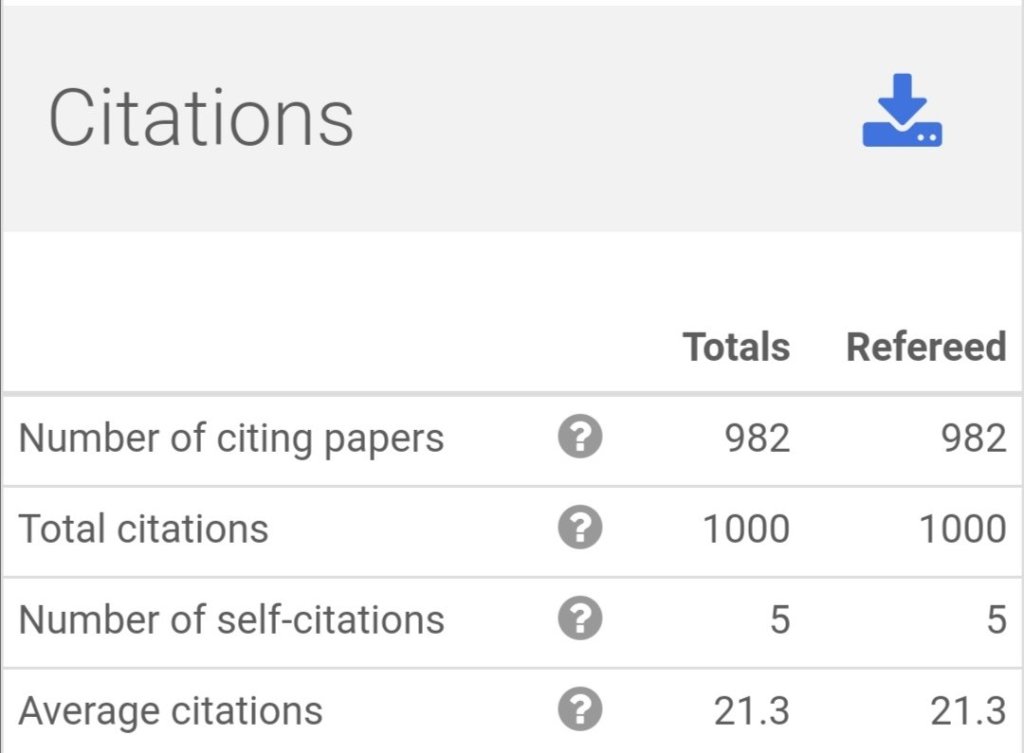
Just over a week ago I posted an item about the citations garnered by papers in the Open Journal of Astrophysics in the course of which I speculated on whether we would reach the 1000 mark before the end of 2021. Well, I checked on the NASA/ASD system today and it seems we have just made it:
There is still one paper we have published but not yet listed on ADS so the real number might be a little higher. It’s also possible that the figure will dip below a thousand again, at least for a short time. That is because ADS sometimes counts the citations to a published paper and to its preprint separately thus causing some duplication; when the issue is finally resolved the number of citations can go down.
Anyway, that’s a nice note to end the year on. Tomorrow we start with Volume 5 (2022)!
The views presented here are personal and not necessarily those of my employer (or anyone else for that matter).
Feel free to comment on any of the posts on this blog but comments may be moderated; anonymous comments and any considered by me to be vexatious and/or abusive and/or defamatory will not be accepted. I do not necessarily endorse, support, sanction, encourage, verify or agree with the opinions or statements of any information or other content in the comments on this site and do not in any way guarantee their accuracy or reliability.



 In the Dark