Archive for the Politics Category

A System of Dishonour

Posted in Politics with tags , , , on December 28, 2019 by telescoper

In the news this morning was the release of the New Year’s Honours List for 2020. The awards that made the headlines were various sports persons, musicians and other celebrities, as well as the odd ghastly politician.

The honours system must appear extremely curious to people from outside the United Kingdom. It certainly seems so to me. On the one hand, I am glad that the government has a mechanism for recognising the exceptional contributions made to society by certain individuals. Musicians, writers, sportsmen and sportswomen, entertainers and the like generally receive handsome financial rewards, of course, but that’s no reason to begrudge a medal or two in recognition of the special place they occupy in our cultural life. It’s good to see scientists recognized too, although they tend not to get noticed so much by the press. I noticed for example, Ed Hawkins, who got his PhD at in Astronomy at Nottingham when I was there and is now Professor of Climate Science at the University of Reading, received an MBE.

On the other hand, there are several things about the hinours system that make me extremely uncomfortable. One is that the list of recipients of certain categories of award is overwhelmingly dominated by career civil servants, for whom an “honour” goes automatically with a given rank. If an honour is considered an entitlement in this way then it is no honour at all, and in fact devalues those awards that are given on merit to people outside the Civil Service. Civil servants get paid for doing their job, so they should have no more expectation of an additional reward than anyone else.

Honours have relatively little monetary value on their own, of course so this is not question of financial corruption. An honour does, however, confer status and prestige on the recipient so what we have is a much more subtle form of perversion.

Worse still is the dishing out of gongs to political cronies, washed-up ministers, and various sorts of government hangers-on. An example of the latter is the knighthood awarded to Iain Duncan Smith, a thoroughly loathsome person responsible for introducing the cruel system of Universal Credit designed to make the UK sick and poor even sicker and poorer and which has undoubtedly led to real hardship and even death.

Although the honours system has opened up a little bit over the last decade or so, to me it remains a sinister institution that attempts to legitimise the self-serving nature of its patronage by throwing the odd bone to individuals outside the establishment. I don’t intend any disrespect to the individuals who have earned their knighthoods, MBEs, OBEs, CBEs or whatnot. I just think they’re being rewarded with tainted currency.

And that’s even before you take into account the award of a knighthood to people like Iain Duncan Smith. Well, I mean. Does anyone really think it’s an honour to be in the same club as him? I find it deeply offensive that he could have been considered an appropriate person to be on the list.

There goes my knighthood.

2019: A Summary of the Year

Posted in Politics on December 20, 2019 by telescoper

Change in Northern Ireland

Posted in History, Politics with tags , , on December 17, 2019 by telescoper

One of the potentially most significant outcomes of the 2019 General Election, but one barely mentioned in the English media, was what happened in Northern Ireland. For the first time ever, a majority of the MPs elected in the six counties were nationalist. The Social Democratic and Labour Party (SDLP) gained two seats to add to the seven of Sinn Féin (including a significant gain in Belfast North) while the Democratic Unionist Party (DUP) lost two to finish with eight. The remaining seat went to the Alliance, originally a moderate unionist party but now basically a liberal centrist (and anti-Brexit) party.

Here’s how the electoral map of Northern Ireland changed:

Sinn Féin seats are dark green, DUP orange, SDLP light green and Alliance yellow.

In terms of the popular vote, the DUP+UUP got 42.3% whereas SDLP+ Sinn Féin got 37.7. Both SF and DUP lost vote share compared to 2017 (by 6.7% and 5.4% respectively) at the expense of the Alliance (up 8.8%) and SDLP (up 3.1%).

Incremental differences, perhaps, but significant nonetheless – especially as Brexit hasn’t yet happened. After Brexit there will be a border in the Irish Sea, which will bring the end of partition one step closer. The probability of seeing a United Ireland in my lifetime has definitely increased.

It was no surprise to see the hashtag `#UnityPlan’ trending on Twitter immediately after the election. Irish unification will only happen if there is a public vote and a majority on both sides of the border agree. For that vote to be fair it is vital that there is a definite plan on how to proceed in the event that the vote is in favour, so the public know what they are voting for. The Irish should not make the mistake that Britain did over Brexit.

For many unionists religion was the primary reason for wanting to remain in the United Kingdom at the time of partition in 1921: Protestants felt that their identity would be threatened if they were made to join the Catholic South. Maybe they were right to feel nervous, as the original constitution of the Irish Free State enshrined “the special position of the Holy Catholic Apostolic and Roman Church”.  But the section including that phrase was deltd from the Constitution way back in 1973 and the Roman Church has far less influence in the Republic than it did. Ireland is now an open and progressive country, so I hope those fears have receded.

Just to confuse matters even further I should mention that my Grandfather, the one born in Belfast, to whom I owe my Irish citizenship,  was a protestant republican…

Those in the North who wish to keep their British passports should be able to do so in a United Ireland, just as those of us who were born in Britain but now live in Ireland can keep ours. I’ll be keeping mine, at least until it expires…

P.S. It is worth mentioning (primarily for British friends) that there are three counties in Ireland that belong to the province of Ulster but are not part of Northern Ireland as it was formed after partition: these are Monaghan, Cavan and Donegal. The northernmost point of Donegal, Malin Head, is actually the northernmost point on the island of Ireland.

There are bad times just around the corner – Noel Coward

Posted in Music, Politics with tags , on December 16, 2019 by telescoper

Those `Former Mining Communities’

Posted in Biographical, History, Politics with tags , , , , , , , on December 15, 2019 by telescoper

I’ve generally avoided the UK media over the last few days but couldn’t resist commenting on a phrase that has appeared again in the context of constituencies in the North and Midlands of England that voted in Tory Members of Parliament in the 2019 General Election.

The first of these to declare a result was Blyth Valley, in Northumberland, a place that I know reasonably well as I grew up in the North-East. This constituency was created in 1955 and had a Labour MP continuously from then until December 12th 2019.

(Incidentally, the winning candidate in Blyth Valley, Ian Levy, presented himself as an NHS nurse, which he has never been. I doubt anyone cares, though. Bare-faced lying seems to be completely acceptable these days.)

(Left) Bates Colliery in Blyth in 1986 when it closed; (Right) the scene in 2014. Picture Credit Newcastle Evening Chronicle.

I should state for the record that I was born in Walker, to the East of Newcastle upon Tyne, but grew up in Benwell, to the West. When I was a child all the pits in the immediate vicinity, such as the Montague Main Colliery in Denton Burn, had already closed because the inland coal seams had been exhausted. Those remaining open were deep mines in which the coal faces were out under the North Sea.

Anyway, Blyth Valley was described in the media after the election result as a `Former Mining Community’. The town of Blyth is a port and was at one time a major centre for shipbuilding as well as coal mining, but the coal industry –especially Bates colliery – was indeed an extremely important factor in the town’s economy.

But Bates Colliery closed in 1986. A bit further inland the larger, and probably more famous, Ashington Colliery closed in 1988. The last mine in the North West Durham coalfield closed in 1994. Further South, Bolsover Colliery (in the Derbyshire constituency by Dennis Skinner for 49 years, until December 12th 2019) closed in 1993. And so on. All these places, and many others. decided to return Conservative MPs in 2019.

None of these places has had a working coal pit for 25 years or more, yet they are still consistently described in the media as `former mining communities’. I find that very telling, when there hasn’t been any mining there for a generation.

Coal mining forged the identity of these places. Almost everything revolved around the pits. Many of the houses were specifically by colliery owners to house the miners and their families. In the North-East, miners even had their own dialect, Pitmatic (distinct from Geordie). It wasn’t by any means an easy life being a miner but to be a miner at least meant having a distinct and proud identity,

The foundations of these communities were taken away during the Thatcher years. It’s not just about the local economic devastation, though that was bad enough, it was that the entire raison d’être disappeared. Over the subsequent decades little effort has been made by any Government of any complexion to stimulate the towns and villages so they remain `former mining communities’. Their past is well-defined, their future not.

After a decade of particularly severe austerity it’s hardly surprising that people in such areas expressed their anger at a political system that has failed them so badly, first in the 2016 referendum and then in this year’s General Election.

What’s less comprehensible (at least to me) is why anyone would think that their situation is likely to improve under the same Tories that have ignored them so consistently for so long. All I can guess is that it’s something to do with finding a sense of identity in a mining community that’s no longer a mining community. I suppose that, for some, this entails adopting increasingly nationalistic attitudes, such as were encouraged by the Conservative Party’s consistently xenophobic and anti-immigrant rhetoric.

For myself I don’t see what identity has to do with nationality at all. We can identify ourselves in all kinds of ways without having to rely on the geographical accident of our birthplace.

I have no idea what the next five years will bring for places like Blyth Valley and Bolsover. But the wider question is whether by the time of the next General Election we will will be talking about the former United Kingdom.

Britain’s Potential Explained

Posted in Politics, The Universe and Stuff with tags , , , on December 14, 2019 by telescoper

As a physicist I was intrigued by the recent use by Tory election campaigners of the slogan “Unleash Britain’s Potential”, so I decided to study the matter in more detail. I am pleased to say I am now ready to report on my conclusions.

First here is a sketch of Britain’s potential, which I denote V(r):

How do we interpret this potential?

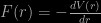
Recall that the force F(r) derived from V(r) is given by

F(r) = - \frac{dV(r)}{dr}.

The gradient of this potential being negative the force is directed towards increasing values of r. By Newton’s Second Law this means accelerated motion to the right (i.e. in the direction of increasing isolation), accompanied by steady and irreversible decline.


Note also that the form of this potential implies that there is something completely repulsive at its origin.

I hope this clarifies the situation.

Britain dutifully bows down to the ruling elite.

Posted in Politics on December 14, 2019 by telescoper

A view from New Zealand…

leftinnewzealand's avatarLeft in New Zealand

Congratulations to the people of ‘Great’ Britain for voting the ruling elite into power yet again. You certainly do know your place. Now they have a mandate to treat people with disdain and contempt, for the next five years. I always thought people in the US were dumb, but there is a new kid on the block vying for the title. How can a party offering no credible policies, with a history of inflicting misery on millions, with a leader who hides in a fridge when things get mildly difficult remain in power. I could glibly say you get what you deserve, but that would be grossly unfair to the millions who can see through this charade of thinly veiled fascism.

It would appear that many people from where I grew up in the north have had a lobotomy, believing all that the billionaire controlled media had to say pre-election…

View original post 714 more words

Goodbye UK

Posted in Biographical, Politics, Uncategorized on December 13, 2019 by telescoper

Britain’s Prime Charlatan

Here I am on a Late Great Western train heading to this month’s Meeting of the Royal Astronomical Society in London and to pass the time I thought I’d have a go on the blog.

I’m not going to comment at length of the election results, except to say that the scale of the Conservative majority and corresponding Labour rout mean that the UK is heading for at least five years with the hard right in charge, and probably many more. That is if the United Kingdom exists five years from now, which is doubtful.

During this time the country of my birth will almost certainly turn itself into a Trumpian dystopia, with planned assaults on the National Health Service, the courts, and what remains of its threadbare constitution. Poverty and homelessness will continue to rise and the evil xenophobic rhetoric that helped win the election (as it did the 2016 Referendum) will make the environment of the UK even more hostile to anyone ‘foreign’.

That’s whats going to happen and that, apparently, is what people voted for. How anyone could vote for a party led by a person so palpably unsuitable for high office is beyond me. But that’s what people did. I hope they’re proud.

For myself, I’ll just say two things. One is that at least this Election Night made me feel young again. I relived all the horror of 1983.

The second is just that although Ireland is no paradise I’m glad I found a way out of the nightmare of Britain. Sorry if that sounds selfish but it’s the truth.

Goodbye UK.

P.S. My train is going to be at least an hour late. No chance of the railways being fixed in the next five years either.

Postal Voting Par Avion

Posted in Biographical, Cardiff, Politics on December 7, 2019 by telescoper

After giving the matter much thought, some weeks ago I decided to apply for a postal vote so I could vote in the general election in the constituency of Cardiff West where I still (for the time being) have a house. I couldn’t vote in person owing to work commitments in Ireland on Thursday 12th December. Teaching term doesn’t end in Maynooth until 20th.

The postal ballot paper was sent to my address in Cardiff because I wasn’t confident in the post between the UK and Ireland. (It takes over a month for my copy of Physics World to reach Ireland. Last night I flew from Dublin to complete it and this morning I put it in the mail, so it should arrive in time to be counted.

In case you’re interested, I voted for Kevin Brennan (Welsh Labour).

I fear this will turn out to be a futile gesture, and that this election will put liar and charlatan Boris Johnson in Downing Street with a significant majority. The prospect of a government headed by this creature appals me, as does the thought that so many people don’t care that he’s so demonstrably dishonest and untrustworthy. As far as I see it, anyone who votes for the modern Conservative Party must be either a simpleton or a sociopath. Or possibly both.

Update: relevant advice from today’s Financial Times:

(It’s actually about dealing with cold callers, but is in my opinion more widely applicable..)

The Case for Irish Membership of CERN

Posted in Politics, The Universe and Stuff with tags , , , , on November 16, 2019 by telescoper

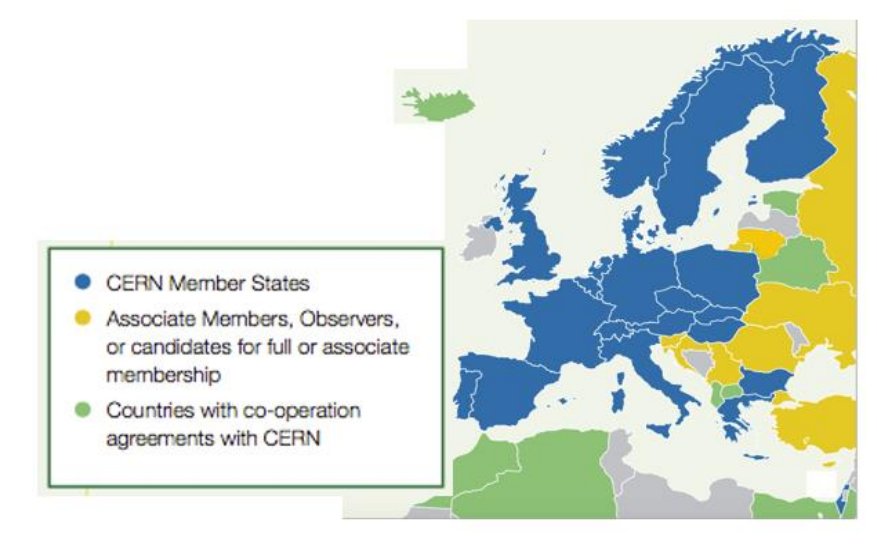
In the news here in Ireland this week is a new report from a Committee of the Houses of the Oireachtas making the case for Ireland to join CERN. You can download the report here (PDF) and you’ll find this rather striking graphic therein:

You will see that there are only three European countries that don’t have any form of membership or other agreement with CERN: Latvia, Bosnia-Herzegovina and Ireland. The fact that almost everyone else is in is not in itself necessarily a good argument for Ireland to join, but it does make one wonder why so many other countries have found it to join or have an agreement with CERN while Ireland has not.

As the document explains, if the Irish government  were to decide to take Ireland into CERN then  it would first have to become an Associate Member, which would cost around €1.2 million per year. That’s small potatoes really, and  the financial returns to Irish industry and universities are likely to far exceed that, so the report strongly recommends this step be taken. This Associate member stage would last up to 5 years, and then to acquire full membership a joining fee of around €15.6 million would have to be paid, which is obviously a much greater commitment but in my view still worthwhile.

While I strongly support the idea of Ireland joining CERN I do have a couple of concerns.

One is that I’m very sad that the actual science done at CERN is downplayed in the Oireachtas report. Most of it is about return to industry, training opportunities, etc. These are important, of course, but it must not be forgotten that big science projects like those carried out at CERN are above all else science projects. The quest for knowledge does have collateral benefits, but it a worthy activity in its own right and we shouldn’t lose sight of that.

My other (related) concern is that joining CERN is one thing, but in order to reap the scientific reward the government has to invest in the resources needed to exploit the access to facilities membership would provide. Without a related increase in research grant funding for basic science the opportunity to raise the level of scientific activity in Ireland would be lost.

Ireland recently joined the European Southern Observatory (ESO), a decision which gave Irish astronomers access to some amazing telescopes. However, there is no sign at all of Irish funding agencies responding to this opportunity by increasing funding for academic time, postdocs and graduate students needed to do the actual science.

Although astronomy is clearly much more interesting than particle physics (😉) in one respect the case of ESO is very like the case of CERN – the facilities do not themselves do the science. We need people to do that.