Archive for the Politics Category

Meaningful Betting

Posted in Biographical, mathematics, Politics with tags , , , , on January 15, 2019 by telescoper

I’ve now finished my first batch of marking (Astrophysics & Cosmology) and I now have a few days to do other things until the next (larger) set of scripts arrives from Vector Calculus and Fourier Series which takes place on Saturday.

Before going home I turned my attention to the news of tonight’s “Meaningful Vote” in the House of Common’s about whether or not to accept the Withdrawal Agreement negotiated between PM Theresa May and the European Union. The Government is widely expected to lose the vote but it’s not clear by what margin. Interested to see what the betting markets think I had a look just now at the Betfair exchange and found this, on the basic question of whether the vote will pass or not:

(You might want to click on the image to make it clearer.) You can find the live odds here.

You will see that this is quite an active market – with over €700K being wagered. Odds of greater than 40 to 1 against a `yes’ vote but most of the action is on `no’. Note that quite a few punters are laying on this outcome, with odds of about 25-1 on. (The way odds are shown in the second row is that 1.04 means you with 4p for every £1 staked).

Clearly, therefore, the markets think the vote will fail. What is less clear is how many MPs will vote in favour of the Government. Here is the corresponding Betfair market:

The shortest odds are for the first option, i.e. for 199 or fewer voting with the Government, but there is activity across the whole range of possibilities. The press are talking about a defeat by 225 votes, but for what it’s worth I don’t think it will be such a large margin. I’m not going to bet on it, but I expect it to be defeated by less than 150 votes.

UPDATE: Not for the first time I was wrong. The vote was Ayes 202 Noes 432, a majority of 230 against. That means there were no abstentions.

Turning a Corner after Brexit

Posted in Politics on January 3, 2019 by telescoper

As I wait at Cardiff Airport for my flight back to Ireland, I see Theresa May has said that the UK ‘can turn a corner’ if MPs back her Brexit plan.

I’ve found a helpful graphic to show how that would work.

Turning a Blind Eye

Posted in History, Politics with tags , , on January 2, 2019 by telescoper

As my little festive sojourn in Wales draws to a close, there’s no sign of the Brexit Pantomime season doing likewise. The latest episode of this tragicomedy saw Transport Secretary Chris Grayling dishing out £14 million of taxpayers’ money to a ‘company’ called Seaborne Freight to operate ferries between Ramsgate and Ostend when, in less than 90 days, the UK leaves the EU.

As his name suggests, there’s something very fishy about Grayling’s decision to hand out a lucrative contract, without any proper procurement process, to a company that has only existed for a few months, has never operated a ferry, has no trained staff and, above all, has no ships!

Is this lawful? I doubt it. Is it ethical? Certainly not. Will Grayling get away with it? Almost certainly. Recent events have shown that illegality, fraud and corruption are all part of the job description for a Brexiter.

Perhaps Grayling is trying to channel Lord Nelson who, in legend anyway, at the Battle of Copenhagen in 1801, held a telescope to his blind eye when ordered to retreat, saying “I see no ships”. The difference here is of course that the ships can’t be seen because they don’t exist.

“I see no ships” is actually a misquote: what Nelson said was something like “I have a right to be blind sometimes. I really do not see the signal”. This event is not the origin of the phrase ‘to turn a blind eye’, either: the OED gives an example of its usage from 1698..

Anyway I think we can all see what the signal is in this case, a desperate government throwing public money down the drain without a shred of accountability. Get used to it. There will be a lot more of that in Brexit Britain. It’s what you voted for, isn’t it?

Sustainability and Irish Science

Posted in Politics, Science Politics, The Universe and Stuff with tags , , , , on December 19, 2018 by telescoper

There’s an interesting news item in the Education section of the Irish times about the appointment of Prof Séamus Davis to positions at both the University of Oxford and University College Cork, under a Science Foundation Ireland scheme intended to capitalize on Brexit (and the imminent loss of EU funding it implies) and the unhappy situation for science in the USA. This is the first appointment to one of the new Research Professorships, which allow the holders to be paid up to €250K.

While I support any investment in Irish science, and wish Prof. Davis every success in his new role, my reaction to the SFI scheme is very similar to my view of the Sêr Cymru (“Star Wales”) project which began a few years ago when I was working in Cardiff, with the aim of attracting `research leaders’ to Wales.

I am very skeptical about the likely success of `top-down’ moves like this. What Ireland really needs (and currently does not have) is a sustainable research base, so at very least I’d like to complementary  `bottom-up’ projects nurturing  researchers at PhD and PDRA level, perhaps through a greatly expanded system of national fellowships.  The trouble in Ireland is that there are so few opportunities for early career researchers that many have to go abroad to further their careers. There’s nothing wrong with Irish researchers choosing to work in another country, of course, but in an ideal world they would choose rather than be forced to do so by lack of opportunity and their loss would be offset by a other nationals choosing to come into Ireland. Unless this problem is fixed Ireland might end up with some leaders but nobody around to follow them.

The question I ask myself is, if one had to choose, what would be better in the long run for Irish science, one Professor on a salary of €250,000 or eight new postdoctoral fellowships (at roughly the same cost)?

Of course the idea of bringing in `research leaders’ is that they will manage to bring in funds from elsewhere, especially the European Union. This may indeed happen and indeed some may already have money in the bag when they move in. The problem with the strategy, though,  is that it’s not very easy to persuade such leaders to leave their current institutions, especially in experimental sciences, if they’ve already spend years acquiring the funding needed to equip their laboratories. This is not just a question of moving people, which is relatively easy, but can involve trying to replace lots of expensive and delicate equipment. The financial inducements needed to fund the relocation of a major research group and fight off counter-offers from its present host are likely to be so expensive that the benefit gained from doing this takes years to accrue, even they succeed. And EU grants are exceptionally competitive..

It’s a big shame that Ireland does not take research funding as seriously as it should, especially in fundamental science. Brexit could well turn out to be very damaging for the Irish economy, but science is one area where in which there are enormous opportunities if only there was the political will to seize them.


Fintan O’Toole on “Heroic Failure: Brexit and the Politics of Pain”

Posted in Literature, Maynooth, Politics with tags , , , on December 6, 2018 by telescoper

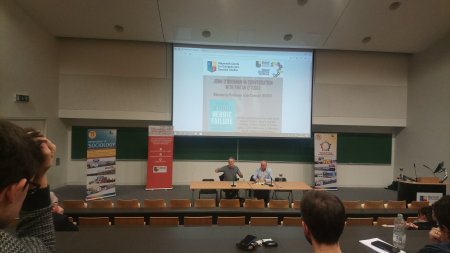
Time for a tea break and a quick post about a very interesting event this afternoon at Maynooth featuring renowned Irish journalist and author Fintan O’Toole (whose regular columns in the Irish Times I read with great interest).

This event saw John O’Brennan, Director of the Centre for European and Eurasian Studies in Maynooth in conversation with Fintan on his new book, Heroic Failure: Brexit and the Politics of Pain. The book deals with the Brexit referendum, the chaos it unleashed in British politics and the challenges posed to the island of Ireland by a ‘No Deal Brexit’. In particular the book examines how a country that once had colonies is redefining itself as an oppressed nation requiring liberation; the dreams of revolutionary deregulation and privatization that drive Arron Banks, Nigel Farage and Jacob Rees-Mogg; and the silent rise of English nationalism, the force that dare not speak its name. He also discusses the fatal attraction of heroic failure, once a self-deprecating cult in a hugely successful empire that could well afford the occasional disaster: the Charge of the Light Brigade, or Franklin lost in the Arctic. Now failure is no longer heroic – it is just failure, and its terrible costs will be paid by the most vulnerable of Brexit’s supporters, and by those who may suffer the consequences of a hard border in Ireland and the breakdown of a fragile peace.

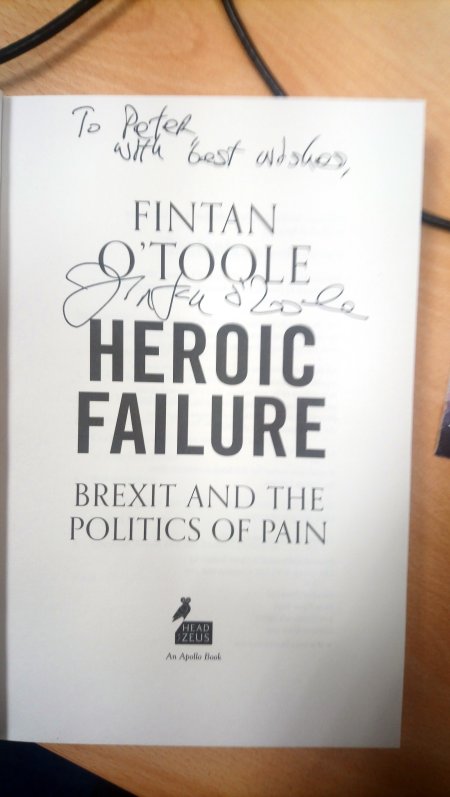
The discussion was so interesting – and Fintan O’Toole was so eloquent and amusing –  that I bought the book. The author was kind enough to sign it for me too!

There’s an extract printed on the cover that will give you a taste, but if you want more you’ll have to buy the book:

Of all the pleasurable emotions, self-pity is the one that most makes us want to be on our own…Only alone can we surrender completely to it and immerse ourselves in the steaming bath of hurt, outrage and tender regard for our terribly wronged selves. Brexit therefore makes sense of a nation that feels sorry for itself. The mystery, though, is how Britain, or more precisely England, came not to just experience this delightful sentiment but to define itself through it.

I only bought the book today so haven’t read it yet, but I will endeavour to write a review when I have.

Now back to the writing of lecture notes…

The Final Shootout

Posted in Film, Music, Politics with tags , , , , on December 6, 2018 by telescoper

“Only connect” they say so I thought I’d connect two topical items with this video clip of one of my favourite movie scenes.

The first item is that on 15th February next year the legendary composer Ennio Morricone will be conducting a concert of his music in Dublin. Moricone’s 90th birthday was on 10th November 2018.

The other thing is that the UK Parliament is currently debating the terms of Brexit. It seems that there are now only three options: accept Theresa May’s ugly Withdrawal Agreement, reject it and suffer a bad `No Deal’ Brexit or take the sensible, good choice of withdrawing Article 50, admitting it was all a terrible idea in the first place, and remaining in the European Union.

So here we are then, the climactic final shoot-out from Sergio Leone’s famous Spaghetti Western The Good The Bad And The Ugly, featuring Clint Eastwood, Eli Wallach and Lee Van Cleef respectively, together with superb (and very complex) music on the soundtrack from Morricone. We all know who wins in the end, at least in the film.

P.S. Hats off to the guitarist Alessandro Alessandroni (who also did the whistling on the soundtrack) producing that unforgettable twangy sound with a hint of scordatura…

Where Government Ministers Come From..

Posted in Politics on November 28, 2018 by telescoper

We and They

Posted in Biographical, Literature, Politics with tags , , , , , , on November 25, 2018 by telescoper

All good people agree,
And all good people say,
All nice people, like Us, are We
And every one else is They.

(from `We and They‘, by Rudyard Kipling.)

A few days ago one of my colleagues here in Maynooth mentioned that he found it amusing that, although I’ve been living and working here in Ireland for less than a year, I have already taken to referring to the British as `They’ rather than `We’. He went on to point out that he noticed this transformation from First Person to Third Person some months ago.

I hadn’t realised that I was doing this, but I suppose it is a reflection of the fact that I have accepted that I will almost certainly be spending the rest of my working life in Ireland, and will probably end my days here too. It has taken relatively little time of observing Britain from the other side of the Irish Sea to recognize that it is changing into something grotesque and horrible. I want no part of what it is becoming, a squalid xenophobic rathole run by crooks, liars, and narrow-minded bigots. My new home is far from perfect, but it’s a damn sight better than Brexit Britain.

About a year ago I wrote (from Cardiff) about my reasons for moving to Maynooth. Here is a quote:

Because I’ve lived here all my life I thought I would find it difficult to leave Britain. I was quite traumatised by the Brexit referendum, as one would be by the death of a close relative, but it made me re-examine my life. There is a time when you have to move on, and that’s what I’m doing. I’m done here.

I haven’t changed my mind.

Not that I now consider myself fully Irish. Passport and citizenship notwithstanding, I still feel like a foreigner here and probably always will. I lived for over fifty years in Britain and do not have sufficient experience of Ireland to feel really part of it. Yet. That may come. But to appropriate the phrase Theresa May used in her Lancaster House speech last year I am proud to be for the time being, and perhaps forever, a `Citizen of Nowhere’. I don’t mind that, and a little bit of autobiography that might explain why I see things the way I do.

I was born in Wallsend (on Tyneside) in the North East of England. My parents were both born just before World War II started, also in the area where I was born. Of my four grandparents, one was born in England, one in Northern Ireland, one in Scotland, and one in Wales. I always smile when I had to put my nationality on a form, because I always put `United Kingdom’. Of course being born in England makes me English too, but I find that less defining than `UK’ or `British’ or even `Geordie’, and now of course there’s the Irish dimension. To be honest, my ancestry means that I generally find the whole concept of nationality fundamentally silly. I find nationalism silly too, except for those occasions – regrettably frequent nowadays – when nationalism takes on the guise of xenophobia. Then it is truly sinister. Nationalism is a tool by which unscrupulous individuals whip up hatred for political gain, regardless of the economic or social consequences. This is what lies behind Brexit.

Anyway, talking about Theresa May, it appears that the Prime Minister has written a letter to the British public asking for them to support her `deal’. I find it very curious that she has done this when, without another referendum or a General Election, the British public is denied any way of either expressing or withholding such support. Is this an admission that there will have to be another vote?

It appears from her letter that the PM is particularly happy about one aspect of the deal:

We will take back control of our borders, by putting an end to the free movement of people once and for all.

Apart from the fact that the UK always had control of its borders anyway, I find it absolutely astonishing that any politician could brag about removing from its own citizens the right to free movement across 27 countries. Freedom of movement was and is one of the great benefits of the European Union. Outside the EU, Theresa May’s `hostile environment’ in which all foreigners are viewed with suspicion and contempt will become even more hostile. It is just a matter of time before the unlawful deportations that the Home Office have inflicted on members of the Windrush generation will begin happening to Europeans currently living in the United Kingdom.

Towards the end of her awful letter, there is this:

We will then begin a new chapter in our national life. I want that to be a moment of renewal and reconciliation for our whole country. It must mark the point when we put aside the labels of ‘Leave’ and ‘Remain’ for good and we come together again as one people.

Excuse me, but the time for reconciliation was in the immediate aftermath of the 2016 Referendum result. Instead, Mrs May went out of her way to insult, denigrate and marginalize everyone who voted Remain; she never apologized for the `Citizens of Nowhere’ jibe and her pals in the right-wing added other pejoratives like ‘saboteur’ and ‘enemy of the people’. Like so many other things she says and does, Mrs May’s letter is so phony it is painful.

Worse, the Prime Minister has continued to insult European citizens working in the UK by accusing them of `jumping the queue’. It seems that the Prime Minister just can’t stop her deep-seated xenophobia showing itself from time to time. It’s her defining characteristic, and it is sure to be the defining characteristic of post-Brexit Britain.


Women-only Professorships in Ireland

Posted in Education, Politics with tags , , , , on November 16, 2018 by telescoper

Earlier this week the Irish Government made an announcement that has ruffled a few feathers: it aims to create a number of new senior positions at Professor level in Irish Universities that are open only to female candidates. I don’t know the details of how this scheme will work, but I understand that the positions will be targeted at subject (and perhaps geographical) areas in which there is a demonstrable gender imbalance and the scheme will cost about €6M.

Reactions to this among people I know have been very varied, so it seems a good topic on which to have a  simplistically binary poll:

For the record, I should state that I am broadly in favour of the idea, but I’d like to know more about how these positions will be allocated to institutions, how they will be advertised and how the recruitment will be done. I’ll also add that my main worry about this initiative is that it might distract attention away from the need for Irish higher education institutions to have much better promotion procedures; see, e.g. here. There are plenty of female lecturers in Irish universities, but they seem to face ridiculous difficulties getting promoted to Professorships.


What are we going to do now?

Posted in Politics, Television with tags , on November 15, 2018 by telescoper

On this tumultuous day in British politics, this blog is proud to be able to show exclusive behind-the-scenes footage of the Cabinet discussions at Number 10 Downing Street: