This is a picture of one of my old expired passports. It is, in fact, the first I ever had. It was issued to me in 1986, when I was 23 years old and a PhD student; I needed it to travel to a conference in France. It expired in 1996 (hence the docking of the top right corner) whereupon I had it replaced by a much better made Burgundy one.
I had never travelled abroad before 1986. I’m not from a wealthy family and we never had any holidays outside the UK. Given that, I’m grateful that I ended up in a career that allowed me to travel quite widely, within in the European Union and beyond.
I’m guessing that most of the people celebrating the imminent “return of the blue passport” recently announced by the Government never actually had one of these old-style passports, as they weren’t the colour of the ones UK citizens will have to carry after Brexit which will be Navy Blue, a tone much lighter than the blue of old passport, which is almost black.
This is, to me, just another example of the absurd hankering after an imagined past that never was that characterizes Brexit Britain.
Anyway, the colour of the next UK passport is of no real concern to me. Whatever its design it will not allow UK citizens to live and work freely within the European Union, so it will be of considerable less value than the existing ones.
Fortunately (for me, at least) I won’t be needing a British passport much longer and will have no need to renew mine for the downgraded version that will be mandatory after 2019. In fact when I get my Irish passport the first thing I’ll do is throw the old British one in the bin.
The last few days I’ve been trying to deal with the sort of apparently insoluble problem usually called a double bind, similar to the logical paradox which provided the central plot device of Joseph Heller’s classic novel Catch-22. I’ve seen this particular double bind happen to so many colleagues from abroad wanting to work in the United Kingdom that in a sense it’s quite reassuring that the same thing happens in much the same way in other countries too, specifically Ireland.
The problem facing me is that I need to find somewhere to rent temporarily in Maynooth until I can find longer-term accommodation (i.e. by buying a house). As convenient as St Patrick’s College is as a short-term residence, it’s not somewhere I would want to live for weeks and months. The trouble is that in order to secure private rented accommodation you need to prove that you are able to pay the rent, which generally means having a bank account. On the other hand, in order to open a bank account you need to have proof of an address. No address, no bank account and no bank account, no address.
This is not exactly the same as Heller’s Catch-22 (which is basically that an airman can’t be discharged from military service on grounds of being insane because his wanting to be discharged from military service means that he can’t actually be insane), but it belongs to the same broad class of logical quandaries where there appears to be no solution.
Although it’s quite intimidating to be put in a seemingly impossible position, Robert M. Persig’s Zen and the Art of Motorcycle Maintenance offers a way out: you just need to `unask the question’, and proceed in a way that denies the (binary) premises on which the conundrum is based. Engaging in a bit of lateral thinking, calling on the assistance of influential bodies, and employing a bit of gentle persuasion you often find that what look initially like hard rules turn out to have a surprising degree of flexibility. Anyway, to cut a long story short, and with fingers crossed, I should have my bank account and place of residence both sorted out before I return to Cardiff on Thursday.
For me of course this isn’t anything like a life-or-death situation. I have been around long enough not to let bureaucracy get to me. Things like this seem very serious at the time, but there’s always a way to resolve the, usually because there are still some reasonable people in the world. And I am lucky. I can cope with the uncertainty and frustration of being in a double bind as I have resources to fall back on if there are problems. It would no doubt have been more difficult had I just arrived in the country as a recent graduate with no savings. I’ve seen many others at all kinds of stages in their career go through a similar impasse and, though it’s troublesome, such things invariably sort themselves out in time. Still, it’s nice to get such things settled sooner rather than later.
Thinking about this as I listened to the radio this morning, I was struck by another, much larger, more important, and slightly more complex, paradox. That is the inability of the UK government to find a solution to the Irish border problem in the Brexit negotiations. In essence, the nature of this pickle is that the EU insists (as it always said it would) that there should be no hard border between Northern Ireland and the Republic of Ireland. That is possible if the UK leaves the EU but seems to require that Northern Ireland remains in the Single Market and Customs Union in some form. However, the PM has insisted that the United Kingdom must leave the Single Market and Customs Union. Moreover, the Democratic Unionist Party, which is propping up the Conservative government, insists (as it always said it would) that Northern Ireland should not be treated differently from the rest of the UK. If cast in these terms, there seems to be no solution to the problem.
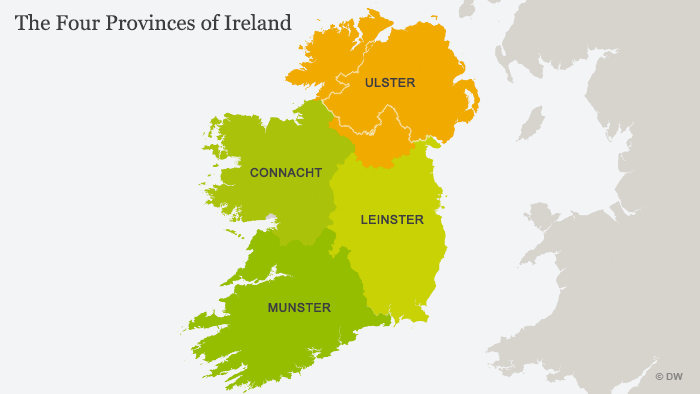
Incidentally, and I now digress, here is a map showing the Four Provinces of Ireland, together with the current border:
These are historical divisions and nowadays have no political or administrative role, but I think the map is interesting because it shows, if you didn’t know it before, that: (a) the current Irish border does not coincide with the boundary of Ulster; and (b) the most northerly point of the island of Ireland (Malin Head on the Inishowen Peninsula, in County Donegal) is in the Irish Republic, not in Northern Ireland. Maynooth, incidentally, is in Leinster.
Anyway, I think the current stalemate over the Irish Border is the inevitable outcome of one of Theresa May’s `red lines’ which seem to me to make a negotiated settlement impossible a priori. The only option for the Prime Minister seems to me to be to frame the problem another way. One way of making progress would be to abandon the red line on SM and CU membership. I don’t think that will happen as it would look too much like an admission of failure. Another way to do it would be to use gentle persuasion to get the DUP to shift its position. That is more likely, but will prove costly in both political and financial terms. The best way to unask this particular question is, of course, to abandon the Brexit project altogether. I’m not going to quote odds, but the possibility of the United Kingdom remaining in the European Union is increasing by the day. That won’t affect me directly very much, as I’ll be remaining in the EU come what may.
I found this letter by accident yesterday while I was searching for something else. Apparently, it’s very famous but I had never seen it before, and it struck me as unbearably moving. It was written by Sir William Waller to his friend Sir Ralph Hopton on 16th June 1643, during the (First) English Civil War and it is the last known communication between the two men. The former was a General in the Parliamentarian army, the latter held the same rank in the Royalist army.
This one heartbreaking letter reveals the tragedy that was unfolding all over the country at the time, as friends and families were torn apart by forces not of their making but that proved impossible to to resist. It seems that countries are doomed to do this from time to time.
To my noble friend Sir Ralph Hopton at Wells
Sir,
The experience I have of your worth and the happiness I have enjoyed in your friendship are wounding considerations when I look at this present distance between us. Certainly my affection to you is so unchangeable that hostility itself cannot violate my friendship, but I must be true wherein the cause I serve. That great God, which is the searcher of my heart, knows with what a sad sense I go about this service, and with what a perfect hatred I detest this war without an enemy; but I look upon it as an Opus Domini and that is enough to silence all passion in me. The God of peace in his good time will send us peace. In the meantime, we are upon the stage and must act those parts that are assigned to us in this tragedy. Let us do so in a way of honour and without personal animosities.
Whatever the outcome I will never willingly relinquish the title of Your most affectionated friend.
William Waller
Following the eventual defeat of the Royalist cause Sir Ralph Hopton fled to the Continent with the young Prince Charles. He died of fever in Bruges in 1651. Sir William Waller served as a Member of Parliament but became increasingly disillusioned with the new Commonwealth and subsequently worked for the Restoration of the Monarchy, which began in 1660 with Charles II. Waller died in 1668.
It is not normal for universities to occupy the front pages of national newspapers. Granted, at any time there is a vital, occasionally tense, dialogue between universities and the nations in which they are situated. The line between ideals of academic freedom on the one hand, and the realities of finances and state oversight on the other hand, is notoriously fuzzy. The extent to which universities reflect or represent their nations is always a potential point of controversy.
But these are not normal times. Over the past few months, debate has swirled frenetically around questions including university funding, whether we have too many universities, what our top managers are paid, free speech on campus, how we select our students, and what we teach. We appear now to be at the point where even what academics think might be a point for national outrage.
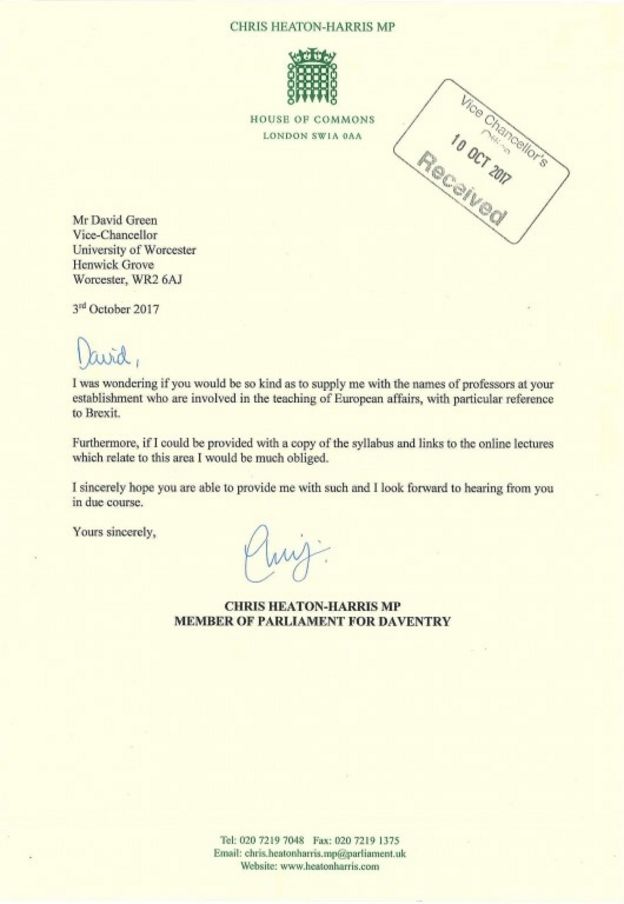
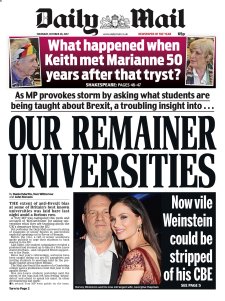
Yesterday, Tory MP Christopher Heaton-Harris wrote to all Vice-Chancellors of UK universities asking them to send him the names of professors teaching about “European affairs” together with links to relevant syllabuses and course materials. There has been an overwhelmingly negative response to this sinister request, which comes from an arch-Brexiteer apparently intent on thought control.
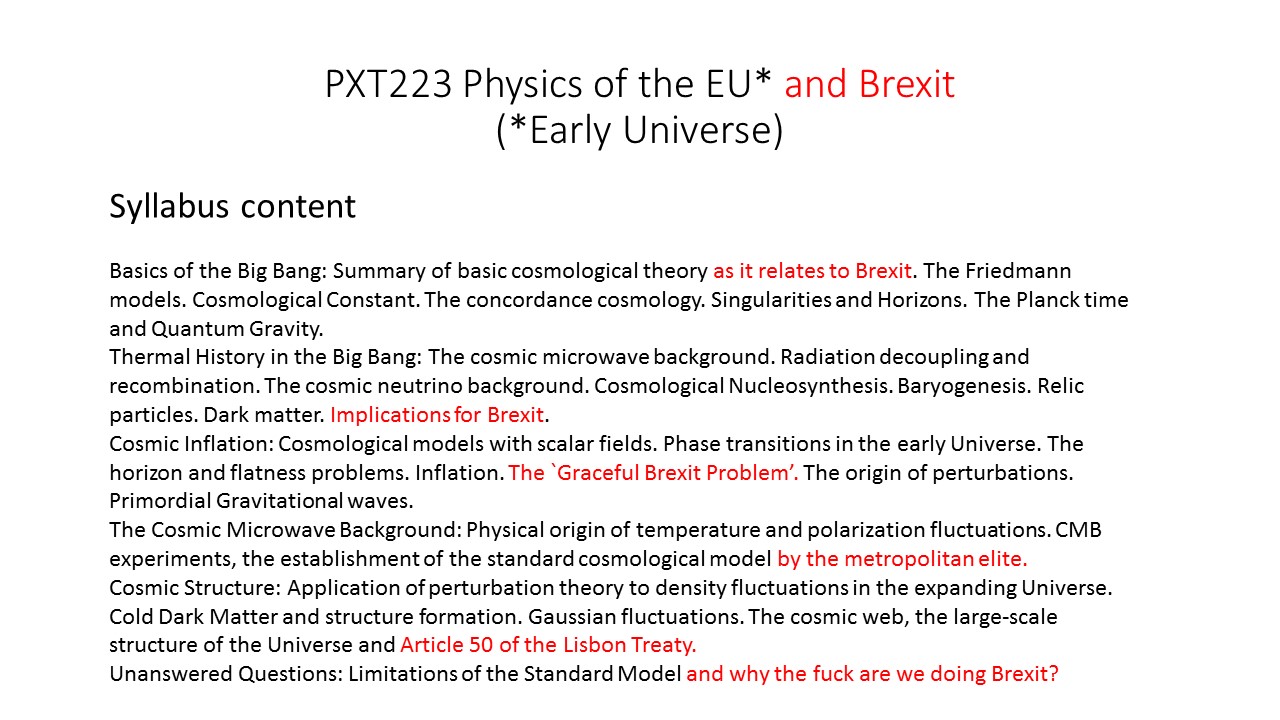
Not wishing to fall foul of the Brexit Police, I have updated my syllabus for next term and include it here so Mr McCarthy Heaton-Harris can read it:
I’m afraid that, for any further information and/or course materials relating to this module, Mr Heaton-Harris will have to register and pay the requisite fee which, thanks to his government is £9250.
P.S. I posted this slide on Twitter yesterday, and it got as close as any of my tweets have ever done to going viral (with over 800 retweets).
I’m sure I’m not the only one who was appalled by the scenes of violence yesterday as police tried to stop voting in the `referendum’ on Catalonia. Here’s some footage from the BBC which clearly shows excessive use of force inside a polling station:
This is far from the worst example: elsewhere plastic bullets were fired at unarmed protesters. In all, about 900 people have been reported injured, though this claim is contested and thankfully none of them – as far as I know – seriously.
Whatever you think about the rights and wrongs of the independence movement – and I’ll tell you what I think in a moment – there’s no question that the Spanish government has handled this issue very badly and in so doing has conceded a propaganda victory. There was no need to use force to prevent the voting, as the referendum was unlawful. The national government was undoubtedly in a difficult position, but I think it would have been far better just to let the vote go ahead in full knowledge that it had no constitutional validity. The referendum result (claimed to be about 90% for independence, on a turnout of just over 40%) means nothing even if you actually believe the numbers (which are doubtful). ‘Democracy’ means nothing without the rule of law.
Nevertheless, it just may be that history will judge Sunday 1st October to be the day that Catalonian independence became inevitable not because of the vote per se but because of the reaction to it.
Many seem to be either casting this as a battle between democracy and fascism, raising the spectre of Franco, or, even more absurdly, blaming all this on the European Union, ignoring the blame attached to the antics of the separatists. For a counter to the simple-minded propaganda emanating from the extremes of left and right, you might read this piece.
Of course I’m just an ignorant foreigner and I encourage those with different opinions to express them through the comments box below.
The EU will of course not intervene in what is essentially an internal problem for Spain, but is right to call for a dialogue to begin quickly before things get any worse, as the Commission has made clear:
Under the Spanish Constitution, yesterday’s vote in Catalonia was not legal.
For the European Commission, as President Juncker has reiterated repeatedly, this is an internal matter for Spain that has to be dealt with in line with the constitutional order of Spain.
We also reiterate the legal position held by this Commission as well as by its predecessors. If a referendum were to be organised in line with the Spanish Constitution it would mean that the territory leaving would find itself outside of the European Union.
Beyond the purely legal aspects of this matter, the Commission believes that these are times for unity and stability, not divisiveness and fragmentation.
We call on all relevant players to now move very swiftly from confrontation to dialogue. Violence can never be an instrument in politics. We trust the leadership of Prime Minister Mariano Rajoy to manage this difficult process in full respect of the Spanish Constitution and of the fundamental rights of citizens enshrined therein.
It was wrong to proceed with the referendum, but it was also wrong to use heavy-handed tactics to try to stop it going ahead. There is blame on both sides, and both sides need to get together to sort it out. I’m not optimistic that will happen immediately, but the only way to make peace is by talking to your opponents. Let’s hope that common sense prevails, if not immediately then perhaps eventually.
So what do I think about the case for Catalonian independence? Well, I’m not qualified to talk about the specific arguments, so I’ll keep to the generalities. Let me start with a bit of autobiography that might explain why I see things the way I do. I was born in Wallsend (on Tyneside) in the North East of England. My parents were both born just before World War II started, also in the area where I was born. Of my four grandparents, one was born in England, one in Northern Ireland, one in Scotland, and one in Wales. I always smile when I get to write my nationality on a form, because I put “United Kingdom”. Of course being born in England makes me English too, but I find that less defining than “UK” or “British” or even “Geordie”. To be honest, my ancestry means that I generally find the whole concept of nationality fundamentally silly. I find nationalism silly too, except for those occasions – regrettably frequent nowadays – when nationalism takes on the guise of xenophobia. Then it is truly sinister. Nationalism is a tool by which unscrupulous individuals whip up hatred for political gain, regardless of the human consequences.
It may be apocryphal, but Albert Einstein is reported to have said “nationalism is an infantile disease”. The obvious way to cure it is to grow up and focus on fixing the real problems facing us instead of just waving flags, shouting slogans, and blaming others for our own failings. The reality is that we depend on each other too much for independence to have any meaning, let alone be desirable.
I’ve been busy most of today so I only have a little time for a short post pointing out that the long-awaited `position paper’ about collaboration on science and innovation between the UK and EU after Brexit has now been published. Those of you intending to remain in the United Kingdom if and when it leaves the European Union might be interested in reading it. I say `might be’ rather than `will be’ as it doesn’t really say anything concrete about anything.
Here’s the overall summary:
In preparing to leave the EU, one of the UK’s core objectives is to “seek agreement to continue to collaborate with European partners on major science, research, and technology initiatives”. It is the UK’s ambition to build on its unique relationship with the EU to ensure that together we remain at the forefront of collective endeavours to improve the world in which we live. The UK believes this is in the joint interest of the UK and EU, and would welcome discussion on how best to shape our future partnership in this area.
The answer to the last bit is, of course, easy. The best way to shape our future partnership in this area is unquestionably for the United Kingdom to remain in the European Union. This document says as much itself. As with most of these papers it consists primarily of a long list of the benefits in this area that the United Kingdom has enjoyed as a direct result of our membership of the European together with a desire to keep most of them after our departure. It offers no real ideas as to how to square the many circles that would involve. In particular, many EU schemes, including those funded by the European Research Council, depend on the freedom of movement the European Union guarantees. Given the leaked Home Office document outlining how it intends to deter EU citizens from coming here I don’t see how we can possibly remain an attractive destination for scientists, or anyone else for that matter.
Meanwhile, today, Parliament is debating the European Union Withdrawal Bill which, if passed, would give the Government sweeping powers – the so-called `Henry VIII’ powers – to bypass Parliament and directly repeal or amend any law it doesn’t like the look of without debate. This is exactly the right-wing power grab that many of who voted Remain feared would happen. If this Bill passes without significant amendment then we can say goodbye to our parliamentary democracy. The parallel with the Enabling Act of 1933 that gave absolute power to Adolf Hitler is frightening.
It’s been a while since I had a guest post on this blog so it’s a pleasure to present this, by Philip Moriarty, to add to your reading for the Bank Holiday Weekend. Phil and I have had a number of exchanges over the years about the possibility of him writing a post for In The Dark and I’m very happy that it’s finally happened!
Take it away, Philip Moriarty…
–o–
If the conversations and feedback I’ve had at recent “social media in academia” meetings are anything to go by, I suspect that the majority of my academic friends and colleagues will be unaware of the source of the quote above. Although ignorance is certainly the more blissful option here, those of us with any semblance of interest in diversity, equality, gender balance, and widening participation issues in higher education need to start paying attention to just why memes like the title of this post are gaining such wide traction online. That way we can learn a great deal about the origins of the hostility that academics, on either side of the political divide, are increasingly facing, both inside and outside (see also this) the lecture theatre. Forewarned is forearmed [1].
The “Conservatism is the New Punk Rock” tagline was popularised earlier this year by a certain Paul Joseph Watson, of Infowars infamy. Watson is a conspiracy theorist-cum-YouTube pundit-cum-Alt-Right talking ranting head who, when not being given a thorough dressing-down on Twitter for his amusingly uninformed bleating about ethnicity in Roman Britain [2], spends his time as editor-at-large of the aforementioned Infowars. He’s essentially a bargain basement Milo Yiannopoulos [3]; a self-styled “New Right” provocateur who believes that it’s the height of cultural cool to channel the casual seventies racism and bigotry of an Alf Garnett or a Bernard Manning.
And the problem is that Watson is dead right about this new breed of conservatism.
Generation Z. Plus ça change…
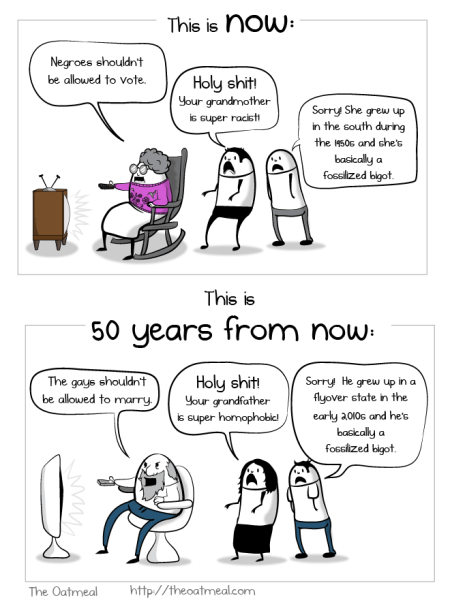
It’s now achingly edgy in some teenage (and permateen) circles to espouse bigotry, to rail against “PC culture”, and — as the YouTuber ContraPoints pointed out in a recent online discussion — to echo the views of a stereotypically racist grandmother. Even the more moderate in those particular cliques appear to have adopted the mindset of an uber-reactionary lifelong Tory backbencher. Bizarrely, this is what passes for teenage rebellion these days.
To illustrate what I mean, I’m afraid that I’m going to have to ask you to forgo the conventional advice on reading comments sections online. (My apologies for this — we all know that online forums are where the touchingly naive “marketplace of ideas” concept goes to die.) I suggest that you take a look at the comments under the “Conservatism is the new Counter-Culture” video Watson uploaded back in February. Here are just three comments that I happened upon in a cursory ten second trawl through the thread:
All anonymous, of course, so we have no way of telling whether or not each claim to be a Millenial/member of Generation Z — which are both rather ill-defined in terms of the date-of-birth range that they span in any case — holds up to scrutiny. But there’s very good reason to believe that Watson and his ilk indeed appeal to large sections of those particular demographics. Putting the demographic diversity (or lack thereof) of his audience to one side, however, Watson and others like him have subscriber bases numbering in the hundreds of thousands to over one million. Watson himself recently passed 1M subscribers on YouTube. On Twitter, Watson has got some way to go before he reaches the lofty heights of, for example, a Deepak Chopra (3.18M and rising steadily; another one in the eye for the marketplace of ideas). But, nonetheless, he, and other “New Right” pundits like him, clearly appeal to a sizable audience.
A defining feature of Generation Z is that they are, if you’ll excuse the jargon, digital natives. I’m a couple of chapters into Angela Nagle’s brilliant Kill All Normies at the moment. If you’d like to get an insight into just how internet subcultures and communities have influenced the rise of the New Right (and the alt-right, and neo-Nazism, and anti-social-justice cliques etc…) I enthusiastically recommend both Nagle’s book and Whitney Phillips’ This Is Why We Can’t Have Nice Things[4]. (Be warned, however, Nagle’s book, while being critical of the new right/alt-right, doesn’t exactly go easy on those on the left of the political spectrum. It’s equal opportunities critique.)
Nagle and Phillips each highlight the importance of the meme culture of the internet, of the pervasive influence of message boards like 4chan, and of anonymity’s central contribution to online interactions. But they also both focus on the key role of transgression: of pushing the boundaries, of ‘edginess’ in youth sub-cultures. It was ever thus, of course — each and every generation kicks against the pricks. And transgression of this type is key to understanding the rise of the “new right” among certain Generation Z sub-cultures.
With parents who will be counted among the “normies” of the title of Nagle’s book — conventional, staid, boring, “virtue signalling” and, most of all, politically correct — what better way for the more aggrieved and brooding members of Generation Z to rebel than to reject PC culture? “Fuck your feelings” and all that. (Of course, the Right (New or otherwise) is just as sensitive and prone to signalling as the “PC” Left on very many issues. More on this soon but let’s not have ugly facts get in the way of a good narrative just yet.)
Like many who regularly read the In The Dark blog [5],I’m an academic — a physicist at the University of Nottingham. (I used to blog quite regularly. Less so now). In common with practically all other UK universities, the majority of our undergraduate students are members of Generation Z. (This was made abundantly clear to me while I spent days answering the phone during the clearing period after A-level results were released last week. I entered a lot of date-of-birth details for applicants into online forms. My, but did I feel old.) If, as Watson suggests, the New Right indeed has quite some cachet among Generation Z — and we certainly don’t need to rely on Watson’s YouTube content for evidence of this; hyperbolic paranoia about ‘leftist’ professors brainwashing their classes is rife out there [6] — we academics need to be rather less complacent and naive about the extent to which our continued focus on diversity and inclusion will be met with unalloyed enthusiasm by some undergraduate students. We should perhaps expect some resistance.
And that brings me to…
Inclusion Matters
The Engineering and Physical Sciences Research Council (EPSRC), which funds the bulk of physics research in the UK, has very recently announced an innovative and welcome new funding scheme focused on furthering equality, diversity and inclusion in engineering and physical sciences research. Here’s how the EPSRC describes the call:
Funding of up to £5 million is available to support around ten inspiring applications with duration of up to 24 months to promote a more diverse, fair and inclusive engineering and physical sciences community. There is no limit on how large or small requests for funding can be.
(…listen carefully now and you too will hear the frantic rattling of keyboards late into the night as a certain hypersensitive online faction catches wind of this funding scheme. Of late, the Ghostbusters remake, superheroes on tins of pasta, and the announcement of a female Doctor have each been enough to drive the righteous anger of that faction to new heights as they bemoan the injustice of it all. The levels of distress caused by EPSRC’s allocation of £5M to diversity and inclusion in STEM could well be off the scale. Perhaps some type of helpline might be in order?)
All joking aside, while EPSRC is to be loudly applauded for establishing this funding initiative, the potential for a significant backlash is very high indeed. Too often, as academics we assume that all it takes to fix a problem is education, education, education. This is unfortunately exceptionally naive in political/ideological contexts, particularly, and especially, when it comes to the types of gender balance and diversity issues that EPSRC hopes to address. The James Damore/Google manifesto furore that broke out at the end of last month highlighted just how much sensitivity underpins the themes of the Inclusion Matters call.
I’m not going to go into a blow-by-blow dissection of Damore’s claims here. For one, it’s already been done by so many others much better than I ever could (here,here, and here. And definitely here. Oh, and here.) For another, a couple of weeks ago I spent a little over two hours chatting with my friend the “Ranting Feminist” (RF is, in fact, among the least ranty people I know) about Damore’s claim that the science backs up his position on the aptitudes and preferences of women in STEM fields. The science of course does no such thing — it’s equivocal at best and there’s a complete lack of consensus in many areas, as RF and I discuss in the video below. Moreover, Damore’s claim of “universal” traits, independent of culture and environment, is a remarkably uninformed, unscientific, and unconvincing position that can be readily rebutted when it comes to, for example, aptitude in maths.
I refer to Angela Saini‘sInferiora number of times during the discussion with RF. Beg, borrow, steal, or, better, shell out some of your hard-earned cash for Saini’s book. You will not regret it. It’s an exceptionally good piece of writing which provides a well-balanced analysis of the science (and the pseudoscience) underpinning gender differences. (I thought I was a major fan of Saini’s work until I met Jess Wade at the recent SciFoo conference at the Googleplex. Jess had bought up a supply of Saini’s book to hand out during the session she organised!) While I’m at it, I’ll also strongly recommend BBC2’s “No More Boys and Girls: Can Our Kids Go Gender Free?“, presented by Javid Abelmoneim. I watched Part 1 with my kids over the weekend and they were so engrossed they had to tell me to shut up because I was talking over the TV at one point. (Those who may be upset by the title of the BBC programme alone should perhaps pay attention to the trigger warning at the start of the discussion with RF above).
What would Sagan say? The Cult of Peterson.
At about the 1:41:00 mark in the video above, we turn to a consideration of Prof. Jordan Peterson, a Professor of Psychology at the University of Toronto, who currently makes of order $50K per month via Patreon for his YouTube videos. I’m not going to rehash my arguments about Peterson beyond those in the video largely because Eiynah has comprehensively analysed and dissected the Cult of Peterson in an important post. (Note the Reddit thread to which Eiynah refers where Peterson is described as a prophet.).
The sociology of Peterson’s YT/Patreon/Twitter following is truly fascinating and is part-and-parcel of the “edginess” and cachet of the New Right. Peterson — who, let’s be clear, is an intelligent, charismatic, and eloquent man [7] – largely gained his Patreon and YouTube following via his criticism of hate speech legislation in Canada and his associated often overwrought — or, at worst, histrionic — musings on the descent of modern academia into a Cultural Marxist Lowest Circle of Hell. But what’s remarkable is that Peterson is a Christian conservative who, while railing against the evils of postmodernism (and I’m certainly not a fan of a great deal of postmodern writing), has some very postmodern things indeed to say about the value of scientific truth vs religious/moral truth (or as he puts it, Darwinian truth).
It’s worth taking two hours of your time to listen to the podcast that Sam Harris did with Peterson earlier this year, where they focus on the meaning of truth. Harris repeatedly cuts Peterson’s exceptionally flawed and woolly thinking down to size. Just like Chopra, and indeed in line with many of the postmodernists Peterson criticises at length, Peterson’s arguments about truth and the nature of reality are dressed up in obscure and impenetrable language — a triumph of style over substance. And yet Peterson attracts a large, and growing, audience of those who would class themselves as rational, skeptical, logical, and atheist in their thinking. Strip away the florid language, however, as Harris does, and the emperor clearly has no clothes.
Listening to Peterson flail around during his podcast with Harris, I couldn’t help but be reminded of Carl Sagan‘s words:
Skeptical scrutiny is the means, in both science and religion, by which deep thoughts can be winnowed from deep nonsense.
When so-called “rational skeptics” (including many STEM students) enthusiastically embrace the deep postmodernist thoughts of Peterson, it’s clear that the edgy transgressiveness of the New Right has trumped reasoned, logical argument. What does it matter if Peterson argues that the morality and ethics of a scientist studying smallpox defines the truth of the underlying biochemistry? (As he does. No, really — he does.). Let his post-modern views on science slide. What matters is that he’s edgily refused to use the preferred pronouns of transgender students. [8] So where do I sign away my Patreon bucks?
This cult of personality represents something of a challenge for universities, whose core “mission” should be to develop the critical thinking skills of the students we teach. Anyone who comes away from the Harris-Peterson exchange feeling that Peterson successfully argued his position in the face of Harris’ systematic skeptical scrutiny — and, remarkably, many do (just take a look at the comments thread under the YouTube upload of the podcast [9]) — is clearly putting their ideological biases and allegiances before reason, logic, and objectivity. (Ummm, now where have I heard that complaint before?)
Let’s bring this overlong post to a close by reconnecting with the spirit of punk. The parallels of the 70s punk movement with the rise of the New Right are striking — Paul Joseph Watson is closer to the truth than I suspect he realises.
The photo of the poster below has been circulating widely on Twitter over the last week. (Kristi Winters, the author of the tweet in question, certainly gave that particular poster a massively large “signal boost” on Twitter — it’s accrued quite a number of retweets in just a few days). It’s a telling example of online culture bleeding into the offline “real” world (and vice versa). The clever visual simplicity of the poster accounts for its popularity and is yet another example of the increasing importance of visual content, rather than traditional text, online. Memes abound. (This is especially troublesome when it comes to how universities instill deep learning, analytic skills, and critical thinking in (some of) Generation Z, but that’s a whole other story.)
The frog at the bottom of the poster, for those of you again blissfully unaware of the relevance, is Pepe, whose tarnished history — in particular, its appropriation by white supremacists — is described here. What’s more important in the context of Paul J Watson’s “new punk” aphorism, however, is that there are also those who use the Pepe symbol/meme online (alongside other in-group signalling such as the Kekistani flag and the appropriation of Nazi symbols and gestures) who are adamant that they are not neo-Nazi or alt-right sympathisers. Here’s a good example:
The appropriation of Nazi symbolism and gestures, and the use of all those Pepe/ Kekistan memes clichés, is apparently edgy and transgressive, it’s pushing the envelope, it’s all about freedom of speech. And that type of posturing and signalling has, of course, definitely not got anything to do with the “identity politics” so despised by some on the Right. Nothing at all. Zilch. Nada. Definitely not. Because that’s how the “Regressive Left” behaves. The Pepe meme and the Kekistan flag “ironically” critique in-group dynamics and identity politics…by fostering and strengthening in-group dynamics, group-think, and identity politics. Right?
Yawn.
For something meant to be so “edgy”, this is all so tediously deja vu. The older punk generation did it all before back in the seventies. They could certainly teach the new breed a thing or two about the appropriation of Nazi symbols…
Siouxsie’s appropriation of Nazi icongraphy, and the use of an anti-Semitic lyric here or there, could never backfire, could it? It’s all just a bit of fun. You’d have to be a “normie” to take it seriously.
Well, let’s hear what Siouxsie herself has to say. The following excerpts from an interview back in 2005 are telling. Siouxsie at first sounds just like a member of today’s Pepe/Kekistan/”ironic Nazi” club:
For much of 1976, Siouxsie wore swastika armbands in an attempt to enrage the Establishment’s ‘we fought a war for the likes of you’ mindset. She succeeded, though today her naivety- what NME’s Julie Burchill decried as “making a fashion accessory out of the death of millions of people”-seems unforgivable. Siouxsie is surprisingly frank, if unrepentant.
“The culture around then,” she explains, “it was Monty Python, Basil Fawlty, Freddie Starr, The Producers- ‘Springtime For Hitler’.” She kicks out her leg in a mock goosestep. “It was very much Salon Kitty. It was used as a glamour thing. And you know what?” she sighs.” I have to be honest but I do like the Nazi uniform. I shouldn’t say it but I think it’s a very good-looking uniform.”
You shouldn’t say it for fear of upsetting the PC mob?
“Yeah. It’s almost like you feel like saying,’Aw, come on. Nazis – they’re brilliant.’ Political correctness becomes imprisoning. It’s very – what’s the word? It’s being very Nazi! It’s ironic but this PC-ness is so fucking fascist. In America they’re especially touchy about Nazis and it’s so Nazi! You go to LA and it’s so segregated. It’s very Nazi and the irony is they don’t get it. They don’t realise how Nazi they are about taking offence to mentioning the word Nazi.”
Let’s leave aside the issue of the comparable PC hypersensitivity of the right, and scroll down that interview a little to see just what effect Siouxsie’s penchant for Nazi memorabilia and “ironic” anti-Semitism had on the Banshees’ audience (and, subsequently, Siouxsie herself).
What about the accusation of anti-Semitism? Come on, there was that original lyric in “Love In A Void”: “Too many Jews for my liking”…
“That was a Severin lyric.”
You sang it.
“Yeah, I sang it, but I took it as it was meant, as ‘skinflints’. Obviously a lot of people didn’t get it that way, so it was changed.”
Sadly, not in time to prevent the Far Right from claiming Siouxsie as one of their own. Dismayed by the NF‘s attendance at gigs, she resorted to wearing a Star of David T-shirt as a middle finger to the BNP.
We reap what we sow.
[1] A major irritation in online communication is the exceptional and tiresome literal-mindedness that is often encountered. Subtlety and nuance are in very short supply. I’ve been “burnt” by this previously (on many occasions) so let me state here, for the record, that this is not a literal call to arms. [Add smiley emoticon to taste].
[3] Prior to the precipitous drop in his public speaking engagements prompted by his comments on paedophilia, Yiannopoulos was also very fond of trotting out the “conservatism is the new punk rock” mantra.
[5] Thanks, Peter, for this opportunity to write a guest post for In The Dark. Embarrassingly, particularly as I’m a big fan of your blog, it’s only taken me about three years to get round to it…
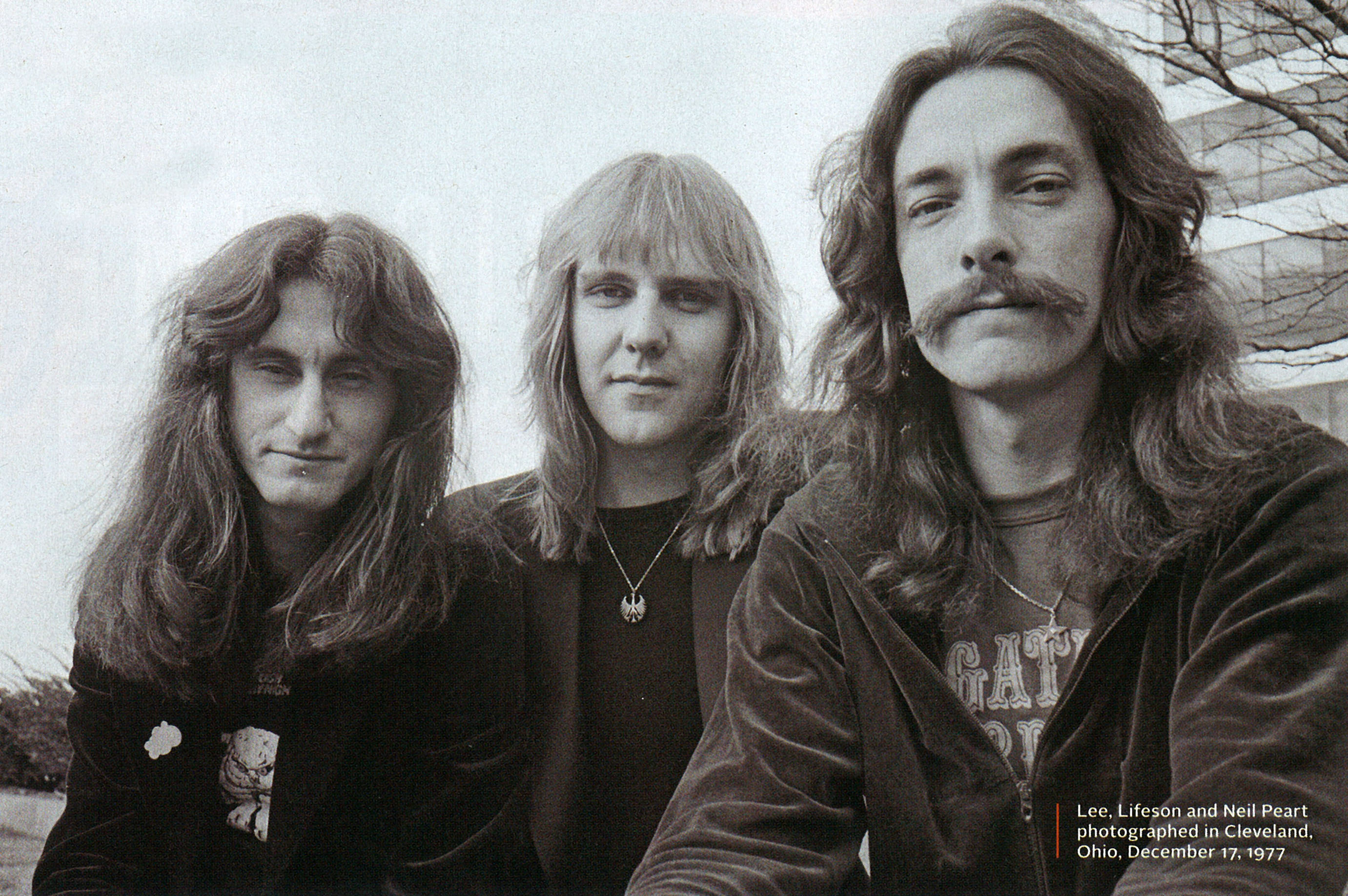
[6] I only wish I could routinely brainwash undergraduate students. There’d be a heck of a lot more Rush fans emerging from my lectures…
[7] One important criticism that can be levelled at both the left and the right of the online political spectrum is that there’s a strong tendency to demonise and indulge personal attacks. (And I’ve regrettably not been blameless here). For example, and despite my criticisms of Peterson’s arguments, I’m not at all comfortable with this. Peterson has spoken very movingly about his mental health issues in the past. I think we do our critiques of Peterson a disservice if we exploit those mental health issues to ridicule him.
[8] It’s similarly worrying when an academic feels that it’s fine to use a slur popularised by 4chan/8chan (which has subsequently diffused “overground” via the worst corners of social media). Steve Fuller has caught a lot of flak at this point for his lack of judgement in posting this a couple of days ago: “Academic Autism: Its Institutional presence and Treatment”. The use of “autistic” as a perjorative is exceptionally common among those edgy meme-driven teenage and permateen sub-cultures online. It’s immensely dispiriting that the slur has now been normalised to the extent that an academic feels free to similarly adopt the pejorative. Nonetheless, Steve has apologised more than once and I don’t think it’s at all helpful at this stage to castigate him any further. We all make mistakes and I, for one, can certainly not get on my high-horse when it comes to inappropriate language online.
The other day I was surprised to see this tweet announcing the impending formation of a new council under the umbrella of the new organisation UK Research & Innovation (UKRI):
Welcome to the official Twitter account of Research England – a new council within @UKRI_news. Launching in April 2018!
These changes are consequences of the Higher Education and Research Act (2017) which was passed at the end of the last Parliament before the Prime Minister decided to reduce the Government’s majority by calling a General Election.
It seems to me that it’s very strange indeed to have a new council called Research England sitting inside an organisation that purports to be a UK-wide outfit without having a corresponding Research Wales, Research Scotland and Research Northern Ireland. The seven existing research councils which will henceforth sit alongside Research England within UKRI are all UK-wide.
This anomaly stems from the fact that Higher Education policy is ostensibly a devolved matter, meaning that England, Wales, Scotland and Northern Ireland each have separate bodies to oversee their universities. Included in the functions of these bodies is the so-called QR funding which is allocated on the basis of the Research Excellence Framework. This used to be administered by the Higher Education Funding Council for England (HEFCE), but each devolved council distributed its own funds in its own way. The new Higher Education and Research Act however abolishes HEFCE and replaces some of its functions into an organisation called the Office for Students, but not those connected with research. Hence the creation of the new `Research England’. This will not only distribute QR funding among English universities but also administer a number of interdisciplinary research programmes.
The dual support system of government funding consists of block grants of QR funding allocated as above alongside targeted at specific projects by the Research Councils (such as the Science and Technology Facilities Council, which is responsible for astronomy, particle physics and nuclear physics research). There is nervousness in England that the new structure will put both elements of the dual support system inside the same organisation, but my greatest concern is that by exlcuding Wales, Scotland and Northern Ireland, English universities will be given an unfair advantage when it comes to interdisciplinary research. Surely there should be representation within UKRI for Wales, Scotland and Northern Ireland too?
Incidentally, the Science and Technology Facilities Council (STFC) has started the process of recruiting a new Executive Chair. If you’re interested in this position you can find the advertisement here. Ominously, the only thing mentioned under `Skills Required’ is `Change Management’.
The views presented here are personal and not necessarily those of my employer (or anyone else for that matter).
Feel free to comment on any of the posts on this blog but comments may be moderated; anonymous comments and any considered by me to be vexatious and/or abusive and/or defamatory will not be accepted. I do not necessarily endorse, support, sanction, encourage, verify or agree with the opinions or statements of any information or other content in the comments on this site and do not in any way guarantee their accuracy or reliability.









 In the Dark