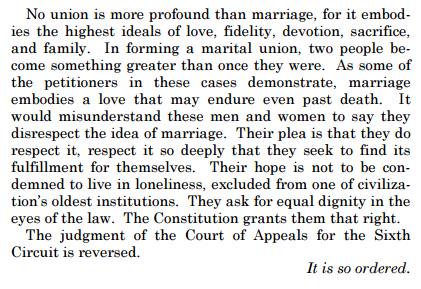
I never expected to be moved to tears by the eloquence of a court judgement, even if the margin was as narrow as it could have been (5-4).
Follow @telescoper
I never expected to be moved to tears by the eloquence of a court judgement, even if the margin was as narrow as it could have been (5-4).
Follow @telescoperAfter a whole day off yesterday to recover from an exceptionally busy week I’m back in the office on a Sunday to sort out a few things before leaving tomorrow on a short trip to the Midlands, of which more, perhaps, anon.
In a way I’m quite glad I have been so busy over the last few days, with Exam Boards and the like. Had I had time I might have been tempted to write a post at some point about the Tim Hunt affair which broke on Tuesday. As it turns out, everything moved so quickly that anything I wrote would have been overtaken by events. In any case I didn’t feel that I had much to add to the excellent response written by the Head of the Department of Physics & Astronomy, Prof. Claudia Eberlein, in the Huffington Post on Thursday. However, now I have a little bit of time I thought I would add a few comments.
I hope it goes without saying that I thought Tim Hunt’s comments about female scientists, made in public at an event in South Korea, were outrageous and indefensible. My heart sank when I found out what he’d said. I might have believed his story that they were intended to be humorous had it not been for an awful non-apology on Radio 4, which effectively made that line of defence untenable. Nobel Prize winning biochemist he may be, but Tim Hunt clearly has a lot to learn about how to interact with people. When we find ourselves in a hole, most of us have the sense to stop digging.
I know my opinion here differs from that of some of my friends and colleagues, but I also think University College London did the right thing in asking him to resign. I’ve heard it argued that it over the top for him to lose his job over his remarks. But that’s not what happened. In fact, Tim Hunt is in his seventies and has been effectively retired for many years; his position at UCL was honorary (i.e. unpaid). I don’t think the severance of his relationship with UCL can be construed as an excessive punishment. In today’s Observer there’s a piece in which Tim Hunt claims he has been “hung out to dry” . I have to admit that I find his attempt to portray himself as victim to be as nauseating as his earlier apology. I think UCL were fully justified in severing their relationship with Tim Hunt. This is not an issue of freedom of speech. Tim Hunt had every right to express his opinions. Those opinions are, however, completely incompatible with the values of the institution with which he was associated and his statement of them harmful to the reputation if UCL. He simply had to go.
On the other hand, there’s a lot about this story that troubles me greatly. Although some of the social media reaction to Tim Hunt’s comments was incisively humorous, some was unpleasant and some downright nasty. Worse, the Twitterstorm that raged last week also unleashed the gutter press, chiefly the Daily Mail, whose hacks tried to drag Prof. Mary Collins (Hunt’s wife) into the story. That was unpleasant, even by the standards of the Daily Mail. Mary Collins’ private life has nothing to do with her husband’s failings.
Anyway, I hope that a line will now be drawn under this episode. Tim Hunt should now be left alone to enjoy his retirement. As someone once said of someone else “I’ve nothing against his family, but I’m glad he will be spending more time with them”.
Nobody should be deluded that the departure of one high-profile academic will solve anything. Tim Hunt was one senior academic stupid enough make offensive comments in public. There are countless others in positions of power and influence who hold very similar opinions but only express them behind closed doors, or under the cover of anonymity. Indeed, I know a number of senior academics who put on a public show of being in favour of equality and diversity but in private have acted deliberately to undermine the careers of, usually junior, female scientists. The culprits aren’t always men, either..
P.S. In the interest of full disclosure I should point that I have never met Tim Hunt so do not know what his views really are. Neither do I have any connection with University College London.
Follow @telescoper I came across this wonderful photograph this morning via Twitter and couldn’t resist sharing it here.
Some people fought very hard to secure the right to vote, like this courageous Suffragette addressing a vast and hostile audience on Newcastle quayside way back in 1914. The rights we enjoy today were hard won. Don’t squander them.
At last we’ve reached General Election day and I’ve just been to cast my vote in the crypt of St George’s Church in Kemptown, very close to my Brighton residence. It was quite busy this morning when I got there, and I had to queue to get my ballot paper. I don’t know what the turnout is like this time, but I hope it’s good. I don’t think there’s really any excuse for not voting, although some people seem to prefer to whinge than to vote.
I doubt if I’ll stay up late tonight to watch the results come in. Polls don’t close until 10pm and until then there’s a blackout of press coverage relating to the vote so there’s nothing to follow until quite late at night, when I’m usually tucked up in bed with my cocoa. The latest opinion polls suggest that the Conservative Party may just get the biggest share of the vote, but it is highly unlikely they’ll win a majority of the seats. The likelihood therefore is abother hung parliament, at which point there’ll be some frantic negotiation behind the scenes. It will still be interesting to see how the horse-trading works out over the next few days, but after three weeks of phoney war we’ll soon have to face up to reality. I’m not really looking forward to that.
On the corresponding Polling Day eighteen years ago in 1997 I was actually in Lawrence, Kansas. Don’t ask me why. I’d arranged a postal vote, but had to watch the proceedings from afar on the TV. Some expat British friends of mine decided to hold a party that night in their house and I went along to drink beer while the results came in. Watching a British election from the midwest USA is a bit strange, but it’s improved by the fact that the polls close in the UK at what is early evening Kansas-time and it’s all pretty much over by midnight.
That election I was swept up in the euphoria generated by the prospect of a New Labour government with its slogan “Things can only get better”. When they won a landslide majority we celebrated in grand style, singing Jerusalem in the back garden and then tottered not-too-soberly to a tattoo parlour to have a red rose put on my arm.
We had a great time that night, and the good vibes continued after I returned to London from my short stay at the University of Kansas. It didn’t take long, however, for my enthusiasm to wane. Instead of doing the really radical things their large majority would have allowed, they didn’t seem to have the gumption to tackle the really important issues. Then of course Blair took us into Iraq and, despite having voted Labour all my life before then, I vowed never again to vote for the Labour Party while it was led by the people that made that decision.
But I’ve still got the red rose tattoo and this time I returned to the fold by voting for Nancy Platts in Brighton Kemptown. I wasn’t initially very impressed with Ed Miliband but I have changed my mind over the last few weeks. I think during this campaign he has behaved with great dignity and strength of character in the face of some pretty nasty personal attacks from his political opponents. Now I really hope that Ed Miliband leads the next Goverment of the United Kingdom, although it will probably only be able to do so in some sort of coalition with the Scottish Nationalist Party and possibly the Liberal Democrats.
For what it’s worth, my predictions for the consituencies in Brighton is that Labour will win both Kemptown and Hove, whereas in Pavilion Caroline Lucas of the Green Pary will hold the seat for the Conservatives.
But whether or not you agree with my political opinions, please get out there and vote. Tomorrow, VE Day, is the 70th Anniversary of the end of the Second World War in Europe. Remember that as you cast your vote, and have faith in the democracy so many gave their lives to defend.
Follow @telescoperInteresting post about the constitutional limits on the ability of the SNP to influence UK budget setting.
The SNP are claiming they can ‘block Labour budgets’, ‘end austerity’ and ‘stop Trident’. Their problem however is simple – most of what they say is based on assuming that Westminster works the same way as Holyrood does for budgeting – and it doesn’t. There are huge ‘constitutional’ and practical obstacles to implementing the sort of radical challenges to Government tax and spend decisions that the SNP and others seem to be mooting. The first set of problems is that in the Westminster parliament only the Government can propose taxation or spending measures. These can be defeated, or amended, but only by cutting spending or lowering or removing taxes – not by increasing either.
View original post 1,076 more words
I haven’t posted much about the forthcoming General Election but I couldn’t resist making a short comment about the situation here in Brighton & Hov, which is actually quite interesting. The three constituencies in the city are all marginal: Hove, Brighton Pavilion, and Brighton Kemptown. All of these were Conservative strongholds until 1997, when they all fell to the Labour party which held them until the last General Election 2010. Hove and Brighton fell to the Conservatives in 2010 while Brighton Pavilion was taken by the UK’s only Green MP, Caroline Lucas. Much of the media attention in Brighton is focussing on the latter seat, where (surprisingly to my mind), Caroline Lucas seems set to retain her place in the House of Commons having apparently succeeded in her campaign of distancing herself from the local Green Party’s abject performance in running Brighton and Hove City Council.
I am currently living in Brighton Kemptown, a two-way marginal in which the Labour candidate (Nancy Platts) is fighting the incumbent Conservative (Simon Kirby). The seat encompasses the eastern part of Brighton and the semi-rural suburbs and villages stretching out to the east of the seat. At its western end it includes Queen`s Park ward, the centre of Brighton`s vibrant gay community, then Kemptown, the council estates of Whitehawk and Moulscoomb and then, beyond the racecourse, more affluent and genteel coastal villages like Woodingdean, Saltdean and the town of Peacehaven. At the north of the seat is Brighton University`s Falmer campus – despite Moulscoomb itself being in the constituency, Moulscoomb campus lies just over the boundary marked by the A27 in Brighton Pavilion. The University of Sussex, where I work, also has a campus at Falmer, but it is also in Brighton Pavilion.
Here is a map showing the constituency boundaries:

I often get the No. 23 bus home from work in the evenings. The route of this bus takes it down the A27 to Elm Grove, where it turns left up the hill into Elm Grove which runs uphill into Hanover, which is (more-or-less) that segment at the Western boundary of Brighton Kemptown that has been eaten into by Brighton Pavilion. The bus then turns right and travels south taking it into Queen’s Park and then left again to take it along towards the Marina (the bit that sticks out into the sea).
I know it’s not a very scientific guide to the likely election result, but it is noticeable that the posters showing in the windows in the houses of the Hanover salient of Brighton Pavilion are almost exclusively for Caroline Lucas while those along the rest of journey in Kemptown are almost exclusively for Nancy Platts. It’s a remarkably sudden transition that coincides with the constituency boundary in fact. I’m not sure how much it is reasonable to infer from this observation, but I’d say based on other evidence that Caroline Lucas will probably hold Brighton Pavilion and Nancy Platts will be the next Member of Parliament for Brighton Kemptown.
But of course I could be wrong.
Follow @telescoperTo follow up on my previous post, here’s a a lot more about the Tell Them Science Is Vital initiative…

 There’s another election coming up and, whatever the outcome, we’ll all (hopefully) still be doing our jobs and waiting for the situation to improve.
Something the government could do to lay foundations for education, industries and economic growth in the UK is to fund science. Over the last 2 decades, they’ve really let this slide. Enter #TellThemSiV, the new campaign from Science is Vital, to do just that…
In just a few weeks, Britain goes to the polls to vote in a new government. This is obviously a crucial time for science funding and policy.
That is why Science Is Vital needs you to contact your MP or parliamentary candidate.
Since 2010, the science budget, despite having been protected from the worst of the austerity measures by the ring-fence we fought for, will nevertheless have shrunk in real terms by up to 20%.
In…
View original post 811 more words
The General Election looming on the horizon could prove to be a watershed for scientific research in the United Kingdom. In the period immediately following the 2010 Election there was a great deal of nervousness about the possibility of huge cuts to spending on research. One of the most effective campaigns to persuade the new government against slashing funding for science on the grounds that scientific research was likely to be the principal fuel for any economic recovery was led by Science is Vital. I have written a few posts about this organisation.
The scientific community breathed a collective sigh of relief in autumn 2010 when the UK Government announced that research funding would be “ring-fenced” and maintained in cash terms for the duration of the Parliament. Things could have been far worse, as they have been in other parts of the public sector, but over the years the effect of inflation has been that this “flat cash” settlement involves a slow strangulation as opposed to a quick fall of the axe.
A recent piece in the Guardian includes this picture, which speaks for itself:
 The United Kingdom now spends less than 0.5% of its GDP on research, and this fraction is falling rapidly. We are now ranked last in the G8 by this criterion, way behind the USA and Germany. Why are we in this country so unbelievably miserly abou funding research? Other countries seem to recognize its important, so why can’t our politicians see it? We should be increasing our investment in science, not letting it wither away like this.
It seems to me that much more of this squeeze and we’ll be needing to close down major facilities and start withdrawing from important international collaborations. The Science and Technology Facilities Council (STFC) is particularly vulnerable, as such a large fraction of its budget is committed to long-term projects. It’s already trimmed funding for other activities to the bone, with research grants under particularly intense pressure. Will the ongoing Nurse Review of the Research Councils spell doom for STFC, as many of my colleagues think? Will be research funding be transferred rom universities into research institutes?
Anyway, it seems an appropriate time to advertise the latest campaign from Science is Vital, which involves writing to candidates (including incumbent MPs) in your constituency to Tell Them That Science Is Vital. You might consider including some of the following, or others suggested by the website. If you’re a scientist, describe why your research is important. Here are some suggestions. If there is a local research institute in your constituency, explain how important it is to your local economy (how many people it employs, for example). If you’re a patient, or someone who cares for a patient, say how important you think research into that disease. Ask your candidate or MP to endorse the Science is Vital campaign to increase public funding of science to 0.8% of GDP. And if you do write, remember that the economic argument for investing research isn’t the only one…
Follow @telescoperTwo years ago I posted an item about the effects of industrial action by Brighton & Hove’s refuse collectors, the ironically-named company Cityclean. Strikes and other industrial action have happened intermittently over the last year, but it has been difficult to establish when Cityclean are working and when they are not because the typical level of service is absolutely abysmal. Apparently the latest strike is supposed to have finished, but some drivers are still “working to rule”.

The fact of the matter is that this state of affairs is the rule in Kemptown, the part of Brighton I live in. The refuse collection service is shockingly unreliable and more often than not the street resembles a rubbish tip, whether or not there’s a strike.
It’s quite obvious who is to blame for all this. Cityclean is managed, badly, by the local Council which is controlled by a shambolic Green Party more interested in splurging money on vanity projects like the infamous i360, and trying to wreck the budget-setting process, than providing decent services for local people. Given the importance the Green Party pretends to attach to recycling and sustainability, it is appalling that the fraction of refuse that is recycled is just 24%, one of the lowest rates in the entire country. The local Greens think the council should take over running bus services too. If they do as good a job of that as they do with the refuse collection service then I’ll probably be walking to work most days of the week.
I keep hearing from people living elsewhere who a flirting with the idea of voting for the Greens in the General Election and Local Elections forthcoming in May. I very much doubt that there will be any “Green Surge” in Brighton, unless it comes in the form of a noxious ooze emanating from mountains of uncollected garbage. I am pretty sure the Green will get wiped off the face of the Council in Brighton and Hove. If you’re actually thinking of voting for them elsewhere, take a look at the mess they’ve made here and I’m sure you will change your mind.
Britain’s only Green MP (Caroline Lucas) is looking to retain her seat in Brighton Pavilion at the General Election. To attempt to achieve this she has initiated a frantic campaign to distance herself from the antics of the Green Party’s representatives on the local council. I find that attitude completely hypocritical and I hope she fails. If she really doesn’t agree with her party she should stand as an independent. I won’t be voting for her anyway. Apart from everything else I’m not in her constituency..
Follow @telescoperJust thought I’d reblog this to show how close it seems the May 2015 General Election will be. The situation with respect to seats is even more complex. It looks like Labour will lose many of their seats in Scotland to the SNP, but the Conservatives will probably only lose a handful to UKIP.
It looks to me that another hung Parliament is on the cards, so coalitions of either Con+Lib+UKIP or Lab+SNP+Lib are distinct possibilities..
 I’ve updated my “Poll of Polls” to include 13 more polls that were carried out since I did my last graph. The graphs now include the Greens as I now have data for them too.
Overall this Poll of Polls shows no real change from last week.
If you want to download the spreadsheet that did this analysis go here. If you want to understand the methodology behind the “Poll of Polls” click here and scroll down to the bit that gives the description.


