Archive for the Politics Category

The Trouble With Brighton’s Roads..

Posted in Biographical, Brighton, Politics with tags , , , , on April 26, 2014 by telescoper

I travelled back to Brighton yesterday after taking a short break in Wales over Easter. To occupy myself on the train journey back I was, as usual, messing about on Twitter as a result of which I discovered that the main road along Brighton’s seafront had been closed. The reason for this – and the ensuing traffic chaos in the City Centre – was that the main A259 had partially collapsed. My heart sank at the thought of the problems I might have getting home from the station, but in fact by the time I got there – just after seven in the evening – the worst of the congestion seemed to have cleared and I got a bus home without any difficulty or delay.

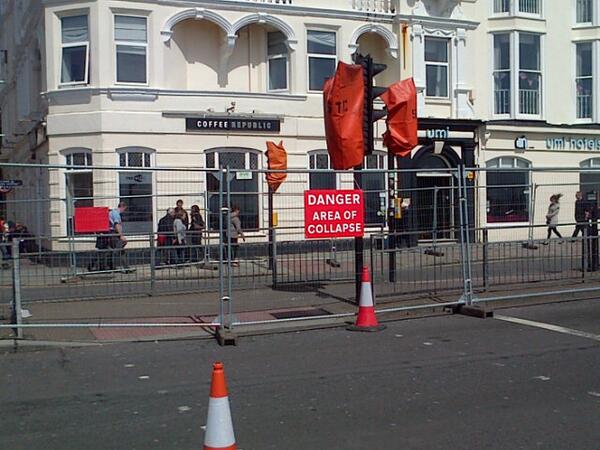
When I walked past the spot earlier today I found that it wasn’t as dramatic as I’d been led to believe:

Hole_in_Road

There isn’t actually a hole as such, just a couple of very wonky pavements either side of a section of road that’s in a very poor state of repair. In that respect it’s no different from most of Brighton’s streets.

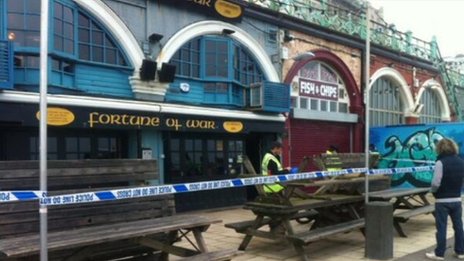
If you don’t know the area concerned, just at the bottom of West Street, you won’t know that this section of the A259 (King’s Road) runs above the a series of arched underground structures occupied by various shops and pubs. In fact the collapse happened inside a pub called the Fortune of War, when some workmen discovered several tons of rubble had fallen down from the roof above. Fortunately, no-one was hurt.

This is the view at beach level; the King’s Road runs above the pub, behind the iron railings at the top of the picture.

The Fortune of War Pub (Credit: BBC)

The Fortune of War Pub (Credit: BBC)

One lane of the A259 is currently closed and a contraflow is in operation. Given that it is at the best of times a very busy road this, and the diversions that have been placed elsewhere to ease traffic on it, is set to cause congestion for some time to come, probably several weeks.

The problem is obviously that the structures underneath the road were never designed to carry the weight of traffic that they are now expected to support. Brighton and Hove Council have been spending money on extensive roadworks elsewhere in the City but seem to have been reluctant to perform reinforcing work on this crucial route. There’s already a political row brewing about this.

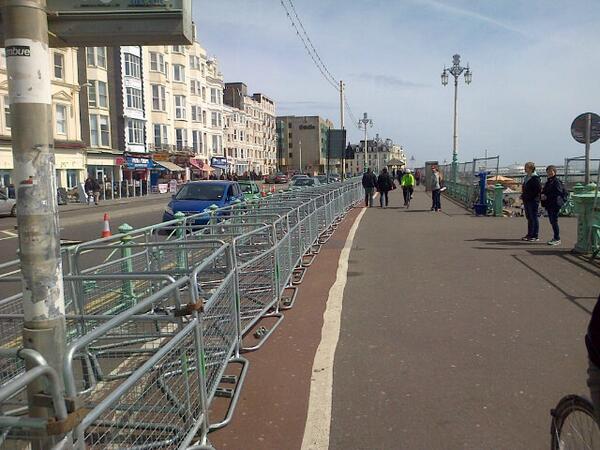
Here’s another picture of the seafront:

EDL_route

The barricades you see are nothing to do with with subsidence, but are there for tomorrow’s “March for England”, the annual attempt by the gang of Neo-Nazi thugs called the EDL to stir up trouble in Brighton. Presumably the fences are intended to separate the EDL from human beings. The collapsed road was to have been part of the route, but presumably alternative arrangements have been made. I would have preferred the road closure to have been used as an excuse to cancel the march altogether actually. I’d rather have no road at all than one filled with such creatures.

I’m very worried about tomorrow. I despise the EDL, but I strongly believe that the best way to deal with people like that is to make sure you don’t give them what they want. They’re clearly coming to Brighton for a fight, so the best approach is to exercise restraint. Unfortunately, there are extremists on the other side of the political spectrum who want a fight just as much as the EDL do. It’s all rather pathetic, if you ask me. Anyway, I’ll be avoiding any aggro by heading up to campus in the morning and catching up on some of the things I’ve missed while I’ve been away over the last week or so…


The Stifling Effect of REF Impact

Posted in Education, Politics with tags , , , on April 22, 2014 by telescoper

Well, I’m back to civilization (more or less) and with my plan to watch a day of cricket at Sophia Gardens thwarted by the rain I decided to pop into an internet café and do a quick post about one of the rants that has been simmering on the back burner while I’ve been taking a break.

Just before the Easter vacation I had lunch with some colleagues from the Department of Physics & Astronomy at the University of Sussex. One of the things that came up was the changing fortunes of the department. After years of under-investment from the University administration,  it was at one time at such a low ebb  that it was in real danger of being closed down (despite its undoubted strengths in research and teaching).  Fortunately help came in the form of SEPnet, which provided funds to support new initiatives in Physics not only in Sussex but across the South East. Moreover, the University administration had belatedly realized that a huge part of the institutional standing in tables of international research rankings was being generated by the Department of Physics & Astronomy. In the nick of time, the necessary resources were invested and the tide was turned and there has been steady growth in staff and student numbers since.

As Head of the School of Mathematical and Physical Sciences I have had to deal with the budget for the Department of Physics & Astronomy. Just a decade ago very few physics departments in the UK were  financially solvent and most had to rely on generous subsidies from University funds to stay open. Those that did not receive such support were closed down, a fate which Sussex narrowly avoided but which befell, for example, the physics departments at Reading and Newcastle.

As I blogged about previously, the renaissance of Sussex physics seems not to be unique. Admissions to physics departments across the country are growing at a healthy rate, to the extent that new departments are being formed at, e.g. Lincoln and Portsmouth. None of this could have been imagined just ten years ago.

So will this new-found optimism be reflected in the founding of even more new physics departments? One would hope so, as I think it’s a scandal that there are only around 40 UK universities with physics departments. Call me old-fashioned but I think a university without a physics department is not a university at all. Thinking about this over the weekend however I realized that any new physics department is going to have grave problems under the system of allocating research funding known as the Research Excellence Framework.

A large slice (20%) of the funding allocated by the 2014 REF will be based on “Impact” which, roughly speaking, means the effect the research can be demonstrated to have had outside the world of academic research. This isn’t the largest component – 65% is allocated on the basic of the quality of “Outputs” (research papers etc) – but is a big chunk and will probably be very important in determining league table positions. It is probably going to be even larger in future versions of the REF.

Now here’s the rub. When an academic changes institution (as I have recently done, for example) he/she can take his/her outputs to the new institution. Thus, papers I wrote while at Cardiff could be submitted to the REF from Sussex. This is not the case with “impact”. The official guidance on submissions states:

Impact: The sub-panels will assess the ‘reach and significance’ of impacts on the economy, society and/or culture that were underpinned by excellent research conducted in the submitted unit, as well as the submitted unit’s approach to enabling impact from its research. This element will carry a weighting of 20 per cent.

The emphasis is mine.

The period during which the underpinning research must have been published is quite generous in length: 1 January 1993 to 31 December 2013. This is clearly intended to recognize the fact that some research take a long time to generate measurable impact. The problem is that the underpinning research must have been done within the submitting unit; it can’t be brought in from elsewhere. If the unit is new and did not exist for most of this period,then it is much harder to generate impact no matter how brilliant the staff it recruits. Any new departments in physics, or any other subject for that matter, will have to focus on research that can generate impact very rapidly indeed if it is to compete in the next REF, expected in 2018 or thereabouts. That is a powerful disincentive for universities to invest in research that may take many years to come to fruition. Five years is a particularly short time in experimental physics.


Bearded Bishop Brentwood welcomed but too late for Beard of Spring poll

Posted in Beards, Biographical, Football, Politics on April 15, 2014 by telescoper

I’m still way behind John Brayford (who he?), but there’s definitely signs of a bounce! The Deadline is 19th April. Vote for me!


kmflett's avatarKmflett's Blog

Beard Liberation Front
PRESS RELEASE 14th April
Contact Keith Flett 07803 167266
Bearded Bishop Brentwood welcomed but too late for Spring Beard poll

The Beard Liberation Front, the informal network of beard wearers that campaigns against beardism, has welcomed the news that the Pope on Monday appointed Fr Alan Williams FM as the Bishop of Brentwood but say that his appointment is too late for inclusion on the Beard of Spring 2014 poll which concludes on Friday.

The campaigners say that they are certain that the distinguished Bishop will feature in future

The big issue in the days left for voting is whether current leader Sheffield United footballer John Brayford did enough in his team’s defeat to Hull in Sunday’s FA Cup semi-final to take the title or whether challengers such as cosmologist Peter Coles and Editor of the I Paper Olly Duff can catch him

The Beard of Spring…

View original post 136 more words

Tuition Fees, Ponzi Schemes and University Funding

Posted in Education, Finance, Politics with tags , , on March 30, 2014 by telescoper

Last week the Higher Education Funding Council for England (HEFCE) finally released information on allocations for 2014/15. As expected, there are large cuts in recurrent grants pretty much across the board (a full table can be found here).  These cuts reflect the fact that government funding for teaching in many subjects is being progressively replaced by tuition fee income in most disciplines, the prominent exception being STEM subjects, which continue to attract a (small) element of grant support in addition to the £9K fees.  Grants for research are largely unchanged for the time being; the big upheaval there will happen when the outcome of the Research Excellence Framework is applied, from 2015/16 onwards.

If you look at the table you will see that some big research universities have relatively small cuts, especially if they focus on STEM disciplines; the obviously example is Imperial College which has a cut of only 3%. Typical Russell Group universities seem to be getting cuts of around 15%. My own institution, the University of Sussex, has been handed a cut of 24%, which reflects the fact that a large majority (greater than 75%) of students here are doing non-science subjects. Universities with less research income and a higher concentration on Arts & Humanities subjects are having to bear cuts of up to 60%.  These reductions are larger than anticipated as a result of the government’s decision to increase the total number of places by about 30,000 this year.

These numbers look alarming, but in most cases, including Sussex, the net income (FEES+GRANT) will actually go up next year, as long as the institution manages to recruit a sufficient number of students. The ability of a university to generate sufficient income to cover its costs has always depended on its ability to attract students, but this has previously been managed using a student number control, effectively applying a cap on recruitment to institutions that might otherwise corner the market.   This year some institutions who failed to recruit strongly have had their cap lowered, but worse is in store from 2015/16 as the cap will be lifted entirely, so that there will effectively be a free market in student recruitment. I sure I’m not the only person who thinks the likely outcome of this change will be a period of chaos during which a relatively small number of institutions will experience a bonanza while many others will struggle to survive.

As if this weren’t bad enough, there is also the growing consensus that the current fee regime is unsustainable. Revised estimates now suggest that about 45% of graduates will never pay back their tuition fees anyway. If this percentage grows to about 50% – and I am very confident that it will – then the new tuition fee system will end up costing the Treasury (i.e. the taxpayer) even more than the old regime, while also saddling generations of graduates with huge debts and also effectively removing the sector from public control.

Apparently, the response of the government to the level of default on repayments is to consider increasing fees to a level even higher than the current £9K per annum. It seems to me that the likely consequence of this would simply be to increase the default rate still further, largely by driving UK graduates abroad to avoid liability for paying back their loans, and thus drive the system into runaway instability.

The more one looks at the fees and loans debacle the more it resembles  a Ponzi scheme that’s destined to unravel with potentially catastrophic consequences for England’s universities; note that Wales, Northern Ireland and Scotland are not covered by HEFCE arrangements.

So what can be done?

I’ll assume at the outset that the only really sensible plan – taking the entire system back under public control – is, by the very nature of the British political system, unthinkable.

My first suggestion reflects the fact that I am a scientist and that I think  science education and research properly should be a very high priority for any system of university funding. Whatever is done therefore must address the point I made a post about the threat to STEM subjects presented by HEFCE’s policies the essence of which is that the £9K flat-rate fee across all disciplines does not reflect the true difference in cost of teaching between, say, English and Physics. Differential fees would have a disastrous effect on recruitment into science subjects while the current system underfunds STEM disciplines so severely that it offers a perverse incentive for universities to focus on non-science areas. Under the current system, fees from Arts disciplines are effectively subsidizing science subjects rather than providing education to those paying the fees; in other words, Arts students are being ripped off.

Second, if the taxpayer is going to foot a significant part of the bill for higher education then HEFCE (or whatever organization replaces it in future) must have sufficient clout to manage the sector for the public interest, rather than allow it to be pulled apart by the unfettered application of market forces.

Third, any new system must be designed to reduce the level of graduate debt which, as I’ve mentioned already, simply encourages our brightest graduates to emigrate once they’ve obtained their degree.

I’ve actually never really been opposed to the principle that students who can afford to should contribute at some level to the cost of their education; I have, on the other hand, always been opposed to fees being set at the level of £9K per year. The Labour Party’s suggestion that fees should be cut to £6K would go some of the way to satisfying the third requirement, but would be disastrous unless the cut were offset by increased state funding through recurrent grants. I think a better suggestion would be to cut fees by a greater amount than that if possible, but to have a much bigger differentiation in the unit of resource paid to different subjects. I’d say that the net income per student should be about £15K per annum in STEM subjects, whereas for Arts and Social Sciences £6K probably covers the full cost of tuition.  So if the fee is set at £X across the board, STEM disciplines should receive £(15-X) from HEFCE while Arts subjects get a subsidy of £(6-X).


Countdown to Equal Marriage

Posted in Biographical, LGBTQ+, Politics with tags , , on March 28, 2014 by telescoper


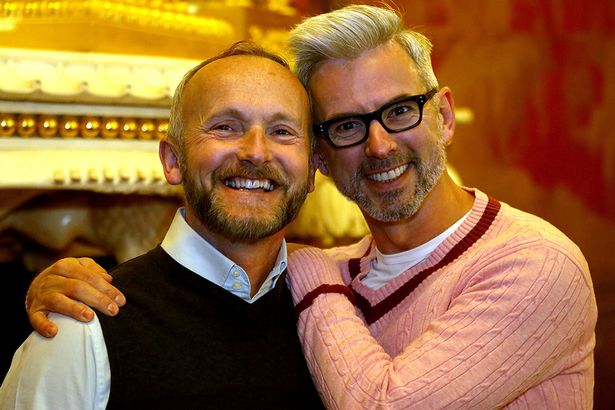
So, from midnight tonight, same-sex couples have the right to marry in England & Wales. Not surprisingly, one of the first gay weddings in the UK will be in Brighton: Andrew Wale and Neil Allard (below) will marry just a few minutes after midnight:

Neil-Allard-left-and-Andrew-Wale-3155478

Nice beards! I’d like to take this opportunity to send my very best wishes to Andrew and Neil and indeed to everyone (straight or gay) taking the plunge this weekend.

I find the fact that this has become reality absolutely amazing. When I came to the University of Sussex as a graduate student in 1985, Brighton was one of the most gay-friendly cities in the UK, if not the world. However, the veneer of tolerance was really very thin. Homophobic prejudice was still commonplace, and it was by no means uncommon for that to turn into violence, as I know to my own cost. The Local Government Act of 1988 included Section 28, which enshrined anti-gay attitudes in law. I would never have imagined at that time that, just 25 years later, a law would be passed allowing people of the same sex to marry. It still seems barely comprehensible that attitudes can have changed so much in the second half of my lifetime. Equality in marriage doesn’t mean equality in everything, of course, and prejudice obviously hasn’t vanished entirely, but it’s a start.

And what’s this tripe about same-sex marriage “threatening” of “devaluing” traditional marriage? Is the function of marriage simply to make married people feel superior to those who aren’t allowed to be married? That’s what that argument sounds like to me. If that’s what it’s for I think the state should withdraw legal recognition from all forms of marriage and let us all be treated equally by the law, as individuals.

For those who don’t approve of the change in the law, it’s all actually very simple. If you don’t approve of same-sex marriage, don’t marry someone of the same sex.

It’s all come a bit too late for me to get married. I think I’m destined to remain forever an ineligible bachelor. I will however be spending this weekend wandering around Brighton randomly asking men if they’ll marry me. This isn’t because of the change in the law. It’s what I do anyway…

I hope at least I’ll get invited to quite a few weddings in the near future. I think there’s going to be quite a lot of catching up going on…

Postcard from Cardiff

Posted in Biographical, Cardiff, Politics, Rugby with tags , , , on March 16, 2014 by telescoper

So here I am in Cardiff for the weekend, relaxing after a very busy and stressful week. It’s nice to have the option to get away like this, especially in the spring sunshine, so I’m glad I kept the Cardiff house going rather than try to sell it the moment I got the job at Sussex University. I have been working very long hours recently and with another month to go before the end of teaching term, I think I need to make better use of the weekends if I’m going to avoid a state of complete exhaustion.

On Friday I attended a meeting of the Council of the Royal Astronomical Society (of which I am an elected member) followed by a very interesting Open Meeting and a nice dinner with the RAS Club. After all that I took the late train to Cardiff instead of going back to Brighton.

During the journey I thought quite a lot about Tony Benn; the news of his death at the age of 88 was announced on Friday morning. Although I didn’t agree with his political views on some things, he was a person I admired enormously and I am very sad that he is no more.

I only ever met Tony Benn once, many years ago, as it happens, on a train from Brighton to London. It was one of those old-fashioned carriages, divided into compartments each with a door. I had almost missed the train and was so flustered when I got on that it took me some time to recognize the gentleman opposite who was just lighting his pipe.

I summoned up the nerve to speak, shook his hand, and introduced myself. We were the only occupants of the carriage and we talked for the entire journey – an experience I’ve never forgotten. In person Tony Benn was wonderful: charming, kindly, impeccably polite and above all absolutely fascinating to talk to. As I recall it, I did most of the listening. Not that I minded. I’m a man who likes talking to a man who likes to talk..

People also forget that Tony Benn was one of the very few politicians to champion LGBT rights. It’s now a fashionable thing, but it wasn’t then back in the dark days of Section 28.

So I’d just like to record a little personal farewell to Tony Benn. There’s nobody of his stature in current British politics, and none whose company I’d like to spend a train journey in, either.

Yesterday I was out and about in sunny Cardiff running various undemanding errands, in the course of which I came across an internet cafe. I’ve never actually used one of those before, and was quite surprised that an hour’s access cost just £1. I took the chance to sit down for a bit and wrote yesterday’s blog post there.

Saturday was the last day of the Six Nations rugby and Wales were hosting Scotland. The two sets of supporters were mingling and imbibing throughout the city. When it came to the match, Wales thrashed Scotland 51-3.

Earlier England had comfortably beaten Italy so were top of the table, but would only win the competition if Ireland lost the last game to France in Paris. It was an exciting finale, with stout Irish defence enabling them to cling on to a lead of just two points. So well played Ireland, who probably deserved the title, but also good signs for England whose young side have performed admirably this year. Better luck next year?

At least English supporters can now enjoy one of their favourite pastimes: blaming everything on the French.

It’s warm and sunny again today so I think I’ll take another walk around. I really miss Cardiff, but one has to follow one’s star wherever it leads.

The Royal Observatory Bomb and the Rise of Unreason

Posted in History, Literature, Politics, Science Politics with tags , , , , , , , , , , on February 16, 2014 by telescoper

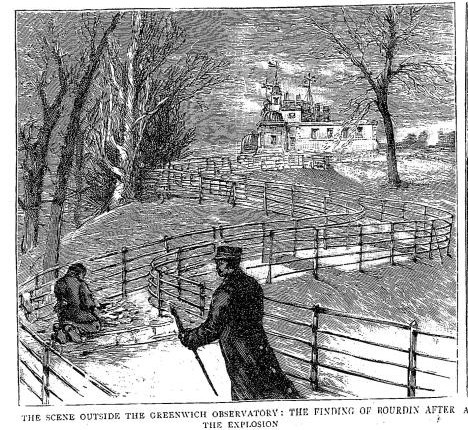
I missed the anniversary by a day but I thought I’d pass on a fascinating but very sad little bit of history. One hundred and twenty years ago yesterday, on February 15th 1894, a 26-year old Frenchman by the name of Martial Bourdin blew himself up near the Royal Observatory in Greenwich. His death seems to have been an accident caused by the bomb he was carrying going off prematurely. It is not really known either whether the bomb was meant for the Royal Observatory or somewhere else. Anarchist attacks involving bombs were not uncommon in the 1890s and the range of targets was very wide.
Greenwich_Observatory_Bomb

Bourdin was found alive, though very seriously injured, by people who heard the blast. Though able to speak he did not offer any explanation for what had happened. He died about half an hour later.

This sad and perplexing story inspired Joseph Conrad‘s famous novel The Secret Agent. Conrad added an “Author’s Note” to the manuscript of his book:

The attempt to blow up the Greenwich Observatory: a blood-stained inanity of so fatuous a kind that is is impossible to fathom its origin by any reasonable or even unreasonable process of thought. For perverse unreason has its own logical processes. But that outrage could not be laid hold of mentally in any sort of way, so that one remained faced by the fact of a man blown to pieces for nothing even most remotely resembling an idea, anarchistic or other. As to the outer wall of the Observatory, it did not show as much as the faintest crack.

We’ll never know what Bourdin’s motivations were; perhaps he didn’t really know himself. He is usually described as an “anarchist” although that term describes such a wide spectrum of political beliefs that it doesn’t really explain Bourdin’s actions; not all anarchists embrace violence and aggression, for example, although some – such as the members of Class War – clearly do. At one end of the anarchist spectrum there are the violent thugs who are nothing more than the mirror image of fascism and at the other there are reasonable intelligent people who simply don’t believe in hierarchical structures.

Brighton has its share of anarchists and the thing that’s most noticeable about them to an outsider like me is their conformity; the dress code is apparently very strictly enforced. The obvious irony aside, this suggests to me that much of the attraction of being an anarchist is not really the existence of a compelling political philosophy, but simply to fulfill the need to belong to something.

The main thing that occurred to me yesterday while I was reading about the Greenwich Observatory bomb plot concerns the implications of the location. If the Royal Observatory was the intended target then why was it so? The simple answer is that a core belief for most varieties of anarchist is their opposition to “the State”. A powerful symbol of the British state in 1894 was the Royal Navy; it was Britain’s maritime traditions that led to the founding of the Royal Observatory in the first place and most of the work carried out there involved accurate positional measurements designed to help with navigation. Or maybe it was to do with the role of the Observatory in defining the time? Insofar as acts like this make any sense at all, these seem reasonable interpretations. 

I’m tempted to suggest that the adoption of Greenwich as the Prime Meridian in 1884 may have given a young Frenchman additional grounds for resentment..

A different answer from the suggestion that it was an anti-establishment gesture stems from  the conflict between anarchism and the nature of scientific knowledge. Anarchists usually express their beliefs in terms of the desire to make society more “equal” and “democratic”, so that decisions should be made collectively for the common good. I’m happy with that line of argument, and agree that we should all enjoy equal rights versus the government and other institutions, and in relation to one another. However, having equal rights does not mean having equal knowledge and it doesn’t mean that any person’s opinion about anything is as good as anyone else’s. What I mean is that there are scientific experts, and the knowledge they possess has demonstrable value.

The approach of some to this challenge is simply to deny the value of scientific knowledge, and assert instead that it’s just a social construct like anything else. I am aware of a number of so-called social scientists at the University of Sussex and elsewhere who hold this view; my usual response is to ask them whether they regard witchcraft or crystal healing as equal to orthodox medicine.

CLARIFICATION: Please note I do not mean to imply that all social scientists hold the opinions described above. I’m fully aware that they are fringe views. The phrase “so-called social scientists” does not refer to all social scientists, just the fringe in much the same way I’d use “so-called geographers” to describe the Flat Earth Society.

I’m not trying to suggest that members of the Department of Sociology are plotting to blow up the Astronomy Centre! What I do think that while we should always strive to be as democratic as possible there are always limits, not just because of what is practically possible but also what is socially desirable. Any organization in which everyone votes about every decision that has to be made would struggle to function at all. We have to find ways of working that make best use of the different skills and knowledge we all possess.

A constructive approach is to argue that if we are to build  a more democratic society it is first necessary to greatly increase the level of scientific literacy in the population, so that more people can make informed decisions about the big issues facing the future, such as how we fulfill our energy requirements for the next 30 years and how we cope with global warming. That will not be an easy thing to do given the dearth of scientists in Parliament and in the media, but that’s not an argument for not trying.

Symptomatic of the widespread rejection of science among the politically disaffected is the lamentable state of Green politics in the United Kingdom. In my opinion there is huge potential for a scientifically-informed political movement focussed on environmental issues. Unfortunately the current Green Party is anti-science to the core, which would doom it to perpetual marginalization even without the loss of credibility stemming from the childish antics of the only Green MP, Caroline Lucas. I know that many will argue with me about whether the Green Party should be included in “The Left”, but since both Labour and Conservative parties now belong to the Centre-Right it seems a sensible classification to me.

It hasn’t always been like this. As Alice Rose Bell pointed out in a Guardian piece some time ago, there have been examples of constructive engagement between science and left-wing politics. This seems to me to have largely evaporated. I don’t think that’s so much because scientists have rejected the left. It’s more that the left has rejected science.
More Cuts to University Funding

Posted in Education, Politics, Science Politics with tags , , , , , , on February 11, 2014 by telescoper

Grim news arrived yesterday with the announcement by the Department of Business, Innovation and Skills of further deep cuts in funding for Higher Education in England. This announcement has been delayed due to internal wrangling over the allocation of funds but in the end the grant letter to HEFCE makes little attempt to sugar the pill:

The settlement will mean reductions in HEFCE funding for higher education institutions in 2014-15 and again in 2015-16 beyond those accounted for by the switch to publicly funded tuition fees. The Government has asked HEFCE to deliver the reductions in ways which protect as far as possible high-cost subjects (including STEM), widening participation (which is funded via the HEFCE Student Opportunity allocation), and small and specialist institutions.

The science budget is, of course, “ring-fenced” which means that recurrent funding for that is maintained at £1,573 million, the same cash levels as 2013-14. This has, for example, translated into the expected flat cash settlement for the Science & Technology Facilities Council (STFC), although there has been some rejigging of the way this money is allocated within STFC, and an apparent increase in funds available for international subscriptions. At least this should unblock the numerous programmes in STFC and elsewhere in the Research Councils that have been on hold pending the final budget allocations.

That said, the overall picture looks very bleak for Higher Education. The really important figure for HEFCE is buried in Annex 2 of the latest grant letter, which reveals that, including the ring-fenced funds, HEFCE will have just £4,091 million to allocate in 2014/15. The corresponding figure for the current year, 2013/14, was £5,014 million. That’s a cut in cash terms of an eye-watering 18.4%.

The scale of the cuts makes it even more likely that if they continue there will be very little money available for HEFCE to allocate as a result of the 2014 Research Excellence Framework, in which case the vast expenditure across the sector preparing for that exercise may will have been wasted too.

For the time being, however, it seems that research has been spared the axe. The bulk of the cuts will therefore fall on teaching grants. HEFCE has been instructed to try to protect STEM subjects as it cuts expenditure on teaching, but will it be able to? The extra funds that have previously supplemented tuition fees have been steadily whittled away anyway, so expensive subjects like Physics only get about £1000 per year more than Arts subjects. There is already a strong incentive in the current funding model for universities to expand cheap subjects. That pressure will only increase with this new settlement.

The last paragraph of the grant letter says:

We recognise that our universities are one of our most valuable national assets. Higher education transforms people’s lives through excellent teaching and transforms society through research and the application of knowledge. The Government’s reforms have laid the foundations for a more securely funded, stronger, more confident and more responsive higher education sector. We will continue to work with the Council and the sector to communicate the enduring value of higher education to potential students and the wider world.

I’m sure readers of this blog will forgive me if I suggest that these words are rendered meaningless by the scale of the cuts announced in the grant letter. If the government really regarded our universities as “valuable national assets” it would be increasing investment in them, not cutting it. What worries me most is that these cuts will never be reversed, whatever the complexion of the next government as there seems to be more enthusiasm across the political spectrum for continued cuts than for investment in the future education of our young people. I’m increasingly ashamed of the legacy being left by my own generation.

A Partly Political Message

Posted in Politics on February 1, 2014 by telescoper

You may decide for yourself who this is aimed at!


40 years since the beginning of the ‘three day week’

Posted in History, Politics with tags , , , on January 4, 2014 by telescoper

Is it really 40 Years ago?
I wonder how many of you are old enough to remember the “Three Day Week”? I am. In fact I remember sitting my 11+ examination right in the middle of the period (from January to March 1974) in which electricity supplies across the UK were restricted to three days per week. Although it meant reading books by candlelight, it wasn’t as bad as it may sound to younger readers because we didn’t have that many electrical gadgets in those days and at least our house was heated by coal, not electricity. I dread to think what would happen nowadays if we should experience  problems with fuel supplied similar to those caused by the Oil Crisis of 1974. But such an event is not altogether impossible…

hatfulofhistory's avatarNew Historical Express


This week marks the 40th anniversary of the beginning of the ‘three day week’, which lasted from 1 January to 6 March 1974. The ‘three day week’ was an initiative by the Heath Government to avoid the stand-still of Britain’s industry in response to the Oil Crisis of late 1973 and the threat of a strike by the National Union of Mineworkers (who were on a ‘work to rule’ basis at the time). It involved cutting electricity supplies to three consecutive days per week to conserve coal stocks, which was threatened by a strike by mineworkers.

A search of the digitised Cabinet Papers available through the National Archives show how the Heath Government approached the looming threat of a strike by the NUM and the energy crisis faced by Britain in 1973-74. One Cabinet meeting from 20 December, 1973 outlined the problem facing the Heath Government and the…

View original post 1,175 more words