Archive for the Politics Category

EUROPE’S NEW FAULTLINE

Posted in Politics with tags , , on May 23, 2014 by telescoper

Perceptive analysis of the rise of UKIP et al….

Kenan Malik's avatarPandaemonium

The Front National is expected to win next week’s European election in France; UKIP may well do so in Britain. Both parties combine a visceral hostility to immigration with an acerbic loathing of the EU, a virulent nationalism and deeply conservative views on social issues such as gay marriage and women’s rights. The problems that such parties pose for mainstream politics goes, however, far beyond the odiousness of their policies. What their success expresses is the redrawing of the political map in Europe, and in ways in which mainstream parties often do not understand. The new populists seem to thrive on different political rules to mainstream parties.

Take UKIP. The electoral threat it poses to both Tory and Labour has in recent weeks led to a fierce assault from mainstream politicians of all hues and from the media. UKIP leader Nigel Farage has been accused of misusing his expenses and…

View original post 1,527 more words

Your Chance to Influence UK Government Investment in Science

Posted in Education, Finance, Politics, Science Politics with tags , , , , on May 4, 2014 by telescoper

A recent piece of bloggery by esteemed Professor Jon Butterworth 0f the Grauniad reminded me that an important government consultation has just opened. In fact it opened on 25th April, but I neglected to post about it then as I was on my Easter break. I’m now passing it on to you via this blog, by way of a sort of community service.

Anyway, the consultation, which is being adminstered through the Department of Business Innovation and Skills, can be found here; there’s a large (110 page) document as well as information on how to respond. Basically about £5.8 billion in capital expenditure has been set aside for science research, and the government is asking how it should be divvied up. Such funds could be used to build big ticket items such as new telescopes, particle accelerators, lasers or other infrastructure including new laboratory buildings. It has to be capital, though, which means it can’t be used on staffing for such facilities that are funded. You might argue that this is a weakness (because ultimately science is done by people not by facilities) but, on the other hand if the government stumps up additional money for capital that might free up funds for more people to be employed.

Anyway, do read the consultation document and submit your responses. You could do a lot worse than reading Jon Butterworth’s commentary on it too. The deadline is some way off, July 4th to be exact, but this is very important so you should all get your thinking caps on right away.

One thing I’ll be including in my response concerns funding for university laboratories. The funding body responsible for English universities, the Higher Education Funding Council for England (HEFCE), is currently underfunding STEM subjects across the country. I’ve blogged about this before so I won’t repeat the argument in detail, but severe reductions in the unit of resource applied to laboratory-based subjects have meant that the new tuition fee regime does not provide anything like sufficient income to cover the costs of, say, physics undergraduate teaching. All students pay a flat-rate fee of £9K across all disciplines (including arts, humanities and science subjects) but science subjects only get £1.4K per student on top of this. The withdrawal of capital allowances has also made it very difficult for universities to invest in teaching laboratory space.

The cost of educating a physics student is actually about twice that of educating a student of, say, English, so this differential acts as a deterrent for universities to expand  STEM disciplines. Shortage of teaching laboratory space is a major factor limiting the intake of students in these areas, whereas other disciplines are able to grow without restriction.

So my vote will go for a sizeable chunk of the £5.8 billion capital  to be allocated to improving, refurbishing, expanding and building new teaching laboratories across all STEM disciplines to train the next generation of scientists and engineers that will be vital to sustain the UK’s economic recovery.

I’d be interested in people’s views about other aspects of the consultation (e.g. what big new facilities should be prioritized). Please therefore feel free to use the comment box, but not as a substitute for participating in the actual consultation.

Over to you!


On the Birth of his Son

Posted in Poetry, Politics with tags , , on May 2, 2014 by telescoper

Families, when a child is born
Want it to be intelligent.
I, through intelligence,
Having wrecked my whole life,
Only hope the baby will prove
Ignorant and stupid.
Then he will crown a tranquil life
By becoming a Cabinet Minister.

by Su Shi (1037-1101); he is generally viewed as the greatest poet of the Sung dynasty in China and was also known as Su Dong-po or Si Tung-p’0.


On the Buses in Brighton and Cardiff

Posted in Biographical, Politics with tags , , , on May 2, 2014 by telescoper

Recently there was an Emergency General Meeting of the University of Sussex Student Union to discuss rises in bus fares in Brighton & Hove. I was a bit surprised at this because, although the prices charged by the Brighton & Hove Bus Company did go up on 13th April, they seemed to me to be quite cheap, at least given the general cost of living in Brighton. I should add that I use the bus every day to travel to and from work.

Caroline Lucas (MP for Brighton Pavilion) chipped in to say that the fare rise justified Green Party policy of taking buses back under the control of local councils. Given the disastrous management of Brighton & Hove’s  Recycling and Refuse operation by Mrs Lucas’ colleagues in Brighton & Hove Council, I think the least said about that idea the better.

Anyway, out of interest, I decided to check the relative prices of bus tickets in Brighton & Hove relative to the city in which I used to live, Cardiff. That’s of interest for two reasons: (a) the general cost of living in Cardiff is very much lower than it is in Brighton (as someone who’s just moved here I can vouch for this); and (b) Cardiff Bus (or, if you prefer Bws Caerdydd) is one of the very few bus services in the United Kingdom was never privatised. While most local bus operations were taken over by private operators during the Thatcher era, but Cardiff Bus remains entirely owned and managed by Cardiff City Council.

It is very difficult to do a like-for-like comparison of fares, because Brighton & Hove Bus covers a much larger area (including Eastbourne, which is 22 miles from Brighton) and many discounted tickets offer unlimited travel within that. Also, the fare to Falmer from Brighton is most relevant for students and it’s not obvious what to compare that with in Cardiff. Since the distance from Brighton to Falmer is about 5 miles, but Cardiff University is right in the city centre, I’ve included a fare from Cardiff to Barry (also about 5 miles) for comparison as that’s the nearest fare I could find; the time for each journey is about 20 minutes.

Fare Type Brighton Cardiff
Short Hop £1.80 £1.80
~5 miles from City £2.00 £2.50
Day Rider (bought on bus) £4.70 £4.90
Day Rider (phone or card) £4.10 £4.70
7 Day Saver £18 £19
1 Month Saver £66 £66
Annual Saver £510 £485

I’ve only included the full adult fare here; discounted tickets for students are available in both cities. In fact the annual saver ticket for students in Brighton is £365. I use a 3-month saver which costs me £168, which I regard as very good value for money; the cost of this ticket for a student is only £90, which is a bargain!

Clearly, then, despite the recent price rises, Brighton & Hove Bus Fares are actually if anything cheaper than Cardiff, at least when you take into account the much bigger area covered by the saver tickets.

I should also mention that Brighton’s bus drivers give change for tickets bought on the bus whereas Cardiff’s demand the exact fare only…

I think I’ve made my point. I also checked Nottingham’s bus fares (as I’ve also lived there). A comparison is more difficult in this case because of the different fare structure, but as far as I can tell it’s broadly in line with Brighton.


The Trouble With Brighton’s Roads..

Posted in Biographical, Brighton, Politics with tags , , , , on April 26, 2014 by telescoper

I travelled back to Brighton yesterday after taking a short break in Wales over Easter. To occupy myself on the train journey back I was, as usual, messing about on Twitter as a result of which I discovered that the main road along Brighton’s seafront had been closed. The reason for this – and the ensuing traffic chaos in the City Centre – was that the main A259 had partially collapsed. My heart sank at the thought of the problems I might have getting home from the station, but in fact by the time I got there – just after seven in the evening – the worst of the congestion seemed to have cleared and I got a bus home without any difficulty or delay.

When I walked past the spot earlier today I found that it wasn’t as dramatic as I’d been led to believe:

Hole_in_Road

There isn’t actually a hole as such, just a couple of very wonky pavements either side of a section of road that’s in a very poor state of repair. In that respect it’s no different from most of Brighton’s streets.

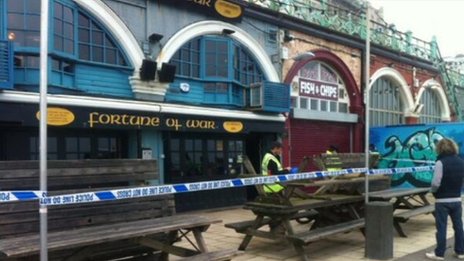
If you don’t know the area concerned, just at the bottom of West Street, you won’t know that this section of the A259 (King’s Road) runs above the a series of arched underground structures occupied by various shops and pubs. In fact the collapse happened inside a pub called the Fortune of War, when some workmen discovered several tons of rubble had fallen down from the roof above. Fortunately, no-one was hurt.

This is the view at beach level; the King’s Road runs above the pub, behind the iron railings at the top of the picture.

The Fortune of War Pub (Credit: BBC)

The Fortune of War Pub (Credit: BBC)

One lane of the A259 is currently closed and a contraflow is in operation. Given that it is at the best of times a very busy road this, and the diversions that have been placed elsewhere to ease traffic on it, is set to cause congestion for some time to come, probably several weeks.

The problem is obviously that the structures underneath the road were never designed to carry the weight of traffic that they are now expected to support. Brighton and Hove Council have been spending money on extensive roadworks elsewhere in the City but seem to have been reluctant to perform reinforcing work on this crucial route. There’s already a political row brewing about this.

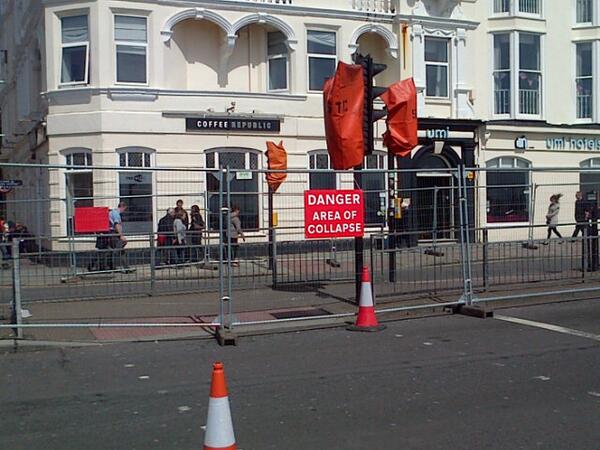
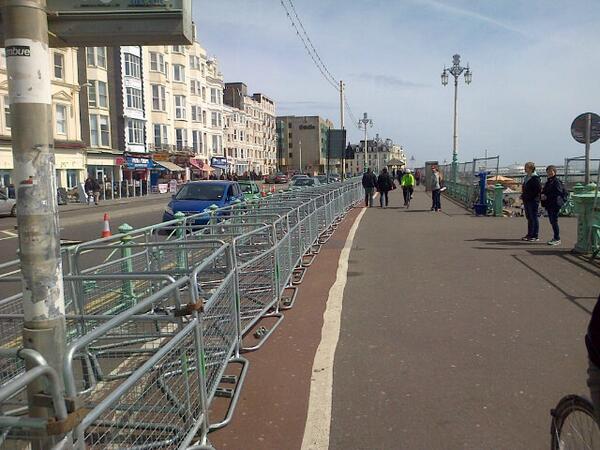
Here’s another picture of the seafront:

EDL_route

The barricades you see are nothing to do with with subsidence, but are there for tomorrow’s “March for England”, the annual attempt by the gang of Neo-Nazi thugs called the EDL to stir up trouble in Brighton. Presumably the fences are intended to separate the EDL from human beings. The collapsed road was to have been part of the route, but presumably alternative arrangements have been made. I would have preferred the road closure to have been used as an excuse to cancel the march altogether actually. I’d rather have no road at all than one filled with such creatures.

I’m very worried about tomorrow. I despise the EDL, but I strongly believe that the best way to deal with people like that is to make sure you don’t give them what they want. They’re clearly coming to Brighton for a fight, so the best approach is to exercise restraint. Unfortunately, there are extremists on the other side of the political spectrum who want a fight just as much as the EDL do. It’s all rather pathetic, if you ask me. Anyway, I’ll be avoiding any aggro by heading up to campus in the morning and catching up on some of the things I’ve missed while I’ve been away over the last week or so…


The Stifling Effect of REF Impact

Posted in Education, Politics with tags , , , on April 22, 2014 by telescoper

Well, I’m back to civilization (more or less) and with my plan to watch a day of cricket at Sophia Gardens thwarted by the rain I decided to pop into an internet café and do a quick post about one of the rants that has been simmering on the back burner while I’ve been taking a break.

Just before the Easter vacation I had lunch with some colleagues from the Department of Physics & Astronomy at the University of Sussex. One of the things that came up was the changing fortunes of the department. After years of under-investment from the University administration,  it was at one time at such a low ebb  that it was in real danger of being closed down (despite its undoubted strengths in research and teaching).  Fortunately help came in the form of SEPnet, which provided funds to support new initiatives in Physics not only in Sussex but across the South East. Moreover, the University administration had belatedly realized that a huge part of the institutional standing in tables of international research rankings was being generated by the Department of Physics & Astronomy. In the nick of time, the necessary resources were invested and the tide was turned and there has been steady growth in staff and student numbers since.

As Head of the School of Mathematical and Physical Sciences I have had to deal with the budget for the Department of Physics & Astronomy. Just a decade ago very few physics departments in the UK were  financially solvent and most had to rely on generous subsidies from University funds to stay open. Those that did not receive such support were closed down, a fate which Sussex narrowly avoided but which befell, for example, the physics departments at Reading and Newcastle.

As I blogged about previously, the renaissance of Sussex physics seems not to be unique. Admissions to physics departments across the country are growing at a healthy rate, to the extent that new departments are being formed at, e.g. Lincoln and Portsmouth. None of this could have been imagined just ten years ago.

So will this new-found optimism be reflected in the founding of even more new physics departments? One would hope so, as I think it’s a scandal that there are only around 40 UK universities with physics departments. Call me old-fashioned but I think a university without a physics department is not a university at all. Thinking about this over the weekend however I realized that any new physics department is going to have grave problems under the system of allocating research funding known as the Research Excellence Framework.

A large slice (20%) of the funding allocated by the 2014 REF will be based on “Impact” which, roughly speaking, means the effect the research can be demonstrated to have had outside the world of academic research. This isn’t the largest component – 65% is allocated on the basic of the quality of “Outputs” (research papers etc) – but is a big chunk and will probably be very important in determining league table positions. It is probably going to be even larger in future versions of the REF.

Now here’s the rub. When an academic changes institution (as I have recently done, for example) he/she can take his/her outputs to the new institution. Thus, papers I wrote while at Cardiff could be submitted to the REF from Sussex. This is not the case with “impact”. The official guidance on submissions states:

Impact: The sub-panels will assess the ‘reach and significance’ of impacts on the economy, society and/or culture that were underpinned by excellent research conducted in the submitted unit, as well as the submitted unit’s approach to enabling impact from its research. This element will carry a weighting of 20 per cent.

The emphasis is mine.

The period during which the underpinning research must have been published is quite generous in length: 1 January 1993 to 31 December 2013. This is clearly intended to recognize the fact that some research take a long time to generate measurable impact. The problem is that the underpinning research must have been done within the submitting unit; it can’t be brought in from elsewhere. If the unit is new and did not exist for most of this period,then it is much harder to generate impact no matter how brilliant the staff it recruits. Any new departments in physics, or any other subject for that matter, will have to focus on research that can generate impact very rapidly indeed if it is to compete in the next REF, expected in 2018 or thereabouts. That is a powerful disincentive for universities to invest in research that may take many years to come to fruition. Five years is a particularly short time in experimental physics.


Bearded Bishop Brentwood welcomed but too late for Beard of Spring poll

Posted in Beards, Biographical, Football, Politics on April 15, 2014 by telescoper

I’m still way behind John Brayford (who he?), but there’s definitely signs of a bounce! The Deadline is 19th April. Vote for me!


kmflett's avatarKmflett's Blog

Beard Liberation Front
PRESS RELEASE 14th April
Contact Keith Flett 07803 167266
Bearded Bishop Brentwood welcomed but too late for Spring Beard poll

The Beard Liberation Front, the informal network of beard wearers that campaigns against beardism, has welcomed the news that the Pope on Monday appointed Fr Alan Williams FM as the Bishop of Brentwood but say that his appointment is too late for inclusion on the Beard of Spring 2014 poll which concludes on Friday.

The campaigners say that they are certain that the distinguished Bishop will feature in future

The big issue in the days left for voting is whether current leader Sheffield United footballer John Brayford did enough in his team’s defeat to Hull in Sunday’s FA Cup semi-final to take the title or whether challengers such as cosmologist Peter Coles and Editor of the I Paper Olly Duff can catch him

The Beard of Spring…

View original post 136 more words

Tuition Fees, Ponzi Schemes and University Funding

Posted in Education, Finance, Politics with tags , , on March 30, 2014 by telescoper

Last week the Higher Education Funding Council for England (HEFCE) finally released information on allocations for 2014/15. As expected, there are large cuts in recurrent grants pretty much across the board (a full table can be found here).  These cuts reflect the fact that government funding for teaching in many subjects is being progressively replaced by tuition fee income in most disciplines, the prominent exception being STEM subjects, which continue to attract a (small) element of grant support in addition to the £9K fees.  Grants for research are largely unchanged for the time being; the big upheaval there will happen when the outcome of the Research Excellence Framework is applied, from 2015/16 onwards.

If you look at the table you will see that some big research universities have relatively small cuts, especially if they focus on STEM disciplines; the obviously example is Imperial College which has a cut of only 3%. Typical Russell Group universities seem to be getting cuts of around 15%. My own institution, the University of Sussex, has been handed a cut of 24%, which reflects the fact that a large majority (greater than 75%) of students here are doing non-science subjects. Universities with less research income and a higher concentration on Arts & Humanities subjects are having to bear cuts of up to 60%.  These reductions are larger than anticipated as a result of the government’s decision to increase the total number of places by about 30,000 this year.

These numbers look alarming, but in most cases, including Sussex, the net income (FEES+GRANT) will actually go up next year, as long as the institution manages to recruit a sufficient number of students. The ability of a university to generate sufficient income to cover its costs has always depended on its ability to attract students, but this has previously been managed using a student number control, effectively applying a cap on recruitment to institutions that might otherwise corner the market.   This year some institutions who failed to recruit strongly have had their cap lowered, but worse is in store from 2015/16 as the cap will be lifted entirely, so that there will effectively be a free market in student recruitment. I sure I’m not the only person who thinks the likely outcome of this change will be a period of chaos during which a relatively small number of institutions will experience a bonanza while many others will struggle to survive.

As if this weren’t bad enough, there is also the growing consensus that the current fee regime is unsustainable. Revised estimates now suggest that about 45% of graduates will never pay back their tuition fees anyway. If this percentage grows to about 50% – and I am very confident that it will – then the new tuition fee system will end up costing the Treasury (i.e. the taxpayer) even more than the old regime, while also saddling generations of graduates with huge debts and also effectively removing the sector from public control.

Apparently, the response of the government to the level of default on repayments is to consider increasing fees to a level even higher than the current £9K per annum. It seems to me that the likely consequence of this would simply be to increase the default rate still further, largely by driving UK graduates abroad to avoid liability for paying back their loans, and thus drive the system into runaway instability.

The more one looks at the fees and loans debacle the more it resembles  a Ponzi scheme that’s destined to unravel with potentially catastrophic consequences for England’s universities; note that Wales, Northern Ireland and Scotland are not covered by HEFCE arrangements.

So what can be done?

I’ll assume at the outset that the only really sensible plan – taking the entire system back under public control – is, by the very nature of the British political system, unthinkable.

My first suggestion reflects the fact that I am a scientist and that I think  science education and research properly should be a very high priority for any system of university funding. Whatever is done therefore must address the point I made a post about the threat to STEM subjects presented by HEFCE’s policies the essence of which is that the £9K flat-rate fee across all disciplines does not reflect the true difference in cost of teaching between, say, English and Physics. Differential fees would have a disastrous effect on recruitment into science subjects while the current system underfunds STEM disciplines so severely that it offers a perverse incentive for universities to focus on non-science areas. Under the current system, fees from Arts disciplines are effectively subsidizing science subjects rather than providing education to those paying the fees; in other words, Arts students are being ripped off.

Second, if the taxpayer is going to foot a significant part of the bill for higher education then HEFCE (or whatever organization replaces it in future) must have sufficient clout to manage the sector for the public interest, rather than allow it to be pulled apart by the unfettered application of market forces.

Third, any new system must be designed to reduce the level of graduate debt which, as I’ve mentioned already, simply encourages our brightest graduates to emigrate once they’ve obtained their degree.

I’ve actually never really been opposed to the principle that students who can afford to should contribute at some level to the cost of their education; I have, on the other hand, always been opposed to fees being set at the level of £9K per year. The Labour Party’s suggestion that fees should be cut to £6K would go some of the way to satisfying the third requirement, but would be disastrous unless the cut were offset by increased state funding through recurrent grants. I think a better suggestion would be to cut fees by a greater amount than that if possible, but to have a much bigger differentiation in the unit of resource paid to different subjects. I’d say that the net income per student should be about £15K per annum in STEM subjects, whereas for Arts and Social Sciences £6K probably covers the full cost of tuition.  So if the fee is set at £X across the board, STEM disciplines should receive £(15-X) from HEFCE while Arts subjects get a subsidy of £(6-X).


Countdown to Equal Marriage

Posted in Biographical, LGBTQ+, Politics with tags , , on March 28, 2014 by telescoper


So, from midnight tonight, same-sex couples have the right to marry in England & Wales. Not surprisingly, one of the first gay weddings in the UK will be in Brighton: Andrew Wale and Neil Allard (below) will marry just a few minutes after midnight:

Neil-Allard-left-and-Andrew-Wale-3155478

Nice beards! I’d like to take this opportunity to send my very best wishes to Andrew and Neil and indeed to everyone (straight or gay) taking the plunge this weekend.

I find the fact that this has become reality absolutely amazing. When I came to the University of Sussex as a graduate student in 1985, Brighton was one of the most gay-friendly cities in the UK, if not the world. However, the veneer of tolerance was really very thin. Homophobic prejudice was still commonplace, and it was by no means uncommon for that to turn into violence, as I know to my own cost. The Local Government Act of 1988 included Section 28, which enshrined anti-gay attitudes in law. I would never have imagined at that time that, just 25 years later, a law would be passed allowing people of the same sex to marry. It still seems barely comprehensible that attitudes can have changed so much in the second half of my lifetime. Equality in marriage doesn’t mean equality in everything, of course, and prejudice obviously hasn’t vanished entirely, but it’s a start.

And what’s this tripe about same-sex marriage “threatening” of “devaluing” traditional marriage? Is the function of marriage simply to make married people feel superior to those who aren’t allowed to be married? That’s what that argument sounds like to me. If that’s what it’s for I think the state should withdraw legal recognition from all forms of marriage and let us all be treated equally by the law, as individuals.

For those who don’t approve of the change in the law, it’s all actually very simple. If you don’t approve of same-sex marriage, don’t marry someone of the same sex.

It’s all come a bit too late for me to get married. I think I’m destined to remain forever an ineligible bachelor. I will however be spending this weekend wandering around Brighton randomly asking men if they’ll marry me. This isn’t because of the change in the law. It’s what I do anyway…

I hope at least I’ll get invited to quite a few weddings in the near future. I think there’s going to be quite a lot of catching up going on…

Postcard from Cardiff

Posted in Biographical, Cardiff, Politics, Rugby with tags , , , on March 16, 2014 by telescoper

So here I am in Cardiff for the weekend, relaxing after a very busy and stressful week. It’s nice to have the option to get away like this, especially in the spring sunshine, so I’m glad I kept the Cardiff house going rather than try to sell it the moment I got the job at Sussex University. I have been working very long hours recently and with another month to go before the end of teaching term, I think I need to make better use of the weekends if I’m going to avoid a state of complete exhaustion.

On Friday I attended a meeting of the Council of the Royal Astronomical Society (of which I am an elected member) followed by a very interesting Open Meeting and a nice dinner with the RAS Club. After all that I took the late train to Cardiff instead of going back to Brighton.

During the journey I thought quite a lot about Tony Benn; the news of his death at the age of 88 was announced on Friday morning. Although I didn’t agree with his political views on some things, he was a person I admired enormously and I am very sad that he is no more.

I only ever met Tony Benn once, many years ago, as it happens, on a train from Brighton to London. It was one of those old-fashioned carriages, divided into compartments each with a door. I had almost missed the train and was so flustered when I got on that it took me some time to recognize the gentleman opposite who was just lighting his pipe.

I summoned up the nerve to speak, shook his hand, and introduced myself. We were the only occupants of the carriage and we talked for the entire journey – an experience I’ve never forgotten. In person Tony Benn was wonderful: charming, kindly, impeccably polite and above all absolutely fascinating to talk to. As I recall it, I did most of the listening. Not that I minded. I’m a man who likes talking to a man who likes to talk..

People also forget that Tony Benn was one of the very few politicians to champion LGBT rights. It’s now a fashionable thing, but it wasn’t then back in the dark days of Section 28.

So I’d just like to record a little personal farewell to Tony Benn. There’s nobody of his stature in current British politics, and none whose company I’d like to spend a train journey in, either.

Yesterday I was out and about in sunny Cardiff running various undemanding errands, in the course of which I came across an internet cafe. I’ve never actually used one of those before, and was quite surprised that an hour’s access cost just £1. I took the chance to sit down for a bit and wrote yesterday’s blog post there.

Saturday was the last day of the Six Nations rugby and Wales were hosting Scotland. The two sets of supporters were mingling and imbibing throughout the city. When it came to the match, Wales thrashed Scotland 51-3.

Earlier England had comfortably beaten Italy so were top of the table, but would only win the competition if Ireland lost the last game to France in Paris. It was an exciting finale, with stout Irish defence enabling them to cling on to a lead of just two points. So well played Ireland, who probably deserved the title, but also good signs for England whose young side have performed admirably this year. Better luck next year?

At least English supporters can now enjoy one of their favourite pastimes: blaming everything on the French.

It’s warm and sunny again today so I think I’ll take another walk around. I really miss Cardiff, but one has to follow one’s star wherever it leads.