Archive for the Politics Category

The Welsh University Funding Debacle

Posted in Education, Finance, Politics with tags , , , , on September 4, 2013 by telescoper

Although I no longer work in Wales, I still try to keep up with developments in the Welsh Higher Education sector as they might affect friends and former colleagues who do. That’s why my eye was drawn this morning to a news item on the BBC website about the effect of the Welsh Government’s policy of giving Welsh students bursaries to study at English universities. The gist of the argument is that:

For every Welsh student that goes to university across the border it costs the Welsh government around £4,500.

It means this year’s 7,370 first-year students from Wales who study in other parts of the UK could take more than £33m with them. Including last year’s students, the total figure is over £50m.

I did in fact make exactly the same point over three years ago on this blog, when former Welsh Education Minister Leighton Andrews announced that students domiciled in Wales would be protected from then (then) impending tuition fee rises by a new system of grants. In effect the Welsh Assembly Government would pick up the tab for Welsh students; they would still have to pay the existing fee level of £3290 per annum, but the WAG would pay the extra £6K. I wrote in May 2010:

This is good news for the students of course, but the grants will be available to Welsh students not just for Welsh universities but wherever they choose to study. Since about 16,000 Welsh students are currently at university in England, this means that the WAG is handing over a great big chunk (at least 16,000 × £3000 = £48 million) of its hard-earned budget straight back to England. It’s a very strange thing to do when the WAG is constantly complaining that the Barnett formula doesn’t give them enough money in the first place.

What’s more, the Welsh Assembly grants for Welsh students will be paid for by top-slicing the teaching grants that HECFW makes to Welsh universities. So further funding cuts for universities in Wales are going to be imposed precisely in order to subsidise English universities. This is hardly in the spirit of devolution either!

English students wanting to study in Wales will have to pay full whack, but will be paying to attend universities whose overall level of state funding is even lower than in England (at least for STEM subjects whose subsidy is protected in England). Currently about 25,000 English students study in Wales compared with the 16,000 Welsh students who study in England. If the new measures go ahead I can see fewer English students coming to Wales, and more Welsh students going to England. This will have deeply damaging consequences for the Welsh Higher Education system.

It’s very surprising that the Welsh Nationalists, Plaid Cymru, who form part of the governing coalition in the Welsh Assembly, have gone along with this strange move. It’s good for Welsh students, but not good for Welsh universities. I would have thought that the best plan for Welsh students would be to keep up the bursaries but apply them only for study in Wales. That way both students and institutions will benefit and the Welsh Assembly’s budget will actually be spent in Wales, which is surely what is supposed to happen…

Well, the changes did go ahead, and now the consequences are becoming depressingly clear.

The figures in the BBC story suggest something that I’ve also worried about, which is that the WAG policy might actually increase the number of Welsh students deciding to study in England, while also decreasing the number of other students deciding to study in Wales. Why would this happen? Well, it’s because, at least in STEM subjects, the tuition fee paid in England attracts additional central funding from HEFCE. This additional resource is nowhere near as much as it should be, but is still better than in Wales. Indeed it was precisely by cutting the central teaching grant that the Welsh Government was able to fund its bursaries in the first place. So why should an English student decide to forego additional government support by choosing to study in Wales, and why should a Welsh student decide to do likewise by not going to England?

I really hope the Welsh Government decides to change its policy. There didn’t seem to be any chance of a U-turn while Leighton Andrews remained in charge, but now that he’s gone perhaps there’s hope.

HS2 or H2O?

Posted in Finance, Politics, Science Politics with tags , , , on August 26, 2013 by telescoper

Since it’s a Bank Holiday – and a fine and sunny one at that – I’ll restrict myself to a brief post today so I can return to the outside part of the Universe and get a bit of sun while it lasts.

I saw an article in the Observer yesterday about the proposed High Speed 2 rail link (`HS2′) between London and the Midlands. The budget for this project has risen to a whopping £42.6 billion pounds. Another article in today’s Grauniad argues that HS2 is `certainly not for northerners’ benefit’, which is clearly the case because according to current plans it only goes as far as Leeds, which as everyone knows, is in the Midlands.  But  the real point is that I find it extraordinary that  we are  even considering investing such a staggering sum in a new railway with few obvious benefits to anyone other than the lucky company that gets the contract to build it. In the mean time our existing railways will continue to be poorly maintained, shockingly unreliable and of course excruciatingly expensive.

Thinking about the cost of HS2, which had earlier been estimated at a mere £30 billion, reminded me of an old post about renewable energy, and specifically the proposed Severn Barrage, which has an estimated cost somewhere between £10 billion and £35 billlion, but which could generate 2GW average power from tidal energy extracted from plain old H2O,  which is about 6% of the UK’s average demand. Of course there are important environmental issues to be dealt with – no form of electricity generation is free from such concerns – and the power generated by a Severn Barrage would be variable, with peaks not necessarily coinciding with peak demand. At least the variation is predictable, though, which is more than can be said for wind power…

Anyway, let’s suppose for the sake of argument that the price tags on these two projects are both £30 billion. I’d be interested in knowing how many people think, as I do, that £30 billion invested in tidal energy generation would be a far better use of funds than a fast train from London to nowhere interesting.

Science, Fracking and the Balcombization of the Left

Posted in Politics with tags , , , , on August 19, 2013 by telescoper

Well, here’s a find. A rare, peer-reviewed scientific article about hydraulic fracturing. And it’s not behind a paywall! The abstract of the paper, which I’m passing (as with my earlier post) on in the (probably forlorn) hope that it will introduce some rationality into the so-called “fracking” debate, reads:

The widespread use of hydraulic fracturing (HF) has raised concerns about potential upward migration of HF fluid and brine via induced fractures and faults. We developed a relationship that predicts maximum fracture height as a function of HF fluid volume. These predictions generally bound the vertical extent of microseismicity from over 12,000 HF stimulations across North America. All microseismic events were less than 600 m above well perforations, although most were much closer. Areas of shear displacement (including faults) estimated from microseismic data were comparatively small (radii on the order of 10 m or less). These findings suggest that fracture heights are limited by HF fluid volume regardless of whether the fluid interacts with faults. Direct hydraulic communication between tight formations and shallow groundwater via induced fractures and faults is not a realistic expectation based on the limitations on fracture height growth and potential fault slip.

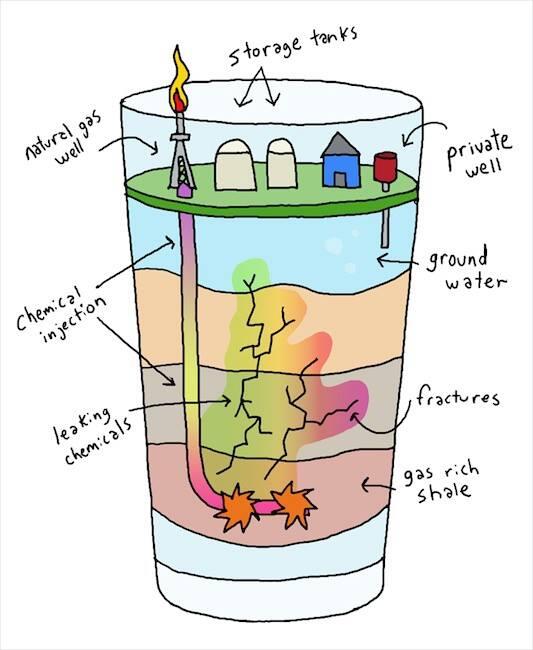
It would be nice if either the media or the protestors at Balcombe made some attempt to discuss the actual science behind fracking, but that seems a forlorn hope. The best I could come up with from the latter is this picture, offered by someone who thinks that anyone in possession of a set of crayons is qualified as a geologist:

BR-KG0SCAAAkSIu

In the interest of balance, here is a link to a blog post on fracking in the USA, the first paragraph of which reads:

For some time now, proponents of the controversial practice of hydraulic fracturing or “fracking” have claimed there was little or no evidence of real risk to groundwater. But as the classic saying goes: “the absence of evidence is not evidence of absence” of a problem. And the evidence that fracking can contaminate groundwater and drinking water wells is growing stronger with every new study.

I encourage you to read it, but if you do please carry on to the comments where you will see detailed counter-arguments.

I do not have a strong opinion either way on fracking. I’d prefer to make a decision as a result of an informed debate based on evidence, but there are clearly people who don’t want that to happen and are instead intent on scaremongering to suit their own ends. It seems to me that the legitimate concerns of sensible people have yet again been hijacked by the small but vociferous mob of “against everything” anarchists who see protest as an end in itself. It’s all so depressingly puerile. There’s no fracking going on in Balcombe anyway!

Why does the Green movement – and the left generally for that matter – have to be so comprehensively anti-scientific? As long as it remains that way it will never be taken seriously.

Fracking Confusion

Posted in Politics, Science Politics, The Universe and Stuff with tags , , , , , , on August 12, 2013 by telescoper

The news on the radio this morning featured a story about the Prime Minister wanting the UK to “get behind” hydraulic fracturing (or “fracking” as it is known for short) , a means of  liberating shale gas that offers the prospect of boosting the UK’s energy supply.

There’s not much sign any “getting behind” happening up the road from here in Balcombe, where a sizable anti-fracking protest has been going on for some time. There’s actually no fracking going on in Balcombe at the moment; the company involved, Cuadrilla Resources, is doing exploratory drilling to look for oil but may apply for a licence to pursue hydraulic fracturing if that is unsuccessful.

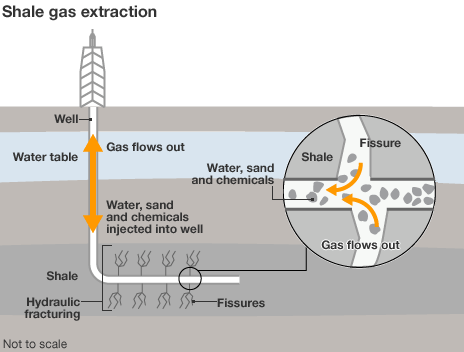
There’s a simple graphic on the BBC website that illustrates how fracking works:

_65309507_shale_gas_extraction464

In simple terms it involves pumping a mixture of water, sand and chemicals into a deposit of shale ato fracture the solid material contained therein and thus liberate the gas. Environmentalists argue that this technique might cause earth tremors and/or contamination of the water supply; advocates of fracking dispute these claims. I’m not sufficiently expert to be able to comment usefully on the arguments about the possible environmental dangers associated with it, so I’d be glad to receive comments via the box below.

One thing I will comment on, though, is the very poor quality of the media reporting on this issue. I’ve yet to see any meaningful attempt to comment on the science involved when surely that’s the key to whether we should “get behind” fracking or not? It struck me that quite a few readers might also be interested but ill-informed about this issue to, so for them I’d recommend reading the Beddington Report, the key findings of which were:

  • The health, safety and environmental risks can be managed effectively in the UK. Operational best practices must be implemented and enforced through strong regulation. Fracture propagation is an unlikely cause of contamination.
  • The risk of fractures propagating to reach overlying aquifers is very low provided that shale gas extraction takes place at depths of many hundreds of metres or several kilometres. Even if fractures reached overlying aquifers, the necessary pressure conditions for contaminants to flow are very unlikely to be met given the UK’s shale gas hydrogeological environments.
  • Well integrity is the highest priority. More likely causes of possible contamination include faulty wells. The UK’s unique well examination scheme was set up so that independent, specialist experts could review the design of every offshore well. This scheme must be made fit for purpose for onshore activities.
  • Robust monitoring is vital. Monitoring should be carried out before, during and after shale gas operations to detect methane and other contaminants in groundwater and potential leakages of methane and other gases into the atmosphere.
  • An Environmental Risk Assessment (ERA) should be mandatory. Every shale gas operation should assess risks across the entire lifecycle of operations, from water use through to the disposal of wastes and the abandonment of wells.
  • Seismic risks are low. Seismicity should be included in the ERA.Seismicity induced by hydraulic fracturing is likely to be of smaller magnitude than the UK’s largest natural seismic events and those induced by coal mining.
  • Water requirements can be managed sustainably. Water use is already regulated by the Environment Agency. Integrated operational practices, such as recycling and reusing wastewaters where possible, would help to minimise water requirements further. Options for disposing of wastes should be planned from the outset. Should any onshore disposal wells be necessary in the UK, their construction, regulation and siting would need further consideration.
  • Regulation must be fit for purpose. Attention must be paid to the way in which risks scale up should a future shale gas industry develop nationwide. Regulatory co-ordination and capacity must be maintained.
  • Policymaking would benefit from further research. The carbon footprint of shale gas extraction needs further research. Further benefit would also be derived from research into the public acceptability of shale gas extraction and use in the context of the UK’s energy, climate and economic policies.

I’m not sure how many anti-fracking activists, or others involved in the Balcombe protest, have read this report.

Anyway, in an attempt to gauge the mood of my totally unrepresentative readership, I thought I’d try a little poll:

And if you have strong opinions, please feel free to use the comments box.

Surplus Value, Exploitation and Scientific Publishing

Posted in Open Access, Politics with tags , , , , on August 11, 2013 by telescoper

The August edition of Physics World – house organ of the Institute of Physics – contains an article about Open Access Publishing which is available online here.  In fact, I get a mention in it:

Another vocal critic of the science-publishing industry has been astronomer Peter Coles from the University of Sussex. “Publishers want a much higher fee than [the real cost of publishing a paper on the Internet] because they want to maintain their eye-watering profit margins, despite the fact that the ‘service’ they provide has been rendered entirely obsolete by digital technologies,” Coles claimed on his blog In the Dark earlier this year. Yet publishers have been fighting back, pointing out that scientists often do not understand how the publishing industry operates and highlighting the many valuable – and expensive – functions they provide to the scientific community. In addition to the often complex process of managing peer review, these include everything from developing and maintaining IT systems to checking papers through plagiarism detection software – none of which comes cheap (see “The value publishers bring”).

Publishers have indeed been fighting back, but you’d expect that of vested interests.  You can read the rest of the article yourself to see if you’re convinced. I’m not. I think it’s a desperate piece of propaganda.

The last comment in the quoted paragraph (in parenthesis) points to a box purporting to explain why scientific journals should be so expensive. The explanations presented in that box  are so obviously  disingenuous that they don’t merit a detailed debunking because the argument can be refuted without any need to refer to the box: note the deliberate confusion between cost (“none of which comes cheap”) and “value” in the last paragraph quoted above.

IOP Publishing (along with  other profiteering organizations of its type) insist that it brings value to scientific papers. It doesn’t. The authors and referees do all the things that add value. What the IOP does is take that value and turn it into its own profits. The fact that enormous profits are made out of this process in itself demonstrates that what the scientific community is being charged is nothing whatever to do with cost.

This reminds me of many discussions I had in my commie student days about surplus value, a concept that I believe was first discussed by Friedrich Engels, but which was explored in great detail by Karl Marx, in Das Kapital. According to the wikipedia page, the term “refers roughly to the new value created by workers that is in excess of their own labour-cost and which is therefore available to be appropriated by the capitalist, according to Marx; it allows then for profit and in so doing is the basis of capital accumulation.”

Engels is quoted there as follows:

Whence comes this surplus-value? It cannot come either from the buyer buying the commodities under their value, or from the seller selling them above their value. For in both cases the gains and the losses of each individual cancel each other, as each individual is in turn buyer and seller. Nor can it come from cheating, for though cheating can enrich one person at the expense of another, it cannot increase the total sum possessed by both, and therefore cannot augment the sum of the values in circulation. (…) This problem must be solved, and it must be solved in a purely economic way, excluding all cheating and the intervention of any force — the problem being: how is it possible constantly to sell dearer than one has bought, even on the hypothesis that equal values are always exchanged for equal values?

Marx’s solution of this economical conundrum was central to his theory of exploitation:

…living labour at an adequate level of productivity is able to create and conserve more value than it costs the employer to buy; which is exactly the economic reason why the employer buys it, i.e. to preserve and augment the value of the capital at his command. Thus, the surplus-labour is unpaid labour appropriated by employers in the form of work-time and outputs.

In this context of academic publishing, the workers are scientific researchers and the employers are the publishers. The workers  not only produce the science in the first place, but also carry out virtually all of the actions that the employers claim add value. The latter are simply appropriating the labour of the former, which is exploitation. It has to stop.

Equal Marriage!

Posted in Biographical, Politics with tags , on July 15, 2013 by telescoper

BPOdpF3CcAAfr5C

I just heard that the Equal Marriage Bill has now passed its Third Reading in the House of Lords – without a vote – and now just requires the Royal Assent to become the Equal Marriage Act, allowing couples of the same sex the right to marry.

I find this quite an amazing thing. When I came to the University of Sussex as a graduate student in 1985, Brighton was one of the most gay-friendly cities in the UK, if not the world. However, the veneer of tolerance was often very thin. Homophobic prejudice was still commonplace, and it was by no means uncommon for that to turn into violence, as I know to my own cost. The Local Government Act of 1988 included Section 28, which enshrined anti-gay attitudes in law. I would never have imagined at that time that, just 25 years later, a law would be passed allowing people of the same sex to marry. It still seems barely comprehensible that attitudes can have changed so much in the second half of my lifetime. Equality in marriage doesn’t mean equality in everything, of course, and prejudice obviously hasn’t vanished entirely, but it’s a start.

It’s probably all come a bit too late for me to get married. I think I’m destined to remain forever an ineligible bachelor,  but I hope at least I’ll get invited to quite a few weddings in the near future. There’s quite a lot of catching up to do…

Can a University be Democratic?

Posted in Education, Politics with tags , , , on July 6, 2013 by telescoper

Today I thought I’d pick up on a topic I mentioned in last week’s post about Simon Fanshawe, about University governance.

The Royal Charter which formed the University of Sussex way back in 1961 includes the following clauses:

1.         By this Charter there shall be constituted and founded a University by the name of ‘The University of Sussex’ (‘the University’).

2.         In this Charter: ‘Council’ means the Council of the University; ‘Regulations’ except when otherwise required by the context, means Regulations made pursuant to this Charter or the Statutes. ‘Statutes’ means the Statutes of the University set out in the Schedule.

3.         The objects of the University shall be to advance learning and knowledge by teaching and research to the benefit of the wider community.

7.         There shall be a Council of the University which shall be the governing body of the University and shall have the custody and use of the Common Seal and shall be responsible for the revenue and property of the University, its conduct and activities, and shall exercise all the University’s powers.

8          There shall be a Senate of the University which shall, subject to the general control and approval of the Council, be responsible for academic standards and the direction and regulation of academic matters.

9.         There shall be a Students’ Union of the University.

This makes it quite clear that  the Senate (on which I happen to sit) is specifically meant to focus on academic matters; see below for a comment on this.  The role of the Student’s Union is not specified at all in this document, although it should be said that there are student members of Senate and Council too.

The reason for including this in a blog post is that it demonstrates an organization formed in this way has to strike a difficult balance between, on the one hand, listening to staff and students when it comes to forming policy and, on the other, having an efficient and effective executive that can implement those policies. There are about 16,000 people working and studying at the University of Sussex (c. 13,000 students and c. 3,000 staff), most of whom are highly intelligent and independent-minded so there’s bound to be a divergence of opinion on almost any topic under discussion. Even if it were possible for everyone to get involved in the University’s governance, it’s inevitable that decisions will be made that run counter to some of the input.

Difficult balances that have to be struck in the governance of any organization, whether religious, administrative, commercial or educational. The Council of the University of Sussex is its supreme governing body and everyone who works here is in some way accountable to it. In turn, Council is accountable to its “stakeholders”, not just funding authorities and students, but the wider world; its Charter states that

The objects of the University shall be to advance learning and knowledge by teaching and research to the benefit of the wider community.

In a nutshell, a University is not a democracy. It can’t be, not unless “democracy” is defined in a very limited way. A university can employ some democratic structures, and may (for many reasons) desire to include as many people as possible in its governance, but in the end this is limited by the need for effective and efficient management. We can – and do – debate where this balance should lie, but anyone who has ever worked in a University will agree that if it were allowed to be run “democratically” by some of academic collective then the result would be a complete shambles. Democracy has to be balanced by the rule of law.

Similar issues apply further down the pecking order. Since I took over as Head of Mathematical and Physical Sciences here earlier this year, I have had a wide range of responsibilities for the School, including its finances, academic matters, and even health and safety. I’m not an autocrat, so I try to do things as democratically as possible within the constraints I have to work, but this democracy is necessarily limited. I like to keep staff informed about and involved in decisions, but I sometimes have to make decisions without any consultation at all. This can be because such a quick decision is required that there is no time to consult widely, or because there is some issue to do with confidentiality which means that it can’t be discussed in an open forum (including, e.g., email). More often, though, it is just because they pay me to be Head of School and its my job to take responsibility so staff working in the School can get on with what they are supposed to do without being inundated with requests for input from me on trivial things.

On the other hand there are things in  MPS that are extremely  democratic compared with other places I’ve worked. We have a  Joint Committee which gives students direct input into various aspects of School life. In particular, the School has ceded part of its building to form Student Spaces and given students a budget to manage them (i.e. choose furniture, equipment, etc). These are extremely popular and no doubt contribute a great deal to our healthy position in the National Student Satisfaction (NSS) Survey. I think it’s great to have students involved in this way, but we have to remember that students are not the only stakeholders in a University; we also have obligations to other bodies whose requirements may run counter to the wishes of the student body.

Anyway, these ramblings are given a bit of topicality by an item in the Times Higher recently about two student representatives on the University of Sussex Senate who resigned in protest against alleged lack of consultation by the University management. I was at the Senate meeting when they resigned, as well as the previous one where there was a lengthy discussion at which they and others were given an extremely good hearing despite the fact that the matter concerned was not to do with academic so wasn’t strictly speaking in the remit of Senate anyway.

Eventually Senate voted and the two students concerned were on the losing side. I’m sad that they subsequently decided to resign from Senate, although to be absolutely factual both were due to be replaced next academic year anyway so it was a pretty empty gesture.

The point is that democracy isn’t just about being given the chance to express your own views. It’s also about acknowledging that others might feel very differently and accepting the decision when it turns out that you lost the argument.

A Bit of Simon Fanshawe

Posted in Biographical, Brighton, Politics with tags , , , , on June 30, 2013 by telescoper

27On Friday I attended a very interesting event on the University of Sussex campus. This was arranged to mark the forthcoming end of the term of office of the current Chair of Council of the University of Sussex, Simon Fanshawe (left). Simon Fanshawe OBE is, of course,  a well-known radio and TV broadcaster, award-winning comedian and co-founder of the campaigning organization Stonewall. He also has an interesting taste in suits, and provided evidence of that in his outfit on Friday. But enough of matters sartorial. Simon has been Chair of Council for six years, and served as a member of Council for as many years before that, so really has contributed a huge amount to the University over that period. I think it’s safe to say that he has had a much higher profile in his role as Chair than most of his counterparts in other UK universities, so the idea of having a special event in his honour was thoroughly well justified.

First we had a series of three short lectures by Sussex on various issues relating to equality and diversity and how their relate to power and governance. More specifically these were talks about female islamic religious leaders, the nature of political corruption and attitudes to it in different countries, and a particularly fascinating talk by Robert Livingston that touched on many things, including how facial features seem to correlate with success in leadership positions.

After that there was a wine reception and a nice dinner with lots of stimulating conversation. For some reason a major topic on my table was bell-ringing, and why English church bells sound so different from those in continental Europe. I wrote some stuff about that years ago, while I was teaching probability, and may blog about it in future. Everyone else seemed to head home via taxi after dinner, but I wobbled off to the bus stop and got the trusty No. 23 back to Kemptown.

Anyway, I may post later on about some things that popped into my mind as a result of the talks and the subsequent discussion and conversation but for the time being I’ll just mention a very tenuous link with Simon Fanshawe that involves taking a little trip down memory lane. The picture below was taken in either 1988 or 1989 (I’m not very good at dates). It shows me and my partner at the time, Roger, preparing to act as volunteer waiters at a fund-raising dinner (somewhere in Lewes if I remember correctly) organized by the Communist Party of Great Britain:

Marxism_today

I wasn’t involved very much in campus politics when I was a graduate student at Sussex (from 1985 to 1988) or a postdoctoral researcher (1988-90) because I found most of it depressingly puerile and short-sighted, that being especially true of the sizable lunatic fringe which also had a disagreeable taste for mindless vandalism. Sadly, times haven’t changed in that respect. I did, however, during that time become an avid reader of magazine called Marxism Today which I thought contained the most incisive political writing of the time and which therefore prompted me to join the CPGB, and eventually became Branch Secretary until I left for London in 1990. Incidentally the Cee-Pee-Gee-Bee decided to dissolve itself as a political party in 1991 and became a sort of leftist think-tank called Democratic Left.

Anyway, the point about that photograph is that the after-dinner speaker on that occasion was none other than Simon Fanshawe, although I doubt if he remembers!

Farewell, then, Leighton Andrews…

Posted in Education, Finance, Politics with tags , , , , , , , on June 27, 2013 by telescoper

Although I no longer live in Wales I couldn’t resist commenting on the resignation, announced on Tuesday, of the Welsh Education Minister, Leighton Andrews. It seems that Mr Andrews was spotted holding a placard protesting against the planned closure of a school, a closure that results from his own policies. Personally, I think that it’s quite an imaginative move for a Minister to campaign against his own policies. It shows an open-mindedness absent in most politicians.

Leighton Andrews will probably be best remembered as the architect of the policy that students domiciled in Wales would be protected from having to pay large tuition fee rise by a system of grants, meaning that the Welsh Assembly will pick up the tab for Welsh students. They will still have to pay the “old”  fee level of £3290 per annum, but the WAG will pay the extra approx £6K charged by most Universities since the fee cap was raised. This is good news for the students of course, but the grants will be available to Welsh students not just for study in Welsh universities but wherever they choose to go. Since about 16,000 Welsh students are currently at university in England, this means that the WAG is handing over a great big chunk (up to 16,000 × £6000 = £96 million) of its hard-earned budget straight back to England. This has always seemed to me a very strange thing to do when the Welsh Government is constantly complaining that the Barnett formula doesn’t give them enough money in the first place.

What’s more, the Welsh Assembly grants for Welsh students are paid for by top-slicing the grants that HECFW makes to Welsh universities. So funding cuts for universities in Wales have been  imposed in order to subsidize English universities. This is hardly in the spirit of devolution either!

English students wanting to study in Wales will have to pay full whack, but will be paying to attend universities whose overall level of state funding is even lower than in England (at least for STEM subjects whose subsidy is protected in England). Currently about 25,000 English students study in Wales, compared with the 16,000 Welsh students who study in England, but I wonder how many of them realize that if they study England their £9K fee attracts an additional investment of £1.5K from HEFCE whereas there is no equivalent central resource supplied by HEFCW if they study in Wales? To put it another way, each £1 of tuition fee paid by a STEM student is worth £1.16 in England, but just £1 in Wales.

The other drastic implication of this policy is that HEFCW will have no money left to fund research via the QR mechanism that pertains in England (at least for the time being). I blogged about this a couple of days ago so won’t say any more today.

I don’t think any of my former colleagues in Cardiff are terribly upset to see Leighton Andrews go, but there is some nervousness about whether the replacement might be even worse. The new Education Minister is Huw Lewis. I wish him well in his new post, and hope he has the courage to question some of the decisions made by his predecessor that have had such a negative effect on education in Wales.

Anyway, in bidding farewell to Leighton Andrews I thought I’d show him all due respect, and do him the honour of presenting a look-alike. All reference to Muppets purely coincidental…

Slide1

University Research Funding: Will the Axe Fall on QR?

Posted in Finance, Politics, Science Politics with tags , , , on June 25, 2013 by telescoper

As we tremble in anticipation of this week’s Spending Review, which will determine the budgets for Science and Higher Education in 2015/16, there’s fairly strong evidence that Chancellor of the Exchequer George Osborne is looking to save about £11.5 billion of public spending. Given that funding for some Whitehall departments is ring-fenced there is considerable speculation that the axe will fall heavily on the Department for Business, Innovation and Skills (BIS), which seems likely to have to make over £1 billion of savings.

But where will these savings in the BIS budget be made? The government has made noises that it will protect science funding (at least in cash terms) so big cuts in the larger research council budgets appear unlikely. However, Treasury officials have been rumoured as thinking that the Universities are now “awash with money” and should therefore be cut. On the other hand, incoming for University teaching now largely comes from fees so there’s very little of the HEFCE teaching budget to cut further.

Now here’s the rub. The part of HEFCE’s budget that deals with research amounts to about £1.6 billion per year. This, the so-called `QR’ funding, is currently being distributed to Higher Education Institutions according to the outcome of the 2008 Research Assessment Exercise (RAE). This year we
are preparing submissions to a new system called the Research Excellence Framework (REF), which was always intended to be used to distribute QR funding from 2015/16 onwards. But what if the government decides that the only way to balance the books is to remove the QR funding stream entirely?

The 2012 funding letter from HEFCE states explains that it is distributing

£1,558 million for research. The ring-fenced settlement for science and research means that we will be able to maintain overall funding, in cash terms, until 2014-15.

But this does not include the period covered by the spending review, so it’s perfectly possible that the “ring fence” could be removed, or at least re-interpreted as a result of this spending review.

The government could argue that QR and Research Council grant income correlate so well that there’s no need to continue with the current dual funding system, by which the Research Councils provide grants for specific projects and programmes and the higher education funding bodies provide block grant funding to universities via the QR line. It could also argue that the high fees being charged mean that Universities will be able to cope with these cuts without undue hardship. There is a precedent in Wales, where HEFCW will not be awarding any QR funding after the 2013 REF, so why shouldn’t England do the same? They could also get away with the argument that this money isn’t part of the ring fence mentioned above.

The only problem is that so many institutions have spent so much time on preparations for the REF that cancelling the funding associated with it will mean all that effort is wasted. Indeed, the only remaining justification (if it can be called that) for Universities participating in the REF is for position in various league tables, which is rather a lot of expense for something of extremely debatable value.

Anyway, if I were a gambling man (which I am, actually) I don’t think I’d be betting against this outcome. Predictions are very difficult, especially about the future, but this one is mine. And I hope it’s proved wrong…