Archive for the Politics Category

Unravelling Cable

Posted in Politics, Science Politics with tags , , , , , , , on September 8, 2010 by telescoper

I woke up this morning with the Vince Cable Blues, owing to an item on the BBC News concerning a speech by the Secretary of State for Business, Innovation and Skills that clearly signals that the forthcoming Comprehensive Spending Review will entail big cuts to the UK’s science budget.

It was a depressing way to start the day, but I for one wasn’t particularly surprised by the news. We all know big cuts are coming, the only remaining questions are “how big?” and “where?”. However, when the text of the speech was released, I was shocked by what it revealed about the Secretary of State’s grasp of his brief.  Read it for yourself and see if you agree with me.

Vince Cable: Out of his Depth

Of course there are the obligatory  platitudes about the quality of the UK’s scientific research, a lot of flannel about the importance of “blue skies” thinking, before he settles on the utilitarian line favoured by the Treasury mandarins who no doubt wrote his speech for him: greater concentration of research funding into areas that are “theoretically outstanding” (judged how?) or “commercially useful” (when?). In fact one wonders what the point of this speech was, as it said very little that was specific except that the government is going to cut science. We knew that already.

For what it’s worth I’ll repeat my own view that “commercially useful” research should not be funded by the taxpayer through research grants. If it’s going to pay off in the short term it should be funded by private investors or venture capitalists of some sort. Dragon’s Den, even. When the public purse is so heavily constrained, it should only be asked to fund those things that can’t in practice be funded any other way. That means long-term, speculative, curiosity driven research. You know, science.

So was Cable’s speech was feeble-minded, riddled with clichés, and totally lacking in depth or detail? Yes.  Was it surprising? No.

What was surprising, at least to me, is Cable’s deliberate use of spurious numbers to back up his argument. For example,

Its is worth noting in the last RAE 54 per cent of submitted work was defined as world class and that is the area where funding should be concentrated.

This appears to be what Cable  was referring to when he stated on the BBC Radio 4 Today Programme that  “45% of research grants were not of excellent standard”.

For one thing, there’s a difference between a research grant and the money allocated by HEFCE through the Research Assessment Exercise (RAE); more about that in a moment. Moreover, at least in England,  RAE funding is only allocated to grades 3* and 4* anyway, so the concentration he talks about is already happening. The comment is made all the more meaningless, however, because the 54% was actually imposed on the assessment panels anyway; they were told to match the outcome of their deliberations to a target profile. The figure quoted is therefore hardly an objective measure of the quality of scientific research in the UK.

When it comes to research grants – usually obtained from one of the Research Councils, such as the Science and Technology Facilities Council (STFC) scientists apply for funding and their proposals are assessed by panels. In the case of STFC I can assure every one that the only proposals funded are those graded excellent, and there isn’t anything like enough money to fund all the proposals graded that way. Further cuts will simply mean that  even more excellent research will have to be scrapped, and even more excellent scientists will  go abroad.

This basic misunderstanding convinces me that Vince Cable is completely out of his depth in this job. That’s very unfortunate because it means he will probably be susceptible to manipulation by the dark side (i.e. the anti-science lobby in Whitehall). Already  someone – most likely a Civil Service mandarin with an axe to grind – seems to have  duped him into thinking that 45% of  taxpayer’s money funds mediocre research. What with him already singing so enthusiastically from the Treasury hymn sheet, I fear they have got him exactly where they want him. Rarely has a new arrival in the Whitehall jungle gone native so quickly.

Another remark of his that was quoted today is that “the bar will have to be raised somewhat” in terms of  science funding.  At the next General Election I hope the British people, especially those foolish enough to opt for the Liberal Democrats last time, will “raise the bar” when it comes to deciding who is worthy of their vote. I’m sure of one thing, though. The fraction of British politicians who are “mediocre” is an awful lot higher than 45%.


Share/Bookmark

Political Correlation

Posted in Bad Statistics, Politics with tags , , , , on August 28, 2010 by telescoper

I was just thinking that it’s been a while since I posted anything in my bad statistics category when a particularly egregious example jumped up out of this week’s Times Higher and slapped me in the face. This one goes wrong before it even gets to the statistical analysis, so I’ll only give it short shrift here, but it serves to remind us all how feeble is many academic’s grasp of the scientific method, and particularly the role of statistics within it. The perpetrator in this case is Paul Whiteley, who is Professor of Politics at the University of Essex. I’m tempted to suggest he should go and stand in the corner wearing a dunce’s cap.

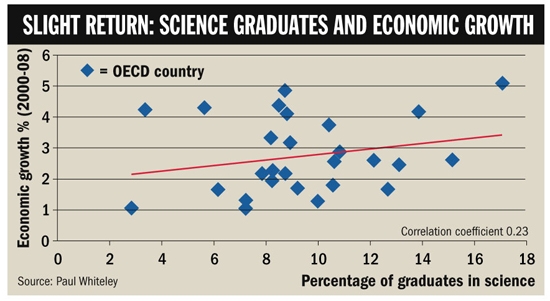
Professor Whiteley argues that he has found evidence that refutes the case that increased provision of science, technology, engineering and maths (STEM) graduates are -in the words of Lord Mandelson – “crucial to in securing future prosperity”. His evidence is based on data relating to 30 OECD countries: on the one hand, their average economic growth for the period 2000-8 and, on the other, the percentage of graduates in STEM subjects for each country over the same period. He finds no statistically significant correlation between these variates. The data are plotted here:

This lack of correlation is asserted to be evidence that STEM graduates are not necessary for economic growth, but in an additional comment (for which no supporting numbers are given), it is stated that growth correlates with the total number of graduates in all subjects in each country. Hence the conclusion that higher education is good, whether or not it’s in STEM areas.

So what’s wrong with this analysis? A number of things, in fact, but I’ll start with what seems to me the most important conceptual one. In order to test a hypothesis, you have to look for a measurable effect that would be expected if the hypothesis were true, measure the effect, and then decide whether the effect is there or not. If it isn’t, you have falsified the hypothesis.

Now, would anyone really expect the % of students graduating in STEM subjects  to correlate with the growth rate in the economy over the same period? Does anyone really think that newly qualified STEM graduates have an immediate impact on economic growth? I’m sure even the most dedicated pro-science lobbyist would answer “no” to that question. Even the quote from Lord Mandelson included the crucial word “future”! Investment in these areas is expected to have a long-term benefit that would probably only show after many years. I would have been amazed had there been a correlation between measures relating to such a short period, so  absence of one says nothing whatsoever about the economic benefits of education in STEM areas.

And another thing. Why is the “percentage of graduates” chosen as a variate for this study? Surely a large % of STEM graduates is irrelevant if the total number is very small? I would have thought the fraction of the population with a STEM degree might be a better choice. Better still, since it is claimed that the overall number of graduates correlates with economic growth, why not show how this correlation with the total number of graduates breaks down by subject area?

I’m a bit suspicious about the reliability of the data too. Which country is it that produces less than 3% of its graduates in science subjects (the point at the bottom left of the plot). Surely different countries also have different types of economy wherein the role of science and technology varies considerably. It’s tempting, in fact, to see two parallel lines in the above graph – I’m not the only one to have noticed this – which may either be an artefact of small numbers chosen or might indicate that some other parameter is playing a role.

This poorly framed hypothesis test, dubious choice of variables, and highly questionable conclusions strongly suggest that Professor Whiteley had made his mind up what result he wanted and simply dressed it up in a bit of flimsy statistics. Unfortunately, such pseudoscientific flummery is all that’s needed to convince a great many out there in the big wide world, especially journalists. It’s a pity that this shoddy piece of statistical gibberish was given such prominence in the Times Higher, supported by a predictably vacuous editorial, especially when the same issue features an article about the declining standards of science journalism. Perhaps we need more STEM graduates to teach the others how to do statistical tests properly.

However, before everyone accuses me of being blind to the benefits of anything other than STEM subjects, I’ll just make it clear that, while I do think that science is very important for a large number of reasons, I do accept that higher education generally is a good thing in itself , regardless of whether it’s in physics or mediaeval latin, though I’m not sure about certain other subjects.  Universities should not be judged solely by the effect they may or may not have on short-term economic growth.

Which brings me to a final point about the difference between correlation and causation. People with more disposal income probably spend more money on, e.g., books than people with less money. Buying books doesn’t make you rich, at least not in the short-term, but it’s a good thing to do for its own sake. We shouldn’t think of higher education exclusively on the cost side of the economic equation, as politicians and bureaucrats seem increasingly to be doing,  it’s also one of the benefits.


Share/Bookmark

No Science Please, We’re British

Posted in Education, Politics, Science Politics with tags , , , , , , , , , on August 27, 2010 by telescoper

The time is getting closer when the Condem government’s hatchet men announce the detailed plans for spending cuts over the next few years. Those of us scientists working in British universities face an anxious few weeks waiting to see how hard the axe is going to fall. Funds for both teaching and research seem likely to be slashed and there’s fear of widespread laboratory closures across the sector, particularly in “pure” science that doesn’t satisfy the current desire for a rapid return on investment.

The mood is pretty accurately summarised by an article in the Guardian, in which John Womersley (who is the Director of Science Programmes at the Science and Technology Facilities Council) pointed out the very real possibility that the UK might be forced to mothball expensive national facilities such the recently built Diamond Light Source and/or withdraw from international collaborations such as CERN (which would also entail pulling out of the Large Hadron Collider). Astronomers also fear that cuts to STFC might force us to withdraw from the European Southern Observatory, which would basically destroy our international competitiveness in a field which for so long we have been world-leading. Withdrawal from CERN would similarly ensure the end of particle physics in Britain.

As well as the loss of facilities and involvement in ongoing international research programmes, big cuts in science funding – especially at STFC – will also lead to a “lost generation” of young scientists having little or no opportunity to carry out their research here in Britain. In fact the process of throwing away the UK’s future as a scientific nation has already begun and is likely to accelerate even without further cuts this year.

The STFC budgets for training young scientists at both postgraduate and postdoctoral levels were slashed even before the General Election because STFC was formed in 2007 with insufficient funds to meet its commitments. The total funding for research grants in astronomy – which is how many postdoctoral researchers are trained has been squeezed by an unsustainable level of 40% already. Many young scientists, whose contracts have been terminated with virtually no notice, have not unreasonably decided that the UK can offer them nothing but a kick in the teeth and gone abroad, taking their expertise (which was developed thanks to funding provided by the UK taxpayer) to one of our competitors in the global economy.

Some say the previous funding crisis was due to downright incompetence on behalf of the STFC Executive, some say it was part of a deliberate policy at the RCUK level to steer funding away from pure science towards technology-related areas. Either way the result is clear. Opportunities for young British scientists to do scientific research have been severely curtailed. Another round of cuts to STFC of the 25% being talked about by the new government will certainly lead to wholesale closures of labs and observatories, the withdrawal from international commitments such as CERN and ESO, and the loss of irreplaceable expertise to other countries.

On top of this, it seems not only STFC but also other research councils (such as EPSRC) are talking about clawing back funds they have already granted, by reneging on contracts they have already signed with Universities to fund research by scientists carried out there. If this does happen, there will be a catastrophic breakdown of trust between University-based scientists and the government government that will probably never be healed.

This government risks destroying the foundations of scientific excellence that have taken over 300 years to build, and all for what level of saving? The annual subscription the UK pays to CERN is about £70 million, a couple of pounds per British taxpayer per year, and a figure that most bankers would regard as small change. It would be madness to throw away so much long-term benefit to save so little in terms of short-term cost.

In the Guardian article, John Womersley is quoted as saying

Our competitor nations such as Germany and the US are investing in science and engineering right now because they recognise that they stimulate economic growth and can help to rebalance the economy. It is pretty obvious that if the UK does the exact opposite, those companies will look elsewhere. That would deepen the deficit – in a recession you need to invest in science and engineering to reap the benefits, not cut back.

Of course we don’t know how the Comprehensive Spending Review will turn out and there may be still time to influence the deliberations going on in Whitehall. I hope the government can be persuaded to see sense.

I’m trying very hard to be optimistic but, given what happened to STFC in 2007, I have to say I’m very worried indeed for the future of British science especially those areas covered by STFC’s remit. The reason for this is that STFC’s expenditure is dominated by the large facilities needed to do Big Science, many of which are international collaborations.

In order to be active in particle physics, for example, we have to be in CERN and that is both expensive and out of STFC’s control. The cost of paying the scientists to do the science is a relatively small add-on to that fixed cost, and that’s the only bit that can be cut easily. If we cut the science spend there’s no point in being in CERN, but we can’t do the science without being in CERN. The decision to be made therefore rapidly resolves itself into whether we do particle physics or not, a choice which once made would be irreversible (and catastrophic). It’s the same logic for ESO and ground-based astronomy. There’s a real possibility in a few years time that the UK will have killed off at least one of these immensely important areas of science (and possibly others too).

A decade ago such decisions would have been unthinkable, but now apparently they’re most definitely on the cards. I don’t know where it all went wrong, but given the (relatively) meagre sums involved and the fact that it started before the Credit Crunch anyway, it’s difficult to escape the conclusion that it’s a deliberate stitch-up by senior mandarins. All I can say is that the future looks so grim I’m glad I’m no longer young.


Share/Bookmark

Grade Inflation

Posted in Education, Politics with tags , , , on August 12, 2010 by telescoper

Still too busy to post anything too substantial, but since this year’s A-level results are out next week – with the consequent scramble for University places – I thought I’d take a few minutes to share this  graph (taken from an article on the BBC website) which shows the steady dumbing-down improvement of educational standards student performance over the last few decades.

Nowadays, on average, about 27 per cent of students taking an A-level get a grade A. When I took mine (in 1981, if you must ask) the fraction getting an A was about 9%. It’s scary to think that I belong to a generation that must be so much less intelligent than the current one. Or could it be – dare I say it? – that A-level examinations might be getting easier?

Looking at the graph makes it clear that something happened around the mid-1980s that initiated an almost linear growth in the percentage of A-grades. I don’t know what will happen when the results come out next week, but it’s a reasonably safe bet that the trend will continue.

I can’t speak for other subjects, but there’s no question whatsoever that the level of achievement needed to get an A-grade in mathematics is much lower now than it was in the past. This has been proven over and over again. A few years ago, an article in the Times Higher discussed the evidence, including an analysis of the performance of new students on a diagnostic mathematics test they had to take on entering University.  The same test, covering basic algebra, trigonometry and calculus, had been administered every year so provided a good diagnostic of real mathematical ability that could be compared with the A-level grades achieved by the students.  They found, among other things, that students entering university with a grade B in mathematics in 1999 performed at about the same level as students in 1991 who had failed mathematics A-level.

The steadily decreasing level of mathematical training students receive in schools poses great problems not only for mathematics courses, but also for subjects like physics. We have to devote so much more time on the physics equivalent of “basic training” that we struggle to cover all the physics we should be covering in a degree program. Thus the dumbing down of A-levels leads to pressure to dumb down degrees too.

That brings me to the prospect of huge cuts – up to 35% if the stories are true – in government funding for universities, leading to pressure to shorten the traditional three-year Bachelors degree to one that takes only two years to complete. If this goes ahead it won’t be long before a student can get a degree by achieving the same level of knowledge as would have been displayed by an A-level student 30 years ago. Are we supposed to call this progress?

Or perhaps this business about two year degrees all really  does make sense. Maybe we should just accept that universities have to offer such courses because the school system has become broken beyond repair over the last 30 years, and it will be up to certain Higher Education institutions from now on to do the job that school sixth-forms used to do, i.e. teach A-levels.

Scientology and Stupidity

Posted in Politics with tags , , , , on July 20, 2010 by telescoper

The first bit of news that caught my eye this morning as I ate my toast was a local item about Councillor John Dixon of Cardiff City Council. I’m not a big fan of the Council, particularly their bizarre Highways Department which, on the one hand, is narrowing all the roads in the city centre causing ridiculous levels of traffic congestion and, on the other, has completed an appalling road into Bute Park for the purpose of promoting its use by heavy trucks and lorries. When I saw a councillor was in trouble and that the word “stupid” was involved, I assumed I knew what it would be about …

However, that turns out not to be true. The Councillor was on the receiving end of a complaint by the Church of Scientology because of something he posted on Twitter. The message was

I didn’t know the Scientologists had a church on Tottenham Court Road. Just hurried past in case the stupid rubs off.

The notoriously litigious “Church” complained to Cardiff City Council that this comment impinged on their right to religious freedom. The main point of the Scientologists’ argument was that offending tweet came from “CllrJohnDixon”, implying that he was acting in an official capacity. Indications are that Councillor Dixon has indeed transgressed the Council’s code of conduct and the case will be referred to their disciplinary committee.

This is an interesting situation that brought a number of questions to my mind. First is whether Councillor Dixon actually did anything wrong. I think it’s obvious that his comment wasn’t a criminal act. I doubt if it was actually defamatory either, so it’s unlikely to be involved in a civil case on that basis. However, he was identified as a Councillor and may well have acted contrary to the code of conduct that forms part of his terms of employment if the code of conduct says something about religious belief. That is a matter for the Council to decide and I don’t think it’s helpful to comment here, primarly because I don’t know what the Code of Conduct says.

The second question is whether one’s reaction to a quip that Scientologists are stupid should generate any different reaction to a similar remark about Christians. Or Muslims. Or any other religion. I’ve run into Scientologists myself and read a bit about their religion, which I regard as a hilarious  hotch-potch of laughable fantasies cobbled together by a tenth-rate Science Fiction author with the express purpose of duping the gullible and the vulnerable out of their cash. I believe that anyone caught up in it must indeed be a few sandwiches short of a picnic, but does that give me the right to say they’re “stupid” in public?

Actually, I think it does. And I think I should have the right to say such things about other religions too. For their part they also have the right to protest if they’re offended. But they do not or should not have the right for any form of legal redress simply because I expressed an opinion. I don’t have a problem with this, any more than I have a problem with lampooning people like Simon Jenkins for the stupid things they say.

I suspect there are atheists who think all religions and religious people are stupid, as well as religious people who think all religions are stupid other than the one they believe in. Then there are people, like me, who don’t follow any religion but also don’t think that all of them are totally silly. I think it’s a reasonable principle that the right to hold and to espouse religious beliefs should be respected, unless, of course, the religious beliefs in question contradict common law or basic morality. Should we consider racism or homophobia to be acceptable if motivated by religion but not if such views stem from an atheistic political philisophy?

Although I don’t have any particularly objective yardstick for judging how silly different religions are, and therefore find it quite difficult to be entirely even-handed in my attitudes to religions, I do find Scientology particularly ridiculous. But then looking at the Church of Scientology’s track-record I don’t feel the need to apologize for that.

Behind this is the whole issue of freedom of expression and the extent to which it should be limited, either by the law or by employment contracts. For a start, I know that nobody likes to be on the receiving end of abusive comments, but I can think of much worse examples than “stupid”. Abuse related to an individual’s beliefs also belong to a different category to those related to, for example, race, gender or sexual orientation. People choose their religion (as they do their political views) and while one must respect another’s right to have different opinions, that doesn’t mean those opinions should be immune from challenge or comment. That’s why I disagree with all laws, such as those relating to blasphemy, that put religious beliefs in some special category compared to other kinds of thought. I’m not so sure about laws relating to racist sexist or homophobic abuse. Part of me says that in a free society you have to put up with the freedom people have to be nasty. Another part says that people deserve legal protection from extreme forms of verbal abuse, especially when it becomes threatening to them or if they are in a vulnerable situation.

However, all this about laws is really irrelevant in this case (I think). Whatever the legal situation in the big wide world, employers have a right to decide on what sort of behaviour they will accept from their employees in their office. In many cases – especially, but by no means exclusively,  in the public sector – such things form part of the contract of employment. If an employee transgresses they should face disciplinary action. If that doesn’t happen, or it is done in a discriminatory way, then the whole system starts to look grossly hypocritical. Better surely not to have rules at all than to have them but use them only as window-dressing?

I think what I’m saying is that I think it’s at worst a bit impolite for a private individual to call Scientologists “stupid” but nothing more than that. It’s also perhaps a bit different for a Councillor to do so in their professional capacity than as a private individual. However, I myself would not say that the Church of Scientology itself is stupid. I think it’s much worse than that. I think it knows exactly what it’s doing.

It’ll be interesting to see what happens now in this case. I hope Councillor Dixon gets nothing more than a slap on the wrist. I fear, however, that the media spotlight will compel the Ethics committee to take more drastic measures. That would be a shame, especially when I can think of other examples where much worse and much more obvious  transgressions than this have gone completely unpunished by public bodies who have indeed also connived with the miscreant to conceal evidence of wrongdoing.

The Shoe Event Horizon

Posted in Education, Politics, Science Politics with tags , , , , , on July 16, 2010 by telescoper

After yesterday’s  satisfying and enjoyable graduation festivities, it’s back to reality today with a clutch of scary news items about future cuts.

Vince Cable, the coalition Minister responsible for Universities, has revealed plans for Higher Education that include introducing a graduate tax and encouraging the growth of private universities,  the latter to be introduced at the expense of some current institutions which are to be allowed to go bankrupt. You can find some discussion of his speech in the Times Higher as well as in the Guardian piece I linked to earlier.

The graduate tax isn’t a new idea, but it does seem rather strange to be suggesting it right now. The proposal won’t lead to any significant income for universities in the short term so presumably either the government or the institutions themselves will have to borrow until the cash starts to flow in. But I thought we were supposed to be cutting public borrowing?

In fact, it seems to me that the announcements made by Cable are little more than a ragbag of ill-considered uncosted measures likely to do little but cause alarm across the Higher Education sector. Perhaps he would have been wiser to have kept the Ministerial trap shut until he’d actually worked out whether any of the half-baked ideas he announced were worth thinking through properly, as some of them just might be.

Apart from anything else, Vince Cable’s dramatic U-turn on Higher Education funding shows that the LibDem contingent have now been completely subsumed by the dominant right-wing, pro-market political stance of the Conservatives. In other words, we now know there’s no reason ever to vote LibDem again; they’re Tories in all but name.

I hope this year’s new graduates realised how lucky they’ve been to get their education before universities turn into Discount Education Warehouses, although I cling to the hope that the Welsh and Scottish assemblies might take a stand against if some of the worst aspects of the ConDem policy look like becoming reality in England, where the Tories live.

Meanwhile, the Royal Society has submitted its, er, submission to the ongoing debate about research funding. The headline in an accompanying article from the Times – which you won’t be able to read unless you give money to the Evil Empire of Murdoch – suggests that it could be “game over” for British science if the suggested cuts go ahead. Paul Crowther has done his usual fabulously quick job of hacking his way through the documentary jungle to get to the juiciest quotes, including this one:

Short-term budget cuts will put our long-term prosperity at risk.. The UK should maintain its breadth of research .. a flat cash settlement will be painful but manegeable; a 10% cash cut will be damaging .. while a 20% cut will be irreversibly catastrophic for the future of UK science and economic growth.

I’m sorry if I’m introducing a note of pessimism here, but I think we’ll be very lucky indeed if the cuts are as small as 20%.

And finally, not unexpectedly, the news this week includes an announcement that university staff are to have their pensions reduced and/or deferred and will have to pay more for the privilege. Employee’s contributions to the USS scheme will increase from 6% to 7.5%. For new members the pension will not be based on their final salary, but on average earnings. This isn’t a surprise as it’s been clear for some time that USS was actuarially unsound, but it’s one more sign of the forthcoming squeeze on academics, those of them that don’t get made redundant anyway…

Looking around for a bit of good news, I could only manage this. If you’re worried about the future of UK universities and scientific research then consider how lucky you are that you’re not Italian. Owing to budget cuts imposed by the Berlusconi regime, several Italian institutions will no longer be able to pay scientists’ wages. Responding to this situation the Italian premier replied with all his usual tact and intelligence:

Why do we need to pay scientists when we make the best shoes in the world?

Fans of the late Douglas Adams will be reminded of the following passage from The Restaurant at the End of the Universe:

Many years ago this was a thriving, happy planet – people, cities, shops, a normal world. Except that on the high streets of these cities there were slightly more shoe shops than one might have thought necessary. And slowly, insidiously, the number of the shoe shops were increasing. It’s a well-known economic phenomenon but tragic to see it in operation, for the more shoe shops there were, the more shoes they had to make and the worse and more unwearable they became. And the worse they were to wear, the more people had to buy to keep themselves shod, and the more the shops proliferated, until the whole economy of the place passed what I believe is termed the Shoe Event Horizon, and it became no longer economically possible to build anything other than shoe shops. Result – collapse, ruin and famine.

I see that Big Brother isn’t the only dystopian vision to have become reality, but perhaps Douglas Adams should have called his book The Restaurant at the End of the University?

Nerth gwlad ei gwybodaeth

Posted in Education, Opera, Politics with tags , , , , , , on July 15, 2010 by telescoper

Once again the wheel of academic life has turned full circle. A year to the day since I blogged about the last graduation ceremony for the School of Physics & Astronomy at Cardiff University, here I am doing it again. Last night Cardiff experienced some of the heaviest rainfall I’ve seen for ages and I got a bit soggy on the way to St David’s Hall for this morning’s ceremony. Given that today is St Swithin’s Day this doesn’t bode well for the rest of the summer…

I confess it didn’t feel too comfortable sitting there on stage under the lights in a slightly damp suit, wearing a tie, and sporting mortarboard and gown but it went pretty well. Three Schools went through during the ceremony I attended: Earth & Ocean Sciences and Psychology as well as Physics & Astronomy.

We had by far the smallest group of graduands; the School of Psychology is particularly huge and is also notable for having such a small percentage of male graduates. In Physics & Astronomy we have about 20% female students whereas Psychology must be >95%. We often sit around at tea-time discussing how to persuade more girls to study Physics, but I wonder if anyone frets about how to get more boys to do Psychology?

It’s a very proud moment when the students you know receive their degrees. This year, in fact, produced the first set of BSc graduates that have completed their entire study period while I’ve been here since I only arrived three years ago.

It must be a nerve-wracking experience crossing the stage at St David’s Hall in front of your family and friends, especially in high heels as most of the girls did. I would have thought sensible shoes were a wiser option, but then what do I know?

If you want to see the ceremony you can do so by following this link. I’m in the front row on stage, to the right hand side, dressed in a blue gown and mortarboard but not visible on the cross-stage view.

The Honorary Fellowship presented during our ceremony was received by Professor Paul Harris, a distinguished psychologist. It’s worth mentioning that another such event earlier in the week saw the award of an Honorary Fellowship to Stephen Fry who has been involved in studies of bipolar disorder at the University. He tweeted regularly during his short visit to Cardiff, e.g.

Must say Cardiff is looking spankingly good in the late afternoon sunshine. Castle is gleaming, Town Hall glowing. Much to like here.

I’m sure the university press machine will make as much as they can of his comments. And why not? Cardiff does indeed have much to like. Even in the rain.

The ceremony ended on a high note or, in fact, on several.  Mary-Jean O’Doherty, a wonderful young Soprano from the Cardiff International Academy of Voice, gave us a fine rendition of the Queen of the Night’s  Act II aria from Mozart’s The Magic Flute. Die Hölle Rache kocht in meinem Herzen is a tremendously difficult coloratura piece featuring a barrage of stratospheric high notes. I thought it was tremendously brave to take that on, coming into it completely cold, but she did it fantastically well and it fair brought the house down. I note that the opera from which this aria was taken is featured in Welsh National Opera’s forthcoming autumn season, where it is sure to prove popular.

I’m pretty sure not many people in the audience knew the Opera or could understand German, however, because although the music is wonderful the lyrics aren’t entirely appropriate. The first line translates as “The Rage of Hell is boiling in my heart….”. Perhaps that was a subliminal response to the fact that the  Cardiff International Academy of Voice is closing later this year.

Anyway it was then back to the School for a lunch party – which was very nicely done, I think – and a speech of farewell from the Head of School ending with the award of prizes for students who had performed exceptionally well in their studies. I’m fortunate that the prize-winning student of the MPhys (4-year) cohort is staying on in Cardiff to do a PhD under my supervision.

Just in case any of the new graduates are reading this, let me add my congratulations to those of the Head of School and also repeat his encouragement to you to stay in touch. It’s always a delight when former students drop in for a chat, but if you can’t do that please do keep in touch on Facebook or the like.

I know the graduate job market is tough at the moment, but don’t be discouraged if you haven’t got anything sorted out yet. In the long run what you’ve learned will benefit you.  I’m sure I speak on behalf of everyone who has had the pleasure of teaching you over the last three or four years when I say that we wish you all the very best in your future careers.

PS. The title of this post in in Welsh. It translates as “A nation’s strength is in its learning”.

Cardiff inSPIREs Willetts

Posted in Politics, Science Politics, The Universe and Stuff with tags , , , , on July 9, 2010 by telescoper

The Minister for Universities and Science David Willetts’ important speech today at the Royal Institution in London has already attracted a considerable amount of comment and reaction. I haven’t really got time to comment on it in detail, but in between the expected warning of tough times ahead, it does contain a great deal of extremely interesting and thoughtful material, which I recommend you read if you’re interested in science policy.

Of particular interest to us here in the School of Physics & Astronomy at Cardiff University is that we get a specific mention for the wonderful work done by the Astronomical Instrumentation Group on the development of the SPIRE instrument on the Herschel Space Observatory.  Everyone’s chuffed about it, and delighted that the Minister chose to highlight this particular example of excellence.

In my speech at Birmingham University in May, I spoke of links between the academic and the vocational, the conceptual and the physical. We are not always good at this – we have world-class particle physicists at the Large Hadron Collider but sadly not many British engineers helped to build it. But there are other areas where these links between British science and technology are stronger. We not only have distinguished astronomers, but it was scientists and engineers at Cardiff University who produced the Spectral and Photometric Imaging Receiver for Herschel and Planck. This combination of scientific research and technological advance creates extraordinary dynamism, both intellectual and commercial. I see it as one of my tasks to strengthen these links.

OK, so I know SPIRE wasn’t for “Herschel and Planck” but the AIG was involved with instruments for both these missions so the point is well made anyway.

Stay of Execution

Posted in Education, Finance, Politics, Science Politics with tags , , , , on June 22, 2010 by telescoper

Another beautiful summer’s day here in Cardiff just happened to be the day when the new ConDem government unleashed its much-feared budget. I suppose we were all expecting some combination of  tax rises and spending cuts but nodody I know had managed to predict the details. A big rise in VAT (to 20%) is the headline figure most of the newspapers seem to be running with, but the other side is the one that caught my eye;  average cuts of 25% in “unprotected” Whitehall departments. That means basically everything outside Health and Education, and “Education” doesn’t include Higher Education which falls within the remit of the Department of Business Innovation and Skills.  Universities (in England; Scotland, Wales and Northern Ireland run their own budgets for HE) and the Research Councils are therefore bracing themselves for cuts of 25% or even more; if some departments are cut less than this average, then some will be cut more…

For informed comment, see here and here.

However, the details of how these cuts will be implemented – and, of particular relevance to me, how much the Science and Technology Facilities Council will be chopped – will have to wait until the Comprehensive Spending Review to be announced in October 2010. No doubt the STFC Executive will be using all their political skills and powers of persuasion to argue for a positive settlement. Like they did last time. In other words, we’re doomed.

Incidentally, you can hear Lord Rees’ scathing comments about the inept management of STFC here, although to so involves shaking hands with the devil that is iTunes.

There’s also a two-year freeze on public sector salaries – again, not entirely unexpected – but obviously that will only apply to those who keep their jobs after the departmental budgets are cut by a quarter.

Anyway, no point in griping. We all knew this was coming. The big question now is whether the increases in unemployment and tax rises will stop our feeble economic recovery in its tracks, and how badly the cuts in investment will jeoparside future growth. I’m not sufficiently knowledgeable about economics to comment sensibly on this.

Coincidentally today was also the day that STFC Council met here in Cardiff. Of course they did so behind closed doors, but they also had a quick tour of the buildings and a briefing by our Head of School, Swiss Tony Walter Gear. I’m told one of the Council members asked “Excuse me, but what is Planck?”. Apparently the question was posed by one of the non-scientists on STFC Council. So that’s alright then.

Still, there’s always the elimination of France from the World Cup to gladden the heart of an Englishman. Like STFC, the England  football team will learn its fate soon eough …

Universities Challenged

Posted in Education, Politics with tags , , , , , on June 10, 2010 by telescoper

The news headlines over the last couple of days have been dominated by remarks made by David Willetts, Minister for Universities and Science, who has called for a radical overhaul of the way UK universities are organized and funded. Predictably, his comments set alarm bells ringing about the savage cuts likely to be coming our way, but I hope it’s not just about slash-and-burn and that some imagination is applied to the problem of sorting out the mess the system has become. We’ll see.

According to a piece in the Guardian, for example, Willetts suggested that some students could study at smaller local colleges instead of going to a big university, but these colleges would teach courses designed and administered by the larger “elite” institutions, such as the University of London. This suggestion isn’t  exactly new because it’s actually how things used to work many years ago. In fact, Nottingham University, where I used to work used to be Nottingham University College and its degrees, along with those of a number of similar provincial universities, were University of London degrees. Nottingham University only got the power to award its own degrees in 1948. Of course, there wasn’t really such a thing as distance learning in those days, so there’s a possibility that a 21st Century revival of this basic idea could turn out very differently in terms of how things are actually taught.

On the up side of this suggestion is the fact that it would be a lot easier to maintain standards, if examinations were set by a common body. On the down side is the fact that the distinctive flavour of speciality courses taught in different colleges, which is a strength of research-led teaching, would be lost. In between these positives and negatives there is a huge grey area of questions, such as where the funding would go, precisely which universities should administer the changes and so on. A lot of thinking and planning will be  needed before anything like this could be implemented.

Let me add two more specific comments to this. First, I think Willetts’ suggestion would make a lot of sense here in Wales where it could be easily implemented by returning to the old University of Wales.  As I’ve mentioned before, as well as suffering from many of the problems besetting the English university system, the Principality has a few extra ones all its own. Among the most pressing is the proliferation of small colleges and the consequent duplication of administrative systems. I think a great deal of money could be saved and teaching quality improved by cutting out the unnecessary bureaucracy and having the smaller places administered by a larger central University (as Willetts imagined with the University of London).

My other comment is specific to my own subject, physics (and astronomy). The problem with this – and other laboratory based STEM subjects – is that it’s very difficult to imagine how they can actually be taught at all at degree level without access to research laboratories for, e.g., project work. This is why physics is only taught in 40-0dd of the 131 universities and colleges around the UK. You can call me old-fashioned, but I just don’t think it’s either possible or desirable to separate teaching from research in science subjects in the way this plan seems to suggest. I know some colleagues of mine disagree strongly with this, but there you go.

Behind this proposal is the issue of student funding, as it is at least partly motivated by the suggestion that students could stay at home and study at a local college instead of moving to a university further away, which would necessitate them taking out student loans which the Treasury has to pay out. 

There’s also the issue of fees. At the moment students in England are expected to pay a flat-rate annual fee of £3225. In addition to this the government pays to the University concerned an amount called the “Unit of Resource”. Last year, in England, the basic amount was around £4K but there is multiplier for more expensive courses. Clinical medicine, for example, attracts four times the basic rate. Subjects like physics and chemistry get a multiplier of 1.7 (so each student comes with around £6.7K of funding). Subjects with no laboratory component, i.e. most Arts and Humanities courses,  just get the bog-standard amount.

I think there’s an obvious problem with this system, namely that physics (and other science subjects) are  much more expensive to teach than the formula allows for. The total income per student for an arts subject would be about £7.2K, while that for physics is about £10K. Why bother with all that expensive laboratory space and shiny new kit when the funding differential is so small. That’s another reason why so many universities have scrapped their physics departments in favour of cheaper disciplines that generate a profit much more easily.

Coincidentally I attended a lunch yesterday with some of our soon-to-be-graduating students. I’ve been a member of a committee working on updating our Physics courses and we wanted to discuss the proposed changes with them. One of the group was a mature student who had already done an English degree (at another university). She said that a physics drgee was much harder work, but was impressed at how much more contact she had with staff. Like most physics department, virtually all our teaching is done by permanent academic staff. Students doing  Physics at Cardiff get about three times as many contact hours with staff as students doing English. It’s unfair to compare apples with oranges, but I’m convinced the funding model is stacked against STEM subjects.

The awful financial climate we’re in has led to a general sense of resignation that the government contribution to university education (the Unit of Resource) is going to decrease and the student contribution go up to compensate. However, there’s a Catch-22 here for the Treasury. If the tuition fee goes up students will have to borrow more, and the Treasury doesn’t want to take on more  subsidised student loans. It seems much more likely to me that the cuts will be achieved by simply reducing the number of funded places. However, in the light of what I argued above, I think this is a great opportunity to think about what is the correct Unit of Resource for different subjects. If we all agree the country needs more scientists and engineers, not less, I’d argue that funded places elsewhere should be cut, and that the difference between arts and science units of resource also be substantially increased.

I’d even go so far as to suggest that there should be zero-rated courses, i.e. those which students are welcome to take if they pay the full cost but to which the government will not contribute at all. That should put an end to the Mickey Mouse end of Higher Education provision once and for all.

PS. A review of the tuition fee system is currently taking place but isn’t due to report until the autumn. It is led by Lord Browne who was formerly the boss of BP. I wonder if there’ll be any leaks?