Archive for the Science Politics Category

Newcastle Joins the Resurgence of UK Physics

Posted in Education, Science Politics, The Universe and Stuff with tags , , , on August 17, 2014 by telescoper

I’ve posted a couple of times about how Physics seems to undergoing a considerable resurgence in popularity at undergraduate level across the United Kingdom, with e.g. Lincoln University setting up a new programme. Now there’s further evidence in that Newcastle University has now decided to re-open its Physics course for 2015 entry.

The University of Newcastle had an undergraduate course in Physics until 2004 when it decided to close it down, apparently owing to lack of demand. They did carry on doing some physics research (in nanoscience, biophysics, optics and astronomy) but not within a standalone physics department. The mid-2000s were tough for UK physics,  and many departments were on the brink at that time. Reading, for example, closed its Physics department in 2006; there is talk that they might be starting again too.

The background to the Newcastle decision is that admissions to physics departments across the country are growing at a healthy rate, a fact that could not have been imagined just ten years ago. Times were tough here at Sussex until relatively recently, but now we’re expanding on the back of increased student numbers and research successes. Indeed having just been through a very busy clearing and confirmation period at Sussex University, it is notable that its the science Schools that have generally done best.  Sussex has traditionally been viewed as basically a Liberal Arts College with some science departments; over 70% of the students here at present are not studying science subjects. With Mathematics this year overtaking English as the most popular A-level choice, this may well change the complexion of Sussex University relatively rapidly.

I’ve always felt that it’s a scandal that there are only around 40 UK “universities” with physics departments Call me old-fashioned, but I think a university without a physics department is not a university at all; it’s particularly strange that a Russell Group university such as Newcastle should not offer a physics degree. I believe in the value of physics for its own sake as well as for the numerous wider benefits it offers society in terms of new technologies and skills. Although the opening of a new physics department will create more competition for the rest of us, I think it’s a very good thing for the subject and for the Higher Education sector general.

That said, it won’t be an easy task to restart an undergraduate physics programme in Newcastle, especially if it is intended to have as large an intake as most successful existing departments (i.e. well over 100 each year). Students will be applying in late 2014 or early 2015 for entry in September 2015. The problem is that the new course won’t figure in any of the league tables on which most potential students based their choice of university. They won’t have an NSS score either. Also their courses  will probably need some time before it can be accredited by the Institute of Physics (as most UK physics courses are).

There’s a lot of ground to make up, and my guess is that it will take some years to built up a significant intake.The University bosses will therefore have to be patient and be prepared to invest heavily in this initiative until it can break even. The decision a decade ago to cut physics doesn’t exactly inspire confidence that they will be prepared to do this, but times have changed and so have the people at the helm so maybe that’s an unfair comment.

There are also difficulties on the research side (which is also vital for a proper undergraduate teaching programme), there are also difficulties. Grant funding is already spread very thin, and there is little sign of any improvement for the foreseeable future  in the “flat cash” situation we’re currently in. There’s also the stifling effect of theResearch Excellence Framework I’ve blogged about before. I don’t know whether Newcastle University intends to expand its staff numbers in Physics or just to rearrange existing staff into a new department, but if they do the former they will have to succeed against well-established competitors in an increasingly tight funding regime. A great deal of thought will have to go into deciding which areas of research to develop, especially as their main regional competitor, Durham University, is very strong in physics.

On the other hand, there are some positives, not least of which is that Newcastle is and has always been a very popular city for students (being of course the finest city in the whole world). These days funding follows students, so that could be a very powerful card if played wisely.

Anyway, these are all problems for other people to deal with. What I really wanted to do was to wish this new venture well and to congratulate Newcastle on rejoining the ranks of proper universities (i.e. ones with physics departments). Any others thinking of joining the club?

End of Term Report: David Willetts

Posted in Education, Politics, Science Politics with tags , , , , on July 15, 2014 by telescoper

News broke yesterday that the Minister responsible for Universities and Science within the Department of Business, Innovation and Skills, David Willetts, had stepped down from his role and would be leaving Parliament at the next election.

Willetts’ departure isn’t particularly surprising in itself, but its announcement came along with a host of other sackings and resignations in a pre-Election cabinet reshuffle that was much wider in its scope than most expected. It seems to me that Prime Minster David Cameron has decided to play to the gallery again. After almost four years in which his Cabinet has been dominated by white males, most of them nondescript timeserving political hacks without beards, he has culled some of them at random to try to pretend that he does after all care about equality and diversity. Actually, I don’t think David Cameron cares for very much at all apart from his own political future and this is just a cynical attempt to win back some votes before the next Polling Day, presumably in May 2015. Rumour has it that one of the new Cabinet ministers may even have facial hair. Such progress.

Willets

David Willetts was planning to step down at the next General Election anyway so his departure now was pretty much inevitable. I never agreed with his politics, but have to admit that he was a Minister who at least understood some things about Higher Education. In particular he knew the value of science and secured a flat cash settlement for the science budget at a time when other Whitehall budgets were suffering drastic cuts. He was by no means all bad. He even had the good taste – so I’m told – to read this blog from time to time….

The campaigning organization Science is Vital has expressed its sadness at his departure:

We’re sorry to see David Willetts moved from the Science Minister role. He listened, in person, to our arguments for increasing public funding for science, and we appreciated the support he showed for science within the government.

We look forward to renewed dialogue with his successor, in order to continue to press the case that science is vital for the UK.

Now that he has gone, my main worry is that the commitments he gave to ring-fence the science budget will go with him. I don’t know anything about his replacement, Greg Clark, though I hope he follows his predecessor at least in this regard.

Other aspects of Willetts’ tenure of the Higher Education office are much less positive. He has provided over an ideologically-driven rush to force the University sector into an era of chaos and instability, driven by a rigged quasi-market propelled by an unsustainable system of tuition fees funded by student loans, a large fraction of which will never be repaid.

Another of Willetts’ notable failures relates to Open Access. Although apparently grasping the argument and make all the right noises about breaking the stranglehold exerted on academia by outmoded forms of publication, he sadly allowed the agenda to be hijacked by vested interests in the academic publishing lobby. Fortunately, there’s still a very strong chance that academics can take this particular issue into their own hands instead of relying on the politicians who time and time again prove themselves to be in the pockets of big business.

My biggest fear for Higher Education at the moment is that the new Minister will turn out to be far worse and that if the Conservatives win the next election (which is far from unlikely), Science is Vital will have to return to Whitehall to protest against the inevitable cuts. If that happens, it may well be that David Willetts is remembered not as the man who saved British science, but the man who gave it a stay of execution.

Changing the framework for industrial policy

Posted in Finance, Science Politics with tags , , , on June 11, 2014 by telescoper

Here’s another one of the showcases of research from Sussex University. This one features Professor Mariana Mazzucato who debunks the myth of the state as a bureaucratic nanny that stifles creativity in industry, and instead recognizes the vital role of state-led investment in driving innovation and shaping and creating new markets from the internet to biotech to clean tech.

For what it’s worth this gives me an excuse to a view that I’ve expressed before that “commercially useful” research should not be funded by the taxpayer through research grants. If it’s going to pay off in the short term it should be funded by private investors or venture capitalists of some sort. Dragon’s Den, even. When the public purse is so heavily constrained, it should only be asked to fund those things that can’t in practice be funded any other way. That means long-term, speculative, curiosity driven research. You know, things like science…

This is pretty much the opposite of what the Treasury thinks. It wants to concentrate public funds in projects that can demonstrate immediate commercial potential. Taxpayer’s money used in this way ends up in the pockets of entrepreneurs if the research succeeds and, if it doesn’t, the grant will have been wasted if the research does not have any long-term fundamental significance. My proposal, therefore, is to phase out research grants for groups that want to concentrate on commercially motivated research and replace them with research loans. If the claims they make to secure the advance are justified they should have no problem repaying it from the profits they make from patent income or other forms of exploitation. If not, then they will have to pay back the loan from their own funds (as well as being exposed as bullshit merchants). In the current economic situation the loans could be made at very low interest rates and still save a huge amount of the current research budget for higher education. Indeed after a few years – suggest the loans should be repayable in 3-5 years, it would be self-financing. I think a large fraction of research in the Applied Sciences and Engineering should be funded in this way.

The money saved by replacing grants to commercially driven research groups with loans could be re-invested in those areas where public investment is really needed, such as pure science and medicine. Here grants are needed because the motivation for the research is different. Much of it does, in fact, lead to commercial spin-offs, but that is accidental and likely to appear only in the very long term. The real motivation of doing this kind of research is to enrich the knowledge base of the UK and the world in general. In other words, it’s for the public good. Remember that?

If it’s fair to ask students to contribute to their teaching, it’s fair to ask commercial companies to pay for the research that they exploit. Just as student grants should be re-introduced for certain disciplines, so should research loans be introduced for others. You know it makes sense.

However, if you want to tell me why it doesn’t, via the comments box, please feel free!

Mathematics and Meningococcal Meningitis

Posted in Education, Science Politics with tags , , , , on June 9, 2014 by telescoper

Last week I attended a very enjoyable and informative event entitled Excellence with Impact that showcased some of the research that the University of Sussex submitted to the 2014 Research Excellence Framework. One of the case studies came from the Department of Mathematics which is part of the School of Mathematical and Physical Sciences (of which I am Head) so I thought I would showcase it here too:

The description from Youtube reads

Meningococcal meningitis is a debilitating and deadly disease, causing an estimated 10,000 deaths annually in endemic areas of sub-Saharan Africa. A novel mathematical model developed by Sussex researcher Dr Konstantin Blyuss and colleagues has helped explain the patterns of the dynamics of meningococcal meningitis in endemic areas. This model is now being used by epidemiologists and clinical scientists to design and deliver efficient public-health policies to combat this devastating disease.

You can find out more by following this link.

The Logistics of Scientific Growth in the 21st Century

Posted in Science Politics, The Universe and Stuff with tags , , on June 8, 2014 by telescoper

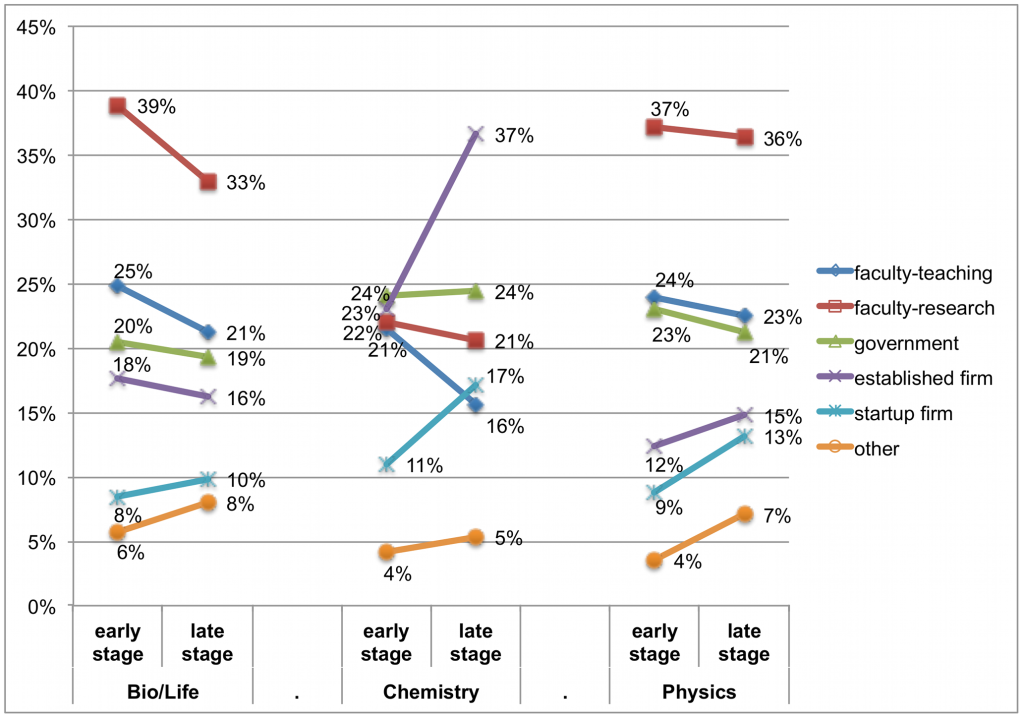
Interesting piece that argues that the recent growth in STEM PhD and postdocs is not sustainable.

caseybergman's avatarAn Assembly of Fragments

ResearchBlogging.org

Over the last few months, I’ve noticed a growing number of reports about declining opportunities and increasing pressure for early stage academic researchers (Ph.D. students, post-docs and junior faculty). For example, the Washington Post published an article in early July about trends in the U.S. scientific job market entitled “U.S. pushes for more scientists, but the jobs aren’t there.” This post generated over 3,500 comments on the WaPo website alone and was highly discussed in the twittersphere. In mid July, Inside Higher Ed reported that an ongoing study revealed a recent, precipitous drop in the interest of STEM (Science/Technology/Engineering/Mathematics) Ph.D. students wishing to pursue an academic tenure-track career. These results confirmed those published in PLoS ONE in May that showed the interest to pursue an academic career of STEM students surveyed in 2010 showed evidence of a decline during the course of Ph.D. studies:

Figure 1. Percent of…

View original post 1,620 more words

RAS Council and after..

Posted in Biographical, Science Politics on May 9, 2014 by telescoper

Just time for a brief post as it’s quite late and I’ve just got back to Brighton after a day out in London. I’ve been too busy to blog until now.

Today was the last day of my year-long stint as an elected Member of the Council of the Royal Astronomical Society; the final Council meeting of the Society’s year is on the day of the Annual General Meeting at which new Council members and other Officers are elected. On this occasion the President, David Southwood, had also reached the end of his term so at the end of the AGM he stood down and was replaced by his successor, Martin Barstow.

There was quite a lot to discuss during today’s Council Meeting in advance of the AGM, but in the end we got through the business and it and the AGM went off quite smoothly.

There then followed the announcement of a major initiative Council has been working on (of which more anon) and a short but very interesting talk about BICEP2 by Stephen Feeney of Imperial College. Thereafter it was dinner at the Athenaeum with RAS Club.

All in all, a busy but pretty productive day. I’ll miss the days out of the office on RAS business, but I suppose the overall reduction in workload is not a bad thing! It just remains for me to wish the new members of Council well in their future endeavours.

On the way in to Burlington House I noticed the enclosed poster for an exhibition of “Renaissance Impressions” at the Royal Academy. I’m not sure of the identity of the bearded chap who is the subject of that particular impression. I’m no historian, but I think Karl Marx came after the Renaissance..

Your Chance to Influence UK Government Investment in Science

Posted in Education, Finance, Politics, Science Politics with tags , , , , on May 4, 2014 by telescoper

A recent piece of bloggery by esteemed Professor Jon Butterworth 0f the Grauniad reminded me that an important government consultation has just opened. In fact it opened on 25th April, but I neglected to post about it then as I was on my Easter break. I’m now passing it on to you via this blog, by way of a sort of community service.

Anyway, the consultation, which is being adminstered through the Department of Business Innovation and Skills, can be found here; there’s a large (110 page) document as well as information on how to respond. Basically about £5.8 billion in capital expenditure has been set aside for science research, and the government is asking how it should be divvied up. Such funds could be used to build big ticket items such as new telescopes, particle accelerators, lasers or other infrastructure including new laboratory buildings. It has to be capital, though, which means it can’t be used on staffing for such facilities that are funded. You might argue that this is a weakness (because ultimately science is done by people not by facilities) but, on the other hand if the government stumps up additional money for capital that might free up funds for more people to be employed.

Anyway, do read the consultation document and submit your responses. You could do a lot worse than reading Jon Butterworth’s commentary on it too. The deadline is some way off, July 4th to be exact, but this is very important so you should all get your thinking caps on right away.

One thing I’ll be including in my response concerns funding for university laboratories. The funding body responsible for English universities, the Higher Education Funding Council for England (HEFCE), is currently underfunding STEM subjects across the country. I’ve blogged about this before so I won’t repeat the argument in detail, but severe reductions in the unit of resource applied to laboratory-based subjects have meant that the new tuition fee regime does not provide anything like sufficient income to cover the costs of, say, physics undergraduate teaching. All students pay a flat-rate fee of £9K across all disciplines (including arts, humanities and science subjects) but science subjects only get £1.4K per student on top of this. The withdrawal of capital allowances has also made it very difficult for universities to invest in teaching laboratory space.

The cost of educating a physics student is actually about twice that of educating a student of, say, English, so this differential acts as a deterrent for universities to expand  STEM disciplines. Shortage of teaching laboratory space is a major factor limiting the intake of students in these areas, whereas other disciplines are able to grow without restriction.

So my vote will go for a sizeable chunk of the £5.8 billion capital  to be allocated to improving, refurbishing, expanding and building new teaching laboratories across all STEM disciplines to train the next generation of scientists and engineers that will be vital to sustain the UK’s economic recovery.

I’d be interested in people’s views about other aspects of the consultation (e.g. what big new facilities should be prioritized). Please therefore feel free to use the comment box, but not as a substitute for participating in the actual consultation.

Over to you!


A Note to the Physics REF Panel

Posted in Education, Finance, Science Politics with tags , , , on April 23, 2014 by telescoper

I’ve just been skimming through an interesting report about the strength of UK physics research. One of the conclusions of said document is that UK physics research is the best in the world in terms of quality.

I couldn’t resist a brief post to point this out to any members of the Physics panel involved in the 2014 Research Excellence Framework. My motivation for doing this is that the Physics panel of the 2008 Research Assessment Exercise evidently came to the conclusion that UK physics research wasn’t very good at all, awarding a very much lower fraction of 4* (world-leading) grades than many other disciplines, including chemistry. I’ve never understood why the Panel arrived at such a low opinion of its own discipline, but there you go..

Physics departments across the country have fought very hard to recover from the financial and reputational damage inflicted by the 2008 RAE panel’s judgement. Let’s just hope there isn’t another unwarranted slap in the face in store when the 2014 results are announced later this year…


UPDATE: I’m grateful to Paul Crowther for pointing out a surprising fact based on a talk given by the Chairman of the Physics RAE Panel in 2008, Sir John Pendry. Here are the slides in full, but the pertinent fact is the distribution of 4*, 3* and 2* grades across disciplines shown in this table:

Bl8OKv0CYAE6EMq

You can see that they are in fact broadly, similar across disciplines. However, what is clear is that the highest scoring departments in Chemistry did much better than the highest-scoring in Physics; for example top of the table for Physics was Lancaster with 25% of its outputs graded 4* while top in Chemistry was Cambridge with 40%. Is it really justifiable that the top physics departments were so much worse than the top chemistry departments? Suspicion remains that the Physics scores were downgraded systematically to produce the uncannily similar profiles shown in the table. Since all the RAE documents have been shredded, we’ll never know whether that happened or not…

Day Trip to Harwell

Posted in Education, Science Politics with tags , , , on April 1, 2014 by telescoper

Only time for a quick post as I’ve just got back from a visit to the Rutherford Appleton Laboratory which is located at Harwell (in the heart of the Midlands).

I was there to find out about the Science and Technology Facilities Council‘s Apprenticeship scheme, as we are planning to introduce a similar scheme at the University of Sussex and needed some advice about how to set it up. I hope to write more about that in due course.

Anyway, it was a very informative and useful visit with the added bonus that we also got an impromptu guided tour of the Diamond Light Source (and its associated workshops where some of the current STFC apprentices are employed). The Diamond Light Source is actually shut down at the moment so various upgrades can be performed, and we were therefore allowed up close to where the beam lines are. That was very interesting indeed, especially when I saw that special devices are apparently deployed to counteract the effects of Cold Dark Matter..

Clover: What Might Have Been

Posted in Science Politics, The Universe and Stuff with tags , , , on March 23, 2014 by telescoper

Quite a few people have been asking me whether the UK’s cancelled B-mode experiment, Clover, could have detected what BICEP2 may  have found; I’m still not convinced, by the way. It therefore seemed apt to do a quick post in order to direct you to relevant sources of information. If you’re interested in Clover’s capabilities you can find a nice summary on the ArXiv here. The abstract reads:

We describe the objectives, design and predicted performance of Clover, which is a ground-based experiment to measure the faint “B-mode” polarisation pattern in the cosmic microwave background (CMB). To achieve this goal, clover will make polarimetric observations of approximately 1000 deg^2 of the sky in spectral bands centred on 97, 150 and 225 GHz. The observations will be made with a two-mirror compact range antenna fed by profiled corrugated horns. The telescope beam sizes for each band are 7.5, 5.5 and 5.5 arcmin, respectively. The polarisation of the sky will be measured with a rotating half-wave plate and stationary analyser, which will be an orthomode transducer. The sky coverage combined with the angular resolution will allow us to measure the angular power spectra between 20 < l < 1000. Each frequency band will employ 192 single polarisation, photon noise limited TES bolometers cooled to 100 mK. The background-limited sensitivity of these detector arrays will allow us to constrain the tensor-to-scalar ratio to 0.026 at 3sigma, assuming any polarised foreground signals can be subtracted with minimal degradation to the 150 GHz sensitivity. Systematic errors will be mitigated by modulating the polarisation of the sky signals with the rotating half-wave plate, fast azimuth scans and periodic telescope rotations about its boresight. The three spectral bands will be divided into two separate but nearly identical instruments – one for 97 GHz and another for 150 and 225 GHz. The two instruments will be sited on identical three-axis mounts in the Atacama Desert in Chile near Pampa la Bola. Observations are expected to begin in late 2009.

The following points, gleaned from a very quick skimming of the above paper, are worth noting (but please note the important corrections and clarifications in the comments below from the first author of the above paper and also bear in mind that the Clover numbers are estimated rather than based on actual measurements):

  1. The sky coverage of Clover would have been 1000 square degrees, compared with 380 square degrees of BICEP2
  2. Clover measurements would have been made at three frequencies, 97 GHz, 150 GHz and 225 GHz. This would have enabled the possibility of foreground contamination to be rejected with much greater confidence than in BICEP2 (which only operates at 150 GHz)
  3. The sensitivity of Clover at 150 GHz (the frequency at which BICEP2 operates) would have been about 1.4 times better than BICEP2
  4. Had it gone ahead, Clover would have started taking data at around the same time as BICEP2 (perhaps even a bit earlier).
  5. Clover was originally intended to be positioned at the South Pole, where observing conditions are better than in Chile and where BICEP2 is placed, but this was in the middle of STFC’s financial crisis and running costs would have been much higher than the alternative location in Chile. This might have had a negative impact on its sensitivity.

Here’s a plot from the above paper showing a the anticipated measurement if the tensor scalar ratio had been 0.1; BICEP2 detection (if real) corresponds to a signal twice this amplitude:

Clover_sensitivity

In other words, we don’t know whether Clover would have hit its target sensitivity and there are many other imponderables, but  it’s a very great shame it never got the chance to try…