Archive for the Science Politics Category

(Lack of) Diversity in STEM Subjects

Posted in Science Politics with tags , , , , , , on May 10, 2013 by telescoper

Among the things I learnt over the last few days was some interesting information about the diversity (or, rather, lack of diversity) of undergraduates taking undergraduate degrees in STEM subjects in the UK universities. For those of you not up on the lingo, `STEM’ is short for Science, Technology, Engineering and Mathematics. Last year the Institute of Physics produced a report that contains a wealth of statistical information about the demographics of the undergraduate population, from which the following numbers are only a small component.

Physics

Maths

Chemistry

Engineering

Female

21%

41%

44%

12%

BME

11%

24%

20%

30%

Socio-Economic

37%

42%

43%

51%

Non-EU

5%

12%

7%

32%

For completeness I should point out that these numbers refer to first-year undergraduates in 2010-11; I have no particular reason to suppose there has been a qualitative change since then. “BME” stands for “Black and Minority Ethnic”, and “Socio-Economic” refers to students whose with parents not employed in managerial or professional positions.

Overall, the figures here at the University of Sussex are roughly in line with, but slightly better than, these national statistics; the proportion of female students in our Physics intake for 2010/11, for example, was 27%.

There are some interesting (and rather disappointing) things to remark. First is that the proportion of Physics students who are female remains low; Physics scores very badly on ethnic diversity too. Mathematics on the other hand seems a much more attractive subject for female students.  Notice also how Physics and Chemistry attract a very small proportion of overseas students compared to Engineering.

In summary, therefore, we can see that Physics is a subject largely studied by white  middle-class European males. What are we doing wrong?

Despite considerable efforts to promote Physics to a more diverse constituency,  the proportion of, e.g., female physics students seems to have been bumping along at around 20% for ages.  Interestingly, all the anecdotal evidence suggests that those women who do Physics at University do disproportionately well, in the sense that female students constitute a  much larger fraction of First-class graduates than 20%. This strongly suggests that the problem lies at school level; some additional IOP information and discussion on this can be found here.

I’m just passing these figures on for information, as I’m quite often asked about them during, e.g., admissions-related activities. I don’t have any really compelling suggestions, but I would like to invite the blogosphere to comment and/or make suggestions as to promote diversity in STEM disciplines.

The Cosener’s House

Posted in Biographical, Science Politics with tags , , , on May 9, 2013 by telescoper

Back in Brighton after a busy but productive day-and-a-half in Abingdon discussing the future of SEPNET of which more soon. I just have time to post a few pictures of the place I was staying, The Cosener’s House.

Incidentally, being fascinated by words, I just looked up “cosener” on the online Oxford English Dictionary and found that it is a common variant of the word “cozener” which means a “deceiver, cheat or impostor”. I felt quite at home there

The place is right next to the River Thames, which runs along the bottom of the pleasant garden adjacent to the house. I hadn’t realized that the whole establishment is run by the Science and Technology Facilities Council and is much frequented by users of various large scientific facilities (such as ISIS and the Diamond Light Source) situated nearby at the Rutherford Appleton Laboratory (RAL).

The particle physicists among us were quite familiar with The Cosener’s House owing to the connection with RAL but although I’ve done quite a few STFC panels I’ve never been there before. Anyway, as you can see, it’s a pleasant enough location and it met with my particular strong approval because of the splendid black pudding available at breakfast!

IMG-20130508-00106

House and Garden

IMG-20130508-00108

This be the Thames…

IMG-20130508-00110

The Bridge at Twilight.

IMG-20130508-00109

Calm as a Millpond…

Vote Away Day

Posted in Biographical, Science Politics with tags , on May 8, 2013 by telescoper

Well, I’m up early today because no sooner do I get back to work when I have to leave for the South East Physics Network SEPNET “Awayday”. Actually it’s more than a day, more like a day and a half but it’s pointless quibbling about such things. Anyway, it’s going to be held at the Cosener’s House in Abingdon and will be my first visit to that august establishment.

Before departing into the wilds of Oxfordshire, however, I thought I’d just post a quick reminder to any Fellows of the Royal Astronomical Society who happen to be reading this blog that the deadline is approaching for votes in the election of a new President and new Members of Council.Electronic votes must be received by 12 noon on 9 May 2013, and paper votes by the start of the Annual General Meeting on 10 May 2013, so if you are eligible but haven’t voted yet please get your finger out.

In the interest of full disclosure I should make it clear that I am standing for election to Council…

Counting for the REF

Posted in Open Access, Science Politics with tags , , , , , , on April 20, 2013 by telescoper

It’s a lovely day in Brighton and I’m once again on campus for an Admissions Event at Sussex University, this time for the Mathematics Department in the School of Mathematical and Physical Sciences.  After all the terrible weather we’ve had since I arrived in February, it’s a delight and a relief to see the campus at its best for today’s crowds. Anyway, now that I’ve finished my talk and the subsequent chats with prospective students and their guests I thought I’d do a quick blogette before heading back home and preparing for this evenings Physics & Astronomy Ball. It’s all go around here.

What I want to do first of all is to draw attention to a very nice blog post by a certain Professor Moriarty who, in case you did not realise it, dragged himself away from his hiding place beneath the Reichenbach Falls and started a new life as Professor of Physics at Nottingham University.  Phil Moriarty’s piece basically argues that the only way to really judge the quality of a scientific publication is not by looking at where it is published, but by peer review (i.e. by getting knowledgeable people to read it). This isn’t a controversial point of view, but it does run counter to the current mania for dubious bibliometric indicators, such as journal impact factors and citation counts.

The forthcoming Research Excellence Framework involves an assessment of the research that has been carried out in UK universities over the past five years or so, and a major part of the REF will be the assessment of up to four “outputs” submitted by research-active members of staff over the relevant period (from 2008 to 2013). reading Phil’s piece might persuade you to be happy that the assessment of the research outputs involved in the REF will be primarily based on peer review. If you are then I suggest you read on because, as I have blogged about before, although peer review is fine in principle, the way that it will be implemented as part of the REF has me deeply worried.

The first problem arises from the scale of the task facing members of the panel undertaking this assessment. Each research active member of staff is requested to submit four research publications (“outputs”) to the panel, and we are told that each of these will be read by at least two panel members. The panel comprises 20 members.

As a rough guess let’s assume that the UK has about 40 Physics departments, and the average number of research-active staff in each is probably about 40. That gives about 1600 individuals for the REF. Actually the number of category A staff submitted to the 2008 RAE was 1,685.57 FTE (Full-Time Equivalent), pretty  close to this figure. At 4 outputs per person that gives 6400 papers to be read. We’re told that each will be read by at least two members of the panel, so that gives an overall job size of 12800 paper-readings. There is some uncertainty in these figures because (a) there is plenty of evidence that departments are going to be more selective in who is entered than was the case in 2008 and (b) some departments have increased their staff numbers significantly since 2008. These two factors work in opposite directions so not knowing the size of either it seems sensible to go with the numbers from the previous round for the purposes of my argument.

There are 20 members of the panel so 6400 papers submitted means that, between 29th November 2013 (the deadline for submissions) and the announcement of the results in December 2014 each member of the panel will have to have read 640 research papers. That’s an average of about two a day…

It is therefore blindingly obvious that whatever the panel does do will not be a thorough peer review of each paper, equivalent to refereeing it for publication in a journal. The panel members simply won’t have the time to do what the REF administrators claim they will do. We will be lucky if they manage a quick skim of each paper before moving on. In other words, it’s a sham.

Now we are also told the panel will use their expert judgment to decide which outputs belong to the following categories:

  • 4*  World Leading
  • 3* Internationally Excellent
  • 2* Internationally Recognized
  • 1* Nationally Recognized
  • U   Unclassified

There is an expectation that the so-called QR  funding allocated as a result of the 2013 REF will be heavily weighted towards 4*, with perhaps a small allocation to 3* and probably nothing at all for lower grades. The word on the street is that the weighting for 4* will be 9 and that for 3* only 1. “Internationally recognized”  will be regarded as worthless in the view of HEFCE. Will the papers belonging to the category “Not really understood by the panel member” suffer the same fate?

The panel members will apparently know enough about every single one of the papers they are going to read in order to place them  into one of the above categories, especially the crucial ones “world-leading” or “internationally excellent”, both of which are obviously defined in a completely transparent and objective manner. Not. The steep increase in weighting between 3* and 4* means that this judgment could mean a drop of funding that could spell closure for a department.

We are told that after forming this judgement based on their expertise the panel members will “check” the citation information for the papers. This will be done using the SCOPUS service provided (no doubt at considerable cost) by   Elsevier, which by sheer coincidence also happens to be a purveyor of ridiculously overpriced academic journals.  No doubt Elsevier are  on a nice little earner peddling meaningless data for the HECFE bean-counters, but I have no confidence that they will add any value to the assessment process.

There have been high-profile statements to the effect that the REF will take no account of where the relevant “outputs”  are published, including a pronouncement by David Willetts. On the face of it, that would suggest that a paper published in the spirit of Open Access in a free archive would not be disadvantaged. However, I very much doubt that will be the case.

I think if you look at the volume of work facing the REF panel members it’s pretty clear that citation statistics will be much more important for the Physics panel than we’ve been led to believe. The panel simply won’t have the time or the breadth of understanding to do an in-depth assessment of every paper, so will inevitably in many cases be led by bibliometric information. The fact that SCOPUS doesn’t cover the arXiv means that citation information will be entirely missing from papers just published there.

The involvement of  a company like Elsevier in this system just demonstrates the extent to which the machinery of research assessment is driven by the academic publishing industry. The REF is now pretty much the only reason why we have to use traditional journals. It would be better for research, better for public accountability and better economically if we all published our research free of charge in open archives. It wouldn’t be good for academic publishing houses, however, so they’re naturally very keen to keep things just the way they are. The saddest thing is that we’re all so cowed by the system that we see no alternative but to participate in this scam.

Incidentally we were told before the 2008 Research Assessment Exercise that citation data would emphatically not be used;  we were also told afterwards that citation data had been used by the Physics panel. That’s just one of the reasons why I’m very sceptical about the veracity of some of the pronouncements coming out from the REF establishment. Who knows what they actually do behind closed doors?  All the documentation is shredded after the results are published. Who can trust such a system?

To put it bluntly, the apparatus of research assessment has done what most bureaucracies eventually do; it has become  entirely self-serving. It is imposing increasingly  ridiculous administrative burdens on researchers, inventing increasingly  arbitrary assessment criteria and wasting increasing amounts of money on red tape which should actually be going to fund research.

And that’s all just about “outputs”. I haven’t even started on “impact”….

Should UK Research Funding Be Reorganized?

Posted in Finance, Science Politics with tags , , , , , , , , , , on April 13, 2013 by telescoper

A couple of recent news items spurred me on to reflect a bit about the system of research funding in the UK. The first of these was an item I noticed a while ago in Research Fortnight about the (ongoing) Triennial Review of the research councils, and specifically, input from the Wellcome Trust to that review that was rather critical of the Science and Technology Facilities Council and suggested it might be dismantled.

For context it’s probably a good idea to look back to the formation of STFC in 2007 via the merger of the Particle Physics and Astronomy Research Council (PPARC) and the Council for the Central Laboratories of the Research Councils (CCLRC). Previously, PPARC had looked after particle physics and astronomy (including space science) and CCLRC had run large experimental facilities in other branches of science. The idea of merging them wasn’t silly. A large chunk of PPARC’s budget went on managing large facilities, especially ground-based astronomical observatories, and it was probably hoped that it would be more efficient to put all these big expensive pieces of kit under the same roof (so to speak).

However, at the time, there was considerable discussion about what should happen in general with science grants. For example, physicists working in UK universities in areas outside astronomy and particle physics previously obtained research grants from the Engineering and Physical Sciences Research Council (EPSRC), along with chemists, engineers and even mathematicians. Some experimentalists working in these areas used facilities run by the CCLRC to do their work. However, astronomers and particle physicists got their grants from PPARC, the same organisation that ran their facilities and also paid subscriptions to international agencies such as CERN and ESA. These grants were often termed “exploitation”  or “responsive mode” grants; they involved funding for postdoctoral researchers and staff time used in analysing observational or experimental data and comprised relatively little money compared the the cost of the PPARC facilities themselves. PPARC also funded PhD studentships and postdoctoral fellowships under the umbrella of its Education and Training division, although needless to say all the Education and Training involved was done in host universities, not by PPARC itself.

The question was whether the new merged organisation, STFC should continue giving grants to university groups or whether the responsibility for doing this should be moved elsewhere, perhaps to EPSRC. At the time, most astronomers were keen to have their research grants administered by the same organisation that ran the facilities. I thought it made more sense to have research scientists all on the same footing when it came to funding and in any case thought there were too many absurd divisions between, say, general relativity (EPSRC) and relativistic astrophysics (PPARC), so I was among the (relatively few) dissenting voices at the time.

There were other reasons for my unease. One was that, during a previously funding squeeze, PPARC had taken money from the grants line (the pot of money used for funding research groups) in order to balance the books, necessarily reducing the amount of science being done with its facilities. If STFC decided to do this it would probably cause even more pain, because grants would be an even smaller fraction of the budget in STFC than they were in PPARC. Those EPSRC physicists using CCLRC facilities seem to have managed pretty well so I didn’t really see the argument for astronomy and particle physics being inside STFC.

The other reason for me wanting to keep research grants out of STFC was that the (then) new Chief Executive of PPARC, Keith Mason, had made no secret of the disdain he felt towards university-based astronomy groups and had stated on a number of occasions his opinion that there were too many astronomers in the United Kingdom. There are two flaws with this argument. One is that astronomy is essential to the viability of many physics departments because of its appeal to potential students; without it, many departments will fold. The other problem is that Mason’s claim that the number of astronomers had grown by 40% in a few years was simply bogus.  This attitude convinced me that he in particular would need only the slightest excuse to divert funds away from astronomy into areas such as space exploration.

It all seems a very distant memory now, but six or years ago UK physics (including astronomy) was experiencing a time of relative plenty. The government had introduced a system whereby the research councils would fund research groups on the basis of the Full Economic Cost of the research, which meant more money coming into research groups that were successful at winning grants. The government increased funding for the councils to pay for this largesse and probably diminished the fear of another funding pinch. Astronomers and particle physicists also felt they would have more influence over future strategy in facility development by remaining within the same organisation. In the end what happened was that STFC not only kept the portfolio of astronomy and particle physics grants, but also acquired responsibility for nuclear physics from EPSRC.

But then, in 2007, just after STFC came into existence,  a major financial disaster broke: that year’s comprehensive spending review left the newly formed STFC with a huge gap in its finances. I don’t know why this happened but it was probably a combination of gross incompetence on behalf of the STFC Executive and deliberate action by persons higher up in the Civil Service. The subsequent behaviour of the Chief Executive of STFC led to a public dressing down by the House of Commons Select Committee and a complete loss of confidence in him by the scientific community. Miraculously, he survived, at least for a while. Unfortunately, so did the financial problems that are his legacy.

I don’t like to say I told you so, but that’s exactly what I am going to dp. Everything that happened was predictable given the initial conditions. You might argue that STFC wasn’t to know about the global economic downturn.As a matter of fact I’d agree. However, the deep cuts in the science budget we have seen have very little to do with that. They all stem from the period before the Credit Crunch even started. Although Prof. Mason was eventually replaced (in 20111), the problems inherent in STFC are far from solved.

The last Comprehensive Spending Review (2010) was less bad for STFC than some of us feared – with a level cash settlement which still holds. In real times the funds are now being eroded rather than being slashed further, but the situation remains very difficult because of past damage. I don’t think STFC  can afford to settle for flat cash at the next spending review. The new Supreme Leader  Chief Executive of STFC, John Womersley, said much the same thing at last night’s RAS dinner, in fact.

I know this preamble has been a bit long-winded, but I think it’s necessary to see the background to what I’m going to propose. These are the steps I think need to be taken to put UK physics back on track.

First, the powers that be have to realize that university researchers are not just the icing on the cake when it comes to science: they actually do most of the science. I think the new regime at STFC recognizes this, but I’m not sure the government does. Another problem is that  that the way scientists are supported in their research is a complete mess. It’s called the dual support system, because the research councils pay 80% of the cost of research grants and Higher Education Funding Councils (i.e. HEFCE in England) are meant to provide the other 20%. But in reality it is a bureaucratic nightmare that subjects researchers to endless form-filling and costs hundreds of millions in wasteful duplication. This was true enough of the old Research Assessment Exercise, but has been taken to even higher levels of absurdity by the forthcoming Research Excellence Framework, the decisions coming out of which will be more influencing by guesswork and institutional game-playing than actual research excellence.

The Research Councils already have well-managed systems to judge the quality of research grant applications, so do we really needed the REF on top of them?  The second article I referred to in the introduction, on a study showing that Research Council grant income, appeared in last week’s Times Higher. That study shows -at least at institutional level – that the two streams are pretty closely correlated. While REF/RAE income is awarded on a retrospective basis, and grant awards are based on proposals of future activity, it should be a surprise that people with a good track-record are also good at thinking up interesting new projects. Moreover, panels such as the STFC Astronomy Grant Panel (of which I am a member) certainly take into account the applicants’ track-record when assessing the viability of research proposals.

So if we don’t need two systems, what could we have instead? Moving grants from STFC to EPSRC, as some proposed in the past,  would go part of the way, but EPSRC has many problems too. I would therefore prefer to see a new organisation, specifically intended to fund blue-skies scientific research in universities. This organisation would have a mission statement that  makes its remit clear, and it would take over grants, studentships and fellowships from STFC, EPSRC and possibly some of the other research councils, such as NERC.  The new outfit would need a suitable acronym, but I can’t think of a good one at the moment. Answers on a postcard.

As a further suggestion,  I think there’s a strong case to be made that HEFCE should be deprived of its responsibility for research funding. The apparatus of research assessment it uses is obviously  flawed, but why is it needed anyway? If the government believes that research is essential to universities, its policy on selectivity doesn’t make any sense. On the other hand, if it believes that university departments don’t need to be research groups then why shouldn’t the research funding element be administered by a reserch organisation? Even better, a new University Research Council along the lines I have suggested  could fund research at 100% of the Full Economic Cost instead of only 80%. The substantial cash saved by scrapping the REF should be pumped into grants to be administered by the new organisation, reversing the  cuts imposed we’ve endured over past years.

So what should  STFC become after the Triennial Review? Clearly there is still a role for an organisation to manage large experimental facilities. However, the fact that the UK now has its own Space Agency means that some activity has already been taken out of the STFC remit.  The CERN and ESO subscriptions could continue to be managed by STFC along with other facilities, and it could in some cases commission projects in university research groups or industrial labs as it does now. Astronomers and particle physicists would continue to sit on its Board.  However, its status would change radically, in that it would become an organisation whose job is to manage facilities, not research. The tail will no longer be wagging the dog.

I very much doubt if these suggestions are at all in line with current political “thinking” nor with those of many of my colleagues. The input to the Triennial Review from the Institute of Physics, for example, is basically that nothing should change. However, I think that’s largely because most of us working in STFC area,  have much greater confidence in the current management than we did in the previous regime rather than because the structure is right. Some of the bureaucrats in the Treasury, RCUK and HEFCE won’t like my suggestion  either, because they’ll all have to go and do something more useful.  But unless someone stands up for the university sector and does something to safeguard future funding then the ongoing decline in funding levels will never be reversed.

I very much doubt if many of my fellow physicists or astronomers agree with my suggestion either. Not to worry. I’m used to being in a minority of one. However, even if this is the case I hope this somewhat lengthy post will at least get you thinking. As always, I’d be interested in comments..

Being on the panel…

Posted in Biographical, Science Politics with tags , on March 26, 2013 by telescoper

As well as all the University of Sussex business I’ve been having to take care of over the last couple of months or so, I’ve also been trying to find time to keep up with the new round of applications to the Astronomy Grants Panel of the Science and Technology Facilities Council. I had originally thought that the 2012/13 round would be the last one on which I served, but I must have misbehaved in some way because it appears that my sentence has been extended for another year.

The latest duty required of panel members has been to assign reviewers to the new proposals, which means reading each case and trying to think of appropriate experts to assess them in detail. Normal procedure is to contact such people informally in the first instance, with Swindon Office following up by sending the actual documents if and only if they agree. fortunately, most people out there in astronomyland are very public spirited and it’s usually not that difficult to find willing reviewers.

In the course of contacting potential referees this round I had a couple of replies from people who were apparently already considering the possibility of volunteering to be on the panel next year and who therefore asked me what it would be like. I thought I’d make a few comments here in case anyone reading this blog has toyed with similar thoughts.

Basically, my view is that the AGP is extremely hard but also extremely interesting work, and it’s also the chance to work with a very friendly and cooperative group of people. From that point of view I think it’s well worth doing. Plus, of course, the wider the range of people who participate in panel work the fairer it is likely to be.

In fact, if it weren’t for the friendly company the three-day meetings in Swindon during which the final recommendations are drawn up would be truly horrendous. These meetings are extremely pressured, by the way. If I recall correctly the volume of grants to get through corresponds to about £10,000 per minute of discussion time.

On the other hand, the job is not without its frustrations. Most important of these is that there simply isn’t enough money to fund all the top-rated research proposals. Established researchers who have become used to having a steady stream of research grants are not spared this stark arithmetic. I think most people are mature enough not to take it personally when a grant application is turned down, but there are exceptions. I’ve been beset at more than one RAS dinner by disgruntled senior scientists complaining about various aspects of the AGP process. Sometimes these have been fair criticisms (e.g. about the quality of feedback) but others have been quite disturbingly ill-informed, to such an extent that I don’t think the persons concerned had even read the grant guidance…

Anyway, if you’re wondering whether to put yourself forward for nomination as a member of the AGP then please do, because the process needs to engage the community it tries to serve. If you do join up, though, just be prepared to suffer a few of the odd slings and arrows. As for me, this is definitely my last year. I have a few enough friends already, and I can’t afford to lose any more.

E-ELT: The Big Picture

Posted in Science Politics, The Universe and Stuff with tags , , , on March 4, 2013 by telescoper

Some astronomy news that made a bit of a splash over the weekend was the announcement that the UK is to invest £88 million in the European Extremely Large Telescope. This amount is to be spread over 10 years, so isn’t quite as astronomical as it sounds, but in any case it is only the UK’s contribution to a project that involves large contributions from the other countries involved in the European Southern Observatory. The UK announcement isn’t the end of the story, in fact, as not all the money needed to make the project work is yet in place.

This is all good news, especially because not long ago it seemed quite likely that the UK would have to make a choice between the E-ELT and the Square Kilometre Array. Now it looks like we’re going to be involved in both of the world’s leading ground-based observational facilities. There is a price to be paid, of course. In order to accommodate these projects within the flat-cash budget of the Science and Technology Facilities Council, difficult choices had to be made, and some things have to go. Not everyone will be happy about the outcome, but Big Science requires Big Decisions.

Anyway, it was nice to see the Observer run a piece about this story, although I was a bit baffled by the implication of the caption going with the picture used to illustrate the story:

The European Extremely Large Telescope will study the Magellanic Cloud.

I’ll avoid asking “which Magellanic Cloud (Large or Small)?” and just point out that E-ELT will study a lot more than either or both! Still, people are more likely to read web articles if they include images, so I’ll end this piece with an appropriate one.

Random Astronomical Image

Random Astronomical Image

Planck (but only in name?)

Posted in Science Politics, The Universe and Stuff with tags , , , , , , on March 3, 2013 by telescoper

First, a serious announcement. It appears that the announcement of results from the Planck Mission will be streamed live from ESA HQ on 21st March from 10.00 to 12.00 CET (whatever that is). The UK will remain on GMT until 31st March so the  ESA web server will probably crash at 9am British time on 21st March.

There’s a short press release making this announcement here. It says:

On Thursday 21 March 2013, the main scientific findings from the European Space Agency’s Planck spacecraft will be announced at a press briefing to be held at ESA’s Headquarter in Paris. Simultaneously with this event, data products and scientific papers based on the “nominal” operations period will be made public through the Planck Legacy Archive.

I was interested in the appearance of the word “nominal” in quotes in there so I searched for its meaning in the One True Chambers Dictionary, where I found:

nominal, adj relating to or of the nature of a name or noun; of names; by name; only in name; so-called, but not in reality; inconsiderable, small, minor, in comparison with the real value, hardly more than a matter of form…

Interesting. It seems that the “nominal” could mean, on the one hand, that ESA are being unusually modest about the importance of the forthcoming Planck results or, on the other, that there will now be a host of conspiracy theorists suggesting that the Planck results aren’t real….

That reminds me that years and years ago I had an idea for a crime novel with a plot that revolves around the murder of a prominent cosmologist just as some important scientific discovery is about to be announced. Suspicion gathers that the whole thing is an enormous hoax and the discovery bogus. But the experiment is shrouded in secrecy, and so expensive that it can’t easily be repeated, so  who can tell, and how?

It’s very difficult to know for sure whether any scientific discoveries are genuine or not, even if the data and analysis procedures are made public. There’s always the possibility that everything might have been fabricated simulated, but in most cases the experiment can be repeated at a later date and the fraud eventually exposed, such as in the Schön Scandal.  In Big Science, this may not be practicable. However, Big Science requires big teams of people and the chances are someone would blow the whistle, or try to…

Anyway, I know that there are people out there who take everything I write on this blog absurdly literally so I’ll spell it out that I am in no way suggesting that the Planck mission is a fraud. Or predicting that there’ll be a murder just before the announcements on March 21st. Any similarity purely coincidental and all that. And I’ve never had time to write the book anyway – perhaps a publisher might read this and offer me an advance as an incentive?

Moreover, going back to the Chambers Dictionary, I note the final definition omitted above

…according to plan (space flight)

So that’s that. Nothing sinister. I’m not sure how “nominal” acquired that meaning, mind you, but that’s another story…

Open Access and Closed Telescopes

Posted in Science Politics, The Universe and Stuff with tags , , , on February 22, 2013 by telescoper

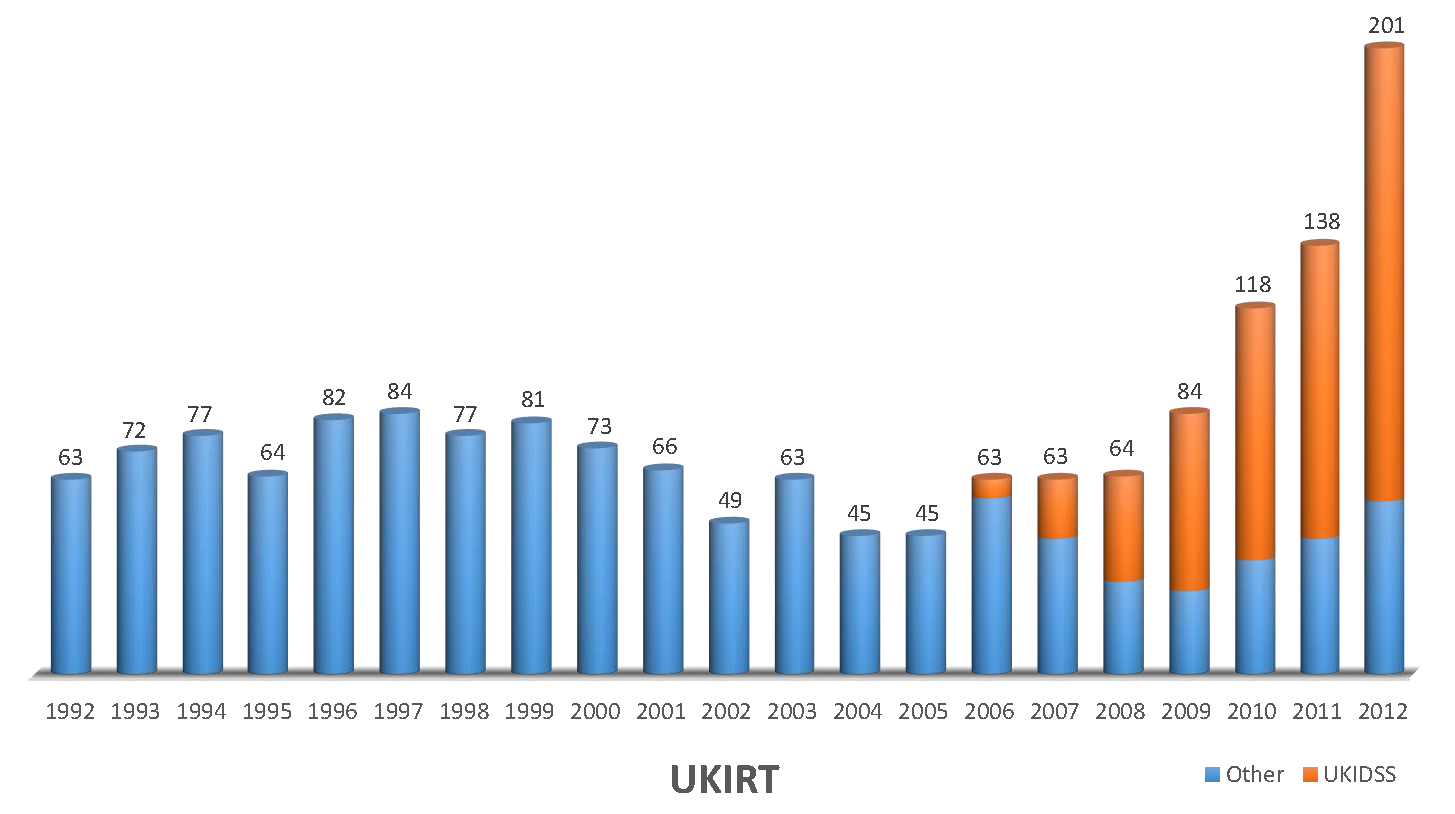
Interesting to note that 2012 was a bumper year for productivity at the UK Infra-Red Telescope (UKIRT), as demonstrated by the following nice graphic.

UKIRT-pubs-2012

Some of my colleagues have expressed a measure of consternation at the fact that unless some individual or organization steps in and offers to take over the running costs, this facility will be closed down at the end of this year (2013). Why shut down a telescope that is generating so many publications?

The answer is of course that, under the UK Government’s new plans for  Gold Open Access, astronomers will be forced to pay Article Processing Charges, possibly exceeding £1000 per paper, in order to disseminate the fruits of their research. The Science and Technology Facilities Council (STFC), which administers the budget for the UK’s astronomy research,  simply can’t afford the level of expenditure required to cover the costs associated with the number of articles being generated by the wanton exploitation of this facility. Indeed, in future, STFC will only be able to operate facilities that produce very few results worthy of publication.

I hope this clarifies the situation.

Presentation by the CEO of STFC at the IOP

Posted in Science Politics with tags , , , on February 13, 2013 by telescoper

Yesterday the Supreme Leader Chief Executive of the Science and Technology Facilities Council (STFC), Professor John Womersley, gave a presentation to the assembled masses of the Institute of Physics in London, followed by a discussion at the RAS Astronomy Forum. Topics he covered, including the Triennial Review of the Research Councils, which is seeking evidence via an open consultation exercise. Contributions are invited by the end of February.

I was planning to attend both sessions, but had pressing matters to attend to here in Sussex so wasn’t able to make it in the end. However, owing to a miracle of technology I’ve been furnished with the slides used in the presentation and, with his permission, am sharing them here as a service to the community because,as you will see,  there is a lot at stake for all of us…