Archive for the Science Politics Category

Being on the panel…

Posted in Biographical, Science Politics with tags , on March 26, 2013 by telescoper

As well as all the University of Sussex business I’ve been having to take care of over the last couple of months or so, I’ve also been trying to find time to keep up with the new round of applications to the Astronomy Grants Panel of the Science and Technology Facilities Council. I had originally thought that the 2012/13 round would be the last one on which I served, but I must have misbehaved in some way because it appears that my sentence has been extended for another year.

The latest duty required of panel members has been to assign reviewers to the new proposals, which means reading each case and trying to think of appropriate experts to assess them in detail. Normal procedure is to contact such people informally in the first instance, with Swindon Office following up by sending the actual documents if and only if they agree. fortunately, most people out there in astronomyland are very public spirited and it’s usually not that difficult to find willing reviewers.

In the course of contacting potential referees this round I had a couple of replies from people who were apparently already considering the possibility of volunteering to be on the panel next year and who therefore asked me what it would be like. I thought I’d make a few comments here in case anyone reading this blog has toyed with similar thoughts.

Basically, my view is that the AGP is extremely hard but also extremely interesting work, and it’s also the chance to work with a very friendly and cooperative group of people. From that point of view I think it’s well worth doing. Plus, of course, the wider the range of people who participate in panel work the fairer it is likely to be.

In fact, if it weren’t for the friendly company the three-day meetings in Swindon during which the final recommendations are drawn up would be truly horrendous. These meetings are extremely pressured, by the way. If I recall correctly the volume of grants to get through corresponds to about £10,000 per minute of discussion time.

On the other hand, the job is not without its frustrations. Most important of these is that there simply isn’t enough money to fund all the top-rated research proposals. Established researchers who have become used to having a steady stream of research grants are not spared this stark arithmetic. I think most people are mature enough not to take it personally when a grant application is turned down, but there are exceptions. I’ve been beset at more than one RAS dinner by disgruntled senior scientists complaining about various aspects of the AGP process. Sometimes these have been fair criticisms (e.g. about the quality of feedback) but others have been quite disturbingly ill-informed, to such an extent that I don’t think the persons concerned had even read the grant guidance…

Anyway, if you’re wondering whether to put yourself forward for nomination as a member of the AGP then please do, because the process needs to engage the community it tries to serve. If you do join up, though, just be prepared to suffer a few of the odd slings and arrows. As for me, this is definitely my last year. I have a few enough friends already, and I can’t afford to lose any more.

E-ELT: The Big Picture

Posted in Science Politics, The Universe and Stuff with tags , , , on March 4, 2013 by telescoper

Some astronomy news that made a bit of a splash over the weekend was the announcement that the UK is to invest £88 million in the European Extremely Large Telescope. This amount is to be spread over 10 years, so isn’t quite as astronomical as it sounds, but in any case it is only the UK’s contribution to a project that involves large contributions from the other countries involved in the European Southern Observatory. The UK announcement isn’t the end of the story, in fact, as not all the money needed to make the project work is yet in place.

This is all good news, especially because not long ago it seemed quite likely that the UK would have to make a choice between the E-ELT and the Square Kilometre Array. Now it looks like we’re going to be involved in both of the world’s leading ground-based observational facilities. There is a price to be paid, of course. In order to accommodate these projects within the flat-cash budget of the Science and Technology Facilities Council, difficult choices had to be made, and some things have to go. Not everyone will be happy about the outcome, but Big Science requires Big Decisions.

Anyway, it was nice to see the Observer run a piece about this story, although I was a bit baffled by the implication of the caption going with the picture used to illustrate the story:

The European Extremely Large Telescope will study the Magellanic Cloud.

I’ll avoid asking “which Magellanic Cloud (Large or Small)?” and just point out that E-ELT will study a lot more than either or both! Still, people are more likely to read web articles if they include images, so I’ll end this piece with an appropriate one.

Random Astronomical Image

Random Astronomical Image

Planck (but only in name?)

Posted in Science Politics, The Universe and Stuff with tags , , , , , , on March 3, 2013 by telescoper

First, a serious announcement. It appears that the announcement of results from the Planck Mission will be streamed live from ESA HQ on 21st March from 10.00 to 12.00 CET (whatever that is). The UK will remain on GMT until 31st March so the  ESA web server will probably crash at 9am British time on 21st March.

There’s a short press release making this announcement here. It says:

On Thursday 21 March 2013, the main scientific findings from the European Space Agency’s Planck spacecraft will be announced at a press briefing to be held at ESA’s Headquarter in Paris. Simultaneously with this event, data products and scientific papers based on the “nominal” operations period will be made public through the Planck Legacy Archive.

I was interested in the appearance of the word “nominal” in quotes in there so I searched for its meaning in the One True Chambers Dictionary, where I found:

nominal, adj relating to or of the nature of a name or noun; of names; by name; only in name; so-called, but not in reality; inconsiderable, small, minor, in comparison with the real value, hardly more than a matter of form…

Interesting. It seems that the “nominal” could mean, on the one hand, that ESA are being unusually modest about the importance of the forthcoming Planck results or, on the other, that there will now be a host of conspiracy theorists suggesting that the Planck results aren’t real….

That reminds me that years and years ago I had an idea for a crime novel with a plot that revolves around the murder of a prominent cosmologist just as some important scientific discovery is about to be announced. Suspicion gathers that the whole thing is an enormous hoax and the discovery bogus. But the experiment is shrouded in secrecy, and so expensive that it can’t easily be repeated, so  who can tell, and how?

It’s very difficult to know for sure whether any scientific discoveries are genuine or not, even if the data and analysis procedures are made public. There’s always the possibility that everything might have been fabricated simulated, but in most cases the experiment can be repeated at a later date and the fraud eventually exposed, such as in the Schön Scandal.  In Big Science, this may not be practicable. However, Big Science requires big teams of people and the chances are someone would blow the whistle, or try to…

Anyway, I know that there are people out there who take everything I write on this blog absurdly literally so I’ll spell it out that I am in no way suggesting that the Planck mission is a fraud. Or predicting that there’ll be a murder just before the announcements on March 21st. Any similarity purely coincidental and all that. And I’ve never had time to write the book anyway – perhaps a publisher might read this and offer me an advance as an incentive?

Moreover, going back to the Chambers Dictionary, I note the final definition omitted above

…according to plan (space flight)

So that’s that. Nothing sinister. I’m not sure how “nominal” acquired that meaning, mind you, but that’s another story…

Open Access and Closed Telescopes

Posted in Science Politics, The Universe and Stuff with tags , , , on February 22, 2013 by telescoper

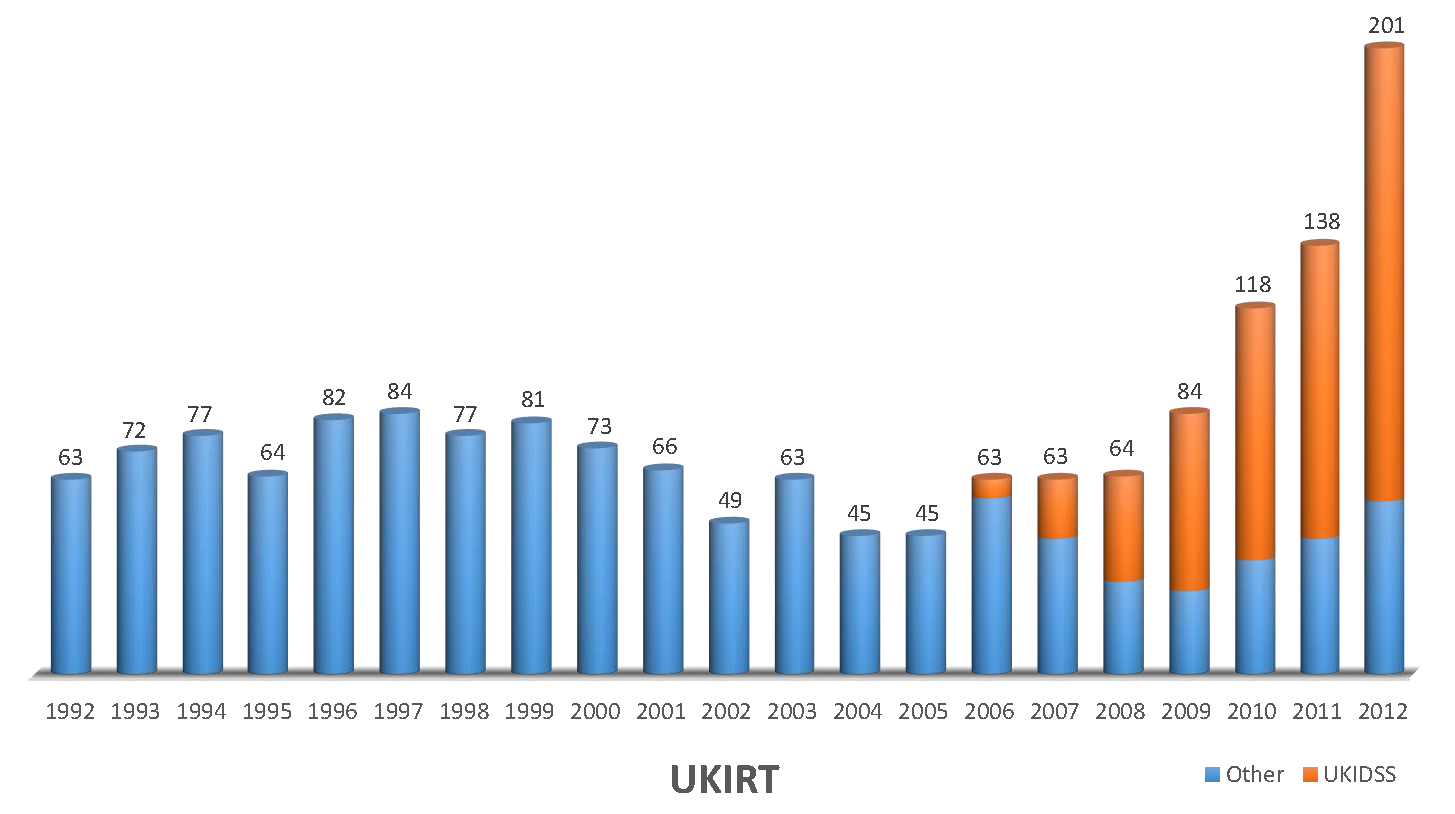
Interesting to note that 2012 was a bumper year for productivity at the UK Infra-Red Telescope (UKIRT), as demonstrated by the following nice graphic.

UKIRT-pubs-2012

Some of my colleagues have expressed a measure of consternation at the fact that unless some individual or organization steps in and offers to take over the running costs, this facility will be closed down at the end of this year (2013). Why shut down a telescope that is generating so many publications?

The answer is of course that, under the UK Government’s new plans for  Gold Open Access, astronomers will be forced to pay Article Processing Charges, possibly exceeding £1000 per paper, in order to disseminate the fruits of their research. The Science and Technology Facilities Council (STFC), which administers the budget for the UK’s astronomy research,  simply can’t afford the level of expenditure required to cover the costs associated with the number of articles being generated by the wanton exploitation of this facility. Indeed, in future, STFC will only be able to operate facilities that produce very few results worthy of publication.

I hope this clarifies the situation.

Presentation by the CEO of STFC at the IOP

Posted in Science Politics with tags , , , on February 13, 2013 by telescoper

Yesterday the Supreme Leader Chief Executive of the Science and Technology Facilities Council (STFC), Professor John Womersley, gave a presentation to the assembled masses of the Institute of Physics in London, followed by a discussion at the RAS Astronomy Forum. Topics he covered, including the Triennial Review of the Research Councils, which is seeking evidence via an open consultation exercise. Contributions are invited by the end of February.

I was planning to attend both sessions, but had pressing matters to attend to here in Sussex so wasn’t able to make it in the end. However, owing to a miracle of technology I’ve been furnished with the slides used in the presentation and, with his permission, am sharing them here as a service to the community because,as you will see,  there is a lot at stake for all of us…

Should Open Access Include Open Software?

Posted in Open Access, Science Politics, The Universe and Stuff with tags , , , , on February 4, 2013 by telescoper

Very busy today, so just time for a quick post (and associated poll) about Open Science.

As you all know I’ve been using this blog for a while to bang on about Open Access to scientific publications. I’m not going to repeat my position in detail here except to say that I’m in favour of Open Access but not at the immense cost envisaged by the Finch Report.

I thought however that it might be useful to float some opinions about wider issues related to open science. In particular, the question that often troubles me is that is open access to scientific results actually enough, or do we have to go a lot further?

I think an important aspect of the way science works is that when a given individual or group publishes a result, it should be possible for others to reproduce it (or not as the case may be). Traditional journal publications don’t always allow this. In my own field of astrophysics/cosmology, for example, results in scientific papers are often based on very complicated analyses of large data sets. This is increasingly the case in other fields too. A basic problem obviously arises when data are not made public. Fortunately in astrophysics these days researchers are pretty good at sharing their data, although this hasn’t always been the case.

However, even allowing open access to data doesn’t always solve the reproducibility problem. Often extensive numerical codes are needed to process the measurements and extract meaningful output. Without access to these pipeline codes it is impossible for a third party to check the path from input to output without writing their own version assuming that there is sufficient information to do that in the first place. That researchers should publish their software as well as their results is quite a controversial suggestion, but I think it’s the best practice for science. There isn’t a uniform policy in astrophysics and cosmology, but I sense that quite a few people out there agree with me. Cosmological numerical simulations, for example, can be performed by anyone with a sufficiently big computer using GADGET the source codes of which are freely available. Likewise, for CMB analysis, there is the excellent CAMB code, which can be downloaded at will; this is in a long tradition of openly available numerical codes, including CMBFAST and HealPix.

I suspect some researchers might be reluctant to share the codes they have written because they feel they won’t get sufficient credit for work done using them. I don’t think this is true, as researchers are generally very appreciative of such openness and publications describing the corresponding codes are generously cited. In any case I don’t think it’s appropriate to withhold such programs from the wider community, which prevents them being either scrutinized or extended as well as being used to further scientific research. In other words excessively proprietorial attitudes to data analysis software are detrimental to the spirit of open science.

Anyway, my views aren’t guaranteed to be representative of the community, so I’d like to ask for a quick show of hands via a poll…

…and you are of course welcome to comment via the usual box.

Critical Masses

Posted in Education, Science Politics with tags , , , , , , , on January 26, 2013 by telescoper

One of the interesting bits of news floating around academia at the moment is the announcement that my current employer (until the end of next week), Cardiff University is to join forces with the Universities of Bath, Exeter and Bristol in an alliance intended to create a ‘critical mass of knowledge’ and help Cardiff  ‘better compete for more research income’ (apparently by pretending to be in England rather than in Wales).  How successful this will be – or even what form this alliance will take – remains to be seen.

There’s been a lot of gossip about what inspired this move, but it’s not the first attempt to create a collaborative bloc of this kind. Last year five universities from the Midlands announced plans to do something similar. The “M5” group of   Birmingham, Leicester, Loughborough, Nottingham and Warwick got together primarily to share infrastructure in order to help them win grants, which is probably what also lies behind the Cardiff-Bath-Exeter-Bristol deal.

Of course there are also a myriad  alliances at the level of individual Schools and Departments. I’ll shortly be joining the University of Sussex, which is a major player in SEPNET – the South-East Physics Physics Network which was set up with help from HEFCE There are other such networks in England, as well as SUPA in Scotland, funded by the devolved Scottish Funding Council. Attempts to form a similar arrangement for Physics in Wales were given short shrift by the Welsh Funding Agency, HEFCW. The inability or unwillingness of HEFCW to properly engage with research in Wales is no doubt behind Cardiff’s decision to seek alliances with English universities but I wonder how it will translate into funding. Surely HEFCE wouldn’t be allowed to fund a Welsh University, so presumably this is more aimed at funding from the research councils or further afield, perhaps in Europe. Or perhaps the idea is that if GW4 can persuade HEFCE to fund Bath, Bristol and Exeter, HEFCW will be shamed into stumping up something for Cardiff? Sneaky.

Anyway, good luck to the new “GW4” alliance. Although I’m moving to pastures new I’ll certainly keep an eye on any developments, and hope that they’re positive. The only thing that really disturbs me is that the name “Great Western Four” is apparently inspired by the Great Western Railway, now run by an outfit called First Great Western. My recent experiences of travelling on that have left a lot to be desired and I’m sure the name will have negative connotations in the minds of many who are fed up of their unreliable, overcrowded, overpriced and poorly managed services. They say a rose by any other name would smell as sweet, but so far this is only a name – and one with a distinctly questionable odour.

REF moves the goalposts (again)

Posted in Bad Statistics, Education, Science Politics with tags , , , on January 18, 2013 by telescoper

The topic of the dreaded 2014 Research Excellence Framework came up quite a few times in quite a few different contexts over the last few days, which reminded me that I should comment on a news item that appeared a week or so ago.

As you may or may not be aware, the REF is meant to assess the excellence of university departments in various disciplines and distribute its “QR” research funding accordingly.  Institutions complete submissions which include details of relevant publications etc and then a panel sits in judgement. I’ve already blogged of all this: the panels clearly won’t have time to read every paper submitted in any detail at all, so the outcome is likely to be highly subjective. Moreover, HEFCE’s insane policy to award the bulk of its research funds to only the very highest grade (4* – “internationally excellent”) means that small variations in judged quality will turn into enormous discrepancies in the level of research funding. The whole thing is madness, but there seems no way to inject sanity into the process as the deadline for submissions remorselessly approaches.

Now another wrinkle has appeared on the already furrowed brows of those preparing REF submissions. The system allows departments to select staff to be entered; it’s not necessary for everyone to go in. Indeed if only the very best researchers are entered then the typical score for the department will be high, so it will appear  higher up  in the league tables, and since the cash goes primarily to the top dogs then this might produce almost as much money as including a few less highly rated researchers.

On the other hand, this is a slightly dangerous strategy because it presupposes that one can predict which researchers and what research will be awarded the highest grade. A department will come a cropper if all its high fliers are deemed by the REF panels to be turkeys.

In Wales there’s something that makes this whole system even more absurd, which is that it’s almost certain that there will be no QR funding at all. Welsh universities are spending millions preparing for the REF despite the fact that they’ll get no money even if they do stunningly well. The incentive in Wales is therefore even stronger than it is in England to submit only the high-fliers, as it’s only the position in the league tables that will count.

The problem with a department adopting the strategy of being very selective is that it could have a very  negative effect on the career development of younger researchers if they are not included in their departments REF submission. As well as taking the risk that people who manage to convince their Head of School that they are bound to get four stars in the REF may not have the same success with the various grey eminences who make the decision that really matters.

Previous incarnations of the REF (namely the Research Assessment Exercises of 2008 and 2001) did not publish explicit information about exactly how many eligible staff were omitted from the submissions, largely because departments were extremely creative in finding ways of hiding staff they didn’t want to include.

Now however it appears there are plans that the Higher Education Statistics Agency (HESA) will publish its own figures on how many staff it thinks are eligible for inclusion in each department. I’m not sure how accurate these figures will be but they will change the game, in that they will allow compilers of league tables to draw up lists of the departments that prefer playing games to   just allowing the REF panels to  judge the quality of their research.

I wonder how many universities are hastily revising their submission plans in the light of this new twist?

Science Propaganda

Posted in Science Politics, The Universe and Stuff with tags , , on January 2, 2013 by telescoper

I thought I’d do a quick rehash of an old post which is vaguely relevant to the still simmering controversy generated by the Cox-Ince editorial I blogged about before Christmas.

The legitimate interface between science and society has many levels to it. One aspect is the simple need to explain what science tells us about the world in order that people can play an informed part in our increasingly technological society. Another is that there needs to be encouragement for (especially young) people to study science seriously and to make it their career in order to maintain the supply of scientists for the future. And then there is the issue of the wider cultural implications of science, its impact on other belief-systems (such as religions) other forms of endeavour (such as art and literature) and even for government.

I think virtually all scientists would agree with the need for engagement in at least the first two of these. In fact, I’m sure most scientists would love to have the chance to explain their work to a lay audience, but not all subjects are as accessible or inspirational as, say, astronomy. Unfortunately also, not all scientists are very good at this sort of thing. Some might even be counter-productive if inflicted on the public in this way. So it seems relatively natural that some people have had more success at this activity than others, and have thus become identified as “science communicators”. Although some scientists are a bit snobby about those who write popular books and give popular talks, most of us agree that this kind of work is vital for both science and society.

Vital, yes, but there are dangers. The number of scientists involved in this sort of work is probably more limited than it should be owing to the laziness of the popular media, who generally can’t be bothered to look outside London and the South-East for friendly scientists. The broadsheet newspapers employ very few qualified specialists among their staff even on the science pages so it’s a battle to get meaningful scientific content into print in the mass media. Much that does appear is slavishly regurgitated from one of the press agencies who are kept well fed by the public relations experts employed by research laboratories and other science institutes.

These factors mean that what comes out in the media can be a distorted representation of the real scientific process. Heads of research groups and laboratories are engaged in the increasingly difficult business of securing enough money to continue their work in these uncertain financial times. Producing lots of glossy press releases seems to be one way of raising the profile and gaining the attention of funding bodies. Most scientists do this with care, but sometimes the results are ludicrously exaggerated or simply wrong. Some of the claims circulating around the time the Large Hadron Collider was switched on definitely fell into one or more of those categories. I realise that there’s a difficult balance to be struck between simplicity and accuracy, and that errors can result from over-enthusiasm rather than anything more sinister, but even so we should tread carefully if we want the public to engage with what science really is.

The Cox-Ince editorial is refreshingly clear about the limitations of science:

Science is a framework with only one absolute: all opinions, theories and “laws” are open to revision in the face of evidence. It should not be seen or presented, therefore, as a body of inviolate knowledge against which policy should be judged; the effect of this would be to replace one priesthood with another. Rather, science is a process, a series of structures that allow us, in as unbiased a way as possible, to test our assertions against Nature.

However, there is still far too much science reporting that portrays as facts  ideas and theories which have little or no evidence to support them. This isn’t science communication, it’s science propaganda and I think too many scientists go along with it. There’s a difficult balance to be struck, between engaging the public with inspirational but superficial TV programmes and explaining the intellectual struggles that science really involves.  Give the public the latter without any of the former and they’ll surely switch off!

Most worryingly is the perceived need to demonstrate black-and-white certainty over issues which are considerably more complicated than that. This is another situation where science popularisation becomes science propaganda. I’m not sure whether the public actually wants its scientists to make pronouncements as if they were infallible oracles, but the media definitely do. Scientists sometimes become cast in the role of priests, which is dangerous, especially when a result is later shown to be false. Then the public don’t just lose faith with one particular scientist, but with the whole of science.

Science is not about certainty. What it is a method for dealing rationally with uncertainty. It is a pragmatic system primarily intended for making testable inferences about the world using measurable, quantitative data. Scientists look their most arrogant and dogmatic when they try to push science beyond the (relatively limited) boundaries of its applicability and to ride roughshod over alternative ways of dealing with wider issues including, yes, religion.

I don’t have any religious beliefs that anyone other than me would recognize as such. I am also a scientist. But I don’t see any reason why being a scientist or not being a scientist should have any implications for my (lack of) religious faith. God (whatever that means) is, by construction, orthogonal to science. I’m not at all opposed to scientists talking about their religion or their atheism in the public domain. I don’t see why their opinions are of any more interest than anyone else’s in these matters, but I’m quite happy to hear them voiced.

This brings us to the question, often raised by hardline atheists, as to whether more scientists  should follow Richard Dawkins’ lead and be champions of atheism in the public domain. As a matter of fact, I agree with some of Dawkins’ agenda, such as his argument for the separation of church and state, although I don’t feel his heavy-handed use of the vitriol in The God Delusion achieved anything particularly positive (except for his bank balance, perhaps). But I don’t think it’s right to assume that all scientists should follow his example. Their beliefs are their business. I don’t think we will be much better off if we simply replace one set of priests with another. In this respect I wholeheartedly agree with Peter Higgs who has recently described Dawkins as “embarrassing”.

So there you have my plea for both public and scientists to accept that science will never have all the answers. There will always be “aspects of human experience that, even in an age of astonishing scientific advance, remain beyond the reach of scientific explanation”.

Can I have the Templeton Prize now please?

The Cox-Ince affair rumbles on..

Posted in Science Politics with tags , , on January 1, 2013 by telescoper

The Cox-Ince controversy rumbles on, apparently…

Ken's avatarOpen Parachute

Popular science presenters like Brian Cox are sometimes criticised by colleagues suffering from a bit of professional jealousy – although it’s a lot better than in the old days. I think most scientists today recognise the need for good science communication with the public – who, after all, are financing our science through the taxation system.

Brian Cox and his mate Robin Ince wrote a recent New Statesman editorial promoting a better understanding of the nature of science and its role in public decision-making (see Politicians must not elevate mere opinion over science). It made some good points – but upset some people. The jealousy this time seems to come from a few historians and sociologists – and not scientists themselves.

I think their criticism reveals an unfortunate attitude towards the scientific process, or indeed a misunderstanding of that process. Nevertheless, the debate does reveal some aspects of the…

View original post 2,382 more words