Archive for the Science Politics Category

Open Letter about Cuts to UK Theoretical Physics Funding

Posted in Science Politics with tags , , , , , , , , on March 7, 2026 by telescoper

I am remiss in having forgotten until now to circulate an open letter that has been set up to express support for the high energy physics theory and particle theory communities in the United Kingdom. I signed the letter a few days ago but neglected to circulate it for further signature.

The letter reads:

We the undersigned wish to raise serious concerns about the current cuts to UK high energy particle physics theory grants by signing up to the letter below. The open letter and list of signatories are printed on this page. Individuals who wish to support this initiative may add their name as a signatory by completing the form below. This letter will be sent to Lord Patrick Vallance (Minister of State for Science, Innovation, Research and Nuclear), Liz Kendall (Secretary of State for Science, Innovation and Technology), Chi Onwurah MP (Chair of the UK House of Commons Science, Innovation and Technology Select Committee), and Prof. Sir Ian Chapman (CEO of UKRI).

We are signing this letter to raise serious concerns about the proposed cuts to high energy physics theory and particle theory in the United Kingdom. The UK is a world leader in this area: its historical activity led to the development of the Standard Model of particle physics and the ongoing development of string theory. UK theoretical physicists provide essential input to major international experiments, including the Large Hadron Collider at CERN and next-generation programmes in neutrino physics, gravitational waves, and cosmology, enabling rigorous interpretation of data and the extraction of fundamental insight. The strength of the UK community lies in its intellectual breadth and integration: researchers operate across phenomenology, formal theory, and their interface, and sustained dialogue between these areas underpins the UK’s leading role in global collaborations and internationally recognised research groups. In parallel, UK theorists advance the theoretical foundations of fundamental physics.

These groups and scientists can only operate thanks to critical funding by UK research council funding.

The current apparent scale of the cuts to the Particle Physics, Astronomy and Nuclear Physics area (30% to the overall budget) will result, when rising costs are taken into account, in a much greater than 50% cut in the number of postdoctoral researchers active in these areas in the UK. This will have a devastating effect on the ability of the UK to maintain its leading role in the subject.

Such funding decisions will affect the famously excellent reputation of the UK university sector. It will risk the health of UK physics departments and will therefore damage economic growth in the UK. Many scientists trained in this sector subsequently move into senior positions in technical industries such as machine learning and finance. Theorists at universities play a crucial role in the training and development of the inventors and disruptors of the future.

We urge UK politicians and leaders in the UK funding organisations to carefully consider the implications of the current direction of funding decisions before it is too late and irreparable damage is done to the UK theory community.

You can sign the letter and see a list of existing signatories here.

On the Blog

Posted in Biographical, Science Politics with tags , , , on February 15, 2026 by telescoper

This “shitty WordPress blog” (to use someone’s memorable phrase) has been going for over 17 years now. I have occasionally thought about breaking the habit but having gone this far I think I might as well keep going until I retire, by which time in it will have reached the grand old age of 20.

In recent years the traffic here has settled down to a level about 40% lower than it was in its heyday. There are about 2,000 people recceiving posts by email and a few hundred who read it on the fediverse; these are not counted in the web traffic statistics unless they click through to the website.

The most popular year ever for web traffic was 2012, in which In The Dark attracted 464k visitors, whereas for the last few years it has been more like 260k per annum. Part of the reason for the drop will have been my move to Ireland and not posting so much of relevance to people in the UK, which was my main audience. I prefer not to think that the decline is because I’m now older and my posts more boring, but that may well the case. Twitter used to be the source of a considerable number of clicks too, but the changes introduced by Elon Musk put a stop to that even before I left that platform. In any case the blog numbers are far higher than I thought I would attract when I started blogging way back in 2008.

Anyway, I have noticed that in recent weeks the levels of traffic have been closer to those of a decade or more ago, with several notifications like this popping up:

In the first two weeks of February, for example, there have been over 30k views, i.e. over 2000 per day. The drivers of this increase have been two posts about the STFC funding crisis, first mine at the end of January and then a Guest Post by George Efstathiou which has been shared very widely.

I suppose the recent increase in traffic is a new manifestation of the old adage that “bad news sells newspapers”…

The STFC Funding Crisis – Guest Post by George Efstathiou

Posted in Science Politics with tags , , , on February 6, 2026 by telescoper

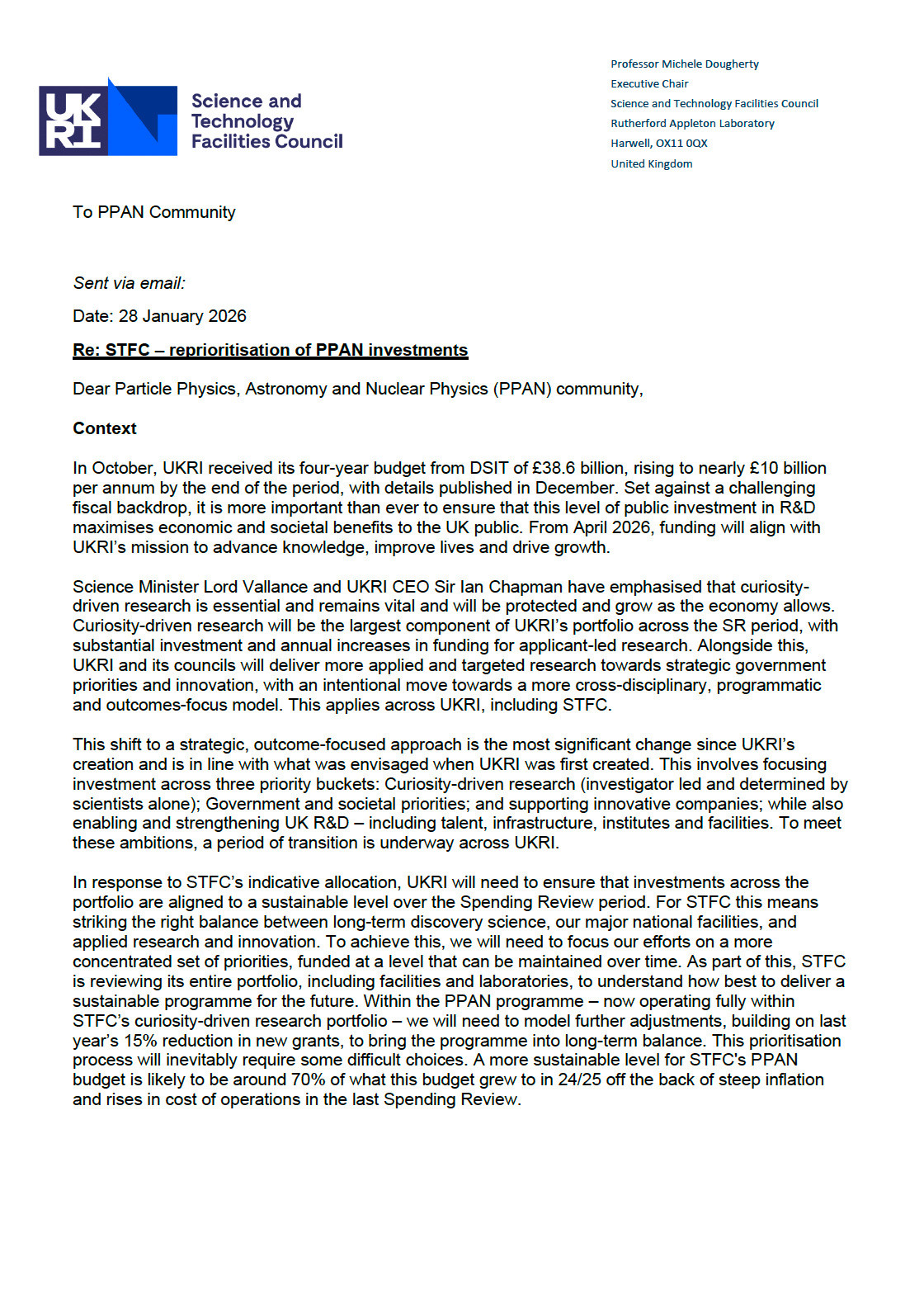
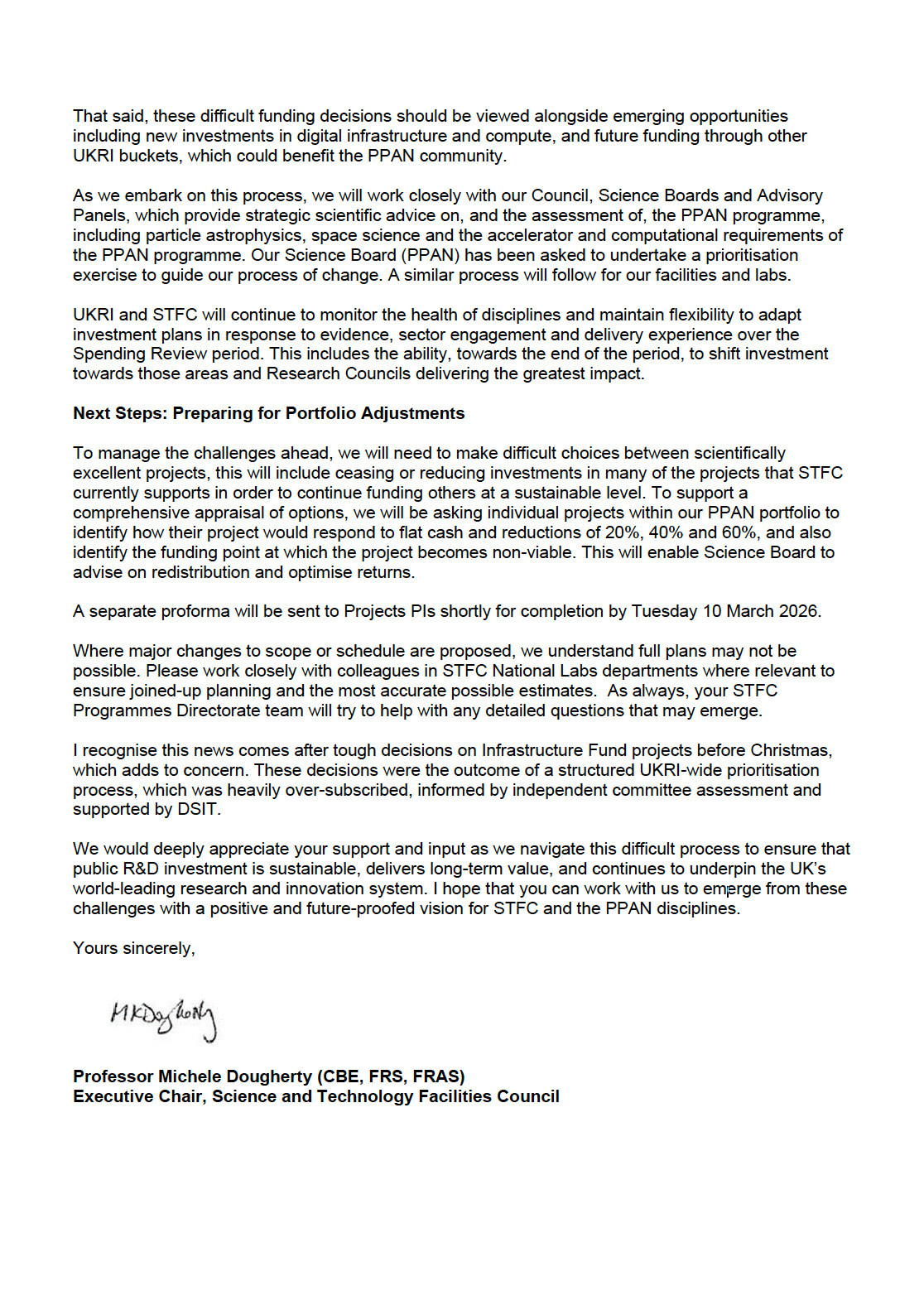
The following guest post by George Efstathiou is a response to the current STFC funding crisis I blogged about here, and specifically to a letter by the Executive Chair of STFC, Professor Michele Dougherty. I include the letter here for completeness:

George’s post follows:

–o–

I am glad that Michele Dougherty has finally communicated the position of STFC to the community.  There is a  glaring inconsistency between paragraphs 2 and 4 of her letter.

I have just finished a 5 year term on the STFC Science Board and now that the problems are in the public domain I am able to speak freely. In brief, the financial problems at STFC have arisen because of high inflation and high costs of energy against the backdrop of long term flat cash settlements. The national labs/facilities are particularly vulnerable to both. In addition, the labs invested heavily in ambitious upgrades that are now acknowldeged to be unsustainable. However, it is difficult to downsize programmes at the facilities quickly because it takes time to cut staff levels. In fact, money needs to be spent up front to achieve long term reductions in staff levels. From my time on Science Board, I can see no solution given the SR settlement other than for PPAN to take a big cut. Asking for more money from UKRI will likely fall on deaf ears, since the STFC problems are (to a large extent) of their own making.

The problem, as I see it, is whether it is possible for STFC to construct a recovery programme for PPAN science. The impression given in the Dougherty letter is that the ‘bucket’ allocation formula constrains STFC and so they are forced to reduce PPAN expenditure (Bucket 1) at the expense of ‘outcome driven’ growth related expenditure (Bucket 2) which goes mostly to the government labs/facilities. Science board was told that the new allocation formula was to blame for the huge cuts in the PPAN programme. Furthermore, the STFC plan to shift towards ‘growth related’ priorities is envisaged by STFC to lead to a long term cut in PPAN science. This situation was described to Science Board as the ‘new normal’. This is clearly inconsistent with paragraph 2 in Dougherty’s letter, which states that ‘curiosity-driven research will be the largest component of UKRI’s portfolio across the SR period, with substantial investment and annual increases in funding for applicant-led research’.

I discussed this contradiction with Paul Nurse, who told me that Patric Vallance had assured him that funding for basic research would not be cut under the new funding model. This prompted me to write to Michele Dougherty and Grahame Blair asking for clarification on the interpretation of the new funding model by STFC. I did not receive a reply.

This is what I think is going on. I believe that it is the STFC Executive Board that has decided to prioritise the facilities ahead of the PPAN programme. This is their decision and is not forced on them by the new allocation formula. I also believe that the their priorities are a reflection of conflicts of interest in the governance structure of STFC. Decisions at STFC are made by the Executive Board (EB) which is composed mostly of lab/facility directors and senior programme managers. The Council and Science Boards are advisory. The EB is therefore heavily biased in favour of the facilities component of the STFC portfolio. This bias has afflicted STFC since it was first created. I wrote to Michele Dougherty last July concerning the governance structure at STFC.  I did not get a reply.

The situation for PPAN science is very serious and I objected to Science Board being used to conduct a ‘prioritisation’ exercise. At these high levels of cuts, decisions depend on many programmatic factors that Science Board cannot judge.  Large cuts to key PPAN projects will surely raise questions of whether the UK should continue to pay international subscriptions. In addition, the UK Space Agency is being absorbed into DSIT and there is uncertainty concerning the relationship between UKSA and STFC. We also have the absurd spectacle of deep cuts to PPAN projects running alongside a call for white papers on future space missions.

I would urge the community to ask questions of STFC. It is important, in particular, to extract an answer from Michele Dougherty to the question of ‘how much freedom does STFC have to distribute funds between the three buckets?’. This is pertinent to the issue of whether STFC can construct a recovery plan for PPAN science. I also think that it is worth pursuing questions on the governance of STFC, which are at the heart of the problems. 

George Efstathiou FRS
Emeritus Professor of Astrophysics (1909)
Kavli Institute for Cosmology
Madingley Road
Cambridge

That Letter from UKRI

Posted in Science Politics with tags , , , , on February 2, 2026 by telescoper

I only have time for a quick post today but I think it’s important to comment on the very feeble open letter circulated (yesterday) to “the research and innovation community” by the Chief Executioner Executive of UKRI. I think it’s feeble because it seems to have been intended to clarify what is going on, but does nothing of the sort. In fact, to me, it reads like it was written by someone who doesn’t know what he is doing and is playing for time by waffling.

The letter basically tells researchers working in areas outside the STFC remit (i.e. in anything except particle physics, astronomy and nuclear physics) not to worry because it’s only STFC that will suffer. This is the “explanation”:

In order to remain sustainable, STFC must make significant cumulative savings: a decrease of £162 million relative to our forecasts for their operational costs. The £162 million is the total net reduction in STFC’s annual costs that they must achieve by the end of the 2029 and 2030 financial year. It is not a £162 million saving in each year of the current SR period. Instead, STFC needs to reshape its cost base over the whole SR period so that their budget is balanced by 2029 and 2030 and key facilities are funded properly and sustainably.

That is not the situation at other councils and we do not anticipate equivalent measures will be necessary outside of STFC.

One of the problems with this logic is that a huge slice of STFC’s budget is spent on facilities that support science outside STFC’s scientific remit. The Diamond Light Source, for example, which has annual running costs of almost £70 million caters largely to the EPSRC and BBSRC communities. It makes no sense to me to require particle physics, astronomy and nuclear physics reseachers to bear the entire consequences of cost overruns at this facility when other communities benefit from it.

I’m sure the UKRI Chief Executive knows this, so it must have been a deliberate decision to wield the axe in this way. In other words it’s a conscious downgrade of particle physics, astronomy and nuclear physics. In the new regime, these are less important than any other branch of scientific research.

I’m out of it now, but I always felt that STFC should never have been set up as a research council. It should have been a service organisation, as its title – the Science and Technology Facilities Council – suggests. When STFC was created, back in 2007, funding for particle physics, astronomy and nuclear physics research as opposed to facilities should have been administered by EPSRC. Whether intentionally or not, the current arrangements make these areas of fundamental physics exceptionally vulnerable. We saw the consequences of that back in 2007/8 and it is happening again.

A New STFC Funding Crisis

Posted in Science Politics with tags , , , , on January 29, 2026 by telescoper

I started doing this blog back in 2008 and over the subsequent couple of years wrote many posts about a funding crisis affecting the Science and Technology Facilities Council, the UK funding agency that covers particle physics and astronomy research that had been created in 2007. I particularly remember the cancellation of the experiment Clover back in 2009 which had devastating and demoralising consequences for staff at Cardiff (where I was working at the time). It looks like a return to the Bad Old Days.

I moved from the UK eight years ago and haven’t really kept up with news related to the science funding situation there so I was very disturbed last night to see a message from the Royal Astronomical Society containing the following:

In a letter from its Executive Chair, Professor Michele Dougherty, the research council indicates that the budget for particle physics, astronomy and nuclear physics together will drop by around 30%. The letter also asks project teams to plan for scenarios where their funding is reduced by 20%, 40% and 60%.

All this is on top of a recent squeeze that has led to grants being delayed to make savings of around 15%. The full letter is here:

There’s a further report about this in Research Professional News which, unusually for that source, is not behind a paywall. It leads with

Exclusive: Science and Technology Facilities Council seeks £162m cost savings, with existing projects facing axe

The article goes on to point out the dangers of cuts of this scale to physics departments in the UK, many of which have a significant fraction of their activity in astronomy and particle physics.

The additional reduction and prospect of cuts to ongoing projects is likely to be felt as a hammer blow by physics departments in UK universities, of which a quarter are already at risk of closure.

Grim times indeed. It looks to me like the people running UKRI, the umbrella organization for all the UK research councils which has an annual budget of £8bn, have decided to throw STFC under the bus to chase shorter-term economically driven projects and to hell with the long-term funding of basic research. In Ireland we’re familiar with the consequences of that approach.

Still, at least the UK has the Astronomer Royal as an independent voice to speak up against these cuts. The current Astronomer Royal is… checks notes… oh… Michelle Dougherty, Executive Chair of STFC.

Ireland in CERN!

Posted in Science Politics, The Universe and Stuff with tags , , , , , , , , on October 22, 2025 by telescoper
Photo by Pietro Battistoni on Pexels.com

I saw the news today that the Republic of Ireland is now officially an associate member state of the Conseil Européen pour la Recherche Nucléaire, better known as CERN. This has been in the pipeline for a while: I blogged about it here, for example. But today’s the day that Ireland formally joined.

I think this is a very good move for Irish physics, and indeed for Ireland generally. I will, however, repeat a worry that I have expressed previously. There is an important point about CERN membership, however, which I hope is not sidelined. The case for joining CERN made at political levels was largely about the return in terms of the potential in contracts to technology companies based in Ireland from instrumentation and other infrastructure investments. This was also the case for Ireland’s membership of the European Southern Observatory (ESO), which Ireland joined 7 years ago. The same thing is true for involvement in the European Space Agency, which Ireland joined in 1975. These benefits are of course real and valuable and it is entirely right that arguments should involve them.

Looking at CERN membership from a purely scientific point of view, however, the return to Ireland will be negligible unless there is a funding to support scientific exploitation of the facility. That would include funding for academic staff time, and for postgraduate and postdoctoral researchers to build up an active community as well as, e.g., computing facilities. This need not be expensive even relative to the modest cost of associate membership (approximately  €1.9M). I would estimate a figure of around half that would be needed to support CERN-based science. I am given to understand that some funds have been made available as part of the joining arrangements, but I don’t know the details.

As I have mentioned before, Ireland’s membership of ESO provides a cautionary tale. The Irish astronomical community was very happy about the decision to join ESO, but that decision was not accompanied by significant funding to exploit the telescopes. Few astronomers have therefore been able to benefit from ESO membership. While there are other benefits of course, the return to science has been extremely limited. The phrase “to spoil a ship for a ha’porth of tar” springs to mind.

Although Ireland joined ESA almost fifty years ago, the same issue applies there. ESA member countries pay into a mandatory science programme which includes, for example, Euclid. However, the Irish Government did not put any resources on the table to allow full participation in the Euclid Consortium. There is Irish involvement in other ESA projects (such as JWST) but this is somewhat piecemeal. There is no funding programme in Ireland dedicated to the scientific exploitation of ESA projects.

Under current arrangements the best bet in Ireland for funding for ESA, ESO or CERN exploitation is via the European Research Council, but to get a grant from that one has to compete with much better developed communities in those areas.

The recent merger of Science Foundation Ireland and the Irish Research Council to form a single entity called Research Ireland could provide an opportunity to correct this shortfall in funding for science exploitation. The reorganization won’t do anything on its own, however: the overall level of public sector research funding will have to increase dramatically from its current level, well below the OECD average. The recent Budget in Ireland for 2026 does include an allocation of €426 million for research under the National Development Plan, but how much of this will find its way into basic research generally and CERN science in particular?

Nobel Prize for Physics Speculation

Posted in Biographical, Science Politics, The Universe and Stuff with tags , on October 6, 2025 by telescoper

Just to mention that tomorrow (Tuesday, October 7th 2025) will see the announcement of this year’s Nobel Prize for Physics. I must remember to make sure my mobile phone is fully charged so I can be easily reached, although I am likely to be lecturing when the announcement is made.

The announcement of the Nobel Prize for Physics on Tuesday is preceded today (Monday 6th) by the announcement of the Prize for Applications of Physics to Physiology or Medicine, and followed on Wednesday by the Prize for Applications of Physics to Chemistry. You can find links to all the announcements here.

I do, of course, already have a Nobel Prize Medal of my own already, dating from 2006, when I was lucky enough to attend the prize-giving ceremony and banquet.

I was, however, a guest of the Nobel Foundation rather than a prizewinner, so my medal is made of chocolate rather than gold. I think after 19 years the chocolate is now inedible, but it serves as a souvenir of a very nice weekend in Stockholm! Sadly one of the Laureates whose award we were celebrating passed away recently.

Regular readers of this blog may recall that I called it correctly in 2022 when Alain Aspect, John F. Clauser and Anton Zeilinger won the Nobel Prize for Physics that year. I had, however, predicted them every year for many years until they won, and they won’t win it again.

I drew a blank in 2023 when attosecond light pulses were the topic and was completely wrongfooted last when the 2024 Nobel Prize for Physics was awarded to John J. Hopfield and Geoffrey E. Hinton “for foundational discoveries and inventions that enable machine learning with artificial neural networks”. I didn’t see that one coming at all.

I really have no idea who will win it this year, but I’ll suggest that there’s still an outside chance for Michael Berry and Yakir Aharonov for their work on the geometric phase, although if they were going to win they probably would have done so by now.

To find out who the lucky winners you’ll have to wait for the announcement, around about 10.45 (UK/Irish time) on Tuesday morning. I’ll update this post when the wavefunction has collapsed.

Feel free to make your predictions through the comments box below!

Update: I’m not often right but I was wrong again: the 2025 Nobel Prize for Physics goes to John Clarke, Michel H. Devoret and John M. Martinis “for the discovery of macroscopic quantum mechanical tunnelling and energy quantisation in an electric circuit”…

https://www.nobelprize.org/prizes/physics/2025/press-release/

ResearchFish Again

Posted in Biographical, Science Politics with tags , , , , , , on April 1, 2025 by telescoper

One of the things I definitely don’t miss about working in the UK university system is the dreaded Researchfish. If you’ve never heard of this bit of software, it’s intended to collect data relating to the outputs of research grants funded by the various Research Councils. That’s not an unreasonable thing to want to do, of course, but the interface is – or at least was when I last used it several years ago – extremely clunky and user-unfriendly. That meant that, once a year, along with other academics with research grants (in my case from STFC) I had to waste hours uploading bibliometric and other data by hand. A sensible system would have harvested this automatically as it is mostly available online at various locations or allowed users simply to upload their own publication list as a file; most of us keep an up-to-date list of publications for various reasons (including vanity!) anyway. Institutions also keep track of all this stuff independently. All this duplication seemed utterly pointless.

I always wondered what happened to the information I uploaded every year, which seemed to disappear without trace into the bowels of RCUK. I assume it was used for something, but mere researchers were never told to what purpose. I guess it was used to assess the performance of researchers in some way.

When I left the UK in 2018 to work full-time in Ireland, I took great pleasure in ignoring the multiple emails demanding that I do yet another Researchfish upload. The automated reminders turned into individual emails threatening that I would never again be eligible for funding if I didn’t do it, to which I eventually replied that I wouldn’t be applying for UK research grants anymore anyway. So there. Eventually the emails stopped.

Then, about three years ago, ResearchFish went from being merely pointless to downright sinister as a scandal erupted about the company that operates it (called Infotech), involving the abuse of data and the bullying of academics. I wrote about this here. It then transpired that UKRI, the umbrella organization governing the UK’s research council had been actively conniving with Infotech to target critics. An inquiry was promised but I don’t know what became of that.

Anyway, all that was a while ago and I neither longer live nor work in the UK so why mention ResearchFish again, now?

The reason is something that shocked me when I found out about it a few days ago. Researchfish is now operated by commercial publishing house Elsevier.

Words fail. I can’t be the only person to see a gigantic conflict of interest. How can a government agency allow the assessment of its research outputs to be outsourced to a company that profits hugely by the publication of those outputs? There’s a phrase in British English which I think is in fairly common usage: marking your own homework. This relates to individuals or organizations who have been given the responsibility for regulating their own products. Is very apt here.

The acquisition of Researchfish isn’t the only example of Elsevier getting its talons stuck into academia life. Elsevier also “runs” the bibliometric service Scopus which it markets as a sort of quality indicator for academic articles. I put “runs” in inverted commas because Scopus is hopelessly inaccurate and unreliable. I can certainly speak from experience on that. Nevertheless, Elsevier has managed to dupe research managers – clearly not the brightest people in the world – into thinking that Scopus is a quality product. I suppose the more you pay for something the less inclined you are to doubt its worth, because if you do find you have paid worthless junk you look like an idiot.

A few days ago I posted a piece that include this excerpt from an article in Wired:

Every industry has certain problems universally acknowledged as broken: insurance in health care, licensing in music, standardized testing in education, tipping in the restaurant business. In academia, it’s publishing. Academic publishing is dominated by for-profit giants like Elsevier and Springer. Calling their practice a form of thuggery isn’t so much an insult as an economic observation. 

With the steady encroachment of the likes of Elsevier into research assessment, it is clear that as well as raking in huge profits, the thugs are now also assuming the role of the police. The academic publishing industry is a monstrous juggernaut that is doing untold damage to research and is set to do more. It has to stop.

Ireland Joining CERN

Posted in Science Politics, The Universe and Stuff with tags , , , , , , on February 20, 2025 by telescoper

The big news in Irish physics this week was the announcement that Ireland’s application to join the European Organisation for Nuclear Research (CERN) has been accepted in principle, and the country is expected to become an associate member in 2026. The formal process to join began in late 2023, as described here. Maynooth University responded to the news in positive fashion here, including the statement that

This important decision represents a transformative step for Irish science, research, and innovation, unlocking unparalleled opportunities for students, researchers, and industry.

I think this is a very good move for Irish physics, and indeed for Ireland generally. I will, however, repeat a worry that I have expressed previously. There is an important point about CERN membership, however, which I hope is not sidelined. The case for joining CERN made at political levels is largely about the return in terms of the potential in contracts to technology companies based in Ireland from instrumentation and other infrastructure investments. This was also the case for Ireland’s membership of the European Southern Observatory, which Ireland joined almost 7 years ago. The same thing is true for involvement in the European Space Agency, which Ireland joined in 1975. These benefits are of course real and valuable and it is entirely right that arguments should involve them.

Looking at CERN membership from a purely scientific point of view, however, the return to Ireland will be negligible unless there is a funding to support scientific exploitation of the facility. That would include funding for academic staff time, and for postgraduate and postdoctoral researchers to build up an active community as well as, e.g., computing facilities. This need not be expensive even relative to the modest cost of associate membership (approximately  €1.9M). I would estimate a figure of around half that would be needed to support CERN-based science.

The problem is that research funding for fundamental science (such as particle physics) in Ireland has been so limited as to be virtually non-existent by a matter of policy at Science Foundation Ireland, which basically only funded applied research. Even if it were decided to target funding for CERN exploitation, unless there is extra funding that would just lead to the jam being spread even more thinly elsewhere.

As I have mentioned before, Ireland’s membership of ESO provides a cautionary tale. The Irish astronomical community was very happy about the decision to join ESO, but that decision was not accompanied by significant funding to exploit the telescopes. Few astronomers have therefore been able to benefit from ESO membership. While there are other benefits of course, the return to science has been extremely limited. The phrase “to spoil a ship for a ha’porth of tar” springs to mind.

Although Ireland joined ESA almost fifty years ago, the same issue applies there. ESA member countries pay into a mandatory science programme which includes, for example, Euclid. However, did not put any resources on the table to allow full participation in the Euclid Consortium. There is Irish involvement in other ESA projects (such as JWST) but this is somewhat piecemeal. There is no funding programme in Ireland dedicated to the scientific exploitation of ESA projects.

Under current arrangements the best bet in Ireland for funding for ESA, ESO or CERN exploitation is via the European Research Council, but to get a grant from that one has to compete with much better developed communities in those areas.

The recent merger of Science Foundation Ireland and the Irish Research Council to form a single entity called Research Ireland perhaps provides an opportunity to correct this shortfall. If I had any say in the new structure I would set up a pot of money specifically for the purposes I’ve described above. Funding applications would have to be competitive, of course, and I would argue for a panel with significant international representation to make the decisions. But for this to work the overall level of public sector research funding will have to increase dramatically from its current level, well below the OECD average. Ireland is currently running a huge Government surplus which is projected to continue growing until at least 2026. Only a small fraction of that surplus would be needed to build viable research communities not only in fundamental science but also across a much wider range of disciplines. Failure to invest now would be a wasted opportunity. There is currently no evidence of the required uplift in research spending despite the better-than-healthy state of Government finances.

On Elon Musk

Posted in Politics, Science Politics with tags , on February 13, 2025 by telescoper

I’m taking the liberty of reblogging this post about the Royal Society’s inaction in the case of Elon Musk. I urge you to read the post. As I said in a previous article:

The venerable Royal Society still counts him as a Fellow, despite his overtly antiscientific dissemination of false information and his support for far-right extremism. I don’t know how Musk was elected an FRS in 2018, perhaps before the worst of his character became widely known, but the fact that he remains a Fellow tarnishes the reputation of that organization.

I urge you to read the following blog post and also to sign (as I have done) the open letter from Stephen Curry.