Archive for the Science Politics Category

The 2020 Decadal Survey

Posted in Science Politics, The Universe and Stuff with tags , , on November 4, 2021 by telescoper

Delayed by a year, the 2020 US Decadal Survey of Astronomy -full title Pathways to Discovery in Astronomy and Astrophysics for the 2020s – is now out.

It’s a hefty document of more than 600 pages so I haven’t had time to do anything but skim it. The top priority for NASA for the next decade seems to be a 6-m class space telescope capable of imaging Earth-like worlds orbiting sun-like stars, something that can’t be done with much larger telescopes from the ground though the plan does involve bringing very large ground-based telescopes (the Giant Magellan Telescope in Chile and the Thirty Metre Telescope in Hawaii) into service more quickly than currently scheduled. Any new space telescope won’t be built and launched on the timescale of course: it probably won’t fly until the 2040s by which time I’ll probably be retired,

I also noticed in the section on the Cosmic Microwave Background we have

Recommendation: The National Science Foundation and the Department of Energy should jointly pursue the design and implementation of the next generation ground-based cosmic microwave background experiment (CMB-S4).The panel suggests that third-generation CMB experiments aligned with CMB-S4―specifically, the SPO (South Pole Observatory) and the “nominal” version of the SO (Simons Observatory)―be high priorities for federal support.

The clarifications in parentheses are my additions.

The shopping list is a lot longer than these items however. There is plenty of discussion in the media already. See, for example, here. I may comment further if time allows.

UPDATE: there is a very user-friendly interactive overview of the survey here.

This is of course an American survey but Astronomy is a truly international enterprise so astronomers all round the globe will be studying it and trying to work out its implications for their own research environment.

And of course there’s a box below for comments from you!

Save Dublin’s Science Gallery!

Posted in Science Politics with tags , , on November 1, 2021 by telescoper

Last week Trinity College Dublin decided to close the Science Gallery on Pearse Street owing to losses generated during the pandemic. It would be a terrible shame to lose such an excellent venue and the range of fascinating exhibitions it has hosted. The Irish Government has apparently intervened and a reprieve may be on the way but I think it’s important to demonstrate the strength of feeling about the decision.

There is a piece on RTÉ Brainstorm about the reasons why the Science Gallery should not be closed here.

There is a petition here for you to sign should you so wish. It has so far attracted over 3000 signatures.

From Maynooth to SFI

Posted in Maynooth, Science Politics with tags , , , on October 20, 2021 by telescoper

Last month I mentioned that I attended an event to mark the departure of Professor Philip Nolan at the end of his term as President of Maynooth University. Over drinks afterwards he wasn’t very forthcoming about what he was planning to do next, but yesterday news broke that he is to become the Director General of Science Foundation Ireland.

Amusingly, I see the slogan for SFI is ‘For What’s Next…’

Congratulations to Professor Nolan on this appointment! For the last 18 months, as well as being President of Maynooth University, he has been chairing the Epidemiological Modelling effort as part of National Public Health Emergency Team dealing with Covid-19. He won’t be starting his new job until January, so is now probably taking a bit of a rest.

The job at SFI will be a big challenge. Science in Ireland is in a dire state of under-investment, especially in basic (i.e. fundamental) research. Until recently SFI really only funded applied science, but recently seemed to have shifted its emphasis a little bit in its latest strategic plan.

Currently Ireland spends just 1.1% of its GDP on scientific research and development and SFI currently has a heavy focus on applied research (i.e. research aligned with industry that can be exploited for short-term commercial gain). This has made life difficult for basic or fundamental science and has driven many researchers in such areas abroad, to the detriment of Ireland’s standing in the international scientific community.

The new strategy, which covers the period from now to 2025, plans for 15% annual rises that will boost the agency’s grant spending — the greater part of the SFI budget — from €200 million in 2020 to €376 million by 2025. Much of this is focused in top-down manner on specific programmes and research centres but there is at least an acknowledgement of the need to support basic research, including an allocation of €11 million in 2021 for early career researchers. The overall aim is to increase the overall R&D spend from 1.1% of gross domestic product, well below the European average of 2.2%, to 2.5% by 2025.

Obviously this increase in funding is welcome and that is a big positive for the incoming Director General, but important strategic decisions will need to be taken about the overall balance of the programme. I wish Professor Nolan well as he takes over the helm.

JWST: Nice Telescope, Shame about the Name…

Posted in LGBTQ+, Science Politics, The Universe and Stuff with tags , , , , , , , on October 17, 2021 by telescoper
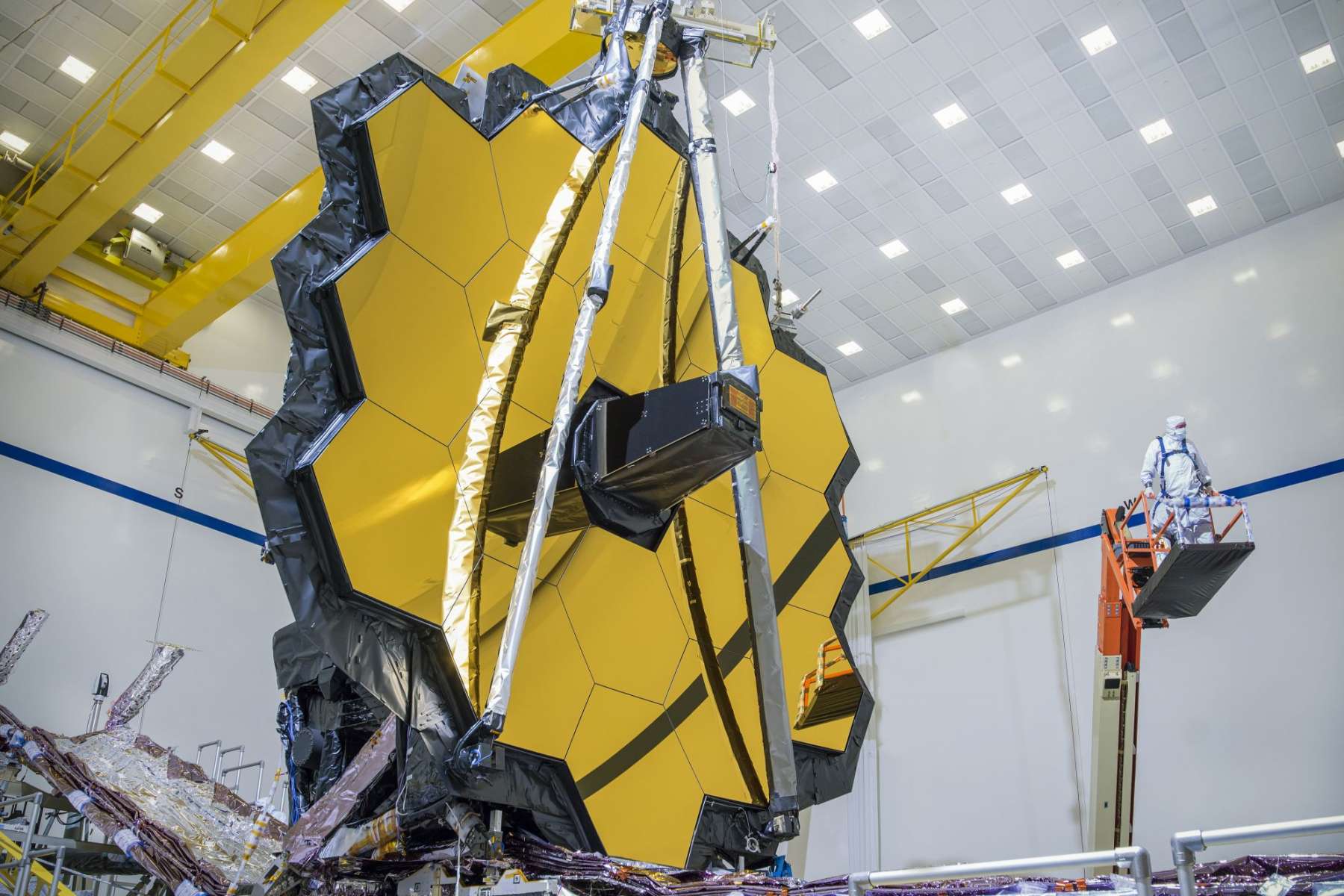
The JWST deployable mirror undergoing tests

I heard last week that the ship carrying the James Webb Space Telescope (JWST) arrived safely in French Guiana and is now being prepared for launch on an Ariane-5 rocket at the European Space Agency’s facility at Kourou. Since the telescope cost approximately $10 billion there was some nervousness it might have been hijacked by pirates on the way.

I’m old enough to remember JWST when it was called the Next Generation Space Telescope NGST); it was frequently discussed at various advisory panels I was on about 20 years ago. Although the basic concept hasn’t changed much – it was planned to be the successor to the Hubble Space Telescope working in the infrared and with a deployable mirror – at that time it was going to have an even bigger mirror than the 6.5m it ended up with, was going to be launched in or around 2010, and was to have a budget of around $600 million. About a decade ago cost overruns, NASA budget problems, and technical hitches led to suggestions that it should be cancelled. It turned out however that it was indeed too big too fail. Now it is set for launch in December total cost greater than ten times the original estimate.

I know many people involved in the JWST project itself or waiting to use it to make observations, and I’ll be crossing my fingers on launch day and for the period until its remarkable folding mirror is deployed about a fortnight later. I hope it goes well, and look forward to the celebrations when it does.

There is a big problem with JWST however and that is its name, which was changed in 2002 from the Next Generation Space Telescope to the James Webb Space Telescope after James E. Webb, a civil servant who was NASA’s chief administrator from 1961 to 1968.

It’s not uncommon for scientific space missions like this to be named after people once the proposal has moved off the drawing board and into serious planning. That happened with the European Space Agency’s Planck and Herschel to give two examples. In any case Next General Space Telescope was clearly never anything but a working title. Yet naming this important mission after a Government official always seemed a strange decision to me. Then news emerged that James Webb had enthusiastically cooperated in a McCarthyite purge of LGBT+ people working in government institutions, part of a wider moral panic referred to by historians as the Lavender Scare. There have been high-profile protests (see, e.g., here) and a petition that received over a thousand signatures, but NASA has ruled out any change of name.

The main reason NASA give is that they found no evidence that Webb himself was personally involved in discrimination or persecution. I find that very unconvincing. He was in charge, so had responsibility for what went on in his organization. If he didn’t know then why didn’t he know? Oh, and by the way, he didn’t have anything to do with infrared astronomy either…

It’s a shame that this fantastic telescope should have its image so tarnished by the adoption of an inappropriate name. The name is a symbol of a time when homophobic discrimination was even more prevalent than it is now, and as such will be a constant reminder to us that NASA seems not to care about the many LGBT+ people working for them directly or as members of the wider astronomical community.

P.S. As an alternative name I suggest the Lavender Scare Space Telescope (LSST)…

Preprints in Applications – a plea to the ARC!

Posted in Open Access, Science Politics with tags , on August 25, 2021 by telescoper

I was astonished to discover (via this article) that the Australian Research Council has placed a ban on preprints veing cited in funding applications, and that many applicants have had applications rejected solely on the basis that they referred to preprints in them.

It beggars belief that anyone who actually understands modern scientific practice could come up with such a stupid idea. I can only surmise that the people who run the Australian Research Council are so out of touch with actual research that they don’t understand not only the silliness of this rule but also the damage being caused by it.

I have been on grants panels in the UK many times, and have reviewed many applications for other agencies too, and I can’t think of any that didn’t refer to preprints. It can take a year or more for a paper to appear in a traditional journal and in many fields research moves so quickly that citing results ahead of (formal) publication is the only way to present a true picture of ongoing research. Any author who doesn’t cite other authors’ preprints is either out of touch with ongoing research or presented an unbalanced view of the literature. I would further argue that, at least in astrophysics, any applicant who doesn’t have a clutch of preprints on the topic of the application can’t be sufficiently active to justify grant funding.

Results made available in preprints may not have been refereed but that is no reason to ban them altogether. Any experienced reviewer will know how to treat them. And don’t forget there are plenty of wrong results in the refereed literature too. I’d prefer a policy that banned applicants whose papers were not published in an Open Access form…

There is a petition here urging the Australian Research Council to revise its preprint policies. I urge you to sign it (as I have done). Be quick, though, as the deadline is 31st August 2021.

And in case you think this is a matter for Australians only, I disagree. Science is collaborative and many of the collaborations span many different countries. It is in all our interests to ensure that our Australian cousins don’t get held back by inane policies like this.

UPDATE: Nature has now covered this story.

IRC Starting and Consolidator Awards

Posted in Maynooth, Science Politics, The Universe and Stuff with tags , , , , on July 9, 2021 by telescoper

Just a quick post to pass on the news that there are a couple of new funding programmes run by the Irish Research Council. The full description of these programmes can be found here, but here is an excerpt:

The Council is inviting applications at the early and mid-career level (Starting and Consolidator). Funding will be awarded on the basis solely of excellence, assessed through a rigorous and independent international peer-review process. Laureates will enhance their track record and international competitiveness. As well as the benefits for the laureate and their team, it is anticipated that the award will enhance the potential for subsequent ERC success as a further career milestone; indeed it will be a requirement of all laureates that they make a follow-on application to the ERC.

Fortunately the remit of the IRC is broader than Science Foundation Ireland, which has a narrow focus on research likely to lead to short-term returns, so it is more likely to appeal to those working in more speculative fundamental or frontier science, including Astrophysics. Unfortunately IRC has a lot less money than SFI.

An overview of the programme can be found in the following recording of a webinar that took place last week:

The way the call works is that you must first lodge an Expression of Interest with the institution to which you wish to apply, i.e. Maynooth University. That must be done by 27th August 2021. Full applications will then be due in November.

On LinkedIn

Posted in Science Politics, The Universe and Stuff with tags , , , , on July 4, 2021 by telescoper

A former colleague recently contacted me with a request to join my “network” on LinkedIn.  That was quite hard to do as (at least until this morning) I was not on LinkedIn. That reminded me of a talk at INAM2019 a couple of years ago about the Astronomical Society of Ireland  which was about to be re-launched with a new website. One of the main reasons for doing this is that Ireland recently joined the European Southern Observatory and in order to capitalize on its involvement it is important to persuade the Irish government to invest in the resources needed (especially postdocs, etc) to do as much science as possible using ESO facilities. The idea was to improve the lobbying power for astronomy in Ireland. One of the suggestions made yesterday was that astronomers in Ireland should join LinkedIn in order to raise their profile individually and collectively.

I was not on LinkedIn at the time and didn’t get around to joining it mainly because I’ve always thought it was more for businessy types than academics. Anyway, in the light of recent events I decided it couldn’t do any harm to bite the bullet and set up a LinkedIn profile, which you can find here. It’s really a rather basic profile but I think I’ve set it up so that posts from here will be posted to LinkedIn too, so if you’re on it yourself you might want to add me. Or not. It’s up to you!

P.S. The only thing I have put under “Awards and Honours” is Winner of Beard of Ireland 2020.

Open Science and Open Software

Posted in Open Access, Science Politics, The Universe and Stuff with tags , , , , on May 22, 2021 by telescoper

As the regular readers of this blog – both of them – will know, I’ve been banging on from time to time about Open Access to scientific publications. After posting a video featuring Volker Springel and the GADGET-4 code I thought I’d return to an issue that came up briefly in my recent talk about Open Access and the Open Journal of Astrophysics here which is the question whether open access to scientific results enough, or do we have to go a lot further?

An important aspect of the way science works is that when a given individual or group publishes a result, it should be possible for others to reproduce it (or not as the case may be). Traditional journal publications don’t always allow this. In my own field of astrophysics/cosmology, for example, results in scientific papers are often based on very complicated analyses of large data sets. This is increasingly the case in other fields too. A basic problem obviously arises when data are not made public. Fortunately in astrophysics these days researchers are pretty good at sharing their data, although this hasn’t always been the case.

However, even allowing open access to data doesn’t always solve the reproducibility problem. Often extensive numerical codes are needed to process the measurements and extract meaningful output. Without access to these pipeline codes it is impossible for a third party to check the path from input to output without writing their own version assuming that there is sufficient information to do that in the first place. That researchers should publish their software as well as their results is quite a controversial suggestion, but I think it’s the best practice for science. There isn’t a uniform policy in astrophysics and cosmology, but I sense that quite a few people out there agree with me. Cosmological numerical simulations, for example, can be performed by anyone with a sufficiently big computer using GADGET the source codes of which are freely available. Likewise, for CMB analysis, there is the excellent CAMB code, which can be downloaded at will; this is in a long tradition of openly available numerical codes, including CMBFAST and HealPix. Researchers in these and other areas do tend to share their software on open-access repositories, especially GitHub.

I suspect some researchers might be reluctant to share the codes they have written because they feel they won’t get sufficient credit for work done using them. I don’t think this is true, as researchers are generally very appreciative of such openness and publications describing the corresponding codes are generously cited. In any case I don’t think it’s appropriate to withhold such programs from the wider community, which prevents them being either scrutinized or extended as well as being used to further scientific research. In other words excessively proprietorial attitudes to data analysis software are detrimental to the spirit of open science.

Anyway, my views are by no means guaranteed to be representative of the community, so I’d like to ask for a quick show of hands via a poll that I started about 8 years ago.

You are of course welcome to comment via the usual box, as long as you respect my comments policy…

Basic Research in Ireland

Posted in Science Politics, The Universe and Stuff with tags , , on March 21, 2021 by telescoper


I realised today that I hadn’t yet posted a reaction to theannouncement earlier this month by Science Foundation Ireland (SFI) of a new five-year strategic plan. Although much of the document Shaping Our Future is fairly bland – as strategic plans usually are – there are some very welcome things in it.

Currently Ireland spends just 1.1% of its GDP on scientific research and development and SFI currently has a heavy focus on applied research (i.e. research aligned with industry that can be exploited for short-term commercial gain). This has made life difficult for basic or fundamental science and has driven many researchers in such areas abroad, to the detriment of Ireland’s standing in the international community.

The new strategy, which will cover the period from now to 2025, plans for 15% annual rises that will boost the agency’s grant spending — the greater part of the SFI budget — from €200 million in 2020 to €376 million by 2025. Much of this is focused in top-down manner on specific programmes and research centres but there is at least an acknowledgement of the need to support basic research, including an allocation of €11 million in 2021 for early career researchers.

The overall aim is to increase the overall R&D spend from 1.1% of gross domestic product, well below the European average of 2.2%, to 2.5% by 2025.

One of the jobs I had to do last week was to write the Annual Research Report for the Department of Theoretical Physics at Maynooth University. I am very pleased that despite the Covid-19 pandemic, over the last year we managed to score some notable successes in securing new grant awards (amounting to €1.3M altogether) as well as doubling the number of refereed publications since the previous year. This is of course under the old SFI regime. Hopefully in the next few years covered by the new SFI strategic plan we’ll be able to build on that growth still further, especially in areas related to quantum computing and quantum technology generally.

Anyway, it seems that SFI listened to at least some of the submissions made to the consultation exercise I mentioned a few months ago.

Hawking and the Mind of God

Posted in Books, Talks and Reviews, Science Politics, The Universe and Stuff with tags , , , , , on March 3, 2021 by telescoper

There’s a new book out about Stephen Hawking which has triggered a certain amount of reaction (see, e.g., here) so I thought I’d mention a book I wrote, largely in response to the pseudo-religious nature of some of Hawking’s later writings.

I have in the past gone on record, both on television and in print, as being not entirely positive about the “cult” that surrounds Stephen Hawking. I think a number of my colleagues have found some of my comments disrespectful and/or churlish. I do nevertheless stand by everything I’ve said. I have enormous respect for Hawking the physicist, as well as deep admiration for his tenacity and fortitude, and have never said otherwise. I don’t, however, agree that Hawking is in the same category of revolutionary thinkers as Newton or Einstein, which is how he is often portrayed.

In fact a poll of 100 theoretical physicists in 1999 came to exactly the same conclusion. The top ten in that list were:

  1. Albert Einstein
  2. Isaac Newton
  3. James Clerk Maxwell
  4. Niels Bohr
  5. Werner Heisenberg
  6. Galileo Galilei
  7. Richard Feynman
  8. Paul Dirac
  9. Erwin Schrödinger
  10. Ernest Rutherford

The idea of a league table like this is of course a bit silly, but it does at least give some insight into the way physicists regard prominent figures in their subject. Hawking came way down the list, in fact, in 300th (equal) place. I don’t think it is disrespectful to Hawking to point this out. I’m not saying he isn’t a brilliant physicist. I’m just saying that there are a great many other brilliant physicists that no one outside physics has ever heard of.

It is interesting to speculate what would have happened if the list had been restricted to living physicists. I’d guess Hawking would be in the top ten, but I’m not at all sure where…

And before I get accused of jealousy about Stephen Hawking’s fame, let me make it absolutely clear that if Hawking was like a top Premiership footballer (which I think is an appropriate analogy), then I am definitely like someone kicking a ball around for a pub team on a Sunday morning (with a hangover). This gulf does not make me envious; it just makes me admire his ability all the more, just as trying to play football makes one realise exactly how good the top players really are.

I am not myself religious but I do think that there are many things that science does not – and probably will never – explain, such as why there is something rather than nothing. I also believe that science and religious belief are not in principle incompatible – although whether there is a conflict in practice does depend of course on the form of religious belief and how it is observed. God and physics are in my view pretty much orthogonal. To put it another way, if I were religious, there’s nothing in theoretical physics that would change make me want to change my mind. However, I’ll leave it to those many physicists who are learned in matters of theology to take up the (metaphorical) cudgels with Professor Hawking.

Anyway, this is the book I wrote:.

And here is the jacket blurb:

Stephen Hawking has achieved a unique position in contemporary culture, combining eminence in the rarefied world of theoretical physics with the popular fame usually reserved for film stars and rock musicians. Yet Hawking’s technical work is so challenging, both in its conceptual scope and in its mathematical detail, that proper understanding of its significance lies beyond the grasp of all but a few specialists. How, then, did Hawking-the-scientist become Hawking-the-icon? Hawking’s theories often take him into the intellectual territory that has traditionally been the province of religion rather than science. He acknowledges this explicitly in the closing sentence of his bestseller, A Brief History of Time , where he says that his ultimate aim is to know the Mind of God . Hawking and the Mind of God examines the pseudo-religious connotations of some of the key themes in Hawking’s work, and how these shed light not only on the Hawking cult itself, but also on the wider issue of how scientists represent themselves in the media.

I’m sure you’ll understand that there isn’t a hint of opportunism in the way I’m drawing this to your attention because my book is long out of print so you can’t buy it unless you get a copy second-hand…