Archive for the Sport Category

The All-Ireland Hurling Final

Posted in GAA, Maynooth with tags , , , , , on July 21, 2024 by telescoper

No prizes for guessing what I’ll be watching this afternoon. Today’s the day of the All-Ireland Senior Hurling Championship Final at Croke Park, between Clare and Cork. The weather isn’t too bad; it’s overcast and a bit cool but there’s no rain forecast and it’s not windy. I’m hoping for a good match.

Clare (An Clár) versus Cork (Corcaigh) is not the final I would have predicted before the semi-finals. I thought Limerick and Kilkenny would be the finalists but that just goes to show how little I know. Cork are favourites with the bookies, by the way (4/7 on Cork, 11/8 against Clare) despite the fact that Clare of won the last two encounters between these teams.

If you’ve never been in Ireland for this occasion you won’t realize what a huge event it is. The atmosphere on this very special day is very much like it used to be in England for the FA Cup Final when I was a kid and the build-up just as long, with constant references on both radio and TV. Maynooth is on the railway line going through Croke Park so we see a lot of supporters in their team colours heading to the match. County Clare (which is in the West of Ireland, straddled by Limerick to the South and Galway to the North) is a bit closer to us than County Cork, which perhaps accounts for the preponderance of blue and gold over red and white.

You can watch the whole game live on BBC2 if you’re in the UK. Throw-in is at 3.30pm.

Update: The attendance is 82,300.

Update: HT score Clare 1-12 Cork 1-12. It’s been a much more open game than I expected. Cork started out the stronger team, finding lots of space in the Clare half and shooting very accurately. Robert Downey scored a memorable goal at which point it looked like Cork might overrun Clare, but that didn’t happen and as the half drew to a close Clare became more confident. It’s all square and poised for an exciting second half.

Update: FT score Clare 3-21 Cork 1-27. What an epic game this is! All square on points after Clare conceded a silly free in the dying seconds to allow Cork to equalize. We go to extra time!

Update: Final Score Clare 3-29 Cork 1-34. Drama to the last second, a long free from the Cork goalie lands in the area but Robbie O’Flynn’s shot to tie the game goes agonizingly wide. Clare are the All-Ireland Champions by one-point. What a breathtaking match. Hats off to both teams for serving up a classic! I wouldn’t have complained if it had gone to a replay though…

Here is a clip of Clare’s amazing 3rd goal, scored by Tony Kelly…

Congratulations to Spain!

Posted in Football, Rugby with tags , , , , , on July 14, 2024 by telescoper

And so it came to pass that Spain beat England 2-1 in the final of the 2024 European Championship. This is a result to add to the memories of Spain I’ve acquired by living there for much of the past year. I haven’t seen every match of the tournament but there’s no doubt in my mind that Spain played consistently the best football, and are worthy Champions. England ran them close in the final, though. Despite Spain having about 66% of the possession it took a very late goal to win it.

So football’s not coming home after all. Evidently it’s still on sabbatical…

I feel a bit sorry for the manager Gareth Southgate. He may not have won a trophy with England (yet) but he’s taken them further in more competitions than most of his predecessors. He attracted a great deal of criticism for his cautious approach in the earlier stages of this competition which he dealt with in a remarkably dignified way. All that eased off a bit when England got to the knockout stage, but I suspect it may come back. Will he put up with it for another two years until the 2026 World Cup?

As for Spain, this is the fourth time they have been European Champions; England have never won this competition. The Spanish squad is very youthful squad too, including the brilliant teenager Lamine Yamal. Nico Williams had a superb tournament too. 

P.S. This evening’s match was broadcast live on RTÉ so I watched it at home. By contrast, yesterday’s rugby between Ireland and the Springboks was not available on a free channel so I was forced against my will to watch it in a pub. I’m glad I did!

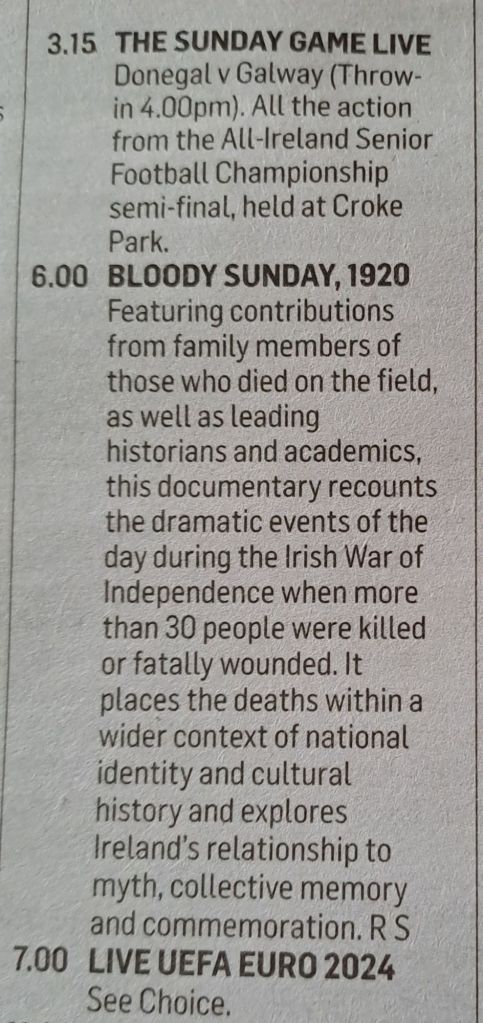
P.P.S the choice of schedule leading up to the Euros final is interesting:

Language on Dry Land

Posted in Football, Irish Language with tags , , , , , , , , , on July 13, 2024 by telescoper

Since I’ve got my own computer again now I thought I’d celebrate by doing one of those rambling, inconsequential posts I haven’t had time to do recently.

Last week, in the run up to the European Championship semi-final between England and The Netherlands, I for some reason decided to look up what “The Netherlands” is in the Irish language. I did know this once, as it came up when I was trying to learn Irish a few years ago but I had forgotten. I remembered “England”, which is Sasana (cf. Saxon). Anyway, the answer is An Ísiltír. I’ll return to that in a moment.

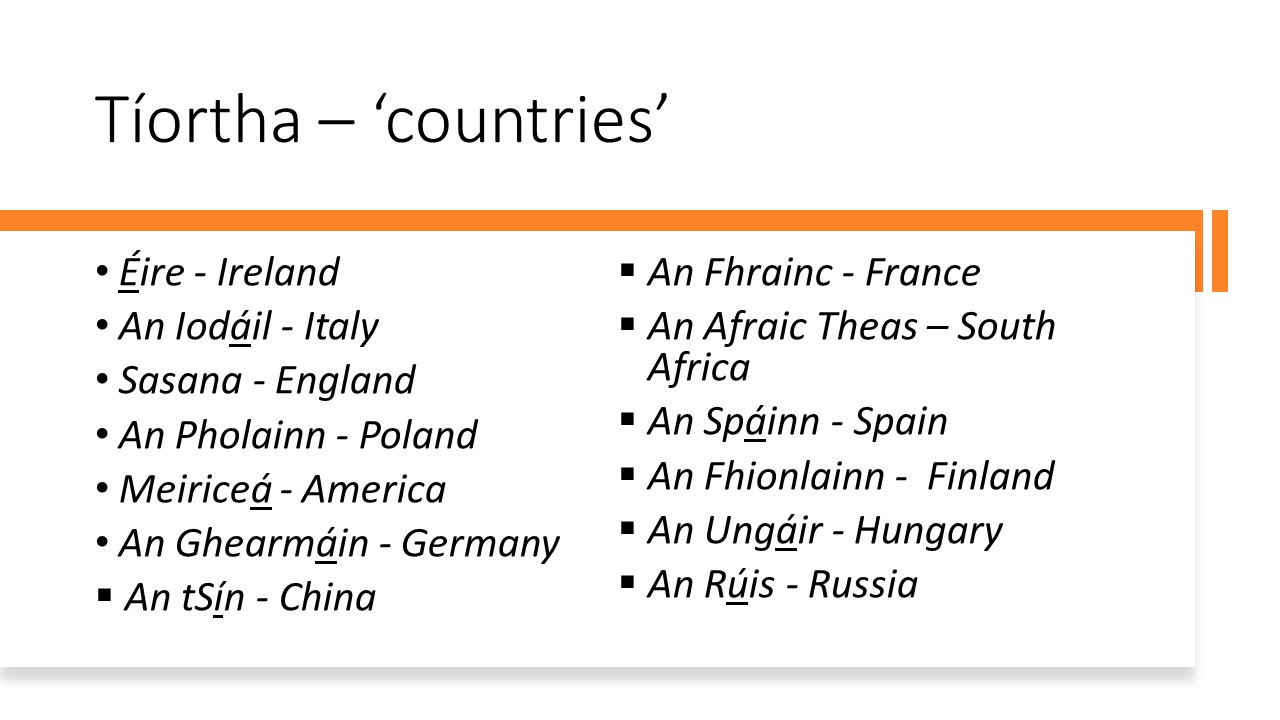
Here are some other names:

Anyway, a couple of things may be interest. One is that you can see that most country names in Irish are introduced by An. This is the definite article in Irish; there is no indefinite article. This contrasts with English in which only a few names start with the definite article, “The Netherlands” being one. The exceptions in Irish include England (Sasana) and Scotland (Albain). Wales is An Bhreatain Bheag (literally “Little Britain”). Of relevance to the final of the European Championship, Spain is An Spáinn.

I should also mention that some nouns suffer an initial consonant mutation (in the form of lenition, i.e. softening) after the direct article. In modern Irish this is denoted by an h next to the initial consonant, hence Fhrainc, for example; the Irish word for “French” is Fraincis.

The second interesting thing pertains to An Ísiltír itself. The second part of this, tír, means “country” or “nation” – see the plural in the heading above – and the first, Ísil, means “low”. An Ísiltír is therefore literally “The Low Country”. I shared this fascinating insight on social media and found in the replies a mention that the Welsh name for The Netherlands is Yr Iseldiroedda meaning literally “The Low Lands”. The first part of this is clearly similar to the Irish, but the second is the plural of a different word meaning ground or earth or an area of land. There is a word tir in Welsh that means ground or earth or an area of land but it does not mean country or nation like the very similar Irish word; the word for that is gwlad. In Irish the word for land or ground or earth (or turf) is talamh.

Welsh and Irish belong to distinct branches of the Celtic group of languages, the first wave of Indo-European languages to sweep across Europe. I blogged about this here.  Celtic languages therefore share roots with many other Indo-European languages and very basic words in many branches of the tree often bear some similarity in form, if slight but significant differences in meaning. It seems that tír/tir illustrates this rather well. These two words also have a very similar form to the French terre which is derived from the Latin terra. And so I disappeared down an etymological rabbit hole and found that all these words are probably derived from a Proto-Indo-European word meaning “dry”, presumably through reference to “that which is dry” as opposed to the wet bits (although neither Ireland nor Wales is famous for being particular dry).

And to bring this little excursion back full circle, the Irish word tirim means “dry”…

All-Ireland Hurling Semi-Final Weekend

Posted in GAA with tags , , on July 7, 2024 by telescoper

Just a quick post to mention that this weekend saw the semi-finals of this year’s All-Ireland Senior Hurling Championship at Croke Park.

Yesterday, after playing very poorly against Kilkenny in the first half,  Clare staged an epic comeback to create an exciting finish, eventually to win by two points (0-24 to 2-16).

Today’s semi-final was even better, with Cork pulling out all the stops against Limerick in the second half in a match that was played at an extraordinary tempo even by the standards of hurling. Cork ran out deserved winners by 1-28 to 0-29. Once again, only two points separated the sides.

Limerick were bidding to win their 5th All-Ireland championship in a row, but they have to settle for four, as the final in two weeks’ time will be between Cork and Clare.

Two More Euclid ERO videos

Posted in Euclid, Football with tags , , , , on July 1, 2024 by telescoper

I’ve been a bit busy catching up on things since my departure from Barcelona with the result that I almost forgot to post anything today. Fortunately there are two more Euclid Early Release Observations I can share to fill the gap. They’re about 4 minutes apiece, so there’ll be plenty time to watch them while waiting for the VAR operators to make an offside decision during the next European Championship match…

The first is entitled Measuring Luminosity Function for the Perseus Cluster of Galaxies using Euclid ERO data:

The article describing this work can be found on arXiv here; it perhaps makes up for the missing article in the title of the video.

The second one is this, about gravitational lensing and the search for high-redshift galaxies:

The paper for this one can be found on arXiv here.

Relativistic Hurling?

Posted in GAA with tags , , , on May 22, 2024 by telescoper

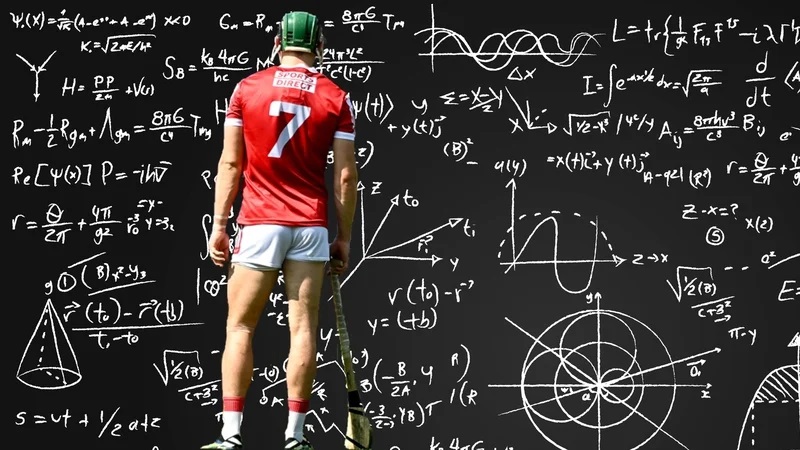
I was intrigued to see this graphic accompanying an article about hurling. Notice that the left hand side shows the field equations of Einstein’s General Theory of Relativity and some expressions to do with quantum mechanics. Hurling is indeed an extraordinary – and extraordinarily fast – sport but is the article implying that classical physics is inadequate to describe it? Perhaps it is implying that through hurling we will at last arrive at a Theory of Everything?

The English Premier League – Classification of Honours

Posted in Football with tags , , , on May 20, 2024 by telescoper

Now all the final results are in and validated, the Board can now proceed to the classification of Honours for the 2023/24 Premier League.

As Chair, I will remind you of the regulations as we go through. Fortunately, as was the case last year, matters are relatively straightforward.

FINAL TABLE

Three candidates (Manchester City, Arsenal, and Liverpool) have a final score greater than or equal to 70 and will therefore be awarded First Class Honours. All three can look forward to further study abroad in Europe next year. Manchester City win this year’s prize for getting the top marks as well as a special award for getting away with so many financial irregularities.

The next five candidates all have scores in the range 60-69 so they are all in the Upper Second Class, i.e. II.1, category though in the case of Newcastle United and Manchester United, only just. Aston Villa will be disappointed to have missed out on a First, but their mark of 68 is nevertheless enough to ensure they will be heading abroad next year along with the top three.

Tottenham and Chelsea (and perhaps Newcastle United) will also get to study abroad next year. Manchester Utd are taking an extra exam on Saturday and if they pass that will get to study abroad, in place of Newcastle.

Only one candidate is in the Lower Second Class (II.2) this year (West Ham), while the next six candidates all get clear Thirds, having marks in the range 40-49. The Board discussed whether to offer Crystal Palace a viva but in the end decided it couldn’t be bothered. Everton only just passed, with a mark of 40, after having points deducted for disciplinary reasons.

Brentford technically failed with a mark of 39 but can pass by compensation.  Nottingham Forest only just scraped through by compensation last year, and did even worse this year including having marks deducted for cheating but, having considered the extenuating circumstances, the Board has decided to allow them yet another go, although they do not qualify for Honours and must be content with being classified as “Ordinary”.

That leaves the three candidates at the bottom of the table – Luton Town, Burnley, and Sheffield United  – who are all “hard fails” . They  will have to terminate the course and consider their options. The Chair has agreed to meet with the Admissions Team to understand how Sheffield United was admitted to the course when they were so clearly under-qualified. Perhaps some form  of administrative error occurred?

R.I.P. Derek Underwood (1945-2024)

Posted in Cricket, R.I.P. with tags , , , , on April 16, 2024 by telescoper

Another sporting hero of my youth has passed away. Derek Underwood – “Deadly” was his nickname – was a bowler like no other. Officially a left-arm orthodox spinner, with a rather flat-footed run-up, and a characteristic twist of his body as he delivered the ball at a brisk medium pace with infallible accuracy, he was not only a prolific taker of wickets but also an extremely difficult bowler to score off. He played for Kent for 24 seasons, his entire First Class career, during which he took 2,465 wickets at a remarkable average of 20.28. Underwood was a regular in the England Test side from 1966 onwards, barring an interruption when he joined Kerry Packer’s cricket circus in the 70s, and played his last Test match in 1982.

Tributes to Derek Underwood have understandably focused on his bowling, but it should be mentioned that, although of limited ability with the bat, he was a capable and stubborn night-watchman who didn’t give his wicket away easily. I remember seeing him bat in that role with great courage (and without a helmet) against Lillee and Thomson, getting struck on the body several times in the process.

When I was a kid I used to get completely absorbed watching him bowl, even on good wickets, and he never seemed to bowl badly and you could see batters getting visibly impatient at his refusal to bowl them a ball they could hit. Here is a little tribute video produced by Kent Cricket Club, with action mostly from the 1960s: you can see what a handful he was when he could use his pace to extract extra bounce from the pitch.

Rest in Peace Derek Underwood (1945-2024)

Six Nations Summary

Posted in Rugby with tags , , , , , , , , , on March 17, 2024 by telescoper

I didn’t see many of the games in this year’s Six Nations Rugby because I was abroad for most of it, but yesterday I saw the last round of matches. The last one, between France and England in Lyon, was probably the best game I’ve seen in this year’s tournament. After a fascinating ebb and flow, England thought they had snatched it with a converted try to make it 31-30 with just a couple of minutes to go, but then immediately conceded a penalty on the halfway line. Up stepped Thomas Ramos, who had scored from a similar distance earlier in the game, stepped up and scored. France won 33-31 in a game that could have gone either way. It was effectively a playoff for 2nd place.

Earlier in the day, Ireland held off a spirited challenge from Scotland in a tense and scrappy match to win 17-13 which guaranteed they would be Six Nations Champions. for the sixth time. I don’t think the team reached the heights of last year’s Grand Slam but it was a deserved victory. It was all a bit more comfortable than the scoreline suggests, though Scotland did score a try late on when Ireland lost concentration which made for a nervy few minutes. A defeat would have meant metaphorical rain on the St Patrick’s Day parades going on today, but in the end there was no rain, either metaphorical or literal.

Given the result in Lyon, Ireland would have been Champions by virtue of their bonus points, even if they had lost to Scotland. England (who beat Ireland last week in a game I didn’t see) had to win with a bonus point to catch them; they managed the bonus point for four tries, but lost the match. Some pundits have commented on whether it was fair for a team to have won having lost more games than the second place team. Of course all the teams know the rules before the competition starts, so there’s no point complaining after the fact. Ireland played attacking rugby knowing that the try count might be important. However, I do think there is a point. In the old Five Nations, and indeed in the World Cup Pools, each team played four games. A bonus point from each of those matches would add 4 to a team’s total, the same as a win. In the Six Nations each team places five matches, so the bonus points could add up to more than a win. A way to remedy this might be to award more points for a win: six for a win and three for a draw is my suggestion.

The first game of the last round yesterday was between Wales and Italy, a game which Italy won to finish 5th. They were unlucky not to beat France earlier in the competition and have played some excellent rugby this year. If they can deal with a marked tendency to fade in the last twenty minutes – as they did yesterday, but managed to hold on – then they will be genuine contenders. Wales had a terrible competition, losing all their games and finishing last. I am reliably informed that “wooden spoon” in Welsh is “llwy bren”. But nil desperandum: the last time Wales got the wooden spoon was in 2003; two years later they did the Grand Slam!

R.I.P. Barry John (1945-2024)

Posted in R.I.P., Rugby with tags , , , on February 6, 2024 by telescoper

I just read the terrible news of the death at the age of 79 of yet another icon of Welsh Rugby Union, the legendary standoff Barry John.

Five years ago I posted an item about Barry John inspired by this clip

The opening part of this clip had caught my attention because it was filmed near the bus stop just outside The Halfway, a pub on Cathedral Road just a few yards from the house in Cardiff in which I lived for many years; in the background you can see Llandaff Fields.

I had often wondered what became of Barry John. He was 74 when I wrote about him and no longer the slim young prodigy who was undoubtedly the best rugby player I ever saw. Since he played in a great era for Welsh rugby that included Gareth Edwards, J.P.R. Williams, Gerald Davies et al, that really says something. As the Guardian obituary aptly puts it, he “played Rugby from another world”.

As a sort of rugby equivalent of George Best, Barry John was incredibly famous during his career. Budding rugby players – even those not born in Wales – all wanted to play like Barry John. But suddenly, at the age of just 27, after playing just 25 internationals, he turned his back on all the publicity and adulation and retired from rugby. He found the pressure of being such a star in the amateur era too difficult to cope with.

So was Barry John really that good? Absolutely yes, he was. Slight of build but with superb balance, he had an extraordinary, almost magical, ability to find his way through a crowd of potential tacklers as if they weren’t there at all. In the memorable words of that great commentator Bill McLaren “he flits like a little phantom”. But you don’t need to take my word for it. Just look at him – and some other giants of the time – in these highlights of the classic Scotland-Wales tie in the Five Nations of 1971. Watch about 30 seconds in, where he wrong-foots half the Scottish three-quarter line before ghosting through three more and releasing the ball to his forwards. Will there ever be another Barry John? I doubt it..

I’m sure there are many of us who remember the excitement of watching Barry John play and feel enriched by what he gave us.

Rest in Peace, Barry John (1945-2024).