There’s an interesting paper on the arXiv today by Tak et al. with the title `How proper are Bayesian models in the astronomical literature?’ The title isn’t all that appropriate, because the problem is not really with `models’, but with the choice of prior (which should be implied by the model and other information known or assumed to be true). Moreover, I’m not sure whether the word `Bayesian’ applies to the model in any meaningful way.
Anyway, The abstract is as follows:
The well-known Bayes theorem assumes that a posterior distribution is a probability distribution. However, the posterior distribution may no longer be a probability distribution if an improper prior distribution (non-probability measure) such as an unbounded uniform prior is used. Improper priors are often used in the astronomical literature to reflect on a lack of prior knowledge, but checking whether the resulting posterior is a probability distribution is sometimes neglected. It turns out that 24 articles out of 75 articles (32\%) published online in two renowned astronomy journals (ApJ and MNRAS) between Jan 1, 2017 and Oct 15, 2017 make use of Bayesian analyses without rigorously establishing posterior propriety. A disturbing aspect is that a Gibbs-type Markov chain Monte Carlo (MCMC) method can produce a seemingly reasonable posterior sample even when the posterior is not a probability distribution (Hobert and Casella, 1996). In such cases, researchers may erroneously make probabilistic inferences without noticing that the MCMC sample is from a non-existent probability distribution. We review why checking posterior propriety is fundamental in Bayesian analyses when improper priors are used and discuss how we can set up scientifically motivated proper priors to avoid the pitfalls of using improper priors.
This paper makes a point that I have wondered about on a number of occasions. One of the problems, in my opinion, is that astrophysicists don’t think enough about their choice of prior. An improper prior is basically a statement of ignorance about the result one expects in advance of incoming data. However, very often we know more than we think we do. I’ve lost track of the number of papers I’ve seen in which the authors blithely assume a flat prior when that makes no sense whatsoever on the basis of what information is available and, indeed, on the structure of the model within which the data are to be interpreted. I discuss a simple example here.
In my opinion the prior is not (as some frequentists contend) some kind of aberration. It plays a clear logical role in Bayesian inference. It can build into the analysis constraints that are implied by the choice of model framework. Even if it is used as a subjective statement of prejudice, the Bayesian approach at least requires one to put that prejudice on the table where it can be seen.
There are undoubtedly situations where we don’t know enough to assign a proper prior. That’s not necessarily a problem. Improper priors can – and do – lead to proper posterior distributions if (and it’s an important if) they include, or the likelihood subsequently imposes, a cutoff on the prior space. The onus should be on the authors of a paper to show that their likelihood is such that it does this and produces a posterior which is well-defined probability measure (specifically that it is normalisable, ie can be made to integrate to unity). It seems that astronomers don’t always do this!
I got into my office in Maynooth a little late this morning as I was moving some things into my new flat, the keys to which I duly received yesterday. I didn’t move in last night as I had already paid for last night’s accommodation in St Patrick’s College, as well as breakfast, so thought it was silly to waste my last night there.
It turned out to be a good decision. Breakfast is served in Putin Pugin Hall and on Thursdays the seminarians get a cooked breakfast. Normally guests are only entitled to a continental breakfast but since this was my last morning the friendly lady in charge said I could help myself to the full Irish. I have to say that the staff at St Patrick’s have been absolutely lovely – very friendly and helpful – so I was a little sad leaving, but it will be nice to settle into my own place.
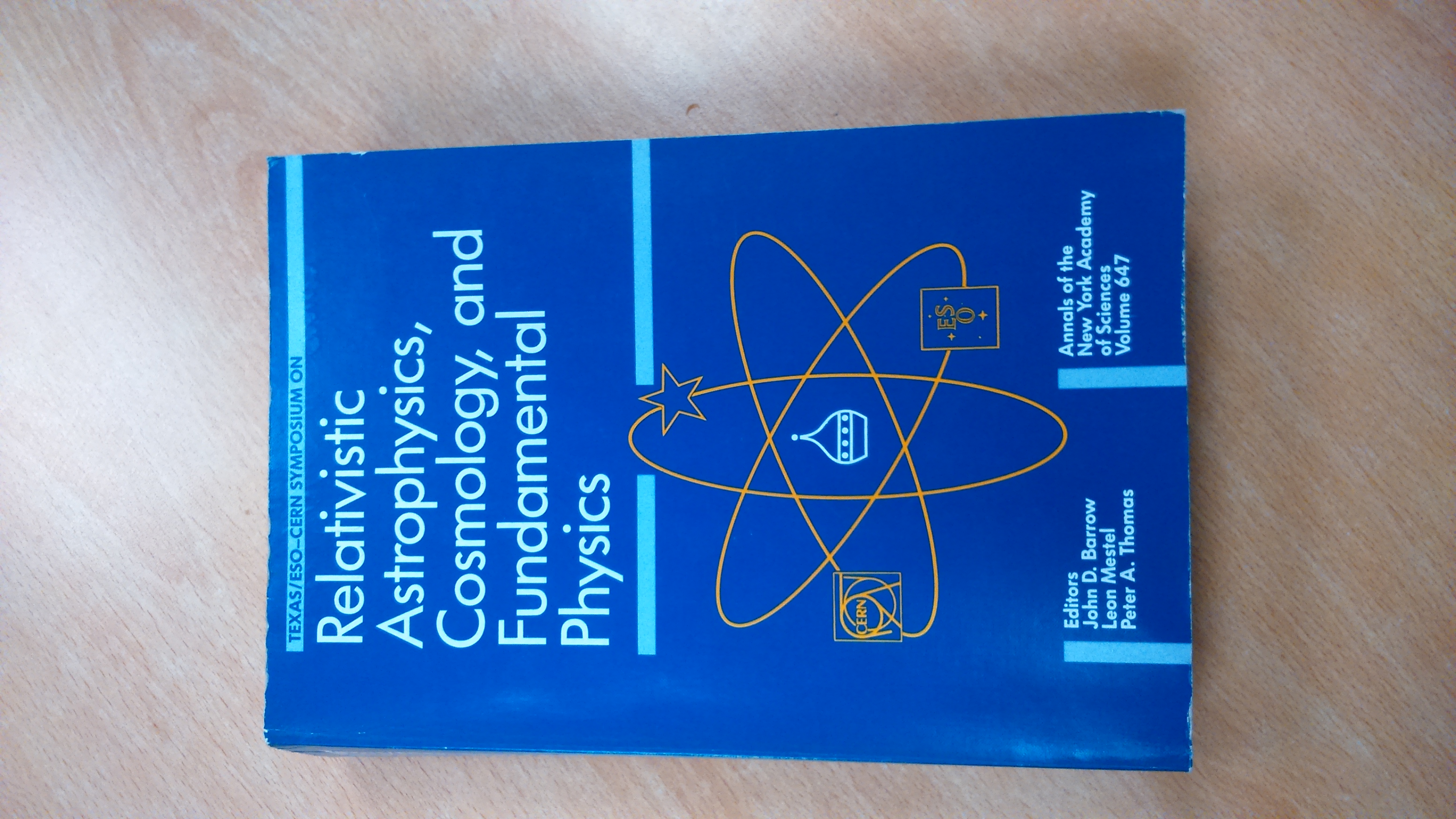
Anyway, duly checked out, I came into the Department of Theoretical Physics and made myself a cup of tea. While I was waiting for the kettle I looked in the pile of books in the staff room and found this:
This is the proceedings of the 15th Texas Symposium on Relativistic Astrophysics, which was held in Brighton in December 1990 (just after I had left Sussex University for Queen Mary, London). I did go back to Brighton from London for this, but actually don’t remember that much about it! Twenty seven years is a long time!
Anyway, these meetings are held every other year, sometimes in association with other meetings, e.g. the CERN-ESO Symposium in the case above, and there’s one going on right now, the 29th Texas Symposium in Cape Town, South Africa.
For detailed maps of the early universe that greatly improved our knowledge of the evolution of the cosmos and the fluctuations that seeded the formation of galaxies.
The award, which is for the sizeable sum of $3 Million, will be shared among the 27 members of the WMAP team whose names I list here in full (team leaders are in italics):
Chris Barnes; Rachel Bean; Charles Bennett; Olivier Doré; Joanna Dunkley,;Benjamin M. Gold; Michael Greason; Mark Halpern; Robert Hill, Gary F. Hinshaw, Norman Jarosik, Alan Kogut, Eiichiro Komatsu, David Larson, Michele Limon, Stephan S. Meyer, Michael R. Nolta, Nils Odegard, Lyman Page, Hiranya V. Peiris, Kendrick Smith, David N. Spergel, Greg S. Tucker, Licia Verde, Janet L. Weiland, Edward Wollack, and Edward L. (Ned) Wright.
I know quite a few of these people personally, including Hiranya, Licia, Eiichiro, Joanna, Olivier and Ned, so it’s a special pleasure to congratulate them – and the other members of the team – on this well-deserved award.
I stumbled across a little video on Youtube (via Twitter, which is where I get most of my leads these days) with the title Why is it Dark at Night? Here it is:
As a popular science exposition I think this is not bad at all, apart from one or two baffling statements, e.g. “..the Universe had a beginning, so there aren’t stars in every direction”. A while ago I posted a short piece about the history of cosmology which got some interesting comments, so I thought I’d try again with a little article I wrote a while ago on the subject of Olbers’ Paradox. This is discussed in almost every astronomy or cosmology textbook, but the resolution isn’t always made as clear as it might be. Here is my discussion.
One of the most basic astronomical observations one can make, without even requiring a telescope, is that the night sky is dark. This fact is so familiar to us that we don’t imagine that it is difficult to explain, or that anything important can be deduced from it. But quite the reverse is true. The observed darkness of the sky at night was regarded for centuries by many outstanding intellects as a paradox that defied explanation: the so-called Olbers’ Paradox.
The starting point from which this paradox is developed is the assumption that the Universe is static, infinite, homogeneous, and Euclidean. Prior to twentieth century developments in observation (e.g. Hubble’s Law) and theory (Cosmological Models based on General Relativity), all these assumptions would have appeared quite reasonable to most scientists. In such a Universe, the intensity of light received by an observer from a source falls off as the inverse square of the distance between the two. Consequently, more distant stars or galaxies appear fainter than nearby ones. A star infinitely far away would appear infinitely faint, which suggests that Olbers’ Paradox is avoided by the fact that distant stars (or galaxies) are simply too faint to be seen. But one has to be more careful than this.
Imagine, for simplicity, that all stars shine with the same brightness. Now divide the Universe into a series of narrow concentric spherical shells, in the manner of an onion. The light from each source within a shell of radius falls off as , but the number of sources increases as . Multiplying these together we find that every shell produces the same amount of light at the observer, regardless of the value of . Adding up the total light received from all the shells, therefore, produces an infinite answer.
In mathematical form, this is
where is the luminosity of a source, is the number density of sources and is the intensity of radiation received from a source at distance .
In fact the answer is not going to be infinite in practice because nearby stars will block out some of the light from stars behind them. But in any case the sky should be as bright as the surface of a star like the Sun, as each line of sight will eventually end on a star. This is emphatically not what is observed.
It might help to think of this in another way, by imagining yourself in a very large forest. You may be able to see some way through the gaps in the nearby trees, but if the forest is infinite every possible line of sight will end with a tree.
As is the case with many other famous names, this puzzle was not actually first discussed by Olbers. His discussion was published relatively recently, in 1826. In fact, Thomas Digges struggled with this problem as early as 1576. At that time, however, the mathematical technique of adding up the light from an infinite set of narrow shells, which relies on the differential calculus, was not known. Digges therefore simply concluded that distant sources must just be too faint to be seen and did not worry about the problem of the number of sources. Johannes Kepler was also interested in this problem, and in 1610 he suggested that the Universe must be finite in spatial extent. Edmund Halley (of cometary fame) also addressed the issue about a century later, in 1720, but did not make significant progress. The first discussion which would nowadays be regarded as a correct formulation of the problem was published in 1744, by Loys de Chéseaux. Unfortunately, his resolution was not correct either: he imagined that intervening space somehow absorbed the energy carried by light on its path from source to observer. Olbers himself came to a similar conclusion in the piece that forever associated his name with this cosmological conundrum.
Later students of this puzzle included Lord Kelvin, who speculated that the extra light may be absorbed by dust. This is no solution to the problem either because, while dust may initially simply absorb optical light, it would soon heat up and re-radiate the energy at infra-red wavelengths. There would still be a problem with the total amount of electromagnetic radiation reaching an observer. To be fair to Kelvin, however, at the time of his writing it was not known that heat and light were both forms of the same kind of energy and it was not obvious that they could be transformed into each other in this way.
To show how widely Olbers’ paradox was known in the nineteenth Century, it is worth also mentioning that Friedrich Engels, owner of a factory in Manchester (in the Midlands) and co-author with Karl Marx of the Communist Manifesto also considered it in his book The Dialectics of Nature, though the discussion is not particularly illuminating from a scientific point of view.
In fact, probably the first inklings of a correct resolution of the Olbers’ Paradox were contained not in a dry scientific paper, but in a prose poem entitled Eureka published in 1848 by Edgar Allan Poe. Poe’s astonishingly prescient argument is based on the realization that light travels with a finite speed. This in itself was not a new idea, as it was certainly known to Newton almost two centuries earlier. But Poe did understand its relevance to Olbers’ Paradox. Light just arriving from distant sources must have set out a very long time ago; in order to receive light from them now, therefore, they had to be burning in the distant past. If the Universe has only lasted for a finite time then one can’t add shells out to infinite distances, but only as far as the distance given by the speed of light multiplied by the age of the Universe. In the days before scientific cosmology, many believed that the Universe had to be very young: the biblical account of the creation made it only a few thousand years old, so the problem was definitely avoided.
Of course, we are now familiar with the ideas that the Universe is expanding (and that light is consequently redshifted), that it may not be infinite, and that space may not be Euclidean. All these factors have to be taken into account when one calculates the brightness of the sky in different cosmological models. But the fundamental reason why the paradox is not a paradox does boil down to the finite lifetime, not necessarily of the Universe, but of the individual structures that can produce light. According to the theory Special Relativity, mass and energy are equivalent. If the density of matter is finite, so therefore is the amount of energy it can produce by nuclear reactions. Any object that burns matter to produce light can therefore only burn for a finite time before it fizzles out.
Imagine that the Universe really is infinite. For all the light from all the sources to arrive at an observer at the same time (i.e now) they would have to have been switched on at different times – those furthest away sending their light towards us long before those nearby had switched on. To make this work we would have to be in the centre of a carefully orchestrated series of luminous shells switching on an off in sequence in such a way that their light all reached us at the same time. This would not only put us in a very special place in the Universe but also require the whole complicated scheme to be contrived to make our past light cone behave in this peculiar way.
With the advent of the Big Bang theory, cosmologists got used to the idea that all of matter was created at a finite time in the past anyway, so Olber’s Paradox receives a decisive knockout blow, but it was already on the ropes long before the Big Bang came on the scene.
As a final remark, it is worth mentioning that although Olbers’ Paradox no longer stands as a paradox, the ideas behind it still form the basis of important cosmological tests. The brightness of the night sky may no longer be feared infinite, but there is still expected to be a measurable glow of background light produced by distant sources too faint to be seen individually. In principle, in a given cosmological model and for given assumptions about how structure formation proceeded, one can calculate the integrated flux of light from all the sources that can be observed at the present time, taking into account the effects of redshift, spatial geometry and the formation history of sources. Once this is done, one can compare predicted light levels with observational limits on the background glow in certain wavebands which are now quite strict .
This morning I was looking through my collection of old books about general relativity and related things, and found this page as part of a `simplified presentation’:
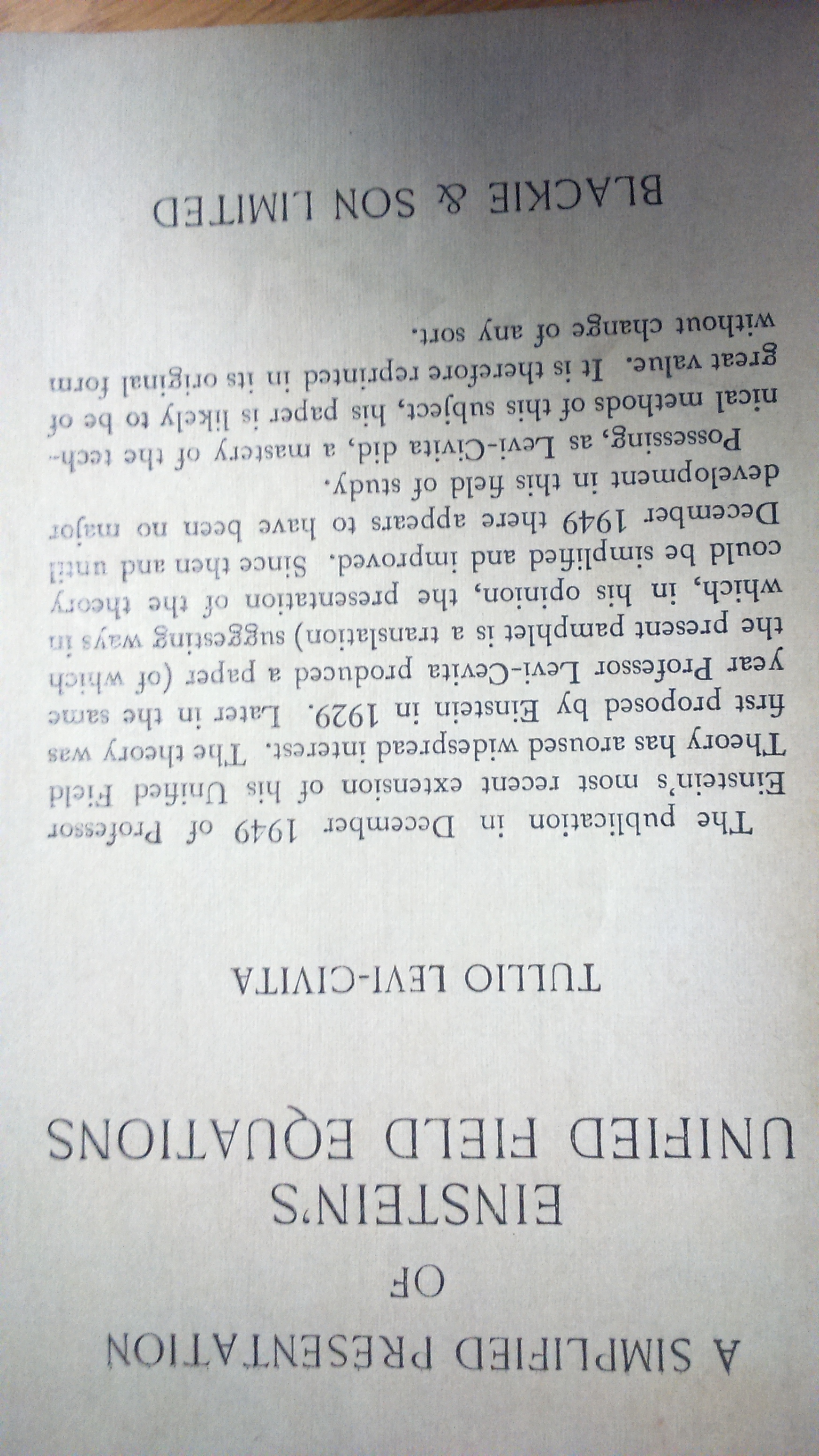
I wonder if you can guess the name of author of the little book in which I found this page, and what it is a `simplified presentation’ of?
Some months ago I did a little post on the occasion of the 100th anniversary of the introduction of the cosmological constant which included a link to the original paper on this subject by Albert Einstein. A nice thread of well-informed comments followed that post and one of the contributors to that thread, Cormac O’Raifeartaigh, is lead author of a paper that has just appeared on the arXiv. It’s quite a lengthy paper (62 pages) that gives an account of the cosmological constant in the context of modern observational cosmology. You can get a PDF of the paper here. It’s well worth reading!
The abstract reads:
We present a centennial review of the history of the term known as the cosmological constant. First introduced to the general theory of relativity by Einstein in 1917 in order to describe a universe that was assumed to be static, the term fell from favour in the wake of the discovery of cosmic the expanding universe, only to make a dramatic return in recent times. We consider historical and philosophical aspects of the cosmological constant over four main epochs: (i) the use of the term in static cosmologies (both Newtonian and relativistic; (ii) the marginalization of the term following the discovery of cosmic expansion; (iii) the use of the term to address specific cosmic puzzles such as the timespan of expansion, the formation of galaxies and the redshifts of the quasars; (iv) the re-emergence of the term in today’s Lamda-CDM cosmology. We find that the cosmological constant was never truly banished from theoretical models of the universe, but was sidelined by astronomers for reasons of convenience. We also find that the return of the term to the forefront of modern cosmology did not occur as an abrupt paradigm shift due to one particular set of observations, but as the result of a number of empirical advances such as the measurement of present cosmic expansion using the Hubble Space Telescope, the measurement of past expansion using type SN 1a supernovae as standard candles, and the measurement of perturbations in the cosmic microwave background by balloon and satellite. We give a brief overview of contemporary interpretations of the physics underlying the cosmic constant and conclude with a synopsis of the famous cosmological constant problem.
You’ve probably all heard of the Antikythera Mechanism, a sophisticated device that was used about 2000 years ago by the Greeks to predict astronomical positions and eclipses for calendar and astrological purposes and found in 1902 at the site of a shipwreck near the island of Antikythera. You may not know that there is a strong connection between the study of this amazing piece of machinery and my current employer, Cardiff University, especially through our own Emeritus Professor Mike Edmunds.
Well, it seems that another episode in the story of Antikythera is about to open up as a result of a new initiative of the National Observatory of Athens, in collaboration with the Prefecture of Attica and the Municipality of the island of Kythira. This will lead to the creation of an Observatory of Climate Change and Centre of Geosciences at the island of AntiKythera, where the famous ancient mechanism was found and which is currently almost deserted.
Here is a little video about this project. The dialogue is in Greek, but with subtitles. I should also point out that the first person you see and hear is Manolis Plionis, who is Director of the National Observatory of Athens, a very old friend of mine who I first met at Sussex when I started my graduate studies in the Astronomy Centre there in 1985.
Interesting post from a gravitational wave researcher, telling the inside story of the latest gravitational wave detection (a binary black hole merger) announced last week.
Detected in June, GW170608 has had a difficult time. It was challenging to analyse, and neglected in favour of its louder and shinier siblings. However, we can now introduce you to our smallest chirp-mass binary black hole system!
The growing family of black holes. From Dawn Finney.
Our family of binary black holes is now growing large. During our first observing run (O1) we found three: GW150914, LVT151012 and GW151226. The advanced detector observing run (O2) ran from 30 November 2016 to 25 August 2017 (with a couple of short breaks). From our O1 detections, we were expecting roughly one binary black hole per month. The first same in January, GW170104, and we have announced the first detection which involved Virgo from August, GW170814, so you might be wondering what happened in-between? Pretty much everything was dropped following the detection of our first…
…black hole mergers detected via gravitational waves, that is. Here are the key measurements for Number 5, codename GW170608. More information can be found here.
On June 8, 2017 at 02:01:16.49 UTC, a gravitational-wave signal from the merger of two stellar-mass black holes was observed by the two Advanced LIGO detectors with a network signal-to-noise ratio of 13. This system is the lightest black hole binary so far observed, with component masses 12+7-2 M⊙ and 7+2-2 M⊙ (90% credible intervals). These lie in the range of measured black hole masses in low-mass X-ray binaries, thus allowing us to compare black holes detected through gravitational waves with electromagnetic observations. The source’s luminosity distance is 340 +140-140Mpc, corresponding to redshift 0.07+0.03-0.03. We verify that the signal waveform is consistent with the predictions of general relativity.
This merger seems to have been accompanied by a lower flux of press releases than previous examples…
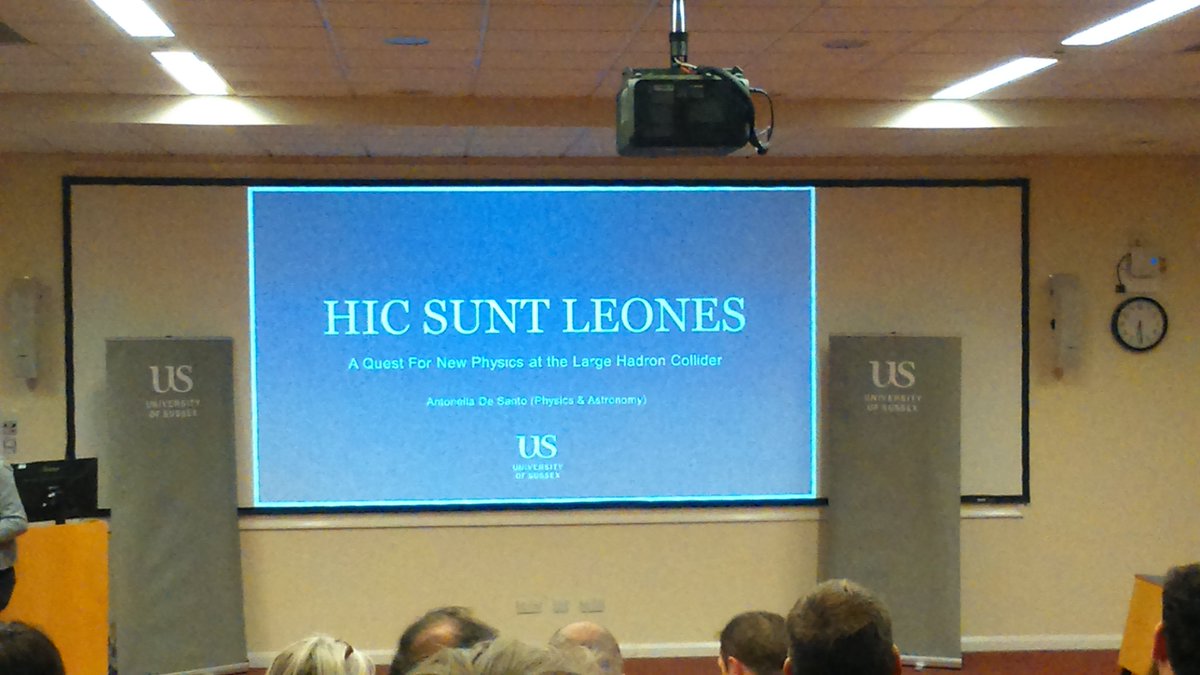
Just time for a very quick post, as today I travelled to Brighton to attend an inaugural lecture by Professor Antonella De Santo at the University of Sussex.
Antonella was the first female Professor of Physics at the University of Sussex and I’m glad to say she was promoted to a Chair during my watch as Head of the School of Mathematical and Physical Sciences, at Sussex. That was about four years ago, so it has taken a while to arrange her inaugural lecture, but it was worth the wait to be able to celebrate Antonella’s many achievements.
The lecture was about the search for physics beyond the standard model using the ATLAS experiment at the Large Hadron Collider, with a focus on supersymmetry and possibly candidates for dark matter. It was a very nice lecture that told a complex story through pictures and avoiding any difficult mathematics, followed by a drinks reception during which I got to have a gossip with some former colleagues.
The title, by the way, stems from the practice among mediaeval cartographers of marking terra incognita with `Here be lions’ or `Here be dragons‘. I hasten to add that no lions were harmed during the talk.
Anyway, it was nice to have an excuse to visit Brighton again. The last time I was here was over a year ago. It was nice to see some familiar faces, especially in the inestimable Miss Lemon, with whom I enjoyed a very nice curry after the talk!
Now for a sleep and the long journey back to Cardiff tomorrow morning!
The views presented here are personal and not necessarily those of my employer (or anyone else for that matter).
Feel free to comment on any of the posts on this blog but comments may be moderated; anonymous comments and any considered by me to be vexatious and/or abusive and/or defamatory will not be accepted. I do not necessarily endorse, support, sanction, encourage, verify or agree with the opinions or statements of any information or other content in the comments on this site and do not in any way guarantee their accuracy or reliability.

 falls off as
  , but the number of sources increases as
  . Multiplying these together we find that every shell produces the same amount of light at the observer, regardless of the value of
 is the luminosity of a source,
  is the number density of sources and
  is the intensity of radiation received from a source at distance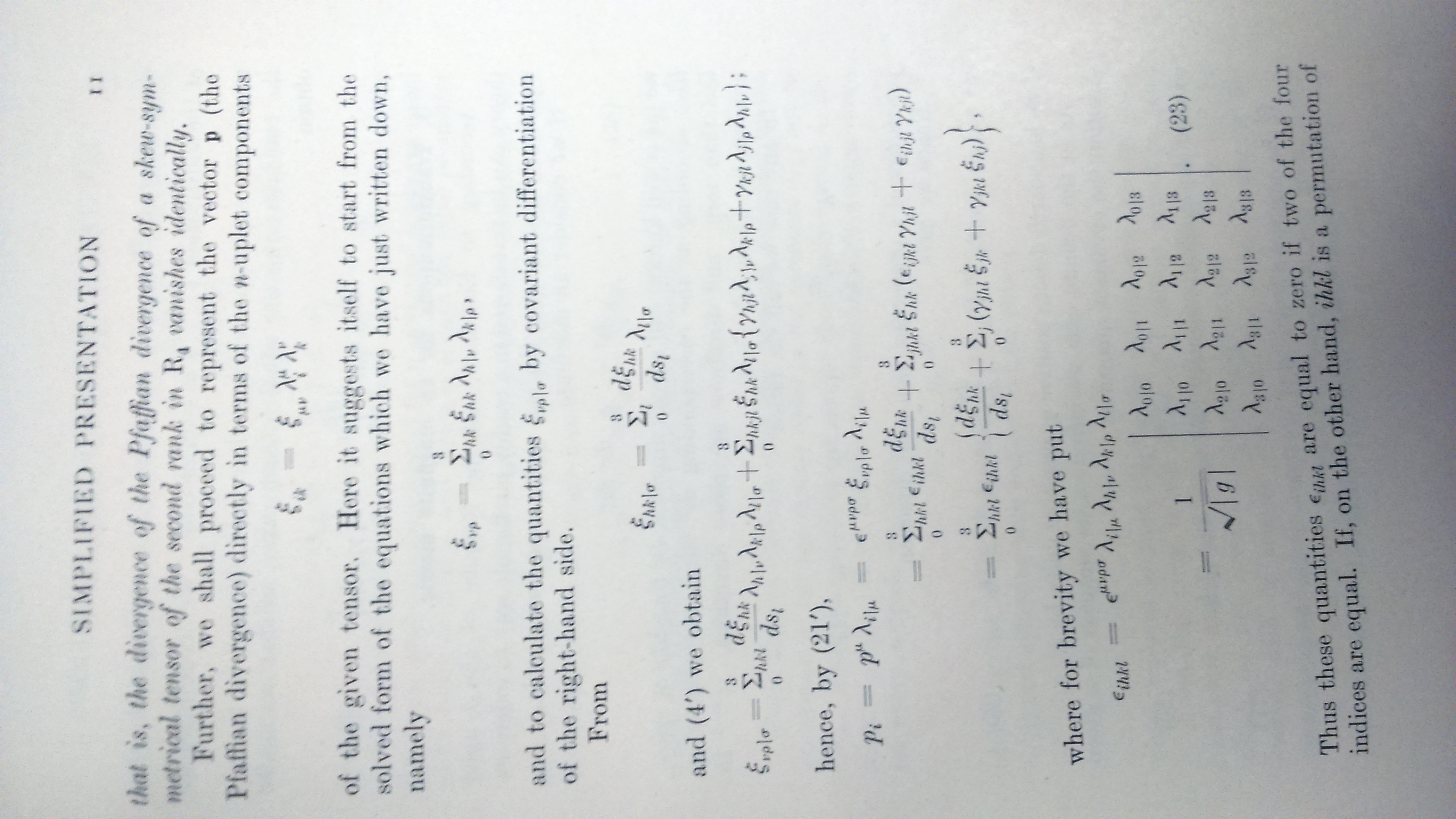

 The growing family of black holes. From

 In the Dark