Archive for the The Universe and Stuff Category

Astronomical and Other Events this Week

Posted in Biographical, The Universe and Stuff with tags , , , , , on July 4, 2017 by telescoper

This week sees the 2017 National Astronomy Meeting which is taking place in Hull (which, for those of you unfamiliar with British geography, is in the Midlands). I usually try to attend this annual event but this year haven’t been able to make it owing to other commitments. I’m particularly sad about this because I’ll miss seeing two old friends (Nick Kaiser and Marek Kukula) being presented with their RAS medals. Moreover, one of the pieces of astronomical research announced at this meeting that has been making headlines features my office mate and fellow resident of Pontcanna, Dr Emily Drabek-Maunder.

Anyway, to keep up with what’s going on at NAM2017 you can follow announcements on twitter:

This week also sees a meeting in Cambridge on Gravity and Black Holes to celebrate the 75th birthday of Stephen Hawking, which goes on until tomorrow (Wednesday 5th). This conference also looks like a very good one, covering a much wider range of topics than its title perhaps suggests. Stephen’s birthday was actually in January, but I hope it’s not too late to wish him many happy returns!

Finally, though not a conference as such, there’s annual Royal Society Summer Science exhibition going on in London this week too. This is a showcase for a wealth of scientific research including, this year, an exhibit about gravitational waves called Listening to Einstein’s Universe. There’s even a promotional video featuring some of my colleagues at Cardiff University (along with many others):

Anyway, if you’re in London and at a loose end and interested in science and that, do pop into the Royal Society and have a look. The Summer Science Exhibition is always well worth a visit!


Cosmology Caption Competition

Posted in Biographical, The Universe and Stuff with tags , , on July 3, 2017 by telescoper

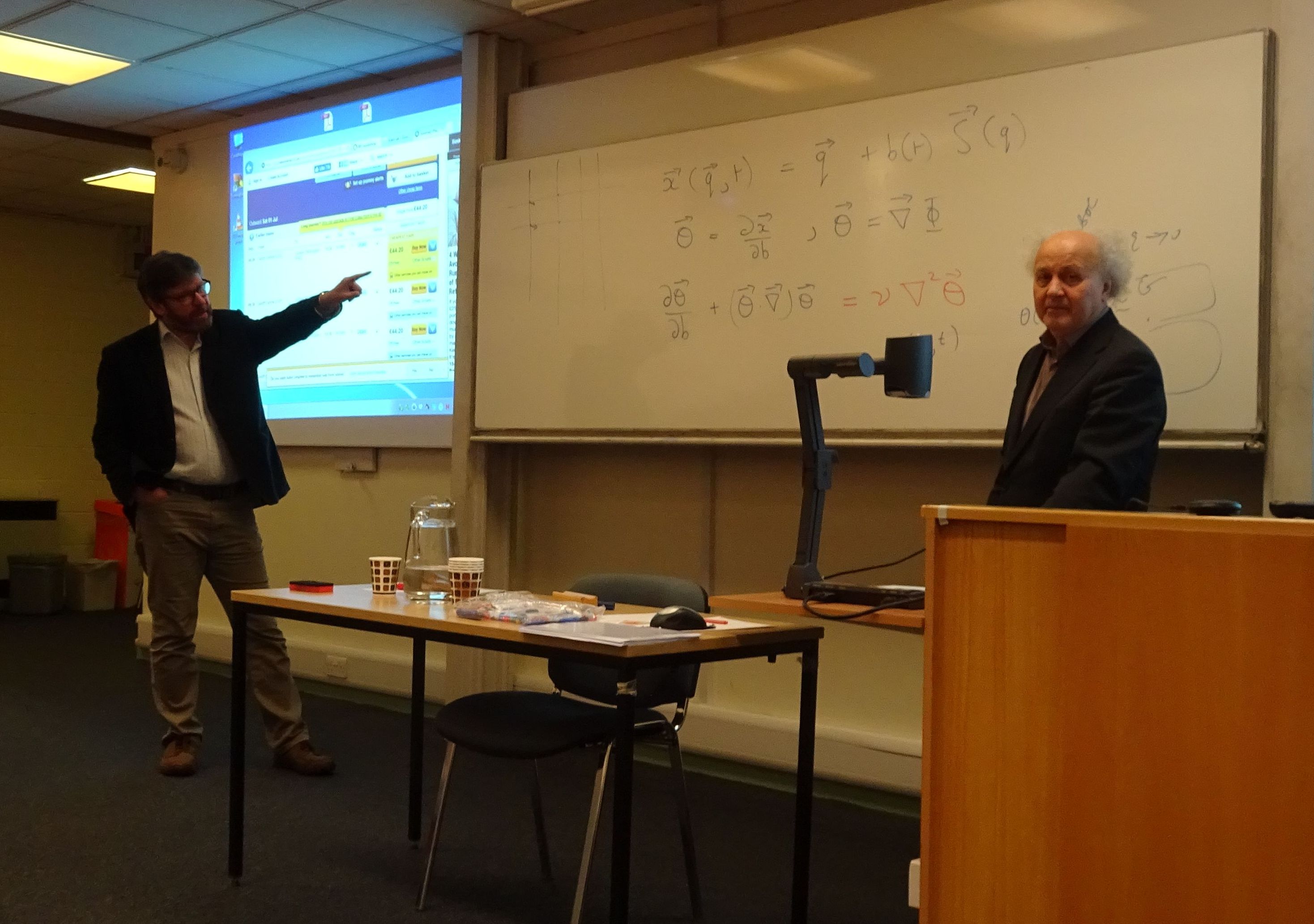
I’ve been a bit busy today so in lieu of a proper post I thought I’d try for a bit of audience participation. In one of the discussion sessions at last week’s workshop on Isotropic Random Fields in Astrophysics I was called upon to deliver a very short impromptu talk on cosmological applications of Burger’s Burgers Equation, during the course of which the following photograph was taken. Appropriate (or inappropriate) suggestions for captions, please, through the comments box!

Isotropic Random Fields in Astrophysics

Posted in The Universe and Stuff with tags , , on June 29, 2017 by telescoper

So the little workshop  on `Isotropic Random Fields in Astrophysics’ I announced some time ago, sponsored via a “seedcorn” grant by the Data Innovation Research Institute, has finally arrived, and having spent most of the day at it I’m now catching up with some other stuff in the office before adjourning for the conference dinner.


This meeting is part of a series of activities aimed at bringing together world-leading experts in the analysis of big astrophysical data sets, specifically those arising from the (previous) Planck (shown above) and (future) Euclid space missions, with mathematical experts in the spectral theory of scalar vector or tensor valued isotropic random fields. Our aim is to promote collaboration between mathematicians interested in probability theory and statistical analysis and theoretical and observational astrophysicists both within Cardiff university and further afield.


It’s been a very interesting day of interleaving talks by cosmologists and mathematicians followed by an open-ended discussion session where we talked about unsolved problems and lines for future research. It’s clear that there are some language difficulties between the two communities but I hope this meeting helps to break down a few barriers and stimulate some new joint research projects.


The ‘Danish Paper’ and How Science Works

Posted in The Universe and Stuff with tags , on June 27, 2017 by telescoper

I’m off work today but couldn’t resist posting a very quick update on the controversial claims of inconsistencies in the recent detection of gravitational waves by LIGO.

If you’re following the story you will know that it started with a paper on the arXiv by Cresswell et al.,  a group mainly based in Denmark, which is why the paper is now frequently referred to as ‘The Danish Paper’ although its authors actually come from all round the world.

Well the same group have now  written a rejoinder to the LIGO critique of their analysis. They’re clearly sticking to their guns, at least on their claim that the residuals left after removing the gravitational wave events from the two time series are correlated, which they should not be if they are simply noise.

Hopefully the public airing this controversy had received will lead to other independent groups downloading and analysing the data, which is all in the public domain, and we’ll eventually arrive at the truth.

Contrary to the opinion of one of my Cardiff colleagues I think this is how science works and, importantly, how it should be seen to work. Science  is a process of investigation, and it doesn’t come to an end when  results have been published in refereed journals. 

 The more the public see how science really works – warts and all – the better they will understand its strengths as well as its limitations.

Whatever the eventual outcome of this discussion I think we will find that the ‘Danish Paper’ has helped advance our understanding, and for that the authors deserve a great deal of credit.


The Quantum Mechanics of Voting

Posted in Politics, The Universe and Stuff with tags , , , , , , on June 23, 2017 by telescoper

Now that I’ve finished a marathon session of report-writing I thought I’d take a few minutes out this Friday afternoon, have a cup of tea and pass on a rather silly thought I had the other day about the relationship between Quantum Mechanics (and specifically the behaviour of spin therein) and voting behaviour in elections and referendums.

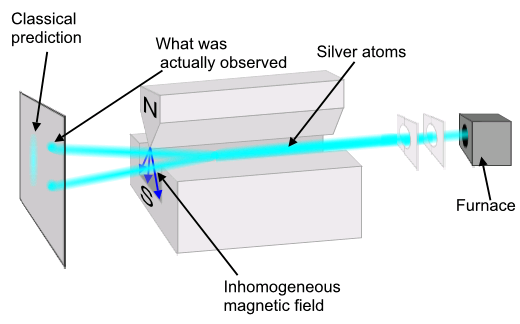
Gratuitous picture of a Stern-Gerlach experiment

For a start here’s a brief summary of the usual quantum-mechanical context as it relates to, e.g., electrons (rather than elections). Being fermions, electrons possess half-integer spin. This attribute has the property that a measurement of its component in any direction has only two possible values, ±½ in units of Planck’s constant. In the Stern-Gerlach experiment illustrated above, which measures the spin in the vertical direction of silver atoms emerging from a source, the outcome is either “up” or “down”, not some spread of values in between. Silver has a single unpaired electron which is why its atoms behave in this respect in the same way as an individual electron.

The way this is often described in physics textbooks is to say that the operator corresponding to spin in the z-direction has only two eigenstates  (call these ↑ and ↓) ; the act of measurement has to select one of them, not some intermediate state. If the source is thermal then the spins of individual atoms have no preferred direction so 50% turn out to be ↑ and 50% to be ↓ as shown in the cartoon.

Once such measurement has been made, a given particle remains in the same eigenstate, which means that if it is passed through another similar measuring device it will always turn out to have spin pointing in the same direction. If you like, the particle has been `prepared’ in a given state by the act of measurement.

This applies as long as no attempt is made to make a measurement of the spin in a different direction, which is when the fun starts. If we start with a particle in the ↑ state and then pass it through an experiment that measures spin (say) with respect to the x-axis instead of the z-axis then the two allowed eigenstates are then not ↑ and ↓ but ← and →.  A particle that was definitely spin-up would then be forced to decide between spin-left and spin-right (each would have a  50% probability).

Suppose now we took our long-suffering particle that began with spin ↑ after a measurement in the z-direction, then turned out to be spin → when we measured it in the x-direction. What would happen if we repeated the z-measurement? The answer is that “preparing” the particle in the → state destroys the information about the fact that it was previously prepared in the ↑ state –  the outcome of this second z-measurement is that the particle that was previously definitely ↑ now has a 50% chance of being either ↑ or ↓.

So what does all this have to do with voting? It is clear than an election (or a referendum) is very far from a simple act of measurement. During the campaign the various sides of the debate make attempts to prepare a given voter in a given state. In the case of last year’s EU referendum the choice of eigenstates was `Leave’ or `Remain’;  no other possibilities were allowed. The referendum then `prepared’ each voter in one or other of these possibilities.

If voters behaved quantum mechanically each would stay in their chosen state until some other measurement were attempted. But that’s exactly what did happen. Earlier this month there was a General Election. More than two parties were represented, but let’s simplify and assume there were only two options, `Labour’ and `Conservative’.

Now it is true that the `Leave’ camp was dominated by the right wing of the Conservative party, and the majority of Labour voters voted `Remain’, but there were a significant number of Labour Leave voters and a significant number of Tories voted Remain. While these pairs of states are therefore not exactly orthogonal, they are clearly not measuring the same thing so the situation is somewhat analogous to the spin measurement problem.

So along came the General Election result which `prepared’ voters in a state of `Labour’ or `Conservative’, with a slight preference for the latter whereas the earlier referendum had prepared a them in a state of `Leave’ versus `Remain’ with a slight preference for the former. From a quantum mechanical perspective, however, you can further argue that the General Election prepared the voters in such a way that should have erased memories of their vote in the referendum so the previous BrExit vote is now invalid.

There’s only one way to test this quantum-mechanical interpretation of voting patterns, and that is by repeating the EU Referendum…
LISA gets the go-ahead!

Posted in The Universe and Stuff with tags , , , , , on June 21, 2017 by telescoper

Just taking a short break from examining duties to pass on the news that the European Space Agency has selected the Laser Interferometric Space Experiment (LISA) – a gravitational wave experiment in space – for its large mission L3. This follows the detection of gravitational waves using the ground-based experiment Advanced LIGO and the success of a space-based technology demonstrator mission called Lisa Pathfinder.

LISA consists of a flotilla of three spacecraft in orbit around the Sun forming the arms of an interferometer with baselines of the order of 2.5 million kilometres, much longer than the ~1km arms of Advanced LIGO. These larger dimensions make LISA much more sensitive to long-period signals. Each of the LISA spacecraft contains two telescopes, two lasers and two test masses, arranged in two optical assemblies pointed at the other two spacecraft. This forms Michelson-like interferometers, each centred on one of the spacecraft, with the platinum-gold test masses defining the ends of the arms.

Here’s an artist’s impression of LISA:

This is excellent news for the gravitational waves community, especially since LISA was threatened with the chop when NASA pulled out a few years ago. Space experiments are huge projects – and LISA is more complicated than most – so it will take some time before it actually happens. At the moment, LISA is pencilled in for launch in 2034…

Questioning LIGO

Posted in The Universe and Stuff with tags , on June 17, 2017 by telescoper

Well. Cat, meet pigeons..

A paper appeared on the arXiv this week with the following abstract:

To date, the LIGO collaboration has detected three gravitational wave (GW) events appearing in both its Hanford and Livingston detectors. In this article we reexamine the LIGO data with regard to correlations between the two detectors. With special focus on GW150914, we report correlations in the detector noise which, at the time of the event, happen to be maximized for the same time lag as that found for the event itself. Specifically, we analyze correlations in the calibration lines in the vicinity of 35 Hz as well as the residual noise in the data after subtraction of the best-fit theoretical templates. The residual noise for the two more recent events, GW151226 and GW170104, exhibits equivalent behavior with respect to each of their time lags. A clear distinction between signal and noise therefore remains to be established in order to determine the contribution of gravitational waves to the detected signals.

I’m going to tread carefully here because (a) I have a number of colleagues at Cardiff who are directly involved in the analysis of LIGO data; (b) one of the authors of the new paper (Panel Naselsky) is a longstanding collaborator of mine; and (c) the new paper has not yet been refereed.

In fact I’m planning to visit Copenhagen in July/August and will catch up with Pavel and the other authors then.

Whether or not the points raised in the new paper are correct – and I am firmly agnostic, having not done the analysis myself – I think it’s entirely reasonable of the authors to subject the LIGO data to independent analysis. That’s how science is supposed to work; the relevant data are in the public domain now. 

No doubt the LIGO consortium will respond officially in due course. Of course, if anyone would like to comment unofficially then they are free to do so through the box below.

Update: Here is a fairly detailed rebuttal post.

Cosmological Wave Mechanics

Posted in The Universe and Stuff with tags , , , , on June 15, 2017 by telescoper

As promised here are the slides I used for my talk yesterday at Imperial College. I stole some of them from an old presentation given by Chris Short, who was a PhD student of mine when I was at Nottingham. Chris now works for the Met Office, working on rather different application of fluid mechanics!

Cosmology at a Crossroads – Poll

Posted in The Universe and Stuff with tags , , , on June 13, 2017 by telescoper

A short comment piece by Wendy Freedman has appeared in Nature Astronomy; there’s a free version on the arXiv here. It gives a nice perspective on the current debate about the value of the Hubble constant from the point of view of an expert on cosmological distance scale measurements.

The abstract is here:

We are at an interesting juncture in cosmology. With new methods and technology, the accuracy in measurement of the Hubble constant has vastly improved, but a recent tension has arisen that is either signaling new physics or as-yet unrecognized uncertainties.

For the record, I’d go for `as-yet unrecognized uncertainties’, primarily because this field has a long history of drastically underestimated error-bars!

However, the publication of this piece gives me the excuse to resurrect the following poll, in which I invite you to participate:

The Great Dark Energy Poll

Posted in The Universe and Stuff with tags , , on June 8, 2017 by telescoper

Yesterday was a very busy day: up early to check out of my hotel and head to the third day of the Euclid Consortium meeting for the morning session, then across to the Institute of Physics for a Diversity and Inclusion Panel meeting, then back to the Euclid Consortium meeting for the last session of the day, then introducing the two speakers at the evening event, then to Paddington for the 7.15 train back to Cardiff. I was not inconsiderably tired when I got home.

I had to bale out of the evening session to get the train I was booked on, but it seemed to be going well. Before I left, Ofer Lahav asked for an informal show of hands about a few possibilities relating to the nature of Dark Energy. Since today is polling day for the 2017 General Election, I thought it might be a good idea to distract people from politics for a bit by running a similar poll on here.

There are lots of possibilities for what dark energy may turn out to be, but I’ve decided to allow only six broad classes into which most candidate explanations can be grouped:

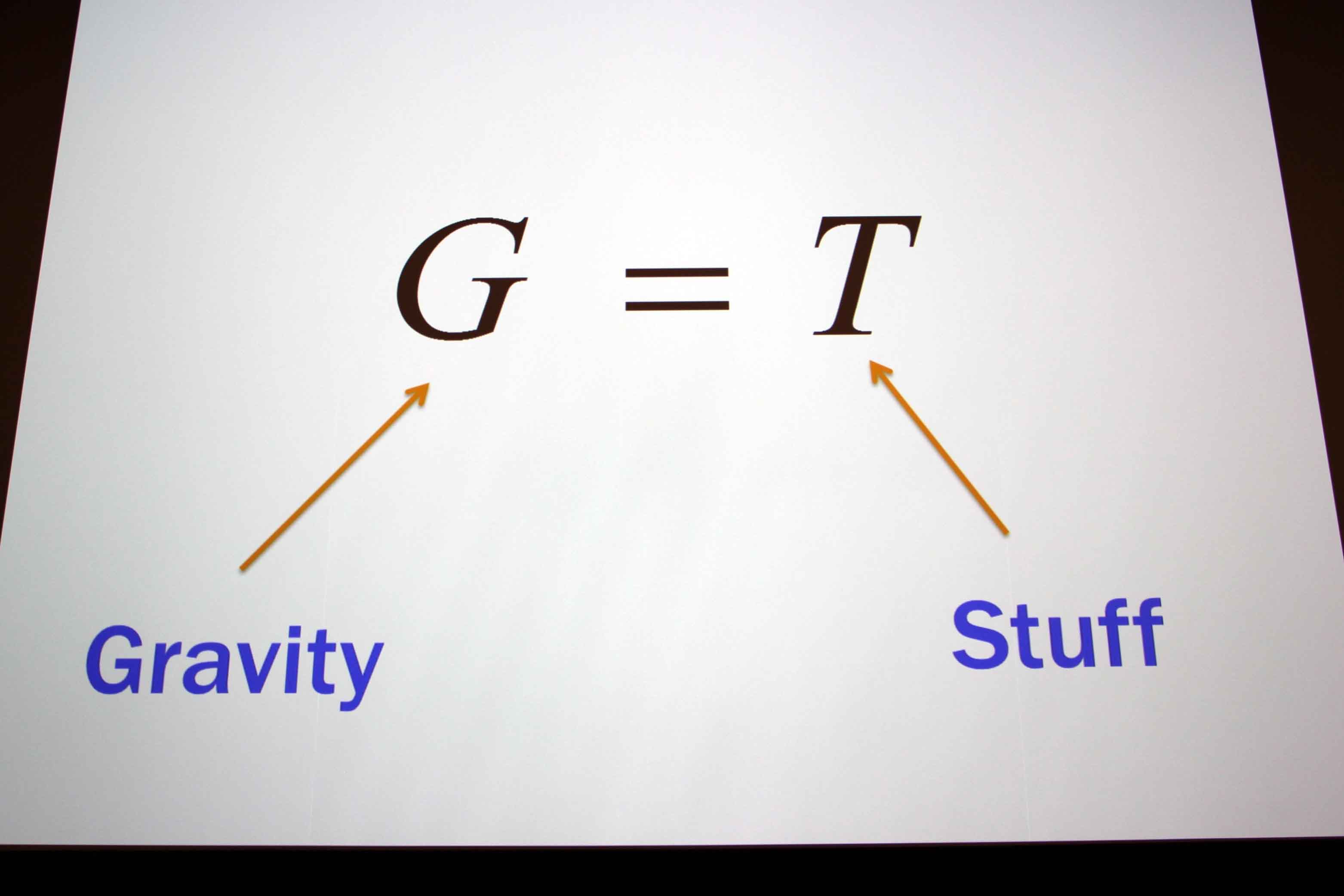
  1. The cosmological constant, originally introduced as a modification of the left hand side of Einstein’s general theory of relativity – the side that describes gravity – but more often regarded nowadays as a modification of the right-hand-side representing a vacuum energy. Whichever interpretation you make of this, its defining characteristic  is that it is constant.
  2.  Modified gravity,  in other words some modification of the left-hand-side of Einstein’s equations that manifests itself cosmologically which is more complicated than the cosmological constant.
  3. Dynamical dark energy, i.e. some other modification of the energy-momentum tensor on the right-hand side of Einstein’s equation that looks like some form of “stuff” that varies dynamically rather than being cosmologically constant.
  4.  Violation of the cosmological principle by the presence of large-scale inhomogeneities which result in significant departures from the usual Friedman-Robertson-Walker description within which the presence of dark energy is
  5. Observational error, by which I mean that there is no dark energy at all: its presence is inferred erroneously on the basis of flawed measurements, e.g. failure to account for systematics.
  6.  Some other explanation – this would include the possibility that the entire standard cosmological framework is wrong and we’re looking at the whole thing from the wrong point of view. If you choose this option you might want to comment through the box below what you have in mind.

Well, there are the six candidates. Make your choice: