Archive for the The Universe and Stuff Category

Wave Mechanics and Large-scale Structure

Posted in Books, Talks and Reviews, The Universe and Stuff with tags , , , on May 24, 2017 by telescoper

I thought I’d share the slides I used for the short talk I gave last Thursday at the Osservatorio Astronomico di Bologna, on the topic of Wave Mechanics and Large-scale Structure. I’ve posted about the general idea underpinning this workhere, and here are some links to references with more details of the cosmological setting, including a couple of papers by myself and Chris Short on some of whose old slides I based the talk.

http://adsabs.harvard.edu/abs/1993ApJ…416L..71W
http://adsabs.harvard.edu/abs/1997PhRvD..55.5997W
http://adsabs.harvard.edu/abs/2002MNRAS.330..421C
http://adsabs.harvard.edu/abs/2003MNRAS.342..176C
http://adsabs.harvard.edu/abs/2006JCAP…12..012S
http://adsabs.harvard.edu/abs/2006JCAP…12..016S
http://adsabs.harvard.edu/abs/2010MNRAS.402.2491J

I had a few problems with the movies during the actual talk, and they probably don’t work in this embedded version. There are a few formatting errors in the slideshare version too, but hopefully you can figure out what’s going on!

The Shaw Prize goes to Simon White

Posted in The Universe and Stuff with tags , , , on May 23, 2017 by telescoper

MPI Astro Physik – Prof .Simon White

To happier things. I was delighted to see just now that Simon White (above) has won this year’s Shaw Prize for Astronomy. The prize was awarded..

for his contributions to understanding structure formation in the Universe. With powerful numerical simulations he has shown how small density fluctuations in the early Universe develop into galaxies and other nonlinear structures, strongly supporting a cosmology with a flat geometry, and dominated by dark matter and a cosmological constant.

The citation seems a bit strange to me because Simon’s contributions to astronomy and cosmology are many and varied, but it’s in any case an extremely well-justified award. In a field filled with very many very clever people, Simon is definitely one of the cleverest!

The announcement of this awarded reminded me that I was one of the co-authors of a paper with Simon White, but looking it up I realized that was way back in 1993! Where does the time go?

Anyway, hearty congratulations to Simon! I think it’s his round…

A Spot of Hype

Posted in Astrohype, The Universe and Stuff with tags , , on May 19, 2017 by telescoper

A few weeks ago a paper came out in Monthly Notices of the Royal Astronomical Society (accompanied by a press release from the Royal Astronomical Society) about a possible explanation for the now-famous cold spot in the cosmic microwave background sky that I’ve blogged about on a number of occasions:

If the standard model of cosmology is correct then a spot as cold as this and as large as this is quite a rare event, occurring only about 1% of the time in sky patterns simulated using the model assumptions. One possible explanation of this ( which I’ve discussed before) is that this feature is generated not by density fluctuations in the primordial plasma (which are thought to cause the variation of temperature of the cosmic microwave background across the sky), but by something much more recent in the evolution of the Universe, namely a local large void in the matter distribution which would cause a temperature fluctuation by the Sachs-Wolfe Effect.

The latest paper by Mackenzie et al. (which can be found on the arXiv here) pours enough cold water on that explanation to drown it completely and wash away the corpse. A detailed survey of the galaxy distribution in the direction of the cold spot shows no evidence for an under-density deep enough to affect the CMB. But if the cold spot is not caused by a supervoid, what is it caused by?

Right at the end of the paper the authors discuss a few alternatives,  some of them invoking `exotic’ physics early in the Universe’s history. One such possibility arises if we live in an inflationary Universe in which our observable universe is just one of a (perhaps infinite) collection of bubble-like domains which are now causally disconnected. If our bubble collided with another bubble early on then it might distort the cosmic microwave background in our bubble, in much the same way that a collision with another car might damage your car’s bodywork.

For the record I’ve always found this explanation completely implausible. A simple energy argument suggests that if such a collision were to occur between two inflationary bubbles, it is much more likely to involve their mutual destruction than a small dint. In other words, both cars would be written off.

Nevertheless, the press have seized on this possible explanation, got hold of the wrong end of the stick and proceeded to beat about the bush with it. See, for example, the Independent headline: `Mysterious ‘cold spot’ in space could be proof of a parallel universe, scientists say’.

No. Actually, scientists don’t say that. In particular, the authors of the paper don’t say it either. In fact they don’t mention `proof’ at all. It’s pure hype by the journalists. I don’t blame Mackenzie et al, nor the RAS Press team. It’s just silly reporting.

Anyway, I’m sure I can hear you asking what I think is the origin of the cold spot. Well, the simple answer is that I don’t know for sure. The more complicated answer is that I strongly suspect that at least part of the explanation for why this patch of sky looks as cold as it does is tied up with another anomalous feature of the CMB, i.e. the hemispherical power asymmetry.

In the standard cosmological model the CMB fluctuations are statistically isotropic, which means the variance is the same everywhere on the sky. In observed maps of the microwave background, however, there is a slight but statistically significant variation of the variance, in such a way that the half of the sky that includes the cold spot has larger variance than the opposite half.

My suspicion is that the hemispherical power asymmetry is either an instrumental artifact (i.e. a systematic of the measurement) or is generated by improper substraction of foreground signals (from our galaxy or even from within the Solar system). Whatever causes it, this effect could well modulate the CMB temperature in such a way that it makes the cold spot look more impressive than it actually is. It seems to me that the cold spot could be perfectly consistent with the standard model if this hemispherical anomaly is taken into account. This may not be `exotic’ or `exciting’ or feed the current fetish for the multiverse, but I think it’s the simplest and most probable explanation.

Call me old-fashioned.

P.S. You might like to read this article by Alfredo Carpineti which is similarly sceptical!

Gravity in the Quantum Vacuum

Posted in The Universe and Stuff with tags , , , , , on May 18, 2017 by telescoper

Yeterday I noticed an interesting paper which has been on the arXiv for a few months but which has just been published in Physical Review D and has been highlighted by the Editors of that esteemed journal. The authors are Qingdi Wang, Zhen Zhu and Bill Unruh – all of them from the University of British Columbia in Vancouver.

Here is the abstract:

You can click on the image if it is too small to read. As you will see it suggests that we may have been thinking about the effect of vacuum energy in completely the wrong way in the context of Dark Energy.

It’s a long paper (35 pages) which I haven’t had time to work through completely yet, and I don’t know whether it will stand up. I have to say, though, that I’ve long left that the problem of dark energy will only be solved by a fundamental reappraisal of the underlying physics, rather than adding new fields or other such contrivances.

I’d be interested in comments from people who have read the paper thoroughly. I’m flying back to Blighty this evening so I hope I can study the article more thoroughly on the plane.

A New Measurement of the Expansion Rate of the Universe – Adam Riess

Posted in The Universe and Stuff with tags , , on May 14, 2017 by telescoper

Here’s a nice talk by Nobel Laureate Adam Riess delivered on May 11th at the Harvard-Smithsonian Centre Center for Astrophysics and is now available for you to watch at your leisure. It’s an hour long, but well worth watching if you’re interested in cosmology in general and in apparent tension between different determinations of the Hubble constant in particular.

Here’s the description of the talk, which is introduced first by Bach and Daniel Eisenstein:

The Hubble constant remains one of the most important parameters in the cosmological model, setting the size and age scales of the Universe. Present uncertainties in the cosmological model including the nature of dark energy, the properties of neutrinos and the scale of departures from flat geometry can be constrained by measurements of the Hubble constant made to higher precision than was possible with the first generations of Hubble Telescope instruments. A streamlined distance ladder constructed from infrared observations of Cepheids and type Ia supernovae with ruthless attention paid to systematics now provide 2.4% precision and offer the means to do much better. By steadily improving the precision and accuracy of the Hubble constant, we now see evidence for significant deviations from the standard model, referred to as LambdaCDM, and thus the exciting chance, if true, of discovering new fundamental physics such as exotic dark energy, a new relativistic particle, or a small curvature to name a few possibilities. I will review recent and expected progress.

And here’s the talk in full.

After watching the video you be interested in voting in my totally unscientific poll on the matter:

Inflationary Perturbation

Posted in The Universe and Stuff with tags , , , , , , on May 11, 2017 by telescoper

I thought I’d just draw the collective attention of my vast readership (Sid and Doris Bonkers) to a bit of a row that has broken out between two groups of cosmologists concerning the theory of cosmic inflation.

This kerfuffle started with an article entitled Pop Goes The Universe in Scientific American by Anna Ijjas, Paul Steinhardt, and Avi Loeb that (among other things) asserts that inflation “cannot be evaluated using the scientific method” and is consequently not a scientific theory. Another group of cosmologists (including Alan Guth, the author of the paper that launched the inflationay universe model) penned a response that was signed by a long list of leading scientists, thirty-three of them to be precise. The original authors then issued a response to the response. Sean Carroll (who was one of those who signed the response the original paper has written a nice blog post summarizing the points of disagreement.

I’m not going to attempt to post a detailed response to every issue raised in this correspondence, but I will make a few points.

First, I think it’s important to realize that there isn’t a single simple definition of `the scientific method’: there are lots of scientific methods, each of which may employed to a greater or lesser degree in different disciplines. Most scientists would probably agree that some notion of `testability’ has to be included if a theory is said to be scientific, but it seems to me that testability is not an absolute, in the sense that not all predictions of a theory need to be observable for the theory as a whole to be testable to a degree. A theory might predict the existence of a phenomenon A that is impossible for all practical purposes to observe, but if that theory also has another necessary consequence B that is observed then the theory does not deserve to be dismissed as unscientific.

One aspect of modern inflationary theory that is singled out for criticism has been the incorporation of the idea of a multiverse. I have to make the confession here that I don’t like the concept of the multiverse, nor do I like the way it has become fashionably mainstream in the field. I’ve never seen it as a necessary (or even useful) addition to inflation theory. However, suppose you have a model of inflation that leads to something like Linde’s version of the multiverse. Causally disconnected domains of this multiverse may indeed not be observable, but if the theory has other necessary implications for things we can observe in our local universe then it is testable to a degree.

My position (such as it is) is that I like the idea of inflation, largely because: (a) it’s very neat; and (b) it provides a simple mechanism for generating fluctuations of the right form to account for so many of the observable properties of our universe, especially the fluctuations we measure in the cosmic microwave background seen by Planck:

These observations don’t prove that inflation is right, nor do they narrow down the field of possible inflationary models very much, but they do seem to be in accord with the predictions of the simplest versions of the theory. Whether that remains true for planned and future observations remains to be seen. Should someone come up with a different theory that matches existing data and can account for something in future data that inflation can’t then I’m sure cosmologists would shift allegiance. The thing is we don’t have such an alternative at the moment. Inflation is the preferred theory, partly for want of compelling alternatives and partly because we need more data to test its predictions.

That said, there are one or two points on which I agree with Ijjas, Steinhardt and Loeb. In particular there has developed what I consider to be a pathological industry dreaming up countless variations of the basic inflation model. There is now a bewildering variety of such models, few of which have any physical motivation whatsoever. I think this is a particularly a grotesque manifestation of the absurd way we measure scientific `success’ in terms of counting publications and how that has driven unhealthy research practice.

No doubt many of you disagree or wish to comment for other reasons either on the original communications or on my comments. Please feel free to offer your thoughts through the box below!

Isotropic Random Fields in Astrophysics – Workshop Announcement!

Posted in The Universe and Stuff with tags , , on May 8, 2017 by telescoper

We have a little workshop coming up in Cardiff at the end of June, sponsored via a “seedcorn” grant by the Data Innovation Research Institute.

This meeting is part of a series of activities aimed at bringing together world-leading experts in the analysis of big astrophysical data sets, specifically those arising from the (previous) Planck and (future) Euclid space missions, with mathematical experts in the spectral theory of scalar vector or tensor valued isotropic random fields. Our aim is to promote collaboration between mathematicians interested in probability theory and statistical analysis and theoretical and observational astrophysicists both within Cardiff university and further afield.

The workshop page can be found here. We have a great list of invited speakers from as far afield as Japan and California (as well as some from much closer to home) and we’re also open for contributed talks. We’ll be publishing the full programme of titles and abstracts soon. Registration is free of charge, but you do need to register so we can be sure we have enough space, enough coffee and enough lunch! That goes whether you want to give a contributed talk, or just come along and listen!

It’s only a short (two-day) meeting and are aiming for an informal atmosphere with plenty of time for discussions, with roughly a 50-50 blend of astrophysicists and mathematicians and to achieve that aim we’d particularly welcome a few more contributed talks from the mathematical side of the house, but we still have spaces for more astrophysics talks too! We’d also welcome more contributions from early career researchers, especially PhD students.

Please feel free to pass this around your colleagues.


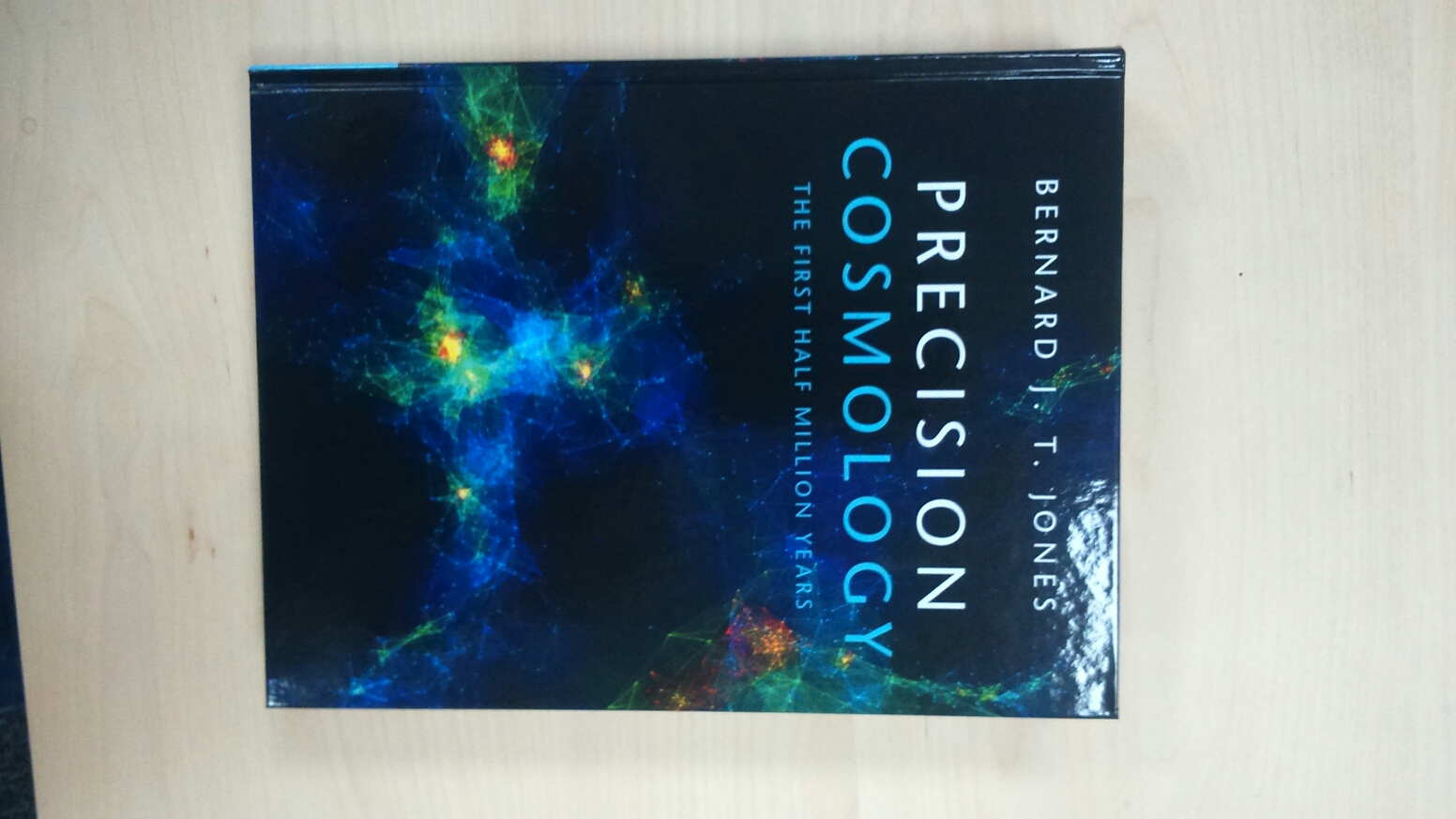
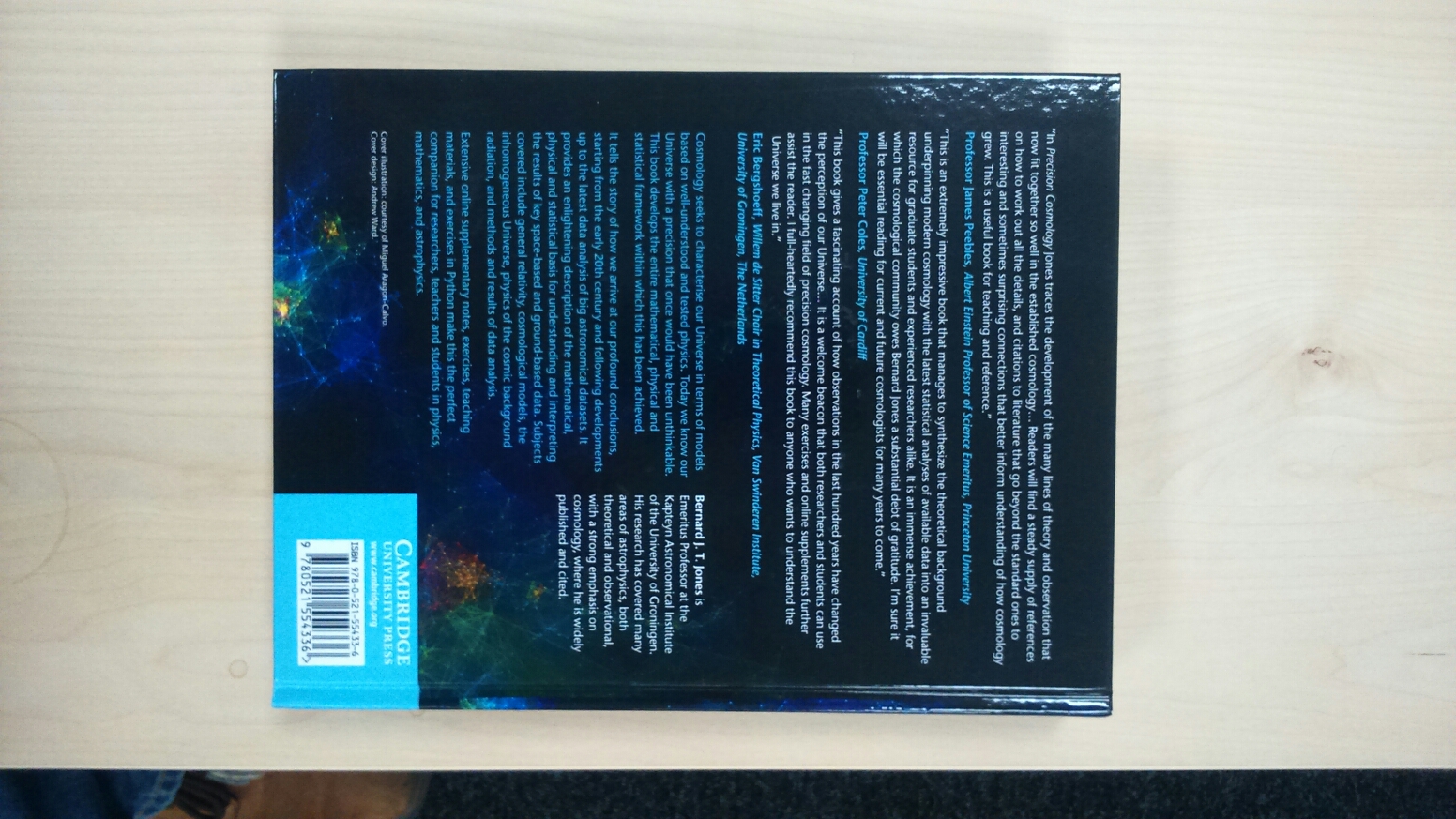
Precision Cosmology!

Posted in Books, The Universe and Stuff with tags , , on April 28, 2017 by telescoper

Well, look what the postman brought me today!

Hot off the press, here is a textbook by my friend and erstwhile collaborator Bernard Jones. As you will see, it even has an endorsement by me on the back cover. I think its a very fine book indeed and it will be immensely useful for cosmologists young and old alike!

PhD Opportunities in Data-intensive Physics & Astrophysics!

Posted in The Universe and Stuff on April 24, 2017 by telescoper

I’m back from my little holiday having accumulated a very long to-do list, near the top of which are a number of things related to our new STFC-funded Centre for Doctoral Training involving the Universities of Cardiff, Bristol and Swansea. This will be coordinated by the Data Innovation Institute at Cardiff University and it covers  a wide range of data-intensive research in particle physics, astrophysics and cosmology carried on at the three member institutions. ‘Data-intensive’ here means involving very big data sets, very sophisticated analysis methods or high-performance computing,  or any combination of these.

The Centre for Doctoral Training is being coordinated by the Data Innovation Institute at Cardiff University. It will commence in September 2017. Applications have been open for a couple of weeks and we will be starting to make selections very soon so if you’re interested in this opportunity you will have to get your skates on! In fact, to secure a PhD place at this STFC CDT administered by the DII you’d better apply PDQ!

For further information on the programme, including details of some of the projects on offer at Cardiff, please see here. Follow that link if you want some more information about the application process.

By the way, for  this special programme, STFC have relaxed the  rules relating to  nationality, so full funding is potentially available for  non-UK citizens under this scheme – that isn’t normally the case for PhD studentships funded by the UK research councils.

If you’re looking to do a PhD in data-intensive physics or astrophysics, get your application in now!


The Einstein Theory of Relativity

Posted in Film, The Universe and Stuff with tags , on April 21, 2017 by telescoper

I thought you might find this film interesting. I think it’s rather wonderful, actually, though it’s silent and definitely pre-CGI. It’s also a bit dodgy on the science in a few places.

However, made way back in 1923 by Max FleischerThe Einstein Theory of Relativity  has to be one of the first science films ever made. Who can think of an earlier one?

P.S. Bonus points if you can name the soundtrack music!