Archive for the The Universe and Stuff Category

The Dipole Repeller

Posted in The Universe and Stuff with tags , , , , , , on February 2, 2017 by telescoper

An interesting bit of local cosmology news has been hitting the headlines over the last few days. The story relates to a paper by Yehuda Hoffman et al. published in Nature Astronomy on 30th January. The abstract reads:

Our Local Group of galaxies is moving with respect to the cosmic microwave background (CMB) with a velocity 1 of VCMB = 631 ± 20 km s−1and participates in a bulk flow that extends out to distances of ~20,000 km s−1 or more 2,3,4 . There has been an implicit assumption that overabundances of galaxies induce the Local Group motion 5,6,7 . Yet underdense regions push as much as overdensities attract 8 , but they are deficient in light and consequently difficult to chart. It was suggested a decade ago that an underdensity in the northern hemisphere roughly 15,000 km s−1 away contributes significantly to the observed flow 9 . We show here that repulsion from an underdensity is important and that the dominant influences causing the observed flow are a single attractor — associated with the Shapley concentration — and a single previously unidentified repeller, which contribute roughly equally to the CMB dipole. The bulk flow is closely anti-aligned with the repeller out to 16,000 ± 4,500 km s−1. This ‘dipole repeller’ is predicted to be associated with a void in the distribution of galaxies.

The effect of this “void in the distribution of galaxies” has been described in rather lurid terms as “Milky Way being pushed through space by cosmic dead zone” in a Guardian piece on this research.

If you’re confused by this into thinking that some sort of anti-gravity is at play, then it isn’t really anything so exotic. If the Universe were completely homogeneous and isotropic – as our simplest models assume – then it would be expanding at the same rate in all directions.  This would be a pure “Hubble flow“, with galaxies appearing to recede from an observer with a speed proportional to their distance:
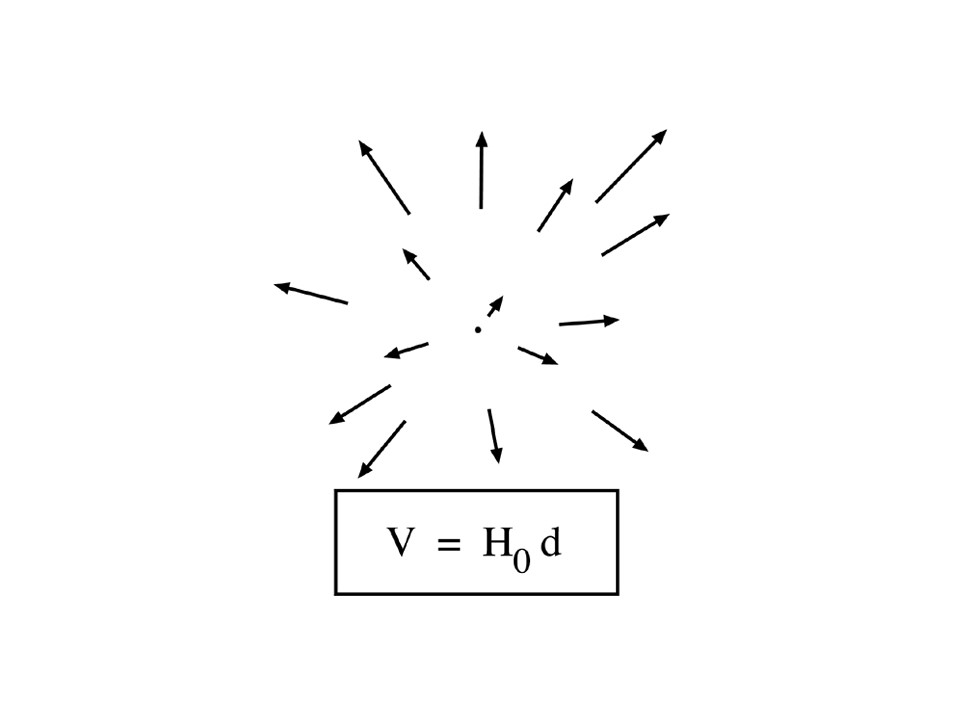
slide7

But the Universe isn’t exactly smooth. As well as the galaxies themselves, there are clusters, filaments and sheets of galaxies and a corresponding collection of void regions, together forming a huge and complex “cosmic web” of large-scale structure. This distorts the Hubble flow by inducing peculiar motions (i.e. departures from the pure expansion). A part of the Universe which is denser than average (e.g. a cluster or supercluster) expands less  quickly than average, a part which is less dense (i.e. a void) expands more quickly than average. Relative to the global expansion rate, clusters represent a “pull” and voids represent a “push”. That’s really all there is to it.

The difficult part about this kind of study is measuring a sufficient number of peculiar motions of galaxies around our own to make a detailed map of what’s going on in the local velocity field. That’s particularly hard for galaxies near the plane of the Milky Way disk as they tend to be obscured by dust. Nevertheless, after plugging away at this for many years, the authors of the Nature paper have generated some fascinating results. It seems that our Galaxy and other members of the Local Group lie between a dense supercluster (often called the Shapley concentration) and an underdense region, so the peculiar velocity field around us has an approximately dipole structure.

They’ve even made a nice video to show you what’s going on, so I don’t have to explain any further!


Fake News of the Holographic Universe

Posted in Astrohype, The Universe and Stuff with tags , , , , , , on February 1, 2017 by telescoper

It has been a very busy day today but I thought I’d grab a few minutes to rant about something inspired by a cosmological topic but that I’m afraid is symptomatic of malaise that extends far wider than fundamental science.

The other day I found a news item with the title Study reveals substantial evidence of holographic universe. You can find a fairly detailed discussion of the holographic principle here, but the name is fairly self-explanatory: the familiar hologram is a two-dimensional object that contains enough information to reconstruct a three-dimensional object. The holographic principle extends this to the idea that information pertaining to a higher-dimensional space may reside on a lower-dimensional boundary of that space. It’s an idea which has gained some traction in the context of the black hole information paradox, for example.

There are people far more knowledgeable about the holographic principle than me, but naturally what grabbed my attention was the title of the news item: Study reveals substantial evidence of holographic universe. That got me really excited, as I wasn’t previously aware that there was any observed property of the Universe that showed any unambiguous evidence for the holographic interpretation or indeed that models based on this model could describe the available data better than the standard ΛCDM cosmological model. Naturally I went to the original paper on the arXiv by Niayesh Ashfordi et al. to which the news item relates. Here is the abstract:

We test a class of holographic models for the very early universe against cosmological observations and find that they are competitive to the standard ΛCDM model of cosmology. These models are based on three dimensional perturbative super-renormalizable Quantum Field Theory (QFT), and while they predict a different power spectrum from the standard power-law used in ΛCDM, they still provide an excellent fit to data (within their regime of validity). By comparing the Bayesian evidence for the models, we find that ΛCDM does a better job globally, while the holographic models provide a (marginally) better fit to data without very low multipoles (i.e. l≲30), where the dual QFT becomes non-perturbative. Observations can be used to exclude some QFT models, while we also find models satisfying all phenomenological constraints: the data rules out the dual theory being Yang-Mills theory coupled to fermions only, but allows for Yang-Mills theory coupled to non-minimal scalars with quartic interactions. Lattice simulations of 3d QFT’s can provide non-perturbative predictions for large-angle statistics of the cosmic microwave background, and potentially explain its apparent anomalies.

The third sentence (highlighted) states explicitly that according to the Bayesian evidence (see here for a review of this) the holographic models do not fit the data even as well as the standard model (unless some of the CMB measurements are excluded, and then they’re only slightly better)

I think the holographic principle is a very interesting idea and it may indeed at some point prove to provide a deeper understanding of our universe than our current models. Nevertheless it seems clear to me that the title of this news article is extremely misleading. Current observations do not really provide any evidence in favour of the holographic models, and certainly not “substantial evidence”.

The wider point should be obvious. We scientists rightly bemoan the era of “fake news”. We like to think that we occupy the high ground, by rigorously weighing up the evidence, drawing conclusions as objectively as possible, and reporting our findings with a balanced view of the uncertainties and caveats. That’s what we should be doing. Unless we do that we’re not communicating science but engaged in propaganda, and that’s a very dangerous game to play as it endangers the already fragile trust the public place in science.

The authors of the paper are not entirely to blame as they did not write the piece that kicked off this rant, which seems to have been produced by the press office at the University of Southampton, but they should not have consented to it being released with such a misleading title.

Back to the (Early) Universe

Posted in Education, The Universe and Stuff with tags , , , on January 24, 2017 by telescoper

After what seems like ages away from the lecture theatre, today I resuming teaching duties with the first session of my module on The Physics of the Early Universe; the link there gives Enzo Pascale as being in charge of the module, but he has left BrExit Britain for his native Italy so I’ve taken his place. I actually wrote the syllabus for this module about five years ago when I worked in Cardiff previously, and was scheduled to deliver it in 2013, but I left for Sussex before it started and never actually lectured it. It’s nice to be able to teach this material at long last – at least it’s stuff that I should know something about.

This lectures are attended by students on the 4th year of the integrated Masters programme (MPhys) and also on stand-alone MSc courses in Physics or Astrophysics. I have about 25 students enrolled, which is not bad for a specialist module.

In fact Enzo recommended the book I wrote with Francesco Lucchin when he taught the module, and I’m happy to use it as the main text. I won’t cover all the material in the book – there isn’t time, and some of the book is out of date (written in 2002) – but at least almost everything I do in the lectures has a counterpart in the book.

Chapter 3 of Coles \& Lucchin has a chapter that may prove particularly popular in this era of ‘Alternative Facts’:

cosmology

I did however resist the temptation to hire a group of people to sit at the front of my first lecture cheering and clapping wildly.

I’ve asked to have my lectures timetabled in two-hour chunks. That’s partly because I only work part-time and I wanted to be able to maximize the flexibility with which I can use the rest of the time by concentrating my teaching commitments. The other reason is that I like the extended format. I don’t talk continuously for the whole time, of course. That would be unbearable for me and for the students. We have a ten-minute break in the middle. However, the two-hour block allows a wider range of activities – lecturing, discussion and worked examples – which is harder to do in the usual (50-minute) slot without being excessively rushed. When I taught postgraduates at Queen Mary we used two-hour blocks, which worked out quite well. The only problem is that I’m now a lot older, and having finished my first double-lecture I think it’s fair to say I’m more than a little knackered.

Another innovation is the use of Cardiff’s new lecture-capture system (called Panopto), which allows the lecturer to record everything – powerpoint, data visualizer, whiteboard and live action – for posterity. I recorded this morning’s lecture in toto and at some point when I get a moment I’ll do a quick edit and put it on Learning Central for the students to view at their leisure. I’m not sure how useful my ramblings will prove to be, but it’s fun to try these things. It’s a significantly more sophisticated and flexible system than the one we used when I was at Sussex, and I’m also lucky to be in a nice, clean and recently refurbished lecture theatre…

Anyway, this gives me the excuse to refloat an old opinion poll about lecture capture. Such facilities are of course very beneficial for students with special learning requirements, but in the spirit of inclusive teaching I think it’s good that all students can access recorded lecture material. Some faculty are apparently a little nervous that having recordings of lectures available online would result in falling attendances at lectures, but in fact the available evidence indicates precisely the opposite effect. Students find the recorded version adds quite a lot of value to the “live” event by allowing them to clarify things they might not have not noted down clearly.

I like the idea of lecture capture a lot and am very happy to do it with my own lectures. It does seem to be the case however that some university staff are wary of this innovation, but opinion may be changing. Please let me know what you think via the poll:

If you don’t like the idea I’d welcome a comment explaining why. I’d also be interested in comments from colleagues in other institutions as to the extent to which lecture capture technology is used elsewhere..


How the Nonbaryonic Dark Matter Theory Grew [CEA]

Posted in The Universe and Stuff with tags , , on January 24, 2017 by telescoper

Another arXiver post, this time from the great Jim Peebles. Always a skeptic about dark matter, especially cold dark matter, it is the hallmark of a great scientist that he weighs up the evidence as objectively as possible.

This is a long review, but well worth reading for its important insights and historical perspective. I agree that the case for non-baryonic dark matter is compelling, but it is also far from proved and it’s still possible that an alternative, equally or more compelling, theory will be found.

arxiver's avatararXiver

http://arxiv.org/abs/1701.05837

The evidence is that the mass of the universe is dominated by an exotic nonbaryonic form of matter largely draped around the galaxies. It approximates an initially low pressure gas of particles that interact only with gravity, but we know little more than that. Searches for detection thus must follow many difficult paths to a great discovery, what the universe is made of. The nonbaryonic picture grew out of a convergence of evidence and ideas in the early 1980s. Developments two decades later considerably improved the evidence, and advances since then have made the case for nonbaryonic dark matter compelling.

Read this paper on arXiv…

P. Peebles
Mon, 23 Jan 17
37/55

Comments: An essay to accompany articles on dark matter detection in Nature Astronomy

View original post

Status of Dark Matter in the Universe [CEA]

Posted in The Universe and Stuff with tags , on January 11, 2017 by telescoper

Courtesy of arXiver, here’s a nice review article if you want to get up to date with the latest ideas and evidence about Dark Matter…

arxiver's avatararXiver

http://arxiv.org/abs/1701.01840

Over the past few decades, a consensus picture has emerged in which roughly a quarter of the universe consists of dark matter. I begin with a review of the observational evidence for the existence of dark matter: rotation curves of galaxies, gravitational lensing measurements, hot gas in clusters, galaxy formation, primordial nucleosynthesis and cosmic microwave background observations. Then I discuss a number of anomalous signals in a variety of data sets that may point to discovery, though all of them are controversial. The annual modulation in the DAMA detector and/or the gamma-ray excess seen in the Fermi Gamma Ray Space Telescope from the Galactic Center could be due to WIMPs; a 3.5 keV X-ray line from multiple sources could be due to sterile neutrinos; or the 511 keV line in INTEGRAL data could be due to MeV dark matter. All of these would require further confirmation in other experiments…

View original post 92 more words

The Path of the 2017 Total Solar Eclipse

Posted in The Universe and Stuff with tags , , , on January 6, 2017 by telescoper

I thought I’d share this nice NASA video showing the path of totality of the solar eclipse which will take place on 21st August 2017. This is he determined by the changing position of the shadow cast on the Earth’s surface by the Moon as the Earth rotates beneath it. As you can see the shadow will cross the United States of America from Oregon in the North West to South Carolina in the South East. It even passes over Kansas City on the way, so this promises to be a phenomenon that very many people will experience and enjoy.

Eclipses are not particularly rare: there are at least two every year, but most of these are partial rather than total and it is less common for totality to be witnessed from highly populated areas.

For much more information about the 2017 total eclipse of the sun, see the NASA page here.

Perihelion and the Seasons

Posted in The Universe and Stuff with tags , , , , , , , on January 4, 2017 by telescoper

Today the Earth is at the point on its orbit at which it is at its closest to the Sun, i.e. at its perihelion. To be precise, this event takes place at 14.18 GMT today 4th January 2017; aphelion (the furthest distance from the Sun) is  at 20.11 GMT on July 3rd 2017. You can find a list of times and dates of perihelion and aphelion for future years  here.

It surprises me how many people think that the existence of the seasons has something to do with the variation of the Earth’s distance from the Sun as it moves in its orbit. The fact that perihelion occurs in the depth of winter should convince anyone living in the Northern hemisphere that this just can’t be the case, as should the fact that it’s summer in the Southern hemisphere while it is winter in the North.

The real reason for the existence of seasons is the tilt of the Earth’s axis of rotation, as explained in a nice little video here. I used to do a little demonstration with a torch (flashlight to American readers) to illustrate this when I taught first-year astrophysics. If you shine a torch horizontally at a piece of card it will illuminate a patch of the card. Keep the torch at the same distance but tilt the card and you will see the illuminated patch increase in size. The torch is radiating the same amount of energy but in the second case that energy is spread over a larger area than in the first. This means that the energy per unit area incident on the card is decreases when the card is tilted. It is that which is responsible for  winter being  colder than summer. In the summer the sun is higher in the sky (on average) than in winter. From this argument you can infer that the winter solstice (which passed on 21st December), not the perihelion, is the relevant astronomical indicator of winter.

That is not to say that the shape of the Earth’s orbit has no effect on temperatures. The eccentricity of the Earth’s orbit is e=0.017. Estimate the percentage difference in the flux of energy arriving at Earth from the Sun at the extremes of its orbit (i.e. at perihelion and aphelion).

I leave it as an exercise for the student that the fractional difference in distance between perihelion and aphelion in an elliptical orbit is 2e. The fractional change in flux received between the two extremes is thus 4e or about 6.8%, which is indeed a significant in the insolation at the Earth’s surface.

Assuming (for the sake of illustration only)  that the Earth behaves like a black body  then the incident flux would go as the fourth power of the temperature, which means that the temperature should change by about 1.7% between perihelion and aphelion. Taking the mean temperature to be about 300 K the difference should be around 5° C.

Ignoring any effects other than insolation this means that summer in the Southern hemisphere (when the Earth is at perihelion) should be significantly warmer than summer in the Northern hemisphere (when the Earth is at aphelion).

Things are not as simple as that, however, because the Earth’s surface possesses a significant North-South asymmetry: there is a much larger fraction of ocean in the Southern hemisphere, for example, which could be responsible for moderating. The climate is a non-linear system that involves circulating air and ocean currents that respond in complicated ways and on different timescales not just to insolation but to many other parameters, including atmospheric composition (especially water vapour).

The perihelion effect on summer temperatures can be readily verified by observations of Mars, which has no oceans and a much thinner, drier atmosphere, as well as a much more eccentric orbit (e=0.0934).


P.S. Of course, at perihelion the Earth is not only closest to the sun but also moving with its greatest orbit speed. That no doubt explains why January is often very windy…

P.P.S. That was a joke.


Back to Work…

Posted in Biographical, The Universe and Stuff with tags , , on January 3, 2017 by telescoper

Well, the Christmas break is over at Cardiff University and I’m back in the office of the Data Innovation Research Institute. To be honest, it’s rather quiet around here. Most staff seem to be still on holiday. There are a few students around, mainly international ones. This is actually a revision week at Cardiff University in advance of the mid-year examinations which start next week and go on for a fortnight. After that we’ll be back into teaching. I’ll be doing a Masters-level module on The Physics of the Early Universe in the forthcoming term, and I’m very much looking forward to it.

The outcomes of the annual round of consolidated grants administered by the Astronomy Grants Panel of Science and Technology Facilities Council were announced just before Christmas, with success for some and disappointment for others. I only have anecdotal evidence from personal contacts but it seems to have been a tough round, which wouldn’t surprise me because the funding for basic scientific research in the UK has been flat in cash terms for many years now, and is gradually being eroded by inflation. It’s a tough climate but when, in a couple of years, we lose access to all forms of EU funding things will get even tougher…

Anyway, as new grants are announced and old ones terminated, this is a busy time of year for postdocs (who are largely funded by research grants) seeking new positions. I’ve spent most of the day so far writing references for applicants and will return to that task for a couple of hours after lunch. It’s particularly tough on those whose positions lapse at the end of March who only got notice just before Christmas that their existing funding is not going to be renewed. There’s little time in such a position to get a new job sorted, but on the other hand, new grants are starting from 1st April so there are opportunities out there. It’s not easy to respond if you have a family or other commitments, though.

Another thing that happened just before Christmas was that the Data Innovation Research Institute here at Cardiff University announced its first tranche of “seedcorn” grants to foster interdisciplinary research. These grants are quite small in cash terms but it is hoped that at least some of them will help develop substantial projects by bringing together parts of the University that don’t previously collaborate enough. Congratulations to those whose proposals were selected, and commiserations to those who were unsuccessful.

I was pleased that my proposal – together with Professor Nikolai Leonenko of the School of Mathematics – was one of the successful bids. That means that, probably in the spring, we will be organizing a short workshop relating to the analysis and modelling of astrophysical data defined on the sphere, a topic which has interesting mathematical aspects as well as very practical implications for astronomy and cosmology. We’ll be starting to organize that soon, which adds another item to my to-do list, but it should be a fun conference when it happens.

Before you ask: yes, I do work for the Data Innovation Research Institute but because I was an applicant I recused myself from judging the applications in case there was any perception of a conflict of interest. So there.

Most of my work between now and the start of teaching term is going to be devoted to a couple of MSc courses we’re planning to launch this year, but I’ll write more about them – and plug them shamelessly – when they’re all formally announced and ready to go!

And with that I’d better get back to work again.

Exploring Cosmic Origins with CORE: Inflation [CEA]

Posted in The Universe and Stuff on January 3, 2017 by telescoper

More on the capabilities of CORE…

arxiver's avatararXiver

http://arxiv.org/abs/1612.08270

We forecast the scientific capabilities of CORE, a proposed CMB space satellite submitted in response to the ESA fifth call for a medium-size mission opportunity, to improve our understanding of cosmic inflation. The CORE mission will map the CMB anisotropies in temperature and polarization in 19 frequency channels spanning the range 60-600 GHz. CORE will have an aggregate noise sensitivity of $1.7 mu$ K$cdot ,$arcmin and an angular resolution of 5′ at 200 GHz. We explore the impact of telescope size and noise sensitivity on the inflation science return by making forecasts for several instrumental configurations. This study assumes that the lower and higher frequency channels suffice to remove foreground contaminations and complements other related studies of component separation and systematic effects, which will be reported in other papers of the series “Exploring Cosmic Origins with CORE.” We forecast the capability to determine key inflationary parameters, to lower the…

View original post 143 more words

Exploring Cosmic Origins with CORE: Cosmological Parameters [CEA]

Posted in The Universe and Stuff on January 3, 2017 by telescoper

Here’s an arXiver post I missed before Christmas about CORE – an exciting proposed for new CMB mission with a focus on polarization

arxiver's avatararXiver

http://arxiv.org/abs/1612.00021

We forecast the main cosmological parameter constraints achievable with the CORE space mission which is dedicated to mapping the polarisation of the Cosmic Microwave Background (CMB). CORE was recently submitted in response to ESA’s fifth call for medium-sized mission proposals (M5). Here we report the results from our pre-submission study of the impact of various instrumental options, in particular the telescope size and sensitivity level, and review the great, transformative potential of the mission as proposed. Specifically, we assess the impact on a broad range of fundamental parameters of our Universe as a function of the expected CMB characteristics, with other papers in the series focusing on controlling astrophysical and instrumental residual systematics. In this paper, we assume that only a few central CORE frequency channels are usable for our purpose, all others being devoted to the cleaning of astrophysical contaminants. On the theoretical side, we assume LCDM as…

View original post 145 more words