Archive for the The Universe and Stuff Category

Scientific Breakthrough of the Year 2016

Posted in The Universe and Stuff with tags , , on December 31, 2016 by telescoper

The year 2016 is almost over and there are just few hours left  until a 2017 begins. Looking back over the scientific discoveries of the last 12 months, I expect you think I would choose the discovery of gravitational waves by the LIGO consortium as my “Scientific Breakthrough of the Year”.

Wonderful achievement though that was, I have, after due reflection, decided to award the accolade to something else which has even more profound implications for the human race and its place in the Universe.

So without further ado, I hereby announce that the In The Dark award for Scientific Breakthrough Of The Year 2016 goes to Donald Trump,  for providing us at last with a definitive resolution of the Fermi Paradox.


I hope this clarifies the Apocalypse.

The Winter Solstice and the Time of Sunrise and Sunset

Posted in The Universe and Stuff with tags , , , , , on December 21, 2016 by telescoper

You may have missed it, but the winter solstice happened today, Wednesday 21st December 2016, at 10.44am GMT (10.44 UTC). This marks the shortest day of the year: days will get longer from now until the Summer Solstice next June. As we were discussing in the pub last night, however, this does not mean that sunrise will happen earlier tomorrow than it did this morning. In fact, sunrise will carry on getting later until the new year. This is because there is a difference between mean solar time (measured by clocks) and apparent solar time (defined by the position of the Sun in the sky), so that a solar day does not always last exactly 24 hours. A description of apparent and mean time was given by Nevil Maskelyne in the Nautical Almanac for 1767:

Apparent Time is that deduced immediately from the Sun, whether from the Observation of his passing the Meridian, or from his observed Rising or Setting. This Time is different from that shewn by Clocks and Watches well regulated at Land, which is called equated or mean Time.

The discrepancy between mean time and apparent time arises because of the Earth’s axial tilt and the fact that it travels around the Sun in an elliptical orbit in which its orbital speed varies with time of year (being faster at perihelion than at aphelion).

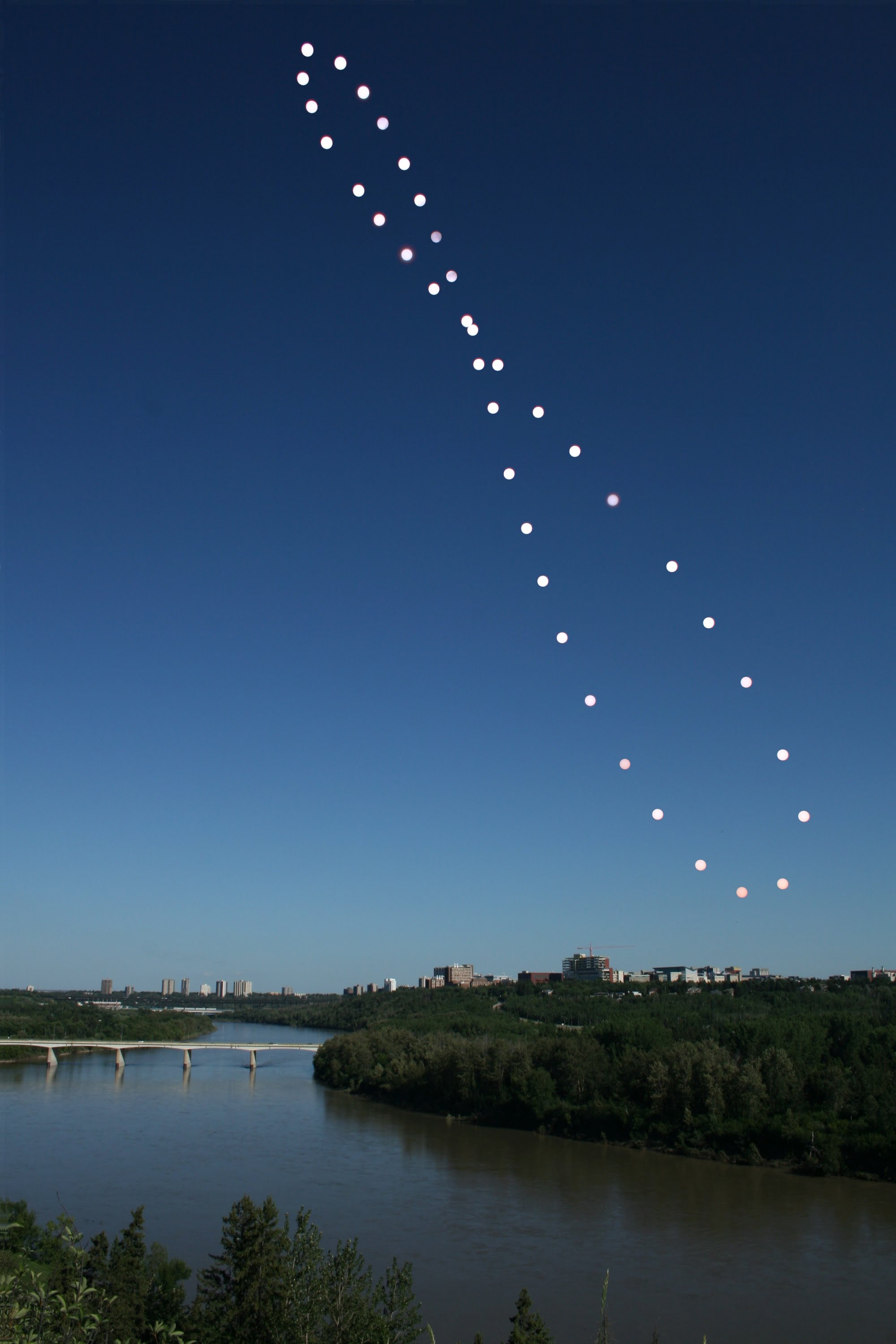
In fact if you plot the position of the Sun in the sky at a fixed time each day from a fixed location on the Earth you get a thing called an analemma, which is a sort of figure-of-eight shape whose shape depends on the observer’s latitude. Here’s a photographic version taken in Edmonton, with photographs of the Sun’s position taken from the same position at the same time on different days over the course of a year:

maxresdefault

The winter solstice is the lowermost point on this curve and the summer solstice is at the top. The north–south component of the analemma is the Sun’s declination, and the east–west component is the so-called equation of time which quantifies the difference between mean solar time and apparent solar time. This curve can be used to calculate the earliest and/or latest sunrise and/or sunset.

Using a more rapid calculational tool (Google), I found a table of the local mean times of sunrise and sunset for Cardiff (where I live) around the 2016 winter solstice. The table shows that today is indeed the shortest day (with a time between sunrise and sunset of 7 hours 49 minutes and 55 seconds). The duration of the shortest day this year is 8 hours and 48 minutes shorter than the longest day (the summer solstice). The table also shows that sunset already started occurring later in the day before the winter solstice (although the weather has been too overcast to notice this), and sunrise will continue to happen later for a few days after the solstice. In fact the earliest sunset this year in Cardiff was on 12th December, and the latest sunrise will be on 30th December.

I hope this clarifies the situation.

Straw Poll on Statistical Computing

Posted in Bad Statistics, The Universe and Stuff with tags , , on December 20, 2016 by telescoper

The abstract of my previous (reblogged) post claims that R is “the premier language of statistical computing”. That may be true for the wider world of statistics, and I like R very much, but in my experience astronomers and cosmologists are much more likely to do their coding in Python.  It’s certainly the case that astronomers and physicists are much more likely to be taught Python than R. There may well even be some oldies out there still using other languages like Fortran, or perhaps  relying on books of statistical tables!

Out of interest therefore I’ve decided to run the following totally biased and statistically meaningless poll of my immense readership:


If you choose “something else”, please let me know through the comments box what your alternative is. I can then add additional options.


Everything we'd like to do with LSST data, but we don't know (yet) how [IMA]

Posted in The Universe and Stuff with tags , on December 16, 2016 by telescoper

Here’s a nice little summary paper (via arXiver) covering the data challenges posed by the Large Synoptic Survey Telescope (LSST) which will come online in 2020 or thereabouts.

To give a bit of a perspective, when the Sloan Digital Sky Survey (SDSS) began to collect astronomical data in 2000, it amassed more in its first few weeks than all data collected in the entire history of astronomy to that date.

Continuing at a rate of about 200 GB per night, SDSS has subsequently amassed more than 140 terabytes of information.

When LSST, which is in many ways a successor to SDSS, comes online it is expected to acquire that amount of data every five days…

arxiver's avatararXiver

http://arxiv.org/abs/1612.04772

The Large Synoptic Survey Telescope (LSST), the next-generation optical imaging survey sited at Cerro Pachon in Chile, will provide an unprecedented database of astronomical measurements. The LSST design, with an 8.4m (6.7m effective) primary mirror, a 9.6 sq. deg. field of view, and a 3.2 Gigapixel camera, will allow about 10,000 sq. deg. of sky to be covered twice per night, every three to four nights on average, with typical 5-sigma depth for point sources of $r$=24.5 (AB). With over 800 observations in $ugrizy$ bands over a 10-year period, these data will enable a deep stack reaching $r$=27.5 (about 5 magnitudes deeper than SDSS) and faint time-domain astronomy. The measured properties of newly discovered and known astrometric and photometric transients will be publicly reported within 60 sec after observation. The vast database of about 30 trillion observations of 40 billion objects will be mined for the unexpected and used…

View original post 61 more words

LIGO Echoes, P-values and the False Discovery Rate

Posted in Astrohype, Bad Statistics, The Universe and Stuff with tags , , , , on December 12, 2016 by telescoper

Today is our staff Christmas lunch so I thought I’d get into the spirit by posting a grumbly article about a paper I found on the arXiv. In fact I came to this piece via a News item in Nature. Anyway, here is the abstract of the paper – which hasn’t been refereed yet:

In classical General Relativity (GR), an observer falling into an astrophysical black hole is not expected to experience anything dramatic as she crosses the event horizon. However, tentative resolutions to problems in quantum gravity, such as the cosmological constant problem, or the black hole information paradox, invoke significant departures from classicality in the vicinity of the horizon. It was recently pointed out that such near-horizon structures can lead to late-time echoes in the black hole merger gravitational wave signals that are otherwise indistinguishable from GR. We search for observational signatures of these echoes in the gravitational wave data released by advanced Laser Interferometer Gravitational-Wave Observatory (LIGO), following the three black hole merger events GW150914, GW151226, and LVT151012. In particular, we look for repeating damped echoes with time-delays of 8MlogM (+spin corrections, in Planck units), corresponding to Planck-scale departures from GR near their respective horizons. Accounting for the “look elsewhere” effect due to uncertainty in the echo template, we find tentative evidence for Planck-scale structure near black hole horizons at 2.9σ significance level (corresponding to false detection probability of 1 in 270). Future data releases from LIGO collaboration, along with more physical echo templates, will definitively confirm (or rule out) this finding, providing possible empirical evidence for alternatives to classical black holes, such as in firewall or fuzzball paradigms.

I’ve highlighted some of the text in bold. I’ve highlighted this because as written its wrong.

I’ve blogged many times before about this type of thing. The “significance level” quoted corresponds to a “p-value” of 0.0037 (or about 1/270). If I had my way we’d ban p-values and significance levels altogether because they are so often presented in a misleading fashion, as it is here.

What is wrong is that the significance level is not the same as the false detection probability.  While it is usually the case that the false detection probability (which is often called the false discovery rate) will decrease the lower your p-value is, these two quantities are not the same thing at all. Usually the false detection probability is much higher than the p-value. The physicist John Bahcall summed this up when he said, based on his experience, “about half of all 3σ  detections are false”. You can find a nice (and relatively simple) explanation of why this is the case here (which includes various references that are worth reading), but basically it’s because the p-value relates to the probability of seeing a signal at least as large as that observed under a null hypothesis (e.g.  detector noise) but says nothing directly about the probability of it being produced by an actual signal. To answer this latter question properly one really needs to use a Bayesian approach, but if you’re not keen on that I refer you to this (from David Colquhoun’s blog):

One problem with all of the approaches mentioned above was the need to guess at the prevalence of real effects (that’s what a Bayesian would call the prior probability). James Berger and colleagues (Sellke et al., 2001) have proposed a way round this problem by looking at all possible prior distributions and so coming up with a minimum false discovery rate that holds universally. The conclusions are much the same as before. If you claim to have found an effects whenever you observe a P value just less than 0.05, you will come to the wrong conclusion in at least 29% of the tests that you do. If, on the other hand, you use P = 0.001, you’ll be wrong in only 1.8% of cases.

Of course the actual false detection probability can be much higher than these limits, but they provide a useful rule of thumb,

To be fair the Nature item puts it more accurately:

The echoes could be a statistical fluke, and if random noise is behind the patterns, says Afshordi, then the chance of seeing such echoes is about 1 in 270, or 2.9 sigma. To be sure that they are not noise, such echoes will have to be spotted in future black-hole mergers. “The good thing is that new LIGO data with improved sensitivity will be coming in, so we should be able to confirm this or rule it out within the next two years.

Unfortunately, however, the LIGO background noise is rather complicated so it’s not even clear to me that this calculation based on “random noise”  is meaningful anyway.

The idea that the authors are trying to test is of course interesting, but it needs a more rigorous approach before any evidence (even “tentative” can be claimed). This is rather reminiscent of the problems interpreting apparent “anomalies” in the Cosmic Microwave Background, which is something I’ve been interested in over the years.

In summary, I’m not convinced. Merry Christmas.



Galaxy Formation in the EAGLE Project

Posted in The Universe and Stuff with tags , , , on December 8, 2016 by telescoper

Yesterday I went to a nice Colloquium by Rob Crain of Liverpool John Moores University (which is in the Midlands). Here’s the abstract of his talk which was entitled
Cosmological hydrodynamical simulations of the galaxy population:

I will briefly recap the motivation for, and progress towards, numerical modelling of the formation and evolution of the galaxy population – from cosmological initial conditions at early epochs through to the present day. I will introduce the EAGLE project, a flagship program of such simulations conducted by the Virgo Consortium. These simulations represent a major development in the discipline, since they are the first to broadly reproduce the key properties of the evolving galaxy population, and do so using energetically-feasible feedback mechanisms. I shall present a broad range of results from analyses of the EAGLE simulation, concerning the evolution of galaxy masses, their luminosities and colours, and their atomic and molecular gas content, to convey some of the strengths and limitations of the current generation of numerical models.

I added the link to the EAGLE project so you can find more information. As one of the oldies in the audience I can’t help remembering the old days of the galaxy formation simulation game. When I started my PhD back in 1985 the state of the art was a gravity-only simulation of 323 particles in a box. Nowadays one can manage about 20003 particles at the same time aas having a good go at dealing not only with gravity but also the complex hydrodynamical processes involved in assembling a galaxy of stars, gas, dust and dark matter from a set of primordial fluctuations present in the early Universe. In these modern simulations one does not just track the mass distribution but also various themrmodynamic properties such as temperature, pressure, internal energy and entropy, which means that they require large supercomputers. This certainly isn’t a solved problem – different groups get results that differ by an order of magnitude in some key predictions – but the game has certainly moved on dramatically in the past thirty years or so.

Another thing that has certainly improved a lot is data visualization: here is a video of one of the EAGLE simulations, showing a region of the Universe about 25 MegaParsecs across. The gas is colour-coded for temperature. As the simulation evolves you can see the gas first condense into the filaments of the Cosmic Web, thereafter forming denser knots in which stars form and become galaxies, experiencing in some cases explosive events which expel the gas. It’s quite a messy business, which is why one has to do these things numerically rather than analytically, but it’s certainly fun to watch!

Absorbed in a Quasar Spectrum

Posted in The Universe and Stuff with tags , , , , , , on December 5, 2016 by telescoper

Many people seem to think that astronomers spend all their time looking at pretty pictures of stars and galaxies. Actually a large part of observational astronomy isn’t about making images of things but doing spectroscopy. In fact the rise of astronomical spectroscopy is what turned astronomy into astrophysics. But that’s not to say that spectra can’t be pretty either. Here is an example (from here) which shows the light from the quasar HE0940-1050 taken by the UVES instrument mounted on ESO’s Very Large Telescope in Chile.

This quasar is an interesting object, at a redshift of z= 3.0932 (which converts to a look-back time of about 11.6 billion years). The dark bands and lines you can see in the spectrum are caused by absorption of the light from the quasar by clouds of hydrogen gas between the quasar and the observer; the strength of the absorption indicates how much gas the light from the quasar has travelled through.  The absorption occurs at a particular wavelength corresponding to the Lyman-α transition but, because the clouds are all at different redshifts, each produces a line at a different observed wavelength in the quasar spectrum. There are many lines, which is why the collection of clouds responsible for them is often called the Lyman-α Forest. In effect the quasar sample is very much like a core sample, as if we were able to drill back in time to the quasar through the material that lies along the line of sight.

This spectrum is particularly remarkable because of the number of faint lines that can be seen: it’s like a detailed DNA Fingerprint of cosmic structure. It’s also very pretty.


Nailing Cosmological Jelly to the Wall

Posted in The Universe and Stuff with tags , , on November 28, 2016 by telescoper

When asked to provide comments for a recent piece about cosmology in New Scientist, all I could come up with was the quote in the following excerpt:

But no measurement will rule out inflation entirely, because it doesn’t make specific predictions. “There is a huge space of possible inflationary theories, which makes testing the basic idea very difficult,” says Peter Coles at Cardiff University, UK. “It’s like nailing jelly to the wall.”

Certain of my colleagues have cast doubt on whether I am qualified to comment on the nailing of jelly to the wall, so I feel obliged to share the results of my highly successful research into this in the form of the following photograph:
orange_jelly_nailed_to_wall

I regret that I was unable to find any Dark Jelly, so had to settle for the more familiar baryonic type. Also, for the record, I should point out that what is shown is actually jelly concentrate. A similar experiment with the more normal diluted form of jelly was somewhat less successful.

I hope this clarifies the situation.

Infinite LIGO Dreams

Posted in Art, The Universe and Stuff with tags , , , , , on November 28, 2016 by telescoper

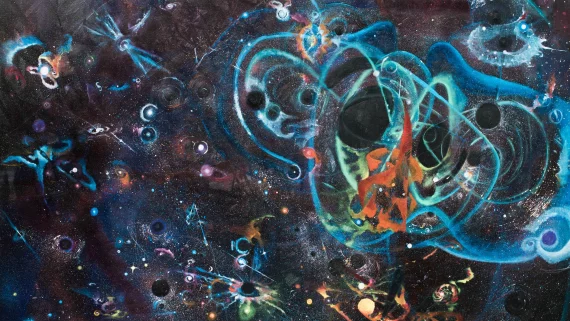
There was a special event in the School of Physics & Astronomy here at Cardiff University on Friday afternoon – the unveiling of a new work of art in our coffee area. The work, a large oil painting, called Infinite LIGO Dreams by local artist Penelope Rose Cowley was inspired by the detection of gravitational waves earlier this year:


gravitational-wave-artwork-copyright-penelope-cowley-16x9

You can read more about this work, and the circumstances behind its creation, at the Cardiff University website and via the Physics World blog. If you like the piece you can order a poster-sized print from Penelope Cowleys’s own website here.

The unveiling of this artwork was preceded by a drinks reception, which probably accounts for the errors that crept into the blog post I wrote on Friday after the party!


R.I.P. John M Stewart (1943-2016)

Posted in Biographical, Education, The Universe and Stuff with tags , , , on November 23, 2016 by telescoper

john-stewartI was very sad this morning to hear of the death of distinguished mathematical physicist Dr John M. Stewart (left). Apart from a few years in Munich in the 1970s John Stewart spent most of his working life in Cambridge, having studied there as an undergraduate and postgraduate and then returning from his spell at the Max Planck Institute to the Department of Applied Mathematics and Theoretical Physics for forty years.
John’s research mostly concerned relativistic fluid dynamics. Indeed, he was one of the pioneers of numerical relativity in the United Kingdom, and he applied his knowledge to a number of problems in early Universe cosmology and structure formation. I think it is fair to say that he wasn’t the most prolific researcher in terms of publications, which is perhaps why he only got promoted to Senior Lecturer in 2000 and never made it to a Chair, retiring as Reader in Gravitational Physics in 2010. However, his work was always of a very high technical standard and presented with great clarity and he was held in a very high regard by those who knew him and worked with him.

The tributes paid to John Stewart by King’s College (of which he was a Life Fellow) here and his colleagues in the Centre for Theoretical Cosmology here give a detailed account of his research achievements, so I refer you to them for more information about that aspect of his career.

I just wanted to add a personal note not about John Stewart’s research, but about something else mentioned in the obituaries linked to above: his teaching. I was fortunate enough to have him as a lecturer when I was studying Natural Sciences at Cambridge during the early 1980s. In the second year (Part IB) I specialised in Physics and Mathematics, and John taught part of the Mathematics syllabus. He was an absolutely superb teacher. For a start he was superbly well organized and had clearly thought very deeply about how best to present some quite difficult material. But it wasn’t just that. He projected a very engaging personality, with nice touches of humour, that made him easy to listen. His lectures were also very well paced for taking notes. In fact he was one of the few lecturers I had whose material I didn’t have to transcribe into a neat form from rough notes.

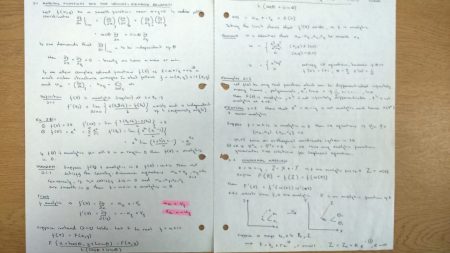
I have kept all the notes from that course for over thirty years. Here are a couple of pages as an example:

wp-1479909754508.jpeg

Anyone who has ever seen my handwriting will know that this is about as neat as I ever get!

When I was called upon to teach similar material at Cardiff and Sussex I drew on them heavily, so anyone who has learned anything from me about complex analysis, contour integration, Green’s functions and a host of other things actually owes a huge debt to John Stewart. Anything they didn’t understand was of course my fault, not his..

I also remember that John came to Queen Mary to give a seminar when I worked there in the early 90s as a postdoc. I was still a bit in awe of him because of my experience of him in Cambridge. His talk was about a method for handling the evolution of cosmological matter perturbations based on an approach based on the Hamilton-Jacobi formalism. His visit was timely, as I’d been struggling to understand the papers that had been coming out at the time on this topic. In the bar after his talk I plucked up the courage to explain to him what it was that I was struggling to understand. He saw immediately where I was going wrong and put me right on my misconceptions straight away, plucking a simple illustrative example apparently out of thin air. I was deeply impressed, not only by his ability to identify the issue but also with his friendly and helpful demeanour.

Rest in Peace, Dr John M. Stewart (1943-2016).