Archive for the The Universe and Stuff Category

50 Years of the Astronomy Centre at the University of Sussex

Posted in Biographical, Education, The Universe and Stuff with tags , , , , , on October 18, 2016 by telescoper

On Saturday (15th October) I was back in Brighton for the first time since I left my job there at the end of July. The occasion was a very nice lunch party to celebrate 50 years of the Astronomy Centre at the University of Sussex, which started properly in 1966. It was a pleasant occasion, and great to have the chance to catch up with some people I haven’t seen for far too long. I had two stints in the Astronomy Centre: once as a student then postdoc from 1985 to 1990, and the other from 2013 to 2016 when I was Head of the School of which the Astronomy Centre is part. I had a lot more time to do research in the first incarnation than in the second!

Quite a few people present hadn’t realised I was no longer working at Sussex, which led to one or two slightly awkward conversations, but I was thankfully very far from being the centre of attention.

After the lunch itself we had short speeches from various alumni of the Astronomy Centre: esteemed science writer John Gribbbin (who was one of its first MSc students in 1966); Lord Martin Rees (who was briefly a Professor at Sussex, before he returned to Cambridge to take up the Plumian Professorship); John Barrow (who was my supervisor while I was there); Carlos Frenk (who was a postdoctoral researcher when I arrived in September 1985, but who left to take up a lectureship in Durham at the end of that year so we overlapped only for a short time); Andrew Liddle (who arrived near the end of my stay and was there for 22 years altogether, leaving at the end of 2012 to take up a post in Edinburgh); and Peter Thomas (current Director of the Astronomy Centre).

When I arrived in 1985 there were only four permanent faculty in the Astronomy Centre itself – Roger Tayler, Leon Mestel, John Barrow and Robert Smith – but research there was thriving and it was a great environment to work in. I count myself very lucky at having made such a good choice of a place to do my PhD DPhil. Leon and Robert both worked on stellar astrophysics, but after Leon’s retirement the centre increasingly focussed on cosmology and extragalactic astrophysics, which remains the case today. Roger Tayler sadly passed away in 1997, but Leon is still around: he is 89 years old and now lives in Cambridge.

Those present at the lunch were given a booklet featuring around 50 academic papers or other research “highlights”(e.g. the launch of Planck), approximately one for each year of the Astronomy Centre, chosen to be the “best” of that year. Each page was also shown as a slide during the lunch. I was thrilled to see that two of my papers (from 1987 and 1991 respectively) made it into the collection. The second one was published after I’d left Sussex, but I definitely did the work on it and submitted it while an employee of the Astronomy Centre. Andrew Liddle and John Barrow have the largest number of “greatest hits”, but the most famous paper is probably the classic “DEFW” which won Carlos Frenk and his collaborators the Gruber Prize about five years ago.

The book also contains various bits of interesting bibliometric information, such as this, which shows that the variation in the productivity of the Astronomy Centre over time.

us-astronomy-50-powerpoint

Anyway, for those who are interested, the whole collection of slides can be viewed here:

Thanks to Seb Oliver and the rest of the Astronomy Centre for organizing this very enjoyable event – and for sending me the slides! Here’s to the next 50 years of Astronomy at the University of Sussex!


A Universe of Two Trillion Galaxies

Posted in The Universe and Stuff with tags , , , , , on October 13, 2016 by telescoper

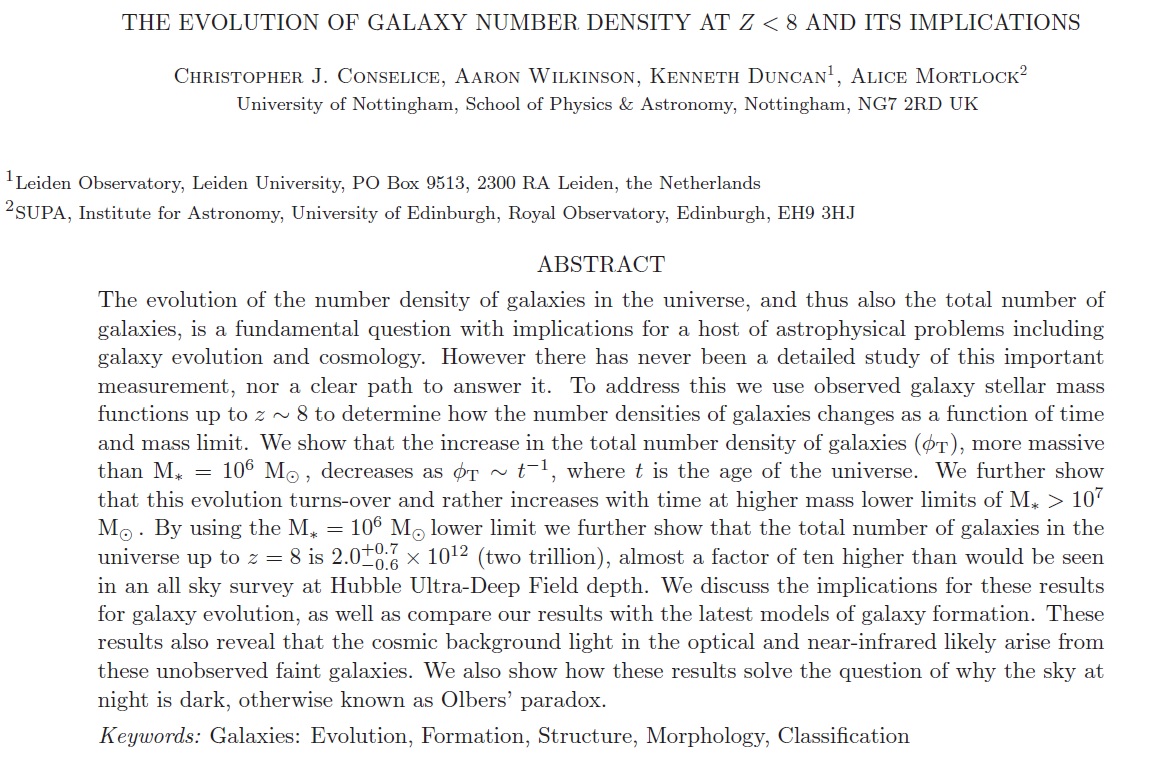
I just saw a press-release that describes a paper, just out, authored by Chris Conselice et al from the University of Nottingham (in the Midlands), with this here abstract:

conselice

The key conclusion of this paper is that when the universe was only a few billion years old there were about ten times as many galaxies in a given volume of space as there are within a similar volume today, but most of these galaxies were much lower mass systems than, e.g., the Milky Way. In fact their masses are similar to those of the satellite galaxies surrounding the Milky Way. These objects are numerous but so faint that even in very deep surveys with very big telescopes they are very easy to miss.

Here’s an image from a deep survey: this is from the Hubble Space Telescoper Great Observatories Deep Survey (HST-GOODS).

hst_goods-south

You can click on this to make it larger if you wish. This is typical of a “pencil beam” survey. It opens a very small window on the heavens – about a millionth of its total area of the sky – in a direction chosen to avoid having too many bright stars from our own Galaxy getting in the way. When you look at such a patch with a big telescope for a long time, what you see is basically all galaxies. The few stars in the above image can be identified by the diffraction patterns they produce, but almost every fuzzy blob in the picture is a galaxy. It looks like there are a lot of galaxies in this image, but the real number seems to be substantially higher than we thought.

When I’ve given popular talks about this kind of thing I’ve always said something like “There are at least as many galaxies in the observable Universe as there are stars in our own Galaxy”. It turns out that I was wise to include the “at least as”. There are about 100 billion (1011) stars in the Milky Way, but the latest estimate is now that there are two trillion (2 ×10¹²) galaxies in the observable Universe. I quote Douglas Adams:

“The Universe, as has been observed before, is an unsettlingly big place, a fact which for the sake of a quiet life most people tend to ignore. Many would happily move to somewhere rather smaller of their own devising, and this is what most beings in fact do.

I believe this explains a lot about modern politics.


General Relativity and Cosmology: Unsolved Questions and Future Directions [CL]

Posted in The Universe and Stuff with tags , on October 12, 2016 by telescoper

I missed this when it appeared on the arXiv last week, but now that I’ve read it I couldn’t resist reblogging this nice review of the current state of General Relativity and its alternatives, with an emphasis on the cosmological ramifications.

arxiver's avatararXiver

http://arxiv.org/abs/1609.09781

For the last 100 years, General Relativity (GR) has taken over the gravitational theory mantle held by Newtonian Gravity for the previous 200 years. This article reviews the status of GR in terms of its self-consistency, completeness, and the evidence provided by observations, which have allowed GR to remain the champion of gravitational theories against several other classes of competing theories. We pay particular attention to the role of GR and gravity in cosmology, one of the areas in which one gravity dominates and new phenomena and effects challenge the orthodoxy. We also review other areas where there are likely conflicts pointing to the need to replace or revise GR to represent correctly observations and consistent theoretical framework. Observations have long been key both to the theoretical liveliness and viability of GR. We conclude with a discussion of the likely developments over the next 100 years.

Read this paper…

View original post 17 more words

Those “Light-Bulb” Moments..

Posted in Biographical, The Universe and Stuff with tags , , , , , on October 11, 2016 by telescoper

Last week I read a piece in the October edition of Physics World (which you can read here, but only if you have a subscription) about whether breakthroughs in physics occur through sudden “light-bulb moments”, or are more often the result of solid hard graft? The piece includes some interesting comments from distinguished scientists about their own “Eureka” moments, which I’m sure will resonate with many researchers, not only physicists. Incidentally, the article refers to such moments as “claritons”, a word I’ve never heard before, presumably a soliton of clarity…

I’m pretty sure that everyone who works in science – even the eminent individuals interviewed for the Physics World piece – has spent a large part of their time “stuck”. I know I have. In the long run it’s probably good to go through such periods as I think they’re essential for intellectual development, but they’re undoubtedly extremely frustrating at the time. How you get “unstuck” is a very mysterious process. I’m not a neuroscientist, but it seems to me that when you get really immersed in, say, a research problem, your subconscious brain gets drawn into what you think is a fully conscious process, to the extent that even when you’re apparently not thinking about something you really are. I’ve had ideas come to me in all kinds of weird situations: watching ducks paddling on a pond, listening to music, walking in a park, and even pushing a trolley around a supermarket. Often it seems that it’s precisely when you’re not thinking that you have your best ideas. It’s not always clear what acted as the trigger, but and when it is it is often something quite abstract. In the case I mentioned of the ducks on the pond it was just a question of thinking about reference frames. It was a nudge in the right direction, but I still had to do quite a lot of work to finish the calculation. Come to think of it, it’s usually at that conceptual level that such things happen rather than in the detailed working, at least in my case.

The Physics World piece also talks about ideas coming through dreams. That has happened to me too, but I think it’s basically the same phenomenon that I’ve just discussed. It seems to me that dreams are a product of your brain sorting through recent events or experiences and trying to make sense of them in terms of others it has filed away. This can help with a research problem by flagging up a connection with something else hidden away. I can remember at least two occasions when I’ve woken up from a dream with an exact understanding of what I’d been doing wrong and how I could fix it. It’s great to wake up in the morning with that kind of feeling!

I know it’s wrong to draw inferences about other people from one’s own particular experiences, but I do feel that there are general lessons. One is that if you are going to be successful at research you have to have a sense of determination that borders on obsession. You have to immerse yourself in it and be prepared to put long hours in. When things are going well you will be so excited that you will find it as hard to stop as it is when you’re struggling. I’m writing as a physicist, but I imagine it is the just same for other disciplines.

The other, equally important, lesson to be learned is that it is essential to do other things as well as doing science. Being “stuck” on a problem is an essential part of mathematics or physics research, but sometimes battering your head against the same thing for days on end just makes it less and less likely you will crack it. The human brain is a wonderful thing, but it can get stuck in a rut. One way to avoid this happening is to have more than one thing to think about.

I’ve lost count of the number of times I’ve been stuck on the last clue in a crossword. What I always do in that situation is put it down and do something else for a bit. It could even be something as trivial as making a cup of tea, just as long as I don’t think about the clue at all while I’m doing it. Nearly always when I come back to it and look at it afresh I can solve it. I have a large stack of prize dictionaries to prove that this works!

It can be difficult to force yourself to pause in this way. I’m sure that I’m not the only physicist who has been unable to sleep for thinking about their research. I do think however that it is essential to learn how to effect your own mental reboot. In the context of my research this involved simply turning to a different research problem, but I think the same purpose can be served in many other ways: taking a break, going for a walk, playing sport, listening to or playing music, reading poetry, doing a crossword, or even just taking time out to socialize with your friends. Time spent sitting at your desk isn’t guaranteed to be productive, and you should never feel guilty about taking a thinking break.

I’d be interested to receive examples of other “light-bulb” moments through the comments box. I’d also welcome comments from neuroscientists on my extremely naïve comments about how the brain works in such situations.

P.S. It’s interesting how the light-bulb has become so strongly associated with the sort of brainwave discussed in this piece. Here’s a short discussion.


Lord Rees on the Threat to UK Science

Posted in Politics, Science Politics, The Universe and Stuff with tags , , , on October 6, 2016 by telescoper

In case you missed the comments by Lord Rees on Newsnight in the wake of the announcement of this year’s Nobel Prizes for Physics, here is a video.

Martin is always impeccably polite but I sense he must have been outraged by the statements made by Home Secretary Amber Rudd at the Conservative Party Conference this week, some of which seem to have been taking directly from Mein Kampf. Prior to this interview, the most extreme word I’ve ever hard Martin use was “reprehensible” – and that on an occasion when he was clearly angry. His use of the word “deplorable” here is very significant.

Quite apart the threat to science, I have to admit I’m extremely worried about the direction this country is taking. Perhaps someone should tell Prime Minister Theresa May that the referendum wasn’t about leaving the League of Nations and that this isn’t 1933. The parallels with Germany are striking. In that case it didn’t end with the identification and deportation of foreign workers. Yesterday Theresa May stated that anyone who describes themselves as a “Citizen of the World” is really a “Citizen of Nowhere”. I’ve never felt less at home in my own country than I do now.

A few days before the referendum a wrote a post that included this:

Of course I’m not saying that all those who want the UK to Leave the EU are fascists. Far from it. Many – indeed the majority – are reasonable, civilised people. But like it or not, if you vote Leave you’re voting the way the far right want you to vote. I for one will not take a single step in that direction. Fascism only needs a foot in the door. I fear that the domestic political consequences of BrExit will give it far more than that. Once they get hold of it, we’ll never get our country back.

My fear is even more real now than it was then.


The 2016 Nobel Prize for Physics goes to David Thouless, Duncan Haldane and Michael Kosterlitz

Posted in Science Politics, The Universe and Stuff with tags , , , , , , , on October 4, 2016 by telescoper

Well, as I suspected, the Nobel Prize Committee for Physics played with a very straight bat and did not award this years Prize to gravitational waves. I thought there was a reasonable chance they might bend the rules, and the polling was very even , so clearly some people thought so too. Anyway, I don’t think any bookmakers will be taking bets on next year!

Anyway, none of this should detract at all from the winner. Half this year’s prize was awarded to David J. Thouless (University of Washington, Seattle, WA, USA)  and the other half to F. Duncan M. Haldane (Princeton University, NJ, USA) and J. Michael Kosterlitz
(Brown University, Providence, RI, USA)

”for theoretical discoveries of topological phase transitions and topological phases of matter”

Although they now live and work in the USA, all three of the winners were born in the United Kingdom (two of them, Kosterlitz and Thouless, in Scotland); Haldane retains British nationality, Kosterlitz is now an American citizen and Thouless has joint US/UK nationality.

And here’s the text of the citation:

This year’s Laureates opened the door on an unknown world where matter can assume strange states. They have used advanced mathematical methods to study unusual phases, or states, of matter, such as superconductors, superfluids or thin magnetic films. Thanks to their pioneering work, the hunt is now on for new and exotic phases of matter. Many people are hopeful of future applications in both materials science and electronics.

The three Laureates’ use of topological concepts in physics was decisive for their discoveries. Topology is a branch of mathematics that describes properties that only change step-wise. Using topology as a tool, they were able to astound the experts. In the early 1970s, Michael Kosterlitz and David Thouless overturned the then current theory that superconductivity or suprafluidity could not occur in thin layers. They demonstrated that superconductivity could occur at low temperatures and also explained the mechanism, phase transition, that makes superconductivity disappear at higher temperatures.

In the 1980s, Thouless was able to explain a previous experiment with very thin electrically conducting layers in which conductance was precisely measured as integer steps. He showed that these integers were topological in their nature. At around the same time, Duncan Haldane discovered how topological concepts can be used to understand the properties of chains of small magnets found in some materials.

We now know of many topological phases, not only in thin layers and threads, but also in ordinary three-dimensional materials. Over the last decade, this area has boosted frontline research in condensed matter physics, not least because of the hope that topological materials could be used in new generations of electronics and superconductors, or in future quantum computers. Current research is revealing the secrets of matter in the exotic worlds discovered by this year’s Nobel Laureates.

It’s not my field, but I send my heartiest congratulations to Professors Thouless, Haldane and Kosterlitz. Enjoy your trip to Stockholm – it’s lovely in December!

Note that the Thomson-Reuters Nobel Prize “predictor”“, which is not often right, was wrong again!


The 2016 Nobel Prize for Physics

Posted in Science Politics, The Universe and Stuff with tags , , , on October 3, 2016 by telescoper

Just time for a quick post to point out that tomorrow, Tuesday 4th October 2016, will see the announcement of the 2016 Nobel Prize for Physics. See here if you want to follow the announcement live.

You might think that this year is a foregone conclusion. The big science result of the year is undoubtedly the discovery of gravitational waves by Advanced LIGO. The three leaders iof the team, i.e.

Ronald W.P. Drever Professor of Physics Emeritus, California Institute of Technology, Pasadena, CA USA
Kip S. Thorne Feynman Professor of Theoretical Physics Emeritus, California Institute of Technology, Pasadena, CA USA
Rainer Weiss Professor of Physics Emeritus, Massachusetts Institute of Technology, MA USA

These three scientists have already won this year’s Gruber and Kavli prizes and they are among the favourites on this Nobel Prize prediction site.

I would be very happy indeed to see the Nobel Prize for Physics go to this group, but I don’t think it’s the foregone conclusion many think it is.

To see why, look at the timetable of how the Nobel Prize Committee works. In particular, note:

SeptemberNomination forms are sent out. The Nobel Committee sends out confidential forms to around 3,000 people – selected professors at universities around the world, Nobel Laureates in Physics and Chemistry, and members of the Royal Swedish Academy of Sciences, among others.

February – Deadline for submission.The completed nomination forms must reach the Nobel Committee no later than 31 January of the following year. The Committee screens the nominations and selects the preliminary candidates. About 250–350 names are nominated as several nominators often submit the same name.

The official announcement of the detection of gravitational waves was not made until 11th February, i.e. after the above deadline. Now of course many people had inside knowledge about the discovery before then so they may well have made a nomination on time, but it’s not obvious how the Nobel Prize Committee would have treated a submission based essentially on hearsay. They have a reputation for being sticklers for procedure so it’s hard to be sure. If it did make the shortlist then this nomination will surely win, but it may not have. We’ll just have to wait and see. Or am I being too cautious? Let me know what you think will happen through the  poll below:


Oh, and if you think it will be for “Something Else” please feel free to expand via the Comments Box.


Formation of black holes in the dark [HEAP]

Posted in The Universe and Stuff with tags , on September 28, 2016 by telescoper

Given the title of my website I could hardly resist reblogging this arXiver post. I’m not an expert on Black Hole (BH) formation, so would be interested to hear opinions on how plausible is this idea that massive BHs might form via implosion rather than following a Supernova explosion.

arxiver's avatararXiver

http://arxiv.org/abs/1609.08411

A binary black hole (BBH) with components of 30-40 solar masses as the source of gravitational waves GW150914 can be formed from a relatively isolated binary of massive stars if both BHs are formed by implosion, namely, by complete or almost complete collapse of massive stars with no energetic SNe accompanied by a sudden mass loss that would significantly reduce the mass of the compact objects, and in most cases unbind the binary system. BBHs can also be formed by dynamical interactions in globular clusters, if the BHs are formed with no energetic SNe that would kick the BHs out from the cluster before BBH formation. Besides, if BHs of ~10 solar masses as in the source GW151226 are formed by implosion, the formation of BBHs would be prolific, and their fusion would make an important contribution to a stochastic gravitational wave background. Theoretical models set mass ranges for…

View original post 183 more words

The Possible Plumes of Europa

Posted in The Universe and Stuff with tags , , , , , , , on September 27, 2016 by telescoper

I was too busy yesterday to write a post about the latest hot news from the NASA Hubble Space Telescope, so here’s a quick catch-up.

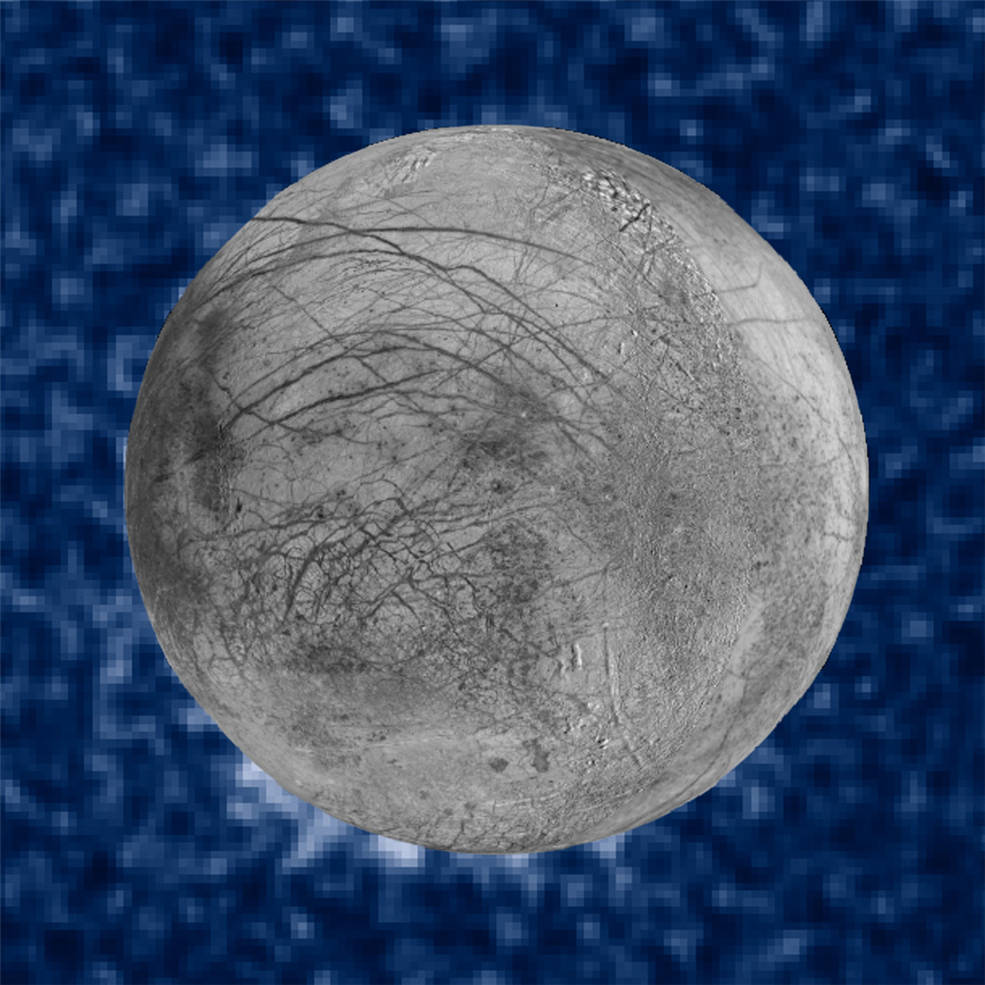
It seems that Europa, the smallest of the four Galilean moons of Jupiter, may from time to time be releasing “plumes” of water vapour. It has long been speculated that there might be large quantities of liquid water under Europa’s extremely smooth icy crust. Here’s a picture of possible plumes (to the bottom left of the image) in which a high-resolution picture of the surface of Europa has been superimposed.

europa

Picture Credits: NASA/ESA/W. Sparks (STScI)/USGS Astrogeology Science Center

There’s also short video explaining the possible discovery here.

It’s not obvious at first sight that features like that shown above are caused by water erupting through Europa’s surface. On the face of it they could, for example, be caused by the impact of a smaller body. However,  long-term observations of this phenomenon suggest out-gassing is much more likely.  The Hubble Space Telescope’s Imaging Spectrograph was used to study what are essentially Aurorae powered by Jupiter’s strong magnetic field in which the presence of excited states of hydrogen and oxygen provide evidence for the disintegration of water molecules through interaction with electrons in this highly energetic environment. The images were taken when Europa was in front of Jupiter so they are seen were seen in silhouette.

There is also evidence that these appearance of these plumes is periodic, and that they are more likely to occur when Europa is further from Jupiter than when it is closer. A plausible theory is that water is released from cracks in Europa’s surface which open and close owing to a combination of tidal gravitational and magnetic effects.

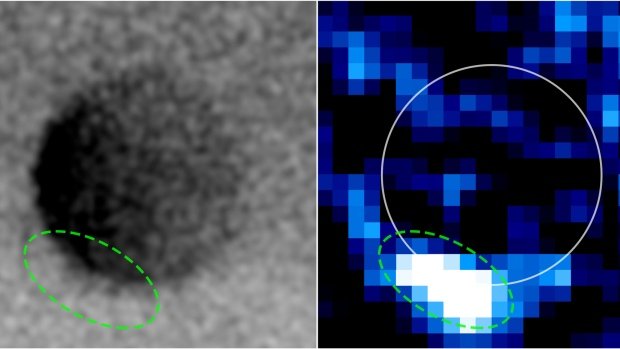
I wouldn’t say this was definite proof of the water interpretation. These observations push the capability of the Hubble Space Telescope to the limit because the features are so faint. For information here’s what the raw image looks like (left)  and with enhanced contrast (right):

raw_image


Verification of these results through independent means is clearly an important priority, though likely to prove challenging. The plume interpretation is possible, but whether it is yet probable I couldn’t say!


My First Contribution to the Scientific Literature.

Posted in Biographical, The Universe and Stuff on September 26, 2016 by telescoper

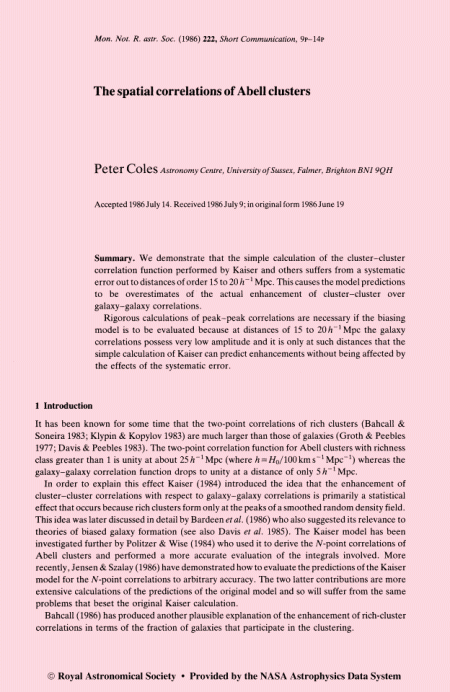
I suddenly realized yesterday that I had forgotten to mark the important anniversary of an event that had immense impact on the field of cosmology. On 15th September 1986, just over thirty years ago, my first ever scientific paper was released into the public domain.

Here is the front page:

mnras_paper

This was before the days of arXiv so there isn’t a copy on the preprint server, but you can access the whole article here on NASA/ADS.

I know it’s a shitty little paper, but you have to start somewhere! I’m particularly sad that, looking back, it reads as if I meant to be very critical of the Kaiser (1984) paper that inspired it. I still think that was a brilliant paper because it was based on a very original idea that proved to be enormously influential. The only point I was really making was that a full calculation of the size of the effect Nick Kaiser had correctly identified was actually quite hard, and his simple approximation was of limited quantitative usefulness. The idea was most definitely right, however.

I was just a year into my PhD  DPhil when this paper came out, and it wasn’t actually on what was meant to be the subject of my thesis work (which was the cosmic microwave background), although the material was related. My original version of this paper had my supervisor’s name on it, but he removed his name from the draft (as well as making a huge number of improvements to the text). At the time I naturally assumed that he took his name off because he didn’t want to be associated with such an insignificant paper, but I later realized he was just being generous. It was very good for me to have a sole-author paper very early on. I’ve taken that lesson to heart and have never insisted – like some supervisors do – in putting my name on my students’ work.

Seeing this again after such a long time brought back memories of the tedious job of making and distributing hard copies of preprints when I submitted the paper and sending them by snail mail to prominent individuals and institutions. Everyone did that in those days as email was too limited to send large papers. Nowadays we just shove our papers on the arXiv, complete with fancy graphics, and save ourselves a lot of time and effort.

I was actually surprised that quite a few recipients of my magnum opus were kind enough to respond in writing. In particular I got a nice letter from Dick Bond which began by referring to my “anti-Kaiser” preprint, which made me think he was going to have a go at me, but went on to say that he found my paper interesting and that my conclusions were correct. I was chuffed by that letter as I admired Dick Bond enormously (and still do).

Anyway, over the intervening 30 years this paper has received the princely total of 22 citations -and it hasn’t been cited at all since 2000 – so its scientific impact hardly been earth-shattering. The field has moved on quickly and left this little relic far behind. However, there is one citation I am proud of.

The great Russian scientist Yacob Borisovich Zel’dovich passed away in 1987. I was a graduate student at that time and had never had the opportunity to meet him. If I had done so I’m sure I would have found him fascinating and intimidating in equal measure, as I admired his work enormously as did everyone I knew in the field of cosmology. Anyway, a couple of years after his death a review paper written by himself and Sergei Shandarin was published, along with the note:

The Russian version of this review was finished in the summer of 1987. By the tragic death of Ya. B.Zeldovich on December 2, 1987, about four-fifths of the paper had been translated into English. Professor Zeldovich would have been 75 years old on March 8, 1989 and was vivid and creative until his last day. The theory of the structure of the universe was one of his favorite subjects, to which he made many note-worthy contributions over the last 20 years.

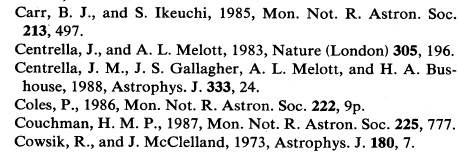
As one does if one is vain I looked down the reference list to see if any of my papers were cited. I’d only published the one paper before Zel’dovich died so my hopes weren’t high. As it happens, though, my very first paper (Coles 1986) was there in the list:

reference