Archive for the The Universe and Stuff Category

Ligatures, Diphthongs and Supernovae

Posted in History, Pedantry, The Universe and Stuff with tags , , , , , , , , on January 18, 2016 by telescoper

At the weekend I noticed a nice article by John Butterworth on his Grauniad blog about where Gold comes from. Regular readers of this blog (Sid and Doris Bonkers) know that I am not at all pedantic but my attention was drawn to the plural of supernova in the preamble:
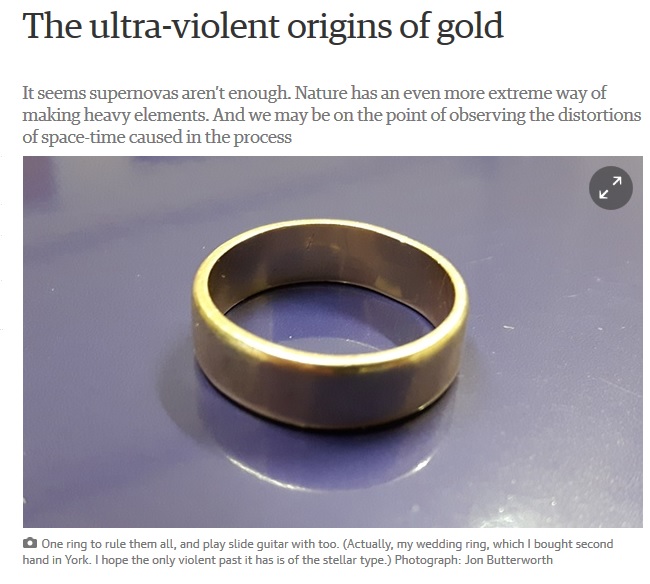
Supernovas

I have to confess that I much prefer the latin plural “supernovae” to the modernised “supernovas”, although most dictionaries (including the One True Chambers) give these both as valid forms.  In the interest of full disclosure I will point out that I did five years of Latin at school, and very much enjoyed it…

When I tweeted about my dislike for supernovas and preference for supernovae some replied that English words should have English plurals so that supernovas was preferred (although I wonder if that logic extends to, e.g. datums and phenomenons). Others said that supernovae was fine among experts but for science communication purposes it was better to say “supernovas” as this more obviously means “more than one supernova”. That’s a reasonable argument, but I have to admit I find it a little condescending to assume that an audience can cope with the idea of a massive star exploding as a consequence of gravitational collapse but be utterly bewildered by a straightforward latin plural.

One of the reasons I prefer the Latin plural – along with some other forms that may appear archaic, e.g. Nebulae – is that Astronomy is unique among sciences for having such a long history. Many astronomical terms derive from very ancient sources and in my view we should celebrate this fact because it’s part of the subject’s fascination. That’s just my opinion, of course. You are welcome to disagree with that too.

Anyway, you might be interested to know a couple of things. One is that the first use of “super-nova” recorded in the Oxford English Dictionary was in 1932 in a paper by Swedish astronomer Knut Lundmark. This word is however formed from “nova” (which means “new” in Latin) and the first use of this term in an astronomical setting was in a book by Tycho Brahe, published in 1573:
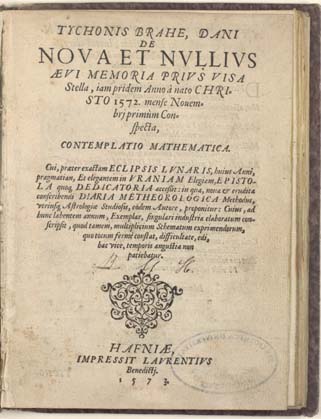
Brahe_book(I’ll leave it as an exercise to the student to translate the full title.)

Nowadays a nova is taken to be a much lower budget feature than a supernova but the “nova” described in Tycho’s book was was actually a supernova, SN1572 which he, along with many others, had observed the previous year. Historical novae were very often supernovae, in fact, because they are much brighter than mere novae. The real difference between these two classes of object wasn’t understood until the 20th Century, however, which is why the term supernova was coined much later than nova.

Anyway, back to pedantry.

A subsequent tweet from Roberto Trotta asserted  that in fact supernovae and supernovas are both wrong; the correct plural should be supernovæ, in which the two letters of the digraph “ae” are replaced with a single glyph known as a ligature. Often, as in this case, a ligature stands for a diphthong, a sort of composite vowel sound made by running two vowels together.   It’s one of the peculiarities of English that there are only five vowels, but these can represent quite different sounds depending on the context (and on the regional accent). This  means that English has many hidden diphthongs. For example,  the “o” in “no” is a diphthong in English. In languages such as Italian, in which the vowels are very pure, “no” is pronounced quite differently from English. The best test of whether a vowel is pure or not is whether your mouth changes shape as you pronounce it: your mouth moves as you say an English “no”, closing the vowel that stays open in the Italian “no”…

So, not all diphthongs are represented by ligatures. It’s also the case that not all ligatures represent diphthongs. Indeed some are composed entirely of consonants. My current employer’s logo features a ligature formed from the letters U and S:

image

The use of the ligature æ arose in Mediaeval Latin (or should I say Mediæval?). In fact if you look at the frontispiece of the Brahe book shown above you will see a number of examples of it in its upper-case form Æ. I’m by no means an expert in such things but my guess is that the use of such ligatures in printed works was favoured simply to speed up the typesetting process – which was very primitive – by allowing the compositor to use a single piece of type to set two characters. However, it does appear in handwritten documents e.g. in Old English, long before printing was invented so easier typesetting doesn’t explain it all.

Use of the specific ligature in question caught on particularly well in Scandinavia where it eventually became promoted to a letter in its own right (“aesc”) and is listed as a separate vowel in the modern Danish and Norwegian alphabets.  Early word-processing and computer typesetting software generally couldn’t render ligatures because they were just too complicated, so their use fell out of favour in the Eighties, though there are significant exceptions to this rule. Latex, for example, always allowed ligatures to be created quite easily. Software – even Microsoft Word – is much more sophisticated than it used to be, so it’s now not so much of a problem to use ligatures in digital text. Maybe they will make a comeback!

Anyway, the use of æ was optional even in Mediaeval Latin so I don’t think it can be argued that supernovæ is really more correct than supernovae, though to go back to a point I made earlier, I do admit that a rambling discussion of ligatures and diphthongs would not add much to a public lecture on exploding stars.


On the Theory of Gravitational Wave Rumour Sources

Posted in Astrohype, The Universe and Stuff, Uncategorized with tags , , on January 12, 2016 by telescoper

There has been a great deal of excitement almost nowhere in the astrophysics community since it was announced recently that rumours of the detection of gravitational waves had yet again begun to circulate, so I thought I would add here a brief discussion of the theoretical background to these phenomena.

The standard theoretical model of such rumours is that they are  produced from time to time during the lifetime of a supermassive science project after periods of relative quiescence. It is thought that they are associated with a perceived lack of publicity which might threaten funding and lead to financial collapse of the project. This stimulates a temporary emission of hype produced by vigorous gossip-mongering which acts to inflate the external profile of the project, resisting external pressures and restoring equilibrium. This general phenomenon is not restricted to gravitational wave detection, but also occurs across many other branches of Big Science, especially cosmology and particle physics.

However, observations of the latest outburst suggest support for a rival theory, in which rumours are produced not by the project itself but by some other body or bodies in orbit around it or even perhaps entirely independent of it. Although there is evidence in favour of this theory, it is relatively new and many questions remain to be answered. In particular it is not known what the effect of rumours produced in this way might be on the long-term evolution of the project or on the source itself.

Lawrence Krauss is 61.


The Renaissance of Sussex Physics

Posted in Education, The Universe and Stuff with tags , , on January 10, 2016 by telescoper

I’m grateful to Darren Baskill for compiling this plot which shows the number of graduates in Physics (including Astrophysics) from the Department of Physics & Astronomy at the University of Sussex since 2004.

Physics

The last two columns are projections, of course, but we can be rather confident about the numbers. The increase over the last few years is predominantly a result of having  more students enter our Physics programmes, but there has also been a significant increase in progression  rates (as a consequence of excellent teaching), which is why we think the predicted numbers of graduates in 2016 and 2017 are likely to be accurate.

One reason for the recent growth was that in 2008 – a particularly low year on the above graph – the Higher Education Funding Council for England (HEFCE) recognized that Physics departments in the South East were struggling to recruit sufficient numbers of students to be financially viable. This led to the formation of SEPNet, a five-year programme which resulted in an injection of cash to promote physics across the South East of England via a range of activities, including a vigorous outreach programme. This almost immediately began to increase the number of applications to do Physics at Sussex (and indeed across the SEPNet consortium), with the result that 3-4 years later the number of graduates started to climb. SEPNet-2, which started in 2013, has developed this initiative still further, with new initiatives in collaborative graduate education.

(For the record note that I took over as Head of School at the beginning of 2013. I will make no further comment…)

This increase in student numbers has generated more income for the Department, all of which is invested back into teaching, research and other activities (including more outreach!) to create a broader curriculum, more choice for students, and more teaching staff;  the number of staff in Physics & Astronomy has increased from 23 to 40 since 2013, for example.

The income generated by this expansion has allowed us to broaden our research base too. This seems an appropriate time to mention that a new research group in Materials Physics has just been established within the Department. Professor Alan Dalton from the University of Surrey will be joining the Department next month as Professor of Materials Physics, and several further appointments will follow to establish a new research activity in his area of interest.

Alan’s research interests focus on understanding the fundamental structure-property relationships in materials containing one- and two- dimensional structures such as carbon nanotubes, graphene and other layered nanomaterials. Alan is  particularly interested in developing viable applications for nano-structured organic composites (mechanical, electrical and thermal). He is also interested in the directed-assembly and self-assembly of nanostructures into functional macrostructures and more recently interfacing biological materials with synthetic inorganic and organic materials and associated applications.

I’m delighted by this development, which will not only create an entirely new research activity but also add significantly to the range of options we can offer students, as well as new opportunities for undergraduate projects and placements. It also has enormous potential to build links with other Departments, especially Chemistry (which is part of the School of Life Sciences).

To end with, I thought I would also comment on another chart that Darren produced:

FemalePhysics

Apart from showing the very high levels of achievement of our students, this provides quantitative evidence of something I had suspected for some time. Although the proportion of female Physics students overall has hovered around 23% with little change since 2004, the propotion of female students getting first class degrees is significantly higher than for male students.

So there you are. Women are better at Physics than men. Discuss.


Stephen Hawking’s Reith Lectures

Posted in Biographical, The Universe and Stuff with tags , , , , on January 8, 2016 by telescoper

Yesterday I took off early from work to head up to the Royal Institution in London to attend a recording of the Reith Lectures, this year given by Stephen Hawking.

Here’s a rather crappy phone pic to show I was there.

image

In fact they recorded two of this year’s lectures, as well as a lengthy question-and-answer session. The talks and answers to audience questions did of course have to be pre-loaded into Stephen’s computer before delivery which necessitated some pauses for uploads. This together with the recording of various intros, outros and idents made for quite a lengthy event but I found the whole process fascinating and didn’t mind that at all. I did have three glasses of wine at the drinks reception before the show, however, so was in quite a relaxed frame of mind generally.

In charge of the whole thing was the inestimable Sue Lawley who did her job brilliantly. On a few occasions, Stephen Hawking’s computer had a glitch and made a spontaneous interjection in an inappropriate place. Sue Lawley proved  completely unflappable.

The topic for the series is, not surprisingly because it is what Hawking is most closely associated with, Black Holes. The lectures were enjoyably sprinkled with some very witty asides, but I did get surprisingly technical at a few points; the audience members beside me were visibly baffled on more than one occasion. See what you think yourself when the lectures are broadcast, the first on 26th January and the second a week later, both at 9pm on BBC Radio 4. They will also be broadcast on the BBC World Service.

The Reith Lectures are open to the public. Apparently over 20,000 applied for tickets to attend last night, such is the draw of Stephen Hawking. The capacity of the Royal Institution lecture theatre is only about 400 so many were disappointed. Fortunately for me, owing no doubt to some form of administrative error, I was an invited guest. I was however somewhat relieved to find I was only on the B-list so although I got to use the VIP entrance I didn’t have to sit among the big nobs at the front in reserved seats.

BICEP3 Cometh…

Posted in The Universe and Stuff with tags , , , , , on January 6, 2016 by telescoper

Back in the office after the Christmas and New Year break, with a mountain of stuff to work through..

Anyway, I saw this paper on the arXiv yesterday and thoought I’d share it here. It’s from a paper by Wu et al. entitled Initial Performance of BICEP3: A Degree Angular Scale 95 GHz Band Polarimeter.  The abstract follows:

BICEP3 is a 550 mm aperture telescope with cold, on-axis, refractive optics designed to observe at the 95 GHz band from the South Pole. It is the newest member of the BICEP/Keck family of inflationary probes specifically designed to measure the polarization of the cosmic microwave background (CMB) at degree-angular scales. BICEP3 is designed to house 1280 dual-polarization pixels, which, when fully-populated, totals to 9× the number of pixels in a single Keck 95 GHz receiver, thus further advancing the BICEP/Keck program’s 95 GHz mapping speed. BICEP3 was deployed during the austral summer of 2014-2015 with 9 detector tiles, to be increased to its full capacity of 20 in the second season. After instrument characterization measurements were taken, CMB observation commenced in April 2015. Together with multi-frequency observation data from Planck, BICEP2, and the Keck Array, BICEP3 is projected to set upper limits on the tensor-to-scalar ratio to r 0.03 at 95% C.L..

It all looks very promising, with science results likely to appear later this year, but who will win the race to find those elusive primordial B-modes?


The Dark Energy MacGuffin

Posted in Science Politics, The Universe and Stuff with tags , , , , , , , , on December 19, 2015 by telescoper

Back from a two-day meeting in Edinburgh about the Euclid Mission, I have to spend a couple of days this weekend in the office before leaving for the holidays. I was a bit surprised at the end of the meeting to be asked if I would be on the panel for the closing discussion, discussing questions raised by the audience. The first of these questions was – and I have to paraphrase becase I don’t remember exactly – whether it would be disappointing if the Euclid mission merely confirmed that observations were consistent with a “simple” cosmological constant rather than any of the more exotic (and perhaps more exciting) alternatives that have been proposed by theorists. I think that’s the likely outcome of Euclid, actually, and I don’t think it would be disappointing if it turned out to be the case. Moreover, testing theories of dark energy is just one of the tasks this mission will undertake and it may well be the case that in years to come Euclid is remembered for something other than dark energy. Anyway, this all triggered a memory of an old post of mine about Alfred Hitchcock so with apologies for repeating something I blogged about 4 years ago, here is a slight reworking of an old piece.

–0–

Unpick the plot of any thriller or suspense movie and the chances are that somewhere within it you will find lurking at least one MacGuffin. This might be a tangible thing, such the eponymous sculpture of a Falcon in the archetypal noir classic The Maltese Falcon or it may be rather nebulous, like the “top secret plans” in Hitchcock’s The Thirty Nine Steps. Its true character may be never fully revealed, such as in the case of the glowing contents of the briefcase in Pulp Fiction , which is a classic example of the “undisclosed object” type of MacGuffin, or it may be scarily obvious, like a doomsday machine or some other “Big Dumb Object” you might find in a science fiction thriller. It may even not be a real thing at all. It could be an event or an idea or even something that doesn’t exist in any real sense at all, such the fictitious decoy character George Kaplan in North by Northwest. In fact North by North West is an example of a movie with more than one MacGuffin. Its convoluted plot involves espionage and the smuggling of what is only cursorily described as “government secrets”. These are the main MacGuffin; George Kaplan is a sort of sub-MacGuffin. But although this is behind the whole story, it is the emerging romance, accidental betrayal and frantic rescue involving the lead characters played by Cary Grant and Eve Marie Saint that really engages the characters and the audience as the film gathers pace. The MacGuffin is a trigger, but it soon fades into the background as other factors take over.

Whatever it is or is not, the MacGuffin is responsible for kick-starting the plot. It makes the characters embark upon the course of action they take as the tale begins to unfold. This plot device was particularly beloved by Alfred Hitchcock (who was responsible for introducing the word to the film industry). Hitchcock was however always at pains to ensure that the MacGuffin never played as an important a role in the mind of the audience as it did for the protagonists. As the plot twists and turns – as it usually does in such films – and its own momentum carries the story forward, the importance of the MacGuffin tends to fade, and by the end we have usually often forgotten all about it. Hitchcock’s movies rarely bother to explain their MacGuffin(s) in much detail and they often confuse the issue even further by mixing genuine MacGuffins with mere red herrings.

Here is the man himself explaining the concept at the beginning of this clip. (The rest of the interview is also enjoyable, convering such diverse topics as laxatives, ravens and nudity..)


There’s nothing particular new about the idea of a MacGuffin. I suppose the ultimate example is the Holy Grail in the tales of King Arthur and the Knights of the Round Table and, much more recently, the Da Vinci Code. The original Grail itself is basically a peg on which to hang a series of otherwise disconnected stories. It is barely mentioned once each individual story has started and, of course, is never found.

Physicists are fond of describing things as “The Holy Grail” of their subject, such as the Higgs Boson or gravitational waves. This always seemed to me to be an unfortunate description, as the Grail quest consumed a huge amount of resources in a predictably fruitless hunt for something whose significance could be seen to be dubious at the outset.The MacGuffin Effect nevertheless continues to reveal itself in science, although in different forms to those found in Hollywood.

The Large Hadron Collider (LHC), switched on to the accompaniment of great fanfares a few years ago, provides a nice example of how the MacGuffin actually works pretty much backwards in the world of Big Science. To the public, the LHC was built to detect the Higgs Boson, a hypothetical beastie introduced to account for the masses of other particles. If it exists the high-energy collisions engineered by LHC should reveal its presence. The Higgs Boson is thus the LHC’s own MacGuffin. Or at least it would be if it were really the reason why LHC has been built. In fact there are dozens of experiments at CERN and many of them have very different motivations from the quest for the Higgs, such as evidence for supersymmetry.

Particle physicists are not daft, however, and they have realised that the public and, perhaps more importantly, government funding agencies need to have a really big hook to hang such a big bag of money on. Hence the emergence of the Higgs as a sort of master MacGuffin, concocted specifically for public consumption, which is much more effective politically than the plethora of mini-MacGuffins which, to be honest, would be a fairer description of the real state of affairs.

Even this MacGuffin has its problems, though. The Higgs mechanism is notoriously difficult to explain to the public, so some have resorted to a less specific but more misleading version: “The Big Bang”. As I’ve already griped, the LHC will never generate energies anything like the Big Bang did, so I don’t have any time for the language of the “Big Bang Machine”, even as a MacGuffin.

While particle physicists might pretend to be doing cosmology, we astrophysicists have to contend with MacGuffins of our own. One of the most important discoveries we have made about the Universe in the last decade is that its expansion seems to be accelerating. Since gravity usually tugs on things and makes them slow down, the only explanation that we’ve thought of for this perverse situation is that there is something out there in empty space that pushes rather than pulls. This has various possible names, but Dark Energy is probably the most popular, adding an appropriately noirish edge to this particular MacGuffin. It has even taken over in prominence from its much older relative, Dark Matter, although that one is still very much around.

We have very little idea what Dark Energy is, where it comes from, or how it relates to other forms of energy we are more familiar with, so observational astronomers have jumped in with various grandiose strategies to find out more about it. This has spawned a booming industry in surveys of the distant Universe (such as the Dark Energy Survey or the Euclid mission I mentioned in the preamble) all aimed ostensibly at unravelling the mystery of the Dark Energy. It seems that to get any funding at all for cosmology these days you have to sprinkle the phrase “Dark Energy” liberally throughout your grant applications.

The old-fashioned “observational” way of doing astronomy – by looking at things hard enough until something exciting appears (which it does with surprising regularity) – has been replaced by a more “experimental” approach, more like that of the LHC. We can no longer do deep surveys of galaxies to find out what’s out there. We have to do it “to constrain models of Dark Energy”. This is just one example of the not necessarily positive influence that particle physics has had on astronomy in recent times and it has been criticised very forcefully by Simon White.

Whatever the motivation for doing these projects now, they will undoubtedly lead to new discoveries. But my own view is that there will never be a solution of the Dark Energy problem until it is understood much better at a conceptual level, and that will probably mean major revisions of our theories of both gravity and matter. I venture to speculate that in twenty years or so people will look back on the obsession with Dark Energy with some amusement, as our theoretical language will have moved on sufficiently to make it seem irrelevant.

But that’s how it goes with MacGuffins. Even the Maltese Falcon turned out in the end to be a fake.

XXL Map of Galaxy Clusters

Posted in The Universe and Stuff with tags , on December 18, 2015 by telescoper

The press office at the European Space Agency is apparently determined to release as much interesting material as possible in the week before Christmas so that as few people as possible will notice. I mentioned one yesterday, and here is another.

XXL

The map is of preliminary data from the XXL Cluster Survey, the largest survey of galaxy clusters ever undertaken, and was obtained using the XMM-Newton telescope. (Thanks to various people, including Ben Maughan below who pointed out the error I made by relying on the accuracy of the ESA Press Release.)

The press-release marks the publication of the first results from this survey on 15th December 2015. The clusters of galaxies surveyed are prominent  features of the large-scale structure of the Universe and to better understand them is to better understand this structure and the circumstances that led to its evolution. So far 450 clusters have been identified – they are indicated by the red rings in the picture. Note that the full moon is shown at the top left to show the size of the sky area surveyed.

If you’ll pardon a touch of autobiography I should point out that my very first publication was on galaxy clusters. It came out in 1986 and was based on data from optically-selected clusters; X-rays emission from the very hot gas they contain is a much better way to identify these than through counting galaxies by their starlight. Cluster cosmology has moved on a lot. So has everything else in cosmology, come to think of it!


Is This the Beginning of the End of the Standard Model?

Posted in The Universe and Stuff on December 18, 2015 by telescoper

Thoughts from a proper particle physicist on the recent announcement from the LHC…

Matt Strassler's avatarOf Particular Significance

Was yesterday the day when a crack appeared in the Standard Model that will lead to its demise?  Maybe. It was a very interesting day, that’s for sure. [Here’s yesterday’s article on the results as they appeared.]

I find the following plot useful… it shows the results on photon pairs from ATLAS and CMS superposed for comparison.  [I take only the central events from CMS because the events that have a photon in the endcap don’t show much (there are excesses and deficits in the interesting region) and because it makes the plot too cluttered; suffice it to say that the endcap photons show nothing unusual.]  The challenge is that ATLAS uses a linear horizontal axis while CMS uses a logarithmic one, but in the interesting region of 600-800 GeV you can more or less line them up.  Notice that CMS’s bins are narrower than ATLAS’s by a factor…

View original post 762 more words

To Edinburgh for Euclid

Posted in Euclid, The Universe and Stuff with tags , , on December 17, 2015 by telescoper

This morning I flew from London Gatwick to Edinburgh to attend the UK Euclid meeting at the Royal Observatory, which lasts today and tomorrow. It turns out there were two other astronomers on the plane: Alan Heavens from Imperial and Jon Loveday from my own institution, the University of Sussex.

The meeting is very useful for me as it involves a number of updates on the European Space Agency’s Euclid mission. For those of you who don’t know about Euclid here’s what it says on the tin:

Euclid is an ESA mission to map the geometry of the dark Universe. The mission will investigate the distance-redshift relationship and the evolution of cosmic structures by measuring shapes and redshifts of galaxies and clusters of galaxies out to redshifts ~2, or equivalently to a look-back time of 10 billion years. In this way, Euclid will cover the entire period over which dark energy played a significant role in accelerating the expansion

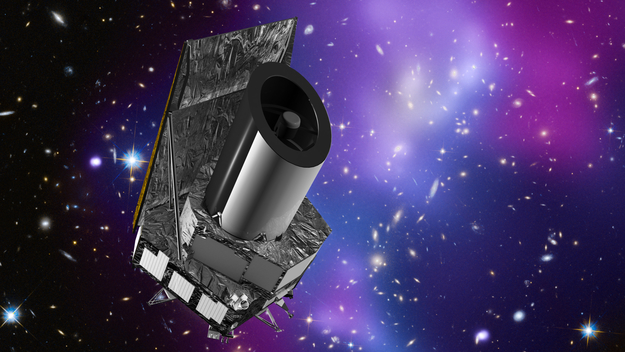
Here’s an artist’s impression of the satellite:

euclid

Do give you an idea of what an ambitious mission this is, it basically involves repeated imaging of a large fraction of the sky (~15,000 square degrees) over a period of about six years. Each image is so large that it would take 300 HD TV screens to display it at full resolution. The data challenge is considerable, and the signals Euclid is trying to measure are so small that observational systematics have to be controlled with exquisite precision. The requirements are extremely stringent, and there are many challenges to confront, but it’s going well so far. Oh, and there are about 1,200 people working on it!

Coincidentally, this very morning ESA issued a press release announcing that Euclid has passed its PDR (Preliminary Design Review) and is on track for launch in December 2020. I wouldn’t bet against that date slipping, however, as there is a great deal of work still to do and a number of things that could go wrong and cause delays. Nevertheless, so far so good!


A Bump at the Large Hadron Collider

Posted in Bad Statistics, The Universe and Stuff with tags , , , on December 16, 2015 by telescoper

Very busy, so just a quickie today. Yesterday the good folk at the Large Hadron Collider announced their latest batch of results. You can find the complete set from the CMS experiment here and from ATLAS here.

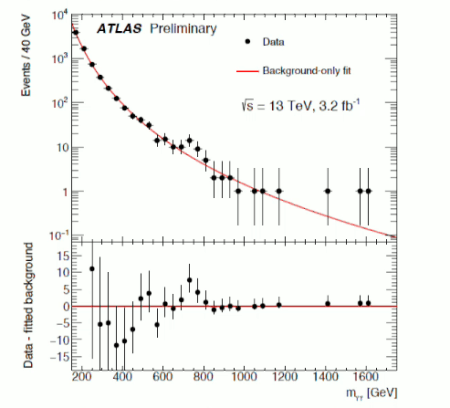
The result that everyone is talking about is shown in the following graph, which shows the number of diphoton events as a function of energy:

Atlas_Bump

Attention is focussing on the apparent “bump” at around 750 GeV; you can find an expert summary by a proper particle physicist here and another one here.

It is claimed that the “significance level” of this “detection” is 3.6σ. I won’t comment on that precise statement partly because it depends on the background signal being well understood but mainly because I don’t think this is the right language in which to express such a result in the first place. Experimental particle physicists do seem to be averse to doing proper Bayesian analyses of their data.

However if you take the claim in the way such things are usually presented it is roughly equivalent to a statement that the odds against this being a real detection are greater that 6000:1. If any particle physicists out there are willing to wager £6000 for £1 of mine that this result will be confirmed by future measurements then I’d happily take them up on that bet!

P.S. Entirely predictably there are 10 theory papers on today’s ArXiv offering explanations of the alleged bump, none of which says that it’s a noise feature..