Archive for the The Universe and Stuff Category

A New Theory of Electromagnetism?

Posted in Cute Problems, Education, The Universe and Stuff with tags , , on September 19, 2013 by telescoper

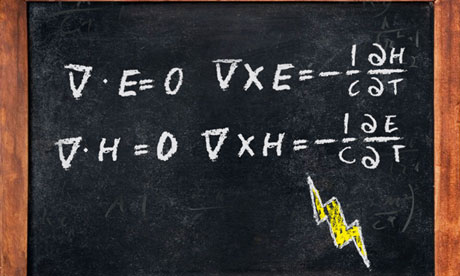
I was delighted to see an article by Alok Jha in the Observer on Sunday discussing Maxwell’s Equations, but my rapture was rapidly modified when I saw the image that accompanied the piece:

Maxwell's Equations

Since our new students are just settling into their courses in the Department of Physics & Astronomy here at the University of Sussex, I thought it would be fun to post this here and invite my readers (some of whom are students) to spot the deliberate mistake(s). More amusingly, how about offering suggestions as to what the Universe would be like if electromagnetism did indeed behave the way described by the alternative theory outlined in the Observer article.

Answers through the comment box please!

Coronal Rain

Posted in The Universe and Stuff with tags , , , on September 17, 2013 by telescoper

Well it’s dark and gloomy and pouring with rain on the day on which I’m required to do the most running about on campus. I think we could all do with another look at the Sun – which might otherwise fade into a distant memory. This is no ordinary look at the Sun, though, it’s a spectacular video taken by NASA’s Solar Dynamics Observatory. According to the description on Youtube,

Eruptive events on the Sun can be wildly different. Some come just with a solar flare, some with an additional ejection of solar material called a coronal mass ejection (CME), and some with complex moving structures in association with changes in magnetic field lines that loop up into the Sun’s atmosphere, the corona.

On July 19, 2012, an eruption occurred on the sun that produced all three. A moderately powerful solar flare exploded on the Sun’s lower right hand limb, sending out light and radiation. Next came a CME, which shot off to the right out into space. And then, the Sun treated viewers to one of its dazzling magnetic displays — a phenomenon known as coronal rain.

Over the course of the next day, hot plasma in the corona cooled and condensed along strong magnetic fields in the region. Magnetic fields, themselves, are invisible, but the charged plasma is forced to move along the lines, showing up brightly in the extreme ultraviolet wavelength of 304 Angstroms, which highlights material at a temperature of about 50,000 Kelvin. This plasma acts as a tracer, helping scientists watch the dance of magnetic fields on the Sun, outlining the fields as it slowly falls back to the solar surface.

The footage in this video was collected by the Solar Dynamics Observatory’s AIA instrument. SDO collected one frame every 12 seconds, and the movie plays at 30 frames per second, so each second in this video corresponds to 6 minutes of real time. The video covers 12:30 a.m. EDT to 10:00 p.m. EDT on July 19, 2012.

Those are the facts, and here is the video, which is simply stunning:

Publication Vanity

Posted in Books, Talks and Reviews, The Universe and Stuff with tags on September 7, 2013 by telescoper

Doing a spot of tidying up I came across this little cutting of a little review (from the Grauniad) of my little book on Cosmology. It’s sheer vanity to keep such things of course, let alone post them on a blog, but it can’t do the sales any harm either!

Orion Nebula (Herschel, after Turner)

Posted in Art, The Universe and Stuff with tags , , , on September 6, 2013 by telescoper

I stumbled across this wonderful image (and associated description) yesterday and thought I’d share it. It’s a region of the Orion Nebula (which is located in the  Midlands region of Orion’s “sword”, i.e. the long thing hanging down below his belt).  It’s a turbulent region of dust and gas in which stars are forming. This image was taken in the far-infrared part of the spectrum by the Herschel Space Observatory, which is now defunct but much data remains to be analysed. Because the image was taken at wavelengths much longer than optical light, the colours are obviously “false”. I don’t work on star formation so I tend to see images like this just as beautiful things to be enjoyed for themselves rather than as a subject for scientific research. In fact, I have no difficulty at all in describing this picture as a work of art, slightly reminiscent of the cloudscapes and seascapes of  J.M.W Turner in that it is, at the same time, both a representation of a natural phenomenon and  an abstract creation that transcends it. You can click on the image to make it larger…

Orion_A

UPDATE: I see that someone else has thought of the parallel with Turner!

Old Emus for Physics

Posted in Education, The Universe and Stuff with tags , on September 3, 2013 by telescoper

It is time to reveal just a part of  the series of innovations I have been introducing to the curriculum here in the School of Mathematical and Physical Sciences at the University of Sussex, since I became head earlier this year.

In order to develop further the problem-solving skills of students in the Department of Physics & Astronomy, I have decided that  all modules OLD EMUS will henceforth be referred to by anagrams of their actual titles. For example, in the forthcoming Semester I will be teaching second-year students MONSTER DELICACY.

Among the other old emus to be taken by Year 2 students of SHY PICS are:

MANIAC MUNCH QUEST

UNFITTING COMIC SPICE

SPIN HISS SLICKLY

A TINSMITH’S DEPTH, SARCASTICALLY

ASTHMATIC MODE HALTED for SPICY SHITS

and for options there are

TRANSPLANTED ASS (compulsory for those into RACY SOPHISTS)

ATHEIST PSYCHIC LORE

This list does not include the compulsory A RICH SORT’S PLAYBOY.

I hope this clarifies the situation.

Black Hole Firewalls, etc.

Posted in Biographical, The Universe and Stuff with tags , , on September 2, 2013 by telescoper

Well, just back to the office after taking a restful weekend in Cardiff to recover from the trials and tribulations of the meeting of the Astronomy Grants Panel of the Science and Technology Facilities Council in Swindon last week. I’ve got a lot to catch up on, so I’ll just post this video which explains all about the issue of Black Hole Paywalls Fire Sales Firewalls about which there’s a not inconsiderable to-do and hoo-ha going on in the world of Physics. Pity they couldn’t put a firewall around Swindon, that’s all I can say…

Quantum Information and Quantum Computing

Posted in The Universe and Stuff with tags , , , , , on August 23, 2013 by telescoper

Having a very late and very short lunch break today because I was involved in a series of meetings this morning all of which overran. That, together with the heat, has put me in a bit of a fluster. Anyway, while I drink my sandwich and eat a cup of tea, I thought I’d post this very cute video that I stumbled across via Twitter. It’s by Jorge Cham, the creator of Piled Higher and Deeper (known to the world as PhDcomics); you can find his blog post about these videos here.

The Open Journal for Astrophysics – Update and Request

Posted in Open Access, The Universe and Stuff with tags , , , , , on August 22, 2013 by telescoper

I’ve been getting quite a few questions about my modest proposal The Open Journal for Astrophysics. I don’t want to give too much away before the site is revealed, but I can say that after a very positive meeting in London last week the project is right on track and will go live pretty soon for beta testing. We have an Editorial Board (names to be revealed in due course), a very nice website, a web team, and an excellent interface for editors and reviewers which, in my opinion, is far better than any offered by a “professional” journal. When the site does go live I’ll explain in more detail how it works and introduce all the people whose contributions enabled this project to get off the ground.

We are going to test everything extensively before the OJFA goes public, however, so please be patient. We will be testing the site initially using papers in a relatively restricted area of astrophysics (largely extragalactic astrophysics and cosmology), but hope to expand by the addition of other members to the Editorial Board. In anticipation of this future expansion, volunteers in areas of astrophysics outside this specialism are welcome!

That’s the update. Now time for the request. Although not essential for the initial testing phase of the project, we do think that it would benefit from a distinctive layout for the papers, which would be easily achieved by having our own Latex style. This came up in discussion some time ago when I first floated the idea of this project and somebody emailed me offering to design an appropriate Latex package. Unfortunately, however, in transit from Cardiff to here I appear to have lost the email and can’t remember who sent it. I’m therefore going to enlist the help of the blogosphere to remedy this act of incompetence. Is there anybody out there among the interwebs who is sufficiently keen and has the necessary expertise to construct a latex style for our new journal? If so please contact me, either through the comments or via email. I can’t do it myself because I have never had any sense of style…

Please pass this on via Twitter, etc.
Advice for Students on Clearing

Posted in Education, The Universe and Stuff with tags , , , , on August 15, 2013 by telescoper

1-dont-panic

We still have places in the School of Mathematical & Physical Sciences at the University of Sussex. No other Physics & Astronomy department in the UK scored more highly in the latest NSS survey than ours, so whether you’re interested in Physics, Astrophysics, Astronomy or Mathematics (or even a combination of those subjects), why not just take a look at the University’s Clearing Page and give us a ring.?

As a matter of fact, I’ll be there myself from 8am this morning to talk to interested students.

11.30 UPDATE. I finished my first shift at 11am. I’ll be going back at 5pm for the last session, until the lines close at 7pm. During the last hour a minimum of 20 overs must be bowled. Or something.  The main call centre (which has fifty phone lines) is next door to where we were sitting and is operated by admissions experts and student helpers who are processing the queries and, if necessary, routing them through to academics (i.e. people like me) to provide further information or to answer specific questions. You can take a peep behind the scenes here. Some of the calls were from very anxious prospective students, and it’s a very nice feeling being able to help them sort out their course! Now back to other things until I start again this evening.


19.30 UPDATE. Phew. Finally been stood down, but I’ll be back on duty tomorrow afternoon. It’s been a very interesting day which has gone very well for us. Lines stay open until 8pm tonight and re-open at 8 in the morning and we’re still in business to see if we can give just a few more students the opportunity to study in the School next academic year. Now I’m off home to chill, probably over a glass or two of wine!

A Three-dimensional Map of the Early Universe

Posted in The Universe and Stuff with tags , , , , on August 14, 2013 by telescoper

I found this video via a web page describing the FastSound project, which is surveying galaxies in the Universe which are at such a huge distance that we are seeing them as they were over nine billion years ago. Using the Subaru Telescope‘s impressive new Fiber Multi-Object Spectrograph (FMOS). This project is “work in progress”. The survey so far contains only 1,100 galaxies, but while that is small by the standards of a modern redshift survey, and will in fact still only comprise about 5000 galaxies when complete, what is amazing about it is that the galaxies are at such enormous distances. Even using a telescope with an 8.2 metre primary mirror, this survey will take another year or so to be completed.

A survey of a representative region of the Universe at such high redshift allows astrophysicists to test theories of the growth of the large-scale structure of the Universe. In the standard cosmology, these form by a process of gravitational instability: small irregularities in the distribution of matter get amplified by the action of gravity to become large structures such as galaxies and galaxy clusters. Comparing the level of clustering at early times with that observed around us today allows us to check whether this growth matches theoretical predictions. There should be much less clumpiness earlier on if the theoretical picture is right.

I began my PhD DPhil at the University of Sussex in 1985, working on the large-scale structure of the Universe. Coincidentally, the largest redshift survey available at that time, the CfA1 Survey, also contained 1,100 galaxies – as displayed in the famous “stick man map”:

cfa2.n30

The galaxies mapped out in that survey, however, are all (relatively speaking) in our back yard: none is further than a few hundred million light years away…