Archive for the The Universe and Stuff Category

The Inflationary Bubble

Posted in The Universe and Stuff with tags , , , , on July 9, 2013 by telescoper

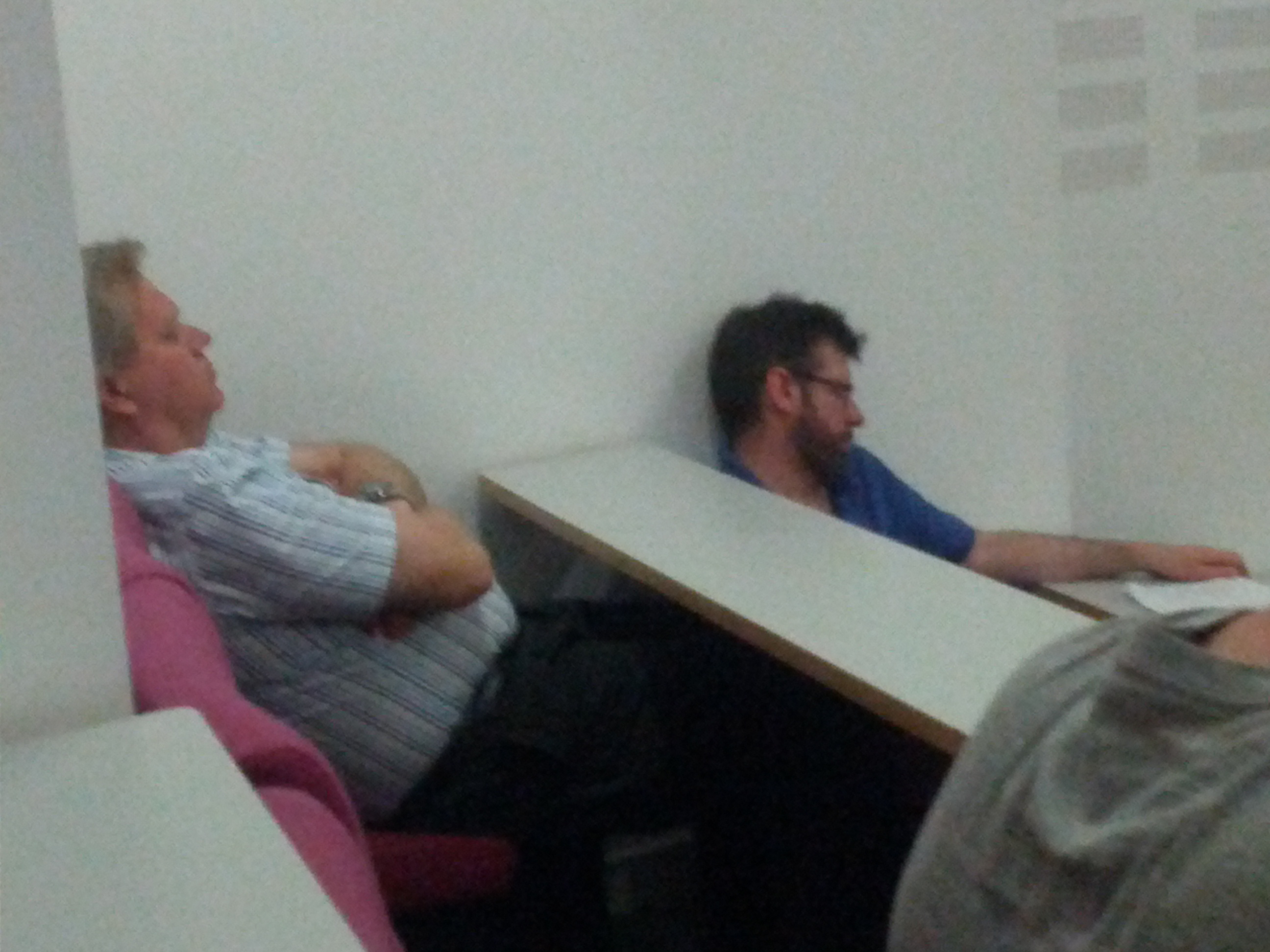
The Summer School I’m attending on Inflation and the CMB got under way yesterday morning with a couple of lectures (90 minutes each) by Andrei Linde, one of the pioneers of the theory of cosmic inflation. I enjoyed the first part of the session, but then he went off into the technical details of a specific model for which there seemed previous little in the way of physical motivation or testable consequences. There’s an occupational hazard for people working on inflation which is that they become so absorbed by their calculations that they forget that they’re supposed to be doing science. It sometimes appears that this field has reached a critical density of activity which means that it’s in danger of forming a closed universe completely incapable of communicating with the world outside and perhaps of collapsing in on itself.

The other thing I didn’t like was the evangelism about the multiverse, which is widespread amongst theorists these days. I’ve stated my position about this before so I won’t repeat my objections here. I will, however, lodge an objection to the way Prof. Linde answered a question about whether the multiverse theory was a testable of various fine-tuning problems in cosmology by saying

Ihe multiverse is the only known explanation so in a sense it has already been tested.

I don’t mind particularly if theories are not testable with current technology. New ideas often have to wait a very long time before equipment and techniques are developed to test them, but Linde’s response is rather symptomatic of a frame of mind that does not consider testability important at all. The worst offenders in this regard are certain string theorists who seem to thing string theory is so compelling in its own right that it just has to be the one true description of how the Universe works, even if the framework it provides is unable to make any predictions at all.

IMG-20130708-00145

Germany Calling…

Posted in Biographical, Books, Talks and Reviews, The Universe and Stuff with tags , , , , on July 7, 2013 by telescoper

Just a quick post to break radio silence and announce my arrival in the picturesque town of Bad Honnef, spa town in Germany near Bonn in the Rhein-Sieg district of North Rhine-Westphalia. We’re right on the banks of the Rhine actually, and there are some fine views of castles and hills to be had all round.

To get here I took my life in my hands and flew with a German budget airline called Germanwings from Heathrow to nearby Bonn-Cologne airport. I mean it’s near to Bad Honnef, not to Heathrow. Apart from the fact that I had to queue for an hour at check-in because the staff apparently didn’t know how to operate the computer system, and the flight was delayed leaving because it was delayed on the way in, it wasn’t actually too bad; we arrived only about 25 minutes late and I was able to have a few beers and some food when I arrived at my destination.

The reason for this expedition is that I’m giving two lectures at the Deutschen Physikalischen Gesellschaft (henceforth DPG) Summer School on Inflation and the CMB. The list of other speakers is very impressive so I assume that some form of administrative error is responsible for my invitation, and especially for the fact that I’ve got to give two lectures while everyone else is just giving one…

Anyway, it’s lovely weather here – although a little on the toasty side for my cold English blood – and I hope to get the chance to take a few pictures as well as some updates from the meeting. I also hope to find out why this place is called Bad Honnef. I know I’ve only been here a few hours, but it seems to me that, as Honnefs go, it’s really not bad at all…

Physics Proverbs

Posted in The Universe and Stuff with tags , on July 2, 2013 by telescoper

I was a bit bored on the bus this morning, as it got stuck in a traffic jam, so decided to amuse myself (and probably nobody else) by thinking up physics-related versions of traditional proverbs and tweeting them (hashtag #physicsproverbs). I thought it might be fun to use them to indulge in a bit of audience participation, by asking the blogosphere to contribute their own through  the comments box below.

Here are some of my offerings:

  • Never mind the Q-factor, feel the FWHM
  • Don’t throw stones if there are periodic boundary conditions
  • A stitch in time may violate causality
  • A thing of beauty is now generally known as a bottom
  • No amplifier, no gain
  • Nothing is certain, except death and deterministic processes
  • Blood is thicker than dark matter
  • May the Devil take the Hindmarsh
  • Don’t change potentials in mid streamline
  • Angular momentum makes the world go round
  • Many a micro makes a mega
  • When the cat’s away the mice will annoy Dr Schrödinger
  • Ask a silly question, and you might well get a research grant
  • Discreteness is the greater part of granularity
  • There’s no time like t=0
  • The course of a random walk never did run smooth
  • Many hadrons make very few Higgs Bosons at CERN
  • Actions speak louder than differential equations
  • Radiation pressure makes light work
  • Don’t cast your PRLs before swine
  • Nature abhors most of the papers submitted there
  • Photons should be seen and not heard. As opposed to phonons.
  • Power corrupts. Absolute power has exactly the same effect because power is always positive.

You can see all the tweets resulting from the Twitter version of this game here.

The Local Universe

Posted in The Universe and Stuff with tags , , , , on July 2, 2013 by telescoper

I just stumbled across this on Amanda Bauer’s blog  and thought I’d post it here because it’s so nice. The film is by Hélène Courtois, Daniel Pomarède, R. Brent Tully, Yehuda Hoffman, and Denis Courtois and it describes the Cosmography – like geography, only more cosmic – of the Local Universe. I’m not sure there’s a consensus among cosmologists about what exactly “local” means, but I’d say it probably means out to a few hundred Megaparsecs from the observer (say up to about a billion light years) or, alternatively, with redshifts much less than unity.  That may not sound very nearby at all, but even on such scales the look-back time is sufficiently short that the effect of cosmic evolution and/or the expansion of the Universe is negligible, so when we look at objects at such distances we’re seeing them as they are “now” rather than as they were in the past, which is the case when we study extremely distant objects.

Slow Progress for Female Physics Professors

Posted in Biographical, The Universe and Stuff with tags , , , , on July 1, 2013 by telescoper

One of the more pleasant jobs I have to do these days is to congratulate staff in the School of Mathematical and Physical Sciences at the University of Sussex when they get promoted, whether it be to Senior Lecturer, Reader or Professor. There has been quite a crop of promotions at all levels in the School recently, owing to the excellent contributions made by so many people to teaching, research and other aspects of the work we do.

One of the successful promotion candidates in the latest round was the Head of our Experimental Particle Physics group, Antonella de Santo, whose promotion to Professor of Physics makes her the first ever female Professor of Physics at the University of Sussex. I’m rather embarrassed to admit that, actually, as the University has existed for 51 years, but at least I can say better late then never!

Anyway, Antonella’s well-deserved success prompted me to look into the statistics of female physics & astronomy professors. I’ve already posted about how the proportion of female undergraduates studying physics as been stuck at around the 20% mark for a decade despite strenuous efforts to widen participation. A recent (2012) study by the Institute of Physics contains a wealth of statistical information about staff in Physics departments, which I encourage people to read if they’re interested in the overall issue with equality and diversity in physics. Here I’ll just pull out the figure (based on a 2010 survey) that out of a total of 650 Professors of Physics (and/or Astronomy) in the UK, just 5.5% were female. At that date about 20 physics departments had no female professors at all; that would have included Sussex, of course.

Another University, Liverpool, also recently appointed its first female Professor of Physics in the person of Tara Shears, another particle physicist. The current  Head of the  Department of Physics at Imperial Collge is Joanna Haigh, (who I thought was the first to occupy such a position until corrected by the comment below) so there are signs that career prospects are improving for female physicists, but progress is painfully slow. The first ever female Professor of Physics in the United Kingdom was Daphne Jackson, a nuclear physicist, who took up her Chair at the University of Surrey way back in 1971. It’s interesting to note that when Daphne Jackson studied physics as an undergraduate at Imperial College she was one of only two women among the 88 undergraduates in her year.

I don’t personally think that there’s a significant gender bias when it comes to the consideration of promotion cases at the University of Sussex (or at any other institution I’ve worked at), but there’s plenty of anecdotal evidence that women are much more reluctant than men to put themselves forward for consideration at any level. I hope that recent successes in MPS, such as Antonella’s Professorship and Readerships for astronomer Kathy Romer and mathematician Vanessa Styles, will provide the necessary encouragement.

Punch and Judy meet Quantum Technology

Posted in The Universe and Stuff with tags , , , , , , on June 28, 2013 by telescoper

It’s an Open Day here on campus, and there’s quite a crowd of potential students and parents gathering in the School of Mathematical and Physical Sciences here at the University of Sussex to find out a bit more about the School in advance of making decisions about where to apply next year.

I noticed the other day that quite a few of these have appeared on campus over the last few days:

IMG-20130627-00139

Apparently they’re information points manned by various helpers to help visitors find their way around the place. When I first saw this one, I thought it was a Punch and Judy box, so assumed that there was some sort of conference of Punch and Judy performers going on. That wouldn’t be inappropriate for a University campus, actually, because the traditional name for a Punch & Judy puppeteer is a “Professor”. Not a lot of people know that.

Anyway, none of that is really relevant to what I wanted to post today. I stumbled across this video featuring Winfried Hensinger (one of my colleagues from the Department of Physics & Astronomy within the School of Mathematical and Physical Sciences). I thought it would be fun to share it here, just to give an idea of some of the work that’s going on here outside my own speciality of astrophysics. I hope this will complement the real open day with a mini virtual open day on the blog.

Winfried is Reader in Quantum, Atomic and Optical Physics at the University of Sussex and he works in the group we generally call “AMO” (Atomic, Molecular and Optical). In this TEDX lecture he talks about the future of quantum computers and the role the team he is part of, at Sussex University, plays as they develop large scale quantum computers using ions cooled to extremely low temperatures using lasers. Enjoy!

Universality in Space Plasmas?

Posted in Astrohype, The Universe and Stuff with tags , , , , , , , , on June 16, 2013 by telescoper

It’s been a while since I posted anything reasonably technical, largely because I’ve been too busy, so I thought I’d spend a bit of time today on a paper (by Livadiotis & McComas in the journal Entropy) that provoked a Nature News item a couple of weeks ago and caused a mild flutter around the internet.

Here’s the abstract of the paper:

In plasmas, Debye screening structures the possible correlations between particles. We identify a phase space minimum h* in non-equilibrium space plasmas that connects the energy of particles in a Debye sphere to an equivalent wave frequency. In particular, while there is no a priori reason to expect a single value of h* across plasmas, we find a very similar value of h* ≈ (7.5 ± 2.4)×10−22 J·s using four independent methods: (1) Ulysses solar wind measurements, (2) space plasmas that typically reside in stationary states out of thermal equilibrium and spanning a broad range of physical properties, (3) an entropic limit emerging from statistical mechanics, (4) waiting-time distributions of explosive events in space plasmas. Finding a quasi-constant value for the phase space minimum in a variety of different plasmas, similar to the classical Planck constant but 12 orders of magnitude larger may be revealing a new type of quantization in many plasmas and correlated systems more generally.

It looks an interesting claim, so I thought I’d have a look at the paper in a little more detail to see whether it holds up, and perhaps to explain a little to others who haven’t got time to wade through it themselves. I will assume a basic background knowledge of plasma physics, though, so turn away now if that puts you off!

For a start it’s probably a good idea to explain what this mysterious h* is. The authors define it via ½h*ctc, where εc is defined to be “the smallest particle energy that can transfer information” and tc is “the correlation lifetime of Debye Sphere (i.e. volumes of radius the Debye Length for the plasma in question). The second of these can be straightforwardly defined in terms of the ratio between the Debye Length and the thermal sound speed; the authors argue that the first is given by εc=½(mi+me)u2, involving the electron and ion masses in the plasma and the information speed u which is taken to be the speed of a magnetosonic wave.

You might wonder why the authors decided to call their baby h*. Perhaps it’s because the definition looks a bit like the energy-time version of Heisenberg’s Uncertainty Principle, but I can’t be sure of that. In any case the resulting quantity has the same dimensions as Planck’s constant and is therefore measured in the same units (Js in the SI system).

Anyway, the claim is that h* is constant across a wide range of astrophysical plasmas. I’ve taken the liberty of copying the relevant Figure here:

constant_h

I have to say at this point I had the distinct sense of damp squib going off. The panel on the right purports to show the constancy of h* (y-axis) for plasmas of a wide range of number-densities (x-axis). However, but are shown on logarithmic scales and have enormously large error bars. To be sure, the behaviour looks roughly constant but to use this as a basis for claims of universality is, in my opinion, rather unjustified, especially since there may also be some sort of selection effect arising from the specific observational data used.

One of the authors is quoted in the Nature piece:

“We went into this thinking we’d find one value in one plasma, and another value in another plasma,” says McComas. “We were shocked and slightly horrified to find the same value across all of them. This is really a major deal.”

Perhaps it will turn out to be a major deal. But I’d like to see a lot more evidence first.

Plasma (astro)physics is a fascinating but very difficult subject, not because the underlying requations governing plasmas are especially complicated, but because the resulting behaviour is so sensitively dependent on small details; plasma therefore provide an excellent exemplar of what we mean by a complex physical system. As is the case in other situations where we lack the ability to do detailed calculations at the microscopic level, we do have to rely on more coarse=grained descriptions, so looking for patterns like this is a good thing to do, but I think the Jury is out.

Finally, I have to say I don’t approve of the authors talking about this in terms of “quantization”. Plasma physics is confusing enough as classical physics without confusing it with quantum theory. Opening the door to that is a big mistake, in my view. Who knows what sort of new age crankery might result?

A Time for Honours

Posted in Education, Politics, Science Politics, The Universe and Stuff with tags , , , on June 15, 2013 by telescoper

The word “honour” provides a (tenuous) link between yesterday’s post and this one. After our recent preoccupation with the classification of honours for graduating students (i.e. first class, second class, and so on), today’s news included the Queen’s Birthday Honours List for 2013, which you can download in full here. To make up for the lack of recycling going on in Brighton these days because of the strike that started yesterday, I thought I’d recycle my thoughts from previous years.

The honours system must appear extremely curious to people from outside the United Kingdom. It certainly seems so to me. On the one hand, I am glad that the government has a mechanism for recognising the exceptional contributions made to society by certain individuals. Musicians, writers, sportsmen, entertainers and the like generally receive handsome financial rewards, of course, but that’s no reason to begrudge a medal or two in recognition of the special place they occupy in our cultural life.  It’s  good to see scientists recognized too, although they tend not to get noticed so much by the press.

The name that stood out for me in this year’s list is Professor Jim Hough, who gets an OBE. Jim is Professor of Experimental Physics at the University of Glasgow, and his speciality is in the detection of gravitational waves.  Gravitational waves haven’t actually been detected yet, of course, but the experimental techniques designed to find them have increased their sensitivity by many orders of magnitude in recent years, Jim having played a large part in those improvements. I imagine he will be absolutely thrilled in February 2016, when gravitational waves are finally detected. Jim is also Chief Executive of the Scottish University Physics Alliance, which does so much to nurture Physics and Astronomy North of the Border.

Although I’m of course more than happy to see recognition given to such people, as I did  a couple of years ago I can’t resist stating my objections to the honours system again. One is that the list of recipients  of certain categories of award is overwhelmingly dominated by career civil servants, for whom an “honour”  goes automatically with a given rank. If an honour is considered an entitlement in this way then it is no honour at all, and in fact devalues those awards that are  given on merit to people outside the Civil Service. Civil servants get paid for doing their job, so they should have no more expectation of an additional reward than anyone else. There’s much more honour in a  student who earns a First Class degree than for a career civil servant who gets a knighthood.

Honours have relatively little monetary value on their own, of course so this is not question of financial corruption. An honour does, however, confer status and prestige on the recipient so what we have is a much more subtle form of sleaze. One wonders how many names listed in the current roll of honours are there because of political donations, for example.

I wouldn’t accept an honour myself, but that’s easy to say because I’m sure I’ll never be nominated for one; hopefully this post will dissuade anyone from even thinking of nominating me for a gong. However, I imagine that even people like me who are against the whole system are probably still tempted to accept such awards when offered, as they generate good publicity for one’s field, institution and colleagues.It’s a very personal decision and I have no criticism to make of people who think differently from me about whether to accept an honour.

Hawking at BAFTA

Posted in Film, Television, The Universe and Stuff with tags , , , , on June 13, 2013 by telescoper

Having survived the chairing of our lengthy Progression and Award Board this morning here in Sussex, I thought I’d just spend a few minutes on the blog before going up to London for an event at the Royal Society this evening.

In fact I was in London for much of yesterday too, partly for a meeting relating to SEPNET but then later to attend a special Event for Fellows of the Institute of Physics at the plush premises of British Academy of Film and Television Arts (BAFTA) in Piccadilly:

entrance-8976

The event was a special preview screening of the a feature length documentary called Hawking, about the life and career of celebrated British cosmologist and theoretical physicist Stephen Hawking, followed by a question-and-answer session with the producer and director. There have been many films about Hawking already, but the distinctive thing about this one is that Hawking himself contributed to the script so, to some extent, it’s “in his own words”. It’s quite clear that it wasn’t meant so much as a science documentary as an unflinching look at Hawking’s struggle against Motor Neurone Disease, with his scientific work merely serving as background to the human interest story. It is, of course, a very moving narrative not only because of the hardship he has been forced to endure but also because of what he has achieved as a scientist in the face of difficulties that would have defeated persons of lesser determination.

I found the film interesting but a little frustrating because, while it raised many interesting issues (such as the conflict between celebrity and privacy), it moved on so quickly that none of them were really explored in any depth. I did strike me, however, as a very honest film – the discussion of the break-up of his first marriage was very candid, but it was nice to discover that in recent years Stephen and Jane have are at least on speaking terms again. Hawking’s sense of humour, which is often concealed by his disability, also came across very well. I could give an example of this from my own experience, but given the nature of the prank he played I think it’s better not to!

Anyway, I won’t say anything more because I don’t want to colour anyone’s judgement about the film, which doesn’t go on general release in the UK until later in the year. Go to see it yourself, and make your own mind up! In the meantime, here is the official trailer:

Replacement Plug

Posted in Biographical, Education, The Universe and Stuff with tags , on June 11, 2013 by telescoper

Time moves on. I just noticed that an advertisement has appeared for my old job at Cardiff University.

Faculty Position in Theoretical Astrophysics or Cosmology

(Senior Lecturer/Reader/Professor depending on experience)

The School of Physics and Astronomy at Cardiff University has an immediate vacancy for a permanent faculty position in Theoretical Astrophysics or Cosmology. Applications are particularly welcome from applicants who can work closely with existing observational astronomers in the School.  The position can be at any level from Senior Lecturer to full Professor depending on the experience of the appointed candidate.

 The appointee will be expected to strengthen further the existing programme and have demonstrated a world-class programme of research. The appointee will also be expected to teach theoretical astrophysics and physics courses at undergraduate and postgraduate level.

 Further information about the School may be found at http://www.astro.cf.ac.uk/ and further details about employment at Cardiff University as well as downloadable application forms may be found on the University website at http://www.cardiff.ac.uk/jobs/  under vacancy number 1046BR.

 Informal enquiries regarding this position may be made to Professor Walter Gear, Head of School (Walter.Gear@astro.cf.ac.uk).

If the person that eventually gets the job applies as a result of seeing the advert here it would be rather ironic! I’d consider applying for it myself, but it says the applicant  must “have demonstrated a world-class programme of research”, which clearly rules me out!